

On January 15, 2025, a couple expecting to start their life in London received a Home Office letter that effectively froze their future: a formal rejection of their UK settlement plans. You’ve likely invested significant emotional energy and substantial application fees into this process, so receiving a negative decision feels like an insurmountable wall. Understanding what happens if spouse visa is refused is the essential first step to moving from a state of uncertainty to a position of strategic advantage.
We recognize that the legal terminology in a refusal letter can be intentionally opaque. According to Home Office transparency data released in late 2024, many rejections stem from technical evidentiary oversights rather than fundamental eligibility issues. This 2026 strategic guide provides a comprehensive legal roadmap to help you interpret the Home Office’s reasoning and choose the right path forward. You’ll gain a clear plan to overturn the decision through an appeal or a fresh application, ensuring your eventual relocation to the UK is handled with absolute precision. We’ll examine the specific criteria for Administrative Reviews and the tactical benefits of submitting new evidence to reunite your family without further delay.
Key Takeaways
- Identify the critical distinction between a technical rejection and a formal refusal to pinpoint the precise legal grounds the Home Office used to deny your application.
- Navigate the rigorous 2026 financial requirements and relationship tests to avoid the common evidentiary traps found in Appendix FM-SE.
- Perform a strategic cost-benefit analysis to understand exactly what happens if spouse visa is refused and whether a reapplication or a Tribunal appeal offers the most efficient path to reunification.
- Learn the essential steps for building a compelling “Appellants Bundle,” ensuring your witness statements and expert evidence meet the high standards of the First-tier Tribunal.
- Discover how professional legal audits and OISC-registered guidance can overturn initial decisions by exposing “hidden” caseworker errors and preventing future complications.
Decoding Your UK Spouse Visa Refusal Letter
Receiving a decision letter from the Home Office is a defining moment in your immigration journey. If the outcome is negative, you must quickly grasp what happens if spouse visa is refused to protect your future in the UK. This document, officially called the Notice of Decision, isn’t just a notification of failure; it’s a technical legal breakdown that dictates your next strategic move. Every word in that letter is chosen based on the current Immigration Rules, and understanding the nuances between different types of negative outcomes is the first step toward a successful resolution.
Refusal vs. Rejection: Why It Matters
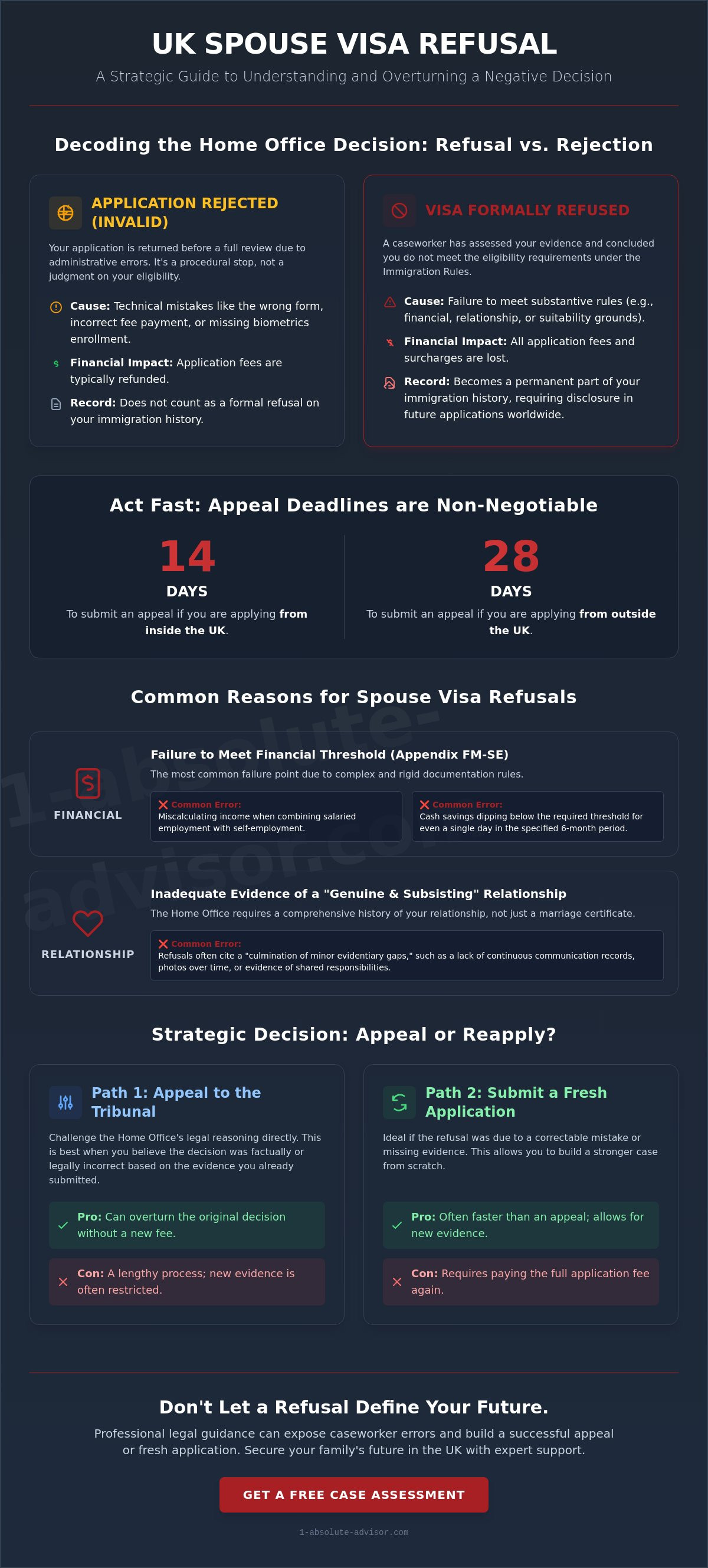
There’s a critical distinction between an application being rejected and one being refused. A rejection occurs when your application is deemed “invalid” before a caseworker even considers your merits. This typically happens because of administrative failures, such as using the wrong application form, failing to pay the correct Immigration Health Surcharge (IHS), or missing the deadline for biometrics enrollment. In these instances, the Home Office hasn’t judged your relationship; they’ve simply declined to process your paperwork.
A refusal is far more serious. It means the caseworker reviewed your evidence and decided you didn’t meet the eligibility requirements of the UK Family Visa category. Whether it’s a failure to meet the financial threshold or a lack of evidence regarding your “genuine and subsisting” relationship, a refusal is a formal judgment on the substance of your life. You won’t get your application fee back, and the decision will remain a permanent part of your record.
The Importance of the “Notice of Decision”
The Notice of Decision will list specific paragraph numbers from Appendix FM that the caseworker claims you didn’t satisfy. You’ll often see citations like E-LTRP.3.1 for financial requirements or R-LTRP.1.1 for suitability. You must verify whether you’ve been granted a “Right of Appeal” or an “Administrative Review.” Most spouse visa refusals involve human rights claims, which should trigger a full Right of Appeal to the First-tier Tribunal. If your letter doesn’t mention an appeal right, it may indicate a serious procedural error by the Home Office that requires immediate professional intervention.
Timing is the most unforgiving element of this process. You have a strict window to act:
- 14 days: The deadline for in-country appeal applications.
- 28 days: The deadline for out-of-country appeal applications.
Every refusal stays on your permanent UK immigration record. This doesn’t mean you’ll never get a visa, but it does mean every future application will face higher scrutiny. You’ll have to disclose this refusal on applications for other countries as well, including the US, Canada, and Australia. Handling the initial refusal with precision is the only way to mitigate these long-term risks and maintain your path toward settlement.
Common Reasons for Spouse Visa Refusals in 2026
Understanding what happens if spouse visa is refused begins with identifying the specific failure points within the Home Office’s current assessment framework. In 2026, caseworkers apply a heightened level of scrutiny to digital evidence and financial documentation. Most denials don’t result from a single major flaw. Instead, they’re often a culmination of minor evidentiary gaps that undermine the application’s credibility under the “Genuine and Subsisting Relationship” test.
Failure to Meet the Financial Threshold
The financial requirement remains the most frequent cause of rejection. Applicants often struggle with the rigid rules of Appendix FM-SE. A common error involves miscalculating income when combining self-employment earnings with salaried employment. These categories require different “specified periods” of evidence, and mixing them incorrectly leads to an automatic refusal. The “six-month rule” for cash savings is equally unforgiving. If your bank balance dips below the required threshold for even one day within the 180-day period, the Home Office will reject the claim. It’s vital to cross-reference your documents against the UK visa financial requirements 2026 to avoid these technical failures.
Inadequate Evidence of a Genuine Relationship
Couples often assume that a large volume of wedding photos proves their commitment. This is a misconception. Caseworkers prioritize “intervening devotion” over staged imagery. They look for evidence of a continuous, active life together. If you’ve been separated for more than 120 days without providing detailed communication logs or evidence of financial interdependence, the risk of a “marriage of convenience” flag increases. To rebut these claims, you must provide a chronological narrative supported by flight receipts and joint financial responsibilities. Precision in this narrative is what separates a successful application from a refusal.
The “Innocent Mistake” trap accounts for approximately 15% of all refusals. This includes missing certified translations or submitting uncertified copies of original documents. In 2026, the Home Office rarely issues “evidential flexibility” requests; they simply issue a refusal letter. Suitability grounds also play a significant role. Previous immigration breaches, such as an overstay from 2021, or undisclosed criminal records can trigger a mandatory refusal under the “bad character” provisions.
Every detail matters when your future is at stake. If you’re concerned about how these rules apply to your specific circumstances, seeking a professional strategic assessment can help identify risks before they lead to a denial.
Strategic Decision: Should You Appeal or Reapply?
Once the initial shock of a rejection fades, you face a critical junction. Determining what happens if spouse visa is refused depends entirely on the specific grounds cited in your refusal letter. You must choose between a fresh application or a formal appeal to the First-tier Tribunal (Immigration and Asylum Chamber). This isn’t just a legal choice; it’s a strategic one that impacts your timeline, budget, and long-term residency prospects.
The timeline for these paths varies significantly. A new application typically receives a decision within 12 to 24 weeks, or even faster if you utilize priority services. In contrast, the tribunal appeal process is currently backlogged. Most applicants wait between 6 and 10 months for a hearing. From a cost perspective, reapplying requires paying the full application fee again, which currently stands at £1,846 for out-of-country applications. An appeal fee is much lower, at £140 for an oral hearing, but the associated legal fees for expert representation often make it the more expensive route overall.
The “Fresh Evidence” rule is the most misunderstood factor in this decision. In an appeal, the judge generally only considers the facts as they existed at the time of the Home Office decision. You can’t usually provide a new pay slip or a new bank statement that was issued after your refusal date to fix a financial shortfall. Reapplying allows you to start with a clean slate and a perfect evidentiary record.
When Reapplying is the Faster Path
Reapplying is the most efficient solution for “technical” refusals. If you forgot to upload a mandatory document or your English language test provider wasn’t on the approved list, an appeal is a waste of time. When you submit a second attempt, it’s vital to address the previous refusal directly in your cover letter. Transparency prevents caseworkers from suspecting “suitability” issues or deception. You must ensure all UK immigration rules are met with absolute precision this time, as a second refusal on the same grounds can lead to much harsher scrutiny.
When an Appeal is Your Only Real Option
An appeal is necessary when the Home Office makes a subjective or legal error. If a caseworker incorrectly dismisses your marriage as “not genuine” despite your extensive evidence, a judge provides the independent oversight needed to correct that bias. This path is also essential for cases involving Article 8 of the European Convention on Human Rights. If you don’t meet the strict £29,000 income threshold but have children in the UK or other “exceptional circumstances,” a judge can exercise a level of discretion that a standard caseworker cannot. Understanding what happens if spouse visa is refused in these complex scenarios requires a deep dive into case law rather than just checking boxes on a form.
Navigating the Appeals Process and Administrative Review
Understanding what happens if spouse visa is refused requires a methodical approach to the UK legal system. The First-tier Tribunal (Immigration and Asylum Chamber) serves as the primary venue for challenging these decisions. This process is highly structured, requiring a strategic focus on evidence and procedural deadlines.
Step 1: Lodging the Appeal. You must submit your appeal within 14 calendar days if you’re inside the UK, or 28 days if you’re applying from overseas. This initial stage is critical because missing these windows often results in the loss of appeal rights. It’s the moment where you formally contest the Home Office’s logic.
Step 2: Preparing the Appellants Bundle. This document is the foundation of your case. It includes detailed witness statements from both spouses and, where necessary, expert evidence. In 2026, judges expect high-quality digital bundles that address every refusal point with fresh, corroborating data. Expert reports might include independent financial audits or medical assessments that clarify complex personal circumstances.
Step 3: The Case Management Review. Before a full hearing, the Tribunal may conduct a review. This is a vital opportunity for the Home Office to withdraw its refusal. If your bundle is sufficiently robust, the Home Office Presenting Officer might concede that the original decision was flawed, saving months of litigation time.
Step 4: The Oral Hearing. This is the final stage where an Immigration Judge hears testimony. Your legal representative will make submissions, and you may be asked questions about your relationship or financial status. The judge’s role is to determine if the decision was lawful and compatible with your rights. This stage is critical when considering what happens if spouse visa is refused under the current 2026 regulations, as it provides a human element that paper applications lack.
The Role of Administrative Review
Administrative Review is a narrower path, typically reserved for in-country switching applications where a “case working error” occurred. If the Home Office simply miscalculated your salary or overlooked a document already in their possession, this is the correct route. However, you can’t introduce new evidence here. In 2026, processing times for these reviews have stabilized at approximately 180 days, making them a slower but sometimes necessary alternative to a full appeal.
Human Rights and Section 120 Notices
A Section 120 Notice, or “Statement of Additional Grounds,” acts as a legal shield. It allows you to raise any new reasons why you should be allowed to stay in the UK that weren’t in your original application. This is often where “insurmountable obstacles” to family life outside the UK are argued, such as severe health issues or safety concerns in your home country. Article 8 of the Human Rights Act protects the right to respect for private and family life, ensuring that family unity is prioritized unless state interference is strictly proportionate. This legal framework ensures that the Home Office cannot easily separate families without a compelling public interest.
If you need a strategic assessment of your refusal notice, contact our specialist team for a comprehensive case review.
Securing Your Future: How Professional Representation Overturns Refusals
Receiving a Home Office refusal letter often feels like a definitive end to your family’s plans, but it’s frequently just a signal that your strategy needs a professional recalibration. Understanding what happens if spouse visa is refused requires looking past the generic rejection text to identify the specific legal or procedural errors made by the caseworker. An OISC-registered advisor provides a level of scrutiny that self-prepared applications usually lack. These professionals identify hidden flaws, such as misapplied Appendix FM rules or the incorrect assessment of the 2024 financial threshold increases, which currently stand at £29,000 for most applicants. By pinpointing these technicalities, an advisor can transform a rejected case into a successful appeal or a robust reapplication.
A professional document audit is the most effective way to prevent a second refusal. Caseworkers follow strict internal guidance; if a single bank statement is missing a date or a letter of support isn’t formatted correctly, the application fails. Our audit process mirrors the Home Office’s own checklist but adds a layer of strategic foresight. We ensure every piece of evidence meets the 2026 standards for authenticity and relevance. This meticulous preparation removes the guesswork, providing you with a fixed-fee management structure that eliminates the financial anxiety often associated with escalating legal costs.
The 1 Absolute Advisor Approach to Refusals
Our “Case Rescue” service begins with a forensic analysis of your previous refusal notice. We don’t just read the letter; we dissect the caseworker’s logic to find inconsistencies with current UK immigration law. Following this analysis, we draft high-level legal representations that accompany your new submission. These aren’t standard cover letters. They’re comprehensive legal arguments that cite specific case law and Home Office policy to pre-emptively address any concerns. Our team maintains direct communication channels with the Home Office, which allows us to resolve procedural delays or administrative errors that would otherwise stall a family’s progress for months.
Long-term Peace of Mind
The implications of a refusal extend far beyond the immediate delay. Every rejection becomes a permanent part of your immigration record, which can complicate your eventual path to ILR UK. Ensuring your history is clean is vital for those who intend to apply for British Citizenship in the future. By managing the challenge professionally, you protect your long-term status and reduce the immense emotional burden on your household. Expert management means you aren’t guessing about what happens if spouse visa is refused; you’re following a proven roadmap back to compliance and family unity.
Don’t let a single setback dictate your family’s future in the United Kingdom. Precision and legal expertise are the only reliable tools for reversing a negative decision.
Contact 1 Absolute Advisor for a professional assessment of your refusal letter and secure your strategic path forward.
Securing Your Family’s Future After a UKVI Refusal
A Home Office refusal notice isn’t the final word on your life together in the UK. It’s a technical challenge that requires a calculated, evidence-based response. You now understand that navigating what happens if spouse visa is refused involves a critical choice between a formal appeal based on the Nationality, Immigration and Asylum Act 2002 or a strategic reapplication. Success in 2026 depends on meticulously addressing the specific evidence gaps identified in your letter. Whether it’s meeting the updated financial thresholds or providing more robust proof of a subsisting relationship, your next move must be precise. Professional integrity and deep legal knowledge are your best assets when challenging a caseworker’s decision.
Absolute Advisor provides the stability and expertise you need during this stressful period. Our OISC-registered immigration consultants are specialists in complex family visa appeals and reapplications. We operate with absolute transparency, offering fixed-fee services with no hidden costs to ensure your case is handled with professional rigor. Don’t let a procedural error keep your family apart. Get Expert Help to Overturn Your Spouse Visa Refusal today. We’re ready to build a stronger case for your future together.
Frequently Asked Questions
Can I stay in the UK while I appeal my spouse visa refusal?
You can generally remain in the UK if you submitted an in-country application before your previous leave expired. Under Section 3C of the Immigration Act 1971, your existing leave is automatically extended while a valid appeal is pending. This protection ends if you leave the country or if the appeal process concludes. It’s vital to confirm your specific appeal rights in the Home Office decision letter to ensure your stay remains lawful.
How much does it cost to appeal a UK spouse visa refusal in 2026?
An appeal to the First-tier Tribunal currently costs £140 for an oral hearing or £80 for a paper hearing. These are the standard fees set by HM Courts and Tribunals Service as of early 2026. You should also budget for professional legal representation and potential expert witness reports. These costs vary based on the complexity of your case and the seniority of the solicitor you instruct to manage the litigation.
Will a spouse visa refusal affect my future UK visa applications?
A refusal doesn’t automatically bar you from future success, but you must declare it in every subsequent application. Failing to disclose a previous refusal can lead to a 10 year ban under Paragraph 9.8.1 of the Immigration Rules for deception. If your refusal involved allegations of a sham marriage, the impact is severe. Most applicants find that what happens if spouse visa is refused depends entirely on the specific grounds cited by the caseworker.
How long does a spouse visa appeal take to reach a hearing?
Most spouse visa appeals currently take between 25 and 40 weeks to reach a substantive hearing at the First-tier Tribunal. This timeline includes the initial lodgement, the Home Office review period, and the final listing process. While some cases conclude faster through administrative reviews, you should prepare for a process lasting approximately 9 months. Delays often occur if the Tribunal requires additional witness statements or specific financial evidence to clarify the record.
Can I provide new evidence during a spouse visa appeal?
You can provide new evidence if your appeal is based on human rights grounds, which applies to most spouse visa cases. Section 85(4) of the Nationality, Immigration and Asylum Act 2002 allows the Tribunal to consider evidence that wasn’t available at the time of the original decision. This is crucial for proving the ongoing nature of a relationship or updated financial stability. We recommend focusing on evidence that directly addresses the specific reasons for the initial rejection.
What is the success rate for spouse visa appeals at the First-tier Tribunal?
Ministry of Justice statistics for the 2023/24 period show that approximately 48% of immigration appeals were allowed at the First-tier Tribunal. This success rate highlights the importance of a robust legal strategy and meticulous preparation. Many initial refusals stem from caseworker errors or a failure to meet the complex financial requirements. Understanding what happens if spouse visa is refused involves recognizing that nearly half of these decisions are overturned when presented before a judge.
Do I need a lawyer for a spouse visa appeal, or can I do it myself?
Legal representation isn’t a mandatory requirement, but the complexity of UK immigration law makes self-representation risky. A qualified solicitor ensures your bundle complies with the Tribunal’s strict procedural rules and Case Management Directions. They identify legal errors in the Home Office’s decision that a layperson might miss. Statistics suggest that represented appellants have a significantly higher probability of success compared to those who navigate the judicial process alone.
What happens if my spouse visa appeal is also refused?
If the First-tier Tribunal dismisses your appeal, you can apply for permission to appeal to the Upper Tribunal. This is only possible if the judge made a specific error of law, not just because you’re unhappy with the outcome. Alternatively, you can submit a fresh application that addresses the previous grounds for refusal. Choosing between these paths requires a strategic assessment of whether a legal error occurred or if new factual evidence is now available.