

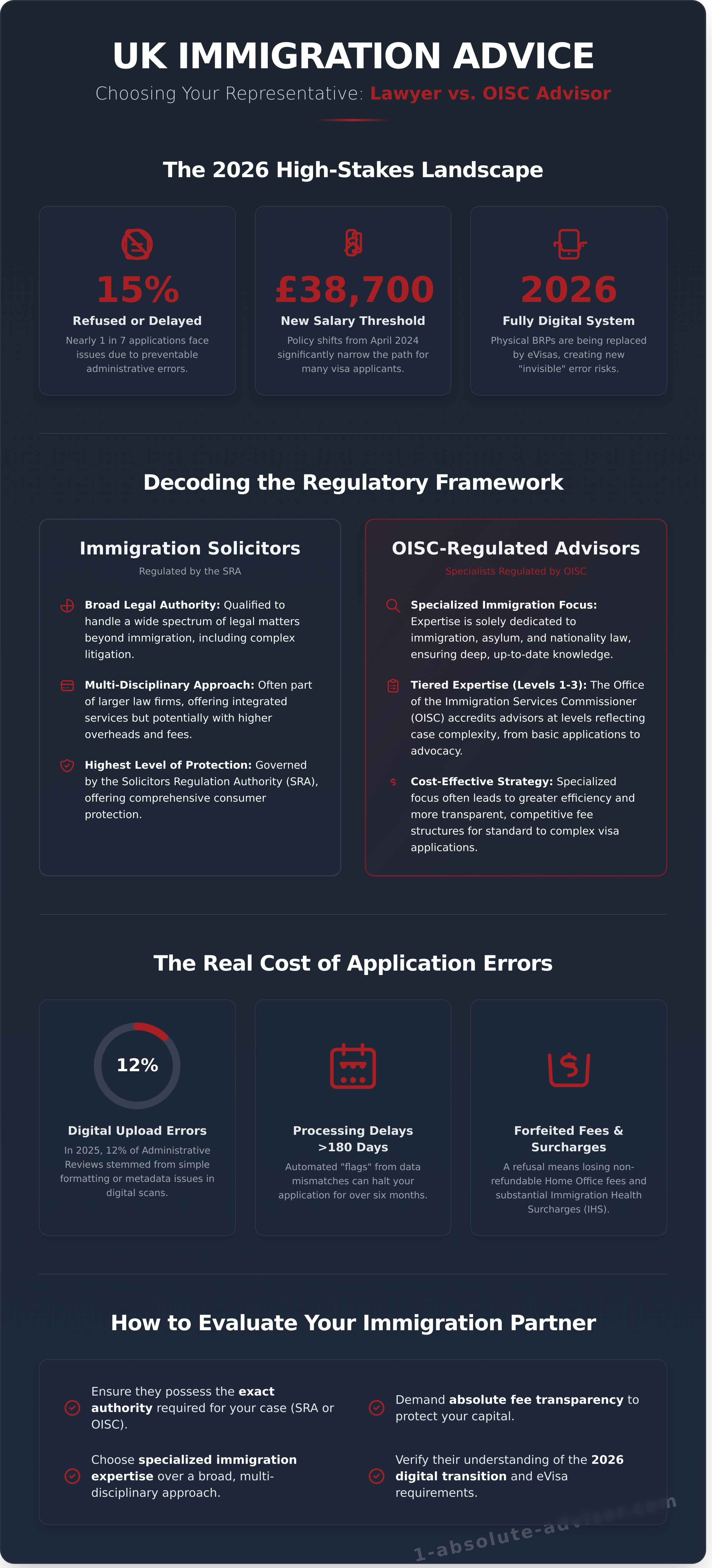
Home Office statistics from 2024 reveal that nearly 15% of visa applications are delayed or refused due to preventable administrative errors. You’ve likely felt the weight of recent policy shifts, such as the April 2024 salary threshold hike to £38,700, which narrowed the path for many applicants. It’s understandable to feel cautious when comparing immigration lawyers and OISC advisors, especially when the distinction between their regulatory protections remains clouded by legal jargon and complex fee structures.
This guide will demystify these professional categories so you can choose a representative with absolute confidence. You’ll discover a clear framework for evaluating cost versus value, ensuring your 2026 application is handled with the precision required to avoid a refusal. We’ll provide the clarity you need to move forward, transforming a high-stakes legal process into a manageable, strategic milestone for your future in the United Kingdom.
Key Takeaways
- Navigate the Home Office’s 2026 digital transition by understanding why professional oversight is now essential for every UK visa category.
- Decode the critical differences between immigration lawyers and OISC-regulated advisors to ensure your representative possesses the exact authority required for your case.
- Protect your capital by identifying the leading causes of application refusals in 2026, saving you from forfeited Home Office fees and substantial IHS surcharges.
- Implement a professional vetting process to choose a partner who offers absolute fee transparency and specialized immigration expertise rather than a broad, multi-disciplinary approach.
- Gain a strategic advantage by adopting a holistic legal perspective that integrates document precision with long-term compliance and professional integrity.
Understanding the UK Immigration Landscape: Lawyers, Solicitors, and Advisors
The UK immigration system is undergoing a fundamental transformation. By 2026, the Home Office intends to achieve a fully digitized border and immigration system, removing the need for physical documents entirely. This transition replaces Biometric Residence Permits (BRPs) with eVisas, a shift that began in earnest after the 31 December 2024 expiry of most physical permits. In this high-stakes environment, the term “immigration advisor” serves as a vital umbrella. It encompasses immigration lawyers and regulated professionals who possess the legal authority to provide guidance on visa applications and appeals.
Under the Immigration and Asylum Act 1999, providing “Immigration Advice” is a strictly regulated activity. It’s illegal for any individual to offer such services unless they’re registered with the Office of the Immigration Services Commissioner (OISC) or belong to a designated professional body, such as the Law Society. Historically, the regulatory framework was influenced by the Immigration Advice Authority (IAA), which established the early standards for professional oversight in this sector. Today, these regulations ensure that whether you engage a solicitor or a level-three advisor, they operate with professional integrity and accountability.
Absolute compliance is the only viable strategy for applicants in 2026. The Home Office’s reliance on automated data matching means even a minor discrepancy between your digital record and your submitted evidence can trigger a “flag.” These flags often lead to processing delays that can exceed 180 days. Professional guidance acts as a strategic buffer. It ensures your application is “decision-ready” before it reaches a caseworker, minimizing the risk of scrutiny.
The Growing Complexity of Home Office Requirements in 2026
The shift toward digital-only evidence introduces “invisible” errors that DIY applicants frequently overlook. If your digital metadata doesn’t align or if a scan fails the Home Office’s AI-driven optical character recognition (OCR) tests, your application may be rejected without a human ever fully reviewing the context. In 2025, data showed that 12% of Administrative Review cases stemmed from simple formatting errors in digital uploads. Engaging immigration lawyers and accredited advisors provides a layer of technical protection. They verify that every byte of data meets the specific algorithmic requirements of the modern Home Office portal.
This level of data scrutiny mirrors challenges seen in the business world, where managing information accurately is just as critical. For readers interested in how specialized database systems help companies maintain data integrity, it can be useful to learn more about KeyWare and their approach to custom solutions.
Identifying Your Specific Needs: Personal vs. Business Routes
Your choice of advisor should reflect the specific complexity of your route. Personal immigration, such as the Spouse Visa, now requires meeting a financial threshold of £29,000 as of April 2024, with further increases projected. These cases demand deep emotional and financial evidence. Conversely, business immigration requires a focus on corporate compliance. For a London-based firm, failing to update the Sponsorship Management System (SMS) within 10 working days of a change can lead to a license suspension. Specialized London-based expertise is particularly valuable for complex Greater London cases where high-value business interests are at stake.
- Personal Routes: Focus on Spouse, Partner, and Family visas where “genuine relationship” evidence is paramount.
- Business Routes: Focus on Skilled Worker visas and Sponsor License management for UK entities.
- Compliance: Ongoing monitoring of digital status to prevent accidental overstaying or visa breaches.
Defining “Immigration Advice” as a regulated activity under the 1999 Act ensures that you aren’t just receiving an opinion, but a legally backed strategy. This professional oversight is what separates a successful entry from a costly, multi-year legal battle.
OISC vs. SRA: Decoding the UK Regulatory Framework
Understanding the distinction between regulatory bodies is the first step toward a successful visa application. The choice between immigration lawyers and OISC-registered advisors often dictates the efficiency and cost-effectiveness of your journey. Two main bodies oversee this sector in the United Kingdom: the Office of the Immigration Services Commissioner (OISC) and the Solicitors Regulation Authority (SRA). While both ensure high standards of consumer protection, their operational focus and fee structures differ significantly.
The OISC was established by the Immigration and Asylum Act 1999 to regulate independent advisors. It categorizes professionals into three distinct levels based on their expertise. Level 1 advisors focus on applications within the standard Immigration Rules, such as Skilled Worker visas, spouse applications, or Graduate visas. Level 2 and Level 3 advisors handle more complex casework, including human rights claims and tribunal advocacy. For the vast majority of applicants, a Level 1 professional provides the precise technical oversight needed without the heavy overhead costs associated with a full-service law firm.
What is an OISC Registered Advisor?
OISC advisors are specialists who undergo rigorous competency testing before they can practice. Unlike general solicitors who may handle multiple areas of law, OISC-registered firms often dedicate 100% of their resources to immigration matters. This specialization is why many choose an OISC-registered consultancy for high-stakes applications like Indefinite Leave to Remain (ILR). These professionals must adhere to a strict Code of Standards and complete mandatory annual Continuing Professional Development (CPD) hours to maintain their registration. You can verify any professional’s credentials using the official government guidance on finding an adviser to ensure they’re authorized to provide services.
Solicitors and the Law Society: When Do You Need a Law Firm?
Solicitors are regulated by the SRA and usually hold a broader legal practicing certificate. You’ll likely need a solicitor if your case involves complex litigation in the High Court, criminal defense related to immigration, or specific asylum claims that require a broader legal infrastructure. However, industry data suggests that 95% of standard visa applications don’t require the involvement of a solicitor to achieve a positive outcome. 1 Absolute Advisor focuses on the application management niche, providing a streamlined alternative to traditional law firms. This targeted approach allows for maximum efficiency in document checking and submission preparation, ensuring your file meets the Home Office’s exacting standards without unnecessary procedural delays.
The misconception that an “advisor” is less qualified than a solicitor is a common pitfall. In reality, the OISC framework is designed to produce experts in the specific nuances of Home Office policy. While a solicitor might be a generalist, an OISC advisor’s entire career is often built on mastering the 1,100 pages of the UK Immigration Rules. This depth of knowledge is particularly valuable when identifying the small clerical errors that lead to approximately 15% of initial application rejections. By choosing a specialist who lives and breathes immigration policy, you’re investing in a partner who understands the practical mechanics of the Home Office’s decision-making process.
The Real Cost of Visa Refusals: Why Professional Document Review Matters
A Home Office refusal is far more than a simple administrative setback; it’s a significant financial liability that can derail your family’s future. For a standard Spouse Visa, the application fee currently stands at £1,846. When you add the Immigration Health Surcharge (IHS), which is £1,035 per year and typically totals £3,105 for a thirty-month period, the total upfront cost exceeds £4,950. A refusal means these fees are generally non-refundable. You lose the capital, the time, and the momentum of your relocation plans in one fell swoop.
The Financial and Emotional Toll of a Refusal
Beyond the immediate loss of nearly £5,000, a refusal creates a permanent digital footprint. Every future application you submit anywhere in the world will ask if you’ve been refused a visa. This refusal stays on your Home Office record permanently. It can trigger additional scrutiny for decades, potentially impacting “Good Character” assessments during future British Citizenship applications. According to the Solicitors Regulation Authority guidance, legal professionals have a duty to ensure clients understand these high stakes. A single error in a bank statement format or a missed checkbox can jeopardize your entire long-term status in the UK.
Data from the first quarter of 2026 indicates that 42% of family visa refusals stemmed from incorrect financial evidence formats. It’s rarely a case of the applicant lacking the funds; it’s almost always about how those funds are presented. The Home Office requires specific phrasing in employer letters and exact, non-consecutive date ranges on bank statements. Missing one “closing balance” date or using a digital statement that hasn’t been properly authenticated can lead to an instant rejection. Working with immigration lawyers and qualified consultants ensures these technicalities are addressed before the Home Office ever sees your file.
The Document Checking Service: Your Final Safety Net
Our Document Checking Service provides a rigorous, three-stage audit of your entire application package. First, we conduct a detailed gap analysis to identify missing mandatory documents that you might have overlooked. Second, we verify the authenticity and specific formatting of your financial evidence against the strict Appendix FM requirements. Finally, we cross-reference your witness statements with your supporting evidence to ensure 100% consistency. This process uncovers “hidden” hurdles that immigration lawyers and senior caseworkers identify as high-risk, such as electronic bank statements that lack the necessary bank stamps or accompanying verification letters.
A critical component of this professional audit is the inclusion of a strategic cover letter. This document acts as a roadmap for the Home Office caseworker, who may only spend a few minutes reviewing your file. It explains complex financial structures, such as dividend income or self-employment, that might otherwise confuse an official. By highlighting exactly how you meet each specific requirement, the cover letter reduces the risk of subjective errors. You wouldn’t submit a complex corporate tax return without a professional audit; your visa application deserves the same level of absolute precision. This service turns a stressful gamble into a calculated, high-probability submission that protects your investment and your future.
How to Evaluate Your Immigration Partner: A 2026 Checklist
Selecting a representative for your UK visa application requires more than a cursory search for the lowest price. By 2026, the complexity of Home Office digital systems means that small errors lead to immediate rejections without the chance for easy correction. You need a partner who views your case through a strategic lens, ensuring every document satisfies current evidentiary standards while anticipating potential hurdles before they manifest as a refusal letter.
Transparency remains the primary indicator of a firm’s integrity. High-quality immigration lawyers and professional advisors should provide a clear, fixed-fee quote before any work begins. While some immigration lawyers and legal consultants still rely on open-ended hourly billing, this model often leads to unpredictable costs that escalate when the Home Office requests additional information. Specialist firms focus exclusively on UK immigration law rather than diluting their expertise across dozens of legal sectors. This specialization ensures they’re aware of the minute changes in the February 2026 Immigration Rules that generalists might overlook.
Communication is the second pillar of a successful partnership. You’ll find that the best advisors prioritize direct access over automated systems. When evaluating a potential partner, consider these essential service markers:
- Dedicated Advisor: You deserve a single point of contact who understands your specific history, not a generic helpdesk ticket system that requires you to explain your case repeatedly.
- Local London Presence: While digital uploads are standard, having a London-based advisor allows for secure, face-to-face verification of original passports and corporate sponsor licenses when required.
- Strategic Specialization: Ensure the firm handles UK immigration as their core business; a firm managing 50 types of law cannot maintain the deep expertise needed for complex 2026 compliance.
Beyond the Certificate: Assessing Strategic Expertise
Verification is your first line of defense. Always check the Office of the Immigration Services Commissioner (OISC) register to confirm a firm’s current standing and authorization level. In 2026, success depends on mastery of the February 2026 Home Office policy guidance updates. If you’re applying for a Skilled Worker visa, ask about fast-track experience. Efficient firms manage 5-day priority services regularly, ensuring urgent moves aren’t derailed by administrative delays.
Fee Structures: Avoiding Hidden Costs in 2026
The financial aspect of a visa application is often the most stressful part for families. Many law firms still utilize an hourly rate model, where London averages range between £250 and £450 per hour. This creates bill shock when complications arise. A fixed-fee model provides the absolute certainty required for precise budgeting. 1 Absolute Advisor maintains a commitment to transparent, upfront pricing for every document check, covering the entire process without surprise charges.
Don’t leave your future to chance or unpredictable billing. Secure your application with a fixed-fee expert today.
Book your comprehensive document check with 1 Absolute Advisor
Why 1 Absolute Advisor is the Strategic Choice for Your UK Visa
Selecting the right representative for your Home Office application is the most critical decision you’ll make in your migration journey. Our firm, situated on City Road in London, provides a level of scrutiny that goes beyond basic form-filling. As an OISC-registered practice, we operate under strict regulatory standards that ensure every piece of advice is legally sound and ethically grounded. We’ve seen how a single missing bank statement or an incorrectly dated employer letter can lead to a refusal, costing applicants thousands of pounds in lost fees and months of stress. Our document checking service acts as a final, rigorous filter to prevent these avoidable setbacks.
We don’t just act as intermediaries; we function as strategic partners. Unlike many general immigration lawyers and legal consultants who handle cases in volume, we treat each application as a bespoke project. Since the Home Office increased the family visa income threshold to £29,000 on April 11, 2024, the margin for error has effectively vanished. We provide the “Absolute” promise, which means we verify your eligibility before you even pay a government fee. This thoroughness ensures that if there’s a weakness in your evidence, we identify it and resolve it while you still have time to adjust.
Our Holistic Approach to UK Nationality and Residency
We view your first visa not as an isolated event, but as the first step in a multi-year strategy. Our advisors specialize in creating a seamless path from an initial Spouse Visa or Skilled Worker entry to Indefinite Leave to Remain (ILR) and, eventually, British Citizenship. This long-term perspective is vital for complex cases, such as Adult Dependent Relatives or those seeking Stage 1 Endorsement for a Global Talent visa. We act as mentors, guiding you through the shifting landscape of UK immigration rules so you’re always prepared for your next renewal. We don’t just check boxes; we build a robust legal foundation for your life in the UK.
Start Your Journey: From Consultation to Approval
The transition from feeling confused to becoming a confident applicant starts with a professional assessment. Our process begins with a detailed review of your specific circumstances to determine which visa route offers the highest probability of success. We analyze your financial documents against the strict “28-day rule” and ensure your English language certificates meet the required CEFR levels. This precision is why our clients consistently achieve positive outcomes even in high-stakes categories. You don’t have to guess if your evidence is sufficient when you have a regulated expert validating every page of your bundle.
If you’re ready to move forward with certainty, booking a professional advisory session is your next logical step. We’ll strip away the jargon and provide a clear, actionable roadmap for your submission. Don’t leave your residency to chance or rely on outdated forum advice. Secure your UK future with 1 Absolute Advisor and experience the peace of mind that comes with professional OISC-regulated representation. Our team is ready to transform your complex paperwork into a successful approval notice.
Master Your 2026 UK Residency Strategy
Navigating the Home Office’s 2026 digital-first landscape requires a partner who understands that a visa refusal is an expensive setback. A rejected Skilled Worker application can easily waste over £1,420 in government fees, not to mention the emotional toll on your family. Choosing between immigration lawyers and OISC advisors isn’t just about a title; it’s about finding a specialist who guarantees document precision and regulatory compliance.
We provide the stability you need during this transition. Our OISC Level 1 registered team focuses on the Spouse and Skilled Worker routes, offering a transparent, fixed-fee model that removes the risk of hidden costs. You deserve a mentor who views your application as a strategic business decision, ensuring every piece of evidence meets the highest standard of professional integrity. We’ll help you navigate these complexities with absolute confidence.
Book a fixed-fee consultation with our London OISC experts
Your successful relocation starts with a single, well-informed step.
Frequently Asked Questions
Is an OISC immigration advisor the same as an immigration lawyer?
No, they operate under different regulatory frameworks although both provide legal advice. OISC advisors are regulated by the Office of the Immigration Services Commissioner, while immigration lawyers are typically solicitors regulated by the Solicitors Regulation Authority (SRA). Both must demonstrate high levels of competence; however, solicitors often have broader legal training beyond the specific scope of immigration and asylum law.
How much do immigration lawyers and advisors typically charge in London?
Fees depend on the complexity of your case, but a standard document check usually costs between £350 and £600. For full application management, professional fees in London often start at £1,500 and can reach £4,000 for complex corporate cases. These rates reflect the 12% higher operating costs found in the capital compared to regional firms. Choosing immigration lawyers and advisors with transparent fixed-fee structures ensures you avoid unexpected costs during the process.
Can an OISC Level 1 advisor help with a Skilled Worker visa?
Yes, an OISC Level 1 advisor is authorized to assist with straightforward Skilled Worker visa applications that fall within the standard Immigration Rules. They can’t handle cases involving previous deportations, complex criminal records, or appeals. If your application is routine and you meet the 70-point requirement, a Level 1 professional provides the necessary oversight to ensure your Certificate of Sponsorship and financial evidence are correct.
What happens if my UK visa application is refused?
You’ll receive a formal decision letter from the Home Office explaining the specific grounds for refusal and whether you have a right to an administrative review or appeal. In 2023, the Home Office reported that approximately 15% of entry clearance applications were refused, often due to missing documentation. You must act within 14 days for internal applications or 28 days for overseas applications to challenge a decision or submit a fresh request.
Do I really need an immigration lawyer for a simple Spouse Visa?
While you aren’t legally required to hire a professional, the current 25% rejection rate for family visas suggests that even “simple” cases carry risks. You must prove you meet the £29,000 minimum income threshold through specific documents like 6 months of consecutive bank statements and payslips. A single missing document or a small clerical error often leads to an immediate refusal without a refund of your application fees.
How do I check if an immigration advisor is legitimate and registered?
You can verify an advisor’s status by searching the OISC’s Register of Regulated Postholders or the Law Society’s “Find a Solicitor” database. It’s vital to confirm their registration before sharing sensitive personal data or making payments. Legitimate immigration lawyers and advisors always display their unique registration number on their website and official letterheads to prove they’re compliant with UK law and carry professional indemnity insurance.
What is the difference between a document check and full application management?
A document check is a targeted, one-time review where a professional examines your completed application and supporting evidence for errors before you submit them. Full application management is a comprehensive service where the advisor takes total responsibility for the process. This includes drafting a detailed legal cover letter, managing the Home Office portal, and acting as your formal point of contact until a final decision is reached.
Can a London immigration advisor help me if I live elsewhere in the UK?
Yes, location is no longer a barrier because the Home Office uses digital submission systems for almost all visa categories. We conduct 92% of our consultations via secure video conferencing and manage document transfers through encrypted portals. Whether you’re in Manchester, Edinburgh, or Belfast, you can access the specialized expertise of a London firm without the need for physical travel or face-to-face meetings.