

In 2026, the 5 year route to settlement uk is no longer a standard expectation; it’s a premium pathway reserved for those who actively manage their professional and financial standing. Following the April 2026 implementation of the “Earned Settlement” model, the baseline for Indefinite Leave to Remain (ILR) shifted to 10 years for many sectors. You’re likely concerned that the new B2 English requirement or the £3,029 application fee represents just the beginning of a more restrictive era. It’s stressful to think that a single salary fluctuation or an overlooked absence could double your wait time for permanent residency.
This article provides the strategic clarity you need to secure your ILR within the 5-year window by mastering the £50,270 earnings threshold and the 180-day continuous residence rules. You’ll gain a definitive checklist of documents and a clear understanding of how to avoid being downgraded to the 10-year route. We’ll outline exactly how to navigate these regulatory shifts to ensure your path to settlement remains both predictable and secure.
Key Takeaways
- Determine if you still qualify for the accelerated 5 year route to settlement uk under the 2026 “Earned Settlement” model and updated salary thresholds.
- Identify the critical financial benchmarks, specifically the £50,270 minimum earnings required for Skilled Workers to bypass the standard 10-year residency baseline.
- Learn to calculate continuous residence accurately to stay within the 180-day annual absence limit and the 540-day total cap over your qualifying period.
- Understand how to align your professional trajectory with the updated B2 English language standards and the Life in the UK test requirements.
- Establish a strategic document audit process from your first year in the UK to ensure a seamless and successful transition to Indefinite Leave to Remain.
Understanding the 5-Year Route to Settlement in 2026
The 5 year route to settlement uk is the most efficient pathway for non-EU nationals seeking to establish a permanent life in Britain. It isn’t merely a convenience; it’s a strategic milestone that grants the right to work, study, and access public funds without the recurring burden of visa renewals. However, the regulatory environment changed significantly following the 2025 “Restoring Control” White Paper. This policy shift moved the goalposts for many, making the 5-year path a selective privilege rather than a universal standard. Success in 2026 demands more than just time. It requires meticulous adherence to continuous residence rules and specific financial benchmarks from the moment you arrive. Proving your eligibility involves meeting character requirements and demonstrating a sustained economic contribution to the UK.
What is Indefinite Leave to Remain (ILR)?
Understanding Indefinite Leave to Remain is essential for anyone planning a long-term future in the UK. ILR is a permanent residency status that effectively removes immigration control, allowing you to live in the country without an expiry date on your stay. It’s the mandatory foundation for those who eventually wish to apply for British citizenship. While the status provides immense security, it remains conditional. If you reside outside the UK for more than two continuous years, you risk losing your ILR status entirely. Maintaining this status requires a commitment to making the UK your primary home, backed by evidence of your ongoing residence.
The 2025-2026 Policy Shift: 5 Years vs. 10 Years
The 2026 “Earned Settlement” framework introduced a tiered system that prioritizes economic contribution and specific skill sets. While the standard baseline for settlement has been extended to 10 years for many “medium-skilled” roles and those in the social care sector, the 5 year route to settlement uk remains accessible for top talent and high earners. Specifically, individuals earning between £50,270 and £125,139 retain their 5-year eligibility. This means your uk immigration strategy must be proactive from day one. You can’t wait until year four to check your eligibility. You must track your “continuous residence” meticulously, ensuring you don’t exceed 180 days of absence in any 12-month period. The Home Office now utilizes automated tracking to flag discrepancies immediately, making precision in your travel records more critical than ever before.
Eligibility Criteria: Who Still Qualifies for the 5-Year Pathway?
The 2026 immigration landscape creates a sharp division between standard residency and what the Home Office now considers “earned” settlement. While the 10-year baseline applies to a broader range of migrants under the new model, the 5 year route to settlement uk remains the primary objective for high-value workers and family members of British citizens. Maintaining your eligibility requires a proactive approach to your immigration status from the moment your initial visa is granted. Beyond the main work and family categories, Global Talent, Innovator Founder, and UK Ancestry visa holders continue to enjoy access to this shorter timeframe, provided they meet the specific endorsement and residency criteria. It’s a premium path that demands total compliance with evolving regulations.
Work-Based Routes and Salary Thresholds
To qualify for settlement after 60 months, Skilled Worker Visa holders must now meet the £50,270 minimum salary threshold established in the April 2026 rule changes. It’s a common misconception that meeting the initial sponsorship salary is sufficient for permanent residency. The “Settlement Salary Requirement” is a distinct hurdle that must be maintained throughout your qualifying period. You should review the skilled worker visa uk 2026 updates to ensure your RQF level and specific job code still align with the 5-year pathway. If your earnings fall below this threshold and you don’t work in a protected public service role, like medicine or teaching, you risk being moved to the 10-year “Standard” route.
Family and Spouse Visa Pathways
The spouse visa uk remains one of the most stable 5-year pathways, though it’s not without its own financial complexities. Applicants must satisfy the financial requirement through combined income or significant savings, which is a separate standard from the “adequate maintenance” rules applied to specific exempt groups. You must be cautious during the extension phase. If you fail to meet the strict financial criteria at the 2.5-year mark, the Home Office may transition your application to the “10-year private life route.” This shift doubles your wait time and exponentially increases your long-term application costs. Checking the official ILR requirements regularly is the most effective way to stay informed about subtle policy shifts that could impact your family’s security. If you’re concerned about meeting these benchmarks, seeking a professional document checking service can provide the necessary certainty before you submit your final application.
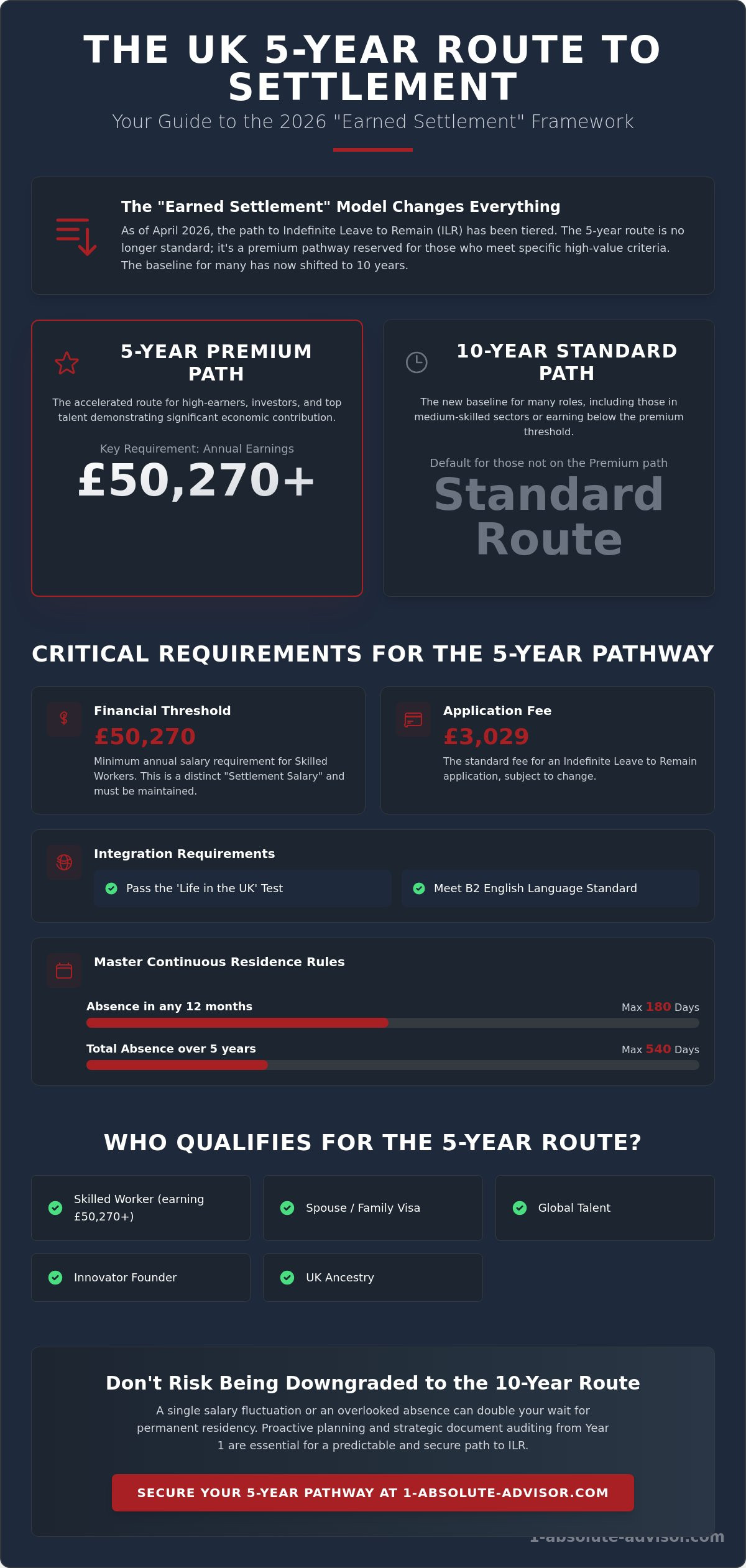
The 5-Year vs. 10-Year Route: Navigating the 2025 Policy Shifts
The divergence between the 5-year and 10-year pathways has created a significant financial and administrative gap for migrants. Under the 2026 “Earned Settlement” model, the standard route now requires a decade of residency. This extension isn’t just a matter of time; it carries a heavy price tag. Choosing the wrong path means paying an additional five years of Immigration Health Surcharge (IHS) fees and multiple visa renewal costs before reaching eligibility. For those in social care or medium-skilled roles, the baseline can even extend to 15 years. This makes the 5 year route to settlement uk an essential strategic target for those who can meet the merit-based criteria.
A critical risk in the current system is the “Dependant Trap.” This occurs when a main applicant qualifies for the accelerated 5-year path, but their family members are relegated to the 10-year baseline due to specific sector restrictions or missing the April 2026 transitional cutoff. It results in a fragmented household status where parents might settle years before their children. Proper planning requires examining the UK government guidelines on Indefinite Leave to Remain to ensure your entire family remains on a synchronized timeline. Every year spent waiting on a temporary visa adds thousands of pounds in cumulative costs and administrative uncertainty.
The “High-Earner” Privilege
The 2026 regulations clearly favor economic contribution as a primary factor for settlement speed. To secure the 5-year ILR track, Skilled Workers must maintain annual earnings between £50,270 and £125,139. If your income exceeds £125,140, you may even qualify for a 3-year accelerated route. The Migration Advisory Committee (MAC) constantly reviews these thresholds based on economic productivity. Your salary isn’t just a paycheck; it’s your ticket to faster residency. If you receive a promotion that pushes you above the £50,270 mark mid-visa, you can effectively “switch tracks” from the 10-year to the 5-year pathway, provided you meet the other continuous residence requirements from that point forward.
Dependants and the 10-Year Baseline
New rules for 2026 have tightened the requirements for partners and children significantly. While partners of British citizens generally retain their 5-year path, dependants of Skilled Workers in lower-earning brackets often face the full 10-year wait. This creates a complex situation for children born in the UK during this period. While they may have a claim to citizenship once a parent settles, the intervening years require constant visa maintenance and high renewal fees. Aligning your family’s settlement dates is no longer automatic. It requires a proactive document strategy and careful timing of your extension applications to avoid unnecessary delays that could push you toward the long-residency route.
Critical Requirements for Maintaining Your Settlement Clock
Maintaining your eligibility for the 5 year route to settlement uk requires more than just physical presence; it demands a continuous, uninterrupted legal status. The Home Office defines “continuous residence” with mathematical precision. Any breach, however minor, can reset your qualifying period to zero. This forces you to start the multi-year process again under potentially stricter future rules. Beyond mere presence, you must demonstrate “Good Character,” which includes a clean criminal record and the absence of civil penalties, such as tax discrepancies or litigation. Every interaction with UK authorities is recorded and reviewed during your final settlement audit.
Calculating Absences and Continuous Residence
The rolling 12-month calculation is the standard for assessing absences. You must not spend more than 180 days outside the UK in any 12-month period. Unlike previous fixed-calendar systems, this rolling method means any trip is measured against the 365 days preceding and following it. If you’ve spent 45 days abroad for work and 20 days for a family emergency, your remaining allowance is 115 days. Valid exemptions do exist for compelling and compassionate reasons. These include serious illness of the applicant or a close relative, or natural disasters. However, these require robust documentary evidence, such as medical reports or official travel disruptions, to be accepted. Maintaining a detailed residence log from your first day in the UK is the only way to ensure your final application is audit-ready.
Knowledge of Life and Language
By May 2026, the English language proficiency requirement for settlement has been elevated to the B2 level on the CEFR scale. This is a step up from the B1 level previously required for initial entry. You must pass a secure English language test (SELT) unless you’ve already met this through a degree taught in English or fall into an exempt age group, such as those under 18 or over 65. The Life in the UK test remains a mandatory component of the 5 year route to settlement uk. It’s advisable to sit this exam at least 12 months before your eligibility date to avoid administrative delays. If you’re unsure if your current qualifications meet the 2026 standards, our Indefinite Leave to Remain (ILR) Application Service can provide a comprehensive eligibility audit to protect your residency clock.
Character requirements are often overlooked but are equally vital. The Home Office scrutinizes your history for any behavior that suggests you aren’t of good character. This includes not just criminal convictions, but also non-custodial sentences and even persistent administrative failures. Late tax filings or unpaid civil fines can be grounds for refusal. In the 2026 landscape, compliance is not optional; it is the foundation of your permanent residency.
Securing Your Future: Professional Strategy for ILR Applications
Reaching the conclusion of the 5 year route to settlement uk requires a final, meticulous audit of your five-year history. You shouldn’t treat the final application as a mere formality; it’s a consolidation of half a decade of compliance. A proactive document strategy, initiated well before your eligibility date, ensures that every salary fluctuation or change in job title is accounted for under the 2026 “Earned Settlement” standards. Overlooking a minor drop below the £50,270 threshold or failing to update your Certificate of Sponsorship (CoS) during a promotion can trigger a “private life” downgrade, extending your path to residency by an additional five years. This shift doesn’t just delay your status; it exponentially increases your long-term costs due to extra visa renewals and health surcharges.
Obtaining Indefinite Leave to Remain is often the gateway to British Citizenship. Once you’ve successfully completed the 5 year route to settlement uk, you’ll typically face a 12-month residency requirement before you can apply for naturalization. This final year remains a period of scrutiny where maintaining good character and primary residence is essential. By viewing your settlement application as part of a comprehensive, multi-stage journey toward becoming a British citizen, you can ensure your transition is both seamless and legally robust. It’s about protecting the investment you’ve made in your professional and personal life since your first day in the country.
Document Audits and Pre-Submission Checks
The complexity of the 2026 framework makes a professional ilr uk audit a critical safeguard against Home Office refusals. A document checking service identifies potential discrepancies in employment records or residence logs that could derail an otherwise valid application. For those on work-based routes, securing explicit employer confirmation of your ongoing role and salary is a non-negotiable requirement. In 2026, utilizing priority or super-priority services can reduce the standard six-month decision window to just 24 hours, providing immediate certainty for your long-term planning.
The 1 Absolute Advisor Advantage
Navigating these high-stakes regulatory shifts requires a partner who understands the holistic intersection of immigration law and professional stability. 1 Absolute Advisor provides a fixed-fee management model for uk work visa settlement, ensuring financial predictability throughout the process. Our OISC-registered experts specialize in the 2025 and 2026 rule changes, offering the strategic depth needed to protect your status. Book a consultation to assess your 5-year eligibility today with 1 Absolute Advisor and secure your permanent future in the United Kingdom.
Strategic Residency: Your Path to Permanent Status
The 2026 “Earned Settlement” model has transformed the 5 year route to settlement uk from a routine process into a merit-based achievement. Maintaining your eligibility requires more than just meeting the £50,270 salary threshold; it demands absolute precision in tracking your 180-day rolling residence and ensuring your professional documentation remains flawless. As the Home Office moves toward more automated compliance checks, the margin for administrative error has effectively vanished. Those who successfully navigate these 2025 policy shifts don’t just secure residency; they establish the mandatory foundation for British citizenship.
Expertise is the most reliable tool to mitigate the risk of a 10-year downgrade. As OISC Registered Immigration Consultants, we specialize in complex ILR and Spouse Visa cases, providing the strategic oversight necessary to protect your immigration timeline. Our fixed-fee visa application management ensures you have a predictable partner throughout this multi-year journey. Secure your 5-year route to settlement with an expert OISC advisor today. Your future in the United Kingdom is a long-term investment, and with the right professional guidance, your path to permanent residency remains clear and attainable.
Frequently Asked Questions
Can I switch from the 10-year route to the 5-year route if my salary increases?
You can transition to the 5-year pathway if your annual earnings rise above the £50,270 threshold established in April 2026. This move requires you to meet all specific criteria of the “Skilled” route from the moment of your transition. It’s a strategic decision that can save you five years of Immigration Health Surcharge fees and administrative burdens. You must ensure your sponsorship details are updated correctly to reflect this change in status.
What happens to my settlement clock if I lose my job during the 5-year period?
Losing your employment stops your residency clock if your leave is curtailed and you don’t secure a new sponsor within 60 days. Any gap in lawful residence resets the 5 year route to settlement uk to zero. To protect your progress, you must transition to a new qualifying employer or a different visa category without a break in your legal stay. Precision in timing these transitions is vital for your long-term security.
Do children born in the UK automatically get settlement after 5 years?
Children born in the UK don’t automatically receive settlement or citizenship at birth unless at least one parent is already settled or a British citizen. Once you achieve Indefinite Leave to Remain, your UK-born children become eligible to register as British citizens. If you haven’t settled yet, children who live in the UK for the first 10 years of their life may have a separate pathway to citizenship regardless of your status.
How do the 2025 changes affect dependants on the 5-year route?
The April 2026 “Earned Settlement” model links dependant eligibility to the main applicant’s economic contribution. Family members of high earners who meet the £50,270 salary benchmark generally retain their 5-year residency pathway. However, dependants of those in lower-earning tiers or the social care sector may be moved to a 10-year baseline. This shift often results in family members settling at different times, requiring careful financial and legal planning.
Is the “Life in the UK” test still required for the 5-year route in 2026?
The Life in the UK test remains a mandatory requirement for all settlement applicants between the ages of 18 and 64. It is a core component of the 5 year route to settlement uk and should be completed well before your 60-month eligibility date. The test assesses your integration and knowledge of British customs. Passing this exam is a one-time requirement that stays valid for all future applications, including British citizenship.
Can I include time spent on a Student visa toward the 5-year route?
Time spent on a Student visa doesn’t count toward the 5-year settlement pathway for work or family routes. While student residency contributes to the 10-year long residence model, the accelerated 5-year route only accepts time spent on specific qualifying visas, such as the Skilled Worker or Spouse visa. You must switch to a qualifying category to begin your five-year countdown toward permanent residency status.
What are “compelling reasons” for exceeding the 180-day absence limit?
Compelling reasons include serious illness, the birth or death of a close relative, or large-scale natural disasters that prevent travel. You must provide robust third-party evidence, such as medical certificates or official government travel advisories, to justify these absences to the Home Office. Without verified documentation, exceeding the 180-day limit in any rolling 12-month period will reset your settlement clock and delay your eligibility for ILR.
How much does the ILR application cost for the 5-year route in 2026?
The standard application fee for Indefinite Leave to Remain is £3,029 per person as of May 2026. This figure doesn’t include additional costs for biometric appointments or priority processing services, which can accelerate the decision-making process to within 24 hours. Because these fees are non-refundable, performing a professional document audit before submission is a necessary step to protect your financial investment and ensure a successful outcome.