

Would you risk £3,226 on a single technicality? For many, the path to settlement feels like a high-stakes gamble where one missing document leads to an expensive refusal. Success in 2026 isn’t just about filling out a form; it’s about building an unassailable audit trail of your life in Britain. Mastering how to apply for ilr uk requires more than just meeting the five-year residency rule. It demands a precise understanding of the digital landscape as the Home Office phases out physical BRPs in favor of eVisas by the end of December 2026.
You’ve likely spent years counting your days outside the country and preparing for the fee increases that took effect on April 8, 2026. It’s natural to feel anxious about the shift toward a fully digital immigration system. This guide provides the strategic clarity you need to navigate the application process and move toward British Citizenship with confidence. We’ll examine the mandatory documentation requirements, the £19.20 biometric enrollment process, and the exact steps to ensure your application stands up to the strictest Home Office scrutiny.
Key Takeaways
- Understand the permanent benefits of Indefinite Leave to Remain, including the removal of all immigration time limits and full access to UK public funds.
- Identify the specific requirements for your route, whether you are on a five-year Skilled Worker path or the ten-year Long Residence track.
- Learn exactly how to apply for ilr uk by mastering the 28-day application window and selecting the correct statutory forms for your circumstances.
- Discover how to build a “Golden Thread” of evidence that proves continuous residence and ensures your documentation meets the Home Office’s evidentiary standards.
- Avoid common pitfalls regarding the “Good Character” requirement by implementing a proactive disclosure strategy to protect your settlement prospects.
Understanding Indefinite Leave to Remain (ILR) in 2026
Indefinite Leave to Remain (ILR) represents the final milestone in the UK immigration journey for most foreign nationals. Knowing how to apply for ilr uk is essential because it grants you the legal right to reside in the country without any time-limited restrictions. Essentially, it transitions you from a temporary visitor or worker to a settled resident. While you remain a citizen of your home country, the Home Office no longer dictates how long you can stay or what activities you can pursue, provided you don’t spend more than two consecutive years outside the UK.
A deep dive into Understanding Indefinite Leave to Remain (ILR) reveals that this status is more than just a visa; it is a permanent change in legal standing. ILR holders enjoy rights comparable to British citizens, excluding the right to vote in general elections or hold a British passport. You can work for any employer without sponsorship, start a business, or study without the constraints of a Tier 4 visa. Crucially, you gain access to public funds and the NHS without paying the Immigration Health Surcharge, which can save individuals thousands of pounds over a lifetime.
The Shift to Digital: ILR and eVisas
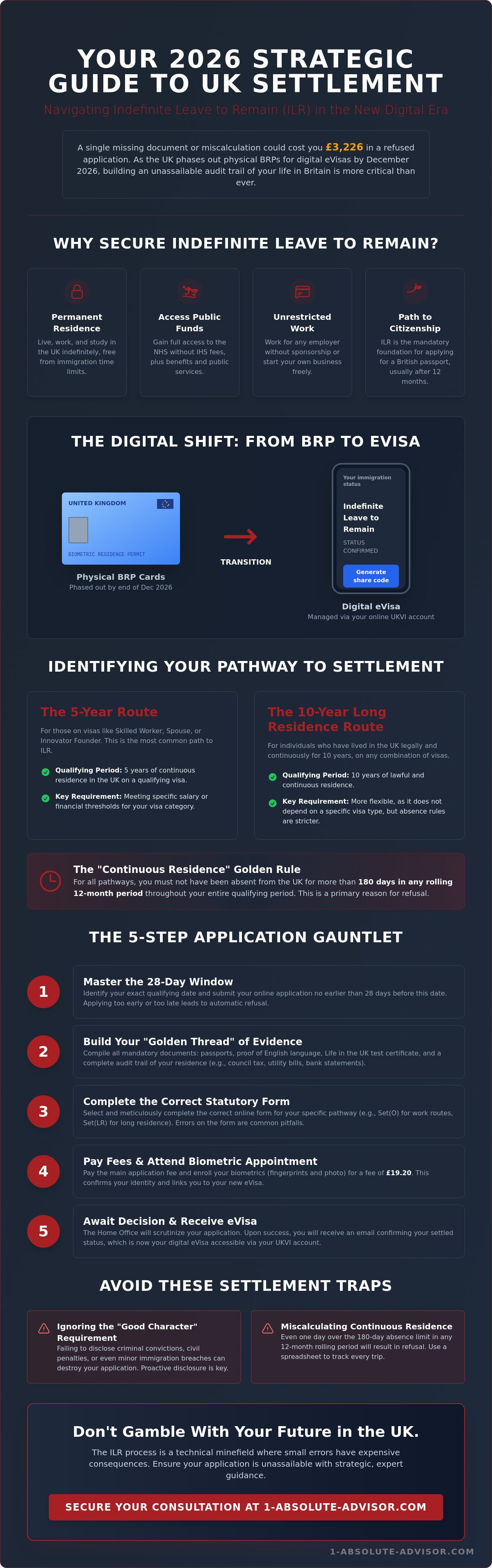
The UK immigration landscape underwent a seismic shift leading up to 2026. Physical Biometric Residence Permits (BRPs) are now a thing of the past. If your application is successful today, you won’t receive a plastic card in the mail. Instead, your settled status is recorded digitally as an eVisa. This digital-only system is designed to reduce fraud and streamline border crossings, but it requires a different approach to proving your rights. The UKVI account serves as the new central hub for all status management, replacing the need for physical documentation entirely.
To view or share your status with employers and landlords, you must log into your UKVI account to generate a secure share code. This code is temporary and provides third parties with time-limited access to verify your right to work or rent. Understanding how to apply for ilr uk in this digital era also means ensuring your passport details are always synced with your online profile. If you get a new passport, you must update your UKVI account immediately to avoid issues at the border.
Why ILR is the Foundation for Citizenship
ILR isn’t the end; it’s the gateway. For most residents, holding ILR for at least 12 months is a mandatory prerequisite before applying for naturalisation. This “waiting period” allows the Home Office to ensure you have maintained your settled status and continue to meet the residence requirements. However, if you’re married to a British citizen, you might be eligible to apply for citizenship immediately after your ILR is granted, bypassing the one-year wait.
This stage is also the final test of your immigration history. The Home Office reviews your “good character” over the previous ten years, looking for criminal convictions, civil penalties, or breaches of immigration rules. Any issues identified during your settlement application could jeopardize your future as a British citizen. For a detailed roadmap on the next stage of your journey, consult our British Citizenship guide. Securing ILR is the most significant step toward total legal security in the UK.
Identifying Your Qualifying Pathway to Settlement
Determining your specific eligibility is the first strategic step in understanding how to apply for ilr uk. You can’t simply apply for settlement in a vacuum; you must qualify through a recognized immigration category that leads to permanent residency. Most applicants rely on the standard five-year route, but individual circumstances often allow for alternative pathways, such as the ten-year long residence track or even accelerated options for high-value migrants. Choosing the wrong category at the start is a common reason for application failure.
The “Continuous Residence” requirement serves as the backbone of every successful settlement claim. To meet this standard, you must demonstrate that you haven’t been absent from the UK for more than 180 days in any rolling 12-month period throughout your qualifying years. For a high-level summary of these categories, Identifying Your Qualifying Pathway to Settlement on the official government portal provides a basic overview, but the nuances of the rules implemented on April 8, 2026, require much deeper scrutiny to ensure compliance.
The 5-Year Route: Skilled Worker and Family Visas
This remains the most frequent path to settlement. For those currently holding a Skilled Worker visa, you must prove you’re still required for your role and that your earnings meet the updated 2026 salary thresholds. If you’re following the UK Spouse Visa route, the focus shifts to proving your relationship is subsisting and that you meet the specific financial requirements. If you’re unsure whether your current income or employment status meets these strict benchmarks, our professional document checking service can provide the legal certainty you need before you commit to the application fee.
The 10-Year Long Residence Pathway
If you’ve switched between various visa categories, the 10-year route is often your most viable option. This pathway allows you to combine time spent on different visas, such as moving from a Student visa to a Graduate visa and finally to a work-based permit. The qualifying period is calculated from the date you first entered the UK on a valid visa. You must be extremely cautious with “broken” residence. Even a short period spent without valid leave to remain can reset your 10-year clock to zero, forcing you to start the entire decade-long process over again.
Accelerated settlement options provide a faster track for specific individuals. Global Talent visa holders can often apply for ILR after just three years of residence. Certain Innovator Founders may even qualify in as little as two years if they meet specific business growth milestones. These accelerated paths are highly scrutinized by the Home Office, as they require proof of significant professional or economic contribution. Regardless of which path you choose, knowing how to apply for ilr uk correctly involves a meticulous audit of your entire immigration history to ensure no gaps or rule breaches exist.
The Step-by-Step ILR Application Process
Executing the steps of how to apply for ilr uk requires a methodical approach to data entry and timing. Once you’ve confirmed your eligibility pathway, the process moves into a technical phase where precision is your greatest asset. This journey begins with selecting the correct digital form, typically SET(O) for work-based routes or SET(M) for family-based applications. In the 2026 digital landscape, your application is directly integrated with your UKVI account, ensuring that your settled status is instantly accessible as an eVisa upon approval.
The submission phase involves more than just uploading files; it’s a financial and legal commitment. You’ll need to pay the standard application fee of £3,226, which became effective on April 8, 2026. At this stage, you must also decide on the speed of your decision. While standard processing can take up to six months, you can opt for Priority Service at an additional £500 for a five-day turnaround, or Super Priority at £1,000 for a decision by the end of the next working day. A comprehensive review of the Essential Supporting Documents and the Evidence Audit is vital to ensure your absences don’t disqualify you at the eleventh hour.
Mastering the 28-Day Rule
Timing is the most common point of failure for unassisted applicants. You’re permitted to submit your application up to 28 days before you complete your five-year or ten-year qualifying period. However, calculating this date requires extreme care. If you apply even one day too early, the Home Office will likely reject the application as “premature,” resulting in the loss of your £3,226 fee. You should generally calculate this period from the date your initial visa was granted or the date you first entered the UK, depending on your specific visa category’s rules. Don’t guess this date; verify it against your original approval letter.
Biometrics and the UKVCAS Appointment
After paying your fees, you must book a biometrics appointment through the UKVCAS portal. This appointment is where your fingerprints and digital photographs are captured for a fee of £19.20. While you can pay for in-person document scanning at the service center, we recommend uploading all evidence digitally via the portal at least 48 hours before your appointment. This allows for a smoother experience and provides a digital trail of your submission.
Once biometrics are submitted, the official waiting period begins. During this time, the Home Office may issue a “Request for Information” (RFI) if they find any inconsistencies in your residence history or financial data. Responding to an RFI with speed and professional clarity is essential to keep your application on track. Understanding how to apply for ilr uk also means being prepared for this potential scrutiny, ensuring you have secondary evidence ready if the caseworker requests further proof of your life in Britain.
Essential Supporting Documents and the Evidence Audit
A successful settlement application rests on the strength of your evidence audit. While the digital form asks for basic details, the caseworker makes a decision based on the “Golden Thread” of documentation you provide. This thread must link your initial entry into the country to your current status without any breaks or unexplained absences. Understanding how to apply for ilr uk effectively means shifting your mindset from simply filling out a form to proving a history. You must present a coherent narrative that leaves no room for doubt regarding your residence or financial stability.
Your identity documents form the foundation of this audit. You must provide your current passport and any previous passports or Biometric Residence Permits (BRPs) used throughout your qualifying period. Even though physical BRP cards are being phased out by the end of 2026, the historical data on these cards remains vital for verifying your past leave. If you’ve lost an old passport, you’ll need to provide alternative evidence, such as Home Office letters or travel records, to bridge the gap in your identity history.
Proving Knowledge of Life and Language
Most applicants must pass the Life in the UK test before they can submit their settlement application. The standard fee for this test is £50, and the certificate never expires. You don’t need to submit a physical certificate; you simply provide the Test ID Number on your digital application. Alongside this, you must meet the English language requirement at CEFR Level B1. Ensure your test is from an approved Secure English Language Test (SELT) provider, such as Trinity College London or Pearson, as certificates from non-approved centers will lead to an immediate refusal.
The Continuous Residence Audit Trail
The Home Office requires proof that you’ve lived in the UK for every year of your qualifying period. This is where many applications fail due to a lack of organization. You should compile a chronological file containing utility bills, council tax records, and tenancy agreements. If you’re on a Skilled Worker route, your P60s and bank statements must align perfectly with your payslips to prove you’ve been paid at the required salary threshold. Every absence from the UK must be documented and justified with travel dates that match your passport stamps.
Gaps in employment or periods of extended travel require specific explanatory letters. If you’re concerned that your documentation might have a weak link, our Indefinite Leave to Remain (ILR) Application Service provides a comprehensive pre-submission audit to ensure your file is unassailable. We help you organize your financial evidence and residence records into a professional bundle that simplifies the caseworker’s task and accelerates your path to approval.
Common Pitfalls and the 1 Absolute Advisor Strategy
The final hurdle in your settlement journey often involves the “Good Character” requirement, a standard that extends far beyond simple criminal records. The Home Office examines your entire history, including civil penalties, late tax filings, and even minor immigration breaches from years ago. Many applicants believe that if a visa was granted previously, their character is already “cleared.” This is a dangerous assumption. Settlement is a fresh assessment, and any perceived deception or non-disclosure can lead to a mandatory refusal and a potential ten-year ban from the UK. The 1 Absolute Advisor approach ensures that every detail of your history is disclosed correctly to avoid these catastrophic consequences. Honesty isn’t just the best policy; it’s the only viable strategy when learning how to apply for ilr uk successfully.
Administrative errors represent another significant risk factor. Even a well-intentioned applicant can fail due to a simple formatting error in their bank statements or a slight miscalculation of their qualifying period. Professional representation acts as a safeguard against these technicalities. By treating your application as a strategic business project rather than a simple form-filling exercise, you ensure that every claim is backed by an unassailable audit trail. This level of precision is what distinguishes a successful grant from an expensive administrative review.
Why ILR Applications Get Refused
Refusals in 2026 often stem from a failure to adapt to the updated financial rules implemented on April 8, 2026. If your salary falls even slightly below the new thresholds, or if your employer’s supporting letter lacks the specific statutory wording required, the caseworker has little discretion to approve. Another frequent pitfall is the 180-day absence limit. Applicants often count “days spent abroad” incorrectly by forgetting to include travel days or failing to account for the rolling 12-month nature of the rule. Finally, missing or improperly formatted financial evidence, such as online bank statements that haven’t been properly authenticated, remains a leading cause of rejection.
Our Professional ILR Application Service
At 1 Absolute Advisor, our OISC-registered consultants provide more than just document checking. We act as your strategic partners, performing a comprehensive audit of your residence and financial history to identify risks before they reach the Home Office. We specialize in drafting detailed legal cover letters that explain complex scenarios, such as periods of self-employment or unavoidable absences from the UK. For a broader perspective on the evolving rules, you can refer to our comprehensive guide to UK immigration.
Before you commit to the submission, run through this final checklist:
- Confirm your application date is within the 28-day window of your qualifying period.
- Verify that your Life in the UK and B1 English certificates are correctly linked to your UKVI account.
- Ensure every absence from the UK is justified by a corresponding entry in your residence log.
- Check that your financial evidence covers the exact 6 or 12-month period required by your specific route.
Don’t leave your settlement to chance. Understanding how to apply for ilr uk is the first step, but flawless execution is what secures your status. If you require absolute certainty, secure your future in the UK with our Fixed-Fee ILR Management Service.
Secure Your Permanent Future in Great Britain
Mastering how to apply for ilr uk is the final step toward complete legal security and freedom from immigration time limits. Success in 2026 depends on your ability to navigate the transition from physical BRPs to the new eVisa system while maintaining a flawless record of continuous residence. You’ve already invested years of your life and at least £3,226 in Home Office fees. Don’t let a single technical error in your documentation jeopardize that investment. Whether you’re on a five-year Skilled Worker path or a complex ten-year Long Residence route, the Home Office expects absolute precision in every record you submit.
Our OISC-registered immigration consultants specialize in transforming complex immigration histories into unassailable settlement applications. We offer a fixed-fee service with no hidden costs, providing the strategic oversight needed to manage both standard 5-year and intricate 10-year pathways. By auditing your documents before submission, we eliminate the risks that lead to costly refusals. Book a Professional ILR Consultation Today and take the final step toward your life as a settled UK resident with confidence. Your path to British citizenship starts with a successful settlement grant today.
Frequently Asked Questions
How much does an ILR application cost in 2026?
The standard Home Office fee for an Indefinite Leave to Remain application is £3,226 per person as of April 8, 2026. You must also pay a £19.20 biometric enrolment fee, though you aren’t required to pay the Immigration Health Surcharge for settlement applications. Faster decisions are available for an additional £500 for Priority service or £1,000 for Super Priority service.
Can I apply for ILR if I have more than 180 days of absence?
Exceeding the 180-day limit in any rolling 12-month period usually disqualifies you from settlement unless you provide evidence of serious or compelling circumstances. These exceptions often include medical emergencies, natural disasters, or specialized work assignments. You’ll need a detailed legal cover letter and supporting documentation to justify why your residence shouldn’t be considered broken despite the absence.
Do I still need a physical BRP card to apply for ILR?
No, physical Biometric Residence Permits are being phased out by December 31, 2026, in favor of a fully digital eVisa system. While you might still hold a physical card from a previous visa, your new settlement status will be granted digitally. You’ll manage your status through a UKVI account, which allows you to share your right to work or rent via secure share codes.
How long does the Home Office take to decide on an ILR application?
The standard processing time for a settlement application is up to six months from the date of your biometric appointment. If you require a faster result, the Priority service provides a decision within five working days. For the most urgent cases, the Super Priority service typically delivers a decision by the end of the next working day after biometrics are captured.
What happens if my ILR application is refused?
If your application is refused, you’ll generally receive a letter outlining your right to an Administrative Review if a caseworker error occurred. Since ILR decisions don’t always carry a right of appeal, you must act within 14 days to challenge the decision. Our Administrative Review Service helps identify technical errors or missing evidence to rectify the refusal without starting a fresh application.
Can I travel outside the UK while my ILR application is pending?
You must not travel outside the Common Travel Area while your application is under consideration. Leaving the UK before a decision is made results in your application being automatically withdrawn by the Home Office. This rule is strictly enforced, and your application fee won’t be refunded if the case is closed due to travel.
Is the Life in the UK Test mandatory for everyone?
Most applicants aged between 18 and 64 must pass the Life in the UK test to qualify for settlement. You’re exempt if you have a long-term physical or mental condition that prevents you from taking the test, supported by a specific medical waiver form. The test costs £50 and requires a pass mark of at least 75 percent to receive your unique reference number.
How do I prove my English language ability for settlement?
You can prove your English proficiency by passing a Secure English Language Test at CEFR Level B1 through an approved provider. Alternatively, you meet the requirement if you have a degree-level qualification taught in English or if you’re a national of a majority English-speaking country. Ensure your certificate is current when you research how to apply for ilr uk, as requirements will increase to B2 level on March 26, 2027.