

In 2024, a significant number of applicants faced immediate refusals and lost their £1,846 application fees because they sat a test with a provider that wasn’t on the Home Office’s approved list. It’s a high-stakes error that often stems from outdated information or subtle changes in immigration rules. We understand that you don’t just want to pass a test; you want the absolute certainty that your uk spouse visa english language test results will be accepted without question.
It’s frustrating to deal with a system where a single administrative oversight can derail your plans for a life together in the UK. You’ve likely felt the pressure of choosing between various CEFR levels or wondered if your international degree truly meets the English proficiency standards. Our objective is to provide the professional clarity you need to move forward with confidence and strategic precision.
This comprehensive 2026 guide breaks down the specific requirements for every stage of the process, from identifying approved SELT centres to understanding the nuances of academic exemptions. By the end of this article, you’ll have a clear roadmap to secure a successful result on your first attempt and ensure your evidence is fully compliant with current Home Office regulations.
Key Takeaways
- Gain a comprehensive understanding of the CEFR framework to ensure your application meets the precise proficiency standards mandated by the Home Office.
- Learn how strategically selecting a higher-level uk spouse visa english language test early in the process can mitigate the risk of refusal and provide long-term financial savings.
- Identify the specific criteria for verifying Secure English Language Test (SELT) providers to avoid the common pitfall of using non-approved centres.
- Discover how to leverage your existing academic qualifications or degrees to bypass the testing requirement entirely through the academic equivalency route.
- Master the nuances of certificate validity to ensure your evidence remains compliant and avoids the most frequent causes of visa application rejection.
Understanding the UK Spouse Visa English Language Requirement in 2026
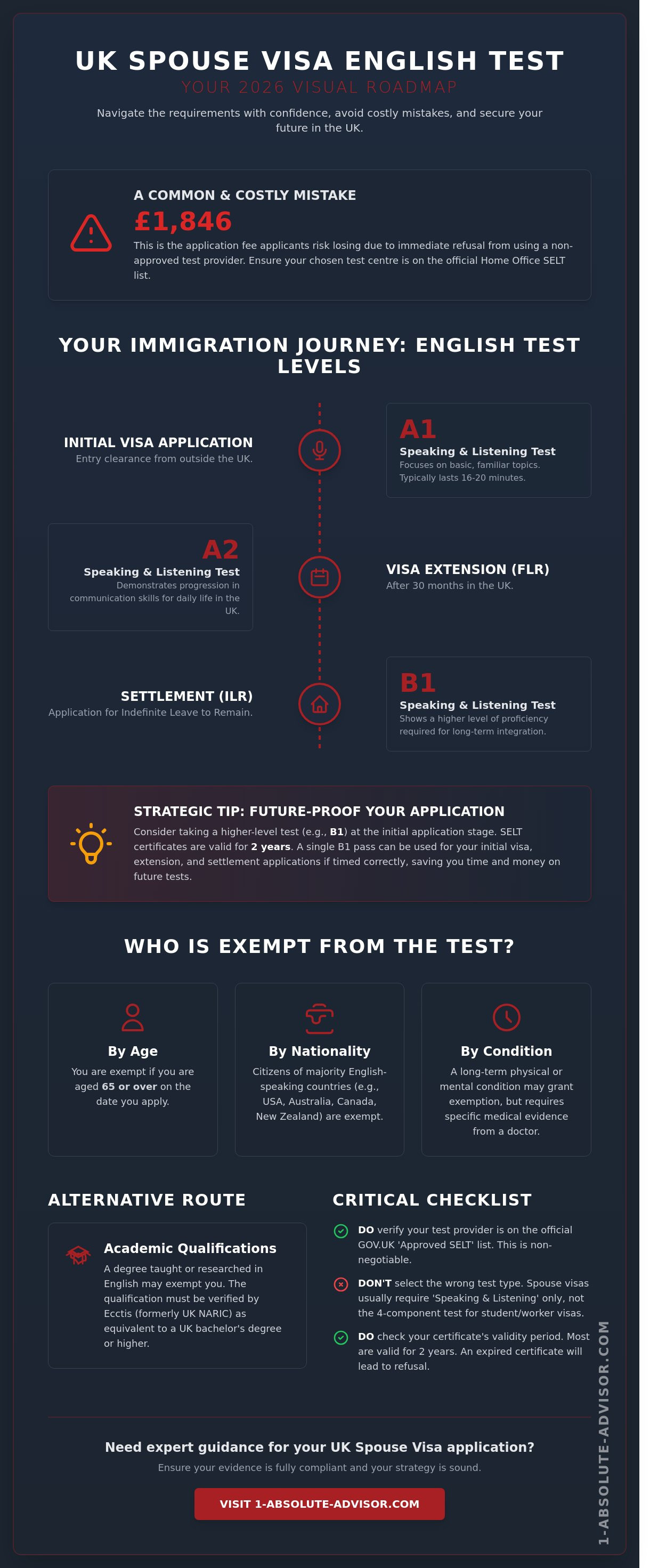
Most applicants must pass an approved uk spouse visa english language test at a level determined by the Common European Framework of Reference for Languages (CEFR). For an initial entry clearance application, you’ll generally need to meet level A1. If you’re extending your stay after 30 months, the requirement rises to level A2. By the time you apply for settlement, level B1 is the standard. These levels ensure a progressive improvement in communication skills as your residency continues.
It’s vital to distinguish between test types. For a spouse visa, you typically only need a “Speaking and Listening” test. This differs from the “Four-component” tests required for skilled worker or student visas, which also assess reading and writing skills. Choosing the wrong test version is a common reason for application delays. You must ensure your provider is on the Secure English Language Test (SELT) list approved by the Home Office for 2026.
Who is Exempt from the English Language Requirement?
Approved Countries and Nationalities
Citizens of majority English-speaking countries automatically meet the requirement. This list includes the USA, Australia, New Zealand, Jamaica, and several Caribbean nations. Canadian nationals are also exempt. While Canada is officially bilingual, the Home Office treats Canadian citizenship as sufficient proof of English proficiency. If you hold a passport from one of these countries, you don’t need to take a uk spouse visa english language test; your valid passport serves as the only evidence required. This exemption simplifies the process significantly for these applicants, removing the need for third-party certification.
Navigating CEFR Levels: From A1 to Indefinite Leave to Remain
Strategic planning is the cornerstone of a successful immigration journey. Choosing the right level for your uk spouse visa english language test prevents unnecessary delays and financial waste. Most Secure English Language Test (SELT) certificates remain valid for two years from the date of the exam. You should consult the UK government’s approved English tests to ensure your provider is recognised by the Home Office. Taking a level higher than the minimum requirement can be a shrewd move for those looking to future-proof their status.
The Initial Application: Level A1
Applicants applying from outside the UK for entry clearance must demonstrate basic proficiency. The A1 test focuses exclusively on speaking and listening. It’s a short session, typically lasting between 16 and 20 minutes. You’ll discuss familiar topics like your home, family, and daily routine. It’s designed to prove you can function in basic social situations. While it’s the minimum requirement, it sets the foundation for your life in Britain.
The Visa Extension: Level A2
After living in the UK for 30 months, or 33 months if you arrived on an entry clearance visa, you’ll need to apply for Further Leave to Remain. The requirements increase to Level A2 at this stage. You can’t reuse an expired A1 certificate for this application. The A2 test builds on your existing skills; it requires more detail in your descriptions and the ability to give simple reasons for your preferences or opinions. It marks your progression toward full integration into British society.
Settlement and Citizenship: Level B1
The final stage of the journey involves applying for Indefinite Leave to Remain (ILR). This requires Level B1 proficiency. This same standard applies when you eventually pursue British Citizenship. Taking the B1 test during your first extension is a highly effective way to save money and reduce future stress. If you pass B1 early, you can often use that same certificate for your settlement application later, provided it was on the approved list when you first used it for a successful application.
Choosing between GESE (Graded Examinations in Spoken English) and IELTS Life Skills depends on your personal comfort. GESE is a one-on-one conversation with an examiner, while IELTS involves two candidates speaking together. Proactive candidates often prefer GESE for its predictable, structured nature. If you’re unsure which path fits your long-term goals, seeking professional guidance can clarify your best route and ensure your uk spouse visa english language test meets all current compliance standards.
Proving Your Ability: Approved SELT Providers and Test Centres
Selecting the correct venue is as critical as the exam itself. Many applicants mistakenly book courses or assessments at local language schools that lack Home Office accreditation. These certificates are invalid for a uk spouse visa english language test application and typically result in an immediate refusal of the visa. You must exclusively use a provider designated as a Secure English Language Test (SELT) provider. The Home Office maintains a strict list of these organisations, which was most recently updated in late 2024 to reflect new security protocols for the 2025 and 2026 period.
Verification is straightforward but essential. Every valid certificate includes a Unique Reference Number (URN). Without this specific code, the Home Office case worker cannot verify your results on their internal system. When you arrive at the centre, you’re required to present the same valid passport or national identity document you used during the booking process. Failure to produce the original document usually results in a cancelled test without a refund; the Home Office reports that identity discrepancies are a leading cause of test day complications.
Approved Test Providers in the UK
Within the UK, you have four primary options for your uk spouse visa english language test. The IELTS SELT Consortium, managed by the British Council and IDP, remains a popular choice with numerous locations across major cities. LanguageCert has updated its programme for 2025 and 2026, offering more flexible booking windows and rapid digital result delivery within 3 to 5 business days. Pearson (PTE Academic UKVI) provides a fully computer-based experience, while Trinity College London specialises in speaking and listening assessments; however, they only operate centres within the UK borders.
Approved Test Providers Outside the UK
If you’re applying from abroad, your options are slightly different. You must access the official GOV.UK portal to find the authorised provider in your specific country. While IELTS and Pearson operate globally, Trinity College London isn’t available for overseas applicants. Booking and payment are handled directly through the provider’s secure website. Fees are typically paid in British Pounds (£) or the local currency equivalent at the current exchange rate. Always confirm the centre is specifically listed for “UKVI” purposes, as standard academic English tests won’t be accepted for your spouse visa application. Once the test is complete, the provider issues the SELT URN, which is the only piece of evidence you’ll need to input into your online visa application form.
Alternative Routes: Degrees and Academic Qualifications
Applicants who have successfully completed higher education often find they can bypass the standard uk spouse visa english language test entirely. The Home Office recognises that the rigour required to obtain a degree demonstrates a level of linguistic proficiency that exceeds the basic A1 or A2 requirements. This route offers a strategic advantage, as it eliminates the need to prepare for a Secure English Language Test (SELT) and provides a permanent solution for future settlement applications.
To qualify, your degree must be equivalent to a UK Bachelor’s, Master’s, or PhD. It is a common misconception that higher-level qualifications carry more weight; for the purpose of a visa application, a Bachelor’s degree is treated with the same validity as a PhD. The primary condition is that the programme was taught or researched in English. If the degree was obtained in a majority English-speaking country, the process is streamlined. For degrees earned elsewhere, specific verification steps are mandatory to ensure the academic standards align with the UK’s framework.
Using a UK Degree Certificate
Holders of degrees awarded by UK universities face the simplest path. These qualifications don’t require external verification because the Home Office maintains a direct database of recognised UK awarding bodies. You must provide your original degree certificate. If your certificate is lost, you’ll need to request a formal replacement or a letter of confirmation from the university. This letter must be on headed paper and confirm your name, the title of the degree, and the date it was awarded. Transcripts are generally only accepted if the certificate hasn’t been issued yet, which often occurs shortly after graduation.
Degrees from Outside the UK: The Ecctis Process
If your degree was awarded by an institution outside the UK, you must use Ecctis (formerly UK NARIC) to validate your credentials. Ecctis provides the official “Visas and Nationality” service, which confirms two critical factors. First, the Academic Qualification Level Statement verifies that your degree is equivalent to a UK degree. Second, the English Proficiency Statement confirms that the medium of instruction was indeed English.
Ensuring your academic documents meet Home Office standards is vital for a successful application. For professional guidance on verifying your qualifications, contact an Absolute Advisor today.
Avoiding Common Pitfalls: Why English Language Evidence Fails
The Home Office rejects thousands of applications every year due to avoidable administrative errors. The most frequent cause for refusal involves applicants sitting a test that isn’t on the approved Secure English Language Test (SELT) list. Even if you’ve achieved a high score in a standard academic exam, the caseworker will reject your uk spouse visa english language test evidence if the provider isn’t specifically authorised for immigration purposes. Currently, the Home Office only recognises tests from providers like IELTS SELT Consortium, Pearson, LanguageCert, and PSI Services (UK) Ltd.
Spelling discrepancies represent another significant risk. If your name on the test certificate doesn’t match your passport exactly, your application faces immediate scrutiny. A missing middle name or a transposed character might seem trivial, but in the eyes of a Home Office official, it constitutes a failure to verify identity. You must ensure your booking details are identical to your travel documents before you enter the test centre.
Expired Certificates and Provider Validity
A common misconception is that a test certificate is valid indefinitely. Most SELT results expire after exactly two years. However, the Home Office allows you to reuse an expired certificate if you used it in a “previous successful application” and it remains at the required level for your current route. If you’re moving from a fiancé visa to a spouse visa, this rule often provides a streamlined path, provided the test was originally on the approved list.
Risks emerge when a provider is removed from the Home Office list. If the government revokes a provider’s licence between your test date and your application date, your evidence might become void. Relying on a certificate older than 24 months without professional verification is a gamble that often leads to a flat refusal rather than a request for more information.
How Professional Guidance Secures Your Application
Engaging an OISC-registered advisor transforms your application from a collection of documents into a robust legal case. Expert UK immigration advice involves a comprehensive audit of your uk spouse visa english language test results against current Appendix English Language requirements. Advisors identify discrepancies in dates, provider codes, and levels long before the Home Office sees them.
Professional guidance is particularly vital for those switching between different visa categories. For example, if you’re transitioning from a Skilled Worker Visa to a spouse visa, your previous B1 level evidence might be sufficient, but the administrative transition requires a specific legal cover letter. Advisors draft these submissions to explain how your existing evidence meets the statutory requirements, preventing caseworkers from making erroneous decisions based on a misunderstanding of your immigration history.
- Verification: Advisors check the SELT unique reference number (URN) against the Home Office database.
- Strategy: We determine if you qualify for exemptions based on age (over 65) or specific medical conditions.
- Precision: Legal cover letters link your evidence directly to the relevant immigration rules.
Securing Your UK Residency with Confidence
Navigating the 2026 Home Office requirements demands absolute precision, particularly when selecting an approved SELT provider for your uk spouse visa english language test. You must ensure your qualification meets the specific CEFR level required for your current stage, whether that’s an A1 certificate for your initial entry clearance or the more advanced B1 level needed for Indefinite Leave to Remain. Minor oversights regarding test centre accreditation or certificate expiry dates often result in immediate application refusals, which can jeopardise your family’s stability and lead to significant financial loss.
Our OISC-registered immigration consultants offer a strategic, professional approach to these complex regulations. We provide an expert document checking service alongside comprehensive fixed-fee application management to remove the stress of compliance. By meticulously verifying your academic qualifications or test results against the latest Home Office Appendix English Language criteria, we ensure your submission is legally robust and ready for approval.
Book a fixed-fee consultation for your Spouse Visa application today to partner with experts who prioritise your success. Your path to a secure life in Britain starts with the right preparation.
Frequently Asked Questions
Do I need an English test if I am from a country where English is the official language?
You don’t need to take a test if you’re a national of a majority English-speaking country recognised by the Home Office. This list currently includes 19 countries such as Australia, Canada, Jamaica, and the USA. In these cases, your valid passport serves as sufficient evidence of your language proficiency.
Can I use my IELTS Academic certificate for a UK spouse visa?
You can use an IELTS Academic or General Training certificate as long as it was taken at a Secure English Language Test (SELT) approved centre. It’s essential that the test appears on the Home Office approved list and includes a specific UKVI reference number. This ensures your results are compatible with the uk spouse visa english language test requirements.
What happens if I fail my UK spouse visa English language test?
You won’t be able to submit a successful visa application until you achieve a passing grade. There’s no limit on how many times you can retake the exam, but you’ll need to pay the full registration fee for every new attempt. Most providers allow you to book a new slot within a few days of receiving a fail result.
How much does the SELT English test cost in 2026?
Standard fees for a SELT in 2026 typically range from £150 to £200 depending on the provider and location. Trinity College London and IELTS SELT Consortium remain the primary organisations authorised to conduct these exams. You should factor in additional costs if you require fast-track results or need to travel to a major city centre.
Is a degree from a non-English speaking country acceptable if it was taught in English?
A degree from overseas is acceptable if Ecctis confirms it’s equivalent to a UK bachelor’s degree or higher. You must obtain an Academic Qualification Level Statement and an English Proficiency Statement from Ecctis to prove the medium of instruction. This verification process usually takes around 10 to 15 working days to complete.
Can I take the B1 test immediately for my first spouse visa application?
You’re allowed to take a higher-level test like B1 for your initial application even though the minimum requirement is A1. This is often a strategic choice because a B1 certificate can be reused for your extension and your eventual settlement application. It prevents the need to sit multiple exams over the course of your five-year route to residency.
How long is a SELT certificate valid for UK immigration purposes?
SELT certificates are generally valid for 2 years from the date the test was taken. However, if you’ve already used a certificate in a successful immigration application, the Home Office may accept it for a renewal even if it has technically expired. This rule provides stability for applicants who stay with the same provider throughout their visa journey.
Do I need to prove my English ability again when I apply for a visa extension?
You must demonstrate a higher level of English proficiency when you apply for your 30-month extension, known as Further Leave to Remain. The requirement increases from level A1 to level A2 at this stage of the process. Successfully passing the uk spouse visa english language test at level A2 or higher ensures you meet the criteria for continued stay.