

What if the primary obstacle to your long-term career isn’t your professional merit, but a £38,700 salary threshold that shifted the entire immigration framework? It’s understandable to feel concerned as the Home Office implements some of the most significant changes to the UK’s points-based system since 4 April 2024. You’ve likely invested years into your British career, yet the fear of visa expiry remains a pressing reality for many professionals. Successfully switching to skilled worker visa in uk requires more than just a job offer; it demands a precise understanding of the 2026 eligibility criteria and the strict timelines that now govern student transitions.
Most individuals holding valid permission to stay in the UK can transition to this route. The most common applicants include those on Graduate visas, as this route provides a natural bridge from study to permanent career placement. Students who have completed their degrees or are within three months of completion are also eligible. For students still planning their academic path, Ideal Study Abroad offers expert admission assistance to help ensure your chosen program supports your long-term residency goals. Additionally, many individuals currently on Intra-company Transfer routes (now part of the Global Business Mobility category) choose this path because it offers a direct route to Indefinite Leave to Remain (ILR), which their original visas might not provide. It’s essential to verify your specific visa sub-category against the latest 2026 Appendix Skilled Worker rules to confirm your eligibility for an in-country move.
We’re here to provide the absolute clarity required to secure your professional future with confidence. This guide breaks down the complex financial requirements and the specific application strategies needed to avoid common pitfalls. You’ll gain a comprehensive overview of the mandatory documentation, updated salary benchmarks, and the essential steps to ensure your transition is both compliant and strategic. For those looking to further optimize their professional trajectory, Pinnacle Global Advisory offers strategic insights into capital efficiency and global scaling.
Key Takeaways
- Identify the updated 2026 eligibility criteria to confirm your transition can be completed entirely within the UK without the need for a costly or disruptive departure.
- Navigate the complex 2026 financial landscape by mastering the new salary thresholds and the “going rate” specific to your role when switching to skilled worker visa in uk.
- Learn the essential steps for securing a valid Certificate of Sponsorship (CoS) and gathering the mandatory evidence required to satisfy strict Home Office compliance standards.
- Discover strategic timing for students and graduates to navigate the “visa brake” and optimize your transition for long-term Indefinite Leave to Remain (ILR) benefits.
- Minimize the high risk of application refusal by identifying common errors and understanding how professional legal audits provide absolute certainty for your immigration status.
Switching to a Skilled Worker Visa: Eligibility and Restrictions in 2026
The process of switching to a skilled worker visa in the UK represents a strategic transition for professionals already residing in the country. It allows you to change your immigration status to a long-term employment category without the necessity of departing the UK to apply from abroad. This administrative shift is rooted in the evolving History of UK Work Permits, which has transitioned from a rigid permit system to the current flexible, points-based framework. Success depends on securing a formal job offer and a Certificate of Sponsorship (CoS) from an employer who holds a valid Home Office sponsor license.
In 2026, the landscape of UK immigration is defined by heightened compliance and the “visa brake” policy. This mechanism allows the government to adjust eligibility criteria or salary thresholds rapidly based on net migration figures. Applicants must navigate these shifts with precision. Maintaining valid leave throughout the transition is non-negotiable. If your current visa expires before you submit your application, you lose the legal right to switch in-country. This gap can lead to an overstaying mark on your record, which complicates any future residency or citizenship goals.
Who is Eligible to Switch Inside the UK?
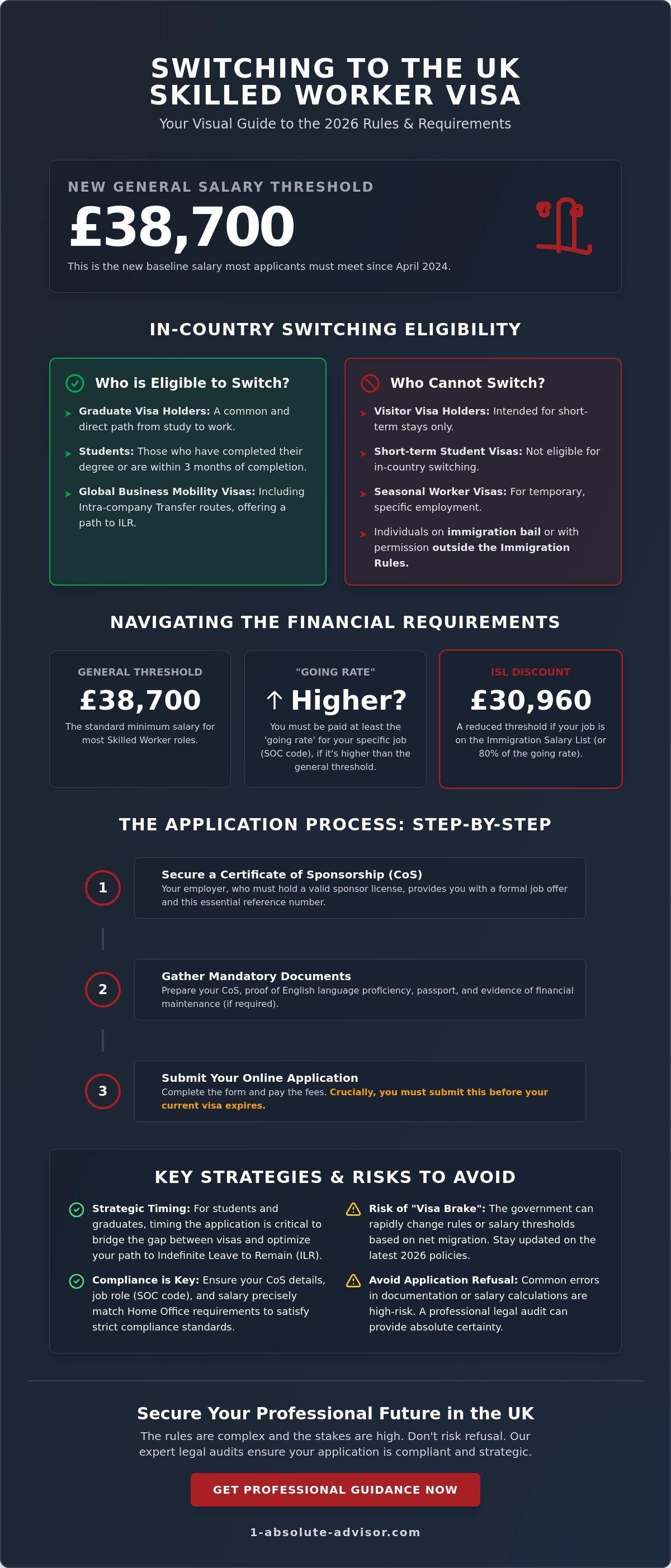
Most individuals holding valid permission to stay in the UK can transition to this route. The most common applicants include those on Graduate visas, as this route provides a natural bridge from study to permanent career placement. Students who have completed their degrees or are within three months of completion are also eligible. Additionally, many individuals currently on Intra-company Transfer routes (now part of the Global Business Mobility category) choose this path because it offers a direct route to Indefinite Leave to Remain (ILR), which their original visas might not provide. It’s essential to verify your specific visa sub-category against the latest 2026 Appendix Skilled Worker rules to confirm your eligibility for an in-country move.
Who Cannot Apply to Switch?
The Home Office maintains strict “no-switch” categories to prevent the circumvention of standard entry clearance procedures. You cannot perform the switching to skilled worker visa in uk if you’re currently on a Visitor visa, a Short-term Student visa, or a Seasonal Worker visa. These categories are designed for temporary stays and don’t permit internal status changes. Furthermore, individuals on immigration bail or those granted permission to stay outside the formal Immigration Rules are excluded from this process. If you fall into these groups, you must depart the UK and apply for entry clearance from your home country. This requirement ensures that the integrity of the border system remains intact while managing the volume of long-term residents effectively.
Meeting the 2026 Financial and Salary Requirements
Success when switching to a skilled worker visa in uk depends heavily on meeting the Home Office’s stringent financial criteria. By 2026, these regulations have become a cornerstone of the UK’s points-based system, requiring applicants to demonstrate both a high earning potential and personal financial stability. The baseline salary for most roles is now £38,700, though the specific requirement often depends on your individual circumstances and the nature of your profession.
Beyond the base threshold, you must account for the “going rate” of your specific job. The “going rate” is the minimum pay for a specific occupation. If the going rate for your role is higher than the general threshold, you’re required to earn that higher amount. This ensures that international workers aren’t used to undercut the local labor market. You can verify the most current rates and SOC codes through the Official UK Skilled Worker Visa Information to ensure your contract aligns with 2026 standards.
The General Salary Threshold vs. Occupation Codes
Every sponsored role is assigned a Standard Occupational Classification (SOC) code, which dictates the specific financial requirements you must meet. While the £38,700 figure is the standard, roles on the Immigration Salary List (ISL) allow for a reduction. If your job is on this list, you might qualify with a salary of £30,960 or 80% of the job’s going rate. It’s a strategic calculation that requires looking at your total compensation package, including basic pay but excluding most bonuses or regional allowances.
Applicants with a PhD relevant to their role can also benefit from “tradeable points.” A relevant PhD allows for a 10% reduction in the salary requirement, while a PhD in a Science, Technology, Engineering, or Mathematics (STEM) subject allows for a 20% reduction, provided the salary stays above £30,960. This holistic approach to eligibility rewards high-level expertise and fills critical gaps in the UK economy.
New Entrant Rates and Discounts
If you’re currently in the UK on a Student or Graduate visa, switching to skilled worker visa in uk is often more affordable through the “new entrant” category. This route is available to those under the age of 26 or those whose most recent visa was a Student visa. New entrants can be paid 70% of the standard going rate for their role, with a minimum floor of £30,960.
- Four-Year Limit: You can only hold new entrant status for a maximum of four years. This includes any time you’ve already spent on a Graduate visa.
- Long-term Planning: Once the four-year period ends, your employer must increase your salary to the full standard rate to renew your visa.
- Financial Maintenance: You must show at least £1,270 in your bank account for 28 days straight to prove you can support yourself, unless your sponsor certifies they will cover this cost.
Precision in these calculations is vital because even a small deficit in your reported salary can lead to an immediate refusal. If you’re unsure how your specific benefits package fits into these 2026 rules, a professional financial assessment can help secure your transition. Most applicants find that documenting their financial history early prevents delays in the final application stage.
The Step-by-Step Process for Switching Your Visa
Transitioning to a new immigration status within the United Kingdom demands meticulous attention to detail. When you’re switching to skilled worker visa in uk, the sequence of your actions determines the success of your stay. You can’t simply start a new role; you must follow the Home Office’s structured digital pathway. According to the official guidance on How to Switch to a Skilled Worker Visa, you should apply at least three months before your new job’s intended start date to avoid administrative gaps.
The process begins with securing your Certificate of Sponsorship (CoS). This isn’t a physical paper document but a virtual reference number that links your application to your employer’s license. Once you have this, you’ll gather mandatory evidence. For most applicants, this includes proving your English language proficiency to at least level B1 on the CEFR scale. If you’re moving into sensitive sectors like healthcare or education, you’ll need a criminal record certificate from any country you’ve lived in for 12 months or more over the last 10 years. While TB tests are usually for those entering the UK, you might need to provide a recent certificate if you’ve traveled to high-risk areas during your current leave.
Completing the online application via the Home Office portal is the next stage. During this phase, you’ll prove your identity. Most applicants can use the “UK Immigration: ID Check” app on a smartphone to scan their BRP or passport chip. This digital route is faster and avoids the need for physical appointments. If the app can’t read your data, you’ll book an appointment at a UK Visa and Citizenship Application Services (UKVCAS) service point to provide biometrics in person.
The Certificate of Sponsorship (CoS) Explained
Your employer must assign an “Undefined” CoS for in-country switches. This differs from “Defined” certificates, which are reserved for those applying from overseas. Precision is vital. Your CoS details must match your passport exactly. Any discrepancy in your job description or salary, which must meet the 2026 threshold of £38,700 for most standard roles, can lead to a refusal. For a deeper look at sponsor requirements, consult our UK Work Visa Guide 2026.
Timelines and Priority Services
Standard processing for in-country switches takes approximately 8 weeks. If you need a faster decision, the Priority service costs an additional £500 for a 5-day turnaround. The Super Priority service provides a decision by the end of the next working day for £1,000. If your current visa expires while your application is pending, Section 3C of the Immigration Act 1971 protects your status. This legal provision allows you to continue living and working under your existing conditions until you receive a formal decision.
Strategic Considerations: Students, Graduates, and the Visa Brake
Success in 2026 requires more than just a job offer; it demands a calculated approach to timing and compliance. The UK government’s “Visa Brake” policy now acts as a dynamic regulator, allowing the Home Office to restrict application volumes or increase scrutiny for specific nationalities if net migration figures surpass established thresholds. This makes switching to skilled worker visa in uk a time-sensitive operation that requires constant monitoring of quarterly immigration statistics. If you’re applying during a period of high volume, expect heightened administrative hurdles.
Switching from a Student Visa: The “Course Completion” Rule
Current rules mandate that most international students must provide evidence of course completion before their new employment begins. You’re no longer permitted to switch mid-course to bypass academic obligations, a change designed to protect the integrity of the UK education system. PhD students represent the primary exception to this trend, as they may transition to a sponsored role after completing at least 24 months of their doctoral program. You cannot start work until the switch is approved, so it’s vital to align your job start date with your expected graduation and visa processing timelines.
Long-term Planning: From Skilled Worker to ILR
While the Graduate route offers short-term flexibility, it’s a temporary solution that doesn’t contribute toward your permanent residency requirements. Transitioning to a Skilled Worker visa is the most effective way to trigger your 5-year qualifying period for settlement. You must ensure your job code remains on the eligible list for the duration of your stay to maintain your path to residency. For a detailed breakdown of these requirements, consult our ILR UK Guide to secure your long-term future in the country.
Managing family unity is equally critical during this transition. In 2026, dependents must be handled with precision to avoid gaps in their lawful stay. If your dependents are already in the UK, they should apply simultaneously with you to ensure their leave aligns with your new status. This prevents administrative overlaps that could complicate future extension applications or lead to accidental overstaying. Following these steps ensures your family remains protected under the new, more restrictive framework.
Strategic planning is the foundation of a successful UK career. Contact Absolute Advisor to build your personalized visa transition roadmap today.
Securing Your Transition with Professional Legal Guidance
The process of switching to skilled worker visa in uk requires more than administrative accuracy; it demands a strategic understanding of Home Office scrutiny. Self-submission carries high risks. Common errors, such as selecting an incorrect SOC code or failing to meet the updated 2026 salary thresholds, lead to immediate refusals. Home Office data historically shows that administrative oversights account for a significant portion of rejected applications. A refusal doesn’t just lose you the application fee; it creates a record that complicates future UK immigration attempts and potentially jeopardizes your right to remain in the country.
Professional advisors provide an “absolute” audit of your evidence. This is vital when your switch involves complex variables like salary discounts for New Entrants or transitions from specialized visas. Our team ensures your Certificate of Sponsorship (CoS) aligns perfectly with your current professional status and long-term residency goals. We eliminate the guesswork by verifying that your sponsor’s license is active and your specific role meets the “genuine vacancy” test required for a successful transition.
Why OISC Registration Matters for Your Application
Professional immigration advice in the UK is strictly regulated. OISC registration ensures that your advisor operates under rigorous standards of competence and integrity. You shouldn’t trust your career to unregulated sources. 1 Absolute Advisor manages the end-to-end process, providing the stability needed during a life-changing transition. This holistic approach integrates legal compliance with your broader career strategy. You can learn more about our methodology for Navigating UK Immigration to understand the depth of our support.
Final 2026 Switching Checklist
Before hitting submit, verify these critical components to ensure your application is robust:
- A valid Certificate of Sponsorship (CoS) specifically assigned for an in-country switch.
- Documented proof of meeting the English language requirement at B1 level or higher.
- Evidence of maintenance funds, typically £1,270 held for 28 days, unless your sponsor certifies maintenance.
- Confirmation that your current visa allows for an in-country switch without a “cooling-off” period.
- Verification that your salary meets the 2026 “going rate” for your specific occupation code.
Next Steps: Consultation and Document Review
Your journey begins with a detailed initial assessment. We review your specific circumstances to identify potential hurdles before they become problems. High-stakes switches, particularly those involving changes in occupation or employer, benefit from a professional document check. This step eliminates the uncertainty that often accompanies switching to skilled worker visa in uk. We act as your strategic partner, ensuring every document meets the Home Office’s exacting standards. Book a consultation for your Skilled Worker switch today to secure your professional future in the United Kingdom.
Securing Your Professional Future in the UK
Navigating the UK immigration landscape in 2026 requires a strategic approach to the Home Office’s strict salary thresholds and “visa brake” policies. Success depends on aligning your professional status with the general £38,700 salary requirement or the specific discounted rates available to new entrants. Precision in your documentation is vital because even minor errors lead to application rejections that disrupt your career trajectory. Switching to skilled worker visa in uk remains a viable path for those who prepare meticulously for the high compliance standards now in place. It’s about more than just a form; it’s about protecting your right to build a life here.
Our OISC-registered immigration consultants specialize in managing complex work visa transitions as your strategic partner. We offer fixed-fee management for total cost transparency, so you won’t face hidden charges during the process. Secure your UK future with our expert Skilled Worker visa switching service and take the next step in your professional journey with confidence. Your long-term stability in the British workforce is within reach when you have the right expertise by your side.
Frequently Asked Questions
Can I switch from a Student visa to a Skilled Worker visa before finishing my degree?
Yes, but specific restrictions apply to ensure academic progression. Under rules updated in 2023, you can only switch if your job start date is after your course completion date. PhD students must have completed at least 24 months of their programme. These regulations prevent students from abandoning their studies early to enter the full-time labour market before reaching their academic milestones.
How long does it take to switch to a Skilled Worker visa in the UK?
Standard processing typically takes 8 weeks once you’ve submitted your application from within the UK. If you require a faster decision, the Home Office provides priority service for £500, which yields a result in 5 working days. For urgent cases, the super priority service costs £1,000 and delivers a decision by the end of the next working day. These timelines depend on a valid Certificate of Sponsorship.
Can I start working for my new employer while my switching application is pending?
You can’t usually begin your new role until the Home Office officially approves your application. If you’re currently on a Student visa, you must continue to follow its specific work conditions, which generally limit employment to 20 hours per week during term time. Once your new visa is granted, you can transition into your full-time position under the Skilled Worker route requirements.
What is the minimum salary for switching to a Skilled Worker visa in 2026?
The standard salary threshold for most applicants in 2026 is £38,700 per year, or the specific going rate for the occupation code. Certain individuals, such as those under 26 or those switching from a Student visa, may qualify as “new entrants.” This status allows for a lower threshold of £30,960 or 70% of the job’s going rate for a maximum period of four years.
Do I need to leave the UK to apply for a Skilled Worker visa if I am already here?
You don’t need to leave the country if your current visa allows for an in-country change of status. Most applicants, including those on Graduate or Student visas, complete the process of switching to skilled worker visa in uk through a “leave to remain” application. It’s vital to submit this application before your current leave expires to ensure you maintain your legal right to stay in the UK.
Can my partner and children switch with me to the Skilled Worker route?
Yes, your eligible dependents can apply to switch their status at the same time as your main application. Each family member must pay the individual application fee and the Immigration Health Surcharge, which is £1,035 per year for adults in 2026. You’ll need to provide evidence of your relationship, such as marriage or birth certificates, and demonstrate that you have sufficient funds to support them.
What happens if my switching application is refused?
If the Home Office refuses your application, you’ll receive a formal letter outlining the specific reasons for the decision. You might have the right to an Administrative Review if you believe a factual error occurred during the assessment. If your previous visa is still valid, you can often submit a new application that corrects the original errors, such as providing a valid Certificate of Sponsorship or meeting financial requirements.
Is there an English language requirement when switching from a Graduate visa?
You don’t usually need to prove your English language ability again if you’ve already met this requirement in a successful previous application. Since Graduate visa holders have completed a degree taught in English at a UK university, they’ve already satisfied the B1 level requirement. This exemption simplifies the administrative burden when switching to skilled worker visa in uk for international graduates who have already integrated into the UK education system.