

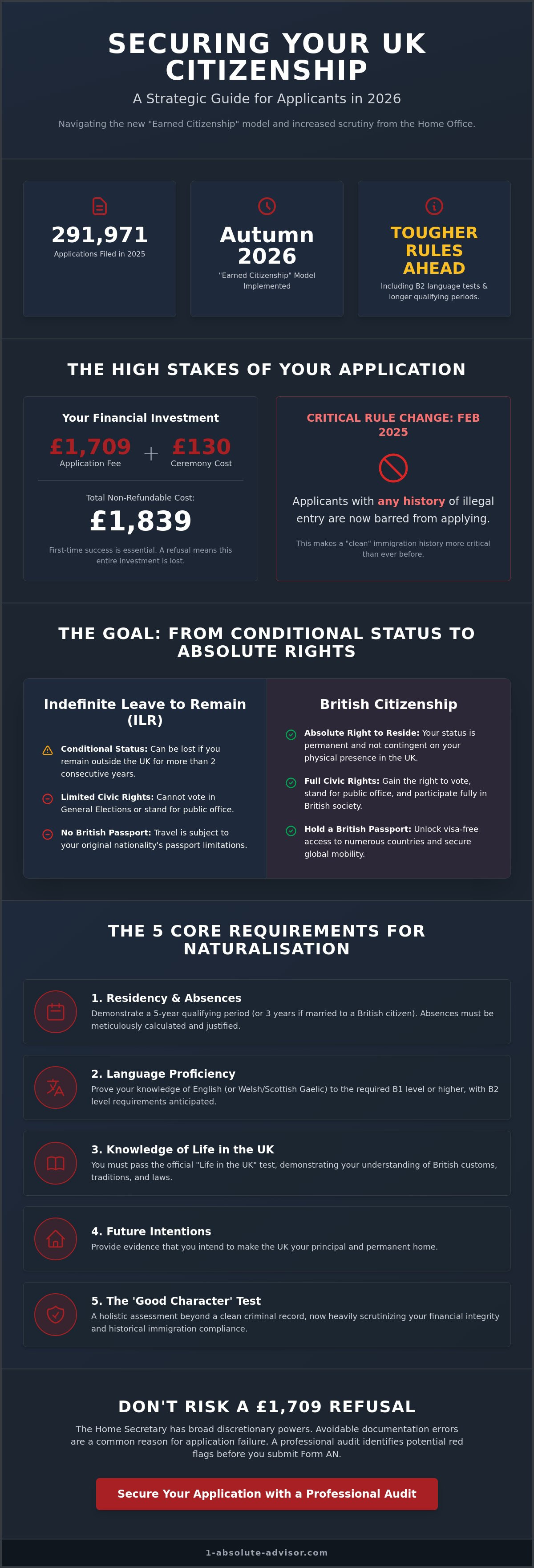
With 291,971 applications filed in 2025, the drive to secure a UK passport has reached an all-time high as the Home Office prepares to implement the “earned citizenship” model in Autumn 2026. When you decide to apply for british citizenship, you’re not just completing a form; you’re presenting a formal legal argument for your permanent place in British society. The financial commitment is significant, with the standard fee now at £1,709 plus a £130 ceremony cost, making a first-time success essential for your family’s stability.
We recognize that the shifting regulatory landscape, including the February 2025 ruling that bars those with any history of illegal entry, creates a sense of uncertainty. This guide provides a professional breakdown of the residency rules and evidence requirements you must navigate to ensure your application stands up to Home Office scrutiny. We’ll explore the updated good character test and the specific documentation needed to protect your investment. By following this strategic path, you’ll be prepared to secure your status before the government introduces tougher B2 language requirements and longer qualifying periods later this year.
Key Takeaways
- Differentiate between Indefinite Leave to Remain and naturalisation to understand the strategic benefits of full British status for your family’s future.
- Master the residency calculations and evidence requirements necessary to meet the qualifying periods without risking a high-cost refusal.
- Navigate the expanded “Good Character” assessment by addressing financial integrity and historical immigration compliance as part of your holistic application.
- Learn the precise steps to apply for british citizenship, including how to select appropriate referees and submit Form AN effectively before rules change.
- Identify how professional audits can mitigate the risk of losing the £1,709 application fee by identifying avoidable documentation errors early.
Understanding British Citizenship: The Final Step in Your UK Immigration Journey
Naturalisation represents the formal legal mechanism through which a non-British adult acquires the same status as those born in the United Kingdom. It’s the definitive conclusion of an immigration journey that often spans many years. While Indefinite Leave to Remain (ILR) grants you the right to live and work without time limits, it remains a conditional status. If you stay outside the UK for more than two consecutive years, you risk losing your ILR status entirely. In contrast, once you successfully apply for british citizenship, your right to reside here becomes absolute; it’s no longer contingent upon your physical presence or periodic Home Office reviews.
The legal framework governing these transitions is rooted in British nationality law, which establishes the criteria for integration and allegiance. Beyond the security of tenure, citizenship unlocks fundamental civic rights. You gain the ability to vote in General Elections, stand for public office, and hold a British passport. This document is one of the most powerful travel assets globally, facilitating visa-free access to numerous jurisdictions. However, we must emphasize that naturalisation is legally classified as a privilege, not an automatic right. The Home Secretary maintains broad discretionary powers to refuse any applicant who fails to meet the stringent statutory requirements, particularly those concerning the good character test.
Naturalisation vs. Registration: Which Route Applies to You?
It’s vital to distinguish between the two primary paths to citizenship. Naturalisation is the standard route for most adult migrants who have lived in the UK for the required qualifying period. It requires the submission of Form AN. Registration, conversely, is typically reserved for children under 18 or individuals who already hold a form of British nationality but aren’t yet citizens. Because the majority of our clients are established professionals and business leaders, this guide focuses exclusively on the naturalisation process for residents looking to apply for british citizenship.
The Strategic Importance of British Citizenship in 2026
In 2026, the decision to secure citizenship has moved from a lifestyle choice to a strategic necessity. With the government’s “earned citizenship” model scheduled for implementation in Autumn 2026, the window for applying under the current framework is narrowing. Securing your status now provides a buffer against future policy shifts that may include tougher B2 language requirements and revised residency tests. A “clean” immigration history, free from breaches or deception, serves as the essential foundation for this transition. By acting now, you ensure your family’s future remains insulated from the complexities of evolving border controls.
The 5 Core Requirements for a Successful Naturalisation Application
To successfully apply for british citizenship, you must satisfy five distinct statutory criteria. These aren’t flexible suggestions; they’re rigid benchmarks that require documented proof. The Home Office evaluates each submission against residency, language proficiency, knowledge of life in the UK, future intentions, and the good character test. Because the application fee stands at £1,709 as of April 8, 2026, understanding the nuances of these citizenship application requirements is vital to protecting your financial and legal interests.
Most applicants must demonstrate a five-year qualifying period of residency. If you’re married to or in a civil partnership with a British citizen, this period is reduced to three years. Beyond time served, you must prove your intention to make the UK your principal home. This means your life, family, and primary economic interests should be centered here. While the requirements appear straightforward, the Home Office maintains a high threshold for evidence. If your background includes complex financial structures or international business interests, a professional audit of your profile can identify potential red flags before you submit your Form AN.
Calculating Your Residency and Absences
The residency requirement is often where applicants stumble. For a five-year application, you cannot have spent more than 450 days outside the UK in total. Crucially, you must not have exceeded 90 days of absence in the final 12 months before applying. There’s also the “physical presence” rule. You must have been physically present in the UK exactly five years (or three years for spouses) before the date the Home Office receives your application. If you were on holiday or a business trip on that specific calendar day five years ago, your application will likely be refused. While the Home Office can exercise discretion for excess absences, this is typically reserved for exceptional circumstances like medical emergencies or unavoidable work postings.
Meeting the Language and Life in the UK Standards
You must prove your integration through two specific tests. First, you need an English language qualification at B1 CEFR level or higher, unless you’re from a majority English-speaking country or over age 65. Second, you must pass the Life in the UK test. This 45-minute exam covers British history, law, and customs. The pass certificate doesn’t expire, so many people complete this during their settlement phase. If you’re still working toward your permanent residency, our ILR UK: The Complete Guide provides the necessary roadmap for that prerequisite stage. Ensuring these certificates are valid and correctly linked to your UAN is a fundamental step in the process.
The ‘Good Character’ Requirement: Beyond Just a Clean Record
The good character requirement is the most qualitative and subjective element of the naturalisation process. Unlike residency days, which are mathematically verifiable, “character” involves a holistic assessment of your conduct, integrity, and compliance with UK society’s norms. When you apply for british citizenship, the Home Office doesn’t just look for the absence of a criminal record. They evaluate whether you’re a person of integrity who respects the laws and obligations of the United Kingdom. Because the application fee is £1,709 as of April 8, 2026, a refusal based on character is an expensive and professionally damaging setback.
Full disclosure is the absolute foundation of a successful submission. Many applicants mistakenly believe that “spent” convictions under the Rehabilitation of Offenders Act 1974 don’t need to be mentioned. This is a critical error. In nationality law, the concept of a spent conviction doesn’t apply in the same way it does for employment. You must disclose every caution, conviction, and civil penalty, regardless of how much time has passed. Dishonesty or “non-disclosure” is often viewed more severely than the original offence itself; the Home Office frequently refuses applications on the grounds of deception rather than the underlying incident.
Criminality and Minor Offences
The 2026 assessment framework places significant weight on even minor infractions. Fixed Penalty Notices (FPNs), such as speeding tickets or parking fines, won’t usually lead to a refusal if they’re disclosed and paid. However, a pattern of multiple FPNs can indicate a disregard for the law. Cautions and more serious convictions are subject to specific “rehabilitation periods” where an application will normally be refused if the conviction occurred within a certain timeframe. For any past mistake, we recommend a proactive strategy: include a detailed cover letter that acknowledges the incident, demonstrates remorse, and highlights your subsequent years of exemplary conduct.
Financial Integrity and Immigration Breaches
Financial soundness is a core pillar of the character test. The Home Office examines your history with HMRC, Council Tax, and even private debts. If you have active County Court Judgments (CCJs), are currently in an undischarged bankruptcy, or owe more than £500 to the NHS, your application faces a high risk of refusal. You must prove you’ve made arrangements to settle these debts. Furthermore, your immigration history is under intense scrutiny. Following the February 10, 2025 update, any history of illegal entry or significant periods of overstaying will normally result in a refusal. Integrity isn’t just about current compliance; it’s about your entire history since arriving in the UK. Ensuring your tax affairs are fully optimized and compliant is a prerequisite before you apply for british citizenship.
Step-by-Step: Navigating the Application Process and Timeline
The administrative journey toward naturalisation is a multi-stage process that requires meticulous attention to detail. Once you’ve confirmed you meet the statutory requirements, the first phase involves assembling your digital evidence portfolio. To apply for british citizenship, you must submit Form AN through the online portal and pay the mandatory fee of £1,709. This payment includes the cost of processing but excludes the £130 citizenship ceremony fee, which is typically settled at the point of approval. Precision during this stage is paramount; any discrepancy between your application and your supporting documents can trigger a request for further information, extending the timeline significantly.
After submission, you’ll book an appointment with UK Visas and Citizenship Application Services (UKVCAS). At this meeting, staff will capture your biometrics, including your fingerprints and a digital photograph. While your original documents are scanned and returned to you, the Home Office begins its internal review. The standard processing time is approximately six months. During this period, caseworkers may conduct enquiries with other government departments, such as HMRC or the Department for Work and Pensions, to verify your residency and financial integrity. If your case involves complex residency gaps, our expert consultants can conduct a pre-submission audit to ensure your timeline is beyond reproach.
Choosing Your Referees Correctly
Every application requires two referees who have known you personally for at least three years. The criteria are strict: one must be a person of any nationality who has a professional standing, such as an accountant, a teacher, or an OISC-registered advisor. The second referee must be a British citizen and either a professional person or over the age of 25. Neither can be related to you or to each other, and they cannot be your solicitor or an employee of the Home Office. Finding individuals who meet these specific parameters while also being willing to provide their passport details can be a logistical challenge for some, so identify these partners early in your preparation.
What to Expect at the Citizenship Ceremony
The final step in your journey is the citizenship ceremony. Once your application is approved, you’ll receive an invitation to book a ceremony with your local council. This must take place within 90 days of the approval date. During the event, you’ll take an oath or affirmation of allegiance to the Monarch and a pledge of loyalty to the United Kingdom. This is the precise legal moment you become a British citizen. You’ll receive your naturalisation certificate immediately after the pledge, which you’ll then use to apply for your first British passport. It’s a formal and celebratory conclusion to what is often a decade-long immigration path.
Ensuring Absolute Compliance: How Professional Advice Mitigates Risk
The decision to apply for british citizenship represents a significant financial and emotional investment. With the standard application fee set at £1,709 as of April 8, 2026, the cost of an administrative error is substantial. Most refusals aren’t the result of fundamental ineligibility but rather of avoidable evidentiary gaps or technical misunderstandings of the Home Office guidance. Professional oversight acts as a critical insurance policy, protecting your investment by ensuring every claim in your Form AN is supported by high-quality, verifiable documentation that meets the current 2026 standards.
OISC-registered consultants provide a level of scrutiny that goes beyond simple form-filling. We conduct a comprehensive audit of your residency history, cross-referencing travel records with HMRC data to ensure your 450-day absence limit is calculated with absolute accuracy. If your history includes complex elements, such as a period of self-employment with fluctuating tax records or a previous minor immigration breach, a professional cover letter becomes essential. This document allows us to present a legal argument for the Home Secretary to exercise discretion in your favor, effectively mitigating risks that might otherwise lead to a summary refusal based on the good character test.
The Value of a Professional Document Check
A professional document check is particularly valuable if you’ve lost previous passports or lack clear travel records from the start of your five-year qualifying period. We can help you reconstruct your residency narrative using secondary evidence like P60s, bank statements, or utility bills that meet the rigorous Home Office evidentiary standards. For a deeper analysis of the policy shifts driving these requirements and how they might affect your specific case, our British Citizenship: The Complete Guide to Naturalisation offers extensive insights into the current legal landscape.
Next Steps: From Citizenship to Your First British Passport
Once you receive your naturalisation certificate at the ceremony, your Biometric Residence Permit (BRP) becomes void. You must return it to the Home Office within five working days of the ceremony to remain compliant with immigration law. This certificate is the primary evidence you’ll need to obtain your first British passport, a process that typically takes an additional three to five weeks. Transitioning to citizenship is a complex, life-changing event that requires a proactive and precise approach. To ensure your application is handled with the professional integrity it deserves, book a consultation with 1 Absolute Advisor today and secure your family’s future in the United Kingdom.
Secure Your Permanent Status in the United Kingdom
The transition from permanent residency to full citizenship is the most significant legal milestone in your UK journey. By mastering residency calculations and ensuring total transparency within the good character assessment, you mitigate the risk of a high-cost refusal. As the Home Office prepares to implement more stringent “earned citizenship” criteria in Autumn 2026, the current window provides a strategic opportunity to solidify your family’s security and obtain your British passport.
Precision is not just a preference; it’s a requirement for success. Our OISC-Registered Immigration Consultants specialize in auditing residency histories and managing complex naturalisation cases to ensure every application is beyond reproach. We provide fixed-fee application management that transforms a daunting administrative burden into a structured, predictable process. When you’re ready to apply for british citizenship, don’t leave your family’s future to chance. Partner with a strategic mentor who understands the nuances of nationality law and the importance of absolute compliance.
Secure Your British Future with Expert Citizenship Advice
Frequently Asked Questions
How much does it cost to apply for British citizenship in 2026?
The total mandatory cost for most adults is £1,839. This figure consists of the £1,709 Home Office application fee, which was updated on April 8, 2026, and a £130 fee for the citizenship ceremony. Additional costs typically include £50 for the Life in the UK test and approximately £150 for an approved English language exam if you don’t already hold a qualifying degree.
Can I apply for British citizenship if I have a criminal record?
You can apply, but the Home Office will evaluate your record against the “Good Character” requirement. While minor infractions like a single speeding fine won’t usually result in a refusal, serious convictions or those falling within specific rehabilitation periods will. It’s vital to note that since the February 10, 2025 guidance update, any history of illegal entry into the UK will normally lead to a refusal regardless of how much time has passed.
What happens if my British citizenship application is refused?
If your application is refused, the Home Office will send a letter detailing the specific legal grounds for the decision. You won’t receive a refund of the £1,709 application fee. If you believe the caseworker made a factual or legal error, you can apply for a reconsideration using Form NR, which currently costs £450. Because of these high stakes, many individuals choose to have their evidence audited by a professional before they apply for british citizenship.
Do I need to live in the UK for 5 years before I can apply?
The standard residency requirement is five years, but this is reduced to three years if you’re married to or in a civil partnership with a British citizen. Standard applicants must also have held Indefinite Leave to Remain (ILR) for at least 12 months before submitting their application. Spouses of British citizens are exempt from this additional 12-month waiting period and can apply as soon as they receive their settlement status.
How many days can I be out of the UK before applying for citizenship?
For a standard five-year application, you must not have spent more than 450 days outside the UK in total. Additionally, you’re limited to 90 days of absence in the final 12 months before your application date. If you’re applying via the three-year route as a spouse, the total limit is 270 days. Exceeding these limits requires a detailed explanation in your cover letter to request Home Office discretion.
Can I travel while my British citizenship application is being processed?
You’re free to travel internationally while your application is pending because you retain your passport and Biometric Residence Permit (BRP) after your biometrics appointment. However, you must maintain your intention to make the UK your principal home. If you spend significant time abroad during the six-month processing window, the Home Office might question whether you meet the “future intentions” requirement of the naturalisation process.
Who can be a referee for my British citizenship application?
You must provide two referees who have known you for at least three years. The first must be a person of any nationality who has “professional standing,” such as an accountant, solicitor, or civil servant. The second must be a British citizen who is either a professional or over the age of 25. Referees cannot be related to you, related to each other, or be employees of the Home Office.
Is the Life in the UK test mandatory for everyone?
The Life in the UK test is a mandatory requirement for all applicants aged 18 to 64. You’re only exempt if you’re 65 or older or have a long-term physical or mental condition, supported by a specific medical waiver form from a doctor. When you apply for british citizenship, you must include the unique reference number from your pass certificate, which remains valid indefinitely once you’ve passed the exam.