

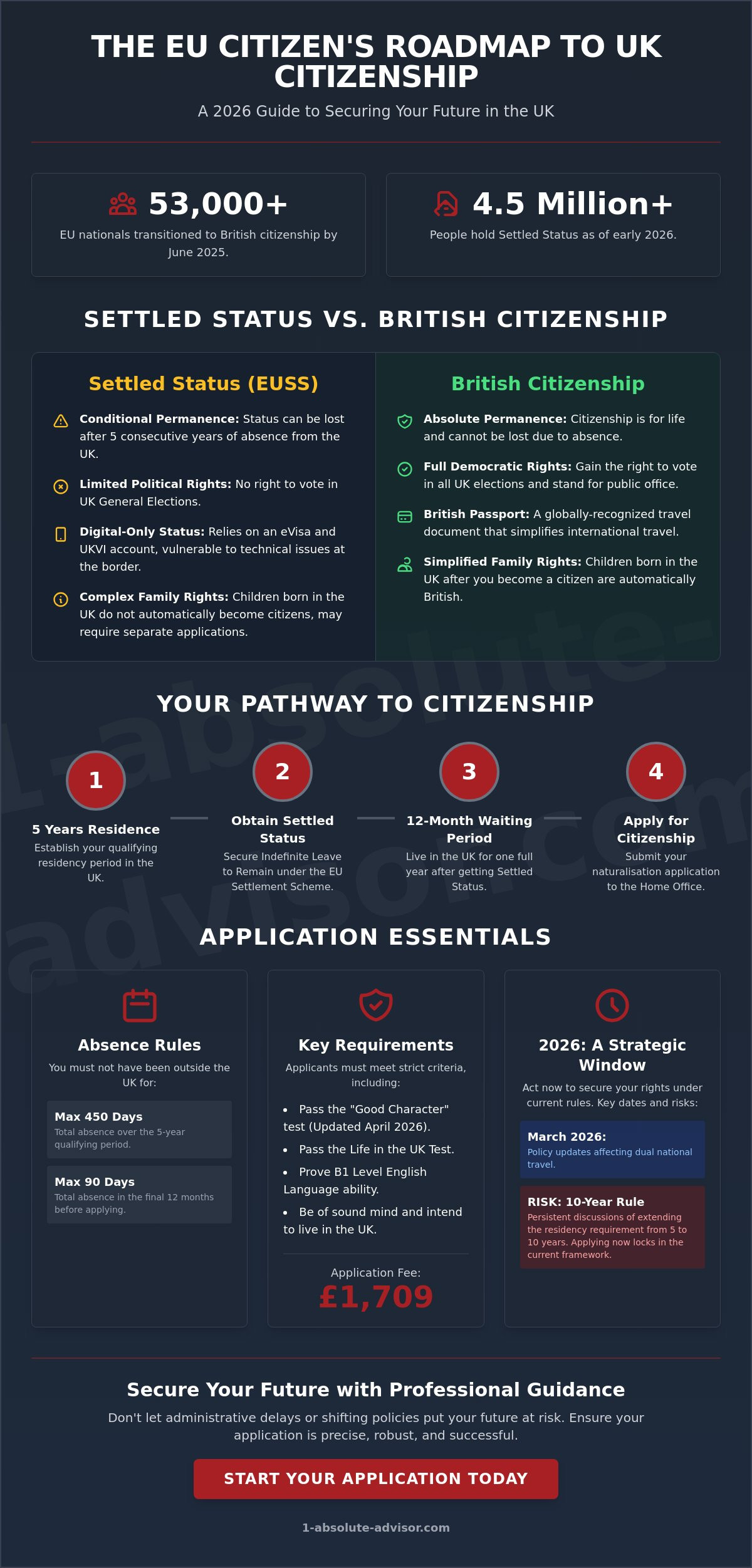
Did you know that by June 2025, over 53,000 EU nationals had already transitioned to British citizenship, seeking the permanent constitutional security that digital status alone cannot provide? As you consider the final step of your residency journey, understanding the nuances of british citizenship for eu citizens becomes essential for protecting your long-term interests. It’s natural to feel some unease regarding the mandatory 12-month waiting period after obtaining settled status or the Home Office’s increasingly rigorous “Good Character” assessments updated in April 2026. You’ve invested years into your life in the UK, and ensuring that this foundation remains unshakable is a matter of prudent strategic planning.
This definitive guide provides a clear roadmap for your naturalisation, offering the insight needed to avoid administrative delays or unexpected refusals. We’ll examine the latest March 2026 policy updates regarding travel rights for dual nationals and provide a detailed breakdown of the £1,709 application process. By understanding the interplay between your current EUSS status and the full rights of a British citizen, you can secure your family’s future with professional precision and total peace of mind.
Key Takeaways
- Gain clarity on the mandatory 12-month waiting period required after obtaining Settled Status before you can formally begin the naturalisation process.
- Navigate the updated April 2026 “Good Character” requirements to ensure your application remains resilient against Home Office scrutiny regarding your immigration history.
- Learn how the March 2026 policy shifts affect travel for dual nationals and how to manage your digital UKVI account effectively when using an EU passport.
- Identify the critical evidence needed to prove lawful residence during your qualifying period, going beyond the basic digital records of the EU Settlement Scheme.
- Explore how a strategic approach to british citizenship for eu citizens ensures a seamless transition to full UK rights while safely maintaining your original nationality.
Navigating British Citizenship as an EU Citizen in 2026
The transition from freedom of movement to the EU Settlement Scheme (EUSS) marked a fundamental change in how Europeans reside in the UK. While digital status provided a bridge, it doesn’t offer the same constitutional weight as full citizenship. As of early 2026, over 4.5 million people hold settled status, yet this remains a revocable form of immigration permission. For those who’ve established deep roots, securing british citizenship for eu citizens is the final step toward absolute legal certainty.
2026 represents a strategic window for applicants. Policy discussions are increasingly focused on residency requirements, with persistent rumors of a move toward a 10-year residency rule for naturalisation. By applying under current British nationality law, you insulate yourself from potential legislative shifts. It’s a proactive measure to protect your future from the shifting tides of UK-EU diplomacy. Acting now locks in your eligibility based on the current five-year residency framework.
The Benefits of Naturalisation for EU Nationals
Naturalisation grants rights that settled status cannot provide. You’ll gain full participation in the democratic process through voting in general elections. Holding a British passport also streamlines international travel. Digital eVisas are convenient, but a physical passport removes the risk of technical errors at the border. This ensures your mobility is never dependent on a database or a digital record that could be subject to outages.
Citizenship vs. Settled Status: Understanding the Difference
The most critical distinction lies in permanence. Settled status expires if you’re absent from the UK for five consecutive years. British citizenship is yours for life, regardless of where you choose to live or how long you stay abroad. There are also significant advantages for family planning. Children born in the UK to a British parent often acquire citizenship automatically. This avoids the complexities and application processes that children of settled residents might face later in life.
Key Eligibility Pathways: EUSS Settled Status and Naturalisation
Achieving british citizenship for eu citizens requires more than just holding a digital status; it demands a meticulous audit of your residency history. The standard route for those who’ve secured Settled Status under the EU Settlement Scheme involves a specific 12-month waiting period. This means even after you’ve lived here for five years and obtained permanent residency, the Home Office typically requires one additional year of ‘settled’ living before you can submit your naturalisation application. This rule ensures that your commitment to the UK is established beyond the initial grant of indefinite leave.
Precision in calculating your absences is vital for a successful outcome. For the standard five-year route, you shouldn’t have been outside the UK for more than 450 days in total. More critically, your absences in the final 12 months before applying must not exceed 90 days. If you’re approaching these limits, the timing of your submission becomes a tactical decision. Given the 2026 landscape and discussions regarding stricter residency rules, securing your status the moment you become eligible is a sound way to protect your future. Professional oversight via a British Citizenship Application Service can help identify any discrepancies in your travel logs before they trigger a refusal.
Applying with Settled Status
The one-year gap between receiving Settled Status and applying for citizenship is a mandatory period for most. During this time, you must continue to meet the “Good Character” requirements and maintain your residence. When you apply, you’ll need to provide robust evidence of your presence. While the Home Office uses automated tax and benefit checks, these aren’t always exhaustive. It’s best practice to prepare P60s, employer letters, or university transcripts to cover your entire qualifying period. You must also be at least 18 years old, of sound mind, and meet the B1 English language standard unless you’re exempt.
Applying as a Spouse of a British Citizen
If you’re married to or in a civil partnership with a British citizen, the path is significantly shorter. The 12-month waiting period after receiving Settled Status is waived, allowing for immediate application. Your qualifying residency period is reduced to three years instead of five. However, the absence limits are stricter: you must not have spent more than 270 days outside the UK during those three years, with the same 90-day limit in the final year. This pathway directly links your security to your partner’s status, making it the most efficient route for eligible families.
Post-Brexit Transitions: Managing Dual Nationality and eVisa Updates
The process of obtaining british citizenship for eu citizens involves more than just a ceremony; it requires a strategic understanding of how your new status interacts with your existing digital identity. Once you naturalise, the Home Office effectively views your British status as superseding your EUSS permission. However, the underlying digital infrastructure remains a vital component of your travel profile. Managing this transition correctly ensures that your mobility remains uninterrupted while you await the issuance of your first British passport.
The March 2026 Travel Policy Change
A significant shift in border protocol occurred in early 2026. Initially, a policy introduced on 25 February 2026 required all British dual nationals to present either a valid British passport or a Certificate of Entitlement to board transport to the UK. This caused considerable anxiety for new citizens. Fortunately, a policy update in March 2026 provided a pragmatic resolution for those who transitioned via the EU Settlement Scheme. You can now travel to the UK using your valid EU passport or national identity card, provided it remains linked to your UKVI account. This digital link confirms your right to enter, acting as a bridge until you obtain physical British travel documents.
Maintaining your UKVI account isn’t optional during this period. You must ensure that your contact details and passport information are current. Any discrepancy between your travel document and the digital record held by the Home Office could lead to delays at carrier check-ins. While the March update offers flexibility, a British passport remains the most robust protection against future policy fluctuations or technical failures within the eVisa system.
Dual Nationality: Strategic Considerations
The UK’s permissive stance on dual nationality is a cornerstone of the naturalisation process. You aren’t required to renounce your original citizenship under UK law. However, the legal framework of your home country may not be as accommodating. Nations such as France, Italy, and Poland fully support dual nationality, allowing for a seamless integration of identities. In contrast, countries like Austria or Lithuania maintain much stricter regulations. In these jurisdictions, acquiring another nationality can result in the automatic loss of your original citizenship unless a specific exemption is granted.
Before proceeding with your application, it’s essential to conduct a holistic review of your home country’s current nationality laws. Losing an EU passport could impact your future rights to live or work within the European Union. If you have concerns about how british citizenship for eu citizens might affect your original status, seeking professional advice is a necessary step to safeguard your global mobility and family heritage.
The Good Character Requirement and Application Logistics
Securing british citizenship for eu citizens involves passing the Home Office’s “Good Character” test, a requirement that has seen increased scrutiny following updated guidance published on April 30, 2026. This assessment isn’t a simple check for a clean criminal record. It’s a holistic review of your financial integrity, immigration history, and general conduct. The Home Office now takes a firmer stance on certain issues; for instance, anyone who entered the UK illegally will normally be refused citizenship, regardless of how much time has elapsed since their entry. It’s vital to be transparent, as non-disclosure of even minor civil penalties can lead to a refusal based on deception.
The application logistics follow a structured three-step process. First, you must complete the mandatory tests and gather your evidence. Next, you’ll submit the online AN form and pay the £1,709 application fee. Once submitted, you’ll attend a biometric appointment to provide your fingerprints and photograph. If your application is successful, you’ll receive an invitation to a citizenship ceremony, which costs an additional £130. This ceremony is the final legal hurdle where you’ll take an oath or affirmation and receive your certificate of naturalisation. To ensure your documentation meets the rigorous standards required, consider using a professional British Citizenship Application Service to audit your history before submission.
Proving Good Character as an EU National
By 2026, the treatment of historic “Comprehensive Sickness Insurance” (CSI) issues has become more predictable. While the Home Office generally disregards lack of CSI for those who’ve already secured Settled Status, any historic “disregard” for immigration rules can still be factored into your character profile. Late applications to the EU Settlement Scheme are also closely examined. If you were granted status after a late submission, you must ensure the reasons for that delay don’t suggest a broader pattern of non-compliance. Additionally, ensure your HMRC records are flawless, as tax discrepancies or unpaid national insurance contributions are frequent red flags for caseworkers.
The Life in the UK Test and Language Proficiency
Passing the Life in the UK Test is a prerequisite for most applicants. The test costs £50 and covers British customs, history, and law. It’s best to study the official handbook thoroughly; many applicants fail by relying on unofficial practice apps. You must also prove your English language proficiency at a B1 level or higher. You can do this through a Secure English Language Test (SELT) from an approved provider or by providing a degree certificate taught in English. Exemptions apply if you’re over 65 or have a long-term physical or mental condition that makes passing the test impossible, though these require specific medical evidence from a qualified professional.
Strategic Legal Support for Your UK Citizenship Journey
The decision to seek professional representation for british citizenship for eu citizens is a strategic investment in your long-term security. With the standard naturalisation fee at £1,709, the financial stakes are high, and a single administrative oversight can lead to a costly refusal. OISC-registered advisors provide a necessary layer of scrutiny, auditing your residency history with a level of detail that standard automated checks often miss. This professional oversight identifies potential discrepancies in travel logs or residency evidence before they reach a Home Office caseworker. Our Document Checking Service ensures that your submission aligns perfectly with the rigorous evidentiary standards established for 2026.
Transparency in legal costs is a cornerstone of our partnership with clients. We operate a fixed-fee management system that provides total predictability from your initial assessment through to the citizenship ceremony. This eliminates the anxiety of hidden charges or escalating costs during what can be a lengthy process. By acting as your strategic partner, we transform a complex legal requirement into a structured journey. Our focus remains on professional integrity and the delivery of a service that prioritizes your future stability in the UK.
How 1 Absolute Advisor Facilitates Your Application
Every application for british citizenship for eu citizens is unique, requiring a personalised assessment of your specific EUSS history. We don’t rely on generic templates; instead, we draft detailed legal cover letters to address potential residency gaps or “Good Character” nuances. These documents provide caseworkers with a clear, authoritative narrative of your time in the UK. We also take on the responsibility of liaising with the Home Office, managing all correspondence and responding to requests for further information to prevent unnecessary delays.
Securing Your Future in the UK
The 2026 immigration landscape is complex and demands uncompromising quality in legal preparation. Relying on professional expertise ensures that your transition from settled status to citizenship is handled with the precision it deserves. If you’re ready to move forward, explore our British Citizenship Application Service for expert assistance. If you haven’t yet secured permanent residency, read our ILR UK Guide 2026 to understand the requirements for the next stage of your integration.
Securing Your Permanent Future in the United Kingdom
The journey toward british citizenship for eu citizens is a transition from temporary digital permission to irrevocable constitutional security. We’ve explored the importance of the 12-month waiting period after obtaining settled status and the heightened scrutiny of the April 2026 “Good Character” guidance. Understanding the March 2026 travel policy updates ensures your global mobility remains intact while you navigate this final integration step. These technical requirements demand a strategic approach to avoid costly delays or refusals.
Our OISC Registered Immigration Consultants specialise in managing complex EU Settlement Scheme transitions with absolute precision. We provide fixed-fee legal services with no hidden costs, giving you the predictability and peace of mind necessary for such a significant life decision. By auditing your residency history and addressing potential gaps proactively, we act as your strategic partner in this process. Book a Professional Citizenship Consultation with 1 Absolute Advisor today to ensure your application meets the highest professional standards. Your future in the UK is a foundation worth protecting with expert care.
Frequently Asked Questions
Can I apply for British citizenship if I only have pre-settled status?
No, you cannot apply for naturalisation while holding pre-settled status. You must first transition to settled status after completing five years of continuous residence in the UK. Once you’ve been granted settled status, you’re typically required to wait an additional 12 months before submitting an application for british citizenship for eu citizens, unless you’re married to a British national.
Do I need to give up my EU passport to become a British citizen?
The United Kingdom permits dual nationality, meaning you aren’t required by UK law to renounce your original citizenship. You can hold both a British and an EU passport simultaneously. It’s essential to verify the specific nationality laws of your home country, as some EU member states have restrictive rules that could lead to the automatic loss of your original nationality upon naturalising elsewhere.
How much does it cost to apply for British citizenship in 2026?
The standard Home Office fee for an adult naturalisation application is £1,709 as of May 2026. Successful applicants must also pay a £130 fee for the mandatory citizenship ceremony. Other associated costs include £50 for the Life in the UK Test and approximately £150 to £250 for an English language qualification if you aren’t exempt from the requirement.
What happens if my British citizenship application is refused?
If your application is refused, the Home Office will issue a letter detailing the specific grounds for the decision. While there is no formal right of appeal for naturalisation, you may be able to request a reconsideration via an Administrative Review if you believe a clerical or legal error was made. Identifying the underlying cause of refusal is vital before attempting a fresh submission to avoid further financial loss.
How long does the British citizenship application process take for EU citizens?
The standard processing time for a naturalisation application is currently within six months. There’s no priority or fast-track service available for british citizenship for eu citizens. You’ll receive a decision via email or post, after which you’ll have three months to attend your citizenship ceremony and complete the legal transition.
Can I travel outside the UK while my citizenship application is being processed?
Yes, you can travel abroad while your application is pending. Your current EUSS settled status remains valid throughout the processing period. It’s critical that you’re physically present in the UK on the day the Home Office receives your application. You must also ensure your UKVI account is updated with your current passport details to avoid issues at the border under the March 2026 travel protocols.
Is the Life in the UK test mandatory for all EU applicants?
The Life in the UK Test is a mandatory requirement for most applicants aged between 18 and 64. The test assesses your knowledge of British history, law, and customs. Exemptions are only granted to those aged 65 or over, or individuals with a long-term physical or mental condition that prevents them from taking the test, supported by specific medical evidence.
What is the “Good Character” requirement for EU citizens?
The “Good Character” requirement is a holistic assessment of your conduct, including your criminal record, financial integrity, and immigration history. Following the April 30, 2026 update, the Home Office has intensified its scrutiny of historic immigration breaches and methods of entry. Caseworkers will review your HMRC records and any civil penalties to ensure you meet the high standards of integrity expected of a prospective citizen.