

Could a minor administrative oversight be the only thing standing between your family and a life together in the UK? It’s completely natural to feel overwhelmed by the Home Office’s rigorous standards, particularly since the minimum income threshold rose to £29,000 in April 2024. The process of sponsoring a spouse to the uk is no longer just about personal commitment; it’s a complex financial and legal audit where the margin for error is effectively zero.
Key Takeaways
- Understand the specific legal obligations of a sponsor and how to meet the 2026 financial threshold of £29,000 through various verified income sources.
- Master the evidentiary requirements for sponsoring a spouse to the uk, ensuring your documentation proves the relationship is genuine and subsisting beyond a marriage certificate.
- Navigate the procedural nuances between Entry Clearance and Leave to Remain to select the application route that aligns with your current residency status.
- Learn how to mitigate the risk of costly visa refusals by identifying common technical errors and the critical value of OISC-regulated professional oversight.
- Discover a strategic approach to the application process that ensures absolute compliance with 2026 regulations and protects your family’s long-term stability.
Understanding the Legal Role of a UK Spouse Visa Sponsor
Sponsoring a spouse to the uk is a significant legal commitment that extends far beyond the initial application process. As a sponsor, you’re entering into a formal agreement with the Home Office to ensure your partner’s welfare without relying on the state. This role requires a deep understanding of the financial and social obligations involved in the UK immigration system, which is designed to protect public funds while allowing families to reunite.
The core of this responsibility lies in the maintenance and accommodation undertaking. You must demonstrate that you have the financial capacity to support your spouse and provide a home that meets UK housing standards. This commitment remains in place even if the relationship faces challenges. Crucially, both the sponsor and the applicant must be at least 18 years old on the date of application. The Home Office also applies the “Intention to Live Together” clause with high scrutiny. They require evidence that you plan to reside permanently as a couple in the UK, rather than using the visa as a temporary entry mechanism.
Who Can Legally Act as a Sponsor?
To qualify as a sponsor, you must hold a specific legal status in the UK. This includes British or Irish citizens, individuals with Indefinite Leave to Remain (ILR), or those with settled status under the EU Settlement Scheme. If you hold pre-settled status, you may also sponsor a partner if you’ve resided in the UK for the required period. Evidence is mandatory; the Home Office accepts valid passports, Biometric Residence Permits (BRPs), or digital status codes for verification. Special provisions also exist for those with refugee status, humanitarian protection, or a Turkish Businessperson visa, though these routes often involve additional layers of complexity.
The Duration of Sponsorship Commitment
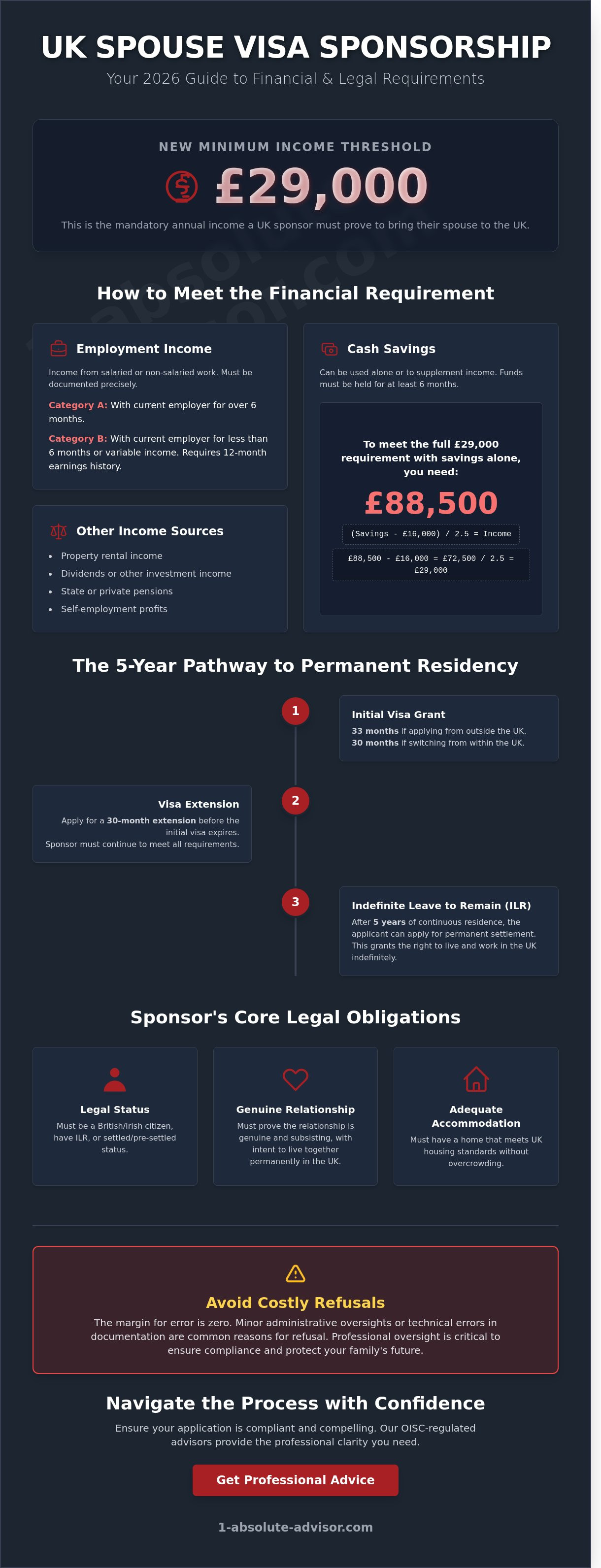
Sponsorship isn’t a one-time event but a multi-year journey. The initial visa is typically granted for 33 months if applied for from outside the UK, or 30 months if switching from within the country. After this period, you’ll need to apply for a 30-month extension. This cumulative five-year period is the standard pathway toward ILR UK, where the applicant gains permanent residency. If the relationship breaks down before this milestone, the sponsor has a legal duty to inform the Home Office. In such cases, the spouse’s leave to remain may be curtailed, as the sponsorship agreement that underpinned the visa is no longer valid.
Meeting the Financial Requirement: Navigating the £29,000 Threshold
A marriage certificate is a legal document, but for the Home Office, it’s merely the starting point of your application. When sponsoring a spouse to the uk, the burden of proof lies entirely with the applicant to demonstrate that the union isn’t just legally valid, but “genuine and subsisting.” This means you must prove you intend to live together permanently and that your bond is active at the time of the decision. Caseworkers are trained to scrutinize applications for “marriages of convenience,” which are unions entered into solely to circumvent immigration control. High-risk indicators that often trigger closer inspection include a lack of a shared language, significant age gaps, or a very short duration between the first meeting and the wedding ceremony.
For unmarried partners, the landscape changed significantly in early 2024. While the traditional two-year cohabitation requirement remains the gold standard, the Home Office now allows for more flexibility. If you can prove a relationship “akin to marriage” but were unable to live together due to work, study, or cultural reasons, you may still qualify. This shift recognizes modern relationship dynamics but requires even more meticulous documentation to avoid a refusal.
The Evidence Hierarchy: What Carries the Most Weight?
The Home Office prioritizes objective, third-party documentation over personal testimonials. Primary evidence consists of joint financial responsibilities and shared residency. This includes joint bank statements showing active household spending, tenancy agreements naming both partners, or utility bills for gas and electricity addressed to both. If you don’t have these, you’ll need a robust collection of secondary evidence. WhatsApp logs, email chains, and photographs spanning the duration of the relationship help build a chronological timeline. While “Letters of Support” from family and friends provide a narrative layer, they’re considered corroborative and cannot replace formal financial or residential proof.
Navigating Periods of Separation
Every piece of evidence should serve a purpose. Don’t overwhelm the caseworker with thousands of photos; instead, select 10 to 15 that show the progression of your relationship over several years, including meetings with each other’s families. This strategic approach demonstrates the stability and professional preparation the Home Office expects from successful applicants.
The Step-by-Step Sponsorship Application Process in 2026
Successfully sponsoring a spouse to the uk requires navigating a rigid administrative framework where the margin for error is non-existent. The first strategic decision involves identifying the correct application route. Entry Clearance is mandatory for spouses applying from outside the UK. Conversely, Leave to Remain applies to those already in the country on a qualifying visa, such as a Skilled Worker or Student visa. It’s vital to remember that switching from a Visitor visa to a Spouse visa while inside the UK is generally prohibited under current immigration rules.
The digital application form serves as the foundation of the case. Precision during data entry is critical because the Home Office frequently cross-references answers with HMRC and Border Force records. Any discrepancy in travel history or previous visa refusals can trigger a refusal under “suitability” grounds. These allegations of “dishonesty” or “material non-disclosure” carry a potential 10-year ban on future applications. Applicants from over 100 specific countries, including India, Pakistan, and Nigeria, must also provide a valid Tuberculosis (TB) certificate from a Home Office-approved clinic. Once the online fee is paid, the applicant must attend a biometric appointment at a Visa Application Centre (VAC) to provide fingerprints and a digital photograph.
Document Preparation and Digital Uploads
Processing Times and Fast-Track Options
Decision timelines depend on the service level selected at the time of application. Standard processing for sponsoring a spouse to the uk from overseas currently averages 24 weeks, while applications made within the UK typically take 8 weeks. If you require a faster result, the Home Office offers two expedited tiers:
- Priority Service: For an additional £500, applicants usually receive a decision within 30 working days.
- Super Priority Service: Available mainly for internal applications, this costs £1,000 and provides a decision by the end of the next working day.
Maximising Success: The Value of Absolute Legal Advice
Sponsoring a spouse to the uk involves navigating a landscape where the Home Office rejected approximately 15% of family visa applications in recent years. Minor technicalities, such as failing to provide bank statements in the exact format required by Appendix FM-SE, lead to costly refusals. These aren’t just administrative delays; they represent significant emotional and financial burdens. A single mistake can mean losing the application fee, which currently stands at £1,846 for applications made outside the UK, plus the Immigration Health Surcharge.
- Previous visa refusals or adverse immigration histories.
- Income sources that are complex, such as self-employment or director dividends.
- Weak evidence of a “genuine and subsisting” relationship.
- Dependents from previous relationships.
We provide absolute transparency through our fixed-fee service. You’ll understand the total legal cost from the outset, which eliminates the uncertainty of billable hours and allows you to budget effectively for your family’s relocation. Our role is to provide the stability and professional integrity required to secure a positive outcome.
Strategic Application Management
Our team identifies potential hurdles before the Home Office caseworker even opens your file. We don’t just collect documents; we curate a bespoke evidence bundle tailored to the nuances of your specific relationship. We draft persuasive legal representations that cite relevant case law and internal Home Office guidance. This proactive approach transforms a standard application into a comprehensive legal argument for your right to live together in the UK.
Beyond the Visa: A Long-Term Partnership
The initial visa is only the first milestone in a multi-year journey. We help you maintain compliance with UK regulations to ensure a smooth transition to the 2.5-year extension and, eventually, British Citizenship. Rules regarding financial thresholds and residency requirements can change, as seen with the significant threshold increases in April 2024. Contact 1 Absolute Advisor today for a comprehensive eligibility assessment to secure your family’s future with confidence.
Navigating Your Path to UK Residency in 2026
Success in sponsoring a spouse to the uk hinges on a meticulous approach to documentation; meeting the £29,000 financial threshold is only the first hurdle. You’ve seen how the 2026 application process demands absolute precision, particularly when evidencing that your relationship is genuine and subsisting under rigorous Home Office scrutiny. Attempting to navigate these complex legal requirements without professional oversight often leads to avoidable errors that jeopardize your family’s long-term stability.
Our OISC-registered advisors serve as your strategic partners, specializing in complex family migration cases where detail is paramount. We operate with complete fixed-fee transparency, ensuring your financial planning remains predictable and secure. By integrating deep technical expertise with a proactive service model, we handle the administrative burden so you can focus on your future together.
Secure your family’s future with our expert Spouse Visa Application Service
Frequently Asked Questions
Can I sponsor my spouse if I am currently unemployed?
You can sponsor your spouse while unemployed if you meet the financial requirement through alternative means like significant cash savings or pension income. For applications in 2024 and 2025, you generally need £88,500 in savings held for at least six months if you don’t have employment income. Other eligible sources include rental income from property or specific insurance payments that meet the Home Office criteria.
How much are the Home Office fees for a spouse visa in 2026?
The Home Office hasn’t officially published the fee schedule for 2026 yet, but costs historically increase by 5% to 10% annually. As of late 2024, the application fee for those applying from outside the UK is £1,846. You must also factor in the Immigration Health Surcharge, which currently stands at £1,035 per year for adults, totaling £3,105 for a standard 33-month visa.
Does my partner need to pass an English language test to be sponsored?
Your partner must pass an approved English language test at level A1 or higher to meet the requirements for sponsoring a spouse to the uk. This test must be taken through a Secure English Language Test (SELT) provider certified by the Home Office. Applicants are exempt if they’re from a majority English-speaking country or hold a degree taught in English that is verified by Ecctis.
What happens if our spouse visa application is refused?
You’ll receive a decision letter outlining the specific reasons for refusal and whether you have a right to appeal. If you’re applying from outside the UK, you typically have 28 days to lodge an appeal with the First-tier Tribunal. Many couples choose to submit a new application instead, as this allows them to correct documentary errors or provide updated financial evidence more quickly than the appeal process.
Can I use my partner’s overseas income to meet the financial requirement?
You cannot use your partner’s income from overseas employment to meet the minimum income threshold for an initial entry clearance application. Only the UK sponsor’s income or the couple’s combined cash savings are valid for this specific requirement. If your partner is already in the UK on a valid work visa, their current UK salary can then be combined with yours to meet the necessary total.
How long does the UK spouse visa last before I need to extend it?
An initial spouse visa granted from outside the UK is valid for 33 months, while one granted from within the UK lasts for 30 months. You’ll need to apply for an extension, known as Further Leave to Remain, before your current permit expires. After completing a total of 60 months on this visa route, your partner may become eligible to apply for Indefinite Leave to Remain in the UK.
Do we need to be married to apply for a spouse visa?
You don’t need to be legally married if you’ve lived together in a relationship akin to marriage for at least two years. This is known as the unmarried partner route and requires extensive evidence of cohabitation. You must provide documents like joint tenancy agreements, utility bills, or bank statements that cover the full 24-month period to prove the relationship is subsisting and genuine.
What is the “Adequate Accommodation” requirement for sponsorship?
The adequate accommodation rule requires you to prove your home has enough space to house the applicant without becoming legally overcrowded. This is a mandatory part of sponsoring a spouse to the uk under the Housing Act 1985 standards. You’ll typically need to provide a property inspection report or a formal letter from your landlord or mortgage provider confirming that the property meets these specific living standards.