

By April 2026, the Home Office anticipates processing over 200,000 work-related applications, yet a single clerical error in the salary threshold calculation remains the leading cause of avoidable delays. You likely understand that the skilled worker visa application process is a high-stakes journey where the rules feel like they’re shifting beneath your feet. It’s natural to feel concerned about the 2026 salary updates and the strict documentation standards required by the UK Visas and Immigration (UKVI). We believe that professional clarity is the best antidote to this uncertainty, especially when your career and relocation plans are on the line.
This guide provides an absolute roadmap to help you master every stage of the journey. You’ll gain the strategic insight needed to transition from your initial Certificate of Sponsorship (CoS) to receiving your Biometric Residence Permit (BRP) with total confidence. We’ve structured this guide to eliminate guesswork, covering the chronological steps and clarifying the latest financial requirements. We’ll provide a definitive checklist for your document submission to ensure your relocation to the United Kingdom is seamless, predictable, and successful.
Key Takeaways
- Navigate the five core phases of the UK immigration journey with a structured approach that ensures every milestone from sponsorship to decision is met with professional precision.
- Adopt a rigorous documentation strategy to satisfy the Home Office’s “Golden Rule,” ensuring your evidence is formatted correctly to avoid immediate disqualification.
- Gain strategic insights into the skilled worker visa application process, including how to manage the GOV.UK portal and fee structures with absolute accuracy.
- Streamline your post-submission requirements by identifying whether you qualify for the smartphone ID check app or require a physical appointment at a UKVCAS or VFS Global centre.
- Mitigate risk by analysing the most common reasons for refusal, from salary threshold errors to the critical importance of full disclosure regarding personal and travel history.
Navigating the 2026 Skilled Worker Visa Application Process
The Skilled Worker visa serves as the foundational pathway for international professionals seeking long-term employment within the UK. Understanding the skilled worker visa application process is vital for both employers and candidates, as the Home Office maintains rigorous standards for compliance. This route reflects a significant shift in the history of UK work permits, moving away from the old Tier 2 system toward a more data-driven, points-based framework that prioritizes specific economic needs.
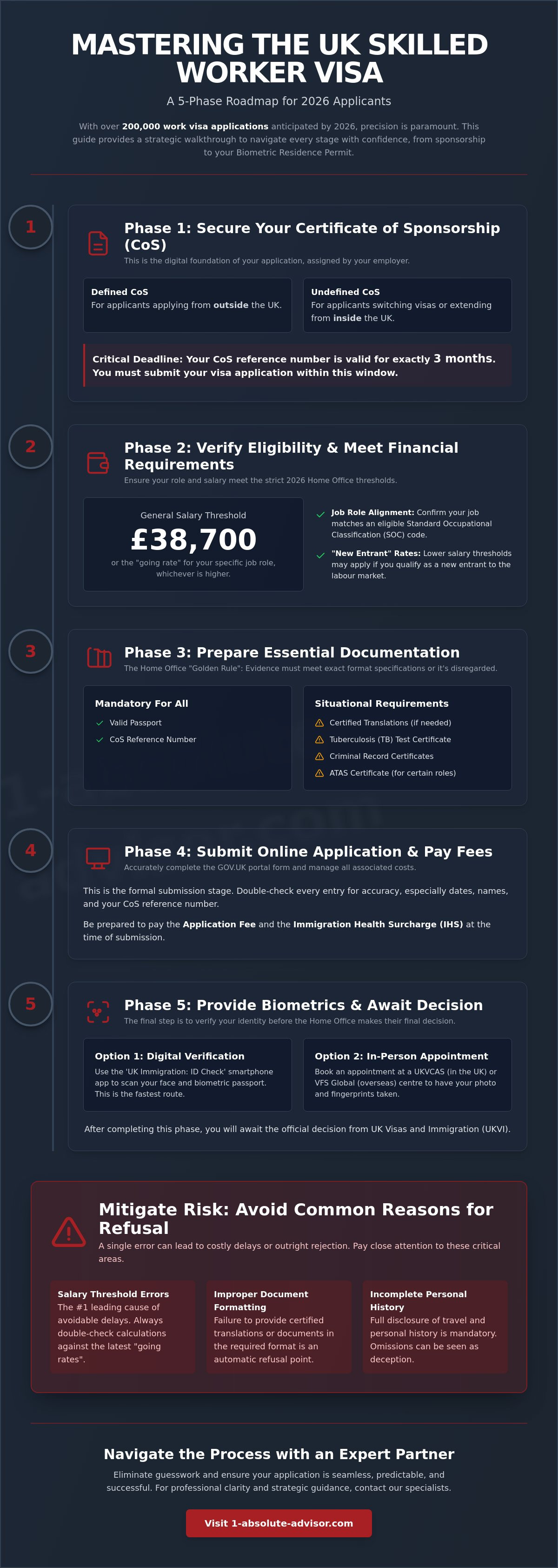
Successful applicants must navigate five distinct phases: securing sponsorship, gathering documentary evidence, completing the online submission, attending biometrics appointments, and awaiting the final decision. It’s a common misconception that the journey starts with the online form. In reality, the process begins three to six months earlier. This lead time allows for the alignment of job roles with the 2026 Standard Occupational Classification (SOC) codes and ensures salary offers meet the updated thresholds. Without this proactive approach, administrative errors often lead to avoidable delays or rejections.
Phase 1: Securing Your Certificate of Sponsorship (CoS)
The Certificate of Sponsorship isn’t a physical document but a digital record assigned through the Sponsor Management System (SMS). Your employer takes the lead here, but your role in verifying the data is critical. There’s a major distinction between a Defined CoS, required for those applying from outside the UK, and an Undefined CoS, used for those switching visas or extending their stay within the country. Once the sponsor assigns the CoS, you have exactly three months to use the reference number in your application. If this window closes, the certificate expires, and the sponsor must start the assignment process again, which can disrupt your planned start date.
Confirming Your Eligibility and Salary Requirements
Before moving to the online submission, you must verify that your role qualifies under the latest Home Office occupation lists. The 2026 regulations require most applicants to meet a general salary threshold of £38,700, though specific roles or “new entrants” may qualify for lower rates. You’ll need to compare your proposed salary against the “going rate” for your specific SOC code to ensure you earn enough points for the visa. For a comprehensive breakdown of these financial requirements, consult our Skilled Worker Visa UK 2026 guide. Ensuring your base pay and hourly rates align with these standards is the most effective way to mitigate the risk of a technical rejection during the skilled worker visa application process.
Essential Documentation: Meeting Home Office Evidential Standards
The Home Office operates with a rigid adherence to technical specifications. In the UK immigration system, a document that doesn’t meet the exact prescribed format is treated as if it doesn’t exist. This binary approach means that even a highly qualified candidate can face a refusal due to a missing date or an uncertified translation. When you begin the skilled worker visa application process, your primary objective is to eliminate any ambiguity in your evidence.
Your documentation strategy should be divided into mandatory and situational categories. Every applicant must provide a valid passport and a Certificate of Sponsorship (CoS) reference number provided by their employer. If your documents are in any language other than English or Welsh, you must provide a certified translation. This translation must include the translator’s credentials, the date, and a confirmation that it’s an accurate reflection of the original text.
Specific roles or backgrounds trigger additional requirements. Applicants from 101 listed countries must provide a clear tuberculosis (TB) test result from a Home Office-approved clinic. If you’re working in sensitive research areas, you’ll likely need an Academic Technology Approval Scheme (ATAS) certificate. Furthermore, those entering “regulated” professions, such as healthcare or social work, must provide criminal record certificates from every country they’ve lived in for 12 months or more over the last 10 years.
Proving Your Knowledge of English
Demonstrating linguistic competence is a non-negotiable pillar of the application. For 2026, the standard remains at Level B1 on the Common European Framework of Reference for Languages (CEFR) scale. Most applicants meet this by passing a Secure English Language Test (SELT) from an approved provider like IELTS SELT Consortium, Pearson, or LanguageCert.
You’re exempt from testing if you’re a national of a majority English-speaking country or if you hold a degree taught in English. However, if your degree was obtained outside the UK, you must obtain a verification statement from Ecctis to confirm its equivalence to a UK degree. Using an expired test result or a provider not currently on the Home Office approved list will result in an immediate rejection. You should verify the most recent list of exempt countries in the official Skilled Worker visa guidance to ensure your credentials qualify.
Financial Requirements and Maintenance
The Home Office must be satisfied that you can support yourself without relying on public funds. You’re required to show at least £1,270 in personal savings. This capital must have been held in your bank account for a minimum of 28 consecutive days. The 28-day period must end within 31 days of your application submission date.
Many applicants bypass this requirement through sponsor certification. If your employer is a “Fully Approved” A-rated sponsor, they can “certify maintenance” directly on your CoS. This means the employer guarantees they’ll cover your costs up to £1,270 during your first month in the UK if necessary. If you’re providing your own bank statements, ensure they meet these criteria:
- The statement must show your name and account number clearly.
- It must feature the bank’s official branding or logo.
- The closing balance must be dated within 31 days of the application.
- Electronic statements are acceptable but must be clear and unaltered.
While these requirements are rigid, a strategic review of your portfolio can prevent costly delays. You might consider an audit of your documentation
Step-by-Step: Completing the Online Application and Managing Fees
The skilled worker visa application process officially moves into the operational phase on the GOV.UK portal. You must first create a secure account, which generates a unique link sent to your email. This setup is vital because it allows you to save your progress and return to the form as you gather specific data points. Accuracy in the personal history and travel history sections is the foundation of a successful submission. The Home Office cross-references your claims against electronic border records; even a minor omission of a short weekend trip taken five years ago can lead to questions regarding your credibility.
The requirements differ depending on your current location. If you’re applying from outside the UK, the administrative path is distinct from those “switching” from another visa category or “extending” an existing one within the country. For international graduates, the Skilled Worker visa for students offers a strategic route to remain in the UK workforce, provided the application is timed correctly to avoid gaps in leave. Precision here prevents the “overstayer” status that can jeopardize future settlement prospects.
Calculating Your Visa Fees and IHS
Financial planning for 2026 must account for both the application fee and the Immigration Health Surcharge (IHS). The IHS is a mandatory payment that grants you access to the National Health Service. It’s calculated at £1,035 per year of the visa’s duration. For a standard three-year visa, this totals £3,105, while a five-year visa requires an upfront payment of £5,175. Application fees themselves vary: a three-year visa currently costs £827 for overseas applicants, whereas a visa exceeding three years costs £1,500. It’s vital to recognize that while the IHS might be partially refundable in specific rejection scenarios, the application fee is non-refundable once processing begins.
The Final Review: Before You Click Submit
The payment screen represents the point of no return. After you pay the fees, the digital form is locked and cannot be edited. Simple clerical errors remain the primary cause of avoidable delays. We frequently see applications stalled because of transposed digits in a passport number or a slight misspelling of a sponsor’s name. These mistakes don’t just cost time; they can lead to a formal refusal that stays on your immigration record. Our document checking service provides a comprehensive audit of your digital form against your physical evidence. This proactive step ensures that your data is absolute and compliant before the Home Office begins its assessment.
Biometrics and Post-Submission: What to Expect
Submitting your online form marks the completion of the data entry phase, but the skilled worker visa application process requires a formal verification of your identity. This transition moves your application from the Home Office digital portal to a physical or mobile verification stage. For many, this involves using the “UK Immigration: ID Check” smartphone app. This technology allows eligible passport holders to scan their identity chips and upload a digital photograph directly, bypassing the need for an in-person visit. If the app doesn’t support your specific passport type, you’ll be directed to schedule an appointment at a commercial partner’s center.
Applicants within the UK attend UKVCAS (Sopra Steria) service points, while those applying from abroad utilize VFS Global or TLScontact facilities. This stage is a mandatory security measure to ensure the integrity of the UK’s immigration system. It’s a logistical step that requires precision, as missing an appointment or failing to provide the correct identification can lead to immediate application rejection.
The Biometrics Appointment Experience
You must bring your appointment confirmation and a valid passport to the service center. If you didn’t upload your supporting evidence digitally beforehand, you’ll need the original documents for scanning. The appointment itself is brief, usually lasting under 30 minutes. Staff will capture your fingerprints and a digital facial image. If you’re applying from outside the UK, the center typically retains your physical passport until a decision is reached. For urgent business needs, you can opt for Priority Service at £500 for a five-day turnaround, or Super Priority at £1,000 for a decision by the end of the next working day.
Waiting for the Decision
Standard processing times for 2026 remain consistent with Home Office targets. You should expect a decision within three weeks if applying from outside the UK, or eight weeks if applying from within the country. You can track your status through the application portal, though the Home Office may contact you via email if they require further information to clarify your professional background or sponsorship details. A “complex case” notification indicates that your application requires additional scrutiny, which can extend the timeline beyond standard windows. Handling these delays requires patience and a proactive approach to communication with the Home Office. To ensure your submission meets every regulatory requirement and avoids these common pitfalls, you can consult with our strategic visa advisors for a comprehensive file review.
Once the decision is made, you’ll receive an email notification. Successful applicants are issued either a digital status or a Biometric Residence Permit (BRP), depending on their nationality and the method used for identity verification. It’s vital to check all details on your visa for accuracy immediately upon receipt, as correcting errors later can be a slow and cumbersome process.
Strategic Advice: Avoiding Common Pitfalls and Ensuring Success
Success in the skilled worker visa application process hinges on technical precision rather than just meeting the basic eligibility criteria. Analysis of Home Office data from 2024 and 2025 shows that approximately 12% of rejections occur due to salary mismatches. With the general threshold now set at £38,700 for most roles, even a minor discrepancy between the Certificate of Sponsorship (CoS) and the actual employment contract leads to an immediate refusal. Errors in the CoS, such as incorrect SOC codes or misspelled names, account for another 15% of failed applications. Finally, document formatting remains a significant hurdle; the Home Office strictly requires certified translations for any document not originally in English or Welsh.
Full transparency is your best defense. You’ve got to disclose every previous visa refusal, whether for the UK or any other country, along with any criminal cautions or convictions. Even a minor traffic offense that resulted in a court appearance must be mentioned. Omitting these facts is classified as “deception” under Part 9 of the Immigration Rules. This carries a mandatory 10-year ban on all future UK applications. Honesty isn’t just about ethics; it’s about protecting your long-term residency goals and professional reputation.
Once your visa is approved, the transition to your first day of work requires a final set of administrative steps. You’ll typically need to collect your Biometric Residence Permit (BRP) within 10 days of arriving in the UK, unless you’ve used the “UK Immigration: ID Check” app for a digital status. Your employer is legally required to conduct a right-to-work check before you begin your duties. View this entire process as a strategic investment. The legal fees and effort you spend now secure a clear path to Indefinite Leave to Remain (ILR) five years down the line.
The Consequences of Refusal
A refusal creates a permanent record that you’ll have to declare on every future travel application to the “Five Eyes” nations. If the Home Office makes a “case-working error,” you have the right to an Administrative Review, which currently costs £80. While this challenges the decision without needing a new application, it can take up to six months to resolve. In many cases, simply re-applying with corrected documents is faster, often taking only three weeks via priority service, despite the higher cost of paying the application fees and health surcharge again.
Expert Support for Your UK Journey
Professional guidance from an OISC-registered advisor is the most effective way to navigate the complexities of UK immigration. 1 Absolute Advisor provides a holistic service that covers every stage of the skilled worker visa application process. We handle everything from CoS verification and document audits to post-arrival BRP collection advice. This strategic partnership ensures your move to the UK is handled with the precision your career deserves. Book a consultation for your Skilled Worker visa today and take the first step toward your future in the UK with absolute confidence.
Securing Your Professional Future in the United Kingdom
The 2026 landscape for UK immigration demands more than just a basic understanding of the rules; it requires absolute precision in meeting Home Office evidential standards. Success hinges on your ability to navigate complex salary threshold requirements and maintain a flawless record throughout the biometrics and post-submission phases. Managing the skilled worker visa application process effectively means anticipating potential delays before they occur and ensuring every piece of documentation aligns with current statutory requirements.
At Absolute Advisor, we act as your strategic partner, providing the stability and foresight needed to secure your professional future. As OISC Registered Immigration Consultants, we specialize in complex work visa cases and navigating the intricate salary threshold tiers that define the current system. Our fixed-fee legal services provide total transparency with no hidden costs, so you won’t have to worry about financial surprises during your transition.
Secure your UK future with our expert Skilled Worker visa application service. Your journey toward a successful career in the United Kingdom starts with the right professional foundation.
Frequently Asked Questions
How long does the Skilled Worker visa application process take?
The standard skilled worker visa application process typically takes 3 weeks if you’re applying from outside the UK, or 8 weeks if you’re applying from within the country. These timelines are based on Home Office performance standards for 2026. You can often pay an additional £500 for priority service to receive a decision within 5 working days, or £1,000 for super priority service to get a result by the next working day.
Can I apply for a Skilled Worker visa without a job offer?
You cannot apply for a Skilled Worker visa without a valid job offer from an approved UK employer. Every applicant must possess a Certificate of Sponsorship (CoS) that contains a unique reference number provided by their sponsor. This document confirms that the role meets the specific skill and salary requirements mandated by the Home Office. Without this foundational element, the skilled worker visa application process cannot begin.
What is the minimum salary for a Skilled Worker visa in 2026?
The general minimum salary threshold for most applicants in 2026 is £38,700 per year, or the specific going rate for the occupation code, whichever is higher. Certain roles, such as those on the Immigration Salary List or Health and Care Worker visas, may qualify for lower thresholds starting around £23,200. It’s vital to verify your specific SOC code against the latest 2026 government tables to ensure your salary offer complies with current regulations.
Can I bring my family members on a Skilled Worker visa?
You can bring your partner and dependent children with you to the UK on this visa route. Each family member must submit a separate application and pay the relevant visa fees and Immigration Health Surcharge. For a family of four, these costs can exceed £5,000 depending on the duration of the visa. Your dependents will have the right to work and study in the UK, providing a holistic solution for your family’s relocation.
What happens if my Skilled Worker visa application is refused?
If your application is refused, you’ll receive a letter explaining the specific reasons for the decision. You usually have the option to apply for an administrative review if you believe an error was made by the Home Office. Alternatively, you can submit a fresh application once you’ve addressed the grounds for refusal. Statistics from previous years show that most refusals stem from incorrect documentation or failing to meet the English language requirement.
Do I need to provide a criminal record certificate?
You must provide a criminal record certificate if you’re applying for a role in sectors like health, education, or social care. This requirement applies if you’ve lived in any country for 12 months or more over the last 10 years while aged 18 or over. For 2026, the Home Office maintains strict compliance standards for these regulated professions to ensure public safety. Failing to provide this document will result in an automatic rejection of your application.
How much does the entire Skilled Worker visa process cost?
The total cost varies based on your circumstances, but a standard 3 year visa from outside the UK costs £719. You must also pay the Immigration Health Surcharge, which is currently £1,035 per year of the visa’s duration. Additionally, you need to prove you have at least £1,270 in personal savings to support yourself upon arrival. For a 5 year visa, the combined mandatory government fees often reach £6,814 per person.
Can I switch to a Skilled Worker visa from a Student visa?
You can switch to a Skilled Worker visa from a Student visa if you’ve completed your course or are studying for a PhD and have finished at least 24 months of it. The job offer must be from a licensed sponsor and meet the required skill level. This transition is a strategic move for graduates looking to establish a long term professional presence in the UK. Ensure your new employment starts after your course completion date to remain compliant with immigration rules.