

In the year ending March 2024, Home Office data revealed that administrative errors and compliance gaps remain the leading skilled worker visa refusal reasons, often stalling careers before they truly begin. It’s natural to feel overwhelmed by the dense legal language of the UK Immigration Rules or to fear that a single rejection might permanently shadow your record. You aren’t just losing a visa; you’re facing the potential loss of a hard-won sponsorship and the professional stability you’ve planned for your future.
This article empowers you to master the complexities of UKVI decision-making by identifying the specific triggers that lead to negative outcomes in 2026. We’ll provide a clear, strategic roadmap for those who need to pursue an Administrative Review or submit a corrected re-application. You’ll gain absolute clarity on how to transform a refusal into a successful visa grant by following our systematic approach to compliance and documentation.
Key Takeaways
- Distinguish between administrative rejections and formal eligibility failures to correctly identify your legal options for an Administrative Review.
- Identify the most common skilled worker visa refusal reasons, focusing on Certificate of Sponsorship (CoS) inaccuracies and the complexities of the 2026 tradeable points system.
- Master the nuances of the “Genuineness Test” and suitability criteria to ensure your application withstands subjective scrutiny regarding job roles and past immigration history.
- Strategically evaluate whether to pursue a time-sensitive Administrative Review or submit a fresh application by analyzing caseworker errors within your refusal letter.
- Discover how a professional document audit and expert representation can mitigate hidden risks, ensuring full compliance with the latest 2026 UKVI regulatory standards.
Understanding the Difference Between a UK Visa Refusal and a Rejection
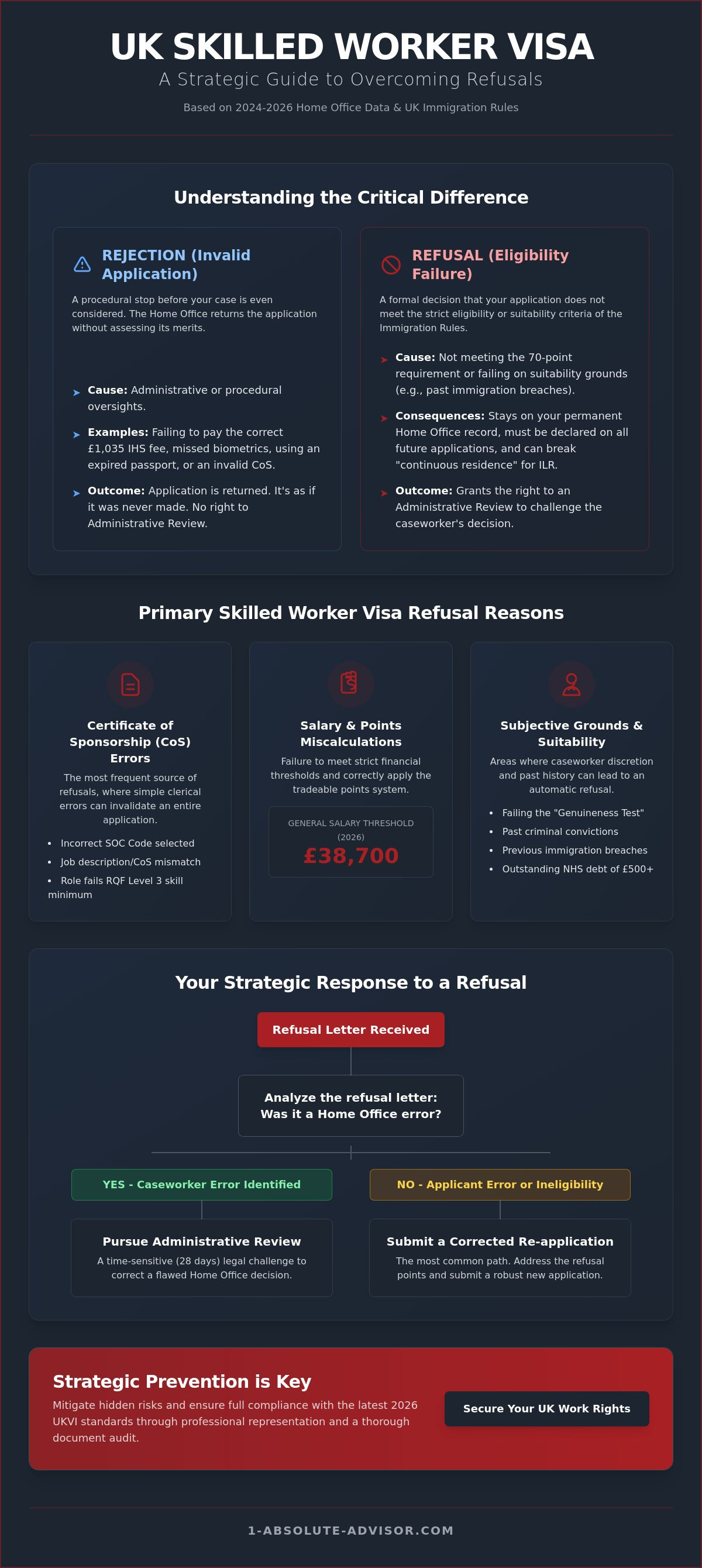
Distinguishing between a “rejection” and a “refusal” is the first step in diagnosing why your application didn’t succeed. While these terms are often used interchangeably in casual conversation, the Home Office treats them as two entirely different legal outcomes. A rejection occurs when an application is deemed “invalid.” This is usually due to a procedural or administrative oversight, such as failing to pay the correct £1,035 Immigration Health Surcharge or missing a mandatory biometric appointment at a visa processing centre. In these cases, the Home Office returns the application without considering the merits of your case. It’s as if the application was never made.
A refusal is a far more serious matter. It happens when a caseworker reviews your 70 points and decides you don’t meet the eligibility criteria. Understanding these skilled worker visa refusal reasons is vital because a refusal grants you the right to an Administrative Review, whereas an invalid application simply ends the process. Beyond points, “suitability” grounds can lead to an automatic refusal regardless of your job offer or salary. These grounds include past criminal convictions, previous immigration breaches, or outstanding NHS debts of £500 or more. Looking at the evolution of the UK work visa system, suitability has become a central pillar of the 2026 framework, designed to filter out applicants who don’t meet the Home Office’s strict character requirements.
The Consequences of a Refusal on Your Record
A refusal isn’t a private matter. It remains on your permanent Home Office record indefinitely. You’ve got to declare it on every future application, whether you’re seeking a Spouse visa or a simple Standard Visitor visa for a holiday. Failure to disclose a past refusal is often viewed as “deception,” which can trigger a mandatory 10-year ban from entering the UK. Furthermore, a refusal can break your “continuous residence” period. This is a major setback for those aiming for Indefinite Leave to Remain (ILR) via the 10-year long residence route, as it effectively resets your progress to zero.
When is an Application Considered “Invalid”?
Under the 2026 Immigration Rules, an application is considered invalid if it fails to satisfy the mandatory procedural requirements set out in the “Validity” section of the Skilled Worker route before a caseworker even begins the assessment. The status of your Certificate of Sponsorship (CoS) is the most common trigger for invalidity. If your sponsor’s license is suspended or the CoS is cancelled by the employer at the moment you hit “submit,” the application cannot proceed. Other common causes include:
- Failing to use the correct online application portal for your specific visa sub-category.
- Leaving mandatory fields blank or providing a passport that has already expired.
- Submitting an application from inside the UK when your current visa type doesn’t allow for “switching.”
Distinguishing between a procedural error and substantive skilled worker visa refusal reasons is the first step in protecting your professional future in Britain. By identifying these risks during the preparation phase, you ensure your application is not only valid but also robust enough to withstand caseworker scrutiny.
Primary Eligibility Failures: Salary, Sponsorship, and Skill Level
The Certificate of Sponsorship (CoS) acts as the foundation of any application, yet Home Office data from 2024 and 2025 indicates it’s the most frequent source of skilled worker visa refusal reasons. A simple clerical error or an incorrect Standard Occupational Classification (SOC) code selection can invalidate the entire process. Selecting the right SOC code requires a precise match between the job description and the Appendix Skilled Occupations. If the Home Office determines the role doesn’t meet the RQF Level 3 skill requirement, they’ll reject the application immediately. Case workers use a “genuineness test” to ensure the role hasn’t been created solely to facilitate entry into the UK, making the alignment between the job title and the CoS description critical.
Salary Thresholds and Tradeable Points
Salary benchmarks for 2026 demand strict adherence to the general threshold, which currently stands at £38,700 for most standard applications. However, the system allows for flexibility through tradeable points. Applicants can reduce this requirement to £30,960 or a specific percentage of the “going rate” if they hold a relevant PhD or work in a role on the Immigration Salary List (ISL). Understanding the nuances of Skilled Worker visa requirements is vital here. Many refusals stem from part-time salary calculations. The Home Office evaluates the actual gross annual salary, not the full-time equivalent, unless specific pro-rata rules apply. If your 30-hour week salary falls below the absolute floor, the visa won’t be granted. Errors often occur when employers fail to update their offers to match the updated 2026 going rates for specific SOC codes.
The Role of the UK Sponsor Licence
A sponsor’s standing with the Home Office is never static. If a company’s licence is suspended or revoked while your application is pending, the Home Office will likely refuse the visa or limit it to 60 days. Employers must correctly distinguish between “Defined” CoS for those applying from outside the UK and “Undefined” CoS for those switching within the UK. Using the wrong type is a fatal administrative error. Additionally, the sponsor must pay the Immigration Skills Charge, which is £1,000 per year for large sponsors. Failure to pay this within the 10-day top-up period leads to automatic rejection. For businesses looking to secure their international talent pool, seeking strategic compliance advice can prevent these costly administrative setbacks.
Applicants often struggle with the “New Entrant” criteria, which offers a lower salary threshold but comes with a strict four-year cap. This limit includes any time already spent under the Graduate route or previous Skilled Worker permissions. Applicants frequently miscalculate this period, leading to skilled worker visa refusal reasons when they exceed the permitted duration. Ensuring your eligibility period is calculated correctly before the CoS is assigned remains a high-priority task for any successful 2026 application.
Subjective Grounds for Refusal: The Genuineness Test and Suitability
Beyond the technical points and salary thresholds, UKVI caseworkers apply a qualitative lens to every application. Subjective assessments often form the basis for many UK Immigration Rules for Skilled Workers rejections. These decisions rely on a caseworker’s belief regarding the applicant’s intentions and the employer’s actual business needs. Understanding these nuances is vital for maintaining compliance and ensuring a successful outcome.
Passing the Genuineness Test
The “Genuineness Test” allows the Home Office to investigate whether a role exists because of a legitimate business vacancy or if it was fabricated to facilitate entry into the UK. Caseworkers scrutinize the business’s hierarchy and financial health to determine if the company can realistically sustain the proposed salary. If a small retail outlet with a £100,000 turnover attempts to hire a “Director of Operations” at a £50,000 salary, it triggers an immediate investigation.
Common red flags that lead to a “genuineness” interview include:
- A job description that looks like a “patchwork” of different roles to meet a specific SOC code.
- An applicant whose previous 10 years of experience bears no logical connection to the new role’s technical requirements.
- Lack of evidence showing how the role was advertised or why this specific candidate was chosen over local labor.
Suitability and General Grounds for Refusal
Suitability centers on the “Good Character” requirement. Applicants often assume minor issues don’t matter, but transparency is the only path to approval. Failure to disclose a drink-driving conviction from 2019 or a previous visa overstay in another country can be categorized as “deception,” leading to a 10-year ban. The Home Office operates a binary framework where mandatory grounds require an immediate rejection, while discretionary grounds allow caseworkers to evaluate the specific nuances of an individual’s history.
Medical compliance is equally rigid. If you’re applying from a country where a TB test is required, you must visit a clinic specifically approved by the Home Office. Using a high-end private hospital that isn’t on the official list will result in an automatic failure. These are avoidable skilled worker visa refusal reasons that stem from a lack of attention to administrative detail.
Financial and Language Requirements
The financial requirement demands that applicants show they can support themselves without relying on public funds. You must prove you’ve held at least £1,270 in your bank account for 28 consecutive days. The 28th day must fall within 31 days of the date you submit your application. Any dip below this balance, even for a single day, leads to a refusal.
Similarly, the English Language requirement is a frequent stumbling block. Only certificates from an approved Secure English Language Test (SELT) provider are valid. Applicants often submit academic degrees from non-English speaking countries without the required Ecctis (formerly UK NARIC) verification, rendering the evidence useless in the eyes of the caseworker.
How to Respond to a Refusal: Administrative Review vs. New Application
Your refusal letter serves as a diagnostic tool for your next steps. It outlines the specific logic used to categorize the skilled worker visa refusal reasons, and you must audit this document against the Immigration Rules as they stand in 2026. Start by verifying if the caseworker ignored evidence you already submitted. If the Home Office made a “case working error,” such as miscalculating your salary against the current £38,700 threshold or overlooking a valid Certificate of Sponsorship (CoS), you have grounds for a challenge. If the error was yours, such as an expired passport or a missing bank statement, a different strategy is required.
The Administrative Review Process
An Administrative Review (AR) is strictly for correcting factual errors made by the Home Office. You can’t submit new evidence during this process; the reviewer only looks at what was originally provided. You must act quickly. The deadline is 14 days if you applied from within the UK and 28 days for entry clearance applications from abroad. If the caseworker applied the wrong version of the 2026 salary scales or missed a document that was clearly attached to your digital application, an AR is the most cost-effective path. You can find more detail on this in our guide on Challenging a UK Visa Refusal.
When a Fresh Application is the Better Strategy
If the refusal happened because you forgot to include a mandatory document or your CoS contained incorrect data, an Administrative Review will fail. ARs don’t allow you to fix your own mistakes. In these cases, a fresh application is the only logical path. You’ll likely need a new CoS from your employer, as the previous one is often cancelled automatically upon refusal. Your new cover letter must be surgical. It should explicitly reference the previous skilled worker visa refusal reasons and demonstrate exactly how the new submission corrects those deficiencies. This proactive approach shows the Home Office that you’ve achieved full compliance.
Complex legal errors that aren’t resolved through AR might require a Judicial Review (JR). This is a high-level legal challenge where a judge reviews the lawfulness of the Home Office decision. It’s a last resort, typically reserved for cases where the Home Office has acted irrationally or failed to follow its own published guidance. Because JR involves the Upper Tribunal, it requires specialized legal expertise to ensure the merits of the case justify the cost and time involved.
Deciding between a review and a new start requires a dispassionate analysis of the facts. If you’re uncertain which path protects your career and right to work, contact Absolute Advisor for a strategic consultation.
Strategic Prevention: How Professional Representation Secures Your UK Work Rights
Securing a UK work permit in 2026 requires more than just meeting the basic criteria; it demands a proactive defense against the common skilled worker visa refusal reasons that often catch unrepresented applicants off guard. When you partner with an OISC-registered advisor, you gain access to a level of scrutiny that mirrors the UKVI caseworker’s own process. We identify “hidden” risks, such as subtle mismatches between your job description and the chosen SOC code, which automated systems or less experienced applicants might overlook. Precision is your strongest asset. A single discrepancy in a salary calculation or a missing mandatory phrase in a Certificate of Sponsorship (CoS) can lead to an immediate rejection.
One of the most critical components we provide is a robust legal cover letter. This document isn’t a mere summary of your application. It’s a strategic legal argument that preemptively addresses “genuineness” concerns. In 2026, UKVI caseworkers have broad discretion to refuse applications if they suspect a role was created primarily to facilitate immigration. Our advisors draft detailed justifications that link the role to your sponsor’s specific business needs, effectively neutralizing subjective grounds for refusal before they can be raised.
Our Comprehensive Document Checking Service
Success lies in the details of your evidence. Our document checking service involves a granular audit of every bank statement, English language certificate, and professional credential against the most recent UKVI caseworker guidance. We don’t just check if a document exists; we verify its format, the issuing authority’s validity, and the specific dates to ensure they fall within the mandatory 28-day or 31-day windows required by law. By cross-referencing your materials with our Skilled Worker Visa UK Guide 2026, we reduce the risk of refusal to the absolute minimum. This expert oversight ensures your submission is “decision-ready” from the moment it hits the caseworker’s desk.
Expert Support for UK Business Sponsors
For UK employers, the stakes are equally high. A mistake in assigning a CoS doesn’t just affect the applicant; it can trigger a Home Office audit of your entire sponsor license. We act as a strategic partner for businesses, ensuring that every CoS is assigned correctly under the 2026 rules and that all compliance duties are met. Whether you’re navigating the complexities of the Immigration Salary List or managing the new reporting requirements, our team provides the stability you need to grow your international workforce. For a detailed breakdown of employer responsibilities, consult our UK Work Visa Guide 2026. Don’t leave your company’s growth to chance. Contact 1 Absolute Advisor for a consultation today to secure your professional future in the UK.
Navigating Your Path to UK Residency with Confidence
Securing a UK work permit in 2026 requires more than just meeting basic criteria; it demands absolute precision in your documentation. The Home Office currently enforces strict salary thresholds and rigorous genuineness assessments that catch many applicants off guard. Understanding common skilled worker visa refusal reasons, such as incorrect SOC codes or insufficient sponsorship evidence, is the first step toward a successful outcome. Whether you’re facing a recent refusal or planning your first application, the distinction between a simple rejection and a formal refusal determines your next legal move.
You don’t have to navigate these complex 2026 regulations alone. Our team of OISC-registered advisors provides fixed-fee application management to ensure every detail aligns with current UK immigration law. We specialize in complex refusal cases, turning potential setbacks into strategic advantages. Secure your UK future with expert Skilled Worker visa assistance and let us handle the administrative burden while you focus on your career. The right professional support transforms a daunting legal process into a predictable journey toward your professional goals in the United Kingdom.
Frequently Asked Questions
What is the most common reason for a Skilled Worker visa refusal in 2026?
The most common skilled worker visa refusal reasons in 2026 involve errors in the Certificate of Sponsorship (CoS) and failing to meet the updated salary thresholds. Since the April 2024 threshold increase to £38,700 for most roles, many applicants struggle to align their pay with specific SOC code requirements. Home Office data shows that administrative mistakes by sponsoring employers account for approximately 35% of all initial application failures.
Can I apply for a Skilled Worker visa again if I have been refused?
You can submit a new application immediately after a refusal unless your decision letter explicitly states a ban for deception. It’s often more efficient to reapply with a corrected CoS than to seek a review if the error was factual or evidentiary. You’ll need to pay the application fee and the Immigration Health Surcharge again, which currently costs £1,035 per year for most adults.
Will a Skilled Worker visa refusal affect my future UK applications?
A refusal won’t automatically disqualify you from future success, but you must disclose it on every subsequent UK immigration form. Failing to mention a past refusal is considered a mandatory refusal under Paragraph 9.7.1 of the Immigration Rules. This can lead to a 10-year ban from entering the United Kingdom, so honesty is vital for your long-term immigration strategy.
What is the difference between a visa refusal and a visa rejection?
A rejection occurs when an application is deemed invalid because of procedural errors like missing fees or using the wrong form. In these cases, the Home Office returns the application without a formal decision on its merits. A refusal happens when a caseworker reviews your evidence and identifies specific skilled worker visa refusal reasons based on your failure to meet eligibility criteria.
How long does an Administrative Review take for a Skilled Worker visa?
The Home Office aims to process Administrative Reviews within 28 days, though complex cases can take 6 months or longer. You must submit your request within 14 days if you’re inside the UK or 28 days if you’re applying from overseas. Current 2026 performance data indicates that approximately 80% of these reviews are concluded within the standard 28-day window.
Can I stay in the UK while my Administrative Review is pending?
You can legally remain in the UK while a timely Administrative Review is pending under Section 3C of the Immigration Act 1971. This protection ensures your existing leave continues under the same conditions until you receive a final decision. You shouldn’t travel outside the Common Travel Area during this period, as doing so automatically withdraws your review request and ends your legal stay.
What is the “Genuineness Test” and how do I pass it?
The Genuineness Test is a subjective assessment where caseworkers determine if the job vacancy is authentic or created solely to facilitate your entry. To pass, you must demonstrate you have the specific qualifications and experience listed in the job description. Caseworkers might request interviews or additional business evidence to verify the role’s necessity within the company’s organizational structure.
How much does it cost to challenge a UK work visa refusal?
An Administrative Review currently costs £80, and this fee is refunded if the decision is overturned due to a Home Office error. If you must proceed to a Pre-Action Protocol or Judicial Review, legal fees and court costs can range from £2,500 to over £10,000. These figures don’t include the costs of a new visa application if you choose that path instead of a legal challenge.