
British Citizenship by Descent: A Comprehensive Guide to Eligibility and Claims in 2026

What if the key to your future in the United Kingdom depends entirely on a technical distinction your parent might not even know they hold? For many, the path to british citizenship by descent feels like a maze of archaic rules and historical injustices. You’ve likely spent hours trying to decode the difference between being British “by descent” and “otherwise than by descent” while worrying about the £1,540 registration fee. It’s natural to feel overwhelmed by a system that often prioritizes legal complexity over the needs of families seeking to reconnect with their heritage.

We’ve designed this guide to provide the certainty you need. You’ll learn exactly how the British Nationality Act 1981 affects your eligibility and how recent legislative changes finally address long-standing gender discrimination for those born before 1983. This article provides a clear roadmap for your application and explains the evidence required to satisfy Home Office scrutiny. We’ll examine the specific requirements for registration and help you build a claim based on professional precision and strategic foresight.

Key Takeaways

  • Identify the critical distinction between being British “by descent” and “otherwise than by descent” to determine if you can pass nationality to your children.
  • Discover how your date of birth serves as the primary legal threshold for your british citizenship by descent claim and how recent laws resolve historical gender discrimination.
  • Explore the complex “double descent” pathways that may allow a claim through a grandparent, specifically in cases involving historical Crown Service.
  • Learn the exact hierarchy of documentation required by the Home Office to ensure your evidence meets the stringent standards needed for a successful outcome.
  • Understand why professional representation is vital for navigating the high financial stakes and technical intricacies of UK nationality registration.

Understanding British Citizenship by Descent: The Otherwise Than Rule

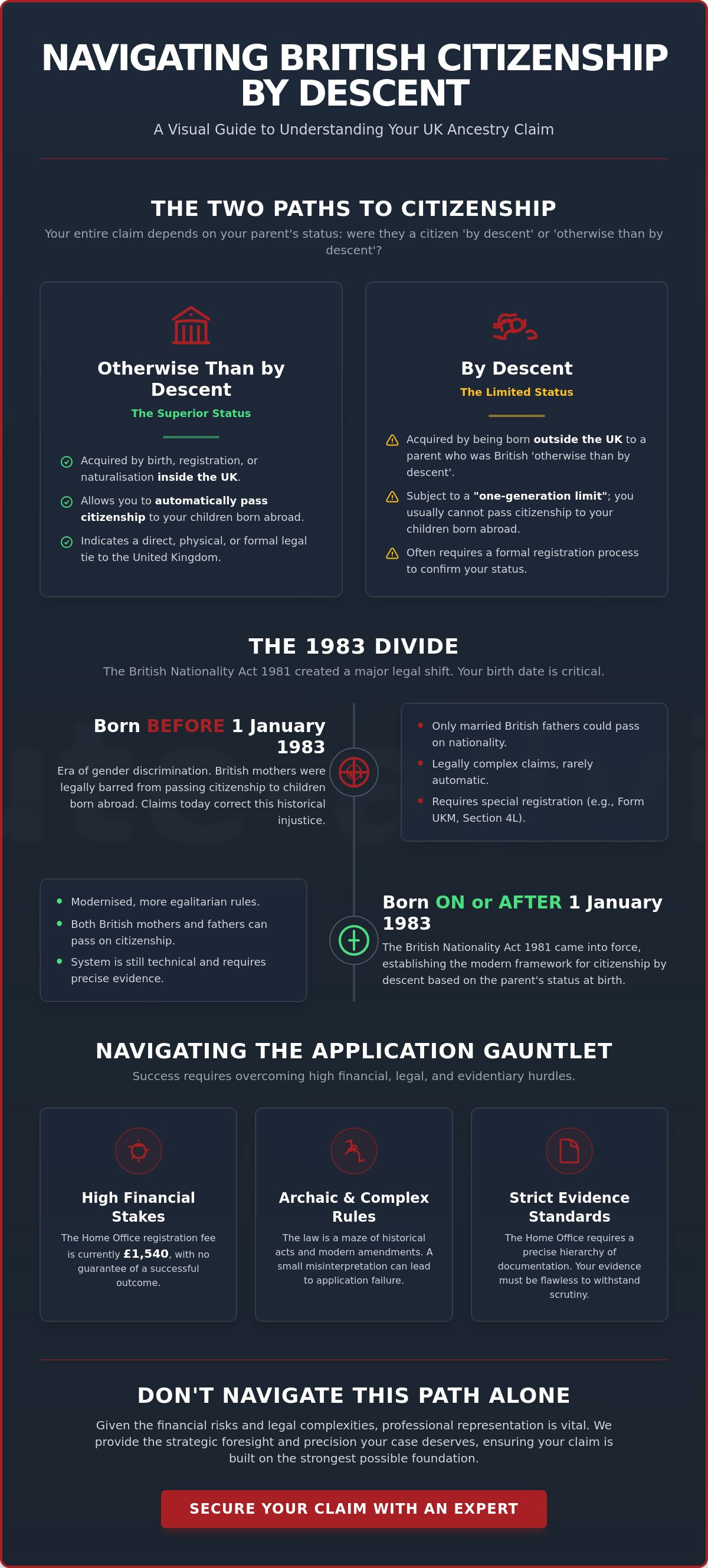
The legal architecture of UK nationality is built upon specific status levels that dictate how rights are transmitted through bloodlines. At the heart of every claim for british citizenship by descent lies a binary distinction: were you born to a parent who was British “by descent” or “otherwise than by descent”? This classification, solidified by British nationality law, acts as a gatekeeper for future generations. If your parent acquired their status by being born, naturalised, or registered within the United Kingdom, they’re typically considered “otherwise than by descent.” This is a superior legal standing because it allows them to pass their nationality to children born outside the UK automatically.

Your parent’s status at the exact moment of your birth is the most critical factor in your eligibility. If your parent was already a British citizen “otherwise than by descent” when you were born, you likely acquired citizenship automatically. However, the law imposes a “one generation” limit. This means that if you were born abroad and received your citizenship through your parent, you are a citizen “by descent.” Consequently, you usually can’t pass that citizenship to your own children if they’re also born outside the UK. While some acquire this status at birth without any paperwork, others must undergo a formal registration process with the Home Office to secure their rights and obtain a certificate of registration.

British Citizen Otherwise Than by Descent

Acquiring the status of “otherwise than by descent” usually requires a physical connection to the UK landmass or a formal legal process like naturalisation. Individuals born in the UK before 1983, or those born there later to parents with settled status, hold this designation. It’s the most robust form of citizenship because it carries the inherent power to transmit nationality across borders. You can often identify this status by looking at a parent’s birth certificate or the “place of birth” listed on their passport. If they naturalised as a British citizen while living in the UK, they also hold this status, granting their foreign-born children a direct path to citizenship.

The Right of Abode and Your Legal Rights

A frequently overlooked aspect of nationality claims is the Right of Abode. This legal status grants an individual the absolute right to live, work, and travel in the UK without any immigration restrictions. While all British citizens have the Right of Abode, not everyone with the Right of Abode is a British citizen. Certain Commonwealth citizens who have held this right since before 1983 retain it today. For those pursuing british citizenship by descent, proving the Right of Abode is a vital step. If you choose not to apply for a full British passport immediately, you should obtain a Certificate of Entitlement. This document is placed in your foreign passport and serves as definitive proof that you aren’t subject to immigration control, providing the same level of security as a citizenship certificate.

The 1983 Divide: How Your Date of Birth Dictates Eligibility

The date of 1 January 1983 stands as the most significant milestone in the history of UK nationality. Before this date, the law operated under a framework of paternal descent that fundamentally ignored the rights of British mothers. The implementation of the British Nationality Act 1981 sought to modernise these rules, but it created a stark divide in how british citizenship by descent is determined today. For those born before this date, eligibility is often a matter of correcting historical injustices, whereas those born after benefit from a more egalitarian, albeit still technical, system. Understanding which side of this divide you fall on is the first step in assessing your claim’s viability.

Born Before 1983: Legally Complex Claims

Historically, British women were legally barred from passing their nationality to children born outside the United Kingdom. Only married British fathers held this right. This gender-based discrimination left thousands of individuals without the citizenship they should have inherited by blood. Today, specific registration routes like Form UKM or Section 4L allow these individuals to claim their status. However, these claims are rarely automatic. As detailed in a House of Commons Library briefing, the complexity of these historical rules requires a deep understanding of the law as it stood at the time of your birth. If you find these historical nuances difficult to navigate, our British Citizenship Application Service can help clarify your specific path and ensure your evidence meets current Home Office standards.

Born Between 1983 and 2006: The Modern Framework

The 1981 Act introduced a framework where either parent could transmit citizenship. If you were born between 1 January 1983 and 30 June 2006, you generally acquired citizenship automatically if at least one parent was a British citizen otherwise than by descent. There is one significant caveat for this era: children born to unmarried British fathers didn’t receive citizenship automatically. This group had to wait until 1 July 2006 for the law to treat children of unmarried parents equally. Even then, the change wasn’t fully retroactive. Those born to unmarried fathers before 2006 often still need to apply for registration rather than simply applying for a passport. This ensures that the Home Office can verify the biological link through specific documentation, such as DNA evidence or secondary birth records, before granting british citizenship by descent.

British Citizenship by Descent: A Comprehensive Guide to Eligibility and Claims in 2026

Beyond the First Generation: Double Descent and Legislative Unfairness

While the “one generation” rule serves as the standard threshold, the law provides narrow but significant pathways for the second generation born abroad. These exceptions, often referred to as “double descent,” primarily apply to families with a history of Crown Service. If your parent was recruited in the UK and serving in the British armed forces or diplomatic service at the time of your birth, they’re treated as being British “otherwise than by descent.” This legal fiction allows them to pass nationality to you automatically, even if you were born outside the UK. For others, the path involves registration under Section 3(2) or 3(5) of the British Nationality Act 1981. These routes are specifically for children of citizens “by descent” and often require a period of residency in the UK or a parent who lived in the UK for at least three years before the child’s birth.

Section 4L: Remedying Historical Injustice

The Nationality and Borders Act 2022 introduced Section 4L, which acts as a remedial “catch-all” for historical legislative unfairness. This provision allows the Home Office to grant british citizenship by descent if an applicant can prove they would’ve become a citizen if not for discriminatory laws or specific administrative errors. Examples include historical gender discrimination that prevented a grandmother from passing citizenship to a parent, who in turn couldn’t pass it to the applicant. It’s the most flexible route available for complex family histories, though it remains a discretionary application that requires a compelling legal argument to succeed.

Citizenship Through a Grandparent

Claims through a grandparent are notoriously difficult and depend heavily on the specific status of the territory where the grandparent was born. While our Ancestry Visa Application Service provides a five-year route to settlement for those with a UK-born grandparent, it’s an immigration path rather than a direct citizenship claim. To secure citizenship through a grandparent, you must often demonstrate a “strong link” to the UK or fall under specific rules for former colonies and protectorates. These cases require meticulous documentation of the grandparent’s birth and marriage records. Because these applications involve a registration fee of £1,540 for adults or £1,000 for children, ensuring your evidence meets the requisite standard is paramount to avoiding a costly refusal. If your family history involves several generations born abroad, identifying a british citizenship by descent claim requires a holistic look at the laws in place during each ancestor’s lifetime.

The Evidence Framework: Documenting Your Claim

Securing recognition of your status requires more than just a biological connection; it demands a rigorous evidentiary trail that satisfies the Home Office’s exacting standards. The department operates on a strict hierarchy of evidence where primary documentation is the undisputed gold standard. To successfully claim british citizenship by descent, you must build a comprehensive file that leaves no room for legal ambiguity. This begins with long-form birth certificates for yourself and the parent through whom you’re claiming. Unlike “short” certificates, these documents list full parental details, which are essential for establishing the legal bloodline required by law.

When primary records are lost or were never issued, the burden of proof shifts to secondary evidence. This might include school records, baptismal certificates, or census entries that place your parent in the UK at a specific time. In instances where the biological link remains unverified, DNA evidence from a Home Office-approved laboratory can serve as a powerful secondary tool. Archival searches through the General Register Office or the National Archives often uncover records that families thought were destroyed or lost. Every document must serve a specific purpose: proving your identity, your parent’s nationality, and their ability to transmit that status to you.

Proving the Parental Link

The most common cause for application refusal is a failure to prove that a parent was a British citizen “otherwise than by descent” at the time of your birth. You must provide the parent’s UK birth certificate or their certificate of naturalisation. If these documents are in a language other than English or Welsh, they require professional translation and, in some jurisdictions, notarisation. If you’re unsure if your current documents meet these exacting standards, our Document Checking Service provides a thorough audit of your evidence before you commit to the non-refundable Home Office fees.

The Application Process and Timelines

Most nationality claims are submitted through the Home Office online portal, though certain complex cases involving historical legislative unfairness may require specific paper forms. Once the digital application is submitted and the fee is paid, you’ll need to attend a biometric appointment at a UKVCAS centre or a designated overseas hub to provide fingerprints and a photograph. As of May 2026, the standard processing time for british citizenship by descent applications remains up to six months. There’s currently no priority or fast-track service available for nationality registrations, so patience and precision during the initial filing are essential to avoid unnecessary delays or rejection.

The financial stakes of a nationality claim are significant. When you consider that the adult registration fee was updated to £1,540 on April 8, 2026, the cost of a clerical or legal error becomes a substantial burden. Home Office fees for nationality applications are rarely refunded following a refusal. This makes the initial submission the most critical phase of your journey toward british citizenship by descent. Professional representation moves beyond simple form-filling; it provides a strategic shield against the technical pitfalls that lead to rejection. An OISC-registered advisor acts as a mentor, identifying “hidden” routes like the Section 4L historical unfairness path that a layperson might easily overlook.

A successful application often hinges on the quality of the legal cover letter. This document synthesises complex family histories into a coherent legal argument. It explains exactly how your ancestry aligns with the British Nationality Act 1981, directly addressing potential Home Office concerns before they lead to a request for further information. By presenting a well-structured evidence chain from the outset, you demonstrate a level of professional rigour that commands respect from case workers. This proactive approach is essential for navigating the six-month processing window with confidence.

Avoiding Common Pitfalls in Descent Claims

Many applicants stumble on the “Good Character” requirement, which applies to all adults and children over the age of 10. Misinterpreting how past immigration breaches or minor legal issues affect this requirement can lead to an automatic refusal. Another frequent error is failing to provide the specific “long-form” documentation needed to prove a parent’s status as a citizen “otherwise than by descent.” If a single marriage certificate or birth record is missing from a multi-generational chain, the entire claim can collapse. Our methodology focuses on a meticulous audit of every document to ensure your evidence is beyond reproach.

Secure Your Future with 1 Absolute Advisor

We provide expert management of British Citizenship applications from start to finish. Whether you are navigating a straightforward parental claim or a complex double descent case involving Section 4L, our team ensures your narrative is legally sound. We specialise in identifying the most efficient path to british citizenship by descent, protecting you from unnecessary costs and administrative delays. To ensure your application is Home Office-ready, you can utilise our Document Checking Service for a professional review of your evidence. For a comprehensive nationality assessment, contact 1 Absolute Advisor for a professional nationality assessment.

Securing Your British Heritage for the Future

Establishing your claim to british citizenship by descent requires a precise understanding of how historical laws intersect with your family’s unique timeline. Success depends on identifying your parent’s specific status and constructing a document chain that leaves no room for Home Office doubt. By navigating the technical divide of 1983 and utilizing modern remedial routes like Section 4L, you can transform a complex ancestral history into a recognized legal right. The process is rigorous. However, it provides a permanent bridge to the United Kingdom for you and your family.

1 Absolute Advisor offers the stability and professional integrity needed to manage these high-stakes applications. Our OISC Registered Level 1 Advisors are specialists in complex nationality law and provide meticulous, fixed-fee application management. We focus on proactive planning to mitigate risks and ensure your evidence meets every regulatory standard. We’ll act as your strategic partner in securing your status with confidence. Book a Consultation for Your British Citizenship Claim today and take the definitive step toward your future as a British citizen.

Frequently Asked Questions

Can I get British citizenship if my mother was British but my father was not?

Yes, you can certainly claim citizenship through your mother. If you were born on or after 1 January 1983, you likely acquired status automatically at birth. For those born before this date, historical gender discrimination previously prevented mothers from passing on nationality, but modern registration routes now allow you to remedy this through a formal application.

Does British citizenship by descent expire if I do not claim it immediately?

British citizenship itself does not expire, but your window to use certain registration routes can be affected by legislative changes. If you acquired citizenship automatically at birth, you remain a citizen for life regardless of when you apply for a passport. However, if you must register to become a citizen, it is prudent to act while current remedial laws like Section 4L are in effect.

What is the difference between a British citizen by descent and a British citizen otherwise than by descent?

The primary difference lies in the ability to pass nationality to future generations born abroad. A citizen “otherwise than by descent” usually acquired their status by birth, naturalisation, or registration within the UK and can automatically pass citizenship to their children born overseas. A citizen “by descent” has inherited their status from a parent and generally cannot pass it to children born outside the UK.

Can I pass British citizenship to my children if I am a citizen by descent?

You cannot usually pass british citizenship by descent to children born outside the UK if you hold that status yourself. There are exceptions if your child is born in the UK or if you lived in the UK for a consecutive three year period before their birth. Some families also qualify through Crown Service or specific discretionary registration routes under the British Nationality Act 1981.

How much does it cost to apply for British citizenship by descent in 2026?

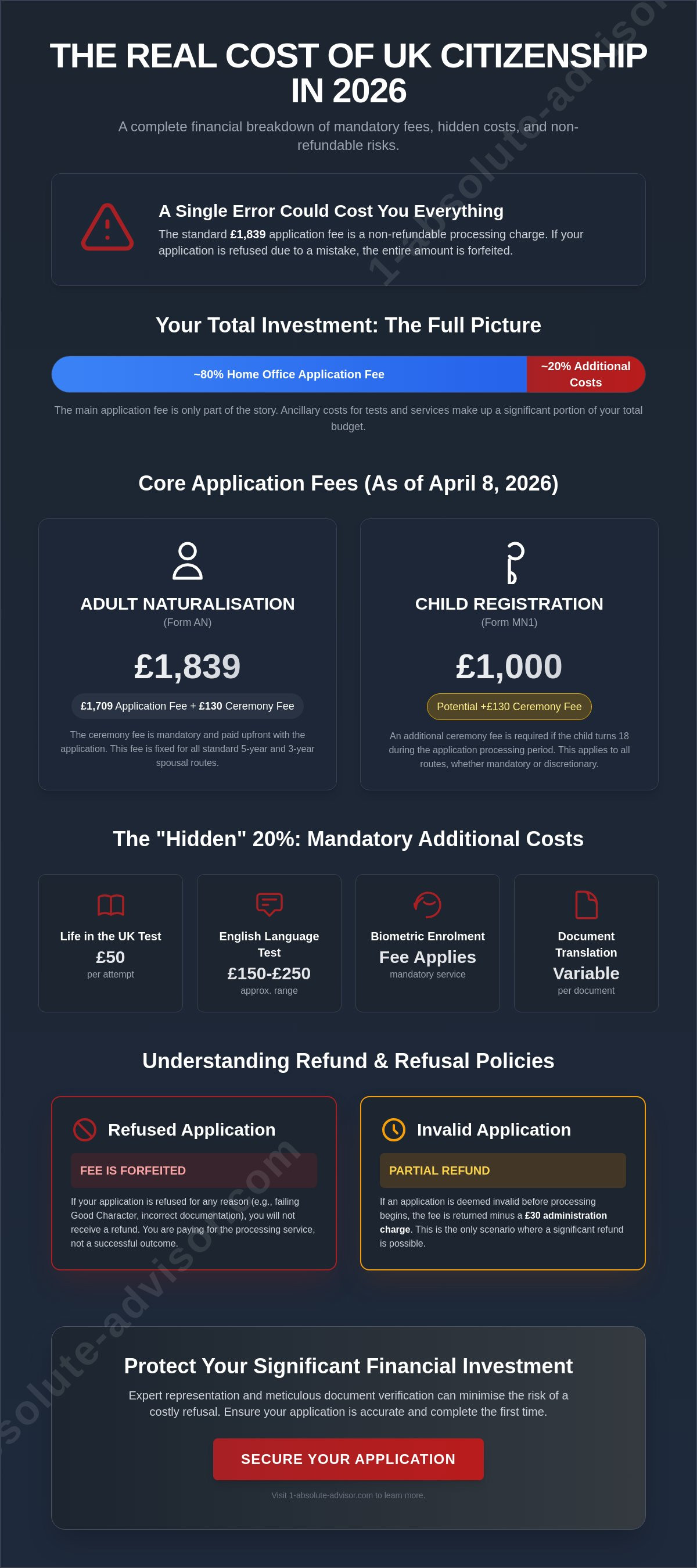
The application fee for an adult registering as a British citizen is £1,540, a rate updated as of 8 April 2026. For children under the age of 18, the registration fee is £1,000. Adult applicants must also factor in a mandatory £130 fee for the citizenship ceremony, which is paid once the Home Office approves the application.

Do I need to live in the UK to apply for citizenship by descent?

You do not need to reside in the UK to submit an application based on your parental bloodline. Most british citizenship by descent claims are processed while the applicant is living abroad. While some complex second generation registration routes require a period of prior UK residency, the standard first generation claim is based entirely on your relationship to your British parent.

What happens if I cannot find my parents original UK birth certificate?

You can obtain official certified copies of UK birth, marriage, or death certificates from the General Register Office. These replacements carry the same legal weight as the originals for Home Office purposes. If your parent was naturalised and the certificate is lost, you may need to apply for a duplicate or provide secondary evidence from the National Archives to verify their status.

Can I have dual citizenship if I claim British citizenship by descent?

The United Kingdom fully recognizes dual nationality and does not require you to renounce your current citizenship upon becoming British. You should, however, verify the laws of your home country. Some nations do not permit dual citizenship and may automatically revoke your original nationality if you formally register as a British citizen or obtain a UK passport.

Good Character Requirement for British Citizenship: 2026 Guidance

Your path to naturalisation doesn’t demand a flawless life history, but it does require an uncompromising demonstration of your current integrity. With the adult naturalisation fee now reaching £1,839, the good character requirement british citizenship assessment is often the most stressful hurdle for applicants to clear. Many people fear that a minor financial oversight or a long-past legal issue will lead to an automatic refusal and the loss of their significant financial investment. This uncertainty has only intensified with the February 10, 2025, policy changes regarding illegal entry, which are currently awaiting a critical judicial review in June 2026.

We recognize that the perceived subjectivity of Home Office caseworkers can make the process feel like a gamble. This strategic guide is designed to replace that anxiety with a structured, professional approach to your application. You’ll gain a precise understanding of the Version 7.0 guidance thresholds, including how the Home Office weighs custodial sentences and financial soundness. By following this framework, you can accurately assess your own eligibility and take proactive, actionable steps to address and mitigate potential character concerns before you submit your documents.

Key Takeaways

  • Understand the statutory framework of the British Nationality Act 1981 to ensure your application aligns with the mandatory standards for all applicants aged 10 and over.
  • Identify the specific thresholds where custodial sentences trigger mandatory refusals versus when caseworkers maintain discretionary power under the latest 2026 guidance.
  • Recognize how financial integrity, including HMRC compliance and debt management, directly impacts the good character requirement british citizenship assessment.
  • Evaluate the implications of the February 2025 immigration compliance rules to understand why past entry breaches remain a focal point for Home Office scrutiny.
  • Develop a robust mitigation strategy using full disclosure and professional evidence to proactively address potential character concerns before submission.

Defining the Good Character Requirement for Naturalisation

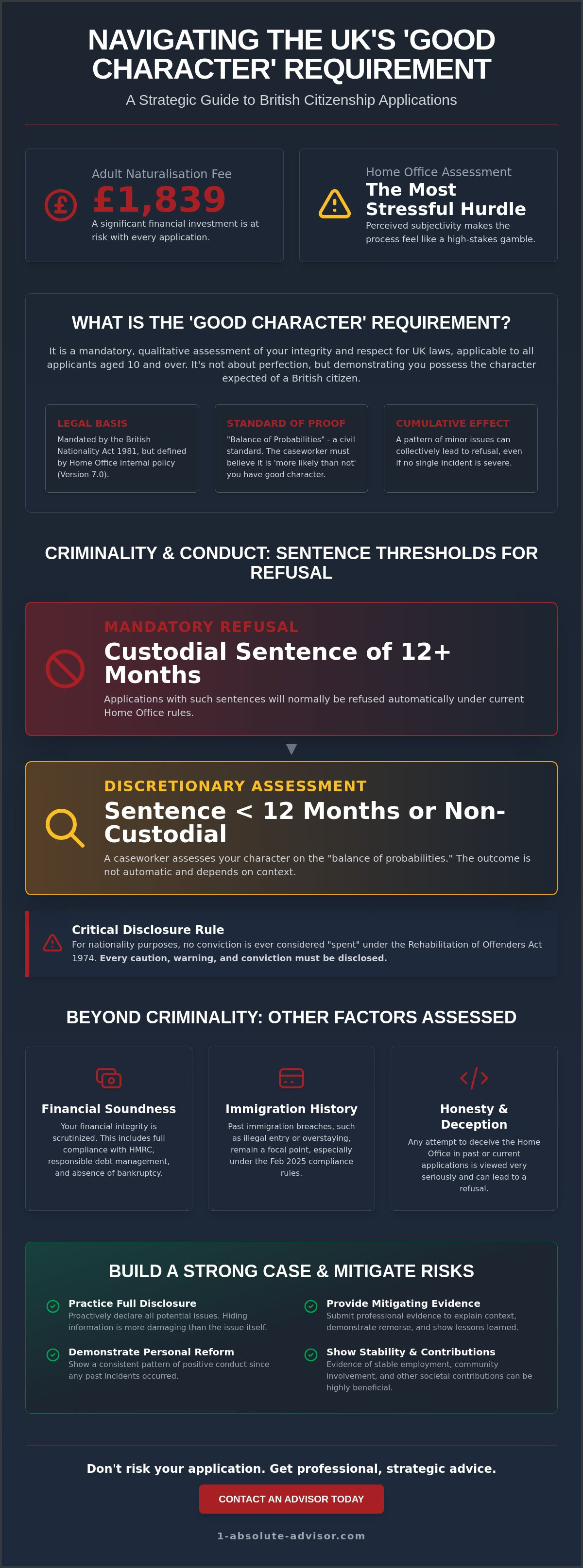
The good character requirement british citizenship isn’t a simple box to tick; it’s a qualitative assessment of your integrity and respect for the laws of the United Kingdom. While the requirement is a mandatory component of British nationality law under the British Nationality Act 1981, the legislation itself doesn’t provide a strict definition of ‘good character.’ This leaves the Home Office to define the standard through its own internal policy guidance, currently updated as Version 7.0 on April 30, 2026. This assessment applies to every applicant aged 10 or over, meaning even young registrants must meet the threshold of being a law-abiding individual.

Caseworkers are tasked with looking beyond a clean criminal record. They evaluate whether you’ve shown honesty in your dealings with the government and whether your presence in the UK is conducive to the public good. Because the definition is policy-driven rather than strictly codified in law, it allows the Home Office to adapt its scrutiny as societal expectations and political priorities change. You aren’t just proving you haven’t broken the law; you’re demonstrating that you possess the level of integrity expected of a British citizen.

The Caseworker’s Perspective: The Balance of Probabilities

When a caseworker reviews your history, they don’t look for proof beyond a reasonable doubt as a criminal court would. Instead, they apply a civil standard of evidence. In the context of nationality law, the balance of probabilities means the caseworker must be satisfied that it is more likely than not that the applicant possesses good character based on the evidence provided. This means that a series of minor, unrelated issues, such as small financial penalties or historical immigration breaches, can have a cumulative effect. Even if no single incident justifies a refusal, a pattern of non-compliance might lead a caseworker to conclude that you don’t meet the necessary standard of integrity.

Why Perfection is Not Mandatory

It’s vital to understand that the Home Office distinguishes between genuine human error and a deliberate attempt to deceive or flout the law. A forgotten parking fine from eight years ago isn’t viewed with the same severity as a recent, undisclosed tax debt. The impact of any negative incident often diminishes as more time passes without further issues. Caseworkers are directed to consider the whole picture, including evidence of personal reform, stable employment, and community contributions. If you can show that a past mistake was an isolated event and that you’ve since lived as a responsible member of society, you can still successfully navigate the good character requirement british citizenship process. Success often depends on how you frame your history rather than the history itself.

Criminality and Conduct: Thresholds for Refusal in 2026

Criminality remains the most objective metric within the Home Office assessment framework, yet its application requires a nuanced understanding of current policy. Since the rule changes on July 31, 2023, the alignment with Part 9 of the Immigration Rules has become more rigid. For any application submitted in 2026, a custodial sentence of 12 months or more will normally result in a mandatory refusal of citizenship. This threshold represents a significant tightening of the rules compared to previous years, where longer sentences were often required to trigger such a definitive outcome. It’s a clear signal that the Home Office prioritizes a clean legal record for those seeking to naturalise.

When a sentence is less than 12 months, or if the applicant received a non-custodial sentence, the decision shifts from mandatory to discretionary. In these instances, the Official Home Office Guidance directs caseworkers to assess the applicant on the balance of probabilities. They look for evidence that the individual’s conduct, even without a lengthy prison stay, suggests a disregard for the law. It is vital to remember that for the good character requirement british citizenship, no conviction is ever considered “spent” under the Rehabilitation of Offenders Act 1974. Every caution, warning, and conviction must be disclosed, regardless of how much time has passed.

The “persistent offender” rule adds another layer of complexity. If an applicant has a long history of minor offences, such as low-level shoplifting or repeated public order incidents, the Home Office may refuse the application based on a pattern of behaviour. Even if no single offence meets the 12-month threshold, the cumulative effect demonstrates a lack of respect for UK society. If you’re concerned about how a past mistake might be interpreted, our British Citizenship Application Service can provide a professional review of your history to identify potential risks.

Driving Offences and Fixed Penalty Notices (FPNs)

A single speeding ticket or a one-off Fixed Penalty Notice for a minor traffic violation rarely leads to a refusal. However, these incidents still fall under the umbrella of the good character requirement british citizenship. A pattern of driving conduct, such as multiple FPNs within a short period or accruing enough penalty points to face a disqualification, indicates a habitual failure to comply with regulations. Transparency is your most effective tool here. Failing to disclose penalty points is often viewed more severely than the points themselves, as it suggests a deliberate attempt to deceive the caseworker.

Pending Charges and Ongoing Investigations

If you’re currently the subject of an active police investigation or have pending criminal charges, the Home Office will typically pause your application. They won’t make a final determination until the legal proceedings have concluded. This is to ensure the character assessment is based on the final outcome of the case. If a charge is eventually dropped or you’re acquitted, you must provide official documentation from the court or police to restart the processing of your naturalisation. Applicants in this situation should wait for a clear resolution before proceeding to avoid a premature decision based on incomplete information.

Good Character Requirement for British Citizenship: 2026 Guidance

Financial Soundness: Debts, Taxes, and Bankruptcy

Financial stability is often overlooked by applicants, but the Home Office views your fiscal conduct as a direct reflection of your integrity. Meeting the good character requirement british citizenship involves demonstrating that you’ve fulfilled your financial obligations to the United Kingdom. This doesn’t mean you must be debt-free to succeed. Instead, the focus is on whether you’ve managed your liabilities honestly and transparently. Caseworkers look for evidence that you respect the financial systems of the country you wish to join.

HMRC compliance is a pillar of this assessment. Caseworkers frequently cross-reference applications with tax records to ensure that you aren’t just living in the UK, but contributing according to the law. If you’ve habitually filed late tax returns or have outstanding tax liabilities without an agreed repayment plan, this can trigger a refusal. It suggests a failure to comply with the statutory obligations expected of a citizen. For those with complex tax histories, our British Citizenship Application Service can help ensure your documentation accurately reflects your compliance.

County Court Judgments (CCJs) and bankruptcy are also critical areas of scrutiny. While a single CCJ might not derail an application, a history of ignored judgments indicates a lack of responsibility. Bankruptcy and Individual Voluntary Arrangements (IVAs) must be disclosed in every case. Bankruptcy is particularly sensitive; if it resulted from reckless behavior or a deliberate attempt to avoid creditors, it’s likely to lead to a refusal. However, if it arose from genuine misfortune and you’ve been discharged, you may still meet the character standard.

NHS Debt and Public Funds

Unpaid NHS charges are a specific point of concern for the Home Office. Current guidance indicates that an outstanding NHS debt of £500 or more will normally lead to an application being refused. Beyond debt, caseworkers also examine whether you’ve accessed public funds you weren’t entitled to. While debt alone is not a bar to citizenship, dishonest debt management or failing to disclose financial liabilities is often fatal to an application.

Council Tax and Utility Arrears

Debts to local authorities, particularly council tax arrears, signal a lack of commitment to your local community. If you have outstanding arrears, it’s essential to have a formal repayment plan in place before you submit your application. You’ll need to provide evidence of this rectification, such as letters from the council or utility providers confirming the agreement and your consistent payment history. This proactive approach demonstrates that you’re taking steps to resolve your financial issues, which supports your claim of good character.

The 2025/2026 Immigration Compliance Rules

The good character requirement british citizenship assessment has undergone its most rigorous transformation since the Nationality and Borders Act. On February 10, 2025, the Home Office introduced a stringent policy stating that any applicant who entered the UK illegally will normally be refused citizenship. Unlike previous versions of the guidance, where a significant passage of time might have mitigated an entry breach, the current stance is largely indifferent to how many years have passed since the initial incident. This change has created significant hurdles for long-term residents who have otherwise lived exemplary lives but whose arrival in the UK was not through official channels.

Deception remains a primary ground for refusal. If you’ve previously provided false information in a visa application, you’re likely facing a 10-year period during which naturalisation is virtually impossible. In some cases, particularly where the deception was orchestrated or involved identity fraud, the bar can be permanent. Similarly, working in breach of your visa conditions, even for a short period, is viewed as a fundamental failure to respect the laws of the United Kingdom. It suggests that your commitment to compliance is conditional, which is a significant red flag for caseworkers.

If your history involves complex entry or compliance issues, our British Citizenship Application Service offers the strategic oversight needed to identify potential grounds for an ‘exceptional circumstances’ plea before you risk your application fee.

Illegal Entry and the ‘Normally Refuse’ Policy

In the current 2026 legal landscape, ‘illegal entry’ includes entering without leave, using clandestine means, or arriving via small boat crossings. The “normally refuse” policy is currently the standard for caseworkers, meaning they’ll reject applications regardless of whether the applicant has since obtained Indefinite Leave to Remain (ILR). While the Home Office acknowledges human rights and exceptional circumstances, these are rarely granted without overwhelming evidence of reform or unique hardship. It’s also vital to monitor the upcoming judicial review scheduled for June 9-11, 2026, as the court’s decision could force a significant softening of this policy for long-term residents.

Deception and Dishonesty

Failing to disclose a material fact is the leading cause of avoidable refusals. This includes not just criminal records, but also past visa refusals from other countries or minor civil penalties. The Home Office also maintains a zero-tolerance policy for dishonesty in Life in the UK or English language tests. If there’s any evidence that you used a ‘proxy’ or cheated during these assessments, it’s considered a fundamental breach of the good character requirement british citizenship. Such findings usually result in a 10-year ban on all future citizenship applications, as they demonstrate a lack of the basic integrity required for naturalisation.

Strategic Preparation: Mitigating Good Character Risks

Success in a naturalisation application often depends less on a perfect past and more on the quality of your current strategic preparation. The good character requirement british citizenship assessment is fundamentally a forward-looking test of integrity. This means that while past mistakes remain on your record, your proactive efforts to rectify them can significantly influence a caseworker’s decision. The cornerstone of any successful mitigation strategy is the ‘Full Disclosure’ approach. Attempting to conceal a historical caution or a financial judgment is almost always viewed as a fresh act of deception, which carries its own mandatory refusal period.

Gathering robust evidence of reform is your most powerful tool when addressing previous conduct issues. This involves more than just a lack of new offences. You should aim to provide professional references, evidence of consistent employment, and documentation of community involvement or voluntary work. These elements help build a narrative of a person who is a settled, contributing member of British society. If your history includes a non-custodial sentence or a period of financial instability, it’s often wise to delay your application. Waiting until you’re well outside the standard refusal windows mentioned in British Citizenship: The Complete Guide to Naturalisation in 2026 ensures your case is built on a foundation of long-term stability.

A compelling cover letter is the final piece of the strategic puzzle. It shouldn’t offer excuses. Instead, it should provide clear, factual context for any historical issues and detail the specific steps you’ve taken to ensure they aren’t repeated. This letter serves as your voice during the assessment, guiding the caseworker through your evidence and explaining why you meet the good character requirement british citizenship today.

The Role of Professional Legal Representation

Engaging an OISC-registered advisor provides an objective audit of your immigration and personal history. These professionals are trained to identify ‘hidden’ risks, such as forgotten historical breaches that might still appear on internal Home Office systems. By building a robust bundle of evidence that anticipates caseworker concerns, an advisor helps move your application from a position of vulnerability to one of professional strength. This level of oversight is particularly vital for those navigating the complexities of the 2025 illegal entry rules.

Checklist for a ‘Character-Ready’ Application

To ensure your submission is as strong as possible, follow this systematic preparation framework:

  • Step 1: Obtain a Subject Access Request (SAR) to see exactly what information the Home Office holds on your file.
  • Step 2: Audit your HMRC status and credit report to identify and resolve any outstanding financial ‘red flags’ before applying.
  • Step 3: Secure high-quality professional references from individuals who can vouch for your integrity and standing in the community.
  • Step 4: Utilize a document checking service to perform a final audit and confirm your evidence meets the 2026 guidance standards.

Securing Your Future as a British Citizen

Achieving naturalisation in 2026 requires more than a simple application; it demands a proactive demonstration of your integrity and respect for UK law. We’ve explored how the Home Office now scrutinizes financial soundness and immigration history with unprecedented depth. Success hinges on your ability to present a transparent, evidence-backed narrative that addresses the good character requirement british citizenship with precision. Whether you’re navigating the complexities of the 2025 illegal entry rules or managing historical financial issues, your approach must be both honest and strategic.

Our team provides the professional stability you need during this life-changing process. With OISC-registered expertise and a focus on fixed-fee application management, we specialize in complex naturalisation cases that require a nuanced touch. We don’t just process documents; we act as your strategic partner to safeguard your investment and your future in the UK. We’ll help you audit your history and build a robust case that stands up to caseworker scrutiny.

Book a Legal Consultation to Assess Your Good Character Eligibility

Taking the right steps today ensures that your path to citizenship remains clear and certain. You’ve worked hard to build your life here, and we’re here to help you finalize that journey with confidence.

Frequently Asked Questions

Does a speeding ticket affect my British citizenship application?

A single speeding ticket or Fixed Penalty Notice doesn’t typically lead to a refusal, provided you disclose it. However, accruing multiple fines or penalty points suggests a habitual disregard for the law. This pattern can negatively impact the good character requirement british citizenship assessment by demonstrating a lack of respect for UK regulations. Transparency is essential; caseworkers view non-disclosure as a more serious integrity issue than the minor traffic offence itself.

Can I apply for citizenship if I have a County Court Judgment (CCJ)?

Yes, you can apply, but you must disclose the CCJ and demonstrate that you’re managing the debt responsibly. A single judgment doesn’t result in an automatic refusal if you’ve entered into a formal repayment plan. Caseworkers are primarily concerned with whether you’ve ignored the court’s order. Providing evidence of consistent payments or showing that the debt has been satisfied helps prove your financial integrity and responsibility.

What happens if I forget to disclose a minor caution from 15 years ago?

Forgetting to disclose any legal incident, regardless of how minor or old it is, can lead to a refusal based on deception. In citizenship law, no caution or conviction is ever considered “spent” under the Rehabilitation of Offenders Act 1974. The Home Office views non-disclosure as a deliberate attempt to mislead the caseworker. It’s always safer to include the details and provide a brief explanation of the circumstances.

How does the Home Office check my financial history for the good character requirement?

The Home Office uses a cross-departmental approach, accessing records from HMRC, the Department for Work and Pensions (DWP), and the NHS. They verify your tax compliance, benefit claims, and any outstanding health service debts over £500. Caseworkers also have the authority to check credit reference agencies for public records like bankruptcies or County Court Judgments. This comprehensive review ensures all applicants meet the financial integrity standards expected of a British citizen.

Will my application be refused if I entered the UK illegally many years ago?

Under the February 10, 2025, policy update, illegal entry will normally lead to a refusal regardless of how much time has elapsed. This is a significant shift from previous guidance where long-term residency could mitigate past breaches. While there are narrow exceptions for human rights or truly exceptional circumstances, the default position is now a refusal. Applicants in this situation should monitor the judicial review scheduled for June 2026 for potential policy changes.

Can I still get citizenship if I have been bankrupt in the past?

You can still succeed if your bankruptcy has been discharged and wasn’t the result of reckless or dishonest behavior. The Home Office assesses the cause of the insolvency to determine if it reflects poorly on your character. If the bankruptcy was due to genuine misfortune, such as a business failure during an economic downturn, it’s less likely to trigger a refusal. You must provide the discharge certificate and a clear explanation of the events.

Does receiving benefits affect the good character requirement?

Lawfully receiving public funds or benefits doesn’t negatively impact your application. The good character requirement british citizenship only becomes an issue if there’s evidence of benefit fraud or a deliberate attempt to claim funds you weren’t entitled to. Caseworkers look for honesty in your dealings with the DWP. As long as your claims were accurate and you’ve complied with all reporting requirements, receiving financial support isn’t a barrier to naturalisation.

What counts as an ‘exceptional grant’ in a good character refusal case?

An ‘exceptional grant’ is a rare decision where a caseworker approves an application despite the applicant failing a specific character threshold. This usually requires overwhelming evidence of positive contribution to the UK or significant human rights considerations that outweigh the negative conduct. It isn’t a standard route and usually involves cases where a refusal would result in a disproportionate impact on the applicant’s life or where remarkable reform has been demonstrated.

British Citizenship Application Timeline 2026: A Strategic Roadmap

The british citizenship application timeline is not a passive waiting period; it’s a strategic sequence where pre-submission precision dictates post-submission speed. It’s understandable if you feel a sense of uncertainty regarding Home Office backlogs or the potential for travel restrictions while your application is pending. Most applicants worry that a single administrative oversight could lead to months of silence or a frustrating Request for Information that stalls their progress indefinitely.

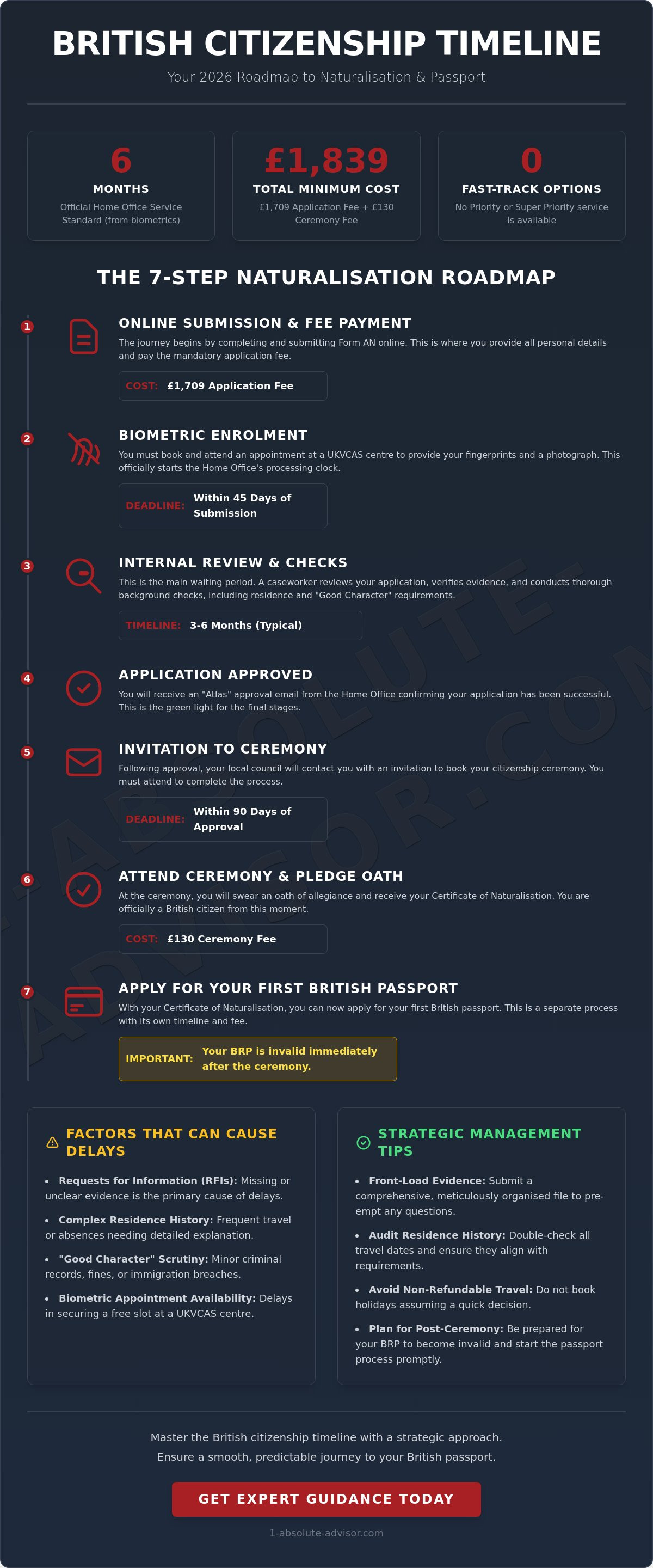
This article ensures you master the naturalisation process by providing an expert breakdown of current processing times and the strategic steps required to secure your British passport. We’ll examine the 2026 landscape, including the £1,709 adult application fee and the mandatory £130 ceremony cost. You’ll learn how to navigate the typical three to six month processing window and what to expect during the 90-day period between approval and your citizenship ceremony. By following this roadmap, you can transform a period of uncertainty into a predictable plan for your future as a British citizen.

Key Takeaways

  • Understand the distinction between the official six-month Home Office service standard and the total journey time required to receive your British passport.
  • Navigate the seven-step naturalisation roadmap with precision, from the initial online submission of Form AN to the final citizenship ceremony.
  • Mitigate potential delays by conducting a rigorous audit of your residence history and front-loading evidence to satisfy the “Good Character” requirement.
  • Prepare for the legal transition post-ceremony, including the immediate invalidation of your BRP and the final steps for your first passport application.
  • Master the british citizenship application timeline by adopting a strategic approach that prioritizes pre-submission accuracy over passive waiting.

Understanding the Official British Citizenship Timeline in 2026

The Home Office maintains a service standard of six months for naturalisation applications, yet this figure often lacks the context needed for effective planning. When evaluating the british citizenship application timeline, it’s vital to distinguish between the internal processing time and the total journey time. While a decision might arrive within the six-month window, your legal status as a citizen only crystallises at the citizenship ceremony, with a British passport following even later. The complexity of British nationality law means that every application requires a manual, high-stakes review that cannot be automated or rushed by standard algorithms.

In 2026, policy shifts regarding residence requirements and “good character” assessments have introduced new variables into the backlog. While the Home Office aims for efficiency, the increased scrutiny on historical immigration compliance means that even minor discrepancies can extend the wait. This is why the british citizenship application timeline must be viewed as a comprehensive project. It begins with your document gathering and only ends when you hold your passport. Relying on the six-month average without accounting for the ceremony invitation or passport processing is a common oversight that can disrupt long-term international travel plans.

The 6-Month Service Standard Explained

The Home Office counts the official start date of your application from the moment you attend your biometric enrolment appointment, not the day you pay the fee online. This distinction is crucial because delays in securing a biometric slot can effectively add weeks to your wait. Statistically, many straightforward cases are decided within three to four months, though you shouldn’t treat this as a guarantee. You can monitor progress through your UKVI account portal. This digital interface provides transparency, allowing you to see when your evidence has been successfully uploaded and acknowledged by the caseworking team.

Why There is No Fast-Track Option

Unlike Skilled Worker or Spouse visa routes, there’s no Super Priority or fast-track service for citizenship. The government’s rationale is that naturalisation is a significant legal privilege requiring exhaustive background checks that don’t fit into a 24-hour window. However, professional preparation acts as a de facto fast-track. By submitting a perfect file, you eliminate the need for Requests for Information (RFIs), which are the primary cause of delays. We advise against booking non-refundable travel during this period. The Home Office won’t expedite a case based on holiday plans, and your current travel documents must remain valid throughout the process.

The 7-Step Naturalisation Roadmap: Submission to Ceremony

The journey toward naturalisation is a structured sequence of administrative milestones. Understanding each phase of the british citizenship application timeline allows you to manage your expectations and coordinate your travel plans effectively. It begins with the digital submission of Form AN and the payment of the required fees. This starts the clock on your application, though the official processing period only commences after your biometric data is captured. Following this, your case enters a period of silence while the Home Office conducts background and character checks. Only after these internal reviews are complete will you receive the “Atlas” approval email, which serves as the precursor to your formal invitation.

From Submission to Biometrics

Once you submit your online application, you enter a critical 45-day window to enrol your biometrics at a UKVCAS service point. Failure to attend an appointment within this timeframe can lead to your application being invalidated. UKVCAS offers a mix of free appointments, which are often booked weeks in advance, and paid appointments that provide more immediate flexibility. It’s essential that all supporting document uploading is completed through the online portal before you attend your appointment. This ensures the caseworker has immediate access to your evidence. If you’re concerned about document accuracy, utilizing a British Citizenship Application Service can provide the necessary oversight to avoid common submission errors.

The Decision and Ceremony Invitation

After your biometrics are processed, your case enters the internal review phase where the Home Office conducts background and character checks. You won’t receive regular updates during this time until a decision is reached. When approved, you’ll receive an “Atlas” notification via email. However, this is not the final step. There is typically a two to four week gap between this approval and receiving the physical invitation from your local council. This letter is the legal trigger for the final stage of your journey. For a more detailed breakdown of the requirements, you can consult this step-by-step guide to applying.

Once the invitation arrives, you must attend a citizenship ceremony within 90 days. This is a non-negotiable legal requirement. You can choose between group ceremonies, which are standard and included in your initial fee, or private ceremonies. Private options can often be scheduled much sooner for an additional fee paid directly to the council. This flexibility is useful if you’re in a hurry to finalise your status and apply for your first passport. Managing this british citizenship application timeline with precision ensures that you transition from a resident to a citizen without unnecessary delays.

British Citizenship Application Timeline 2026: A Strategic Roadmap

Factors That Can Delay Your Citizenship Application

While the Home Office aims for efficiency, the british citizenship application timeline is often extended by specific complexities within an individual file. It’s common for applicants to overlook how historical absences or intricate residence patterns require deeper manual verification. If your travel history includes frequent short trips or extended periods abroad, caseworkers must cross-reference these dates with internal records, which inevitably adds weeks to the process. Similarly, your choice of referees is paramount. If a referee fails to meet the professional standing requirements or cannot be reached for verification, your application may be set aside until a suitable replacement is provided and vetted.

Requests for Information (RFIs) represent the most significant hurdle to a predictable decision. When a caseworker identifies a gap in evidence or requires clarification on a specific point, they issue an RFI. This action effectively pauses the six-month service standard clock. The clock only restarts once the requested documentation is received and reviewed by the caseworking team. Minimising these interruptions requires a front-loading strategy where every potential question is answered in the initial submission, leaving no room for administrative doubt.

The Good Character Manual Review

Financial integrity remains a cornerstone of the naturalisation process. Issues such as outstanding HMRC liabilities, undisclosed County Court Judgments (CCJs), or a history of bankruptcy can trigger an intensive manual review. These aren’t automated checks; they require a senior caseworker to assess the risk profile of the applicant. In 2026, the Home Office has increased its focus on immigration compliance history. Any previous breaches, even those that occurred years ago, can lead to protracted investigations. The most effective strategy is full disclosure. Proactively explaining these issues with supporting evidence prevents the Home Office from discovering them through their own searches, which usually results in longer delays.

Administrative and External Factors

External dependencies often influence the british citizenship application timeline beyond the Home Office’s direct control. Delays frequently occur when waiting for responses from external agencies, such as the police or tax authorities, for background clearance. Additionally, seasonal surges or post-policy change backlogs can inflate waiting times for everyone in the queue. To ensure you meet all the foundational criteria before worrying about these external delays, you should consult our British Citizenship guide for a detailed look at eligibility. Understanding these variables allows you to plan your application during quieter periods, potentially avoiding the administrative bottlenecks that affect many applicants.

The Final Hurdle: Post-Ceremony and Passport Timeline

The legal transition from resident to citizen occurs precisely at the moment you swear the oath or pledge the affirmation during your citizenship ceremony. It’s a definitive moment that concludes the british citizenship application timeline, rewarding the weeks of meticulous evidence gathering you performed before your initial submission. Your previous status, such as Indefinite Leave to Remain, ceases to exist the second you are naturalised. This change has immediate practical implications, specifically regarding your Biometric Residence Permit (BRP) or EUSS digital status. Both become legally invalid post-ceremony because you’re no longer subject to immigration control.

Compliance remains critical even after you’ve celebrated your new status. You’re required to return your invalidated BRP to the Home Office within five working days of your ceremony. Failure to do so can result in a fine of up to £1,000. You should cut the card into pieces and mail it to the specific address provided in your approval pack. If you’re unsure about these post-approval obligations, our British Citizenship Application Service provides the comprehensive oversight needed to ensure you remain compliant during this final transition.

Applying for Your First British Passport

Once you hold your physical Naturalisation Certificate, you’re eligible to apply for your first British passport. In 2026, the typical processing time for a first adult passport is approximately three weeks. It’s vital to understand that you cannot use the Post Office “Check & Send” service for this specific application. First-time passports following naturalisation require a more rigorous verification process than simple renewals. You’ll need to submit your original Naturalisation Certificate; a digital scan or photocopy won’t suffice. HM Passport Office will return this document separately, but you should account for this when planning any other administrative tasks that require proof of citizenship.

Travel Restrictions and Logistics

We strongly advise against booking international travel for the weeks immediately following your ceremony. You’ll find yourself in a logistical “gap” where your BRP is invalid and your British passport hasn’t arrived yet. You cannot use your Naturalisation Certificate as a travel document to cross borders. Attempting to re-enter the UK using an invalidated BRP can lead to significant delays at the border or even the confiscation of the card by immigration officers. Managing this final stage of the british citizenship application timeline requires patience. You should wait until the physical passport is in your hands before committing to any overseas travel. This ensures your first journey as a British citizen is free from the stress of document uncertainty.

Strategic Management: How to Ensure a Smooth Application

Success in naturalisation depends on proactive management rather than passive waiting. To master the british citizenship application timeline, you must begin with a comprehensive audit of your residence history. The Home Office examines the three or five-year qualifying period with extreme scrutiny. You’ve got to account for every single day spent outside the UK. Even minor errors in travel dates can lead to suspicions of non-compliance with the mandatory absence limits. By verifying these dates against your old passports and digital flight records, you eliminate the risk of a caseworker pausing your file to investigate discrepancies.

Selecting your referees is another critical strategic step. These individuals must meet specific professional standing requirements and be easily reachable by the Home Office. If a caseworker attempts to contact a referee and receives no response, your application will likely stall. We recommend choosing professionals who understand the importance of their role and are prepared to respond to government inquiries promptly. This administrative cohesion is what separates a four-month approval from a year-long struggle.

Front-Loading Your Evidence

Caseworkers appreciate clarity. Providing extra evidence for complex residence gaps or historical immigration issues prevents the issuance of Requests for Information (RFIs). A well-drafted legal cover letter serves as a roadmap for the Home Office, guiding them through your history and highlighting how you meet the “Good Character” requirement. It’s also vital to ensure your English language certificates and Life in the UK test results are fully verified before submission. If these documents are near their expiry or come from an unapproved provider, your british citizenship application timeline will be significantly disrupted by an immediate rejection or a mandatory resubmission.

The Value of Professional Oversight

The complexity of British nationality rules means that technical errors are common for unrepresented applicants. 1 Absolute Advisor reduces the risk of administrative delays by providing a meticulous document checking service. Our OISC-registered strategic planning ensures your file is compliant with the latest 2026 regulations before it ever reaches a caseworker’s desk. This professional oversight provides the peace of mind that your celebration is a matter of “when,” not “if.” If you’re ready to proceed with confidence, you should Book a consultation to secure your British citizenship timeline and ensure your journey to a British passport is as efficient as possible.

Securing Your British Future with Strategic Precision

Navigating the british citizenship application timeline requires more than just meeting basic eligibility criteria; it demands a meticulous approach to administrative compliance and logistical planning. You’ve seen how the distinction between the Home Office processing window and your total journey time can impact your ability to travel and celebrate. By auditing your residence history and front-loading evidence, you eliminate the ambiguity that often leads to protracted delays or frustrating requests for information. Every detail, from referee selection to the timely return of your BRP, contributes to a successful outcome.

Our OISC-registered expert advisors specialise in navigating the complexities of the 2026 landscape. We provide fixed-fee application management and maintain a high success rate for complex naturalisation cases, ensuring your transition to citizenship is as seamless as possible. Secure your future with expert British Citizenship application management. Your British passport is the final reward for years of dedication and residence. With a proactive strategy and professional oversight, you can move forward with the absolute confidence that your status is in the most capable hands. We’re here to help you cross the finish line.

Frequently Asked Questions

Can I travel abroad while my British citizenship application is being processed?

You’re permitted to travel abroad while your application is being processed by the Home Office. Your application isn’t automatically withdrawn upon departure from the UK. However, it’s essential to have valid Indefinite Leave to Remain or Settled Status to re-enter. You must also be available to attend your biometric appointment and your citizenship ceremony within the required timeframes.

What happens if the Home Office takes longer than 6 months to decide?

If your decision takes longer than six months, you can request a status update from the Home Office via their standard enquiry channels. They typically won’t provide specific details unless the delay is exceptional. While the six-month standard is a target, complex cases involving extensive travel or character issues often take longer. Professional oversight during the submission phase is the best way to prevent avoidable administrative delays.

Do I need to send my original passport to the Home Office for naturalisation?

You don’t have to surrender your original passport during the naturalisation process. You’ll bring your physical passport to your UKVCAS biometric appointment where a staff member will scan it and return it to you immediately. This digital-first approach allows you to retain your travel documents for the duration of the processing period. You only lose the ability to travel once your BRP is invalidated after the ceremony.

How much does the British citizenship application cost in 2026?

The adult naturalisation application fee is £1,709 as of May 2026. Additionally, you must pay a £130 ceremony fee, bringing the total cost to £1,839. If you’re registering a child, the application fee is £1,000. These mandatory costs are non-refundable even if your application is unsuccessful. You should also budget £50 for each attempt at the Life in the UK test.

Will my BRP be taken away during the citizenship ceremony?

Your Biometric Residence Permit isn’t physically taken from you during the ceremony, but it becomes legally void the moment you swear the oath. You’re under a strict legal obligation to cut the card into pieces and return it to the Home Office within five working days. Failure to comply with this requirement can result in a fine of up to £1,000. Your Naturalisation Certificate replaces the BRP as proof of status.

Can I apply for British citizenship immediately after getting ILR?

You can apply immediately if you’re the spouse of a British citizen. For all other applicants, you must have held Indefinite Leave to Remain (ILR) or Settled Status for at least 12 months before submitting your application. This mandatory waiting period is a core component of the british citizenship application timeline and cannot be waived unless specific marital criteria are met.

What should I do if my referees are contacted by the Home Office?

You should inform your referees that the Home Office might contact them, though this isn’t a universal occurrence. Caseworkers typically reach out if they need to verify a referee’s professional standing or their personal knowledge of your character. Ensure your referees are prepared to respond promptly to any emails or letters from the Home Office. A slow response from a referee can unnecessarily stall your application for several weeks.

Is there a way to check the exact progress of my citizenship application?

Monitoring your progress is done primarily through the UKVI account portal. While the portal confirms that your biometrics have been received and your case is under consideration, it doesn’t offer a detailed “live” view of the caseworker’s desk. Most applicants receive no further communication until the final decision email. This lack of granular updates is a standard feature of the british citizenship application timeline.

How to Apply for Citizenship in the UK: A Step-by-Step Guide for 2026

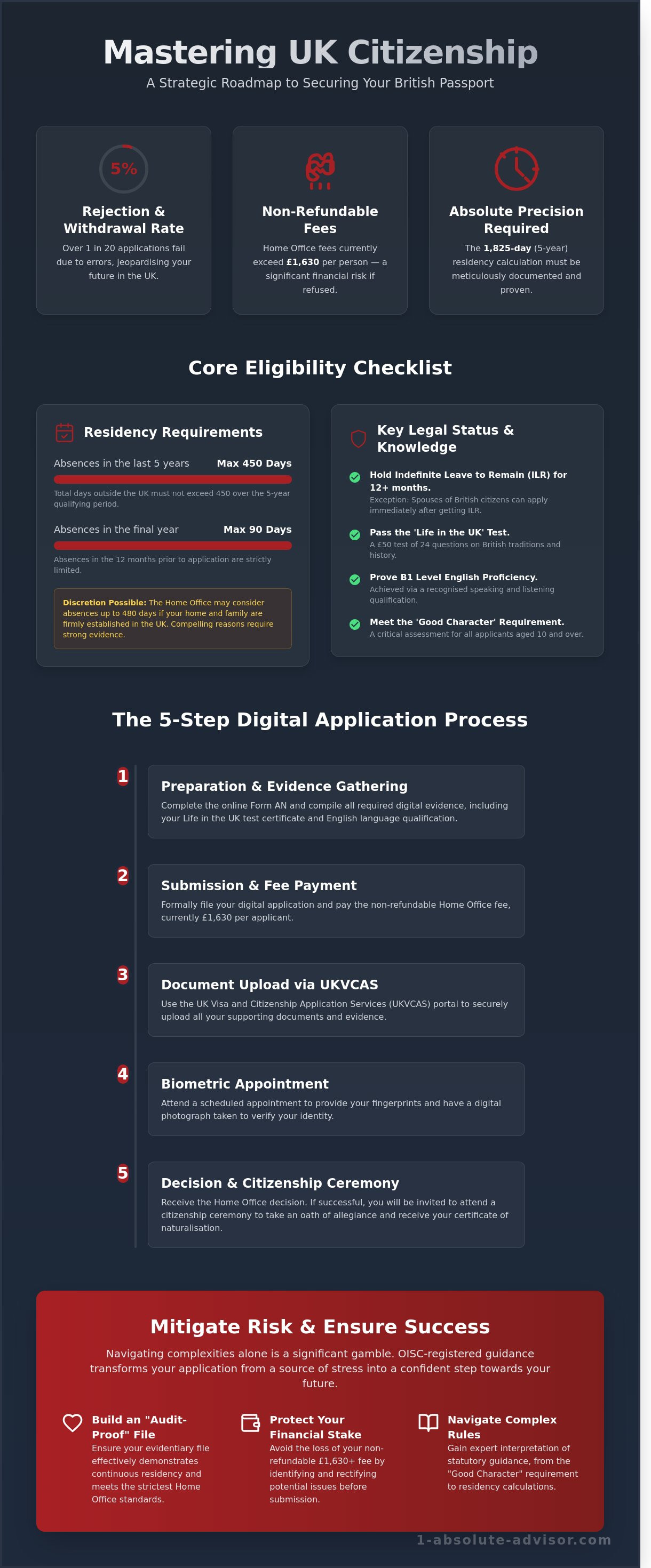
Did you know that according to 2024 Home Office transparency data, over 5% of naturalisation applications are rejected or withdrawn, often resulting in the loss of non-refundable fees that currently exceed £1,600 per person? When you decide to apply for citizenship uk, the margin for error is effectively zero. You’ve likely spent years meticulously tracking your absences and building a life here, so the thought of a single clerical mistake or a misunderstanding of the “good character” requirement jeopardising your future is a significant source of stress. We recognize that the 1,825-day residency calculation requires absolute precision to satisfy Home Office caseworkers.

This guide serves as your strategic partner to master these complexities and secure your British passport with total confidence. Our expert-led roadmap ensures your application is audit-proof by addressing the specific hurdles of the 2026 naturalisation process. We’ll walk you through documenting your residency history, interpreting the latest statutory guidance, and finalizing every detail to ensure your certificate is within reach.

Key Takeaways

  • Understand the mandatory “12-month rule” following the grant of Indefinite Leave to Remain to ensure you meet all legal eligibility criteria before starting your journey.
  • Learn how to accurately complete the online Form AN and prepare the specific digital evidence required to apply for citizenship uk without administrative delays.
  • Discover how to build an “audit-proof” evidentiary file that effectively demonstrates your continuous residency, even when standard passport scans fall short.
  • Navigate the complexities of the “Good Character” requirement to avoid common refusal traps that impact all applicants from age ten and above.
  • Mitigate the significant financial risk of non-refundable Home Office fees by identifying the strategic benefits of professional document checking and OISC-registered guidance.

Understanding British Naturalisation: Are You Eligible to Apply?

British naturalisation is the formal legal process that allows a non-British adult to acquire the same rights and status as those born in the United Kingdom. It represents the final stage of a multi-year immigration journey. Achieving this status requires strict adherence to statutory requirements and a clear understanding of the Home Office’s regulatory framework. To apply for citizenship uk, you must first demonstrate a commitment to living in the country permanently while meeting specific character and residency criteria.

The standard path requires applicants to hold Indefinite Leave to Remain (ILR) or “settled status” for at least 12 months before submitting their documentation. This “12-month rule” ensures that the applicant has maintained a stable presence in the UK beyond the initial grant of permanent residency. However, different rules apply if you’re married to or in a civil partnership with a British citizen. In these cases, the 12-month waiting period is waived, allowing you to submit your application immediately after receiving ILR status. All applicants must be at least 18 years old and possess the “sound mind” necessary to understand the legal implications of the oath of allegiance.

The Residency Requirement and the 90-Day Rule

The Home Office applies a precise look-back period when you apply for citizenship uk. Officials check your physical presence exactly five years before the date your application is received. If you were not physically in the UK on that specific calendar day five years ago, your application will likely be refused. Beyond this specific date, you must not have spent more than 450 days outside the UK during the five-year period. The final year is even more restrictive; you’re limited to just 90 days of absence in the 12 months leading up to your application.

Applicants who have exceeded these limits shouldn’t lose hope immediately. The Home Office may exercise discretion if your absences total between 450 and 480 days, provided you’ve established your main home, family, and estate in the UK. If you’ve surpassed the limits due to “compelling reasons” like a medical emergency or unavoidable work commitments for a UK-based employer, you must provide specific evidence, such as hospital records or certified letters from your company’s director, to justify the breach.

Knowledge of Language and Life in the UK

Demonstrating an integration into British society is a core requirement of the naturalisation process. Most applicants must pass the Life in the UK test, a 45-minute exam consisting of 24 questions about British traditions and history. You can book this test at one of the 30 plus official centres across the country for a fee of £50. You’ll also need to prove your English language proficiency at a B1 CEFR level or higher. This is typically achieved through a recognized qualification in speaking and listening from an approved provider.

Exemptions to these testing requirements are strictly defined. If you’re 65 or older, you aren’t required to take the Life in the UK test or prove your language level. Similarly, individuals with long-term physical or mental conditions that make passing the test impossible can seek a waiver. These claims require a specific medical waiver form completed by a registered UK doctor to ensure compliance with Home Office standards.

The 5-Step Process to Apply for Citizenship in the UK

Securing British nationality is a multi-stage legal procedure that demands absolute precision. When you apply for citizenship uk, the Home Office expects a seamless digital trail of your residency and character history. The process follows a methodical sequence designed to verify your eligibility through five distinct phases. Most applicants find that strategic planning during the initial stages prevents costly delays or rejections later in the cycle.

  • Step 1: Preparation. You must complete the online Form AN and compile digital evidence, including your Life in the UK test pass certificate and English language qualifications.
  • Step 2: Submission. This involves the formal filing of your digital application and the payment of the current Home Office fee, which stands at £1,630 as of late 2024.
  • Step 3: Document Upload. After payment, you’ll use the UKVCAS (UK Visa and Citizenship Application Services) portal to upload your supporting evidence or book a professional scanning service.
  • Step 4: Biometrics. You’re required to attend a physical appointment to provide your fingerprints and a digital facial photograph.
  • Step 5: Decision and Ceremony. Once approved, you’ll receive an invitation to attend a mandatory citizenship ceremony to take your oath and receive your naturalisation certificate.

Navigating the Online Form AN

The government’s digital portal allows you to register and save your progress, which is vital for managing the extensive data required. You must document every trip outside the country with total accuracy. Discrepancies between your travel logs and Home Office records can lead to refusal based on the “good character” requirement. You’ll also need to nominate two referees. One must be a professional of any nationality, such as a teacher or accountant, while the second must be a British citizen over the age of 25 who isn’t related to you. Choosing these individuals carefully ensures your apply for citizenship uk journey remains compliant with strict 2026 standards.

The UKVCAS Biometric Appointment Experience

The biometric stage is the final physical hurdle in the application. You’ll visit a service centre where staff capture your digital identity markers. It’s essential to bring your original passport and the appointment confirmation email. You can choose between “Standard” service points, which are often located in local libraries, or “Premium” VIP lounges in major cities like London or Manchester. The VIP options provide document checking and faster processing in a more comfortable environment. Unlike older systems, the UKVCAS process doesn’t require the Home Office to keep your physical passport. It’s scanned and returned to you immediately. A strategic partner can help you review your digital file before this final submission to ensure every document meets the required evidentiary threshold.

How to Apply for Citizenship in the UK: A Step-by-Step Guide for 2026

Building Your Audit-Proof Evidentiary File

The Home Office operates on a strict principle: the burden of proof rests entirely on your shoulders. When you prepare to apply for citizenship uk, you aren’t just filling out a form; you’re building a legal case for your right to remain permanently as a British national. Caseworkers don’t fill in the blanks or assume your presence in the country. If a gap exists in your timeline, they’ll likely flag the application for further scrutiny or rejection. This is why a simple passport scan often fails to meet the standard. While a passport shows your identity, it doesn’t provide a granular view of your daily residency, especially if you’ve used e-gates that don’t leave physical stamps.

You should view your evidence through a clear hierarchy of reliability. At the top sit official government and financial records. P60 documents from the last five years are the gold standard because they link your residency to HMRC tax contributions. Employer letters on headed paper, confirming specific dates of employment and any periods of leave, offer similar weight. Utility bills and council tax statements are useful but carry less authority. They prove a connection to an address, not necessarily your physical presence. Use a detailed cover letter to tie these threads together. This letter acts as your executive summary, explaining any complexities like name changes or brief periods of unemployment, ensuring the caseworker follows your logic from the first page.

Mandatory Documents for Every Applicant

Every successful application starts with a bedrock of three core components. First, you must provide your current passport and every previous passport held during your three or five-year qualifying period. If a passport was lost, a police report or official correspondence from your embassy is vital. Second, you need definitive proof of your status. This means your physical Biometric Residence Permit (BRP) or a digital status share code if you hold settled status. Finally, include your original Life in the UK test pass notification and your English language certificates at level B1 or higher. These are non-negotiable; missing even one will trigger an immediate stall in the process.

Supplementary Evidence for Complex Cases

If your situation isn’t a standard 9-to-5 employment history, you must provide additional layers of verification. Self-employed applicants should include their Annual Tax Calculations (SA302) and evidence of business activity, such as invoices or business bank statements. If you’ve exceeded the 450-day absence limit due to “compelling reasons,” you must document these events with precision. Medical emergencies require hospital letters; work-related travel needs a letter from your employer confirming the necessity of the trips. Before submitting, it’s wise to consult our ILR UK guide to ensure your underlying status is perfectly aligned with the requirements to apply for citizenship uk, as any flaws in your prior residency can haunt your naturalisation bid.

The “Good Character” Requirement: Avoiding Common Refusals

The “Good Character” requirement represents the most subjective phase when you apply for citizenship uk. Home Office caseworkers don’t simply look for a lack of a criminal record; they perform a discretionary, holistic assessment of your entire history. This rule is mandatory for every applicant aged 10 or older at the time of submission. While the British Nationality Act 1981 doesn’t provide a rigid definition of “good character,” the Home Office Nationality Policy Guidance, last updated in December 2023, identifies specific triggers that lead to refusal. These include criminal convictions, financial impropriety, and historical immigration breaches.

You must practice absolute transparency during this process. You’re required to disclose every incident, regardless of how much time has passed. This includes spent convictions under the Rehabilitation of Offenders Act 1974 and minor traffic offences like speeding tickets or fixed penalty notices. It’s a common mistake to assume minor issues don’t matter. In reality, the Home Office often views non-disclosure as an intentional attempt to deceive, which is a ground for refusal in itself. It’s the concealment, rather than the original minor offence, that often compromises an application.

Financial Integrity and HMRC Compliance

Your financial conduct serves as a key indicator of your reliability. Caseworkers scrutinize your records for unpaid taxes or unresolved disputes with HMRC. If you have a history of bankruptcy or high levels of debt, the Home Office evaluates whether you’ve acted dishonestly or recklessly. While a standard bankruptcy doesn’t cause an automatic refusal, any evidence of “debtor’s misconduct” or fraud will. We advise checking your tax compliance and credit standing before you pay the non-refundable fee. A single unresolved tax discrepancy from 2022 can jeopardize a 2026 application.

Previous Immigration Breaches and Deception

Past errors in your immigration journey can resurface during the naturalisation stage. If you’ve previously overstayed a visa by more than 28 days or worked in breach of your visa conditions, these factors weigh heavily against your character. The Home Office typically examines the last 10 years of your residency. If they determine you used “deception” in any prior application, they’ll likely refuse your request. For a detailed breakdown of how these factors influence your eligibility, read our British Citizenship guide.

Ensuring your background meets these high standards requires a strategic review of your personal and financial history. If you’re concerned about how past events might impact your ability to apply for citizenship uk, securing professional advice is the most effective way to mitigate risks before submission.

Professional Management: Why Use an OISC Registered Advisor?

Deciding to apply for citizenship uk is a significant financial and emotional commitment. As of late 2024, the Home Office application fee for naturalisation stands at £1,630. It’s vital to understand that these fees are generally non-refundable. If your application is refused due to a technical error, a missing document, or a misunderstood residency requirement, you lose that capital entirely. Professional management mitigates this risk by ensuring your file is compliant with the latest Home Office internal guidance before it reaches a caseworker’s desk.

Mistakes are expensive. A professional Document Checking Service provides a rigorous audit of your evidence. Advisors look for gaps in your five-year or three-year residency history that might trigger a rejection. Beyond simple checklists, experts draft detailed legal cover letters. These documents are essential if you need to explain complex issues, such as exceeding the permitted 450 days of absence or addressing “Good Character” concerns related to historical tax errors or civil penalties. We provide the peace of mind that comes with end-to-end management, allowing you to focus on your future while we handle the bureaucratic complexity.

Personalised Legal Support for Your Journey

Caseworkers appreciate clarity. We organise your evidence into a structured, indexed format that follows the logic of the British Nationality Act 1981. This professional presentation often facilitates a faster decision because the caseworker doesn’t have to hunt for facts. If the Home Office issues a request for further information (RFI), we manage all communication directly, ensuring that responses are timely and legally sound. OISC registration serves as a mandatory seal of quality, ensuring that your advisor is regulated, insured, and held to the highest professional standards in UK immigration law.

Next Steps: Securing Your Future in the UK

Approval is the beginning of a new chapter. Once you receive your invitation, you’ll attend a citizenship ceremony to take the oath of allegiance and receive your naturalisation certificate. This document is the key to your first British passport application. Transitioning from a migrant mindset to that of a citizen means gaining full voting rights and the permanent security of tenure in the UK. You no longer need to worry about visa expiries or changing immigration rules. It’s a definitive step toward absolute stability.

Ready to finalise your path to British nationality? Book a consultation with our citizenship experts today to ensure your application for citizenship uk is handled with professional precision.

Securing Your British Future Through Strategic Naturalisation

Navigating the path to British naturalisation requires more than just filling out forms; it demands a strategic alignment with current Home Office regulations. By 2026, the complexity of building an audit-proof evidentiary file and satisfying the stringent “Good Character” requirement has made precision a necessity rather than an option. You’ve now seen how the five-step process functions and why professional OISC-registered oversight is vital to mitigate the risk of a costly refusal. Every piece of evidence must be meticulously vetted to ensure it meets the rigorous standards set by UK Visas and Immigration.

The decision to apply for citizenship uk represents a significant milestone in your professional and personal life. Our team provides the stability and predictable outcomes you need through fixed-fee application management and expert legal cover letter drafting. We don’t just process paperwork; we act as your strategic partner to ensure every detail meets the highest standards of compliance and integrity. Our OISC-registered advisors bring the same level of professional rigor to your immigration status that you’d expect from a top-tier business consultancy.

Secure your British future with our expert citizenship application service and take the final step toward your new life with absolute confidence. Your journey toward British residency is a long-term investment that deserves the highest level of professional protection.

Frequently Asked Questions

How much does it cost to apply for British citizenship in 2026?

The standard fee for a British citizenship application currently stands at £1,630, following the fee structure established by the Home Office. You’ll also need to budget £19.20 for biometric enrollment and £50 for the Life in the UK test if applicable. These costs don’t include professional legal fees or the cost of English language certifications. The government typically reviews these figures every April, so checking the latest 2026 updates before submitting is essential for financial planning.

Can I apply for citizenship if I have been out of the UK for more than 90 days in the last year?

You can still apply, but you’ll need to provide a detailed explanation for the Home Office to exercise its discretion. The statutory limit is 90 days of absence in the 12 months preceding your application date. If your absences total between 100 and 179 days, caseworkers often overlook the excess if you’ve established your home, family, and estate in the UK. For absences exceeding 180 days, approval becomes significantly harder unless you’re working abroad for a UK based company.

How long does the Home Office take to process a citizenship application?

The Home Office aims to process 95% of citizenship applications within six months of the biometric appointment date. Some applicants receive their approval letter within 8 to 12 weeks, but this isn’t guaranteed for every case. If your application is complex or requires additional background checks, the timeline can extend beyond 180 days. You’ll receive a notification via email once the decision is made, and you’ll then have 90 days to book your citizenship ceremony.

What happens if my British citizenship application is refused?

If your application is refused, you’ll receive a letter explaining the specific grounds for the decision. You can request a formal reconsideration by submitting Form NR and paying a £450 fee. There’s no standard right of appeal for nationality cases, so this administrative review is your only path to challenge the Home Office. Statistics show that 10% of applications are refused due to failure to meet the good character requirement or incorrect documentation of residency dates.

Do I need to give up my original nationality to become a British citizen?

You don’t need to renounce your current nationality to apply for citizenship uk because the United Kingdom permits dual citizenship. However, you must verify the laws of your home country before proceeding. Nations like India, China, and Japan don’t recognize dual nationality and will automatically revoke your original citizenship the moment you naturalise as a British citizen. We recommend consulting a specialist to understand how a second passport impacts your tax status and property rights abroad.

Can I travel abroad while my citizenship application is being processed?

You’re allowed to travel outside the UK while your application is pending because the Home Office doesn’t retain your physical passport. After your biometric appointment at a UKVCAS center, you’ll keep all your original identity documents. It’s vital that you remain a UK resident during this period and don’t move your primary home to another country. You must also ensure you’re in the country to attend your citizenship ceremony within three months of receiving your approval.

Who can act as a referee for my UK citizenship application?

You must provide two referees who have known you personally for at least three years. One referee must be a professional person of any nationality, such as a teacher, accountant, or solicitor. The second referee must be a British citizen who is at least 25 years old and not related to you by birth or marriage. Both individuals must be in good standing and cannot be your legal representative or an employee of the Home Office or the UK Border Force.

Is the Life in the UK test required if I am over 65?

The Life in the UK test isn’t required for any applicant who is 65 years of age or older at the time they apply for citizenship uk. You’re also exempt from the B1 English language requirement once you reach this age threshold. If you’re under 65 but have a long term physical or mental condition, you may apply for an exemption by providing a specific medical waiver form signed by a registered doctor. For everyone else, the test remains a mandatory part of the process.

Discuss Your Case For FREE