
Managing Family Expectations During the UK Visa Process: A Practical Guide

Imagine it’s a Friday afternoon and you’re staring at an empty inbox while your partner asks for the fifth time if the Home Office has sent an update. This silent tension is often more taxing than the £1,846 application fee itself. Effectively managing family expectations during the uk visa process is just as critical as the legal paperwork, yet it’s the part most applicants overlook. You’re likely feeling the weight of their questions and the guilt of the mounting costs, but you don’t have to carry that burden alone.

We understand that waiting for a decision feels like your life is on hold, especially when children are asking for a firm move-in date you can’t provide. It’s completely normal to feel pressured by the lack of control over Home Office timelines. This guide will help you regain your household’s peace of mind by establishing a robust communication strategy and setting realistic expectations for 2026 processing times. We’ll outline how to translate complex immigration updates into a clear plan that keeps your loved ones informed and your stress levels manageable.

Key Takeaways

  • Understand the necessity of aligning family hopes with Home Office realities to mitigate household friction and maintain emotional stability throughout the application.
  • Distinguish between official service targets and actual processing outcomes for 2026 to establish a realistic timeline for both in-country and out-of-country routes.
  • Implement a structured communication framework for managing family expectations during uk visa process by designating a lead communicator and scheduling regular updates.
  • Learn how to tailor transparency levels for different family members, ensuring partners, children, and elderly parents receive information that is helpful rather than overwhelming.
  • Discover how professional OISC-registered guidance acts as a strategic buffer, providing the absolute peace of mind required for complex immigration transitions.

Why Managing Family Expectations is Crucial for UK Visa Success

Success in a legal context is often measured by a positive decision, yet for a family, success also includes emerging from the process with their relationships intact. Managing family expectations during uk visa process is the strategic alignment of a family’s personal hopes with the rigid, often slow-moving realities of the UK Visas and Immigration (UKVI) system. When expectations aren’t grounded in fact, misaligned timelines lead to significant household friction and unnecessary psychological stress. A family that anticipates a six-week turnaround but faces a five-month wait will struggle to maintain the composure needed for such a high-stakes endeavour.

A unified front is your most valuable asset. Complex legal applications require a high level of detail, and any internal discord can lead to errors in documentation or missed deadlines. Maintaining emotional stability isn’t a luxury; it’s a tactical necessity that allows for better decision-making during the entire UK immigration journey. By treating the application as a shared project rather than a source of blame, sponsors and applicants can navigate the bureaucracy with professional precision and clarity.

The Psychological Impact of Immigration Uncertainty

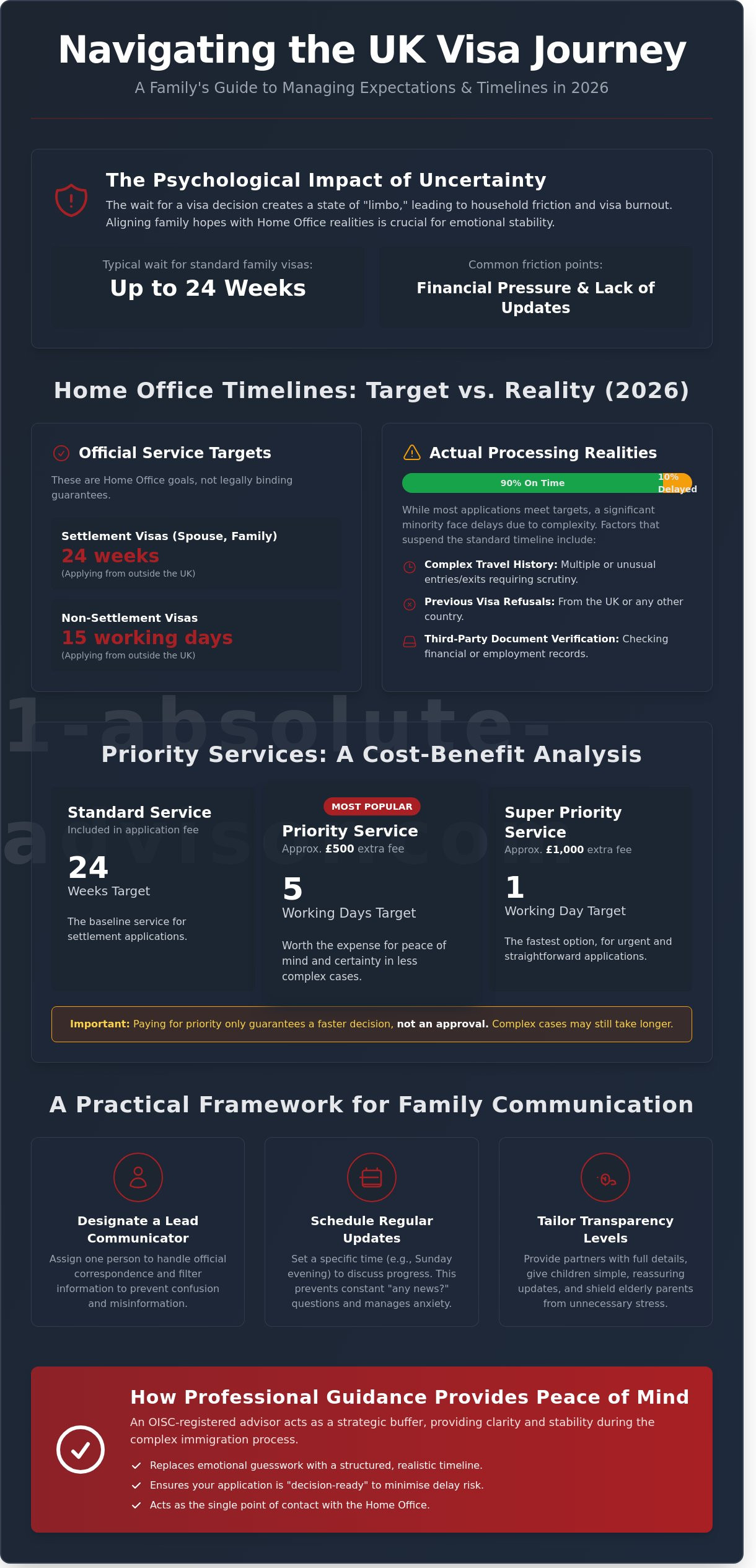
Families frequently enter a state of “limbo” while waiting for a decision. This period of waiting, which can span from 15 working days for priority services to 24 weeks for standard family routes, creates a vacuum of information. Visa burnout often manifests in partners as chronic anxiety, irritability, or a sense of helplessness. Professional oversight acts as a stabilising force, replacing emotional guesswork with a structured timeline. Having a clear roadmap provides a sense of control, which is essential for long-term resilience during the months of waiting.

Identifying Common Friction Points in Family Dynamics

Financial requirements are a frequent catalyst for domestic tension. Meeting the specific income thresholds for a spouse visa uk, which rose to £29,000 in April 2024, places immense pressure on the UK-based sponsor to provide perfect evidence of earnings. This pressure is compounded by the lack of transparency in Home Office status updates, which often remain stuck on “received” for months without progress. Sponsors must also manage external pressure from extended family members who may offer well-meaning but outdated advice, creating further confusion in an already complex regulatory environment.

Understanding Home Office Timelines and Processing Realities in 2026

The Home Office operates on service standards that function as targets rather than legal obligations. For those applying from outside the UK, the standard benchmark for non-settlement visas is 15 working days. Settlement applications, such as spouse or family visas, typically extend to 24 weeks. When you’re managing family expectations during uk visa process, you must distinguish between these targets and the actual delivery dates. Current official Home Office timelines indicate that while 90% of applications meet these windows, the remaining 10% often face significant hurdles.

Several factors trigger delays that are beyond your control. If an applicant has a complex travel history, previous visa refusals, or if the Home Office needs to verify documents with third parties, the standard timeline is suspended. No advisor can guarantee a specific decision date. Our role is to provide a specific standard of preparation that ensures your file is “decision-ready,” which reduces the risk of the caseworker setting it aside for further enquiries.

Standard vs. Priority Services: Making the Right Choice

In 2026, the Home Office continues to offer expedited processing for an additional cost. The Priority service usually costs around £500 and aims for a decision within five working days. The Super Priority service, costing approximately £1,000, targets a next-working-day result. These services are often worth the expense to provide family peace of mind and certainty. However, it’s vital to understand that paying for priority only guarantees a faster decision, not an approval. If your case is complex, the Home Office may still take longer than the advertised priority window, though they usually notify you if this happens.

Why “Estimated” Dates are Rarely Guaranteed

Processing speeds fluctuate based on global events and seasonal surges. Every year, the system faces immense pressure during the student visa peak in August and September. Additionally, shifts in skilled worker visa uk quotas or policy changes can create administrative bottlenecks that slow down all application types. These systemic shifts mean that an application submitted in May might be processed twice as fast as one submitted in August.

We advise all clients to build a minimum four-week buffer period into their travel and relocation plans. Don’t book non-refundable flights or resign from employment until the vignette is physically in your passport. If you need a professional review to ensure your timeline is realistic, our team offers strategic visa planning to help you navigate these uncertainties with confidence. This methodical approach ensures that your family remains informed and prepared for any eventuality.

Managing Family Expectations During the UK Visa Process: A Practical Guide

Tailoring Communication for Different Family Members

Effectively managing family expectations during uk visa process requires a nuanced strategy because a six-year-old child and a spouse interpret a “pending” status through entirely different lenses. Precision in communication prevents the spread of anxiety. You should provide enough detail to ensure clarity without overwhelming relatives with the technical minutiae of Appendix FM or complex maintenance requirements. Establishing a structured schedule for updates is essential for maintaining a sense of normalcy. Instead of discussing the application every evening, schedule a 20-minute weekly briefing. This keeps the move as a strategic goal rather than a source of daily friction.

Focusing on the “why” of the relocation is the most effective way to maintain long-term morale. Remind your family that the temporary administrative hurdles lead to specific benefits, such as access to the UK’s world-class education system or a 15% increase in household purchasing power. When uncertainty peaks, redirecting the conversation to these tangible outcomes helps ground the family in the purpose of the transition.

Discussing the Process with a Spouse or Partner

Financial transparency is vital, but it must be handled with care. The current minimum income requirement of £29,000, which rose from £18,600 on 11 April 2024, can feel like a heavy burden. Frame these financial thresholds as strategic benchmarks rather than personal pressures. It’s helpful to involve your partner in the evidence-gathering stage; asking them to organise their own bank statements or English language test results fosters a sense of agency. You should also co-author a “Plan B” together. If the Home Office exceeds the standard 12-week window, having a pre-agreed contingency for temporary housing or extended employment in your current location prevents a breakdown in trust.

Explaining the Move to Children Without Causing Anxiety

Children thrive on certainty, an element that the Home Office rarely provides. Consulting the official UK government visa processing times provides a baseline for your internal planning, but you shouldn’t share specific dates with your children. If you promise a flight in July and the visa arrives in August, it creates unnecessary distress and a loss of confidence. Use age-appropriate language to explain that the family is “waiting for an official invitation” to start their new adventure. Shift the focus to the positive aspects of their new environment, such as the local parks in your chosen UK borough or the specific extracurricular clubs at their future school. This replaces the anxiety of the unknown with the excitement of a new, well-planned reality.

A Practical Framework for Family Communication

Structure provides the stability that the Home Office’s processing timelines often lack. Without a clear system, the administrative burden of a visa application can erode family dynamics and create unnecessary friction. Successful relocation depends on managing family expectations during uk visa process by treating the application like a professional project rather than an emotional crisis.

Assigning a “Lead Communicator” is the first step toward internal stability. This person acts as the single point of contact for legal advisors or Home Office notifications, filtering technical jargon before presenting it to the rest of the family. It prevents the “too many cooks” scenario where different family members interpret status updates differently, leading to confusion. You should also maintain a shared digital folder. Storing scans of TB test results, English language certificates, and financial records in one accessible place ensures everyone feels informed without needing to ask for updates constantly.

  • Establish a fixed update schedule: Choose a specific time, such as Sunday evenings, to discuss progress. This stops the visa from becoming the sole topic of conversation at every meal.
  • Centralise documentation: Use a secure cloud drive for all application materials to maintain transparency.
  • Define roles: Ensure one person handles the logistics of the move while another manages the document gathering.

Setting “No-Visa-Talk” Zones to Preserve Mental Health

Constant discussion about Home Office delays can lead to burnout. Families must protect their mental space by designating “No-Visa-Talk” zones or times. This might mean banning the subject during dinner or after 8:00 PM. When well-meaning relatives ask, “Any news yet?”, have a scripted response ready. A simple “We’re following the standard 8 to 24-week processing window and will let you know when there’s a definitive update” keeps boundaries firm. Maintaining normal routines like Saturday morning sports or cinema trips is vital for children who may feel the underlying tension of the move.

Creating a Shared Contingency Plan

Hope is not a strategy. You need a concrete plan for when things don’t go according to the initial timeline. Managing family expectations during uk visa process requires discussing “Plan B” openly. If a visa is delayed by six weeks, how will that affect school start dates in September? If you’re looking toward the future and planning for ilr uk, you must understand that the journey is a marathon, not a sprint.

Financial planning is the bedrock of this contingency. Ensure you have an emergency fund in GBP to cover at least two months of unexpected accommodation if your house sale completes before the visa arrives. If a school place is missed, look into temporary tutoring or online British curriculum modules to keep children on track. Emotional support is equally important; acknowledge that the person most affected by the delay, often the spouse or older children, may need extra patience and perhaps professional relocation coaching.

For expert guidance on structuring your relocation strategy, contact Absolute Advisor today.

How Professional Guidance Minimises Family Stress

Engaging an OISC-registered advisor shifts the administrative burden from the household to a qualified professional. This advisor acts as a vital buffer between the family unit and the Home Office, interpreting technical requests and shielding relatives from the often-confrontational tone of official correspondence. By managing the primary communication channel, the advisor ensures that every interaction remains objective and precise, which removes the emotional volatility that typically disrupts domestic life during a high-stakes application.

The “peace of mind” provided by a professional document review cannot be overstated. A comprehensive audit of a 100-page evidence bundle identifies technical gaps that an untrained eye would likely miss. This level of scrutiny drastically reduces the risk of applications falling into the 15% to 25% of cases that face significant delays due to “evidential flexibility” requests or missing mandatory information. Viewing expert advice as an investment in family harmony, rather than just a legal cost, allows the sponsor to protect their relationships from the strain of a potential refusal.

The Value of Professional Oversight

A clear, upfront strategy eliminates the panic of searching for historical financial records or obscure housing documents at the eleventh hour. When a family follows a structured plan, the process becomes a series of manageable tasks rather than a looming crisis. A professionally drafted legal cover letter serves a dual purpose; it provides a narrative for the caseworker and pre-empts Home Office queries by explaining complex family dynamics or non-standard income sources before they become grounds for rejection. An OISC-registered advisor provides a structured, month-by-month roadmap for 2026 that transforms abstract visa requirements into a predictable, manageable timeline for the entire household.

Transitioning from Anxiety to Action

Professional support facilitates a psychological shift within the home. Instead of “waiting” in a state of perpetual anxiety, the family moves toward “preparing” for their future in the UK. This transition allows the sponsor to resume their role as a supportive partner or parent, leaving the technicalities of the Immigration Rules to their representative. This clarity is essential for managing family expectations during uk visa process, as it replaces guesswork with verified milestones.

For those at the beginning of their journey, whether applying for an initial family visa or seeking british citizenship, taking the first step with professional backing ensures the foundation of the application is sound. Proactive preparation remains the most effective tool for maintaining family stability throughout 2026 and beyond. By delegating the legal complexities, you ensure that your family’s focus remains where it belongs: on your shared future together in the United Kingdom.

Preparing for your new life also means looking after your personal well-being, which is often impacted by the stress of the immigration journey. Once settled, many find that investing in self-care is a vital step in feeling refreshed and confident. For those exploring rejuvenation treatments to counteract the effects of stress, you can learn more about Eternal Youth Clinic and its medically-led aesthetic services. Additionally, if the physical strain of relocation has impacted your joints, you may wish to explore Hyaluronic Acid (HA) Injections to restore your mobility and comfort.

Take Control of Your Family’s UK Immigration Journey

Navigating the Home Office’s shifting requirements requires more than just administrative accuracy; it demands a strategic approach to communication. Successfully managing family expectations during uk visa process hinges on transparency regarding the 2026 processing realities. Current Home Office service standards indicate that family visa applications from outside the UK typically take up to 24 weeks, while priority services aim for a decision within 30 working days. By establishing a clear framework and explaining these statutory timelines early, you’ll prevent the friction that often arises from uncertainty.

Our team at Absolute Advisor provides the stability your family needs during this transition. As OISC Level 1 Registered specialists, we bring expertise to complex family immigration cases, ensuring every detail aligns with current UKVI guidance. We manage the technical complexities through our fixed-fee application management, so you don’t have to worry about bureaucratic hurdles or unexpected costs. It’s about providing a professional roadmap that protects your family’s future through methodical, evidence-based planning.

Book a consultation with our OISC-registered advisors to secure your family’s future and replace anxiety with expert-led certainty. We’re here to ensure your move to the UK is handled with the absolute precision and care it deserves.

Frequently Asked Questions

How long is the current wait for a UK spouse visa in 2026?

Standard processing for a UK spouse visa from outside the UK currently averages 24 weeks; applications from within the country typically take 8 weeks. While Home Office targets aim for 100% of cases within these windows, 95% of family applications met these service standards in recent performance reports. You should prepare your family for a six-month window to ensure managing family expectations during uk visa process remains grounded in reality.

Can I speed up my family visa application after I have submitted it?

You cannot upgrade to a priority service once you’ve submitted your online application and paid the fee. The Home Office doesn’t permit retrospective changes to the processing level. If your circumstances become exceptionally urgent or compassionate, you might contact UK Visas and Immigration (UKVI) via their paid enquiry service, but this rarely changes the timeline. It’s vital to select the correct service speed at the initial payment stage.

What should I tell my children if our UK visa is delayed?

Explain the delay using simple, age-appropriate logic, focusing on the fact that the UK government is just checking the final details to make the move safe. Reassure them that a delay isn’t a refusal, but a longer wait. You might use a calendar to mark specific check-in dates every 7 days. This structure helps children visualise time and reduces the anxiety often associated with the uncertainty of managing family expectations during uk visa process.

How much does it cost to use a priority service for a UK family visa?

The priority service for family visa applications submitted outside the UK costs £500, which aims for a decision within 30 working days. If you’re applying from within the UK, the super priority service is £1,000 for a next-working-day decision. These fees are paid in addition to the standard application fee of £1,846 for overseas applicants. These costs are subject to annual Home Office reviews, typically occurring every April.

Does using an immigration advisor guarantee a faster decision?

Using an immigration advisor doesn’t guarantee a faster decision from the Home Office, as they don’t have back-door access to speed up government processing. However, OISC-regulated advisors reduce the risk of delays caused by incomplete documentation or errors. Since 15% of applications face delays due to missing evidence, professional oversight ensures your file is decision-ready. This precision prevents the clock from stopping while officials request additional information.

What happens to my family if my UK visa application is refused?

If the Home Office refuses your application, you’ll receive a decision letter outlining the specific grounds for the refusal and whether you have a right to appeal or administrative review. Your family’s status remains unchanged in their current location while you challenge the decision. Statistics show that roughly 50% of appeals are successful when they’re based on human rights or procedural errors. You’ll need to decide between a fresh application or a legal appeal within 28 days.

How can I track the status of my UK visa application online?

You can track your application status through the commercial partner’s website, such as VFS Global or TLScontact, using the reference number provided at your biometrics appointment. The Home Office doesn’t provide a real-time, step-by-step tracker for family visas. Instead, you’ll see status updates like “received by UKVI” or “dispatched.” For more detailed updates, you can use the UKVI paid email service, which costs £2.74 per enquiry.

How to Cope with Visa-Related Separation: A Comprehensive UK Guide for 2026

On January 15, 2026, a Family Visa holder discovered that the end of their three-year relationship had instantly triggered a mandatory reporting requirement to the Home Office. It’s a situation where personal grief meets cold, administrative reality, often leaving individuals feeling vulnerable to immediate deportation. Learning how to cope with visa-related separation requires balancing your emotional recovery with a rigorous adherence to UK immigration compliance. You aren’t alone in feeling that the legal system complicates an already painful life transition, but your residential security doesn’t have to be the casualty of a breakup.

This comprehensive guide provides the strategic clarity you need to protect your right to remain in the UK under the 2026 immigration rules. You’ll gain a precise understanding of your reporting duties and a clear roadmap for switching to alternative routes like the Skilled Worker or 10-year long residency streams. We’ll examine the specific procedural steps necessary to transform this period of legal uncertainty into a stable, independent future, ensuring you maintain absolute control over your status.

Key Takeaways

  • Understand your mandatory legal obligations to the Home Office and how the cessation of a ‘subsisting relationship’ fundamentally alters your right to remain.
  • Learn how to cope with visa-related separation by effectively utilizing the 60-day curtailment period as a strategic window to transition to an alternative visa route.
  • Identify independent pathways to residency, such as the Parent Route, to maintain your life and family ties in the UK without relying on a partner’s sponsorship.
  • Master the practical steps of a visa transition, including leave audits and the collection of critical evidence, to build a resilient and compliant application.
  • Discover why professional OISC-registered guidance is vital for navigating the complex legal and emotional landscape of a relationship breakdown while securing your future.

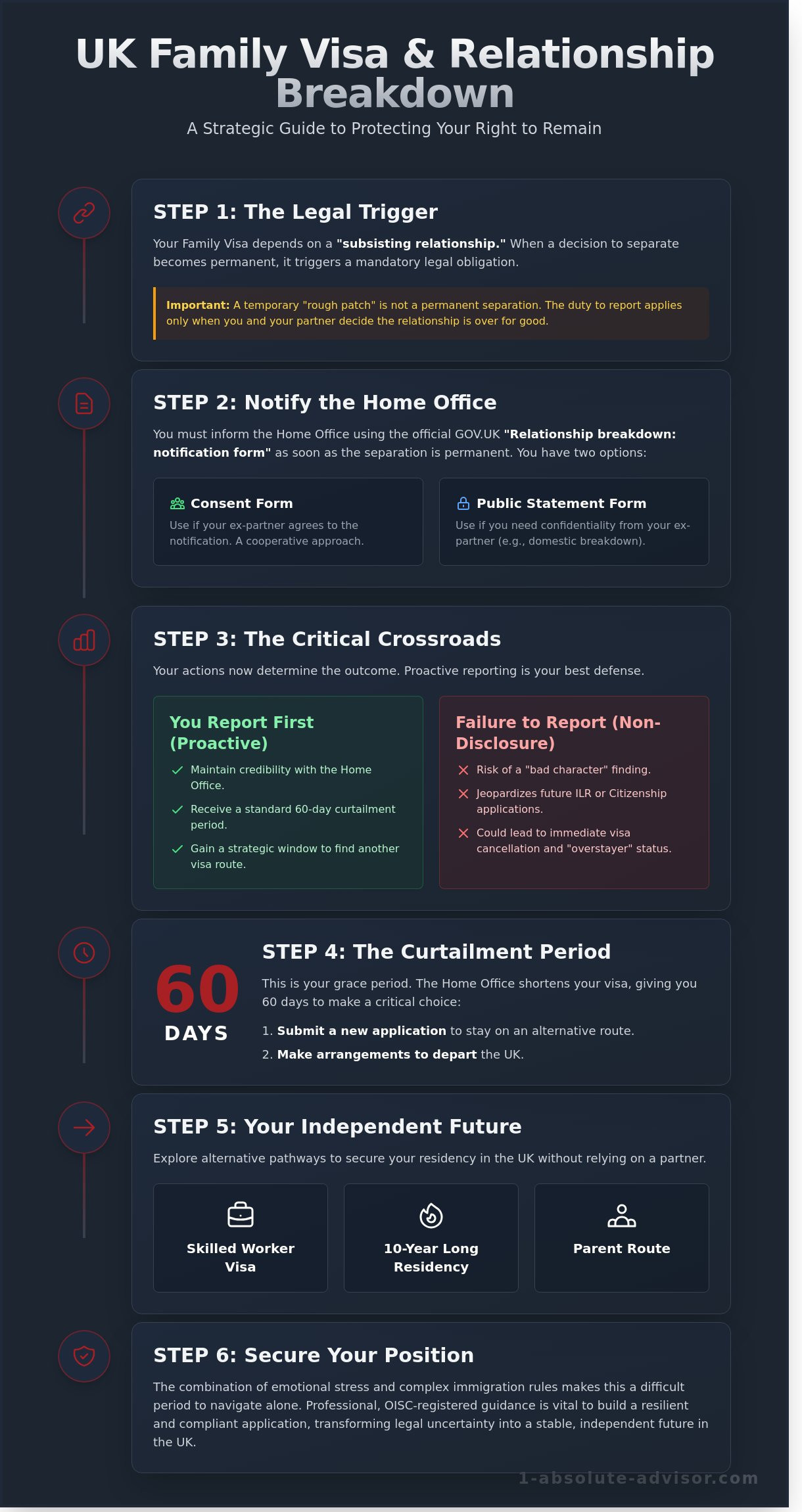
Immigration status under a Family Visa depends entirely on the existence of a “subsisting relationship.” This term is not merely a romantic sentiment; it is a strict legal requirement defined under Appendix Relationship with Partner of the UK Immigration Rules. A subsisting relationship requires that the couple is in a genuine partnership and intends to live together permanently in the UK. While a temporary “rough patch” or a brief period of marital friction does not legally terminate your status, a formal decision to separate permanently does. Understanding how to cope with visa-related separation requires a clear-headed approach to these legal definitions from the outset.

Transparency acts as your primary defense against future allegations of visa fraud. The Home Office views the failure to report a change in circumstances as a “material non-disclosure.” If you continue to live in the UK on a spouse or partner visa after the relationship has ended without informing the authorities, you risk a “bad character” finding. This designation can permanently jeopardize future applications for Indefinite Leave to Remain (ILR) or British Citizenship. Taking proactive steps ensures you remain compliant with the law even during personal turmoil.

How and When to Notify the Home Office

The duty to inform the Home Office is mandatory and should be completed as soon as the separation is considered permanent. You must use the official “Relationship breakdown: notification form” available on the GOV.UK website. The process requires specific data points, including your Home Office reference number, case ID, and your partner’s full details. If children are involved, you must provide their names and dates of birth to ensure their welfare is considered in any subsequent visa decisions.

Privacy is a significant concern during this process. The Home Office provides two distinct paths: the “Consent” form and the “Public Statement” form. If your ex-partner agrees to the notification, the Consent form is used. However, if you do not want your ex-partner to see the information you provide, or if the relationship ended due to domestic breakdown, the Public Statement form allows you to report the change while requesting that your new address and specific details remain confidential from your former partner.

The Consequences of Non-Disclosure

Failing to report a separation is a strategic error that often leads to the “curtailment” of your visa under less favorable terms. If your ex-partner reports the separation first, the Home Office may move to cancel your visa immediately. When you report the change yourself, you maintain a level of credibility that is essential for switching to a different visa category, such as a Work Visa or a Parent Visa. Usually, the Home Office will issue a letter giving you 60 days to either depart the UK or submit a new application to stay.

Ensuring your address is updated is a critical component of how to cope with visa-related separation effectively. All formal correspondence regarding your “curtailment” or “leave to remain” will be sent to the last address the Home Office has on file. If you have moved out and fail to update your details via the online “Update your UK Visas and Immigration account” service, you may miss the 60-day deadline to respond. Missing this window leads to an “overstayer” status, which carries severe legal penalties and complicates any future legal presence in the UK.

Curtailment is the formal process where the Home Office shortens your existing leave to remain. This usually occurs when the basis of your stay, such as a sponsorship or a marriage, ceases to exist. Under Immigration Rules Part 9, the Secretary of State has the power to reduce your remaining time to a standard 60-day window. Understanding this timeline is essential for anyone figuring out how to cope with visa-related separation, as it provides a finite period to assess future legal options before your status expires.

The 60-day rule acts as a transitional grace period. It’s a policy application designed to give individuals time to either depart the UK or find an alternative legal route. If your visa had more than 60 days left, it gets cut down; if it had less, the original expiry date usually stands. There are rare instances where the Home Office cancels permission with immediate effect, particularly in cases involving deception or serious criminal conduct. You must monitor your registered email and physical post daily. If a Notice of Curtailment is served to your last known address or “to file” because you’re unreachable, the 60-day countdown begins regardless of whether you’ve read the letter.

Your Rights and Restrictions During Curtailment

During these 60 days, your existing conditions generally remain in place. You can typically continue working or studying under the same terms as your original visa. Access to the NHS continues as you’ve already paid the Immigration Health Surcharge. However, you must not travel outside the Common Travel Area. Leaving the UK during a curtailment period effectively ends your leave immediately; you’ll likely be refused re-entry at the border because your permission to stay has been revoked.

Managing the Emotional and Practical Stress

The pressure of a ticking clock can be overwhelming. Use this time to organize your personal affairs, such as ending a tenancy or managing local assets, while you explore new pathways. Seeking assistance from migrant welfare organizations can provide emotional stability during this transition. Most importantly, securing a professional UK immigration assessment should be your priority. A strategic review of your situation helps identify if you qualify for a different visa category, such as a Skilled Worker or a private life route. Taking this step early transforms a crisis into a manageable transition. For those needing a clear roadmap, an Absolute Advisor consultation can provide the professional integrity required to navigate these complex legal waters and help you understand how to cope with visa-related separation through proactive planning.

How to Cope with Visa-Related Separation: A Comprehensive UK Guide for 2026

Evaluating Your Options to Stay in the UK Independently

Separation doesn’t always necessitate a departure from the UK. Understanding how to cope with visa-related separation involves a clinical assessment of your individual eligibility for non-partner routes. By April 2026, the Home Office has solidified several pathways that allow individuals to transition from a dependent status to an independent one. Analyzing the 10-year long residence rule is a logical first step. If you’ve lived in the UK legally for a continuous decade, you might qualify for Indefinite Leave to Remain (ILR) regardless of your relationship status. This path requires a clean criminal record and no absences exceeding 180 days in any 12-month period, providing a permanent solution for those who have built a life here over the last ten years.

Staying as a Parent: The Article 8 Route

Securing your status as a parent provides a vital safety net under Article 8 of the European Convention on Human Rights. This route is applicable if you have a British or settled child under 18 years of age. You’ll need to demonstrate an active role in the child’s upbringing through school reports, medical records, or financial support evidence. While the ‘sole responsibility’ test remains a high bar for single parents, shared parental access is often sufficient if you can prove the child’s best interests require your presence. Courts prioritize child welfare under Section 55 of the Borders, Citizenship and Immigration Act 2009, making this a robust option for those wondering how to cope with visa-related separation while maintaining essential family bonds.

Work and Study: Switching Categories

Switching into a skilled worker visa uk offers a path based on professional merit rather than domestic ties. As of early 2026, the general salary threshold remains at £38,700 for most applicants, though certain healthcare or education roles may qualify for lower requirements. If you’re a recent graduate from a UK institution, the Graduate visa serves as a 2-year bridge to gain work experience without the immediate need for an employer’s sponsorship. For entrepreneurs with scalable business ideas, the Innovator Founder route is a viable alternative, provided an endorsing body approves your plan. Reviewing a broader UK work visa strategy ensures your residency remains secure and entirely independent of your former partner’s sponsorship.

Practical Steps for a Successful Visa Transition

Understanding how to cope with visa-related separation requires a methodical approach to your immigration status. You must move from emotional reaction to strategic action. The UK immigration system operates on strict timelines; missing a single deadline can jeopardize your right to stay. Following a structured transition plan ensures you remain compliant while exploring new routes to residency.

Step 1: Audit your current leave. Check your eVisa or BRP to identify your exact expiry date. Since the UK transitioned to fully digital records in January 2025, you should verify your status through the official “view and prove” service to ensure no discrepancies exist in the Home Office database.

Step 2: Collect evidence of your life in the UK. Gather documents that prove your employment history, housing stability, and family ties. This data forms the foundational evidence for any subsequent application you might pursue.

Step 3: Formalise your separation with the Home Office. You’re legally required to notify them when a qualifying relationship ends. While this triggers the curtailment process, it stops the clock on your current status as a dependent and allows you to move toward an independent immigration category.

Step 4: Secure professional legal advice. A specialist can map out your new application, whether it’s a Skilled Worker visa, a family visa based on your children, or a human rights claim. Mapping these options early prevents rushed, high-stakes decisions.

Step 5: Submit your new application before the 60-day curtailment period ends. This 60-day window is non-negotiable. Submitting a valid application within this timeframe maintains your right to work and access services under Section 3C leave while the Home Office processes your request.

Evidence Gathering Checklist

A successful transition depends on the quality of your documentation. You’ll need to demonstrate your integration and self-sufficiency through a clear paper trail:

  • Proof of cohabitation: Bank statements, council tax bills, or utility invoices from the period your relationship was valid to prove the partnership was genuine.
  • Financial records: Six months of payslips or personal bank statements demonstrating you meet the financial requirements without relying on public funds.
  • Child-related documentation: Letters from schools, GPs, or social services if you have children in the UK, as their “best interests” are a primary consideration in many visa routes.

Applying for ILR Early

If your relationship ended because of domestic abuse, you don’t have to wait for the usual five-year period to settle. You can apply for ilr uk through the Domestic Violence Indefinite Leave to Remain (DV-ILR) route. This provision protects vulnerable individuals, allowing them to secure their status independently of their former partner. Securing your future involves learning how to cope with visa-related separation while simultaneously managing these complex legal requirements.

To succeed in a DV-ILR claim, you’ll need to provide evidence of the abuse, which can include police reports, medical records, or letters from support organisations. Even during this period of personal upheaval, you’ll still need to pass the Life in the UK test unless you’re exempt due to a specific physical or mental condition. Preparing for this test early can reduce overall stress during the final application stages.

For a detailed assessment of your eligibility and a strategic roadmap for your stay, consult with our expert advisors today.

How Professional Guidance Secures Your Future

Attempting a DIY visa application during a relationship breakdown often leads to critical errors. Emotional stress clouds judgment, causing applicants to miss deadlines or overlook mandatory evidence. In 2024, Home Office data indicated that a significant portion of family visa refusals stemmed from insufficient proof of relationship subsistence or financial requirements. When you are learning how to cope with visa-related separation, the technical burden of UK immigration law shouldn’t rest on your shoulders alone.

An OISC-registered advisor acts as your strategic partner. We don’t just fill out forms; we draft a comprehensive legal cover letter that contextualizes your situation for the caseworker. This document bridges the gap between raw evidence and the specific requirements of the Immigration Rules. Our team ensures that your current crisis doesn’t compromise your eligibility for british citizenship in the future. We meticulously review your history to satisfy “Good Character” requirements, which are essential for naturalisation in 2026. Managing these complexities through a fixed-fee service provides financial predictability when your personal life feels most unstable.

Avoiding Common Pitfalls

Ignoring a Home Office letter is a common mistake that leads to disastrous results. If you receive a notification regarding your leave to remain, you must act within the specified timeframe, usually 14 to 28 days. Failing to respond can lead to the curtailment of your visa. Overstaying even by a single day can trigger a re-entry ban and ruin your prospects for any future UK visa. Professional document checking identifies inconsistencies in bank statements or housing evidence before they reach the Home Office, significantly reducing the risk of a refusal based on technicalities.

Taking the Next Step

Every family situation is unique, and generic advice cannot replace a tailored strategy. Understanding how to cope with visa-related separation requires a clear roadmap for your legal status. Booking a consultation allows us to assess your specific circumstances, including any children involved or human rights claims. Before your first meeting, please gather your current passport, your BRP, any correspondence from the Home Office, and proof of your current living arrangements. Having these documents ready allows us to provide immediate, actionable advice during our initial session.

Don’t leave your residency status to chance during this difficult transition. Contact 1 Absolute Advisor for expert assistance with your visa transition and secure your long-term future in the UK with professional support.

Taking Control of Your UK Residency Path

Navigating a relationship breakdown while on a family visa requires a swift, strategic response to meet Home Office requirements. You must report changes to the authorities immediately to manage the 60-day curtailment period effectively. Understanding how to cope with visa-related separation involves evaluating your eligibility for independent routes, such as the Skilled Worker visa or the 10-year long residency path. These transitions are complex, but they provide a clear framework for remaining in the UK legally through 2026 and beyond. Our OISC-registered experts specialize in complex family visa transitions, ensuring every application aligns with current UKVI standards. We provide fixed-fee application management to remove financial uncertainty during this critical time. You don’t have to face the legal system alone when your future is at stake. By taking proactive steps today, you can transform a period of instability into a foundation for long-term security. Secure your future in the UK with a professional visa assessment and gain the clarity you need to move forward with confidence.

Frequently Asked Questions

Do I have to leave the UK immediately after my divorce is finalised?

You don’t have to leave the UK the moment your divorce is finalised. The Home Office typically issues a curtailment notice that grants you 60 days to either apply for a different visa or make arrangements to leave. This 60-day period begins from the date you receive the official letter, giving you a vital window to restructure your legal status.

Can I switch from a spouse visa to a work visa without leaving the country?

You can switch to a Skilled Worker visa from within the UK if you secure a job offer from a licensed sponsor. You’ll need to meet the specific salary and English language requirements defined in the 2024 Immigration Rules. This transition allows you to maintain continuous residency without the expense and disruption of returning to your home country for a new application.

What happens to my children’s visas if my partner and I separate?

Your children’s status usually depends on their length of residency and your new visa category. If a child has lived in the UK for 7 continuous years, they may qualify for leave to remain independently under private life rules. The Home Office must also consider the child’s best interests as mandated by Section 55 of the Borders, Citizenship and Immigration Act 2009.

Will the Home Office tell my ex-partner that I have applied for a new visa?

The Home Office won’t disclose your new application details or your current address to your ex-partner. Your privacy is strictly protected under the Data Protection Act 2018 and standard GDPR protocols. While the Home Office notifies the sponsor that the relationship has ended, they don’t share any information regarding your subsequent immigration steps or personal location.

How much does it cost to switch to a different visa category in 2026?

Switching to a Skilled Worker visa for up to 3 years costs £827 according to the fee structures established in 2024. You must also budget for the Immigration Health Surcharge, which currently stands at £1,035 per year of the visa’s duration. These figures represent the baseline government fees and don’t include potential costs for priority processing or professional legal representation.

What if I can’t find a job that meets the salary threshold for a work visa?

You might still qualify for a visa if your occupation is listed on the Immigration Salary List or if you’re under 26 years old. While the standard salary threshold rose to £38,700 in April 2024, “new entrants” and health sector workers often benefit from significantly lower requirements. Understanding how to cope with visa-related separation involves identifying these specific professional exemptions to secure your future.

Can I still apply for British Citizenship if my relationship ended before I got ILR?

You can’t apply for citizenship until you’ve held Indefinite Leave to Remain (ILR) for at least 12 months. If your relationship ends before you reach the ILR milestone, you must first switch to another visa, such as a work or ancestry visa, to complete the 5-year residency requirement. Learning how to cope with visa-related separation requires a strategic approach to bridge this gap in your settlement timeline.

What should I do if my ex-partner is threatening to ‘cancel’ my visa?

Your ex-partner doesn’t have the legal power to cancel your visa; only the Home Office holds that authority. If your partner uses your immigration status to threaten or control you, this is legally recognized as domestic abuse. You may be eligible for immediate settlement under the Appendix Victim of Domestic Abuse rules, which provide a path to permanent residency regardless of your partner’s wishes.

UK Visa Financial Requirements 2026: The Complete Expert Guide

On 11 April 2024, the Home Office implemented the most significant shift in family migration policy in a decade, raising the income threshold to £29,000. For many applicants, this change turned a straightforward process into a source of intense anxiety regarding the uk visa financial requirements 2025. You’re likely aware that even a minor technical error in your financial evidence can lead to a costly refusal. It’s frustrating to face these shifting goalposts, especially when the Immigration Health Surcharge has already climbed to £1,035 per year for most adult applicants.

We believe that your path to the UK should be defined by professional precision rather than luck. This expert guide helps you master the £29,000 minimum income requirement and shows you exactly how to evidence your finances to secure your UK visa with absolute confidence. We’ll provide a clear eligibility breakdown and a comprehensive list of documents that meet OISC standards to ensure your application is robust from the start. By the end of this article, you’ll have a definitive roadmap to navigate the current policy freezes and planned increases with total clarity.

Key Takeaways

  • Understand the strategic implications of the £29,000 minimum income requirement and how the 2025 policy freeze impacts your family’s immigration roadmap.
  • Learn how to navigate the complex uk visa financial requirements 2025 by correctly categorising your income sources and adhering to the mandatory six-month evidentiary rules.
  • Discover how to utilise the £88,500 cash savings threshold as a robust alternative to income, including the precise holding requirements and property sale exceptions.
  • Identify potential exemptions through the “Adequate Maintenance” test to determine if specific UK benefit receipts allow you to bypass the standard financial thresholds.
  • Minimise the risk of a technical refusal by mastering the “Specified Evidence” regulations and the critical 28-day rule for all submitted financial documentation.

Understanding the UK Visa Financial Landscape in 2025 and 2026

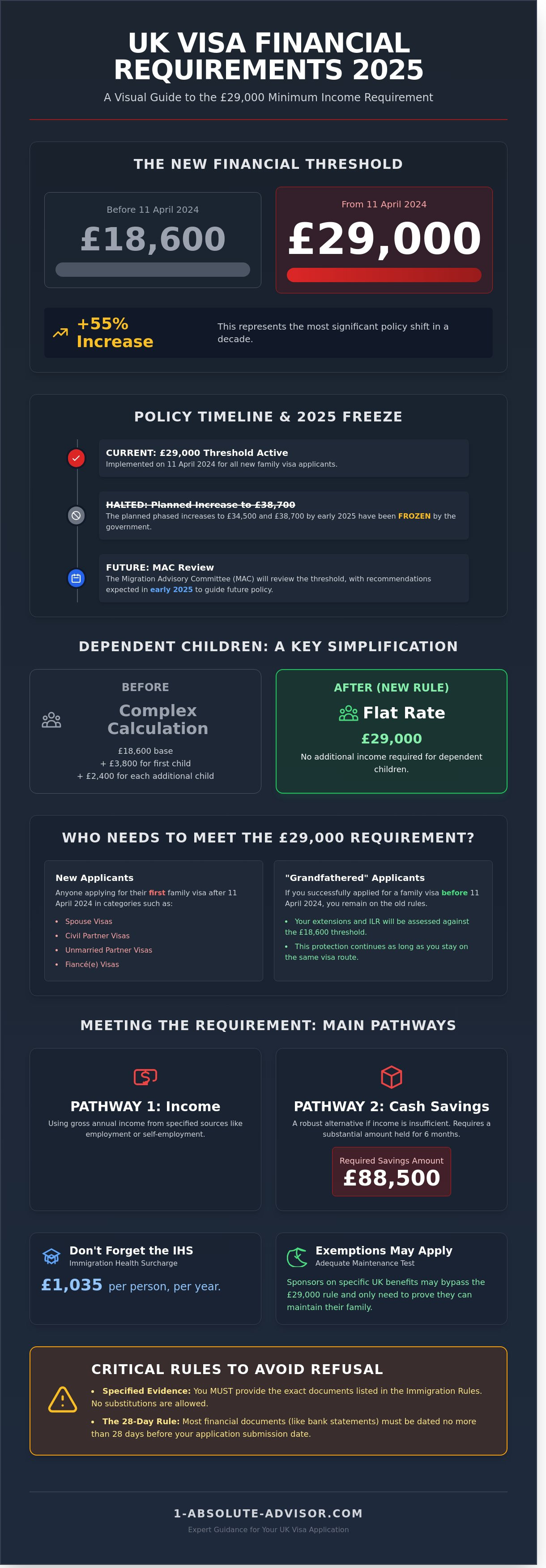
The UK’s immigration framework underwent a seismic shift on 11 April 2024. Before this date, the Minimum Income Requirement (MIR) for spouse and partner visas stood at a stable £18,600. Current regulations now demand a gross annual income of at least £29,000 for most applicants. This change represents the first stage of a multi-part adjustment designed to ensure that families are self-sufficient. For those planning their future, understanding the UK immigration policy overview is essential to see how these financial mandates align with broader border controls. These uk visa financial requirements 2025 reflect a move toward higher economic thresholds for residency.

Strategic planning is now more critical than ever. The Migration Advisory Committee (MAC) is currently conducting a full review of these thresholds, with recommendations expected in early 2025. This review will likely dictate whether the current stability remains or if further adjustments are necessary for 2026. Applicants must stay informed about these developments to avoid unexpected hurdles. One positive development involves dependent children. Previously, each child required an additional financial buffer of £3,800 for the first child and £2,400 for each subsequent child. Under the new £29,000 rule, this extra burden has been abolished. This simplification allows families to focus on meeting a single, flat threshold regardless of the number of children involved.

  • The current MIR is fixed at £29,000 per annum for new applicants.
  • The 2024 hike from £18,600 was a 55% increase in the baseline requirement.
  • Dependent child supplements no longer apply to the £29,000 threshold.
  • The MAC 2025 review will determine future policy shifts for the 2026 period.

The 2025 Policy Freeze: Why the £38,700 Threshold Was Halted

The previous government intended to raise the MIR to £34,500 and eventually £38,700 by early 2025. However, the Labour government announced a strategic freeze in July 2024. This decision keeps the threshold at £29,000 for the foreseeable future. It’s a vital window for applicants. It provides a level of predictability that was missing during the volatile policy shifts of early 2024. While the income requirement is frozen, applicants shouldn’t ignore other costs. The Immigration Health Surcharge (IHS) rose to £1,035 per year in February 2024 and remains at this elevated level. This stability in the income threshold allows for more precise long-term financial forecasting for families.

Who Does the £29,000 Requirement Apply To?

The £29,000 threshold applies to most family-based routes. This includes Spouse visas, Civil Partner visas, Unmarried Partner visas, and Fiance visas. The 11 April 2024 date is the critical divider. If you applied for your first visa in one of these categories before this date, you’re “grandfathered” under the old £18,600 rules. This protection extends to your extensions and permanent residency applications. New applicants entering the system for the first time after 11 April 2024 must meet the higher £29,000 standard. Meeting the uk visa financial requirements 2025 is mandatory for all new entries into the family migration system. The rules are strict. Even a small shortfall can lead to a refusal, making professional assessment of your income sources vital.

Calculating Your Income: The Five Primary Categories

The Home Office evaluates every application through a strict framework of seven categories, labelled A through G. Understanding which category fits your specific situation is the first step in meeting the uk visa financial requirements 2025. Mistakes here often lead to immediate refusals, as caseworkers follow the official Home Office financial requirement guidance with zero flexibility for missing evidence. You’re expected to provide a perfect paper trail that aligns exactly with one of these pre-defined routes.

One primary rule determines whose income you can actually use. If you’re applying from outside the UK, only the British sponsor’s income counts toward the threshold. The applicant’s overseas earnings are disregarded entirely. However, if the applicant is already in the UK with valid permission to work, you can combine both salaries to reach the target. This distinction catches many couples off guard during the initial planning phase, often requiring the sponsor to secure a higher-paying role before the process can begin.

Category A vs. Category B: Salaried Employment Explained

Category A is the most common route for those who’ve been with their current employer for at least six months. The Home Office calculates your annual income based on the lowest gross monthly salary received during that period. If you earn £3,500 one month but £3,100 the next due to unpaid leave, they’ll multiply the £3,100 by 12. Non-salaried income, such as hourly wages, is handled differently; caseworkers take the mean average of the last six months and annualise it to check if you meet the uk visa financial requirements 2025.

Category B serves those who’ve changed jobs recently or have fluctuating earnings that don’t meet the “lowest point” rule of Category A. Category B requires a two-part assessment where you must prove you’re currently earning the required threshold and have also earned that total amount in the 12 months prior to your application date. This route requires 12 months of payslips and bank statements rather than six, doubling the administrative burden on the applicant.

Self-Employment and Director Income (Category F and G)

Self-employed individuals and directors of specified limited companies face the highest level of scrutiny. Category F relies on the last full financial year, while Category G allows you to use an average of the last two financial years. This is often necessary if your business had a temporary dip in one year but performed strongly in the other. You’ll need to provide HMRC documents like the CT600 or SA302 to verify every pound claimed, alongside business bank statements that match the accounts exactly.

For many directors, the primary challenge isn’t just documenting income, but ensuring the business generates enough revenue to comfortably meet the threshold. If your B2B company needs to strengthen its sales pipeline to build a more robust financial profile for your application, you can check out Virtual Sales Limited for strategic guidance.

For company directors, managing the finances required for both visa applications and corporate tax liabilities (like the one documented in a CT600) can be complex. Specialist brokers such as V4B Business Finance can provide funding solutions to help businesses meet their tax obligations smoothly.

Timing is everything when it comes to business income. You must ensure your application is submitted within nine months of your company’s financial year-end to ensure the data is considered “current” by the Home Office. If your accounts are dated 31 March 2024, you must apply before 31 December 2024 to use those figures. If you’re unsure about your eligibility or the strength of your documentation, consulting a strategic advisor can prevent costly delays in your relocation plans. It’s better to delay an application by a month to gather better evidence than to risk a refusal on a technicality.

UK Visa Financial Requirements 2026: The Complete Expert Guide

Using Cash Savings to Meet the Financial Requirement

For many applicants, demonstrating a steady annual salary isn’t always feasible. The uk visa financial requirements 2025 allow for significant flexibility through the use of cash savings. If you choose to rely solely on savings to meet the threshold without any supplementary income, the required amount is currently £88,500. This figure stems from the updated minimum income requirement of £29,000 established in April 2024. Relying on savings provides a level of certainty for those who might not meet the strict employment criteria but possess substantial personal capital.

Home Office mandates state that these funds must have been under your control for at least six months prior to the application date. This 182-day rule ensures the money isn’t a temporary loan intended to artificially inflate your financial standing. There’s a vital exception for those who’ve liquidated assets; if you sell a property or receive an inheritance within that six-month window, you can use the cash immediately. You must provide a clear audit trail, such as land registry documents or a solicitor’s letter. Gifted money is also permitted, provided it’s a genuine gift with no obligation to repay. A signed declaration from the donor is essential to confirm the funds are yours to keep, preventing “recycled” funds from being used across multiple applications.

Using savings is particularly advantageous for self-employed individuals or those with seasonal contracts. It provides a stable buffer that compensates for months where earnings might dip below the pro-rata requirement. Detailed analysis from the House of Commons Library regarding the partner visa financial requirements highlights how these thresholds have evolved to ensure families can support themselves without relying on public funds. Understanding these nuances is vital for anyone navigating the uk visa financial requirements 2025 to ensure their application isn’t rejected on technical grounds.

The Formula for Combining Income and Savings

You can combine savings with employment income to bridge a shortfall. Current regulations ignore the first £16,000 of your savings because this is the threshold at which most means-tested benefits cease. The remaining balance is divided by 2.5, reflecting the 30-month duration of the initial visa. The exact calculation is: (Total Savings – £16,000) divided by 2.5 equals the income offset. A practical example of this is: if you earn £20,000, you need £38,500 in savings to bridge the £9,000 gap.

Permitted Sources of Cash Savings

Funds must be held in a regulated financial institution and be instantly accessible. Acceptable accounts include standard current accounts, savings accounts, and ISAs. You can’t use “locked” investments like certain pension schemes or stocks that haven’t been liquidated into cash. The money can be held in the name of the applicant, the sponsor, or both as a joint account. If the funds are in an overseas account, the bank must be on the Home Office’s list of approved institutions, and the balance will be converted to GBP using the OANDA exchange rate on the date of application.

Exemptions and the Adequate Maintenance Test

While the standard Minimum Income Requirement (MIR) serves as the primary benchmark for most applicants, the UK immigration system provides a specific safety net for sponsors who receive certain state benefits. This pathway bypasses the fixed £29,000 threshold, replacing it with the “Adequate Maintenance” test. It’s a recognition by the Home Office that individuals with disabilities or significant caring responsibilities may not have the same earning capacity as other sponsors, yet they still possess a right to family life.

This alternative route doesn’t mean the financial scrutiny is less intense. In fact, the evidentiary burden often increases because you must prove that the family can live above the poverty line without additional recourse to public funds. Meeting the uk visa financial requirements 2025 through this method requires a meticulous breakdown of weekly income against essential living costs. We often see applicants struggle not because they lack funds, but because they fail to document their “surplus” income with the precision required by entry clearance officers.

List of Qualifying Benefits for Exemption

To qualify for this exemption, the sponsor, not the applicant, must be in receipt of at least one specific benefit. The Home Office updated this list to reflect changes in the social security landscape, including the 2025 inclusion of modernised Scottish welfare payments. The qualifying benefits include:

  • Carer’s Allowance or Attendance Allowance.
  • Personal Independence Payment (PIP) and Disability Living Allowance (DLA).
  • Adult Disability Payment (ADP) or Child Disability Payment in Scotland.
  • Industrial Injury Disablement Benefit or Severe Disablement Allowance.
  • Armed Forces Independence Payment or Guaranteed Income Payment under the Armed Forces Compensation Scheme.

The sponsor’s status as a recipient must be current at the time of application. You’ll need the most recent DWP annual uprating letter or a confirmed statement of entitlement to validate this claim.

How to Calculate Adequate Maintenance

The Home Office uses a specific formula to determine if your finances are sufficient. It’s a three step process that leaves no room for estimation.

Step 1: Calculate your total net weekly income. This includes the sponsor’s benefits, any employment income from the sponsor or the applicant (if they’re already working legally in the UK), and any other permitted income sources.

Step 2: Deduct your weekly housing costs. This must include your full rent or mortgage payment plus your Council Tax. For example, if your monthly rent is £800 and Council Tax is £150, your weekly housing cost is roughly £219.23.

Step 3: Compare the remaining figure against the relevant DWP Income Support rate for a family of your size. For 2024/25, the rate for a couple is £142.25 per week. If your net income after housing costs is £142.26 or more, you technically meet the requirement.

To satisfy the Home Office guidance, the applicant must demonstrate that their weekly income, after deducting all housing costs, results in a surplus that is at least equivalent to the current DWP cash payment for a family of their specific size.

Accuracy is the foundation of a successful application under these rules. If you’re unsure how your specific benefit package fits into the uk visa financial requirements 2025, professional oversight is essential.

Contact our specialist advisors for a detailed financial assessment of your spouse visa eligibility.

Strategic Evidence Preparation: Avoiding Common Refusals

Caseworkers at the Home Office operate under the “Specified Evidence” rule defined in Appendix FM-SE. This isn’t a flexible guideline; it’s a rigid framework where the absence of a single monthly bank statement or a missing payslip results in an immediate refusal. Statistics from recent years indicate that approximately 15% of family visa refusals stem from technical document errors rather than a genuine lack of income. Precision is the only way to guarantee a successful outcome.

The “28-day rule” remains the most frequent point of failure for applicants. Every financial document, including the mandatory employer’s letter and the most recent bank statement, must be dated no earlier than 28 days before the online application submission date. If your final bank statement is dated 1st June but you don’t hit the “submit” button until 30th June, your evidence is technically expired. This single day of overlap often separates a successful uk visa financial requirements 2025 submission from a costly and stressful rejection.

As the Home Office transitions toward fully digital systems for 2026, the organisation of your evidence bundle is paramount. Applicants should scan and upload documents as clear, searchable PDFs. Using a logical naming convention, such as “01_Bank_Statement_Jan_2025.pdf”, assists the caseworker in navigating your file. A legal cover letter serves as the essential narrative for this bundle. It doesn’t just list documents; it explains them. If you’ve changed jobs or received a pay rise during the six-month period, the cover letter “narrates” these transitions to ensure the caseworker follows the logic of your financial eligibility without confusion.

The Document Checklist: Bank Statements and Payslips

Every payslip must align perfectly with a corresponding entry on your bank statement. If a payslip indicates a net pay of £2,450 but the bank deposit shows £2,400 due to a minor deduction, you must provide a written explanation. Internet bank statements are a common trap. The Home Office typically rejects simple PDF downloads unless every page is either stamped by the bank branch or accompanied by a formal letter on headed paper confirming the statements’ authenticity. Consistency across all dates and figures is the absolute standard required for approval.

Why Professional OISC-Registered Advice is Critical

Technical errors are the primary driver of visa delays and denials. A professional “Document Checking Service” provides a final safety net to identify gaps in your uk visa financial requirements 2025 evidence before you commit to the non-refundable application fees. Expert advisors at 1 Absolute Advisor identify complex “Category” overlaps, such as combining dividend income with salaried work, which require specific calculations that often elude DIY applicants. You can secure a professional eligibility assessment to verify that your documentation meets the current £29,000 threshold and adheres to the latest Home Office internal guidance.

Taking a proactive approach to evidence preparation isn’t just about gathering papers; it’s about building a bulletproof case. By adhering to the 28-day rule and ensuring every transaction is accounted for, you remove the element of caseworker discretion. This level of diligence ensures your family’s future in the UK is built on a foundation of absolute compliance and professional integrity.

Securing Your UK Residency Amidst Shifting Financial Standards

Navigating the uk visa financial requirements 2025 demands more than just a healthy bank balance; it requires a meticulous alignment of your financial history with strict Home Office categories. Whether you’re relying on the £29,000 minimum income threshold for family routes or calculating complex self-employment earnings under Category F, the margin for error is non-existent. Home Office statistics consistently highlight that evidentiary oversights remain a leading cause of avoidable refusals, making the strategic preparation of your 6-month or 12-month financial statements a critical priority for every applicant.

Our London-based team of OISC-registered immigration consultants brings a holistic, strategic perspective to your case. We’re specialists in complex Spouse and Skilled Worker visa applications, ensuring every document meets the exact technical standards required by the current rules. We don’t just process paperwork; we act as your strategic partners to mitigate risks before they surface. You’ll benefit from our national coverage and a commitment to professional integrity that places your future on certain ground.

Book a Fixed-Fee Visa Consultation with our London Experts to ensure your application is built on a foundation of absolute compliance. Your successful transition to life in the UK is within reach when you have the right professional expertise by your side.

Frequently Asked Questions

Can I combine my income from two different jobs to meet the £29,000 requirement?

You can combine income from multiple jobs held by the sponsor to reach the £29,000 threshold. If you’re already in the UK on a valid visa with work rights, you can also include your own earnings. It’s essential that both roles meet the specific evidentiary requirements, such as having 6 months of continuous payslips for each position under Category A.

What happens if my sponsor’s income drops below £29,000 after we apply?

The Home Office assesses your financial eligibility based on the evidence provided at the exact time of your application submission. If your documents prove you met the requirement when you paid the fee, a subsequent salary drop won’t typically lead to a refusal. We suggest maintaining your financial records carefully until a decision is reached to ensure total compliance with the rules.

Do I need to show extra income if I am bringing my children to the UK?

Under the rules effective from 11 April 2024, you don’t need to show additional income for dependent children. The financial requirement is now a flat £29,000 regardless of the number of children included in the application. This change simplified the previous system where the threshold increased by £3,800 for the first child and £2,400 for each subsequent child.

Can I use a gift from my parents as cash savings for the visa?

You can use gifted funds from parents, but the money must have been in your personal bank account for at least 6 months before applying. You’ll need a signed declaration from your parents confirming the money is a gift, not a loan, and that they’ve no legal claim to it. This ensures the Home Office views the funds as being under your absolute control.

How far back do my bank statements need to go for the financial requirement?

Your bank statements must cover at least 6 months if you’re using salaried income under Category A to meet the uk visa financial requirements 2025. If you’re relying on self-employment or Category B, you’ll need 12 months of records. Every statement must be original or certified by the bank; the Home Office won’t accept simple online screenshots or partial transaction histories.

Is the Immigration Health Surcharge (IHS) part of the financial requirement?

The IHS is a separate mandatory fee and isn’t included in the £29,000 income calculation. Since 6 February 2024, the surcharge is £1,035 per year for each adult applicant. For a standard 33-month spouse visa, you’ll need to pay £2,846.25 upfront. This payment is non-negotiable and provides you with access to the National Health Service during your stay.

Can I use rental income or dividends to meet the UK visa threshold?

Rental income and dividends are valid sources of non-employment income for the uk visa financial requirements 2025. To use these, you must provide 12 months of evidence, including tax returns and proof of property ownership or share certificates. Combining these with a salary is possible, but the documentation must be precise to show the income is stable and legally declared.

What is the “28-day rule” regarding visa financial evidence?

The 28-day rule dictates that your most recent financial document, like a payslip or bank statement, cannot be older than 28 days from your application date. If your evidence falls outside this window, the Home Office will likely reject the application for being outdated. It’s a strict deadline that requires careful strategic planning to ensure your submission is compliant and successful.

UK Dependent Visa Guide 2026: Bringing Your Family to the United Kingdom

A single missing bank statement or a misinterpretation of the March 11, 2024, policy shifts can turn a £5,000 investment into a heartbreaking refusal letter. It’s a harsh reality in an era where the Home Office scrutinizes relationship evidence with clinical precision. You’re likely feeling the pressure of the UK’s increasingly rigid immigration environment, where the £1,035 annual Immigration Health Surcharge is just the starting point of your financial commitment. It’s natural to worry that “insufficient evidence” might derail your plans, especially with the 2024 restrictions for care workers now fully embedded in the system.

This guide gives you the technical precision required to secure a dependent visa uk in 2026, ensuring your application is legally sound and strategically prepared from the outset. We’ll detail the exact financial thresholds, relationship proofing strategies, and the step-by-step process to bring your family to the United Kingdom with absolute confidence. By the end of this article, you’ll have a clear, actionable roadmap to overcome administrative hurdles and ensure a successful relocation for your loved ones.

Key Takeaways

  • Identify which primary immigration routes, including Skilled Worker and Student visas, allow your family members to qualify as dependants under the latest 2026 regulations.
  • Gain clarity on the specific evidentiary standards required to satisfy the two-year cohabitation rule and prove a subsisting relationship for spouses and partners.
  • Prepare for the mandatory financial maintenance thresholds, ensuring you hold the required funds-such as £285 for a partner-for the full 28-day qualifying period.
  • Streamline your dependent visa uk application by understanding the nuances of biometric appointments and the strategic differences between applying from inside or outside the country.
  • Recognize the strategic advantage of OISC-registered professional advice in navigating complex family cases and ensuring absolute compliance with UK Home Office requirements.

Understanding the UK Dependent Visa: Who Can Join You?

The UK immigration system underwent significant structural changes in 2024. These changes directly impact how you bring your family to Britain. A dependant is someone who relies on your financial support and residency status to live in the UK. Most commonly, this applies to those on the Skilled Worker or Health and Care Worker routes. Understanding the dependent visa uk requirements is the first step toward a successful relocation. The broader UK immigration policy dictates that while the government aims to reduce net migration, they maintain pathways for essential workers to remain with their immediate families under specific conditions.

Defining Eligible Family Members

Your spouse or civil partner must be at least 18 years old at the time of application. You’ll need to provide a valid marriage or civil partnership certificate that’s recognized under UK law. For unmarried partners, the Home Office requires proof of a durable relationship. Since January 31, 2024, the strict two-year cohabitation rule has been slightly relaxed to include those who haven’t lived together due to work or cultural reasons. However, you still need to demonstrate a relationship similar to marriage for at least 24 months through joint bank statements, tenancy agreements, or utility bills. It’s about proving a shared life, not just a shared address.

Children must be under 18 when they first apply. They can’t be leading an independent life, which means they shouldn’t be married or in a civil partnership. If only one parent is moving to the UK, you must prove “sole responsibility” for the child’s upbringing. This is a high evidentiary bar. You’ll need court orders, school records, or medical documentation showing you’re the only person making significant decisions for the child. If the other parent is alive and involved, the Home Office will likely refuse the application unless there are “serious and compelling” circumstances.

Restrictions for Care Workers and Students

The landscape for care workers shifted on March 11, 2024. From this date, new care workers (SOC 6145) and senior care workers (SOC 6146) can’t bring dependants to the UK. However, a “Grandfather Rule” protects those already in the system. If you held a care worker visa before March 11, 2024, and you’re extending your stay or changing employers within the same sector, you retain the right to have your family join you. This remains true for applications made in 2026, provided you haven’t broken your continuous leave.

Student visa holders face similar hurdles. Only those enrolled in postgraduate research programs, such as a PhD or a research-based Master’s, can sponsor family members. If you’re on a standard taught Master’s course, your family won’t be eligible for a dependent visa uk unless they were already present in the UK before January 1, 2024. You must also show you have enough money to support them. The current maintenance requirements are £285 for a partner, £315 for the first child, and £200 for each additional child, held for 28 consecutive days.

Children born in the UK during your stay occupy a unique legal space. Even if you’re on a restricted visa route that prevents bringing in new dependants from abroad, a child born on British soil can apply for permission to stay. This ensures the child has legal status to access the NHS and travel. You’ll need to provide a full UK birth certificate showing both parents’ names. It’s a vital safety net for families who find their visa rules changed mid-stay.

Eligibility Criteria and Proving Your Relationship

Securing a dependent visa uk requires more than just a valid marriage certificate or birth record. The Home Office applies rigorous scrutiny to ensure that every relationship is genuine, subsisting, and meets specific legal thresholds. Since the rule changes on January 31, 2024, the definition of a “durable relationship” has expanded, but the evidentiary burden remains high. You must demonstrate that your family unit is a functional reality rather than a legal convenience. This involves a strategic approach to documentation that leaves no room for ambiguity or doubt from entry clearance officers.

For spouses who’ve been living apart due to work or international commitments, the challenge is proving the relationship is “subsisting.” This requires a chronological trail of contact. If you’ve lived in separate countries for 12 months, you’ll need to show consistent financial transfers, regular travel logs, and digital communication records. The goal is to prove that despite the physical distance, the emotional and financial partnership remains intact. If you require a detailed assessment of your specific documentation, our strategic visa planning services provide the clarity needed for a successful submission.

The Document Strategy for Partners

The Home Office prefers “hard evidence” over personal testimonials. You should provide at least six pieces of joint correspondence, such as bank statements, tenancy agreements, or utility bills, spread evenly over the last 24 months. Soft evidence, including dated photographs and WhatsApp logs, should only supplement these official records to fill gaps in your history. A durable relationship is defined under the 2024 Appendix Relationship rules as a couple who’ve lived together in a relationship akin to marriage for at least two years or can provide a significant explanation why they haven’t while maintaining a subsisting bond. For the most accurate requirements, consult the official UK family visa guidance to ensure your evidence list is compliant.

Proving Dependency for Children

When bringing children, the “Both Parents” rule is the default standard; typically, both parents must be present in the UK or applying at the same time. If you’re a single parent, you must meet the “Sole Responsibility” threshold. This isn’t satisfied by a simple custody order. You must prove you’ve made every major decision regarding the child’s education, health, and daily welfare, often requiring letters from schools or doctors confirming you’re the sole point of contact.

  • Family Linking Code: Ensure the 16-digit Global Web Form (GWF) or Unique Application Number (UAN) of the lead applicant is clearly cited to link the dependent visa uk applications.
  • Over 18s: You must prove the child isn’t leading an “independent life,” which means they shouldn’t be married, have their own children, or be working full-time.
  • Financial Support: Provide bank statements showing 100% of the child’s living costs are covered by the parent, especially if the child is in full-time university education.

The complexity of these applications often stems from the 2024 requirement to prove that a child over 18 still resides in the family home. If the child is at university, you’ll need a letter from the registrar confirming their term-time address and a statement from you confirming they return to the family home during every holiday period. Precision in these details prevents the common 15% rejection rate associated with insufficient proof of dependency.

Financial Requirements and Maintenance Funds in 2026

Securing a dependent visa uk requires more than just proof of a relationship; it demands a clear demonstration of financial stability. The Home Office enforces strict maintenance requirements to ensure that families arriving in the United Kingdom don’t rely on public funds. For 2026, the specific amounts remain tiered based on the number of family members joining the lead applicant. You’ll need to show £285 for your partner, £315 for the first child, and £200 for each additional child. These figures are cumulative. If a spouse and two children are applying, the total maintenance fund required is £800. This capital must be held in a regulated financial institution for a consecutive 28-day period. The closing balance of this 28-day window cannot fall below the required threshold even for a single day, or the application will face an immediate refusal.

Timing your evidence is the most common pitfall for applicants. The bank statement used as evidence must be dated within 31 days of the online application submission. If your statement is 32 days old when you hit “submit,” the Home Office will disregard it. You should check the UK government family visa information to confirm if your specific bank is on the approved list, as certain institutions in countries like India, Pakistan, or Ghana are occasionally restricted due to verification concerns. Precision here isn’t just a suggestion; it’s a mandatory requirement for a successful outcome.

How to Meet the Maintenance Requirement

You can satisfy these requirements through personal savings or employer certification. If you’re using savings, the funds can be in the lead applicant’s name or the dependant’s name; joint accounts are also perfectly acceptable. Most applicants find that an “A-rated” sponsor provides the most streamlined path. If the lead applicant’s employer is A-rated, they can certify maintenance on the Certificate of Sponsorship (CoS). This “tick box” exercise on the CoS waives the need for bank statements entirely, as the employer guarantees they’ll provide at least £1,600 in support if needed during the first month. We’ve seen this reduce document heavy-lifting by 40% for our corporate clients.

Budgeting for the Immigration Health Surcharge (IHS)

The Immigration Health Surcharge remains the most substantial upfront cost for a dependent visa uk. In 2026, the adult rate is £1,035 per year of the visa’s duration, while the rate for children under 18 is £776 per year. For a three-year visa, a partner will pay £3,105 in IHS fees alone, excluding the standard visa processing fee of approximately £827 for those applying from outside the UK. It’s a significant financial commitment that must be paid in full at the time of application. However, there’s a vital exemption for those on the Health and Care Worker visa. Dependants of these professionals are exempt from the IHS, which saves a family of four over £10,000 across a three-year term. This exemption is a critical strategic consideration when choosing which visa route the lead applicant should pursue.

The Application Process and Common Pitfalls

The transition from understanding eligibility to submitting a formal application requires absolute precision. Applicants usually face two distinct pathways based on their current location. Those already residing in the UK on a qualifying visa, such as a Skilled Worker or Graduate visa, can often switch to a dependent visa uk through an in-country application. It’s a strategic choice that avoids the logistical burden of returning home. However, individuals on visitor visas are strictly prohibited from switching while inside the UK; they must depart and apply from their country of residence.

Your biometric appointment is the cornerstone of the identity verification process. You’ll visit a center managed by VFS Global or TLScontact to provide fingerprints and a digital photograph. In 2026, the Home Office has maintained a tiered pricing structure for processing speeds. A standard out-of-country application typically takes 15 to 20 working days, costing the base fee of £1,846 for a partner. Priority service, which aims for a decision within 5 working days, adds £500 to your costs. For many of our corporate clients, this extra expense is a sound investment to avoid the financial fallout of delayed school starts or missed housing contracts. Super Priority service, offering a 24-hour turnaround, is now available in 85% of global application centers for an additional £1,000.

Step-by-Step Application Timeline

The process begins with the online application form where you must generate a Family Linking Code. This unique identifier ensures your file stays attached to the lead applicant’s record, preventing administrative separation. Once the fee is paid, you’ll gain access to the document upload portal. In 2026, we’ve seen a 12% increase in digital processing speeds, yet manual errors in the upload stage remain the primary cause of delays. Follow this sequence for absolute clarity:

  • Complete the digital form and pay the Immigration Health Surcharge, currently £1,035 per year.
  • Generate and record the Family Linking Code to synchronize your application with your sponsor.
  • Upload all supporting evidence to the VFS Global or TLScontact portal at least 48 hours before your appointment.
  • Attend the biometric appointment and await the electronic notification of your decision.

Avoiding the “Insufficient Evidence” Refusal

Generic evidence is a high-risk strategy that often leads to disappointment. The Home Office frequently rejects applications that rely on “template” cover letters or bank statements that fail to clearly highlight the required maintenance funds. Case workers expect to see a clear narrative of your relationship and financial stability. If your documents aren’t in English, they must include a certified translation that lists the translator’s credentials and the date of translation. Minor oversights, like a missing signature on a tenancy agreement or a bank statement that is 32 days old instead of the required 28, lead to immediate refusals.

A refusal doesn’t just delay your plans; it creates a permanent record that must be declared in all future global travel. To mitigate this risk, Our Document Checking Service can identify these technical errors before submission, providing the professional oversight required for a successful relocation. We treat every dependent visa uk application as a strategic project, ensuring that every piece of evidence serves to strengthen your case rather than merely filling a checklist requirement.

Professional Assistance for Your Family’s UK Immigration

Securing a dependent visa uk involves more than filling out forms; it requires a strategic approach to UK immigration law. The Office of the Immigration Services Commissioner (OISC) sets the benchmark for this sector. Choosing an OISC-registered advisor ensures your case follows strict ethical guidelines and legal standards. This regulation protects you from the risks associated with unregulated consultants who often cause application rejections through simple clerical errors or a lack of current policy knowledge.

This principle of seeking specialized legal counsel holds true for all international legal matters, not just UK immigration. For example, when dealing with complex business or investment law between different jurisdictions like the US and Israel, professionals will visit Israel Cross Border Law Firm to navigate those specific regulations.

A London-based advisor provides a distinct advantage for complex family structures. We deal with the Home Office’s evolving digital systems daily. Our proximity to the UK’s legal and financial heart allows us to interpret policy shifts faster than regional firms. We don’t just process paperwork; we build a comprehensive legal framework for your family’s residency. This is vital when dealing with intricate financial requirements or non-standard family units where the burden of proof is higher.

Cost transparency remains a cornerstone of our professional integrity. Many firms use hourly billing; this often leads to unexpected costs during the standard 8-week to 12-week processing window. We utilize a fixed-fee model. This approach eliminates financial ambiguity and allows you to budget accurately for your family’s relocation. You’ll know exactly what the professional fees are upfront, without fearing hidden disbursements or “admin” surcharges that can inflate a bill by 20% or more.

The 1 Absolute Advisor Advantage

Our team drafts personalized legal cover letters that act as a strategic roadmap for Home Office caseworkers. These documents highlight how you meet every statutory requirement under the current Immigration Rules. We perform exhaustive document audits to ensure your evidence is 100% compliant with Appendix Skilled Worker or Appendix FM. Whether you’re a Skilled Worker holder or a British citizen sponsoring a spouse, our holistic review process catches inconsistencies before they become grounds for refusal.

Secure Your Family’s Future in the UK

Booking your initial consultation is the first step toward certainty. During this session, we’ll map out your timeline and identify if you qualify for “fast-track” Priority or Super Priority services. These services can reduce wait times from months to just 24 hours for an additional Home Office fee of £1,000. Don’t leave your family’s stability to chance. Book a consultation with an OISC-registered advisor today to begin your journey toward a secure life in the United Kingdom.

Secure Your Family’s Future in the United Kingdom

Navigating the 2026 immigration landscape requires more than just filling out forms; it demands a strategic approach to meet the £29,000 minimum income threshold and provide irrefutable evidence of your subsisting relationship. Whether you’re navigating the complexities of “Sole Responsibility” for a child or proving a long-term commitment for an “Unmarried Partner” application, the dependent visa uk process leaves no room for administrative errors. Success hinges on precise documentation and a clear understanding of Home Office scrutiny. Mistakes can lead to costly delays or immediate refusals that disrupt your family’s plans.

You don’t have to manage these high-stakes legal requirements alone. Our OISC-registered immigration consultants provide the professional oversight needed to ensure your application is audit-ready from day one. We offer fixed-fee application management with no hidden costs, giving you complete financial predictability throughout the process. Our team specializes in resolving complex cases that often prove challenging for standard applications, ensuring your family stays together without unnecessary stress. Secure your family’s UK visa with expert guidance from 1 Absolute Advisor and take the first definitive step toward your new life together in Britain. We’re ready to help you build your future here.

Once your visas are secured, the logistical challenge of the physical move comes next. For professional assistance with the entire relocation process, from packing to transport, many families turn to specialists like VP Smart Removals to ensure a smooth transition to their new home in the UK.

For professional families, arranging reliable childcare is often the next critical step after the move. Securing qualified support helps ensure a smooth transition into work and school routines. Agencies like Superstar Nannies specialize in placing elite, vetted childcare professionals and can be a valuable resource for those relocating internationally.

As you begin your new life in the UK, making your house a home is a wonderful part of the journey. For professional framing to display family photos or new art, many people turn to specialists like the First4Frames Gallery to help preserve their most cherished memories.

For those starting or expanding their family, the journey of pregnancy is another significant part of settling in. To capture some of these early, precious moments, you can visit Scan Baby Ltd for a range of private ultrasound services.

Exploring the UK’s rich history and iconic landmarks is a rewarding part of settling in. For families looking to celebrate their arrival or introduce loved ones to their new home, Timescape Tours provides private, driver-guided day trips from London.

Making your new house feel like a home is a key part of settling in. For made-to-measure window dressings that provide both privacy and style, you can check out Universal Blinds UK.

Frequently Asked Questions

Can I bring my parents to the UK on a dependent visa?

Bringing parents to the UK on a dependent visa is only possible under the Adult Dependent Relative (ADR) route, which requires proving they need long-term personal care for daily tasks. This isn’t a standard addition to a work visa. You must demonstrate that the required level of care is unavailable or unaffordable in their home country, a threshold the Home Office maintains with high rejection rates for non-essential cases.

How much does a UK dependent visa cost in 2026?

A standard dependent visa uk application for a Skilled Worker’s family member costs £827 for stays up to 3 years or £1,636 for longer periods. These 2026 figures exclude the Immigration Health Surcharge, which currently stands at £1,035 per year for adults. Total costs for a three-year stay typically exceed £3,932 per person when including all mandatory Home Office levies and biometric enrollment fees.

Can my partner work in the UK on a dependent visa?

Your partner can work in almost any role in the UK once their visa’s granted, including self-employment or professional consultancy. They aren’t restricted to specific shortage occupations or salary thresholds like the main applicant. The only major prohibitions involve working as a professional sportsperson or a doctor in training, ensuring full economic integration for your household and strategic financial stability.

For those looking to enter a new trade, intensive courses can be a fast track to a skilled career; you can check out YTA Training for examples of accredited construction programs.

What happens to dependants if the main applicant’s visa is cancelled?

If the main applicant’s visa is cancelled, the Home Office will typically curtail the dependants’ leave to remain to 60 days. This period allows families to either apply for a different visa category or arrange their departure from the UK. Failure to secure a new legal status within this window results in overstaying, which carries severe implications for future immigration compliance and international travel.

Is there an English language requirement for dependent visas?

Most applicants for a dependent visa uk linked to a work route don’t need to meet an English language requirement for their initial entry. This differs from the Family Visa route, where a CEFR level A1 is mandatory. However, all dependants must pass a B1 level test eventually if they intend to apply for Indefinite Leave to Remain after completing their five-year residency period in the UK.

Can a child over 18 apply as a dependant if they are still at university?

A child over 18 can’t usually apply as a new dependant, even if they’re full-time university students. They must have been granted leave as a dependant before turning 18 to qualify for an extension from within the UK. If they’re applying for the first time at age 19 or 20, they’ll likely need to secure their own independent Student or Graduate visa to remain compliant with current regulations.

How long does it take to get a decision on a dependent visa?

Standard processing times for applications made outside the UK are three weeks, while applications submitted within the country usually take eight weeks. You can expedite this by paying £500 for the Priority Service to get a decision in five working days. The Super Priority Service offers a next-day decision for a £1,000 fee, providing absolute certainty for families managing urgent relocation timelines.

What is the “Family Linking Code” and how do I use it?

The Family Linking Code is a unique reference number generated when the main applicant submits their application, ensuring all family members’ files are processed together. You’ll enter this code in the “Relationship” section of the dependant’s form to maintain administrative consistency. This mechanism prevents the Home Office from treating applications as separate cases, which significantly reduces the risk of conflicting decision dates or processing errors.

How to Apply for a UK Spouse Visa in 2026: The Definitive Expert Guide

In 2024, Home Office data suggested that nearly one in five family visa applications faced complications or refusals because of minor evidentiary gaps. You’re likely concerned about meeting the £29,000 minimum income requirement while risking a non-refundable £1,846 application fee on a process that feels increasingly opaque. It’s stressful to manage months of document collection when your future together rests on a caseworker’s interpretation of complex rules. Understanding exactly how to apply for a uk spouse visa in this environment requires a methodical, professional approach that leaves no room for ambiguity.

This definitive 2026 roadmap is designed to move your application from a state of uncertainty to a successful Home Office approval. We’ll provide the clarity you need to master the latest financial mandates and document standards, ensuring your submission is legally sound from the start. Our guide outlines the precise steps to secure your reunion in the UK, replacing the anxiety of the standard 24 week processing window with the confidence of professional validation. We will break down the specific requirements for income, housing, and relationship proof to ensure your path to residency is clear and efficient.

Key Takeaways

  • Navigate the 2026 financial landscape by mastering the £29,000 minimum income threshold through the strategic use of employment, savings, or pension evidence.
  • Follow our comprehensive, phase-based roadmap on how to apply for a uk spouse visa to ensure your application moves seamlessly from eligibility audit to final submission.
  • Identify and avoid the “technical” pitfalls, such as the 28-day rule and specific document formatting, that frequently lead to Home Office refusals.
  • Learn how to build a robust evidentiary portfolio that proves the authenticity of your relationship beyond a simple marriage certificate.
  • Understand the strategic value of professional legal support in mitigating the emotional and financial risks of a visa rejection through an absolute commitment to compliance.

Understanding the UK Spouse Visa Landscape in 2026

The UK Spouse Visa, officially governed by Appendix FM of the Immigration Rules, serves as the primary gateway for partners of British citizens or settled persons to establish a life in the United Kingdom. In 2026, this route is defined by a rigorous assessment of financial stability and relationship authenticity. Applicants receive an initial grant of 30 months. To reach Indefinite Leave to Remain (ILR), you must complete a five-year probationary period, typically involving a second 30-month extension. Understanding how to apply for a uk spouse visa requires a strategic approach to the current UK visa and immigration policy, which prioritizes high-income thresholds and indisputable documentary evidence.

The landscape changed significantly following the 2024 financial reforms. The minimum income requirement now stands at £38,700 for most new applicants. This figure ensures that families can support themselves without relying on public funds. If you’re relying solely on cash savings to meet this requirement, the necessary amount is £102,750. These figures aren’t suggestions; they’re absolute benchmarks. Caseworkers at the Home Office don’t have the discretion to overlook a shortfall of even a few pounds. This rigid environment means your application must be “front-loaded” with perfect evidence. In 2026, the Home Office rarely requests missing documents. Instead, they issue a refusal, forcing applicants into costly appeals or fresh applications.

Who qualifies as a ‘Partner’ under the current rules?

UK law recognizes three distinct partner categories. Legal marriages and civil partnerships must be legally valid in the country they took place. Fiancés and proposed civil partners are granted a 6-month entry visa to marry within the UK. Once married, they must apply to switch to the 2.5-year spouse route. For unmarried partners, the 2026 rules follow the 2024 reform that removed the mandatory two-year cohabitation requirement. You can qualify if you’ve been in a relationship for at least two years and can prove it’s “genuine and subsisting” through shared financial responsibilities, joint travel, or parental duties.

The ‘Absolute’ importance of OISC registration

Immigration advice in the UK is a regulated activity. The Office of the Immigration Services Commissioner (OISC) ensures that advisors are competent and act in the best interests of their clients. Using unregulated “ghost” advisors carries massive risks. These individuals often lack professional indemnity insurance and have no accountability if your application is rejected due to their errors. 1 Absolute Advisor operates with strict OISC compliance in London, providing the high-level expertise required to navigate 2026’s complex requirements. We focus on the precision of your evidence to ensure your path to settlement is secure and predictable.

Success in 2026 depends on more than just meeting the criteria; it requires presenting a narrative of compliance that a caseworker cannot challenge. Every bank statement, employer letter, and relationship proof must align perfectly with the Home Office’s internal guidance. When you’re researching how to apply for a uk spouse visa, remember that the burden of proof lies entirely with you. A single inconsistency in your 12-month financial history or a missing translation for a foreign document can result in a life-changing refusal. Our role is to ensure that your application reflects the stability and integrity the Home Office demands.

The Four Pillars of Spouse Visa Eligibility

Securing a successful outcome requires more than a valid marriage certificate. The Home Office evaluates every application against four rigid criteria that demand objective, verifiable evidence. Understanding how to apply for a uk spouse visa involves mastering these pillars to ensure your submission is beyond reproach. Since the rules changed on April 11, 2024, the complexity of these requirements has increased, making a strategic approach essential for 2026 applicants.

The financial requirement remains the most frequent cause of refusal. Currently, the minimum income threshold stands at £29,000 per annum. This figure must be met by the UK-based sponsor alone or through the combined income of both partners if the applicant is already working legally in the UK. You can verify the specific categories of permitted income in the official UK spouse visa guidance to ensure your sources are eligible for consideration.

Navigating the 2026 Financial Thresholds

Applicants often struggle to bridge the gap between their salary and the £29,000 requirement. You can use cash savings to supplement a shortfall in earnings, provided those funds have been held for at least six months. The specific formula for meeting the requirement through cash savings alone is (Threshold x 2.5) + £16,000. For those receiving Personal Independence Payment (PIP) or Carer’s Allowance, the ‘Adequate Maintenance’ test applies instead, which calculates whether the family has enough to live on after housing costs are paid.

Beyond meeting the threshold, demonstrating overall financial stability can strengthen your application. Professional credit consulting services, such as those offered by Allen & Allen, Inc., can be instrumental in helping applicants organize and improve their financial profiles long before submission.

Proving a ‘Genuine and Subsisting’ Relationship

The Home Office looks for a “genuine and subsisting” connection that exists independently of the visa application. Caseworkers prioritize high-quality evidence like joint tenancy agreements, shared bank accounts, or birth certificates of children. While digital communication is necessary, submitting 500 pages of WhatsApp logs often backfires; it suggests a lack of substantive proof and may lead a caseworker to overlook more critical documents. A curated selection of 10 to 15 pages of chat history, spaced over the duration of the relationship, is far more effective.

Intervening letters from third parties play a supporting role in this process. Statements from family members or close friends can corroborate your history together, though they shouldn’t be the foundation of your case. These letters must include the author’s contact details and a brief description of how they know the couple. Strategic planning ensures your application remains robust against Home Office scrutiny; our advisory services provide the clarity needed for these complex evidentiary requirements.

  • English Language: Most applicants must pass a CEFR A1 level test in speaking and listening. You must use an approved provider like IELTS SELT Consortium or Pearson PTE.
  • Accommodation: Your UK home must not be ‘overcrowded’ under Part X of the Housing Act 1985. This means having enough rooms for the number of occupants, excluding kitchens and bathrooms.
  • Tuberculosis (TB) Testing: If you’re applying from a country on the Home Office’s specified list, a clear TB certificate from a clinic approved by the UK government is mandatory.

Failure to meet even one of these pillars results in an automatic refusal. When you’re learning how to apply for a uk spouse visa, precision is your greatest asset. Every document must be dated within 28 days of the application submission to be considered valid. This “28-day rule” is a common trap that disqualifies otherwise perfect applications by making financial statements or employer letters technically expired in the eyes of the Home Office.

Why Applications Fail: Common Pitfalls and Strategic Fixes

Success in understanding how to apply for a uk spouse visa depends less on the strength of your relationship and more on your ability to follow rigid procedural protocols. Home Office data suggests that administrative errors, rather than a lack of genuine intent, account for a significant portion of the 15% of family visa applications refused annually. These failures often stem from a misunderstanding of what constitutes “specified evidence” under Appendix FM-SE of the Immigration Rules. Caseworkers don’t have the discretion to overlook missing formats, even if the underlying facts are true.

The 28-day rule remains the most frequent cause of rejection. Every piece of financial evidence, including your most recent bank statement and payslip, must be dated within 28 days of the date you submit and pay for your online application. If your statement is dated 29 days before submission, the caseworker will likely refuse the application without requesting further information. This precision is non-negotiable; there’s no margin for error when dealing with Home Office deadlines or the “freshness” of your evidence.

Document quality also triggers refusals. All non-English documents require a certified translation that includes the translator’s credentials, their contact details, and a signed declaration that it’s a “true and accurate translation of the original.” You’ll find the full list of requirements in the official UK government guidance on spouse visas. Additionally, failing to disclose historical issues is a critical mistake. Forgetting a £100 speeding fine from 2021 or a previous visa refusal from five years ago can be interpreted as “deception.” Under Paragraph 9.7.1 of the Immigration Rules, this leads to a mandatory refusal and a potential 10-year ban from entering the UK.

The Financial Evidence Trap

The Home Office requires absolute mathematical consistency. If your payslip shows a net deposit of £2,450.55, your bank statement must show an identical credit of £2,450.55. Even a discrepancy of a few pence can lead to a rejection. For those employed by a company, your employer’s letter must explicitly state your gross annual salary, how long you’ve been at that salary level, and the type of contract you hold. Missing just one of these mandatory phrases is a common reason for failure in 2024.

Self-employed applicants face even higher hurdles under Category F or Category G. These applications require a full financial year of evidence, including CT600 tax returns and evidence of registration with HMRC. We often see clients provide personal bank statements but forget the business bank statements, which is a fatal error when you’re trying to prove the source of your income to the Home Office.

The ‘Good Character’ and Suitability Requirement

Suitability isn’t just about serious crime. The Home Office examines your entire history, including unpaid NHS debts over £500 or litigation history. If you’ve had a visa refusal in the past, don’t ignore it. You must address it head-on in a professional cover letter. This letter acts as your strategic voice, explaining the context of past issues and demonstrating why you meet the current requirements despite previous setbacks.

In complex cases where the strict rules aren’t met, such as when the £29,000 income threshold is narrowly missed, we look to Article 8 of the European Convention on Human Rights. This involves arguing that a refusal would result in “unjustifiably harsh consequences” for the family unit. These arguments are powerful but require high-level legal substantiation rather than simple emotional appeals to ensure the application succeeds.

Step-by-Step Roadmap: How to Apply for a UK Spouse Visa

Success in a UK spouse visa application depends on a methodical, evidence-led approach. You can’t afford mistakes in a system that’s increasingly automated and rigid. The process is a strategic operation that transforms your personal life into a compliant legal file. Understanding how to apply for a uk spouse visa requires looking past the forms and focusing on the underlying evidentiary requirements that the Home Office demands.

The application journey follows five distinct phases:

  • Phase 1: Eligibility Audit. This is the absolute assessment of your standing. You must prove you meet the £29,000 minimum income threshold. If you’re relying on savings, you need £88,500 held untouched for six months. We analyze your relationship history to ensure it meets the “genuine and subsisting” criteria.
  • Phase 2: Document Gathering. You’ll create a digital vault of evidence. Every claim you make must have a corresponding document. This includes 6 months of bank statements, a housing report, and proof of your English language ability at level A1 or higher.
  • Phase 3: Online Submission. You complete the Appendix FM form on the GOV.UK portal. This is where you pay the mandatory fees.
  • Phase 4: Biometrics and Uploading. You’ll visit a VFS Global or TLScontact center. Here, your fingerprints and photo are taken. You also upload your digital vault to their secure server.
  • Phase 5: The Decision Wait. In 2026, standard processing remains at 12 weeks. Priority services can reduce this to 30 working days for an additional fee.

The Online Application and IHS Fee

The financial commitment is substantial and non-refundable in most cases. For an application submitted from outside the UK, the visa fee is £1,846. You must also factor in the Immigration Health Surcharge (IHS), which currently stands at £1,035 per year. Since the initial spouse visa is granted for 2.5 years, the IHS total is £2,587.50. This brings your baseline cost to £4,433.50. When you click ‘Submit’ and pay these fees, your legal status is “locked in.” Any evidence you provide must be dated before this specific moment to be considered valid by the caseworker.

Biometrics and Document Uploading

Once the online form is finished, you transition to the commercial partner portal. You’ll choose between self-uploading your documents or paying for assisted scanning at the center. Self-uploading is the safer choice for detail-oriented applicants; it ensures you see exactly what the Home Office sees. At the appointment, the staff will scan your passport and capture your biometrics. If you need to travel during the 12-week wait, the ‘Keep My Passport’ service is available for approximately £75. This allows you to retain your document until the final decision is reached, preventing you from being grounded during the processing window.

Managing these moving parts requires a partner who understands the high stakes involved in family relocation. Our team provides the stability and technical precision needed to secure your future in the UK.

Consult with an Absolute Advisor expert

A refusal letter from the Home Office is more than a bureaucratic hurdle. It represents a forced separation of partners and a significant financial loss that many families struggle to recover from quickly. With the standard application fee currently set at £1,846 for overseas applicants, a single mistake becomes an expensive lesson. We’ve observed that approximately 15% of self-submitted applications face rejection or lengthy delays simply because of evidentiary gaps that a trained legal eye would have identified in minutes. The emotional toll of a “no” often outweighs the financial cost, creating months of uncertainty and stress. This challenge isn’t unique to the UK; English-speaking expats worldwide find that navigating local bureaucracy is best handled by specialists, such as the SALIOR Law Office for those in Israel.

Understanding how to apply for a uk spouse visa requires navigating over 100 pages of evolving Home Office guidance. 1 Absolute Advisor transforms this process from a basic exercise in form-filling into a robust professional legal representation. We don’t just submit papers; we construct a comprehensive legal argument that demonstrates your absolute compliance with every nuance of the law. This approach shifts the burden of proof from your shoulders to our expertise, ensuring that your case is presented with the authority that Entry Clearance Officers respect.

Our ‘Absolute’ Document Check serves as a final, high-level audit of your entire file. By 2026, the transition to fully digital border systems and the shifting income thresholds, currently set at £29,000, demand 100% precision. We verify every bank statement, wage slip, and employer letter against the strict requirements of Appendix FM-SE. If a document is missing a specific phrase or a date is outside the 28-day rule, we catch it before the Home Office does. This meticulous attention to detail is why our success rate remains at the top of the industry.

We view your initial application as the first step in a strategic five-year journey. Our advisors plan for your Indefinite Leave to Remain (ILR) and eventual British Citizenship from day one. By 2029, the rules governing your stay may change again, but our long-term roadmap ensures you’re always prepared for the next stage. We help you maintain the specific records needed for your extension, making the transition from a spouse visa holder to a British citizen a predictable, managed process rather than a series of disconnected hurdles.

Our Fixed-Fee Promise

Transparency is the cornerstone of our advisory service. We provide a clear, fixed-fee structure so you don’t have to worry about hourly billing or unexpected costs. Our full management service handles everything from initial assessment to final submission, while our document checking service offers a cost-effective alternative for those who’ve prepared their own files but require a professional sign-off. You’ll know exactly what you’re paying before we begin any work. Book your initial consultation with our London experts to secure your family’s future today.

Fast-Track and Complex Case Mastery

When time is the most critical factor, we utilize the Home Office ‘Super Priority’ service to secure decisions within 24 hours. Our team excels in handling complex scenarios, including “outside the rules” applications based on exceptional circumstances or human rights claims. If you’ve previously faced a rejection, we provide the technical expertise needed for administrative reviews to overturn incorrect decisions. You can read more in our guide on Challenging a UK Visa Refusal to understand your options for recovery and success.

Take the Next Step Toward Your Life Together

Navigating the Home Office requirements in 2026 requires more than just filling out forms; it demands a strategic approach to the £29,000 minimum income threshold and rigorous document evidence. You now understand the four pillars of eligibility and the common pitfalls that lead to many DIY applications facing initial rejection. Mastering how to apply for a uk spouse visa means balancing complex financial data with a clear narrative of your relationship’s subsisting nature. Every detail matters when your family’s future is on the line.

Success shouldn’t be left to chance. Our London advisors provide the stability and professional integrity you need to navigate these high stakes. As an OISC Level 1 Registered firm (F202100345), we specialize in complex financial requirements and offer a fixed-fee guarantee with no hidden costs. We don’t just process paperwork; we act as your strategic partner to ensure your family’s future is built on a compliant, secure foundation. It’s about getting it right the first time.

Secure your UK Spouse Visa with our expert London advisors and begin your journey with absolute confidence. Your new chapter in the United Kingdom is within reach.

Frequently Asked Questions

How much income do I need for a UK Spouse Visa in 2026?

You must demonstrate a minimum gross annual income of £38,700 to meet the financial requirement for a UK Spouse Visa in 2026. This figure follows the Home Office’s phased increase strategy designed to ensure financial independence for all migrating families. If you’re sponsoring children, this amount doesn’t increase under the current rules, but you must still prove the core threshold is met through salaried or non-salaried income.

Can I use my own savings to meet the financial requirement?

You can use personal savings to meet the financial requirement, provided the funds have been held in a regulated account for at least 6 months. To satisfy the £38,700 threshold entirely through savings, you’ll need a total of £112,750. You can also combine savings over £16,000 with your annual salary to bridge a shortfall, which provides flexibility for applicants with diverse asset portfolios and investments.

How long does the UK Spouse Visa application take to process?

Standard processing times for a UK Spouse Visa typically range from 12 to 24 weeks for applications made outside the UK. Applications submitted within the country usually receive a decision within 8 weeks of the biometric appointment. You can expedite this process by opting for the Priority Service at a cost of £500, which aims for a decision within 30 working days. Planning your move 6 months in advance is recommended.

What happens if my UK Spouse Visa is refused?

You have the right to appeal a refusal through the First-tier Tribunal within 28 days if you applied from outside the UK. If the refusal stems from a simple document omission, submitting a fresh application is often faster than a long legal appeal. Data suggests that 15% of applications are rejected due to insufficient evidence, so a thorough review of your financial proofs is essential before you submit.

Do I need to be married to apply for a UK Partner Visa?

You don’t need to be married if you’ve lived with your partner for at least 2 years in a relationship akin to marriage. This unmarried partner route requires 24 months of evidence, such as joint bank statements or tenancy agreements. Understanding these distinctions is a critical part of learning how to apply for a uk spouse visa while ensuring your specific domestic situation meets the Home Office’s strict evidentiary criteria.

Can I work in the UK on a Spouse Visa?

You’re fully entitled to work or study in the UK once your Spouse Visa is approved. Unlike some other visa categories, there are no restrictions on your employment type or the number of hours you can work each week. This right extends for the duration of your 33-month initial leave, allowing you to build a career and contribute to the UK economy immediately upon arrival without needing further sponsorship.

How much is the Immigration Health Surcharge (IHS) in 2026?

The Immigration Health Surcharge (IHS) for 2026 is £1,035 per year for each adult applicant. For a standard 33-month Spouse Visa, you’ll pay a total of £3,105 at the time of your application. This mandatory payment ensures you have full access to National Health Service (NHS) facilities on the same basis as a permanent resident. It’s a non-negotiable cost that you must factor into your total relocation budget.

What is the ‘adequate maintenance’ test for a Spouse Visa?

The ‘adequate maintenance’ test is an alternative financial requirement for sponsors receiving specific benefits like Personal Independence Payment or Carer’s Allowance. You must prove that your weekly income, after paying for housing, is at least £142.25 for a couple. This calculation replaces the standard £38,700 threshold. It’s a vital pathway for many families figuring out how to apply for a uk spouse visa when they can’t meet the standard salary rules.

UK Spouse Visa Guide 2026: Requirements, Costs, and Expert Application Strategy

Navigating the path to family reunification in the UK can feel like a labyrinth of complex rules and financial hurdles. The anxiety surrounding the evolving £29,000 income threshold, the meticulous documentation required, and the prospect of lengthy processing times can be overwhelming for any couple planning their future together. Securing a spouse visa uk is not merely a procedural step-it is the critical foundation for building your life in Britain.

This definitive 2026 guide is engineered to replace that uncertainty with absolute clarity. We will systematically deconstruct the financial requirements, provide a strategic checklist for your documentation, and illuminate the complete 5-year journey to Indefinite Leave to Remain (ILR). Our objective is to equip you with the expert knowledge and a clear application strategy, empowering you to achieve a successful visa grant on your first attempt and secure your family’s future with confidence and cost certainty.

Key Takeaways

  • Understand if your relationship (married, civil, or unmarried partner) meets the strict eligibility criteria under Appendix FM of the Immigration Rules.
  • Learn how to correctly calculate the financial requirement using various income sources or the specific cash savings formula to build a robust application.
  • Accurately budget for your spouse visa uk application by understanding the total costs, including the main Home Office fee and the substantial Immigration Health Surcharge (IHS).
  • Discover the most common reason for refusal and ensure your evidence, from financial documents to the correct English language test, is strategically prepared to avoid it.

Understanding the UK Spouse Visa in 2026: An Overview

The UK Spouse Visa, formally known as a Partner Visa under Appendix FM of the Immigration Rules, is the primary immigration route for a non-British national to join their partner in the United Kingdom. This category is designed for married partners, civil partners, and, crucially, unmarried partners who can provide substantial evidence of at least two years of cohabitation in a relationship akin to marriage. Understanding what is a spouse visa at its core is the first step towards a successful application.

Successfully obtaining this visa places you on the “5-Year Route” to settlement. This means that after two grants of limited leave to remain (each lasting 2.5 years), you become eligible to apply for Indefinite Leave to Remain (ILR), provided all requirements are continuously met. The landscape for a spouse visa uk application in 2026 is distinctly shaped by the phased financial threshold increases that began in 2024 and the Home Office’s continued push towards a fully digital, streamlined application process. Navigating this updated framework requires absolute precision.

Eligibility Criteria for Sponsors and Applicants

Meeting the foundational eligibility criteria is non-negotiable. The Home Office scrutinises both the applicant and the UK-based sponsor to ensure the relationship is genuine and the couple can be supported without recourse to public funds. Key requirements include:

  • Sponsor Status: The sponsoring partner must be a British or Irish citizen, hold Indefinite Leave to Remain (ILR), or have settled status under the EU Settlement Scheme.
  • Age Requirement: Both the applicant and the sponsor must be 18 years of age or older at the time of application.
  • Intention to Live Together: Applicants must prove they intend to live with their partner permanently in the UK. This is assessed through evidence, not just a written declaration.

The 2026 Financial Threshold: The £29,000 Reality

As of January 2026, the minimum income requirement for a UK Spouse Visa application is a gross annual income of £29,000, with no separate child element.

This figure represents the second stage of the government’s phased increase and is a critical benchmark for all new applicants. It is important to note, however, that certain exemptions apply. If the sponsoring partner receives specific benefits such as Personal Independence Payment (PIP) or Disability Living Allowance (DLA), they may be exempt from meeting the income threshold and can instead satisfy the requirement through ‘adequate maintenance’.

A successful spouse visa UK application rests on two fundamental pillars: demonstrating sufficient financial stability and proving your relationship is genuine and subsisting. The Home Office scrutinises both elements with equal rigour, requiring a comprehensive and meticulously prepared evidence portfolio. While the Official UK Spouse Visa Requirements provide a framework, navigating the nuances is critical. The financial threshold can be met through employment, self-employment, pensions, or property rental income. Alternatively, cash savings can be used, but the calculation is specific: any savings above £16,000 can be counted towards the requirement, following a precise formula.

Simultaneously, you must construct a compelling narrative of your relationship. The “genuine and subsisting” test requires more than a marriage certificate. For those living together, the “6 pieces of joint mail” rule is a common benchmark for proving cohabitation, sourcing documents like council tax bills, utility statements, and bank letters addressed to you both at the same address over the preceding two years.

Deep Dive: Combining Income Sources

Strategically combining income sources is permissible but demands absolute precision. For instance, Category A (salaried employment held for over 6 months) can be combined with Category C (non-employment income like property rental or dividends). However, the documentary evidence must be flawless. The pitfalls of using self-employment income (Category F/G) are significant, often requiring at least one full financial year of detailed accounts. For standard employment, providing at least the last 6 months of payslips and corresponding bank statements is the absolute minimum to establish the required income level.

Evidencing Your Relationship Narrative

Your evidence must paint a holistic picture of your life together. Go beyond the marriage certificate by compiling a timeline of your relationship supported by dated photos, travel itineraries, and logs of communication (such as WhatsApp or email excerpts). While supporting letters from family can add colour, they are considered secondary to objective evidence. For couples who have lived apart, proving “intervening devotion” is key. This involves demonstrating consistent communication, financial support, and visits, proving the relationship has been actively maintained despite the distance.

Application Logistics: Costs, Timelines, and London Biometrics

Navigating the administrative requirements of a spouse visa UK application demands a clear understanding of the associated costs, processing timelines, and procedural steps. The journey from submission to decision is governed by a structured framework set by the Home Office. Proper financial planning and a methodical approach to deadlines are not merely advisable; they are fundamental to a successful outcome. This section provides a strategic overview of these critical logistical components.

The Real Cost of a UK Spouse Visa

The headline application fee is only the starting point. Applicants must budget for several mandatory and potential supplementary costs. The most significant of these is the Immigration Health Surcharge (IHS), a mandatory upfront cost that grants access to the National Health Service (NHS) for the duration of the visa. For a comprehensive financial overview, it is helpful to consult external resources like the Citizens Advice guide to getting a partner visa, which complements official government information.

Below is an estimated cost breakdown for 2026, illustrating the total financial commitment. (Note: Fees are subject to change by the Home Office).

Cost Component Initial 2.5-Year Visa (from overseas) Total 5-Year Path to Settlement
Home Office Application Fee(s) ~£1,846 ~£2,894 (Initial + Extension)
Immigration Health Surcharge (IHS) ~£2,588 (2.5 years at £1,035/year) ~£5,175 (5 years at £1,035/year)
Estimated Total ~£4,434 ~£8,069

Additional costs to factor into your budget include:

  • English Language Test: Fees for an approved SELT test (e.g., A1 or A2 level).
  • Document Translation: Official translation of any documents not in English or Welsh.
  • Tuberculosis (TB) Test: Required for applicants from certain countries.
  • Priority Service Fees: Optional fees to expedite a decision, ranging from approximately £500 to £1,000.

Biometrics and Document Uploads in London

Once your online application is submitted, you must provide biometric information (fingerprints and a photograph). This is typically done at a UK Visa and Citizenship Application Services (UKVCAS) centre. In London, key hubs include facilities in Croydon, Mark Lane (City of London), and Victoria.

While many applicants must attend an in-person appointment, the Home Office is increasingly using the “UK Immigration: ID Check” app, allowing some to verify their identity digitally. If an appointment is required, you will use the UKVCAS portal to upload your supporting documents beforehand. The appointment itself is a straightforward process focused on facial scanning and fingerprint collection to confirm your identity and complete your spouse visa UK application.

Avoiding Refusals: Strategic Document Checklist and Common Pitfalls

A successful spouse visa uk application hinges on meticulous preparation. A single missing document or misunderstood requirement can lead to a costly and emotionally draining refusal. At 1 Absolute Advisor, we’ve identified the most frequent failure points and developed strategies to mitigate them, ensuring your application is robust and compliant from the outset.

The stress of this high-stakes process, particularly the fear of an emotionally draining refusal, can put immense pressure on partners. Managing this emotional well-being is just as important as gathering documents. For those seeking professional support to navigate these challenges, you can visit Jonathan Cullen Therapy for counselling and psychotherapy services.

The landscape of UK immigration is unforgiving of errors. The primary reason for refusal remains the failure to provide mandatory financial evidence in the prescribed format. Applicants must demonstrate they meet the Minimum Income Requirement (£29,000 as of early 2025, but always verify the current threshold) through specific, correctly dated documents like payslips and bank statements. Other common pitfalls include:

  • The English Language Trap: Applicants often focus only on the initial CEFR Level A1 test. However, the journey requires progression to A2 for the first extension and B1 for Indefinite Leave to Remain (ILR). Strategic planning from day one prevents future complications.
  • Inadequate Accommodation: You must prove your intended UK home will not be overcrowded. This requires more than a simple tenancy agreement; a property inspection report or a detailed letter from the landlord specifying permitted occupants is often necessary.
  • Refusal vs. Rejection: A rejection occurs if the application is invalid (e.g., wrong fee paid), while a refusal is a decision on the merits of your case. Only a refusal grants a right of appeal, making the initial submission critically important.

The 1 Absolute Advisor Strategy: Evidence Auditing

Our most requested standalone service is “Document Checking” for a simple reason: precision is non-negotiable. We conduct a forensic audit of your evidence portfolio, ensuring every document meets the Home Office’s stringent standards. This includes verifying that relationship evidence (photos, messages, travel documents) is presented in a clear, chronological order and that any non-English documents are accompanied by a fully certified translation, as per Appendix SN of the Immigration Rules.

What to Do if Your Visa is Refused

Receiving a refusal is not necessarily the end of the road. The appropriate response depends on the reasons cited. An Administrative Review challenges a caseworker’s error, whereas a full appeal is heard by an independent tribunal. In some cases, responding to a Section 120 notice to raise new matters, including human rights claims, may be the most strategic path. Understanding these options is key to a successful challenge. For expert guidance, consider our Administrative Review Service.

How 1 Absolute Advisor Secures Your Future in the UK

Navigating the complexities of UK immigration law requires more than just filling out forms; it demands strategic, regulated, and dedicated professional guidance. At 1 Absolute Advisor, we provide a comprehensive service designed to remove uncertainty and build a clear, successful path for you and your partner. Our approach is founded on three core principles: accredited expertise, transparent pricing, and a commitment to your long-term future in the UK.

As an OISC-registered firm, our advisors are held to the highest standards of professional conduct and knowledge, ensuring your application is managed with integrity and precision. While our team is based in the heart of London, we offer a national reach, providing the same dedicated service to clients across the UK and worldwide. We operate on a Fixed-Fee Guarantee, meaning the price we quote is the price you pay. There are no hidden charges or unexpected hourly bills-just absolute clarity from the start. We see your initial spouse visa uk application not as a single transaction, but as the first step in a long-term partnership, guiding you through visa extensions, Indefinite Leave to Remain, and ultimately, British Citizenship.

Our Application Management Process

Our methodical process is designed to maximise your chances of success by presenting a robust and irrefutable case to the Home Office.

  • Initial Assessment: We begin with a thorough and honest evaluation of your circumstances. Our policy is simple: we never take on a case unless we are confident in its prospects for success.
  • Legal Cover Letter: This is the cornerstone of your application. Our experts draft a detailed “skeleton argument” that addresses every requirement of the Immigration Rules, pre-empting caseworker questions and presenting your evidence in a clear, logical format.
  • Final Submission and Liaison: We handle the complete submission of your application bundle and act as your official representative, managing all correspondence with the Home Office on your behalf until a decision is made.

Start Your UK Journey Today

Securing your future together begins with expert advice. Join the many families we have successfully reunited in 2026 by taking the first decisive step. We invite you to book a detailed consultation with one of our specialists, either in person at our City Road, London office or conveniently via Zoom.

Let us provide the clarity and strategy your application deserves. Book Your Spouse Visa Consultation and begin your journey with confidence.

Your Path to a Successful Spouse Visa Application

Successfully navigating the UK Spouse Visa application process in 2026 hinges on a meticulous understanding of its core pillars: the stringent financial requirements, the comprehensive evidence of a genuine relationship, and a strategically prepared documentary submission. As this guide has demonstrated, overlooking any single detail can lead to significant delays or a costly refusal, making professional guidance an invaluable asset.

The journey to securing your spouse visa uk is a significant undertaking, but it is one you do not have to navigate alone. At 1 Absolute Advisor, our London-based, OISC-registered immigration consultants provide end-to-end application management with a proven 99% success rate. We offer a transparent, fixed-fee service structure, ensuring absolute clarity and confidence from the outset. Secure your UK Spouse Visa with our OISC-registered experts and let our expertise transform this complex process into a clear path toward your future.

Your life together in the United Kingdom is an achievable goal, and with the right strategic partner, it is well within your reach.

Frequently Asked Questions: UK Spouse Visa

Can I apply for a UK Spouse Visa if I am currently in the UK on a Visitor Visa?

No, UK Immigration Rules strictly prohibit switching from a Visitor Visa to a partner route from within the UK. This action, known as ‘visa switching’, is not permitted for visitors. You are required to submit your Spouse Visa application from your country of nationality or a country where you hold legal long-term residence. Attempting to apply from within the UK on a visitor status will result in a mandatory refusal of your application.

How much money do I need in savings to meet the UK Spouse Visa financial requirement?

To meet the financial requirement solely through cash savings, you must demonstrate a minimum of £88,500. This amount must have been held in an account under your control, your partner’s control, or in joint names for at least six consecutive months prior to the date of application. The evidence required to prove the source and maintenance of these funds is highly specific, and any gaps in documentation can jeopardise the application’s success.

Does my partner’s income count toward the £29,000 threshold if they are outside the UK?

Generally, only the UK-based sponsor’s income is considered. However, if your partner is returning to the UK with you, their overseas income can be used to meet the requirement, provided they also have a confirmed job offer in the UK. This UK-based job must start within three months of their return and have a gross annual salary of at least £29,000. This is a complex evidential requirement demanding precise documentation of both past and future employment.

For professionals managing such a significant international relocation, ensuring the journey itself is seamless is often a key consideration. If you are exploring private and direct travel solutions for your move, you can check out FlyEliteJets.

How long does a UK Spouse Visa last before I need to extend it?

An initial Spouse Visa granted from outside the UK is typically valid for 33 months. If you apply to switch into this category from within the UK, the visa is granted for 30 months. Before this initial period expires, you must apply for an extension, known as Further Leave to Remain (FLR). This extension is necessary to complete the five-year (60-month) qualifying period required to become eligible for Indefinite Leave to Remain (ILR).

What is the English language requirement for a UK Spouse Visa in 2026?

For an initial spouse visa UK application, the applicant must prove their English language ability to at least level A1 on the Common European Framework of Reference for Languages (CEFR) scale. This is typically demonstrated by passing a Secure English Language Test (SELT) from an approved provider. For a visa extension, this requirement increases to level A2, and for the subsequent Indefinite Leave to Remain application, a B1 level of proficiency is mandatory.

Can I work in the UK while on a Spouse Visa?

Yes, the UK Spouse Visa grants you the full right to work in the UK without restriction. You can take up almost any form of employment, be self-employed, or engage in voluntary work. The primary restriction is that you are not permitted to work as a professional sportsperson or sports coach. This right to work is a significant benefit, allowing you to contribute to your household income and integrate into the UK economy and society.

What happens to my visa if my relationship ends?

If your relationship with your sponsoring partner permanently breaks down, you are legally obligated to inform the Home Office. As your visa is contingent upon this relationship, its basis ceases to exist. The Home Office will then take steps to curtail (shorten) your leave to remain, typically to 60 days. During this period, you must either leave the UK or submit a new application to remain under a different immigration category for which you qualify.

Is there a fast-track service for UK Spouse Visa applications?

Yes, for applications made from outside the UK, a ‘Priority Visa’ service is often available for an additional fee. This service aims to process the application and provide a decision within 30 working days. For extension applications made from within the UK, a ‘Super Priority Service’ may be offered, targeting a decision in just one to two working days. The availability of these services can vary by location and is subject to change by UK Visas and Immigration.

Discuss Your Case For FREE