
How to Apply for an Indefinite Visa in the UK: A Step-by-Step 2026 Guide

A single day’s absence beyond the permitted limit can dismantle five years of meticulous residency planning. You’ve likely spent years building a professional life in the UK, yet the prospect of the final application feels more like a high-stakes gamble than a legal formality. It’s natural to feel overwhelmed by the rising Home Office fees and the rigid interpretation of the continuous residence requirement. When you prepare to apply for indefinite visa status, the margin for error effectively disappears under the 2026 immigration framework. Even a minor oversight in your 180-day absence log can lead to a refusal that jeopardizes your future.

We’ve designed this guide to transform that uncertainty into a strategic roadmap, ensuring your documentation meets the rigorous standards required for a successful submission. You’ll gain the clarity needed to present a case that satisfies every Home Office caseworker’s checklist without the need for repetitive inquiries. We’ll examine the specific evidence required for various routes, the updated calculation methods for the 180-day rule, and the precise steps to transition from permanent residency to British citizenship later.

Key Takeaways

  • Understand the fundamental eligibility criteria and the five-year residency requirement necessary to transition to permanent settlement in the UK.
  • Identify the correct digital application portal to apply for indefinite visa status, ensuring you avoid the significant financial and administrative risks of using the wrong form.
  • Master the technicalities of the “Continuous Residence” requirement and the 180-day rule to ensure your time spent outside the UK does not disqualify your submission.
  • Follow a structured, step-by-step roadmap for gathering essential evidence, including language proficiency and Life in the UK test certifications.
  • Discover how professional strategic oversight can mitigate risks for complex cases, providing a secure and predictable path toward your long-term future.

Understanding Eligibility: Who Can Apply for an Indefinite Visa?

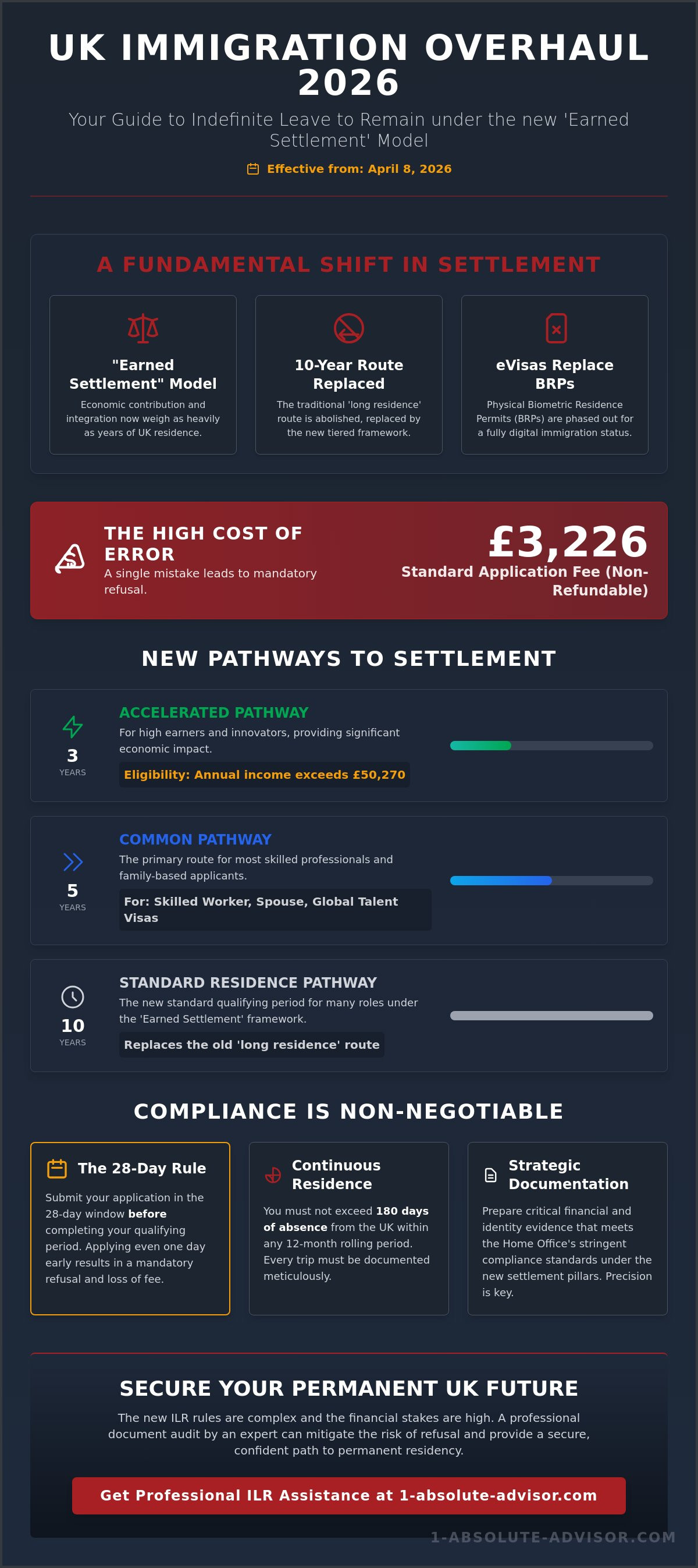
Indefinite Leave to Remain (ILR) represents the final milestone in the UK immigration journey, providing a secure foundation for permanent settlement. It effectively removes time limits on your stay and grants you the freedom to work or study without sponsorship. For most professionals and families, the primary goal is to apply for indefinite visa status after completing a set period of lawful residence. This process requires a strategic approach to ensure every day of your stay aligns with Home Office mandates.

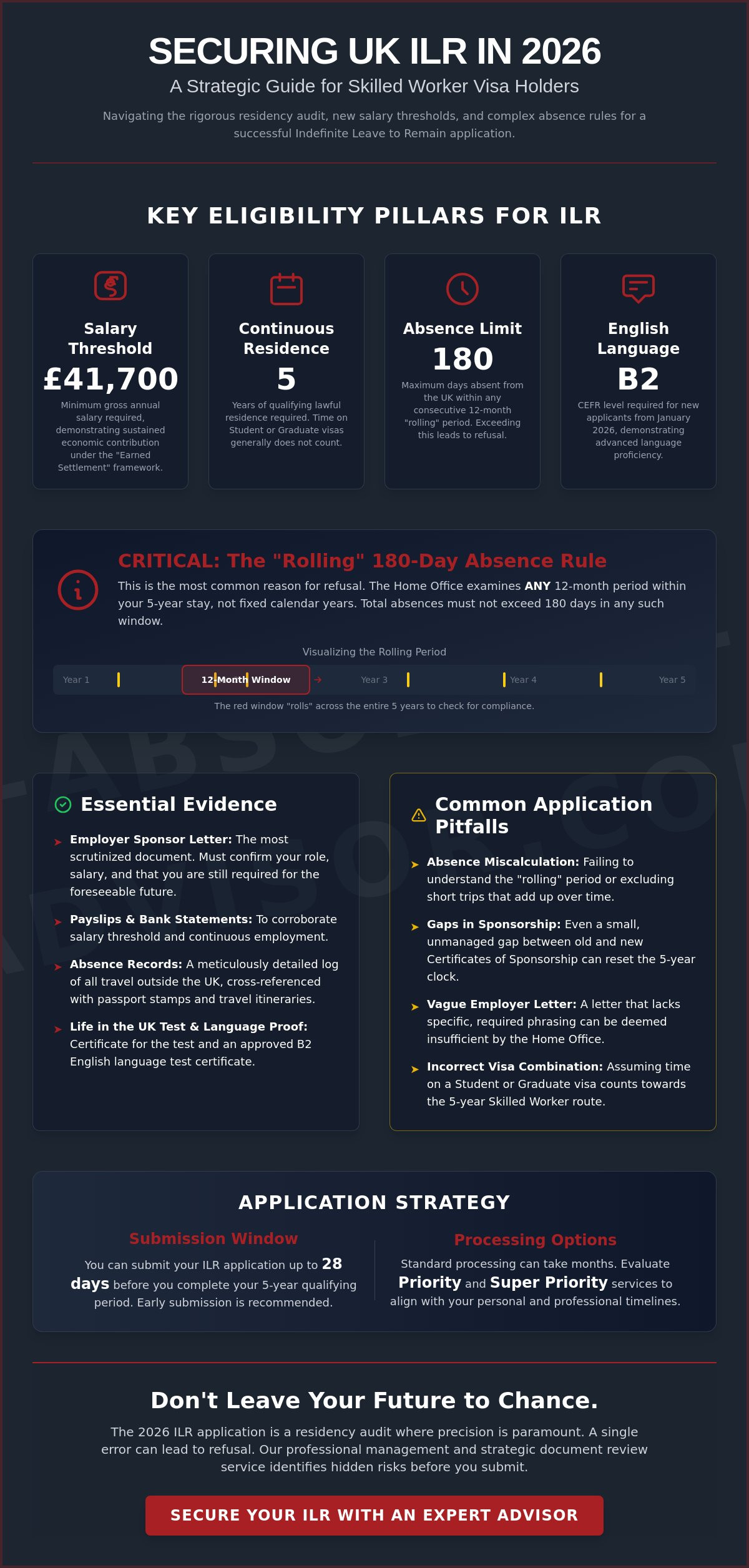
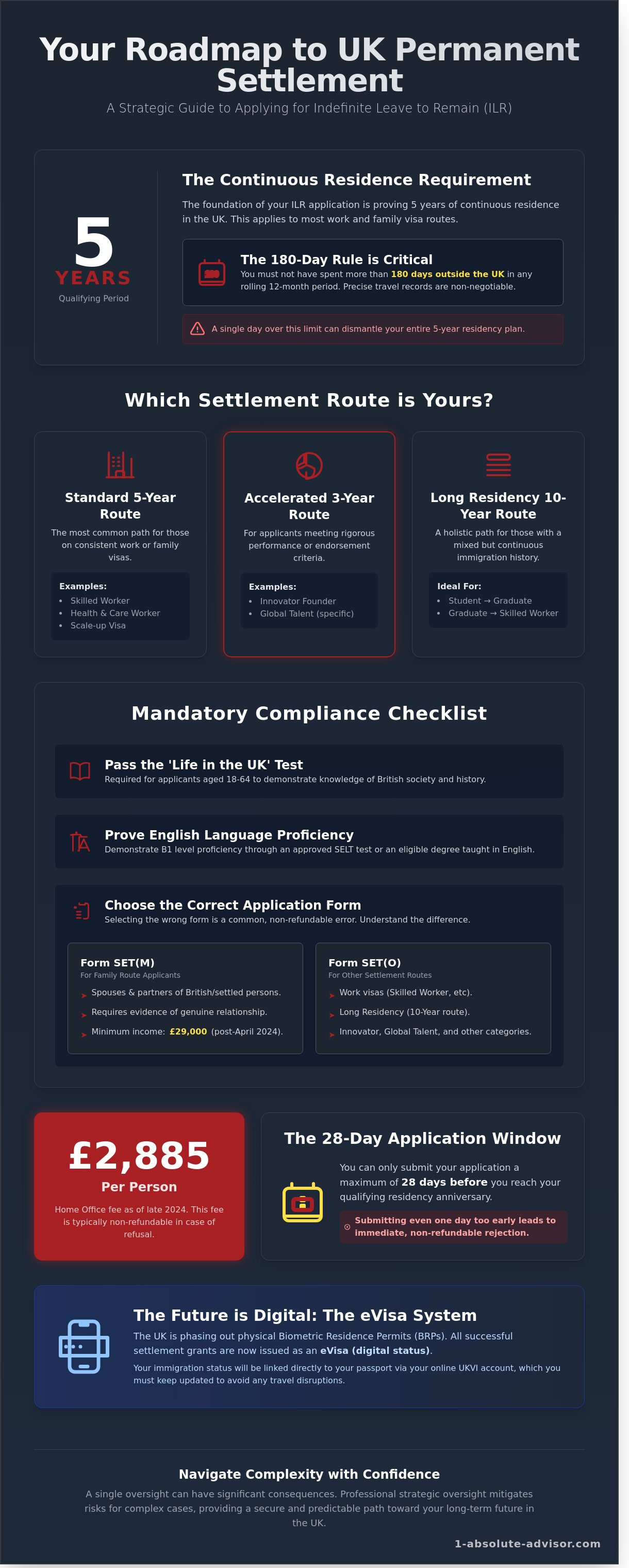
The core eligibility criteria typically center on a five-year continuous residence period. This applies to those on Skilled Worker, Health and Care Worker, or Scale-up visas. You must demonstrate that the UK has been your primary home. Under current 2024 guidelines, “continuous residence” means you’ve not spent more than 180 days outside the UK in any rolling 12-month period. Maintaining precise records of travel is essential for a successful submission, as even minor discrepancies can lead to delays.

Some applicants qualify for accelerated settlement. The Innovator Founder and specific Global Talent routes allow for ILR after only three years, provided you meet rigorous performance benchmarks or endorsement criteria. Regardless of the route, timing is your most significant risk factor. The Home Office allows you to submit your application no more than 28 days before you hit your five-year anniversary. Submitting even 24 hours too early leads to an immediate, non-refundable rejection. This 28-day rule is a common trap that requires careful calendar management.

The 5-Year vs. 10-Year Routes to Settlement

The standard 5-year path is the most direct route for those on consistent work or family-based visas. However, if your immigration history involves switching between various categories, such as moving from a Student visa to a Graduate visa and then to a Skilled Worker visa, the 10-year Long Residency rule may be more appropriate. While the 5-year route is faster, the 10-year path offers a holistic way to count all legal time spent in the country toward your settlement goal, provided there were no gaps in your leave.

Statutory Requirements: Life in the UK and English Language

Compliance involves more than just time spent in the country. Applicants between 18 and 64 must pass the Life in the UK test, which evaluates knowledge of British society and history. You must also prove English language proficiency at level B1 or higher on the CEFR scale. This is usually achieved through an approved Secure English Language Test (SELT) or by holding a degree taught in English. Certain exemptions exist for those with specific medical conditions or those from majority English-speaking nations like Canada or Australia.

Choosing the Correct Form: SET(M) vs. SET(O)

Selecting the wrong digital portal when you apply for indefinite visa is a common but expensive error. The Home Office treats SET(M) and SET(O) as distinct legal pathways with no overlap. Using the wrong form typically leads to an immediate rejection rather than a request for clarification. Since application fees reached £2,885 per person in late 2024, a clerical mistake results in significant financial loss. The Home Office rarely issues refunds for applications processed under the incorrect category.

You can include a partner and dependent children on a single application if they’re applying at the same time as you. This streamlines the process, though each person must still meet their specific eligibility criteria. By 2026, the UK will have fully transitioned to a digital immigration system. All successful settlement grants are now issued as an eVisa. You’ll no longer receive a physical Biometric Residence Permit (BRP). Instead, your status is linked to your passport through a UKVI account, which you must keep updated to avoid travel disruptions.

When to Use Form SET(M)

Form SET(M) is designed specifically for the family route. It’s the correct choice for spouses, civil partners, or unmarried partners of British citizens or persons with settled status. If you’re on the 5-year family path, you must provide robust evidence that your relationship is genuine and subsisting. This involves submitting at least six items of correspondence addressed to both of you at the same address, spread evenly over the last two years. Following the policy shifts in April 2024, most applicants must meet a minimum income threshold of £29,000. Failure to provide specific bank statements and wage slips that match this exact figure will lead to a refusal.

When to Use Form SET(O)

SET(O) serves as the “Other” category, covering the majority of work-based routes. This includes Skilled Workers, T2 Ministers of Religion, and those applying via UK Ancestry. For Skilled Workers, the requirements are particularly rigid. You must submit a formal letter from your employer, dated within 31 days of your application, confirming you’re still required for your role. This letter must also certify that your salary meets the 2026 thresholds. For many, this threshold is £38,700, though specific “going rates” for your occupation code may be higher. Precision in these documents is vital for a successful outcome. Our consultants can perform a comprehensive compliance review to ensure your salary and sponsorship details align with current Home Office benchmarks.

  • SET(M): Used for family-based settlement (spouses and partners).
  • SET(O): Used for work-based settlement (Skilled Workers, Ancestry, etc.).
  • Digital Requirement: All 2026 grants are issued as eVisas.
  • Financial Risk: Incorrect form usage results in a lost £2,885 fee.

How to Apply for an Indefinite Visa in the UK: A Step-by-Step 2026 Guide

Evidence and the Continuous Residence Requirement

Meeting the requirements to apply for indefinite visa status hinges on your ability to prove a stable, uninterrupted presence in the UK. The Home Office defines “Continuous Residence” as the period where an applicant has lived in the country without excessive absences. This remains the most scrutinized part of the process because the level of detail required for travel records is absolute. You must demonstrate that your life, finances, and professional future are firmly rooted in the British Isles.

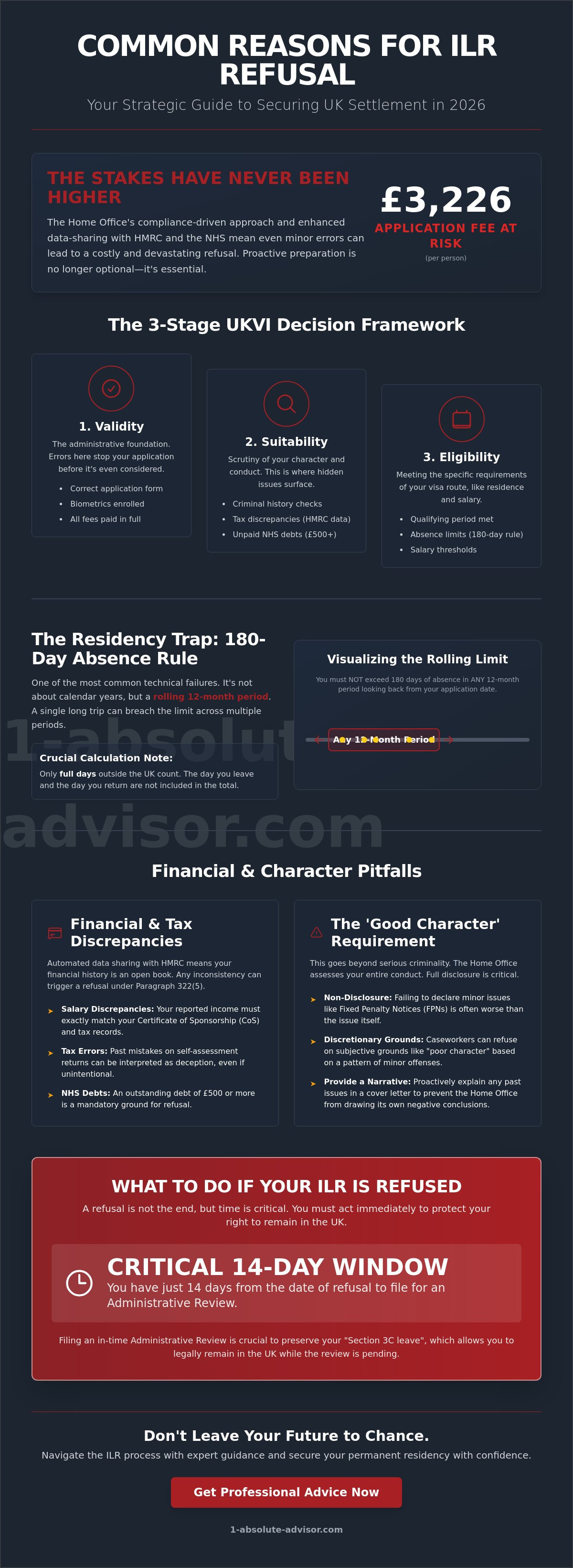
The 180-day rule is the primary metric used for this assessment. You cannot spend more than 180 days outside the UK in any rolling 12-month period during your qualifying five years. It’s a common mistake to calculate this by calendar year; however, the Home Office looks at any consecutive 12-month block. If you exceed this limit, your continuity is broken, which effectively resets your five-year clock to zero. Consistency in your residency is as much about your physical presence as it is about your financial footprint.

The “Good Character” requirement is equally vital. This goes beyond major criminal records. You must disclose every interaction with the law, including fixed penalty notices for driving or minor tax discrepancies with HMRC. Concealing these facts is often viewed as deception. In the eyes of a caseworker, a failure to disclose a minor offence is a greater risk than the offence itself, often leading to a mandatory refusal and a potential ten-year ban on future applications.

Calculating Your Absences Accurately

Precision is mandatory when you apply for indefinite visa status. You should maintain a spreadsheet tracking every flight, ferry, or train journey out of the UK over the last 60 months. The Home Office counts only full days spent outside the country, meaning the day you leave and the day you return don’t count toward the 180-day limit. If you exceeded the limit due to compassionate grounds, such as a serious illness, you’ll need certified medical records to justify the exception. You must also provide evidence, such as utility bills or mortgage statements, to prove your UK home remained your primary residence during those absences.

The Document Checklist for 2026

By 2026, the UKVCAS system has fully digitized the evidence submission process. You’ll need to provide 60 months of bank statements, P60 documents, and employer letters that specifically confirm your ongoing role and salary. A professional cover letter is an absolute necessity to bridge any gaps in your history. It provides the narrative context that raw data cannot. Common errors that trigger a “Request for Information” include submitting scanned documents where the edges are cut off or providing bank statements that aren’t in a sequential, monthly order. These small administrative oversights can delay a decision by 8 to 12 weeks.

The Step-by-Step Process to Apply for Indefinite Leave to Remain

Securing permanent residency requires a methodical approach where timing and documentation must align perfectly. Before you begin the digital paperwork, you’ll need to finalize your preliminary qualifications. This includes passing the Life in the UK test and obtaining a CEFR B1 level English language certificate, unless you’re exempt due to age or a recognized degree taught in English. These credentials must be valid at the moment you hit submit; a common mistake is letting a language certificate expire just before the five-year qualifying period ends.

The process demands absolute attention to detail. In 2026, the Home Office continues to prioritize digital-first interactions, meaning your ability to apply for indefinite visa status depends on a clean, verifiable electronic trail. You’ll need to account for every absence from the UK over the last 60 months, ensuring you haven’t exceeded the 180-day limit in any consecutive 12-month period. This level of precision is what separates successful applications from those that face unnecessary delays or rejections.

Submitting Your Application Online

Your journey starts on the official GOV.UK website where you’ll create a UKVI account. It’s vital to select the specific settlement form relevant to your current visa route, such as Set(O) for skilled workers or Set(M) for family members. Once you’ve filled in your personal history, you’ll be prompted to pay the application fee. As of early 2026, these fees remain a significant investment, often exceeding £2,800 per person. While the Immigration Health Surcharge is generally not required for ILR applicants, you should verify this based on your specific visa category. After payment, you’ll gain access to the Sopra Steria (UKVCAS) portal. This is where you’ll upload high-quality scans of your passport, employer letters, and financial statements. Ensuring these files are legible and correctly categorized is a critical step in the strategy.

Attending the Biometric Appointment

The final physical hurdle is the biometric appointment. You’ll choose between free core centres or premium service points, which often offer evening or weekend slots for an additional fee. During this 15-minute session, a staff member will scan your fingerprints, take a digital photograph, and verify your original passport. It’s not an interview, but it’s a mandatory security check. You must bring your appointment confirmation and your current passport to avoid being turned away. If you’ve opted for the document scanning service, you’ll also bring your physical evidence here, though most applicants now prefer the control of the 100% digital upload route.

Once biometrics are submitted, the waiting game begins. In 2026, standard processing times typically hover around 180 days. If your professional or personal life requires a faster resolution, the Priority Service offers a decision within 5 working days, while Super Priority can deliver a result by the end of the next working day. Choosing the right service level is a tactical decision based on your upcoming travel needs and career moves. For those seeking a seamless transition to permanent residency, our bespoke immigration strategy services provide the clarity needed to navigate these complex timelines with confidence.

Securing Your Future: Professional Guidance and Next Steps

Completing the journey to permanent residency is a milestone that requires absolute precision. While the digital application process appears straightforward, the Home Office continues to exercise rigorous scrutiny. Data from 2024 shows that approximately 12% of settlement applications faced delays or refusals due to avoidable administrative errors or insufficient evidence. When you apply for indefinite visa status, you aren’t just submitting a form; you’re presenting a multi-year narrative of your life and compliance in the UK.

1 Absolute Advisor acts as your strategic partner throughout this transition. We manage the entire settlement journey by identifying potential red flags in your employment history or residency gaps before they reach a caseworker’s desk. For high-salary professionals and complex cases, our holistic approach ensures that every financial statement and employer letter aligns perfectly with current Appendix Settlement rules.

Why Use an OISC-Registered Consultant?

The UK’s immigration system is governed by strict statutory requirements. Engaging an OISC-registered consultant provides a layer of security that self-submission cannot match. We perform a comprehensive document audit to catch discrepancies in salary thresholds or tax records that often trigger mandatory refusals. Our team drafts detailed legal representations that pre-emptively address Home Office concerns, effectively “speaking the language” of the caseworker.

For those with urgent travel needs or professional commitments, we facilitate access to priority and super-priority services. These tracks can reduce the waiting time from six months to just 24 hours. Having a professional representative ensures your application is technically perfect, which is essential when utilizing these expedited, high-cost services.

From ILR to British Citizenship

Receiving your Indefinite Leave to Remain (ILR) is the penultimate step. Most residents must wait a full 12 months after obtaining their indefinite visa before they become eligible for naturalisation. However, if you’re married to a British citizen, this waiting period may not apply. It’s vital to maintain your status during this time; being absent from the UK for more than two years can result in the automatic loss of your ILR. To plan your final step toward a UK passport, consult our British Citizenship: The Complete Guide to Naturalisation in 2026.

Final Readiness Checklist:

  • Residency Audit: Have you confirmed you haven’t spent more than 180 days outside the UK in any 12-month period?
  • Financial Evidence: Do your payslips match your bank statements to the exact penny for the last 3-6 months?
  • Life in the UK: Is your test pass certificate valid and linked correctly to your digital profile?
  • Employer Support: Does your current sponsor confirm they still require you for the foreseeable future?

Don’t leave your future to chance. A single oversight can lead to a refusal that stays on your record permanently. By ensuring 100% accuracy before hitting “Submit,” you protect your investment and your life in the United Kingdom.

Securing Your Permanent Future in the United Kingdom

Achieving permanent residency requires more than just completing the 5-year qualifying period. You must accurately identify whether your specific circumstances demand a SET(M) or SET(O) form. Errors in calculating the 180-day absence limit often lead to avoidable refusals under current Home Office guidelines. Since the 2026 procedural updates, the evidentiary requirements for continuous residence have become significantly more detailed. It’s vital to verify every document against statutory requirements before you commit to the submission process.

When you’re ready to apply for indefinite visa status, small discrepancies in your residency history can jeopardize years of effort. 1 Absolute Advisor’s OISC-Registered Immigration Consultants provide fixed-fee application management to ensure your submission is legally sound. We specialize in complex residency calculations that address specific gaps or overlaps in your immigration history. This strategic approach transforms a stressful administrative burden into a structured path toward your long-term goals.

Book a Professional ILR Consultation with 1 Absolute Advisor to secure your status with confidence. Your permanent future in the UK depends on a precise, professionally managed application.

Frequently Asked Questions

How long does it take to get a decision after I apply for an indefinite visa?

Standard processing for settlement applications takes up to 6 months, though priority services offer decisions within 5 working days or 24 hours. Home Office data shows that 98% of straightforward applications meet these specific service standards. You should plan your professional and personal commitments around these windows to ensure your transition to permanent residency doesn’t disrupt your business or travel plans.

Can I leave the UK while my ILR application is being processed?

You can’t leave the Common Travel Area while your application is pending without automatically withdrawing your submission. Under Section 3C of the Immigration Act 1971, your current leave remains valid during the processing period to protect your legal status. If you depart the UK before receiving a formal decision, the Home Office treats your application as abandoned immediately, which necessitates a costly and time-consuming restart.

What happens if my application for indefinite leave to remain is refused?

If your application is refused, you’ll receive a decision letter outlining whether you have the right to an Administrative Review or a Judicial Review within 14 days. Government statistics indicate that many refusals stem from missing documentation or incorrect financial evidence. We recommend a strategic audit of your submission to identify the specific legal grounds for a challenge and to determine if a fresh application is a more viable path.

How much does it cost to apply for an indefinite visa in 2026?

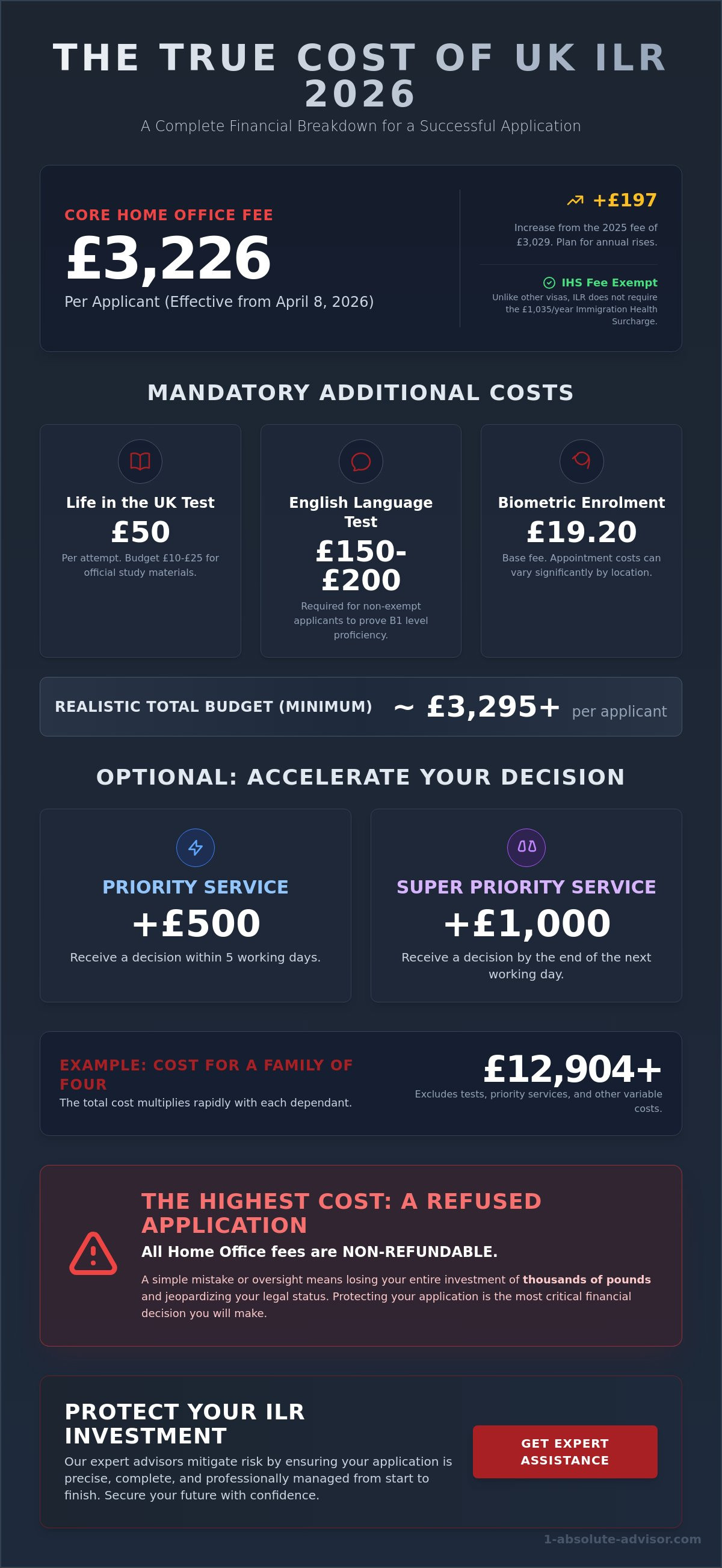
The current fee to apply for indefinite visa status is £2,885 per applicant, though the Home Office traditionally reviews and adjusts these figures every April. You must also account for the £19.20 biometric enrollment fee and potential priority service costs ranging from £500 to £1,000. These costs are non-refundable, so ensuring your documentation is perfect the first time is a critical financial strategy for your household budget.

Do I need to retake the English test if I already did it for my initial visa?

You don’t need to retake the English test if your previous qualification is at CEFR level B1 or higher and is still on the Home Office approved list. If your initial visa only required an A1 or A2 level for entry, you’ll need to pass a new B1 test at an authorized provider. Accuracy here prevents the delays caused by insufficient language evidence, which affects roughly 10% of settlement applicants.

What is the “Life in the UK” test and how do I book it?

The Life in the UK test is a 45 minute exam covering British customs and history that requires a 75% score to pass. You must book it through the official government portal at least 3 days in advance for a fixed fee of £50. This certificate doesn’t expire, so passing it early is a proactive step that ensures your settlement strategy remains on schedule regardless of future policy changes.

Can I include my children in my indefinite visa application?

You can include your children under the age of 18 as dependents when you apply for indefinite visa status. Children born in the UK may have different paths to citizenship, but those born abroad must be included in your settlement application to maintain their legal residency. This holistic approach ensures your entire family’s security is handled in one synchronized process, reducing the risk of fragmented legal statuses.

What happens to my BRP after I am granted an eVisa for settlement?

Your physical Biometric Residence Permit becomes obsolete as the UK transitions to a fully digital eVisa system by the end of 2024. You’ll manage your settlement status through a UKVI account, which provides a share code for employers, banks, or landlords. This shift enhances security and ensures your right to work and reside in the UK is verifiable 24/7 without the need for physical documents.

Innovator Founder Visa UK 2026: The Definitive Guide for Global Entrepreneurs

The removal of the £50,000 investment threshold in April 2023 transformed the UK’s business immigration landscape from a capital-based entry system into a high-stakes competition of pure commercial merit. You probably recognise that while the entry price has vanished, the intellectual and strategic demands of the innovator founder visa uk have become significantly more complex. It’s a common concern that without a clear capital requirement, the criteria for innovation and scalability remain frustratingly subjective, leaving your entrepreneurial future at the mercy of a single endorsement letter.

We’ll replace that uncertainty with a methodical framework designed to satisfy both the Home Office and the most rigorous endorsing bodies. You’ll learn how to construct a business plan that bridges the gap between visionary theory and commercial reality, ensuring you meet the mandatory checkpoints for your three-year path to settlement. This guide details the exact steps to secure your endorsement and manage your long-term residency prospects with absolute confidence.

Key Takeaways

  • Understand how the removal of the £50,000 minimum investment requirement has redefined the innovator founder visa uk as a premier pathway for global talent.
  • Identify the specific criteria Endorsing Bodies utilise to assess the innovation, viability, and scalability of your business proposal.
  • Compare the benefits of the Innovator Founder route against strategic alternatives like Global Talent or self-sponsorship to optimise your entry strategy.
  • Gain insights into the mandatory compliance framework, including critical 12 and 24-month progress reviews required to protect your leave to remain.
  • Learn how professional OISC-registered guidance can bridge the gap between a visionary business concept and a successful Home Office application.

What is the Innovator Founder Visa UK? The 2026 Landscape

The innovator founder visa uk represents the British government’s most streamlined effort to attract high-growth potential to London, Manchester, and the UK’s burgeoning tech hubs. Unlike previous iterations that demanded a rigid £50,000 capital injection, the current framework focuses on the intellectual and strategic value of the entrepreneur. This shift, codified in the changes effective from 13 April 2023, prioritises scalability and innovation over liquid assets. It’s a strategic move that positions the UK as a primary destination for those who possess a vision but might prefer to allocate capital toward operational growth rather than meeting a baseline entry fee.

By removing the minimum investment barrier, the Home Office has opened the door to “lean” startups that rely on intellectual property rather than heavy machinery or stock. This doesn’t mean the route is easy; it means the scrutiny has shifted to the viability of the business plan. In the 2026 market, the UK remains a global centre for innovation because of its robust legal protections and access to a venture capital ecosystem that consistently outperforms European neighbours. Choosing this path isn’t just about a visa; it’s about embedding your business in a territory that rewards original thinking with rapid growth opportunities.

The Evolution from the Old Innovator Route

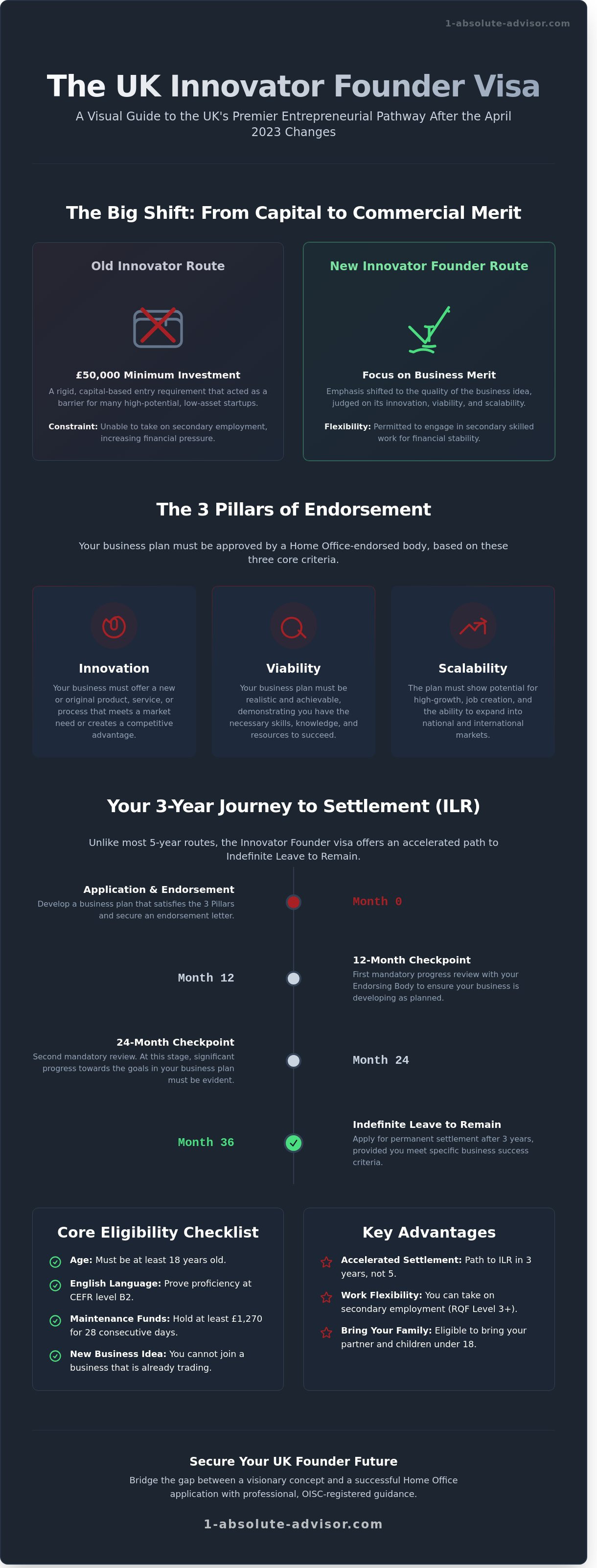
The transition from the old Innovator route to the Founder model solved a critical friction point: the ability for entrepreneurs to support themselves. Previously, founders were strictly tied to their primary venture, which created immense pressure during the initial pre-revenue phase. Today, the rules allow you to take on secondary professional work in roles requiring a skill level of RQF Level 3 or above. The Innovator Founder visa is a flexible, high-integrity route for original business concepts. This flexibility ensures that while your primary focus remains the “new” business, you’ve got the financial breathing room to navigate the early-stage volatility of a startup. This evolution fits within the broader UK visa policy framework, which has increasingly pivoted toward meritocratic, points-based entries.

Core Eligibility Criteria for 2026

To qualify in 2026, you’ve got to meet several non-negotiable benchmarks that ensure only the most serious candidates enter the market. The requirements are designed to filter for individuals who can integrate into the British business community immediately. Key criteria include:

  • Age and Language: You must be at least 18 years old and prove your English language proficiency at a B2 level on the CEFR scale.
  • Maintenance Funds: You’ll need at least £1,270 in your personal bank account for 28 consecutive days before applying to prove you can support yourself without relying on public funds.
  • Originality: Your business idea must be “new.” This means you cannot have traded under this specific business name or model before.
  • Innovation: Copycat models or simple franchises don’t make the cut; your proposal must offer something original that adds value to the UK market.

One of the most compelling reasons to choose the innovator founder visa uk is the accelerated timeline to permanent residency. While most routes require five years of residency, this visa offers a path to Indefinite Leave to Remain (ILR) in just 36 months, provided you meet specific growth or investment milestones. You can bring your partner and children under 18, making it a holistic choice for families looking for long-term stability. Even as global markets fluctuate, the UK’s legal stability and access to venture capital keep it at the centre of international innovation.

The Four Pillars of Endorsement: Securing Your Business Idea

Securing an endorsement is the most critical hurdle in your journey. The Home Office transitioned to the current system in April 2023, delegating the technical assessment of business ideas to a small group of approved Endorsing Bodies (EBs). These organisations serve as the gatekeepers for the innovator founder visa uk, ensuring that every applicant brings genuine value to the British economy rather than just capital. They don’t just review documents; they act as strategic auditors who verify the logic behind your commercial assumptions.

To succeed, your proposal must satisfy three primary criteria, often referred to as the pillars of endorsement. First is Innovation. You must prove your business isn’t merely a “copycat” of existing UK firms. Your plan needs to address a specific market gap or offer a competitive advantage through original intellectual property or a unique delivery model. According to the Official Innovator Founder Visa Guidance, the idea must be new and cannot be an already trading business. You’re expected to show why your solution is better, faster, or more efficient than what’s currently available in the 2024 UK market.

The second pillar is Viability. EBs look for a realistic path to profitability. They’ll scrutinise your personal experience, your educational background, and the resources at your disposal. If your financial forecasts don’t align with current UK market rates or VAT regulations, your application will likely fail. Finally, Scalability requires evidence of potential for national and international growth. A successful plan typically demonstrates how it’ll create at least two full-time jobs for settled workers within the first three years of operation, contributing directly to the UK’s GDP.

How to Choose the Right Endorsing Body

The Home Office currently authorises four main legacy endorsing bodies: UK Endorsement Services, Innovator International, Envestors Limited, and the Global Entrepreneurs Programme (GEP). Choosing the right one depends on your sector. For instance, Envestors often focuses on high-growth tech startups, while GEP is tailored for those already scouted by the Department for Business and Trade. You’ll need to pay a standard endorsement fee, which is typically £1,000 for the initial letter of endorsement. This fee covers the robust due diligence process required to verify your business credentials and professional history.

Drafting a Winning Business Plan

A standard commercial business plan rarely meets the rigorous standards of the innovator founder visa uk. The Home Office requires a level of evidence-based research that goes far beyond generic market summaries. You must replace vague statements like “high growth potential” with concrete data, such as “targeting 5% of the £2.4 billion UK fintech sector by year two.” This level of precision shows the EB that you’ve performed absolute due diligence on your target demographics.

Articulating innovation requires precision. Avoid overused buzzwords like “disruptive” or “revolutionary” unless they’re backed by technical specifications or patent filings. Your plan should act as a strategic roadmap that links your financial projections directly to your operational milestones. Our consultants at Absolute Advisor often see that a holistically structured plan, where tax efficiency and compliance are integrated from day one, has a significantly higher success rate during the EB interview phase. It’s about proving that your business is not just a concept, but a stable, long-term investment for the UK economy.

Innovator Founder Visa UK 2026: The Definitive Guide for Global Entrepreneurs

Strategic Comparison: Innovator Founder vs. Alternatives

Choosing the correct entry path requires a cold, analytical look at your long-term objectives. The innovator founder visa uk, introduced on 13 April 2023, replaced the previous Innovator and Start-up routes to streamline the process. It isn’t always the most efficient choice for every entrepreneur. You must weigh the speed of Indefinite Leave to Remain (ILR) against the administrative burden of endorsement. While the Innovator Founder route offers a three-year path to residency, it demands constant engagement with an endorsing body. Other routes, such as the Skilled Worker or Global Talent visas, provide different levels of autonomy and risk. For Commonwealth citizens with qualifying grandparents, the ancestry visa uk offers a five-year path to settlement without the need for business endorsement or investment requirements. This expert analysis on the UK’s visa changes highlights how these shifts affect the UK’s ability to attract global business leaders.

Innovator Founder vs. Skilled Worker Route

The primary distinction lies in the nature of the “innovation” requirement. An Innovator Founder must present a business plan that’s original, scalable, and viable. This is a subjective assessment performed by third-party endorsing bodies. In contrast, the Skilled Worker route relies on a sponsor licence. Some founders opt for “self-sponsorship,” where their own UK company sponsors their visa. This path is often safer because it depends on objective salary thresholds and job codes rather than a third party’s opinion of your business idea. If your business model is established or traditional, our Skilled Worker Visa Application Service might be the more predictable path. The Skilled Worker route takes five years to reach ILR, whereas the Innovator route cuts this to three years, provided you meet specific growth milestones like creating ten full-time jobs or generating £500,000 in annual revenue.

When is Global Talent a Better Fit?

The Global Talent visa is the “gold standard” for those who qualify. It doesn’t tie you to a specific business plan or a single company. You can pivot your business, work for others, or remain self-employed without notifying the Home Office of every strategic shift. If you’ve a proven track record in digital technology, science, or the arts, this route offers unparalleled freedom. The Innovator route is better suited for those building a team from scratch who don’t yet meet the “Exceptional Talent” criteria but have a disruptive idea ready for market entry. Global Talent recipients with “Exceptional Talent” status can also apply for ILR after three years, matching the Innovator timeline without the restrictive endorsement check-ins every six, twelve, and twenty-four months.

Risk profiles vary significantly across these options. The innovator founder visa uk carries a higher risk of visa curtailment if the endorsing body withdraws its support. This could happen if your business fails to meet the milestones set out in your initial plan. The Skilled Worker route offers more stability, as the sponsor licence is under your company’s control, though it requires a higher initial investment in compliance and payroll. For a founder, the decision rests on whether the two-year saving in the ILR timeline justifies the rigorous oversight of an endorsing body. Most tech founders find the Innovator route rewarding if their product is truly novel; however, those seeking to launch a consultancy or a service-based business often find the Skilled Worker path more sustainable.

Maintaining Your Status: Mandatory Check-ins and Compliance

Securing your innovator founder visa uk is just the first step in a multi-year regulatory journey. The Home Office requires constant engagement with your Endorsing Body (EB) to ensure the business remains viable, scalable, and innovative. If you fail to meet these milestones, your endorsement can be revoked, leading to the immediate curtailment of your leave to remain. Professional founders treat compliance as a core business function rather than an administrative afterthought.

The 12 and 24-Month Review Process

EBs conduct formal reviews at the 12-month and 24-month marks to monitor your progress. They aren’t just checking your bank balance; they want to see that you’re active in the day-to-day management of the venture. You must demonstrate significant progress against the original business plan that secured your initial endorsement. This includes hitting development milestones, securing partnerships, or beginning the hiring process. If your market research suggests a shift in strategy is necessary, you can’t simply change course without notification. A pivot is permitted only with the explicit written approval of your Endorsing Body. Failure to secure this permission might lead to an Endorsement Withdrawal. If this happens, the Home Office usually curtails your visa to just 60 days, leaving you very little time to find an alternative or leave the UK.

Path to Indefinite Leave to Remain (ILR)

Settlement is the ultimate goal for most founders. Under the current rules, you can apply for settlement after just 3 years if you meet specific Significant Achievement criteria. This accelerated route makes the innovator founder visa uk one of the most attractive options for serious entrepreneurs. You must satisfy at least two of the following conditions:

  • At least £50,000 has been invested into the business and spent on development.
  • The number of customers has at least doubled within the last 3 years and is higher than the mean for similar UK businesses.
  • The business has engaged in significant research and development and applied for intellectual property protection in the UK.
  • The business has generated a minimum annual gross revenue of £1 million in the last full year.
  • The business is generating a minimum annual gross revenue of £500,000, with at least £100,000 from exporting overseas.
  • The business has created at least 10 full-time jobs for settled workers.
  • The business has created at least 5 full-time jobs for settled workers with an average salary of at least £25,000 a year.

Preparing for this assessment starts on day one. You’ll need a robust paper trail, including payroll records, VAT returns, and signed contracts. For expert guidance on the final stages, explore our Indefinite Leave to Remain (ILR) Application Service.

Once you achieve these milestones and secure your future in the UK, managing the resulting personal wealth becomes the next critical step. For founders navigating this transition, specialist firms like Neil Jesani Wealth provide the institutional-grade advisory needed to protect and grow their assets for the long term.

Maintaining compliance requires more than just showing up to meetings. We recommend founders keep a dedicated compliance folder containing monthly management accounts and evidence of all business expenditures. Keep track of every job created with PAYE references and employment contracts. If you’re relying on job creation criteria for settlement, the Home Office will scrutinise these documents heavily. This proactive approach ensures that when the final review arrives, you’re ready to demonstrate the absolute value your business brings to the UK economy.

If you need a strategic partner to oversee your compliance roadmap, contact our specialist business advisors today.

How 1 Absolute Advisor Secures Your UK Founder Future

Securing an innovator founder visa uk requires more than a creative business idea; it demands a rigorous adherence to the Home Office’s shifting regulatory framework. As an OISC-registered firm, 1 Absolute Advisor provides the high-level legal oversight necessary for entrepreneurs entering the British market. Our role transcends simple form-filling. We operate as strategic partners, ensuring your business model aligns with the specific “innovative, viable, and scalable” criteria that Endorsing Bodies (EBs) demand. Since the 13 April 2023 rule changes, the subjective nature of these assessments has increased, making professional representation a critical factor in a successful outcome.

Our methodology combines technical legal precision with commercial acumen. We conduct an exhaustive review of your business plan before it ever reaches an Endorsing Body. This “legal + strategic” audit identifies potential red flags, such as insufficient evidence of market gap or weak financial forecasting, which often lead to immediate rejections. By the time your application is submitted, it has been refined to meet the internal benchmarks of organisations like Innovator International or UK Endorsing Services. We manage the entire dialogue with these bodies, acting as your professional intermediary to clarify complex queries and present your vision with absolute clarity.

The path to British Citizenship is a multi-year commitment, and our support reflects this long-term perspective. We don’t just secure your entry; we manage the compliance milestones required at the 12-month and 24-month check-ins. For most founders, the ultimate goal is Indefinite Leave to Remain (ILR), which is achievable after 3 years under this route, followed by citizenship. We maintain your records to ensure every requirement for settlement is documented from day one, reducing the administrative burden on your growing company.

Our Fixed-Fee Application Management

Startup budgets require absolute predictability, which is why we operate on a transparent fixed-fee model. This approach eliminates the uncertainty of hourly billing and allows you to focus your capital on product development and market entry. Our service includes a comprehensive legal audit of your evidence, from proof of funds to intellectual property ownership. We take full responsibility for managing communication with the Home Office, ensuring that every document meets the strict digital and physical submission standards required in 2024.

  • Pre-submission Audit: A 50-point checklist to ensure your evidence is “decision-ready” for the Home Office.
  • Endorsing Body Liaison: Direct management of the endorsement process to reduce the typical 8-week stress window.
  • Strategic Document Preparation: Drafting of legal representations that highlight your business’s unique value to the UK economy.

Next Steps: Your Consultation in London

Your journey begins with a 60-minute eligibility assessment at our London office or via a secure video link. During this session, our senior advisors evaluate your business concept against current Home Office policy guidance and the specific requirements of the current four approved Endorsing Bodies. We provide a clear roadmap, identifying the fastest route to submission and the specific documents you need to gather immediately. This proactive approach ensures your application enters the fast-track queue without the delays caused by missing or incorrect data.

Ready to establish your headquarters in one of the world’s leading financial hubs? Enquire about our Innovator Founder Visa Service today to secure your initial consultation and begin your strategic move to the United Kingdom.

Secure Your Strategic Position in the UK Market

Navigating the 2026 landscape for the innovator founder visa uk demands more than just a creative idea; it requires a rigorous, audit-ready business strategy that aligns with the Home Office’s updated scalability benchmarks. Success hinges on passing the mandatory 12 and 24-month check-ins while maintaining a robust relationship with your chosen endorsement body. These regulatory frameworks are complex, yet they provide a structured pathway to permanent settlement for entrepreneurs who prioritise compliance from day one. Building a business in Britain is a significant commitment that rewards those who approach the process with precision and long-term vision.

At 1 Absolute Advisor, our London-based OISC-registered consultants provide the technical precision needed to bridge the gap between a vision and a successful visa grant. We specialise in comprehensive business plan audits that meet the high thresholds of 2026 endorsement standards. You’ll benefit from a transparent, fixed-fee structure that eliminates the uncertainty of hidden legal costs. By treating your application as a strategic investment rather than a mere administrative task, we ensure your business remains on a stable trajectory. We don’t just process paperwork; we safeguard your professional integrity in the heart of London’s financial district.

Secure your UK Innovator Founder Visa with our expert OISC-registered advisors and take the first step towards your London headquarters today. Your global expansion deserves the certainty of professional excellence.

Frequently Asked Questions

Can I apply for the Innovator Founder visa if I already have a business in my home country?

You can apply for this visa even if you own an existing business abroad, provided your UK venture is a new, distinct entity. The Home Office rules require that your UK business hasn’t started trading yet. If your international firm acts as a parent company, you’ll need to demonstrate how the UK branch introduces a truly innovative product or service to the local market.

What happens if my business fails during the 3-year visa period?

Your visa remains valid only if your endorsing body continues to support your venture. If the business fails, the endorser must inform the Home Office, which usually results in your visa being curtailed to 60 days. During this period, you must find a new business idea to endorse or switch to a different visa category to remain in the country legally.

Do I need to have a specific amount of money in my bank account to apply?

You must show at least £1,270 in personal savings held for 28 consecutive days before your application for the innovator founder visa uk. This maintenance requirement is separate from any investment funds your business might need. If you’ve already lived in the UK for 12 months on a valid visa, you’re typically exempt from showing these personal funds to the Home Office.

Can my partner and children join me on an Innovator Founder visa?

Your partner and dependent children can join you in the UK by applying for their own visas linked to your status. You’ll need to prove you have additional savings of £285 for your partner, £315 for one child, and £200 for each subsequent child. These funds must be held in your account for 28 days to ensure your family’s financial stability without relying on public funds.

How long does the endorsement process typically take in 2026?

The endorsement stage usually takes between 4 and 8 weeks depending on the specific approved body’s internal review cycle. By early 2026, most endorsing bodies have implemented digital screening phases that provide an initial decision within 10 working days. You should plan your business launch around this timeline, as you cannot submit your final visa application to the Home Office without a valid endorsement letter.

Can I switch to an Innovator Founder visa from a Student or Graduate visa?

You can switch to the innovator founder visa uk from a Student or Graduate route if you meet all the eligibility and innovation requirements. This is a common strategic move for entrepreneurs who’ve developed a business concept during their studies. You must ensure your endorsement is secured before your current visa expires to maintain your lawful status and start your business operations immediately.

Is there a limit on how many times I can extend the Innovator Founder visa?

There’s no limit on the number of times you can extend this visa, though most founders aim for permanent residency instead. Each extension lasts for 3 years and requires a new endorsement from an approved body. Since you can apply for Indefinite Leave to Remain after just 3 years, extensions are usually only necessary if you haven’t yet met the specific growth or job creation milestones.

Do I need to be the sole founder, or can I apply as part of a team?

You can apply as part of a founding team, but every individual member must secure their own endorsement for the business. The endorsing body will assess each applicant’s specific role to ensure it’s essential to the company’s success and growth. This allows teams of 2 or 3 partners to combine their expertise while each maintaining their own legal right to work and live in the UK.

Indefinite Leave to Remain: The Complete 2026 Guide to UK Settlement

Nearly 15% of settlement applications face avoidable delays or refusals because of minor administrative discrepancies, even when the applicant meets the core criteria. You’ve likely spent years meticulously building your career and home in the UK, so it’s natural to feel anxious as your current visa expiry approaches. The complexity of the 180-day absence rule often creates unnecessary confusion for even the most diligent professionals who fear a single oversight might jeopardise their status.

This guide provides the exact requirements and strategic steps you need to secure indefinite leave to remain with absolute confidence. You’ll gain a clear roadmap that aligns with the 2026 standards, ensuring your evidence is beyond reproach and your application is robust. We’ll explore the various qualifying routes, clarify the precise calculation of residency periods, and outline the necessary steps to facilitate a successful transition to British Citizenship, giving you the long-term stability your future deserves. By following this structured approach, you can replace uncertainty with a professional strategy for permanent settlement.

Key Takeaways

  • Understand the critical legal distinctions between settlement and citizenship to ensure your long-term status aligns with your personal and professional objectives.
  • Identify whether you qualify for the standard five-year residency path or if your visa category allows for an accelerated two- or three-year route to settlement.
  • Master the strict 180-day absence rule and ‘Good Character’ requirements to ensure your eligibility for indefinite leave to remain remains untarnished.
  • Prepare for the 2026 application process by understanding the latest Home Office fee structures and the comprehensive documentation required for a successful submission.
  • Discover how a proactive, strategic review of your immigration history can identify potential ‘red flags’ and significantly reduce the risk of a costly refusal.

What is Indefinite Leave to Remain (ILR) and Why Does it Matter?

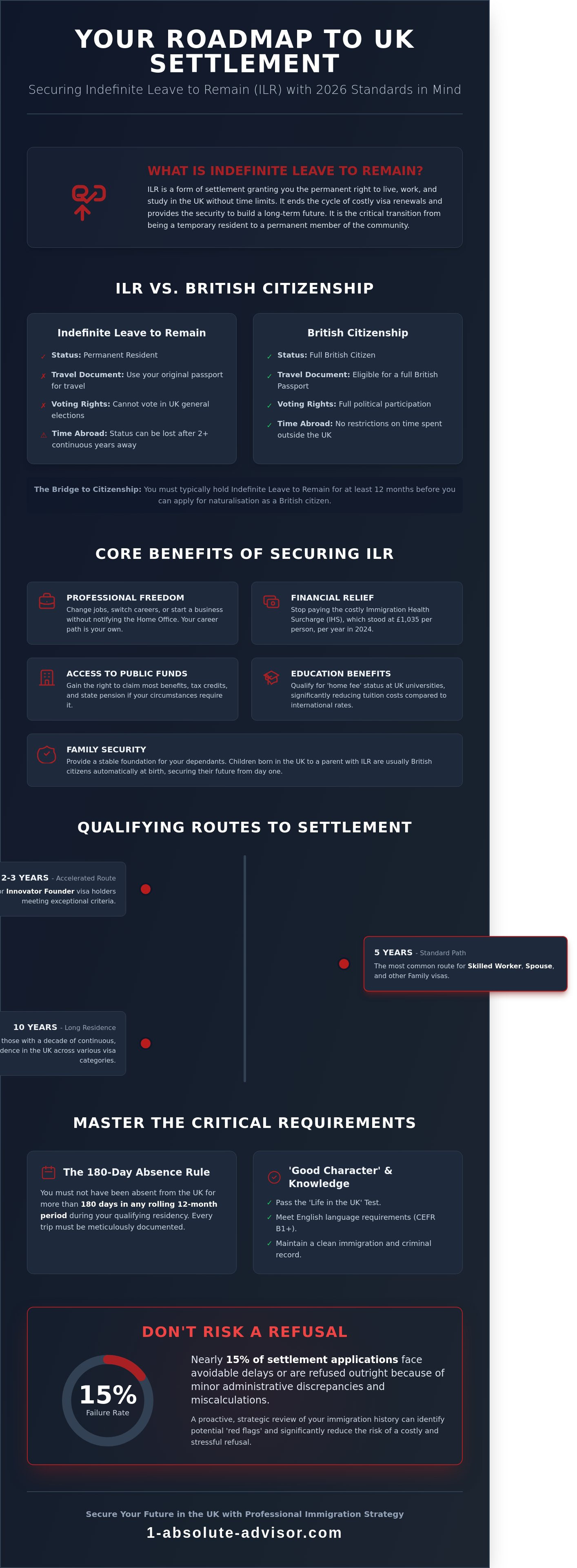
Securing your future in the United Kingdom often culminates in a single, transformative status. Indefinite Leave to Remain (ILR) is a form of settlement that grants non-UK nationals the right to live, work, and study here without any time restrictions. It represents a shift from being a temporary resident to a permanent member of the community. For many, it’s the final hurdle before seeking full British nationality. The year 2026 stands out as a pivotal moment for thousands of applicants. This surge stems from the significant visa rule changes implemented in early 2021 following the UK’s departure from the European Union. Those who entered on five-year routes during that period will reach their eligibility threshold in 2026, making current preparation essential.

Settlement isn’t just a change in paperwork; it’s a strategic move that provides absolute security against future shifts in immigration policy. While a Skilled Worker visa or a Family visa requires periodic renewals and high fees, ILR offers a definitive end to the cycle of applications. It provides the peace of mind necessary for long-term financial planning, such as securing a mortgage or investing in a business. By obtaining ILR, you move from a position of “permitted stay” to “right of abode” in all but name, ensuring your place in the UK’s social and economic fabric is protected by law.

The Core Benefits of Settling in the UK

Indefinite Leave to Remain is the permanent removal of time limits on a person’s stay in the UK. Once you hold this status, you’re no longer tied to a specific employer or a restrictive sponsorship licence. This provides absolute professional mobility; you can switch careers or start a business without notifying the Home Office. Financial pressure also eases significantly. You’ll stop paying the Immigration Health Surcharge (IHS), which rose to £1,035 per year for most adults on 6 February 2024. Additionally, ILR provides a stable foundation for dependants. Children born in the UK to a parent with ILR usually acquire British citizenship automatically at birth under the British Nationality Act 1981. Other key benefits include:

  • Access to Public Funds: You gain the right to claim most benefits and state pension credits if needed.
  • Education: You may qualify for “home fee” status at universities, significantly reducing tuition costs compared to international rates.
  • Healthcare: Full, free access to the NHS continues without the annual surcharge burden.

ILR vs. British Citizenship: Choosing Your Path

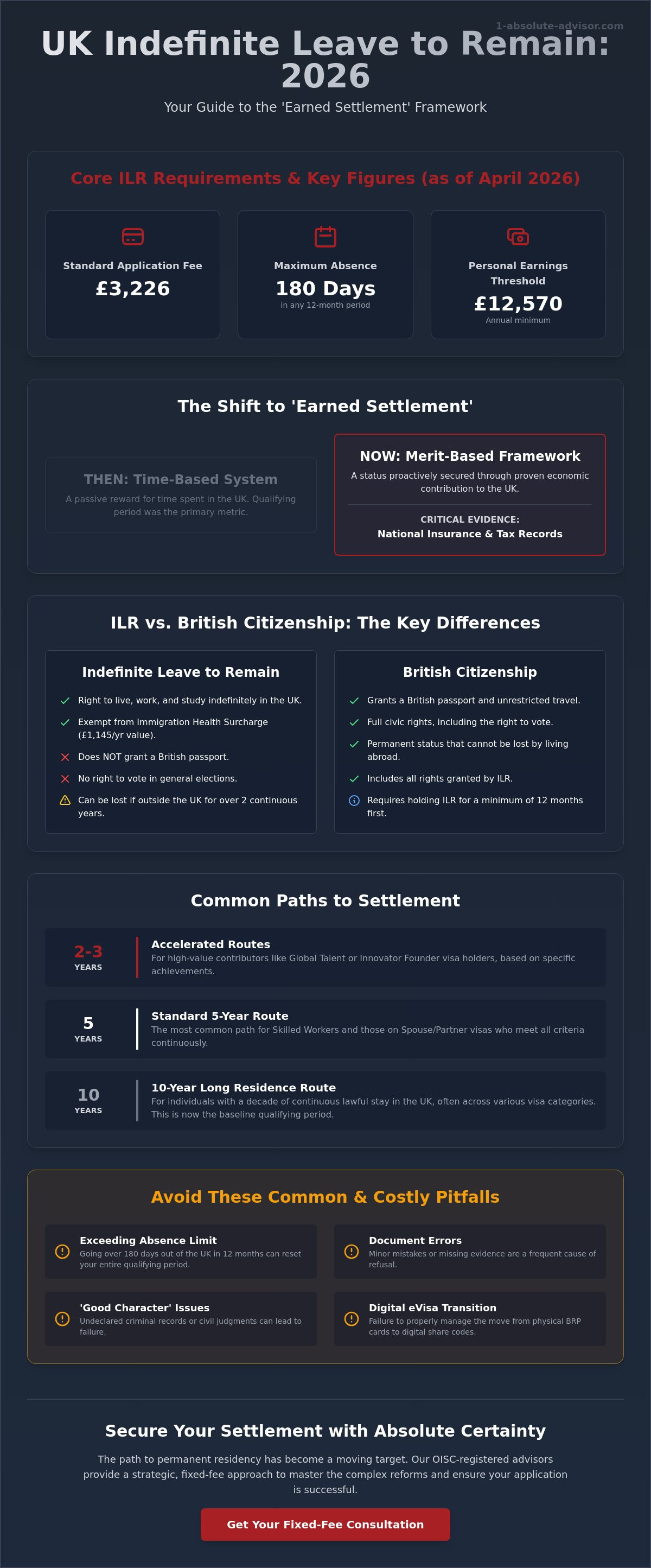
While ILR offers permanent residency, it’s distinct from British citizenship. It serves as the mandatory bridge for most people, as you typically need to hold ILR for 12 months before applying for naturalisation. However, some individuals choose to remain on ILR indefinitely to avoid losing their original nationality, especially if their home country doesn’t permit dual citizenship. You don’t get a British passport with ILR, and you can’t vote in UK general elections. Stability is also conditional. If you remain outside the UK for a continuous period of more than two years, your indefinite leave to remain will automatically lapse. Citizenship, by contrast, is much harder for the government to revoke and offers total protection against future changes in immigration policy. Choosing between the two depends on your long-term global mobility needs and your desire for full political participation in the UK.

Qualifying Routes: How Long Must You Live in the UK for ILR?

Securing indefinite leave to remain requires a meticulous understanding of the specific qualifying period attached to your current visa. It’s not merely about time spent in the country; it’s about the quality and continuity of that residence. Most professionals and family members will find themselves on a 5-year path. However, high-value migrants in the Global Talent or Innovator Founder categories can often reach settlement in 3 years if they meet specific economic or professional benchmarks. To ensure your timeline is accurate, you should check your eligibility for ILR via official channels before preparing your documents.

The 10-year Long Residence route remains a vital safety net for those who’ve held various leave types over a decade. Significant changes introduced in April 2024 now require that the 10-year period must be continuous and the most recent grant of leave must be on a route that leads to settlement. This prevents applicants from using a patchwork of temporary visas to jump straight into settlement without ever being on a long-term path. It’s also possible to combine time spent on different visas, such as moving from a Student visa to a Skilled Worker visa, provided there are no gaps in your lawful residence that exceed the Home Office limits of 180 days in any 12-month period.

The Skilled Worker and Tier 2 Settlement Path

For those on the Skilled Worker route, the landscape changed significantly in April 2024. By 2026, the standard salary threshold for settlement is expected to remain at the £38,700 level or the specific going rate for your occupation, whichever is higher. You’ll need a valid Certificate of Sponsorship (CoS) at the time of your application. Crucially, your employer must provide a formal letter confirming they still require you for the job for the foreseeable future and that your salary meets the 2026 requirements. For a tailored assessment of your timeline, our team can provide a comprehensive eligibility audit.

Family and Partner Routes to Settlement

The path for partners is split between the 5-year and 10-year routes. The 5-year route is reserved for those who meet all financial and English language requirements from the outset. As of 2026, the financial threshold for partners stands at £29,000, a figure that rose from £18,600 in early 2024. You must prove your relationship is ‘subsisting’ after half a decade together. This involves providing shared financial responsibilities, such as joint tenancies or utility bills, dated across the entire five-year period to demonstrate a genuine, ongoing life together in the UK.

Strategic planning is essential when calculating your qualifying period. If you’ve spent significant time outside the UK for work or personal reasons, you must document every absence. The Home Office defines continuous residence strictly; exceeding the 180-day limit in any rolling 12-month period can reset your clock to zero. Maintaining a precise log of travel dates and keeping old passports is not just helpful; it’s a requirement for a successful indefinite leave to remain application. Every day counts when you’re building a future in the United Kingdom.

Indefinite Leave to Remain: The Complete 2026 Guide to UK Settlement

The ‘Hidden’ Criteria: Absences, Good Character, and Life in the UK

Securing indefinite leave to remain requires more than just proving you’ve lived in Britain for five years. The Home Office conducts a qualitative assessment of your residency, focusing on your conduct and your integration into British society. While the Official government guidance on ILR outlines the basic pathway, the “hidden” criteria often cause the most significant delays or refusals for unprepared applicants.

The 180-day rule is the primary hurdle for frequent travellers. You can’t spend more than 180 days outside the UK in any rolling 12-month period during your qualifying years. This isn’t calculated by calendar year; it’s a moving window. If you’ve spent 181 days abroad between June 2024 and June 2025, your continuity is broken. You’ll need to reset your clock unless you qualify for specific exemptions like overseas work for a UK employer or serious family emergencies.

Calculating Continuous Residence and Absences

Documenting travel history is increasingly complex because of the prevalence of e-gates, which often leave passports without physical entry stamps. You must maintain a personal log of every departure and arrival date. If records are missing, cross-reference your history using flight confirmation emails, boarding passes, or bank statements that show your first UK transaction upon return. The 2026 digital application portal demands precise dates for every trip; even a 48-hour discrepancy can trigger a secondary audit of your file.

Exceptional circumstances do exist for those who exceed the 180-day limit. The Home Office may waive the restriction for reasons such as natural disasters, life-threatening illnesses, or professional requirements for certain Tier 1 or Global Talent visa holders. However, these claims require robust evidence, such as medical consultant letters or official employer certifications, to satisfy the caseworker’s discretion.

The Good Character Assessment: Beyond Criminality

The Good Character requirement is often misunderstood as a simple lack of a criminal record. In reality, it’s a deep dive into your financial and civil history. HMRC tax discrepancies are a leading cause of indefinite leave to remain refusals. If the income figures you reported to the Home Office for your previous visa extension don’t align with your Self Assessment filings from 2023 or 2024, caseworkers may accuse you of “litigation” or dishonesty under Paragraph 322(5) of the Immigration Rules.

Civil penalties and debts also carry significant weight. Unpaid NHS debts of £500 or more, outstanding County Court Judgments (CCJs), or a history of driving offences like speeding can suggest a disregard for UK law. Good Character involves an assessment of an applicant’s entire conduct, including financial integrity. Even a single civil penalty for employing an illegal worker in a small business can be grounds for a mandatory refusal, regardless of how long you’ve lived in the country.

Finally, you must demonstrate your integration through the Life in the UK Test and the English Language requirement. The 2026 curriculum for the Life in the UK Test places a heavier emphasis on modern British history and the digital economy. You must achieve a score of at least 75% across 24 questions. Simultaneously, you’ll need a Home Office-approved English qualification at Level B1 or higher. Ensure your test centre is on the Secure English Language Test (SELT) list, as certificates from non-approved providers are rejected instantly.

The ILR Application Process: Costs, Documents, and Timelines in 2026

Securing indefinite leave to remain in 2026 requires navigating an entirely digital ecosystem. The Home Office has fully transitioned to the eVisa system, meaning physical Biometric Residence Permits (BRPs) are now obsolete. Your status is linked directly to your passport via the UKVI portal. The application begins with an online form where you’ll provide a comprehensive history of your travel, employment, and addresses over the last five years. Precision is vital; even minor discrepancies between your application and your digital travel records can trigger lengthy enquiries.

With the entire process moving online, ensuring your personal technology is secure and reliable is more important than ever. For professionals and families navigating these digital requirements, having trusted IT support from a team like Digit-IT can provide essential peace of mind.

Financial planning is a prerequisite for a successful submission. As of January 2026, the standard application fee stands at £3,250 per person. This cost applies to both the main applicant and each dependant, meaning a family of four should budget at least £13,000 for the Home Office fees alone. These figures don’t include the cost of the Life in the UK test or English language certifications, which remain mandatory components of the process.

Standard vs. Super Priority Service

The choice between service tiers often dictates your strategic planning for the year. The Standard Service carries a processing window of up to six months, which can be restrictive if you have urgent international business travel or mortgage applications pending. In contrast, the Super Priority Service provides a decision within 24 hours of your biometric appointment for an additional fee of £1,000. In 2026, these slots remain highly competitive. We’ve observed that priority appointments often sell out within minutes of being released at midnight, so early booking is essential to avoid delays.

Essential Evidence and Documentation

The digital-first system demands high-quality scans of all supporting evidence. You must provide a continuous trail of residency covering your five-year qualifying period. Council tax bills and utility statements are the gold standard here, but employer letters confirming your absences from the UK are equally critical. If you’ve spent more than 180 days outside the UK in any 12-month period, you’ll need robust evidence of exceptional circumstances to avoid a mandatory refusal.

Financial evidence must be contemporary and flawless. You’ll typically need to provide:

  • Six months of personal bank statements showing salary credits.
  • Matching payslips that align perfectly with the net amounts shown in your statements.
  • A formal P60 or an employer letter confirming your current salary and continued employment.
  • Evidence of your English language proficiency at level B1 or higher.

The Home Office’s “Document Checking Service” is available at most biometric centres for an extra fee, but this only ensures your files are legible. It doesn’t verify if your evidence meets the strict legal requirements. For high-net-worth individuals or those with complex income structures, a professional audit is the only way to ensure 100% compliance before the “Submit” button is pressed. Small errors in 2026 are rarely met with requests for more information; they usually result in immediate rejection without a refund of the application fee.

Ensure your application is audit-ready by booking a comprehensive document review with our senior advisors today.

Your biometric appointment is the final physical step. While the eVisa is digital, you must still attend a UKVCAS centre to provide fingerprints and a facial scan. This data is synchronised with your digital profile, completing your transition to permanent residency. Once approved, you’ll receive a digital notification, and your status will be instantly verifiable by employers and landlords through the government’s online “view and prove” service.

Securing Your Future: Why Professional Immigration Advice Minimises Risk

An application for indefinite leave to remain represents the culmination of years of hard work, financial investment, and personal sacrifice. It’s the final bridge to permanent security in the United Kingdom. Treating this process as a mere administrative hurdle is a mistake that leads to costly consequences. The Home Office fee for a standard ILR application currently stands at £2,885 per person. A refusal doesn’t just result in the loss of this significant sum; it puts your right to work and your family’s stability at immediate risk. Professional advice ensures that your case is presented with the precision required to meet strict statutory requirements.

OISC-registered advisors act as a critical line of defence by identifying “red flags” before your file reaches a caseworker. These professionals understand the nuances of the Immigration Rules, which often change with little notice. They scrutinise your history for inconsistencies in tax filings, employment gaps, or previous visa breaches. By conducting a thorough audit of your documentation, they ensure your narrative aligns perfectly with the evidence provided. This proactive approach transforms a high-stakes gamble into a managed, predictable process.

Common Pitfalls That Lead to ILR Refusal

Many applicants fail because they provide standard documents that don’t meet specific Home Office formats. For instance, using simple internet bank statements instead of those that are officially stamped or accompanied by a letter can lead to an instant rejection. Another frequent error involves non-disclosure. You must declare all legal issues, including “spent” convictions or minor traffic offences. Failing to do so is often flagged as “deception,” which carries a mandatory 10-year ban on future applications. Finally, the 5-year qualifying period is calculated to the day. Miscalculating your entry date or the “continuous residence” requirement by even 24 hours results in a refusal without a refund.

How 1 Absolute Advisor Can Help

Our team provides a holistic, end-to-end management service designed to eliminate the stress of settlement. We operate on a fixed-fee basis, ensuring you have complete clarity on costs from the outset. We specialise in strategic solutions for complex cases, such as individuals with excessive absences exceeding the 180-day limit in any 12-month period. We don’t just compile papers; we build a robust legal argument to justify your absences based on professional or compassionate grounds. If you want to ensure your application is handled with absolute integrity, book a consultation for your ILR application with our London experts today.

Securing indefinite leave to remain is the definitive step toward your future as a British citizen. Once you’ve held ILR status for 12 months, you generally become eligible to apply for naturalisation. This transition allows you to hold a British passport and gain full voting rights. Our advisors stay with you through this entire journey, moving from the complexities of settlement to the finality of citizenship. We ensure your records are maintained perfectly, making the final application for a British passport a seamless conclusion to your immigration journey. Reliability and precision aren’t just goals; they’re the standards we apply to every client we represent.

Take the Final Step Toward Your Permanent UK Residency

Achieving indefinite leave to remain is the definitive milestone in your UK immigration journey, but the 2026 landscape demands absolute precision. Success rests on your ability to document continuous residence, usually over a five-year period, while strictly adhering to the 180-day absence limit. You’ve also got to navigate the Home Office’s rigorous good character assessments and the Life in the UK test requirements. With standard application fees currently set at £2,885, even a minor oversight in your evidence portfolio can lead to costly delays or a stressful refusal.

Our London-based consultancy specialises in managing complex settlement cases through a holistic and strategic lens. As OISC-registered advisors, we provide fixed-fee legal services that ensure your application meets every statutory requirement from the outset. We act as your professional mentor, identifying potential risks in your history and resolving them before they reach a caseworker’s desk. It’s about more than just a visa; it’s about securing your long-term stability with a partner who understands the gravity of your investment.

Secure your UK settlement with our expert ILR application service and move forward with the peace of mind that comes from expert representation. Your future in Britain is within reach.

Frequently Asked Questions

Can I apply for Indefinite Leave to Remain before my 5 years are up?

You can submit your application up to 28 days before you complete your 5-year qualifying residency period. It’s a critical error to apply earlier than this specific window, as the Home Office will likely refuse the application and retain your £2,885 processing fee. You’ve got to calculate your eligibility date precisely from the day your initial visa was granted or your date of entry into the UK.

What happens to my ILR if I stay outside the UK for too long?

Your settled status will automatically lapse if you remain outside the UK for more than two consecutive years. This “two-year rule” is strictly enforced, though individuals with status under the EU Settlement Scheme generally enjoy a longer five-year absence limit. If your status expires due to absence, you’ll need to apply for a Returning Resident visa, which requires proving strong, ongoing ties to the British Isles.

Do I need to take the Life in the UK test if I am over 65?

You’re exempt from both the Life in the UK test and the English language requirement if you’re aged 65 or over on the date of your application. This exemption also applies to children under 18 and individuals with long-term physical or mental health conditions. You’ll need to provide a valid passport or birth certificate to satisfy the caseworker of your age during the 2026 application cycle.

How much does the ILR application cost in 2026?

The standard fee for an indefinite leave to remain application currently stands at £2,885 per applicant. If you require a decision within 24 hours, the super priority service adds an extra £1,000 to your total costs. Don’t forget to budget for the £19.20 biometric enrolment fee and any professional fees for document translation or strategic legal advice to ensure your submission is flawless.

Can my dependants apply for ILR at the same time as me?

Your partner and children can apply for settlement alongside you, provided they’ve also completed their own 5-year residency requirement as dependants. If you’ve a child born in the UK, they might be eligible for immediate British citizenship once you’ve been granted your status. Each family member must submit an individual application form and pay the full £2,885 fee to be processed by the Home Office.

What is the 180-day rule for ILR, and how is it calculated?

You must not have spent more than 180 days outside the UK in any 12-month period during your qualifying residency. This calculation is performed on a rolling basis, so any 365-day block is subject to scrutiny. Accurate travel logs are essential for your indefinite leave to remain evidence pack, as missing even a single day of travel history can lead to a refusal based on excessive absences.

What happens if my ILR application is refused by the Home Office?

You’ll receive a formal decision letter that explains whether you’ve been granted the right to an administrative review or a full legal appeal. Recent 2024 data shows a refusal rate of roughly 4% for settlement applications, often due to missing documentation or simple procedural errors. If no appeal rights are provided, a judicial review might be your only remaining path to challenge the legality of the decision.

Will I get a physical BRP card when my ILR is granted in 2026?

You won’t receive a physical Biometric Residence Permit because the UK transitioned to a completely digital e-visa system on 1 January 2025. Your status is now linked to your UKVI account, which you’ll use to generate “share codes” for employers, landlords, or banks. This digital system is designed to reduce document fraud and ensures your right to remain is always accessible through the official government portal.

Discuss Your Case For FREE