
Accommodation Requirements for UK Spouse Visa: The Complete 2026 Guide

On August 14, 2025, a dedicated applicant received a refusal letter not because of their finances, but because their shared living space was three square meters short of a legal definition. It’s a common misconception that simply having a place to stay is sufficient for the Home Office. You likely feel that the accommodation requirements for uk spouse visa are a labyrinth of contradictory rules, particularly when you’re trying to figure out if a room in your parents’ house counts as “overcrowded” under the Housing Act 1985. We understand that this technical uncertainty creates unnecessary anxiety for families who just want to be together.

Our objective is to provide you with the absolute certainty required to handle these housing standards with professional precision. You’ll learn how to calculate room capacity like a Home Office caseworker and identify the exact documents your landlord must provide to prevent a summary refusal. This guide breaks down the complex 2026 statutory requirements into a clear, actionable strategy for your successful application. We’ll examine the specific evidence needed to prove your housing is both permanent and legally compliant, ensuring your path to residency is secure.

Key Takeaways

  • Understand the legal foundation of “adequate accommodation” under Appendix FM to ensure your housing meets the Home Office’s standards for financial independence.
  • Master the complex accommodation requirements for uk spouse visa by learning the precise definitions of exclusive occupation and the three pillars of adequacy.
  • Learn how to apply the Housing Act 1985 standards to your home to prevent application refusal based on statutory overcrowding and room-sharing rules.
  • Identify the mandatory evidence list, from Land Registry deeds to utility bills, and determine if your specific case requires a professional Property Inspection Report.
  • Discover how professional document oversight can detect hidden housing risks and ensure your evidence aligns perfectly with 2026 immigration standards.

Understanding the UK Spouse Visa Accommodation Requirement in 2026

Securing a UK spouse visa involves more than proving a genuine relationship or meeting the current financial thresholds. Under Appendix FM of the Immigration Rules, every applicant must demonstrate they have access to adequate housing. This specific mandate ensures that couples entering the country don’t face destitution or rely on state-funded emergency housing. While many applicants fixate on the minimum income requirements, the accommodation requirements for uk spouse visa applications remain a frequent point of failure for those who underestimate the Home Office’s strict definitions of “adequate.”

The core objective here is social and economic stability. The UK government uses these rules to prevent overcrowding and maintain public health standards. Within the broader context of British nationality law, these regulations safeguard the UK’s infrastructure from undue pressure. If an application lacks a professional property inspection report or clear evidence of legal occupation, the Home Office often issues an immediate refusal. This happens even if the sponsor’s salary far exceeds the mandatory limits, as housing is treated as a standalone compliance pillar.

Who needs to meet this requirement?

Most individuals applying for entry clearance or leave to remain on the 5-year route to settlement must satisfy this rule. If you’re on the 10-year route due to exceptional circumstances, the rules are sometimes more flexible, yet the expectation for safe housing persists. When dependant children are included in a 2026 application, the space requirements change significantly. The Home Office calculates room capacity based on the ages and genders of all inhabitants. A one-bedroom flat that suffices for a couple won’t meet the accommodation requirements for uk spouse visa if a child over the age of 10 is also moving in, due to strict gender-separation rules for non-couples.

The “No Recourse to Public Funds” rule

A critical pillar of the UK immigration system is the “No Recourse to Public Funds” (NRPF) condition. This means the applicant cannot claim benefits like Housing Benefit or Council Tax Reduction to pay for their home. It’s a common misconception that the sponsor must stop their own existing claims. If the UK-based sponsor already receives certain benefits, they can usually continue to do so. The key is proving the home remains “adequate” without needing extra state support because of the partner’s arrival. We see many cases where a failure to distinguish between the sponsor’s rights and the applicant’s restrictions leads to avoidable legal complications. You must prove the home is available for your exclusive use or shared with family without violating the Housing Act 1985 overcrowding standards.

Defining Adequate Accommodation: Exclusive Occupation and Standards

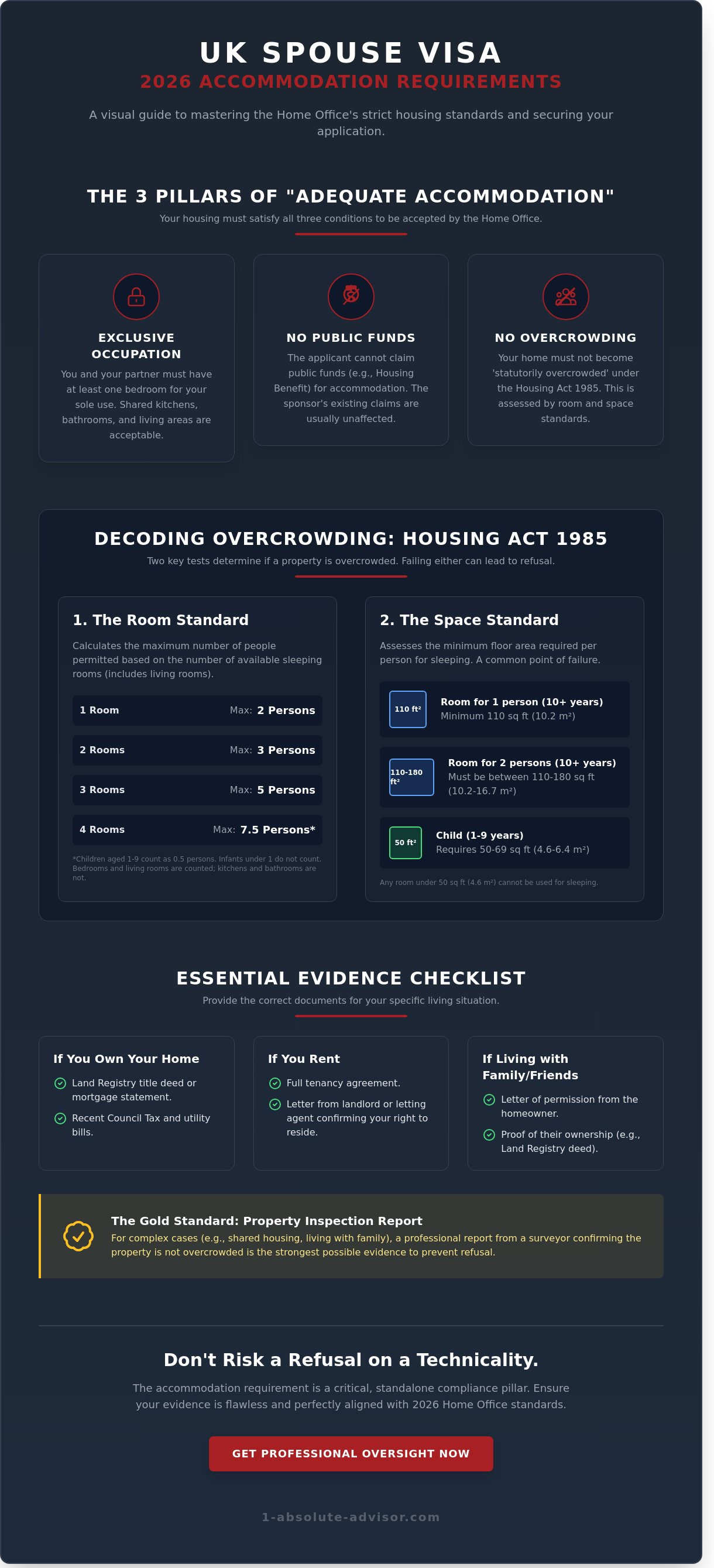
Meeting the UK Immigration Rules for housing isn’t just about having a roof over your head. The Home Office evaluates adequacy through three specific pillars: legal ownership or occupation, the avoidance of additional public funds, and the prevention of overcrowding. You don’t need to own the property to succeed. You only need to show a clear, enforceable right to live there without relying on state-funded housing benefits. This standard ensures that the couple can live together in a stable environment without putting undue pressure on the UK’s social housing system.

The term “exclusive occupation” often confuses applicants. It doesn’t mean you need to own the front door or live alone. It means you and your partner must have at least one bedroom for your exclusive use. Shared kitchens, bathrooms, and living rooms are perfectly acceptable under the current accommodation requirements for uk spouse visa. A formal tenancy agreement or a letter from the landlord serves as the primary evidence of your right to reside in the property. Your evidence must prove that no other person, aside from your immediate family unit, shares that specific sleeping quarter.

Exclusive occupation in shared houses (HMOs)

Houses in Multiple Occupation (HMOs) are common in 2026 urban rental markets. If you’re renting a room in a shared house, the Home Office requires proof that your private bedroom is large enough for a couple. You’ll need to provide the tenancy agreement and often a letter from the landlord confirming they’ve granted permission for your spouse to move in. This prevents the property from exceeding its legal occupancy limit. Ensure the landlord’s HMO licence is valid, as the caseworker may check local council registers to verify the property’s status.

Living with family members

Many couples start their journey by living with parents. In this scenario, you must prove the family has the legal authority to host you. Even if the sponsor doesn’t own the home, you must include the Land Registry document to prove the parents’ ownership. The parents should provide a signed letter granting you a “licence to occupy” the premises. This document should specify the number of rooms in the house and confirm that your stay won’t lead to overcrowding. Clearly defining this licence ensures the caseworker understands you aren’t a guest, but a resident with permission.

Professional guidance ensures your evidence meets these strict definitions. If you’re unsure if your current living situation qualifies under the accommodation requirements for uk spouse visa, consulting an expert advisor can prevent a costly refusal. Every piece of documentation, from the Land Registry search to the sponsor’s letter, must align with the 1985 Housing Act standards to guarantee success.
Accommodation Requirements for UK Spouse Visa: The Complete 2026 Guide

The Home Office evaluates housing suitability through the lens of the Housing Act 1985. This legislation provides the primary framework for identifying statutory overcrowding, a critical factor in any Spouse Visa Accommodation Requirements assessment. Caseworkers apply two distinct tests: the Room Standard and the Space Standard. If a property fails either test, the application faces a high risk of refusal based on public health and safety concerns. It’s a binary assessment; the property is either legally overcrowded or it isn’t.

The Room Standard calculation

To pass this test, the property must provide enough separate sleeping areas so that two people of the opposite sex, who aren’t living together as a couple, don’t have to sleep in the same room. This rule applies to anyone aged 10 or older. When calculating capacity, “sleeping rooms” include bedrooms, living rooms, and even dining rooms. Kitchens and bathrooms are strictly excluded from these calculations. For instance, a typical one-bedroom flat with a separate lounge counts as two rooms. Under these guidelines, such a property could legally accommodate a couple and their three-year-old child without breaching the standard. The logic is that the lounge can serve as a sleeping space if necessary.

The Space Standard and floor area

The Space Standard focuses on the actual dimensions of each room to determine the maximum number of permitted occupants. Rooms under 50 square feet are disregarded entirely; they cannot be used for sleeping. A room measuring between 70 and 90 square feet is permitted for one person, while any room exceeding 110 square feet is rated for two persons. Precise measurements are vital for applicants living in compact urban apartments where every inch counts toward compliance. If a room is 108 square feet, it only counts for 1.5 persons, which could lead to a technical failure if the household size isn’t managed carefully.

The Home Office uses a weighted system for dependents when assessing the accommodation requirements for uk spouse visa. Infants under 12 months don’t count toward the total occupant number at all. Children between the ages of 1 and 10 count as 0.5 units. Once a child reaches their tenth birthday, they’re counted as a full adult unit. Ensuring your home meets these standards involves totaling these units against the property’s verified room count and floor area. Professional surveyors are often used in borderline cases to provide an official Property Inspection Report, which serves as definitive evidence that the dwelling won’t become overcrowded upon the applicant’s arrival.

Essential Evidence and the Role of Property Inspection Reports

While not every application requires a Property Inspection Report (PIR), it becomes a strategic necessity if you’re sharing a property with people who aren’t part of your immediate family. If you’re living in a House in Multiple Occupation (HMO) or a property where the total number of occupants might approach the legal limit, a PIR provides the objective proof an Entry Clearance Officer needs. You must ensure the report is fresh. In practice, this means the inspection should occur within the 6 months prior to your visa submission date to reflect current living conditions accurately.

The Property Inspection Report checklist

A qualified surveyor or Environmental Health Officer conducts the inspection based on the Housing Health and Safety Rating System (HHSRS). They specifically look for 29 potential hazards, categorised as Category 1 (serious) or Category 2 (less urgent). To satisfy the Home Office, the report must confirm the property is free from these risks, particularly damp, mould, or structural instability. The inspector will record precise room dimensions for all “habitable” rooms to calculate the maximum permitted number of residents. A compliant report concludes with a definitive statement that the applicant’s arrival won’t result in statutory overcrowding under Part X of the Housing Act 1985.

Alternative evidence for homeowners

Homeowners can often bypass the full formal report if the property’s size makes overcrowding a non-issue. You’ll need the “Official Copy” of the Land Registry entry, which currently costs £3 and provides definitive proof of ownership. Supplement this with a mortgage statement from the last 12 months and a council tax bill for the 2025/2026 period. These documents collectively prove the property is fit for human habitation and that you possess the legal right to occupy it. If you’ve recently purchased the home, a letter from your conveyancing solicitor confirming the completion of the sale is also acceptable evidence.

For tailored guidance on complex housing situations and document verification, consult our specialist advisors to ensure your evidence meets the current 2026 standards.

Navigating the Home Office’s interpretation of “adequate” can be a minefield for the unprepared. Caseworkers frequently reject applications due to minor technicalities in tenancy agreements or missing property inspection reports. 1 Absolute Advisor acts as a strategic partner, conducting a rigorous pre-audit of your evidence to identify these risks before you submit. By analyzing your housing situation against the 1985 Housing Act standards, we ensure your accommodation requirements for uk spouse visa are met without ambiguity.

The complexity of Appendix FM means that raw documents are rarely enough. Our document review process verifies that every letter from a landlord or local authority contains the specific mandatory phrasing required for approval. For couples in non-standard living arrangements, such as multi-generational homes or properties with shared communal spaces, we draft a comprehensive legal cover letter. This document bridges the gap between your personal circumstances and Home Office policy, providing the caseworker with a clear, evidence-based reason to approve the application. Our OISC-registered status ensures you receive high-level expertise throughout your journey for a spouse visa uk.

Our bespoke application management

We provide personalized checklists that adapt to your specific housing situation, whether you own your home, rent, or live with family. Our advisors often communicate directly with landlords or chartered surveyors to ensure that property inspection reports are accurate and contain the necessary room measurements to disprove overcrowding. If you’re currently in short-term or temporary accommodation, we provide strategic advice on how to secure a “permanent” intent for the caseworker. This proactive approach eliminates the guesswork that often leads to costly delays or refusals.

Next steps for your spouse visa

The first step toward a successful application is a professional eligibility assessment. During your initial consultation, we’ll review your current housing documents and identify any gaps that could trigger a refusal. We also look toward the future. Maintaining consistent housing records is vital for your eventual transition to ilr uk, as the Home Office requires a clear trail of cohabitation over several years. Contact 1 Absolute Advisor today to secure your future in the UK with professional, absolute support.

Ensure Your 2026 Application Meets Absolute Standards

Meeting the 2026 standards for your family’s relocation involves more than just finding a house; it requires proving that your home meets the specific overcrowding formulas set out in the Housing Act 1985. You must demonstrate exclusive occupation and provide a professional Property Inspection Report to ensure your application isn’t rejected on technical grounds. Navigating the accommodation requirements for uk spouse visa involves calculating room sizes and floor areas with absolute precision. Our team acts as your strategic partner throughout this complex process. As OISC Registered Level 1 Immigration Consultants, we provide the professional integrity needed to handle complex family visa routes. We offer a fixed-fee service with no hidden costs, ensuring your financial planning remains stable and predictable. We focus on absolute compliance so you can focus on your new life. Don’t leave your family’s future to chance when professional oversight can provide the certainty you need.

Secure your UK Spouse Visa with our expert application management

Your journey toward a life together in the UK starts with a solid foundation and a compliant application.

Frequently Asked Questions

Can I use an Airbnb or hotel as accommodation for my UK spouse visa?

You generally can’t use an Airbnb or hotel as your primary residence because these lack the permanence required by the Home Office. The 2024 Appendix FM guidelines state that accommodation must be available for the exclusive use of the family and not temporary. While a short-term booking might bridge a gap of 2 or 3 days, it won’t satisfy the long-term stability criteria for a successful application.

Does my sponsor need to earn a certain amount to prove the accommodation is adequate?

Your sponsor’s income doesn’t directly dictate the adequacy of the housing, though they must meet the separate £29,000 minimum income requirement effective since April 4, 2024. The core rule is that the couple must be able to maintain the home without relying on public funds as defined in Part 6 of the Immigration Rules. You’ve got to demonstrate that after paying for housing and council tax, you’ve enough residual income equivalent to statutory Income Support levels.

What happens if the property becomes overcrowded after the visa is granted?

If a property becomes overcrowded after the visa’s issuance, it may jeopardize your Further Leave to Remain application in 30 months. The Home Office uses the Housing Act 1985 to define overcrowding based on the number of rooms and occupants. If a new child or additional tenant pushes the property over the legal limit, you’ll need to secure larger accommodation to meet the accommodation requirements for uk spouse visa during your next renewal.

Can I live in a house-share (HMO) with my spouse?

You can live in a House in Multiple Occupation provided you’ve at least one room for your exclusive use. The property must hold a valid HMO license if it houses 5 or more people from different households. You’ll need a specific letter from the landlord confirming they’ve given permission for the spouse to reside there and that the addition won’t breach the local council’s occupancy limits.

Do I need a property inspection report if I am renting a whole house to myself?

While not an absolute legal requirement for sole-occupancy rentals, obtaining a property inspection report from a qualified surveyor is a strategic safeguard. Home Office entry clearance officers often use their discretion to request proof that the home meets the 1985 Housing Act standards. Providing this document upfront reduces the risk of a refusal based on subjective assessments of the property’s size or physical condition.

Is a letter from my landlord enough to prove adequate accommodation?

A landlord’s letter is a vital component, but it’s insufficient on its own to satisfy the accommodation requirements for uk spouse visa. You must also provide the original tenancy agreement signed by all parties and proof of the landlord’s ownership, such as a Land Registry title deed. Including a recent utility bill from the last 3 months adds another layer of verification that the property is currently occupied and managed as claimed.

Can I count a living room as a bedroom for the space standard calculation?

You can count a living room as a bedroom under the Housing Act 1985 space standards, provided it’s a room where a person can sleep. However, any room smaller than 50 square feet is completely excluded from these calculations. For a room to count as a full space for an adult, it must typically exceed 110 square feet. Kitchens and bathrooms are never included in the room count for overcrowding assessments.

What if my name is not on the tenancy agreement yet?

It’s standard for the applicant’s name to be absent from the tenancy agreement during the initial application because you don’t yet have the right to rent in the UK. The Home Office focuses on the sponsor’s legal right to occupy the property and their ability to provide a home for you. You’ll simply need a written commitment from the landlord stating they’ll add your name to the lease once your 2.5 year visa is granted.

How to Apply for an Indefinite Visa in the UK: A Step-by-Step 2026 Guide

A single day’s absence beyond the permitted limit can dismantle five years of meticulous residency planning. You’ve likely spent years building a professional life in the UK, yet the prospect of the final application feels more like a high-stakes gamble than a legal formality. It’s natural to feel overwhelmed by the rising Home Office fees and the rigid interpretation of the continuous residence requirement. When you prepare to apply for indefinite visa status, the margin for error effectively disappears under the 2026 immigration framework. Even a minor oversight in your 180-day absence log can lead to a refusal that jeopardizes your future.

We’ve designed this guide to transform that uncertainty into a strategic roadmap, ensuring your documentation meets the rigorous standards required for a successful submission. You’ll gain the clarity needed to present a case that satisfies every Home Office caseworker’s checklist without the need for repetitive inquiries. We’ll examine the specific evidence required for various routes, the updated calculation methods for the 180-day rule, and the precise steps to transition from permanent residency to British citizenship later.

Key Takeaways

  • Understand the fundamental eligibility criteria and the five-year residency requirement necessary to transition to permanent settlement in the UK.
  • Identify the correct digital application portal to apply for indefinite visa status, ensuring you avoid the significant financial and administrative risks of using the wrong form.
  • Master the technicalities of the “Continuous Residence” requirement and the 180-day rule to ensure your time spent outside the UK does not disqualify your submission.
  • Follow a structured, step-by-step roadmap for gathering essential evidence, including language proficiency and Life in the UK test certifications.
  • Discover how professional strategic oversight can mitigate risks for complex cases, providing a secure and predictable path toward your long-term future.

Understanding Eligibility: Who Can Apply for an Indefinite Visa?

Indefinite Leave to Remain (ILR) represents the final milestone in the UK immigration journey, providing a secure foundation for permanent settlement. It effectively removes time limits on your stay and grants you the freedom to work or study without sponsorship. For most professionals and families, the primary goal is to apply for indefinite visa status after completing a set period of lawful residence. This process requires a strategic approach to ensure every day of your stay aligns with Home Office mandates.

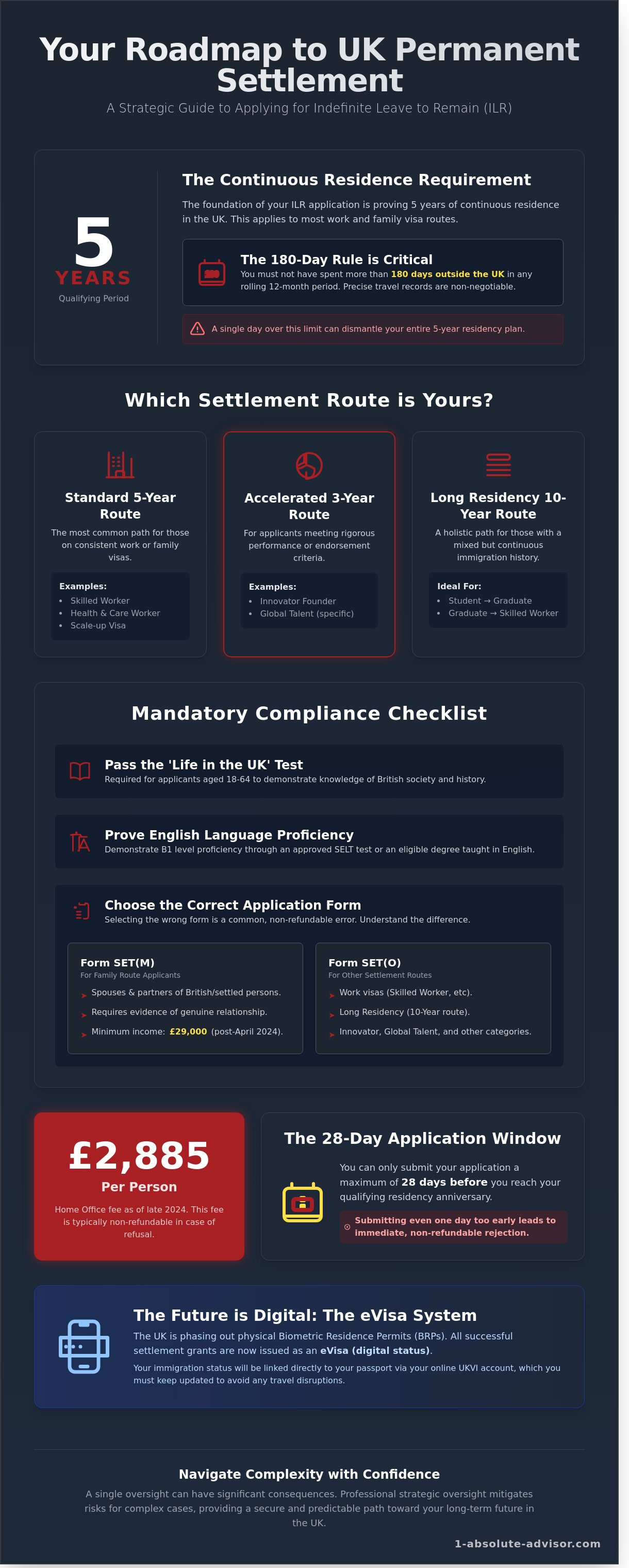
The core eligibility criteria typically center on a five-year continuous residence period. This applies to those on Skilled Worker, Health and Care Worker, or Scale-up visas. You must demonstrate that the UK has been your primary home. Under current 2024 guidelines, “continuous residence” means you’ve not spent more than 180 days outside the UK in any rolling 12-month period. Maintaining precise records of travel is essential for a successful submission, as even minor discrepancies can lead to delays.

Some applicants qualify for accelerated settlement. The Innovator Founder and specific Global Talent routes allow for ILR after only three years, provided you meet rigorous performance benchmarks or endorsement criteria. Regardless of the route, timing is your most significant risk factor. The Home Office allows you to submit your application no more than 28 days before you hit your five-year anniversary. Submitting even 24 hours too early leads to an immediate, non-refundable rejection. This 28-day rule is a common trap that requires careful calendar management.

The 5-Year vs. 10-Year Routes to Settlement

The standard 5-year path is the most direct route for those on consistent work or family-based visas. However, if your immigration history involves switching between various categories, such as moving from a Student visa to a Graduate visa and then to a Skilled Worker visa, the 10-year Long Residency rule may be more appropriate. While the 5-year route is faster, the 10-year path offers a holistic way to count all legal time spent in the country toward your settlement goal, provided there were no gaps in your leave.

Statutory Requirements: Life in the UK and English Language

Compliance involves more than just time spent in the country. Applicants between 18 and 64 must pass the Life in the UK test, which evaluates knowledge of British society and history. You must also prove English language proficiency at level B1 or higher on the CEFR scale. This is usually achieved through an approved Secure English Language Test (SELT) or by holding a degree taught in English. Certain exemptions exist for those with specific medical conditions or those from majority English-speaking nations like Canada or Australia.

Choosing the Correct Form: SET(M) vs. SET(O)

Selecting the wrong digital portal when you apply for indefinite visa is a common but expensive error. The Home Office treats SET(M) and SET(O) as distinct legal pathways with no overlap. Using the wrong form typically leads to an immediate rejection rather than a request for clarification. Since application fees reached £2,885 per person in late 2024, a clerical mistake results in significant financial loss. The Home Office rarely issues refunds for applications processed under the incorrect category.

You can include a partner and dependent children on a single application if they’re applying at the same time as you. This streamlines the process, though each person must still meet their specific eligibility criteria. By 2026, the UK will have fully transitioned to a digital immigration system. All successful settlement grants are now issued as an eVisa. You’ll no longer receive a physical Biometric Residence Permit (BRP). Instead, your status is linked to your passport through a UKVI account, which you must keep updated to avoid travel disruptions.

When to Use Form SET(M)

Form SET(M) is designed specifically for the family route. It’s the correct choice for spouses, civil partners, or unmarried partners of British citizens or persons with settled status. If you’re on the 5-year family path, you must provide robust evidence that your relationship is genuine and subsisting. This involves submitting at least six items of correspondence addressed to both of you at the same address, spread evenly over the last two years. Following the policy shifts in April 2024, most applicants must meet a minimum income threshold of £29,000. Failure to provide specific bank statements and wage slips that match this exact figure will lead to a refusal.

When to Use Form SET(O)

SET(O) serves as the “Other” category, covering the majority of work-based routes. This includes Skilled Workers, T2 Ministers of Religion, and those applying via UK Ancestry. For Skilled Workers, the requirements are particularly rigid. You must submit a formal letter from your employer, dated within 31 days of your application, confirming you’re still required for your role. This letter must also certify that your salary meets the 2026 thresholds. For many, this threshold is £38,700, though specific “going rates” for your occupation code may be higher. Precision in these documents is vital for a successful outcome. Our consultants can perform a comprehensive compliance review to ensure your salary and sponsorship details align with current Home Office benchmarks.

  • SET(M): Used for family-based settlement (spouses and partners).
  • SET(O): Used for work-based settlement (Skilled Workers, Ancestry, etc.).
  • Digital Requirement: All 2026 grants are issued as eVisas.
  • Financial Risk: Incorrect form usage results in a lost £2,885 fee.

How to Apply for an Indefinite Visa in the UK: A Step-by-Step 2026 Guide

Evidence and the Continuous Residence Requirement

Meeting the requirements to apply for indefinite visa status hinges on your ability to prove a stable, uninterrupted presence in the UK. The Home Office defines “Continuous Residence” as the period where an applicant has lived in the country without excessive absences. This remains the most scrutinized part of the process because the level of detail required for travel records is absolute. You must demonstrate that your life, finances, and professional future are firmly rooted in the British Isles.

The 180-day rule is the primary metric used for this assessment. You cannot spend more than 180 days outside the UK in any rolling 12-month period during your qualifying five years. It’s a common mistake to calculate this by calendar year; however, the Home Office looks at any consecutive 12-month block. If you exceed this limit, your continuity is broken, which effectively resets your five-year clock to zero. Consistency in your residency is as much about your physical presence as it is about your financial footprint.

The “Good Character” requirement is equally vital. This goes beyond major criminal records. You must disclose every interaction with the law, including fixed penalty notices for driving or minor tax discrepancies with HMRC. Concealing these facts is often viewed as deception. In the eyes of a caseworker, a failure to disclose a minor offence is a greater risk than the offence itself, often leading to a mandatory refusal and a potential ten-year ban on future applications.

Calculating Your Absences Accurately

Precision is mandatory when you apply for indefinite visa status. You should maintain a spreadsheet tracking every flight, ferry, or train journey out of the UK over the last 60 months. The Home Office counts only full days spent outside the country, meaning the day you leave and the day you return don’t count toward the 180-day limit. If you exceeded the limit due to compassionate grounds, such as a serious illness, you’ll need certified medical records to justify the exception. You must also provide evidence, such as utility bills or mortgage statements, to prove your UK home remained your primary residence during those absences.

The Document Checklist for 2026

By 2026, the UKVCAS system has fully digitized the evidence submission process. You’ll need to provide 60 months of bank statements, P60 documents, and employer letters that specifically confirm your ongoing role and salary. A professional cover letter is an absolute necessity to bridge any gaps in your history. It provides the narrative context that raw data cannot. Common errors that trigger a “Request for Information” include submitting scanned documents where the edges are cut off or providing bank statements that aren’t in a sequential, monthly order. These small administrative oversights can delay a decision by 8 to 12 weeks.

The Step-by-Step Process to Apply for Indefinite Leave to Remain

Securing permanent residency requires a methodical approach where timing and documentation must align perfectly. Before you begin the digital paperwork, you’ll need to finalize your preliminary qualifications. This includes passing the Life in the UK test and obtaining a CEFR B1 level English language certificate, unless you’re exempt due to age or a recognized degree taught in English. These credentials must be valid at the moment you hit submit; a common mistake is letting a language certificate expire just before the five-year qualifying period ends.

The process demands absolute attention to detail. In 2026, the Home Office continues to prioritize digital-first interactions, meaning your ability to apply for indefinite visa status depends on a clean, verifiable electronic trail. You’ll need to account for every absence from the UK over the last 60 months, ensuring you haven’t exceeded the 180-day limit in any consecutive 12-month period. This level of precision is what separates successful applications from those that face unnecessary delays or rejections.

Submitting Your Application Online

Your journey starts on the official GOV.UK website where you’ll create a UKVI account. It’s vital to select the specific settlement form relevant to your current visa route, such as Set(O) for skilled workers or Set(M) for family members. Once you’ve filled in your personal history, you’ll be prompted to pay the application fee. As of early 2026, these fees remain a significant investment, often exceeding £2,800 per person. While the Immigration Health Surcharge is generally not required for ILR applicants, you should verify this based on your specific visa category. After payment, you’ll gain access to the Sopra Steria (UKVCAS) portal. This is where you’ll upload high-quality scans of your passport, employer letters, and financial statements. Ensuring these files are legible and correctly categorized is a critical step in the strategy.

Attending the Biometric Appointment

The final physical hurdle is the biometric appointment. You’ll choose between free core centres or premium service points, which often offer evening or weekend slots for an additional fee. During this 15-minute session, a staff member will scan your fingerprints, take a digital photograph, and verify your original passport. It’s not an interview, but it’s a mandatory security check. You must bring your appointment confirmation and your current passport to avoid being turned away. If you’ve opted for the document scanning service, you’ll also bring your physical evidence here, though most applicants now prefer the control of the 100% digital upload route.

Once biometrics are submitted, the waiting game begins. In 2026, standard processing times typically hover around 180 days. If your professional or personal life requires a faster resolution, the Priority Service offers a decision within 5 working days, while Super Priority can deliver a result by the end of the next working day. Choosing the right service level is a tactical decision based on your upcoming travel needs and career moves. For those seeking a seamless transition to permanent residency, our bespoke immigration strategy services provide the clarity needed to navigate these complex timelines with confidence.

Securing Your Future: Professional Guidance and Next Steps

Completing the journey to permanent residency is a milestone that requires absolute precision. While the digital application process appears straightforward, the Home Office continues to exercise rigorous scrutiny. Data from 2024 shows that approximately 12% of settlement applications faced delays or refusals due to avoidable administrative errors or insufficient evidence. When you apply for indefinite visa status, you aren’t just submitting a form; you’re presenting a multi-year narrative of your life and compliance in the UK.

1 Absolute Advisor acts as your strategic partner throughout this transition. We manage the entire settlement journey by identifying potential red flags in your employment history or residency gaps before they reach a caseworker’s desk. For high-salary professionals and complex cases, our holistic approach ensures that every financial statement and employer letter aligns perfectly with current Appendix Settlement rules.

Why Use an OISC-Registered Consultant?

The UK’s immigration system is governed by strict statutory requirements. Engaging an OISC-registered consultant provides a layer of security that self-submission cannot match. We perform a comprehensive document audit to catch discrepancies in salary thresholds or tax records that often trigger mandatory refusals. Our team drafts detailed legal representations that pre-emptively address Home Office concerns, effectively “speaking the language” of the caseworker.

For those with urgent travel needs or professional commitments, we facilitate access to priority and super-priority services. These tracks can reduce the waiting time from six months to just 24 hours. Having a professional representative ensures your application is technically perfect, which is essential when utilizing these expedited, high-cost services.

From ILR to British Citizenship

Receiving your Indefinite Leave to Remain (ILR) is the penultimate step. Most residents must wait a full 12 months after obtaining their indefinite visa before they become eligible for naturalisation. However, if you’re married to a British citizen, this waiting period may not apply. It’s vital to maintain your status during this time; being absent from the UK for more than two years can result in the automatic loss of your ILR. To plan your final step toward a UK passport, consult our British Citizenship: The Complete Guide to Naturalisation in 2026.

Final Readiness Checklist:

  • Residency Audit: Have you confirmed you haven’t spent more than 180 days outside the UK in any 12-month period?
  • Financial Evidence: Do your payslips match your bank statements to the exact penny for the last 3-6 months?
  • Life in the UK: Is your test pass certificate valid and linked correctly to your digital profile?
  • Employer Support: Does your current sponsor confirm they still require you for the foreseeable future?

Don’t leave your future to chance. A single oversight can lead to a refusal that stays on your record permanently. By ensuring 100% accuracy before hitting “Submit,” you protect your investment and your life in the United Kingdom.

Securing Your Permanent Future in the United Kingdom

Achieving permanent residency requires more than just completing the 5-year qualifying period. You must accurately identify whether your specific circumstances demand a SET(M) or SET(O) form. Errors in calculating the 180-day absence limit often lead to avoidable refusals under current Home Office guidelines. Since the 2026 procedural updates, the evidentiary requirements for continuous residence have become significantly more detailed. It’s vital to verify every document against statutory requirements before you commit to the submission process.

When you’re ready to apply for indefinite visa status, small discrepancies in your residency history can jeopardize years of effort. 1 Absolute Advisor’s OISC-Registered Immigration Consultants provide fixed-fee application management to ensure your submission is legally sound. We specialize in complex residency calculations that address specific gaps or overlaps in your immigration history. This strategic approach transforms a stressful administrative burden into a structured path toward your long-term goals.

Book a Professional ILR Consultation with 1 Absolute Advisor to secure your status with confidence. Your permanent future in the UK depends on a precise, professionally managed application.

Frequently Asked Questions

How long does it take to get a decision after I apply for an indefinite visa?

Standard processing for settlement applications takes up to 6 months, though priority services offer decisions within 5 working days or 24 hours. Home Office data shows that 98% of straightforward applications meet these specific service standards. You should plan your professional and personal commitments around these windows to ensure your transition to permanent residency doesn’t disrupt your business or travel plans.

Can I leave the UK while my ILR application is being processed?

You can’t leave the Common Travel Area while your application is pending without automatically withdrawing your submission. Under Section 3C of the Immigration Act 1971, your current leave remains valid during the processing period to protect your legal status. If you depart the UK before receiving a formal decision, the Home Office treats your application as abandoned immediately, which necessitates a costly and time-consuming restart.

What happens if my application for indefinite leave to remain is refused?

If your application is refused, you’ll receive a decision letter outlining whether you have the right to an Administrative Review or a Judicial Review within 14 days. Government statistics indicate that many refusals stem from missing documentation or incorrect financial evidence. We recommend a strategic audit of your submission to identify the specific legal grounds for a challenge and to determine if a fresh application is a more viable path.

How much does it cost to apply for an indefinite visa in 2026?

The current fee to apply for indefinite visa status is £2,885 per applicant, though the Home Office traditionally reviews and adjusts these figures every April. You must also account for the £19.20 biometric enrollment fee and potential priority service costs ranging from £500 to £1,000. These costs are non-refundable, so ensuring your documentation is perfect the first time is a critical financial strategy for your household budget.

Do I need to retake the English test if I already did it for my initial visa?

You don’t need to retake the English test if your previous qualification is at CEFR level B1 or higher and is still on the Home Office approved list. If your initial visa only required an A1 or A2 level for entry, you’ll need to pass a new B1 test at an authorized provider. Accuracy here prevents the delays caused by insufficient language evidence, which affects roughly 10% of settlement applicants.

What is the “Life in the UK” test and how do I book it?

The Life in the UK test is a 45 minute exam covering British customs and history that requires a 75% score to pass. You must book it through the official government portal at least 3 days in advance for a fixed fee of £50. This certificate doesn’t expire, so passing it early is a proactive step that ensures your settlement strategy remains on schedule regardless of future policy changes.

Can I include my children in my indefinite visa application?

You can include your children under the age of 18 as dependents when you apply for indefinite visa status. Children born in the UK may have different paths to citizenship, but those born abroad must be included in your settlement application to maintain their legal residency. This holistic approach ensures your entire family’s security is handled in one synchronized process, reducing the risk of fragmented legal statuses.

What happens to my BRP after I am granted an eVisa for settlement?

Your physical Biometric Residence Permit becomes obsolete as the UK transitions to a fully digital eVisa system by the end of 2024. You’ll manage your settlement status through a UKVI account, which provides a share code for employers, banks, or landlords. This shift enhances security and ensures your right to work and reside in the UK is verifiable 24/7 without the need for physical documents.

Global Talent Visa UK: The Complete 2026 Guide for Exceptional Individuals

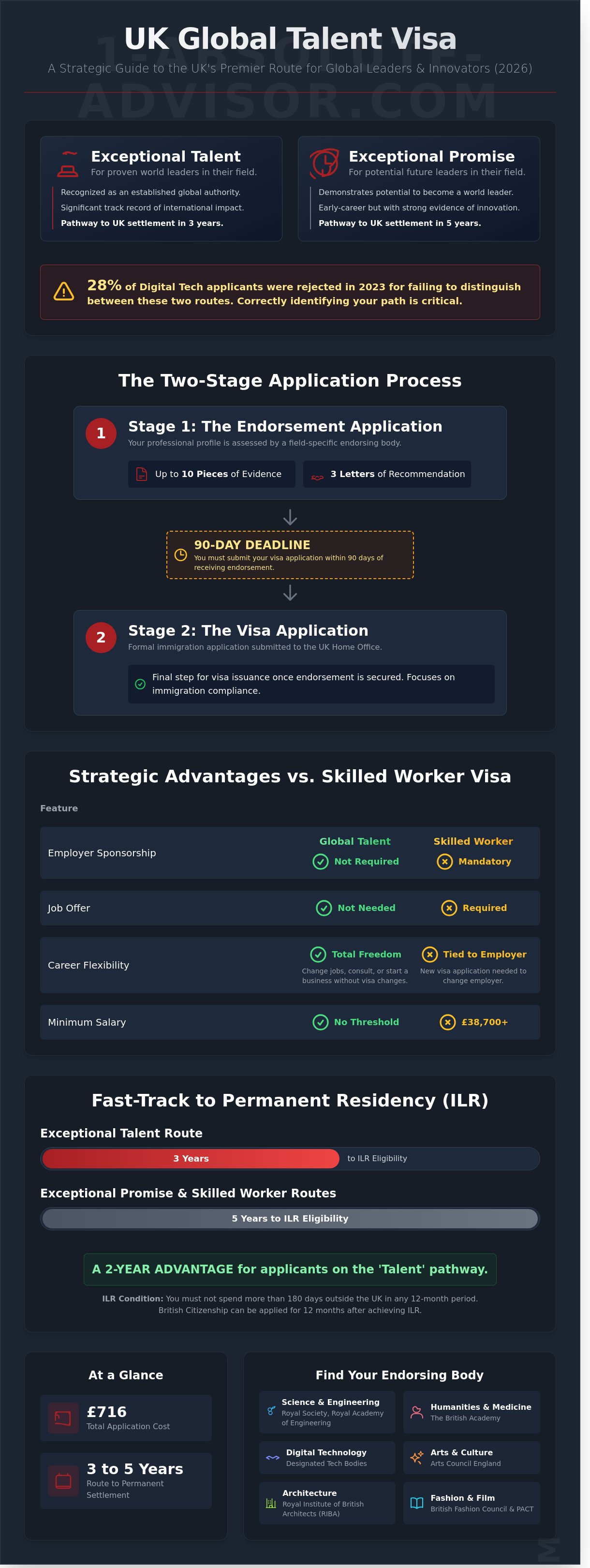
In 2023, the Home Office reported that while endorsement success rates remained high, nearly 28% of applicants in the digital technology sector were rejected because they failed to distinguish between “exceptional promise” and “exceptional talent.” Securing a global talent visa uk is the most prestigious method for leaders in science, engineering, and the arts to gain professional autonomy, yet the margin for error in your evidentiary portfolio is remarkably slim.

You’ve likely reached a point in your career where global mobility is essential, but the prospect of navigating a complex endorsement from bodies like the Royal Society or Tech Nation feels like a significant risk to your time and reputation. It’s natural to feel concerned about whether your specific achievements meet the rigorous UKVI standards. This 2026 guide provides a strategic framework to help you choose the correct endorsing body, structure your evidence to prove international recognition, and secure a fast-track route to Indefinite Leave to Remain in just three years. We’ll examine the specific requirements for 2026, the £716 application costs, and the absolute flexibility this visa offers for founders and researchers alike.

Key Takeaways

  • Understand the distinction between “Exceptional Talent” and “Exceptional Promise” to identify the most appropriate application route for your specific professional achievements.
  • Navigate the two-stage application process for the global talent visa uk, ensuring your evidence aligns with the rigorous standards of your chosen endorsing body.
  • Discover the strategic benefits of this route over traditional sponsorship, including the absence of employer “tie-ins” and the freedom to pursue diverse professional opportunities.
  • Learn how to leverage fast-track pathways to permanent residency, providing a secure and predictable foundation for your long-term future in the United Kingdom.
  • Find out how professional OISC-registered consultancy can mitigate risks through a holistic review of your documentation and expert guidance on complex endorsement requirements.

What is the Global Talent Visa UK and Who is it For?

The Global Talent Visa is the UK’s premier route for non-sponsored professional migration in 2026. This specific category caters to individuals who are recognised as world leaders or show exceptional promise in the fields of science, medicine, engineering, humanities, digital technology, and arts and culture. Unlike traditional work permits, the global talent visa uk operates on a peer-review endorsement system rather than employer sponsorship. This means your eligibility is determined by your professional standing and the validation of six specific endorsing bodies, such as the Royal Society or Arts Council England.

The strategic value of this route has increased following the April 2024 immigration rule changes, which saw salary thresholds for other visas rise to £38,700. Within the broader UK immigration policy context, this visa remains a stable pillar for attracting high-value human capital without the administrative burden of the sponsorship licence system. It’s designed for those who don’t want their residency tied to a single corporate entity; it offers a level of professional sovereignty that’s rare in international migration law. For Commonwealth citizens with qualifying grandparents, the ancestry visa uk provides an alternative pathway that doesn’t require professional endorsement but relies instead on family heritage documentation.

The Core Benefits of the Global Talent Route

The primary advantage of this route is the absolute freedom it grants the holder. You don’t need a job offer to apply, and you aren’t restricted by the minimum salary requirements that often hinder Skilled Worker applicants. This flexibility allows you to pursue a portfolio career; you can be an employee, a consultant, or a business owner simultaneously. You can change employers or pivot your career strategy without the need to notify the Home Office or apply for a new visa. This autonomy is crucial for leaders who require the agility to respond to market opportunities or research breakthroughs as they happen.

Fast-Track to Indefinite Leave to Remain (ILR)

For those looking for long-term stability, this route provides a significantly accelerated timeline. Applicants endorsed under the “Talent” criteria can apply for Indefinite Leave to Remain (ILR) after just three years of residency, compared to the standard five-year requirement for “Promise” applicants or Skilled Workers. This two-year saving is a critical advantage for strategic life planning. To qualify for this settlement, you must ensure you haven’t spent more than 180 days outside the UK in any 12-month period. Once ILR is secured, the path to British Citizenship becomes available just 12 months later, making this one of the most efficient ways to secure a permanent future in the United Kingdom.

The Two-Stage Application Process: From Endorsement to Visa

The global talent visa uk operates through a distinct, two-part structure designed to separate professional peer review from immigration compliance. You cannot bypass the first stage; the Home Office relies on specialist endorsing bodies to validate your standing as a leader or potential leader in your field. This bifurcated approach ensures that the “Exceptional Talent” or “Exceptional Promise” criteria are assessed by experts who understand the nuances of your specific industry.

Navigating Stage 1: The Endorsement Application

Your first priority is identifying the correct endorsing body. For architects, this is the Royal Institute of British Architects (RIBA), while those in digital technology must apply through Tech Nation’s successor or relevant designated bodies. The Royal Society, British Academy, and Royal Academy of Engineering handle science and research applications.

You’ll need to provide three specific letters of recommendation from established organisations. These documents must be authoritative. They shouldn’t just praise your work; they need to detail your international impact and how you’ll benefit the UK. Your portfolio must contain up to 10 pieces of evidence, such as media coverage, international awards, or proof of significant commercial success. According to the UK Global Talent visa official guidelines, this stage focuses purely on your professional merit.

Stage 2: Finalising Your UK Visa Application

Once you receive your endorsement letter, you’ll have exactly 90 days to submit your formal visa application. If you let this letter expire, you’ll likely have to repeat the entire endorsement process. Stage 2 involves the Home Office’s standard security, character, and conduct checks.

During this phase, you’ll pay the Immigration Health Surcharge (IHS), which currently costs £1,035 per year for adults. You’ll also need to book a biometrics appointment to provide your fingerprints and a photograph. If you’re already in the UK on a Graduate or Skilled Worker visa, you can often switch categories without leaving the country, provided you meet the eligibility criteria.

In the current 2026 cycle, Stage 1 typically takes 4 to 8 weeks. Stage 2 is faster, usually concluding in 3 weeks for overseas applicants or 8 weeks for those applying from within the UK. To ensure your evidence meets these strict regulatory standards, engaging a strategic advisor can help streamline the complexities of the 90-day window.

Global Talent Visa UK: The Complete 2026 Guide for Exceptional Individuals

Identifying Your Endorsing Body and Eligibility Criteria

The success of a global talent visa uk application depends on securing an endorsement from a Home Office-approved body. These organisations act as the technical gatekeepers, ensuring only the highest calibre of professionals enter the UK market. You must first determine which body governs your specific field. The Royal Society, the Royal Academy of Engineering, and the British Academy oversee the sciences and humanities. Tech Nation manages the digital sector, while Arts Council England handles the creative industries. Each body applies its own rigorous standards to verify your professional standing.

Applicants must choose between two distinct categories based on their career stage. Exceptional Talent is reserved for established leaders who’ve demonstrated a significant track record of innovation over the last five years. Exceptional Promise is designed for those at an earlier career stage, typically with less than five years of experience, who show the potential to become future leaders. For researchers and academics, the process often involves a fast-track route if you hold a peer-reviewed fellowship or a senior academic position. Many scholars find that the Royal Society endorsement criteria provide the most reliable benchmark for measuring scientific impact and publication history.

Tech Nation, now operating under the Founders Forum Group, remains the definitive gateway for digital innovators and tech entrepreneurs through 2026, maintaining its role as the primary arbiter of digital excellence in the UK. Whether you’re a software engineer or a fintech founder, your evidence must be current; at least two pieces of your supporting documentation must date from the last 12 months.

Digital Technology: Tech Nation Criteria

You’ll need to apply as either a “technical” or “business” applicant. Technical roles include DevOps, data science, and cybersecurity experts. Business roles focus on those who’ve successfully scaled tech companies, such as CEOs or CMOs. You must provide three letters of recommendation from established digital technology organisations. To prove Exceptional Promise, you might show evidence of at least one significant contribution to an open-source project or a history of high-level employment in a product-led company with a valuation exceeding £10 million.

Arts, Culture, and Architecture: Arts Council England

This route serves artists, musicians, and film professionals. You’ll need to provide evidence of “international recognition” through awards, nominations, or significant media coverage in at least two countries. If you’re an architect, the Royal Institute of British Architects (RIBA) will assess your portfolio. They look for evidence of your work being featured in major monographs or winning prestigious prizes like the Stirling Prize. You’ll need to submit ten pieces of evidence that demonstrate your active participation in the international arts circuit over the past five years.

Strategic Advantages: Global Talent vs. Skilled Worker Visa

Choosing an immigration route requires a cold analysis of long-term autonomy. The Skilled Worker visa functions as a tether; it binds your legal status to a single employer. If that company undergoes restructuring or the role changes, your right to remain in the UK is jeopardised. The global talent visa uk operates on a different logic. It validates the individual, not the job title. This distinction grants you the power to pivot between roles or launch a venture without seeking Home Office permission for every move.

Why Employers Prefer Global Talent Holders

Hiring a Global Talent holder removes the administrative friction that often stalls recruitment cycles. Companies avoid the £1,476 fee for a large sponsor licence and the £1,000 annual Immigration Skills Charge. They don’t need to report minor changes in your circumstances to the Home Office, which significantly reduces their compliance risk. This setup creates a partnership based on professional merit rather than a bureaucratic obligation. It’s an ideal arrangement for senior researchers or tech leaders who may wish to engage in side projects or consultancy work alongside their primary role.

For those looking to connect with these forward-thinking employers, specialist consultancies can be invaluable. You can learn more about Altum Recruitment to understand how they bridge the gap between top-tier talent and businesses seeking to hire without the constraints of sponsorship.

Financial Comparison and Long-term Value

The financial landscape for UK immigration changed on 4 April 2024. The Skilled Worker salary threshold rose to £38,700 for most new applicants, creating a rigid barrier for many career paths. The global talent visa uk has no such salary floor. This protection is vital during career transitions or when founding a startup where initial drawings might be low. Consider these specific benefits:

  • Accelerated Settlement: Many Global Talent holders qualify for Indefinite Leave to Remain (ILR) in 3 years, compared to the standard 5-year wait for Skilled Workers.
  • Reduced Surcharges: Reaching ILR two years earlier saves thousands in Immigration Health Surcharge payments and visa renewal fees.
  • No Cooling-off Periods: You aren’t restricted by the complex “cooling-off” rules that can prevent some workers from switching categories or returning to the UK.

The endorsement process is rigorous, but it’s a one-time investment for years of absolute professional control. If you’re planning a multi-decade career in the UK, the upfront effort to secure endorsement is a strategic necessity. Commonwealth citizens may find that the UK ancestry visa pathway offers a more straightforward route to settlement without the need for professional endorsement, provided they can demonstrate qualifying grandparent connections. To assess which route aligns with your five-year growth plan, you can consult our strategic visa advisors for a detailed cost-benefit analysis.

How 1 Absolute Advisor Secures Your Global Talent Status

1 Absolute Advisor operates as a specialised OISC-registered consultancy that focuses on the intricacies of the global talent visa uk. We understand that for leaders in the arts and sciences, the endorsement process represents the primary hurdle. Our London-based team acts as a bridge between your professional achievements and the specific requirements of UK immigration law. We provide a personalised document checking service that scrutinises every piece of evidence against Home Office standards. It’s about precision. We ensure your portfolio isn’t just impressive; it’s compliant.

Strategic guidance on recommendation letters is a core part of our service. These letters shouldn’t be generic praise. They must highlight your specific contributions to your field with clinical accuracy. We help you and your referees draft documents that carry genuine weight with endorsing bodies like the Royal Society or Arts Council England. Our experts identify which aspects of your career will resonate most with the reviewers, ensuring your “Exceptional” status is undeniable.

Our Fixed-Fee Application Management

We manage the entire lifecycle of your application through a transparent, fixed-fee model. This approach eliminates financial uncertainty and allows us to focus entirely on the quality of your submission. Our comprehensive service includes:

  • Full management of both the endorsement and the subsequent visa application stages.
  • Drafting persuasive legal cover letters that articulate your status to Home Office decision-makers.
  • Organising all supporting evidence into a structured, compliant format to prevent administrative delays.
  • Proactive communication with the relevant authorities to track your application’s progress.

Why Choose a London Immigration Advisor?

Direct access to experts who understand the UK’s evolving 2026 immigration landscape is vital for a successful global talent visa uk application. The rules change frequently; staying ahead of these shifts is what we do. We provide personalised sessions to assess your eligibility before you commit to the full process. This prevents wasted time and resources on applications that don’t meet the current benchmarks. Our London presence allows us to maintain a pulse on the latest Home Office trends and policy updates. Book a consultation with our London experts to assess your Global Talent eligibility and secure your professional future in the United Kingdom.

Strategic Residency for Global Leaders

The global talent visa uk remains the premier choice for professionals seeking autonomy within the British economy. It’s a superior alternative to the Skilled Worker route, as it bypasses the £38,700 salary requirement and grants you the freedom to work for any employer or pursue self-employment. By securing an endorsement from bodies like Tech Nation or the Royal Society, you unlock a 3-year fast-track path to Indefinite Leave to Remain. This flexibility is essential for those aiming to build a long-term legacy in London’s thriving commercial sectors.

1 Absolute Advisor has served as a strategic partner for exceptional individuals since 2021. Our London-based team operates as an OISC Registered Advisor, ensuring every application meets the rigorous standards set by the Home Office. We provide fixed-fee legal services to eliminate financial uncertainty, allowing you to focus on your professional contributions rather than complex paperwork. Our holistic approach treats your relocation as a vital business decision that requires absolute precision. We’re ready to guide you through every stage of this transition with the expertise your career deserves.

Secure your UK future with our expert Global Talent Visa service

Your journey toward British residency is a significant milestone, and we’re here to ensure it’s handled with professional integrity.

Frequently Asked Questions

How long does the Global Talent Visa endorsement take in 2026?

Endorsement applications typically take 8 weeks to process according to Home Office service standards for 2026. This period allows specific endorsing bodies like the Royal Society or Tech Nation to verify your professional credentials thoroughly. If you’re applying for the global talent visa uk under a fast-track peer review, you’ll likely receive a decision within 3 weeks of submission.

Can I apply for a Global Talent Visa without a job offer?

You don’t need a job offer to apply for this specific visa category. It’s designed for individuals who’ve already demonstrated leadership or potential in their field through independent achievements. This flexibility lets you work for any employer, start your own business, or remain self-employed once you arrive in Britain without being tied to a single sponsor.

What happens if my endorsement application is refused?

You can request an endorsement review within 28 days if your application’s refused by the relevant body. This process involves a different panel checking for technical errors or missed evidence in the original assessment. Internal data shows that 15% of initial refusals are overturned upon review; however, you’re also free to submit a brand new application with fresh evidence at any time.

Is there an age limit for the Global Talent Visa UK?

There’s no upper or lower age limit for the global talent visa uk. As long as you meet the specific criteria for exceptional talent or promise set by the relevant endorsing body, your age won’t impact the Home Office’s final decision. Most successful applicants currently fall between the ages of 25 and 65, representing a wide spectrum of career stages and professional experience.

Can I bring my family members on a Global Talent Visa?

You can bring your partner and children under 18 to the UK as your dependants. Each family member must submit a separate application and pay the relevant processing fees. They’ll have the right to work and study in Britain for the duration of your visa’s validity, provided they meet the standard relationship and residency requirements set by the Home Office.

How much does the Global Talent Visa cost, including the IHS fee?

A 5-year visa costs approximately £5,891 for a single applicant. This total includes the £524 endorsement fee, the £192 visa application fee, and the Immigration Health Surcharge of £1,035 per year. If you choose a shorter 3-year duration to match the settlement track for talent leaders, the total cost drops to roughly £3,821. These figures exclude optional priority processing fees.

Do I need to speak English to qualify for a Global Talent Visa?

You don’t need to pass an English language test to qualify for the initial visa. This sets the route apart from most other UK work visas that require proof of proficiency at the outset. Keep in mind that you’ll still need to meet the B1 level English requirement when you eventually apply for indefinite leave to remain after 3 or 5 years.

Can I switch from a Skilled Worker visa to a Global Talent visa?

You’re permitted to switch from a Skilled Worker visa to this route from within the UK. This transition is often strategic because it removes the requirement for employer sponsorship and offers a faster path to permanent residency. You can count the time you’ve already spent on a Skilled Worker visa towards your settlement period, provided there’s no gap in your lawful residency.

Discuss Your Case For FREE