
Applying for ILR on a Skilled Worker Visa: The 2026 Comprehensive Guide

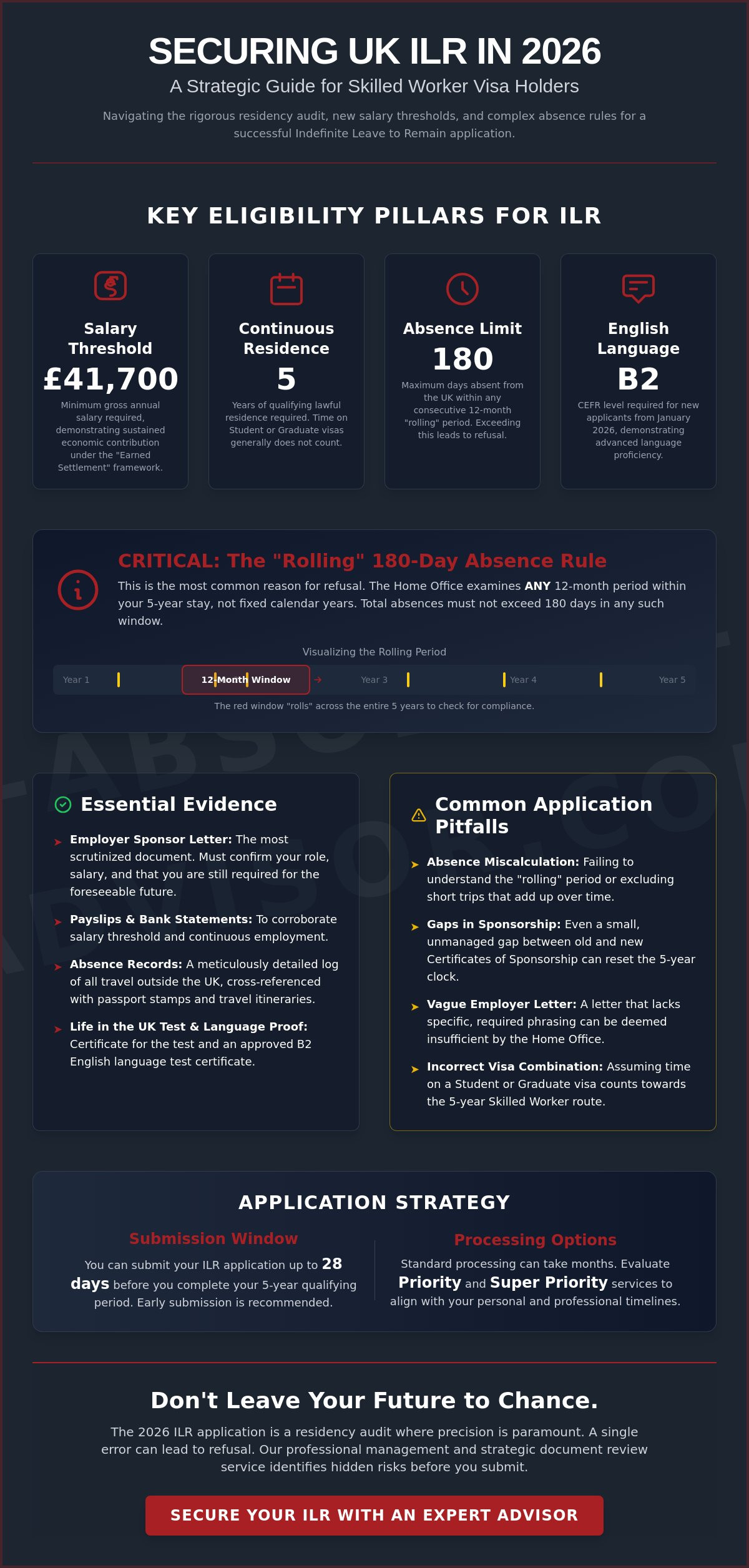
In 2026, securing Indefinite Leave to Remain is no longer a simple matter of checking boxes; it has evolved into a rigorous residency audit that demands proactive evidence management. You’ve likely felt the weight of shifting regulations, from the increased £41,700 salary threshold to the anxiety surrounding the government’s consultation on extending qualifying periods. The complexity of “rolling” 180-day absence calculations and the difficulty of obtaining precise employer support letters can make applying for ilr on skilled worker visa feel like a high-stakes obstacle course where any minor oversight carries significant risk.

We understand that your future stability in the UK depends on navigating these hurdles with absolute precision. This guide provides the strategic clarity you need to master the 5-year settlement route and secure your permanent residency with confidence. We’ll examine the latest “earned settlement” framework, clarify the January 2026 B2 English language requirements, and provide a methodical roadmap to ensure your application meets the Home Office’s strictest scrutiny, finally clearing your path toward British citizenship.

Key Takeaways

  • Understand the 2026 “earned settlement” framework and how current consultations might impact the standard 5-year route to residency.
  • Navigate the updated £41,700 salary threshold and the complex “rolling” 180-day absence rule when applying for ilr on skilled worker visa to ensure full compliance.
  • Learn why the employer sponsor letter is the most scrutinized piece of evidence and how to meet the B2 English language requirements for new applicants.
  • Identify your earliest possible submission window using the 28-day rule and evaluate whether priority processing services are right for your timeline.
  • Discover how a strategic document review identifies hidden risks in your residence history before they lead to a Home Office refusal.

The 5-Year Route to ILR: Navigating the 2026 Regulatory Landscape

For most international professionals, the transition from a temporary visa to Indefinite Leave to Remain (ILR) represents the definitive milestone in their UK journey. ILR is a permanent right to reside in the country without time limits, effectively removing the constraints of immigration control. Once granted, you’re free to work for any employer, engage in business, or pursue education without sponsorship. Crucially, it provides access to public funds and serves as the essential prerequisite for British citizenship. While other paths exist, the Skilled Worker route remains the most robust and predictable method for high-skilled talent to secure their future in the UK.

The current landscape is defined by a rigorous 5-year qualifying period. However, 2026 has brought specific challenges that require careful navigation. You’ve likely heard discussions regarding the government’s recent consultation on extending this period. While rumors of a 10-year requirement have caused widespread anxiety, the 5-year route remains the active standard for those applying for ilr on skilled worker visa status as of May 2026. Maintaining a clear understanding of these shifting policies is vital, as the Home Office increasingly views settlement as a privilege earned through sustained economic contribution and compliance.

The “Earned Settlement” Concept in 2026

The 2025 Immigration White Paper introduced a shift toward “earned settlement,” a framework that prioritizes applicants who demonstrate deep integration and consistent professional growth. Under this model, your employment continuity isn’t just a checkbox; it’s proof of your ongoing value to the UK economy. The Home Office now places greater emphasis on your ability to meet the updated £41,700 salary threshold throughout your residency. This holistic approach means your application is treated as a comprehensive audit of your five years in the UK, rather than a simple administrative filing.

Combining Different Visa Categories

A frequent point of confusion involves “stacking” time spent on different visas to reach the five-year mark. If you switched from a Tier 2 (General) visa to a Skilled Worker visa, that time counts toward your qualifying period. You can also combine time from other specific routes, such as the Global Talent or Innovator Founder categories. However, time spent on a Student visa or a Graduate visa generally doesn’t count toward the 5-year Skilled Worker settlement path. One common pitfall occurs when switching employers; even a short gap between certificates of sponsorship can reset your residency clock if not managed with professional precision. For those in the culinary sector, you can visit Operational Chef Consultant to find permanent roles that offer the sponsorship stability needed for settlement. We ensure your transition dates align perfectly with Home Office requirements to protect your continuous residence status.

Eligibility Criteria: Salary Thresholds and Continuous Residence

Eligibility for Indefinite Leave to Remain is predicated on two primary pillars: financial contribution and physical presence. When applying for ilr on skilled worker visa, you must demonstrate that your residency has been both continuous and lawful. This means avoiding any gaps in your leave and adhering strictly to the absence limits. Even minor administrative oversights, such as a late visa renewal or a misunderstanding of “lawful presence,” can jeopardize your status and potentially reset your qualifying period. Beyond simple presence, you must also prove that your employment continues to meet the government’s elevated economic requirements.

Calculating the 180-Day Absence Limit

The most common cause for application failure is a misunderstanding of the “rolling” 12-month rule. Unlike older regulations that looked at fixed calendar years, the current system evaluates any consecutive 12-month period during your five-year stay. If your total absences exceed 180 days in any of these windows, the Home Office will likely issue a mandatory refusal. It’s vital to remember that only full 24-hour periods spent outside the UK count toward this limit; days of departure and arrival are generally excluded. For those with complex travel histories, utilizing a professional document checking service provides a precise audit of your absence records to ensure you remain within these strict limits.

Certain exemptions do exist for those whose work requires international travel. Research activities, natural disasters, or unavoidable travel disruptions like those seen in recent years may be discounted if supported by robust evidence. However, even a single day exceeding the 180-day threshold without a valid, evidenced exemption can lead to an automatic rejection of your settlement claim.

Salary Thresholds and SOC Code Variations

As of 2026, the financial requirements for settlement have become significantly more stringent. The general minimum salary threshold for Skilled Worker ILR applicants is now £41,700 per year. However, this is only the baseline. You must also meet the “going rate” for your specific Standard Occupational Classification (SOC) code if that rate is higher than the general threshold. This ensures that sponsored workers aren’t undercutting the local labor market.

  • Standard Applicants: Must earn at least £41,700 or the SOC going rate, whichever is higher.
  • Health and Care Workers: Often subject to different salary scales based on national pay structures.
  • Immigration Salary List: Roles previously on the Shortage Occupation List may have transitional arrangements, though these are increasingly rare in 2026.

Your employer must confirm in writing that you’re still required for your role and that your salary meets these updated levels. If your pay has fluctuated or if you’ve changed SOC codes during your five years, your documentation must clearly explain these transitions to satisfy the caseworker’s audit.
Applying for ILR on a Skilled Worker Visa: The 2026 Comprehensive Guide

The Evidentiary Burden: Essential Documentation for Success

The Home Office doesn’t just evaluate your eligibility; they audit your evidence. While the salary thresholds and absence records discussed previously establish your legal standing, the physical documentation you submit serves as the final arbiter of your success. When applying for ilr on skilled worker visa, your file must be beyond reproach. Caseworkers look for consistency across five years of financial data, employer declarations, and personal conduct records. Any discrepancy between your reported income and your P60s, or a gap in your bank statements, can trigger an immediate request for further information or a denial based on a failure to meet the evidentiary burden.

A comprehensive approach involves more than just gathering papers; it requires a strategic “Document Audit” to ensure every piece of evidence reinforces your narrative of compliance. This includes providing your most recent payslip and a corresponding bank statement, both dated within 31 days of your application. You’ll also need to account for your “Good Character.” This requirement extends beyond criminal convictions to include tax irregularities, litigation, or previous immigration breaches. Ensuring your record is clean and accurately disclosed is a fundamental step in securing your permanent tenure in the UK.

The Perfect Employer Support Letter

The sponsor letter is arguably the most scrutinized document in your submission. It isn’t enough for your employer to confirm you work there; the Home Office requires specific legal phrasing to satisfy the “genuine vacancy” and “ongoing need” criteria. The letter must explicitly state that you are “still required for the employment in question for the foreseeable future.” It must also confirm your SOC code and verify that your salary meets the updated £41,700 threshold or the relevant going rate. Common errors, such as using an outdated company letterhead or failing to mention the specific gross annual salary, often lead to avoidable inquiries that stall the process.

Knowledge of Language and Life (KoLL)

To integrate fully into British society, you must satisfy the Knowledge of Language and Life requirements. This involves passing the Life in the UK test, which remains valid indefinitely once completed. Regarding language proficiency, the 2026 standards are precise. As of January 8, 2026, new applicants must meet the B2 level of the Common European Framework of Reference (CEFR). However, if you already held your Skilled Worker visa before this date and met the previous B1 level, you generally don’t need to take a new test. Exemptions apply to those under 18, over 65, or those with long-term physical or mental conditions that make passing the tests impossible. Our Document Checking Service helps verify these exemptions and test certificates early in the process to prevent last-minute complications.

The Application Strategy: Timing and Fast-Track Options

Timing isn’t merely a logistical detail; it’s a legal requirement that determines the validity of your entire submission. When applying for ilr on skilled worker visa status, you must identify a specific window that satisfies the Home Office’s residency requirements without falling foul of early-submission rules. The standard “28-day rule” allows you to submit your application up to 28 days before you reach the five-year anniversary of your initial entry into the UK or the date your first visa was granted. Submitting even 24 hours before this window opens leads to a mandatory refusal, as you won’t have met the statutory qualifying period at the time of application.

Beyond the submission date, you must account for the processing period and its impact on your daily life. While your application is pending, your legal status is governed by Section 3C of the Immigration Act 1971. This crucial provision ensures your current rights, including the right to work for your sponsor and access the NHS, remain intact even if your original visa expires while you wait for a decision. However, this protection is fragile. Leaving the Common Travel Area while your application is under consideration results in the automatic withdrawal of your request, potentially leaving you without a valid visa to return to the UK. If you require professional certainty before hitting the submit button, our Indefinite Leave to Remain (ILR) Application Service provides a comprehensive review of your timeline to prevent these catastrophic errors.

Strategic Timing and Section 3C Leave

Section 3C leave provides a vital safety net for professionals whose visas expire during the administrative process. It’s a seamless extension that prevents you from becoming an overstayer, provided your application was submitted “in-time.” You don’t need to take additional action to trigger this; it happens automatically by operation of law. You must, however, remain in the UK. Any travel outside the UK, Ireland, the Isle of Man, or the Channel Islands while the Home Office is processing your file will void your application immediately. This rule is often overlooked by those with urgent business travel needs, making the choice of processing speed a strategic necessity rather than a luxury.

Fast-Tracking Your Settlement

In 2026, standard ILR applications can take up to six months to reach a conclusion. For many skilled workers, this half-year period of travel restrictions is professionally untenable. To mitigate this, the Home Office offers two expedited paths. The Priority service aims for a decision within five working days for an additional fee of approximately £500. For those requiring the fastest possible resolution, the Super Priority service aims for a decision by the end of the next working day for a cost of roughly £1,000. These fast-track options don’t change the eligibility criteria, but they do provide the immediate security of tenure required for international career commitments.

  • Standard Service: Up to 6 months for a decision.
  • Priority Service: Decision typically within 5 working days.
  • Super Priority Service: Decision usually by the end of the next working day.

Choosing the right service level depends on your upcoming travel schedule and the complexity of your residence history. If your absence records are near the 180-day limit, utilizing a fast-track service combined with expert representation ensures that any queries are addressed while your evidence is fresh and your status is protected.

Professional Management: Why Expert Guidance Is Essential

Successfully applying for ilr on skilled worker visa status in 2026 requires more than just meeting the basic criteria; it demands a strategic approach to legal representation. The Home Office’s shift toward an “earned settlement” model means that every aspect of your five-year history is subject to intense scrutiny. Moving beyond the mere administrative task of filling out forms, our methodology focuses on identifying and mitigating risks before they reach a caseworker’s desk. Whether you’ve faced salary fluctuations due to unpaid leave or have a complex history of employer changes, professional management ensures your narrative remains consistent with the current Immigration Rules.

Our document check service is specifically designed to identify hidden vulnerabilities in your residence records. For instance, many applicants struggle with the rolling 180-day absence calculation, often failing to account for travel days correctly. We perform a granular audit of your passport stamps and travel logs to ensure your continuous residence is mathematically sound. Additionally, we provide guidance for those who have faced previous refusals or administrative challenges, ensuring that past issues are addressed transparently and legally to prevent them from compromising your settlement goals.

Our Fixed-Fee Application Management

We believe in transparent pricing and comprehensive support throughout the settlement process. Our Secure your UK residency with our expert ILR application service includes the preparation of a detailed legal cover letter. This document is vital for explaining complex residency gaps or variations in SOC code salary thresholds that might otherwise trigger a request for further evidence. By presenting a well-structured, evidence-backed argument from the outset, we reduce the likelihood of delays and provide the Home Office with the clarity needed for a prompt decision.

Beyond ILR: The Path to Naturalisation

Securing Indefinite Leave to Remain is a significant achievement, but for many, it’s the mandatory bridge to a UK passport. Once you’ve held ILR for at least 12 months, you may become eligible to apply for naturalisation as a British citizen. This final step requires further evidence of good character and continued residence, but it removes all future immigration restrictions entirely. Planning for this transition early ensures that your settlement application is handled with your long-term citizenship goals in mind. For a deeper understanding of the final stage of your journey, consult our resource on British Citizenship: The Complete Guide to Naturalisation in 2026. Our team remains your strategic partner from your initial Skilled Worker entry through to your final naturalisation ceremony.

Securing Your Permanent Future in the UK

The transition from a temporary visa to permanent residency is a defining moment for any international professional. As we’ve explored, the 2026 landscape demands absolute precision, particularly regarding the £41,700 salary threshold and the complex 180-day rolling absence calculations. Successfully applying for ilr on skilled worker visa status is no longer just about meeting time requirements; it’s about presenting a bulletproof residency audit that satisfies the Home Office’s “earned settlement” criteria.

Our OISC-registered consultants specialize in managing complex Skilled Worker settlement cases, providing the strategic oversight needed to identify risks before they lead to a refusal. We offer fixed-fee transparency and meticulous document checking to ensure your application is beyond reproach. If you’re ready to move beyond the uncertainty of temporary leave and secure your permanent tenure, book a consultation for your Skilled Worker ILR application today. Your path to British citizenship begins with a flawlessly executed settlement strategy. We’re here to ensure your five years of hard work and contribution result in the security you deserve.

Frequently Asked Questions

How early can I apply for ILR on a Skilled Worker visa?

You can submit your application up to 28 days before you reach the five-year anniversary of your qualifying period. Applying earlier than this specific window results in an automatic refusal because you haven’t yet met the statutory residency requirement. It’s vital to calculate this date from the day you first entered the UK on your visa or the date the initial leave was granted; whichever occurred first.

Can I combine time spent on a Student visa with a Skilled Worker visa for ILR?

No, time spent on a Student visa or Graduate visa doesn’t count toward the five-year settlement path. These categories are not qualifying routes for ILR under the Skilled Worker rules. If you switched from a Student visa to a Skilled Worker visa, your five-year qualifying period only began on the date your Skilled Worker leave was officially granted by the Home Office.

What happens to my ILR application if I lose my job?

Your application will likely be refused if you lose your job while the decision is pending. A central requirement for applying for ilr on skilled worker visa is a formal declaration from your sponsor confirming you’re still needed for the foreseeable future. If your employment ends, the sponsor is legally obligated to notify the Home Office, which invalidates the “ongoing need” criteria for settlement.

Do my dependents get ILR at the same time as me?

Dependants can apply for settlement at the same time as the main applicant, provided they’ve also completed five years of continuous residence in the UK. Each family member must satisfy their own eligibility criteria, including the Knowledge of Language and Life requirements. If a dependant hasn’t yet reached the five-year mark, they must apply for a further extension rather than Indefinite Leave to Remain.

What is the minimum salary for ILR on a Skilled Worker visa in 2026?

The general minimum salary threshold for settlement is £41,700 per annum as of May 2026. You must also meet the specific “going rate” for your job’s SOC code if that figure is higher than the general threshold. Your employer must provide written confirmation that your salary meets these updated levels and will be maintained for the foreseeable future to satisfy the Home Office audit.

How do I calculate the 180-day absence limit for settlement?

You must calculate absences on a rolling 12-month basis rather than a calendar year. This means you cannot have spent more than 180 days outside the UK in any consecutive 12-month window during your five-year qualifying period. Only full 24-hour periods spent abroad are counted toward this limit; the days you depart from and return to the UK are generally excluded from the total.

Is the Life in the UK test mandatory for all ILR applicants?

Yes, passing the Life in the UK test is a mandatory requirement for most applicants aged 18 to 64. The test certificate remains valid indefinitely once you’ve successfully completed it. Exemptions are only available for those under 18, over 65, or those with a documented long-term physical or mental condition that makes taking the test impossible, supported by specific medical evidence.

What is the cost of an ILR application in 2026?

The Home Office charges a standard application fee of £3,226 per person for settlement. This is a mandatory government cost and doesn’t include legal representation fees or optional priority service charges. If you require a faster decision, you may pay an additional £500 for the 5-day priority service or approximately £1,000 for the next-day super priority service.

The 5-Year Route to Settlement UK: Navigating ILR Requirements in 2026

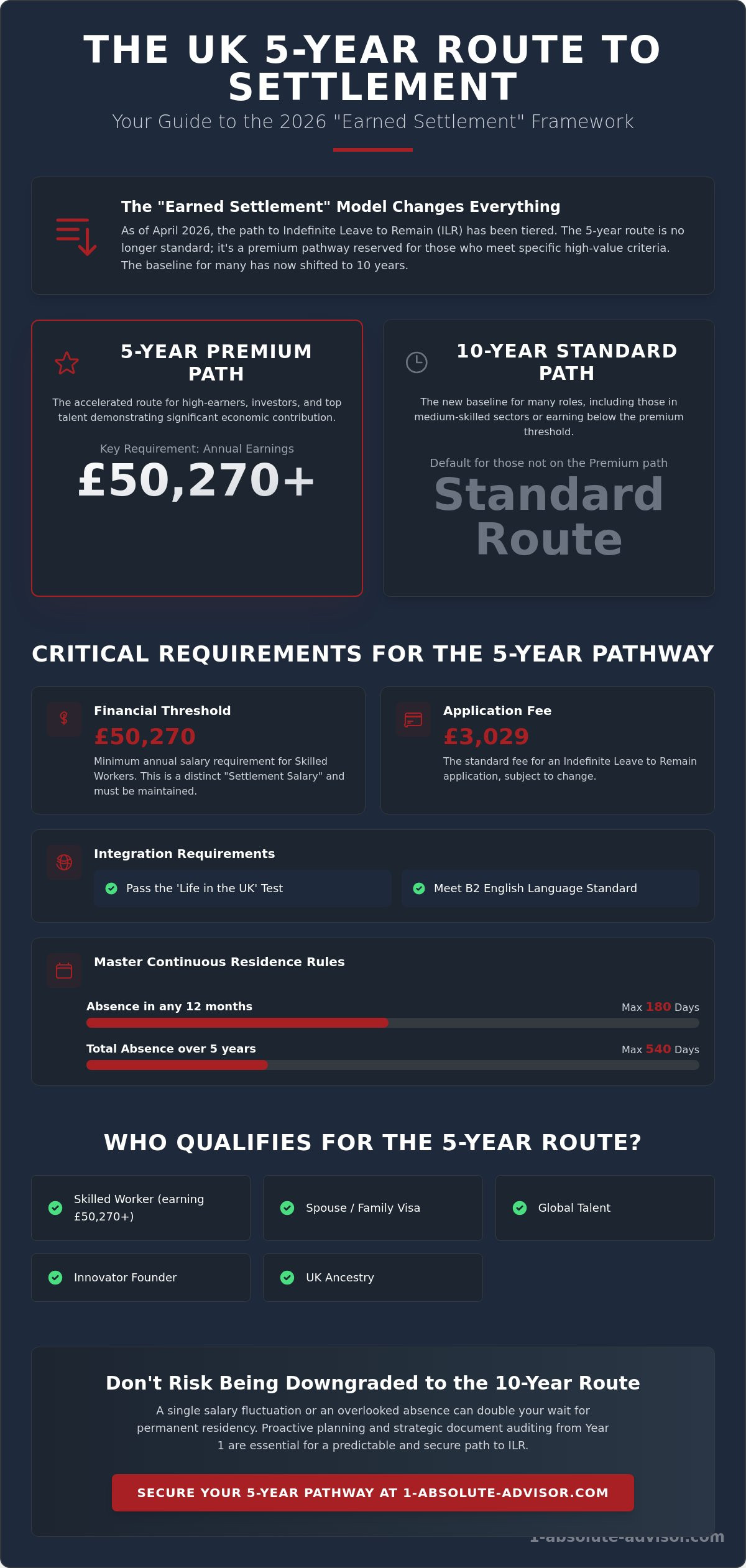
In 2026, the 5 year route to settlement uk is no longer a standard expectation; it’s a premium pathway reserved for those who actively manage their professional and financial standing. Following the April 2026 implementation of the “Earned Settlement” model, the baseline for Indefinite Leave to Remain (ILR) shifted to 10 years for many sectors. You’re likely concerned that the new B2 English requirement or the £3,029 application fee represents just the beginning of a more restrictive era. It’s stressful to think that a single salary fluctuation or an overlooked absence could double your wait time for permanent residency.

This article provides the strategic clarity you need to secure your ILR within the 5-year window by mastering the £50,270 earnings threshold and the 180-day continuous residence rules. You’ll gain a definitive checklist of documents and a clear understanding of how to avoid being downgraded to the 10-year route. We’ll outline exactly how to navigate these regulatory shifts to ensure your path to settlement remains both predictable and secure.

Key Takeaways

  • Determine if you still qualify for the accelerated 5 year route to settlement uk under the 2026 “Earned Settlement” model and updated salary thresholds.
  • Identify the critical financial benchmarks, specifically the £50,270 minimum earnings required for Skilled Workers to bypass the standard 10-year residency baseline.
  • Learn to calculate continuous residence accurately to stay within the 180-day annual absence limit and the 540-day total cap over your qualifying period.
  • Understand how to align your professional trajectory with the updated B2 English language standards and the Life in the UK test requirements.
  • Establish a strategic document audit process from your first year in the UK to ensure a seamless and successful transition to Indefinite Leave to Remain.

Understanding the 5-Year Route to Settlement in 2026

The 5 year route to settlement uk is the most efficient pathway for non-EU nationals seeking to establish a permanent life in Britain. It isn’t merely a convenience; it’s a strategic milestone that grants the right to work, study, and access public funds without the recurring burden of visa renewals. However, the regulatory environment changed significantly following the 2025 “Restoring Control” White Paper. This policy shift moved the goalposts for many, making the 5-year path a selective privilege rather than a universal standard. Success in 2026 demands more than just time. It requires meticulous adherence to continuous residence rules and specific financial benchmarks from the moment you arrive. Proving your eligibility involves meeting character requirements and demonstrating a sustained economic contribution to the UK.

What is Indefinite Leave to Remain (ILR)?

Understanding Indefinite Leave to Remain is essential for anyone planning a long-term future in the UK. ILR is a permanent residency status that effectively removes immigration control, allowing you to live in the country without an expiry date on your stay. It’s the mandatory foundation for those who eventually wish to apply for British citizenship. While the status provides immense security, it remains conditional. If you reside outside the UK for more than two continuous years, you risk losing your ILR status entirely. Maintaining this status requires a commitment to making the UK your primary home, backed by evidence of your ongoing residence.

The 2025-2026 Policy Shift: 5 Years vs. 10 Years

The 2026 “Earned Settlement” framework introduced a tiered system that prioritizes economic contribution and specific skill sets. While the standard baseline for settlement has been extended to 10 years for many “medium-skilled” roles and those in the social care sector, the 5 year route to settlement uk remains accessible for top talent and high earners. Specifically, individuals earning between £50,270 and £125,139 retain their 5-year eligibility. This means your uk immigration strategy must be proactive from day one. You can’t wait until year four to check your eligibility. You must track your “continuous residence” meticulously, ensuring you don’t exceed 180 days of absence in any 12-month period. The Home Office now utilizes automated tracking to flag discrepancies immediately, making precision in your travel records more critical than ever before.

Eligibility Criteria: Who Still Qualifies for the 5-Year Pathway?

The 2026 immigration landscape creates a sharp division between standard residency and what the Home Office now considers “earned” settlement. While the 10-year baseline applies to a broader range of migrants under the new model, the 5 year route to settlement uk remains the primary objective for high-value workers and family members of British citizens. Maintaining your eligibility requires a proactive approach to your immigration status from the moment your initial visa is granted. Beyond the main work and family categories, Global Talent, Innovator Founder, and UK Ancestry visa holders continue to enjoy access to this shorter timeframe, provided they meet the specific endorsement and residency criteria. It’s a premium path that demands total compliance with evolving regulations.

Work-Based Routes and Salary Thresholds

To qualify for settlement after 60 months, Skilled Worker Visa holders must now meet the £50,270 minimum salary threshold established in the April 2026 rule changes. It’s a common misconception that meeting the initial sponsorship salary is sufficient for permanent residency. The “Settlement Salary Requirement” is a distinct hurdle that must be maintained throughout your qualifying period. You should review the skilled worker visa uk 2026 updates to ensure your RQF level and specific job code still align with the 5-year pathway. If your earnings fall below this threshold and you don’t work in a protected public service role, like medicine or teaching, you risk being moved to the 10-year “Standard” route.

Family and Spouse Visa Pathways

The spouse visa uk remains one of the most stable 5-year pathways, though it’s not without its own financial complexities. Applicants must satisfy the financial requirement through combined income or significant savings, which is a separate standard from the “adequate maintenance” rules applied to specific exempt groups. You must be cautious during the extension phase. If you fail to meet the strict financial criteria at the 2.5-year mark, the Home Office may transition your application to the “10-year private life route.” This shift doubles your wait time and exponentially increases your long-term application costs. Checking the official ILR requirements regularly is the most effective way to stay informed about subtle policy shifts that could impact your family’s security. If you’re concerned about meeting these benchmarks, seeking a professional document checking service can provide the necessary certainty before you submit your final application.

The 5-Year Route to Settlement UK: Navigating ILR Requirements in 2026

The 5-Year vs. 10-Year Route: Navigating the 2025 Policy Shifts

The divergence between the 5-year and 10-year pathways has created a significant financial and administrative gap for migrants. Under the 2026 “Earned Settlement” model, the standard route now requires a decade of residency. This extension isn’t just a matter of time; it carries a heavy price tag. Choosing the wrong path means paying an additional five years of Immigration Health Surcharge (IHS) fees and multiple visa renewal costs before reaching eligibility. For those in social care or medium-skilled roles, the baseline can even extend to 15 years. This makes the 5 year route to settlement uk an essential strategic target for those who can meet the merit-based criteria.

A critical risk in the current system is the “Dependant Trap.” This occurs when a main applicant qualifies for the accelerated 5-year path, but their family members are relegated to the 10-year baseline due to specific sector restrictions or missing the April 2026 transitional cutoff. It results in a fragmented household status where parents might settle years before their children. Proper planning requires examining the UK government guidelines on Indefinite Leave to Remain to ensure your entire family remains on a synchronized timeline. Every year spent waiting on a temporary visa adds thousands of pounds in cumulative costs and administrative uncertainty.

The “High-Earner” Privilege

The 2026 regulations clearly favor economic contribution as a primary factor for settlement speed. To secure the 5-year ILR track, Skilled Workers must maintain annual earnings between £50,270 and £125,139. If your income exceeds £125,140, you may even qualify for a 3-year accelerated route. The Migration Advisory Committee (MAC) constantly reviews these thresholds based on economic productivity. Your salary isn’t just a paycheck; it’s your ticket to faster residency. If you receive a promotion that pushes you above the £50,270 mark mid-visa, you can effectively “switch tracks” from the 10-year to the 5-year pathway, provided you meet the other continuous residence requirements from that point forward.

Dependants and the 10-Year Baseline

New rules for 2026 have tightened the requirements for partners and children significantly. While partners of British citizens generally retain their 5-year path, dependants of Skilled Workers in lower-earning brackets often face the full 10-year wait. This creates a complex situation for children born in the UK during this period. While they may have a claim to citizenship once a parent settles, the intervening years require constant visa maintenance and high renewal fees. Aligning your family’s settlement dates is no longer automatic. It requires a proactive document strategy and careful timing of your extension applications to avoid unnecessary delays that could push you toward the long-residency route.

Critical Requirements for Maintaining Your Settlement Clock

Maintaining your eligibility for the 5 year route to settlement uk requires more than just physical presence; it demands a continuous, uninterrupted legal status. The Home Office defines “continuous residence” with mathematical precision. Any breach, however minor, can reset your qualifying period to zero. This forces you to start the multi-year process again under potentially stricter future rules. Beyond mere presence, you must demonstrate “Good Character,” which includes a clean criminal record and the absence of civil penalties, such as tax discrepancies or litigation. Every interaction with UK authorities is recorded and reviewed during your final settlement audit.

Calculating Absences and Continuous Residence

The rolling 12-month calculation is the standard for assessing absences. You must not spend more than 180 days outside the UK in any 12-month period. Unlike previous fixed-calendar systems, this rolling method means any trip is measured against the 365 days preceding and following it. If you’ve spent 45 days abroad for work and 20 days for a family emergency, your remaining allowance is 115 days. Valid exemptions do exist for compelling and compassionate reasons. These include serious illness of the applicant or a close relative, or natural disasters. However, these require robust documentary evidence, such as medical reports or official travel disruptions, to be accepted. Maintaining a detailed residence log from your first day in the UK is the only way to ensure your final application is audit-ready.

Knowledge of Life and Language

By May 2026, the English language proficiency requirement for settlement has been elevated to the B2 level on the CEFR scale. This is a step up from the B1 level previously required for initial entry. You must pass a secure English language test (SELT) unless you’ve already met this through a degree taught in English or fall into an exempt age group, such as those under 18 or over 65. The Life in the UK test remains a mandatory component of the 5 year route to settlement uk. It’s advisable to sit this exam at least 12 months before your eligibility date to avoid administrative delays. If you’re unsure if your current qualifications meet the 2026 standards, our Indefinite Leave to Remain (ILR) Application Service can provide a comprehensive eligibility audit to protect your residency clock.

Character requirements are often overlooked but are equally vital. The Home Office scrutinizes your history for any behavior that suggests you aren’t of good character. This includes not just criminal convictions, but also non-custodial sentences and even persistent administrative failures. Late tax filings or unpaid civil fines can be grounds for refusal. In the 2026 landscape, compliance is not optional; it is the foundation of your permanent residency.

Securing Your Future: Professional Strategy for ILR Applications

Reaching the conclusion of the 5 year route to settlement uk requires a final, meticulous audit of your five-year history. You shouldn’t treat the final application as a mere formality; it’s a consolidation of half a decade of compliance. A proactive document strategy, initiated well before your eligibility date, ensures that every salary fluctuation or change in job title is accounted for under the 2026 “Earned Settlement” standards. Overlooking a minor drop below the £50,270 threshold or failing to update your Certificate of Sponsorship (CoS) during a promotion can trigger a “private life” downgrade, extending your path to residency by an additional five years. This shift doesn’t just delay your status; it exponentially increases your long-term costs due to extra visa renewals and health surcharges.

Obtaining Indefinite Leave to Remain is often the gateway to British Citizenship. Once you’ve successfully completed the 5 year route to settlement uk, you’ll typically face a 12-month residency requirement before you can apply for naturalization. This final year remains a period of scrutiny where maintaining good character and primary residence is essential. By viewing your settlement application as part of a comprehensive, multi-stage journey toward becoming a British citizen, you can ensure your transition is both seamless and legally robust. It’s about protecting the investment you’ve made in your professional and personal life since your first day in the country.

Document Audits and Pre-Submission Checks

The complexity of the 2026 framework makes a professional ilr uk audit a critical safeguard against Home Office refusals. A document checking service identifies potential discrepancies in employment records or residence logs that could derail an otherwise valid application. For those on work-based routes, securing explicit employer confirmation of your ongoing role and salary is a non-negotiable requirement. In 2026, utilizing priority or super-priority services can reduce the standard six-month decision window to just 24 hours, providing immediate certainty for your long-term planning.

The 1 Absolute Advisor Advantage

Navigating these high-stakes regulatory shifts requires a partner who understands the holistic intersection of immigration law and professional stability. 1 Absolute Advisor provides a fixed-fee management model for uk work visa settlement, ensuring financial predictability throughout the process. Our OISC-registered experts specialize in the 2025 and 2026 rule changes, offering the strategic depth needed to protect your status. Book a consultation to assess your 5-year eligibility today with 1 Absolute Advisor and secure your permanent future in the United Kingdom.

Strategic Residency: Your Path to Permanent Status

The 2026 “Earned Settlement” model has transformed the 5 year route to settlement uk from a routine process into a merit-based achievement. Maintaining your eligibility requires more than just meeting the £50,270 salary threshold; it demands absolute precision in tracking your 180-day rolling residence and ensuring your professional documentation remains flawless. As the Home Office moves toward more automated compliance checks, the margin for administrative error has effectively vanished. Those who successfully navigate these 2025 policy shifts don’t just secure residency; they establish the mandatory foundation for British citizenship.

Expertise is the most reliable tool to mitigate the risk of a 10-year downgrade. As OISC Registered Immigration Consultants, we specialize in complex ILR and Spouse Visa cases, providing the strategic oversight necessary to protect your immigration timeline. Our fixed-fee visa application management ensures you have a predictable partner throughout this multi-year journey. Secure your 5-year route to settlement with an expert OISC advisor today. Your future in the United Kingdom is a long-term investment, and with the right professional guidance, your path to permanent residency remains clear and attainable.

Frequently Asked Questions

Can I switch from the 10-year route to the 5-year route if my salary increases?

You can transition to the 5-year pathway if your annual earnings rise above the £50,270 threshold established in April 2026. This move requires you to meet all specific criteria of the “Skilled” route from the moment of your transition. It’s a strategic decision that can save you five years of Immigration Health Surcharge fees and administrative burdens. You must ensure your sponsorship details are updated correctly to reflect this change in status.

What happens to my settlement clock if I lose my job during the 5-year period?

Losing your employment stops your residency clock if your leave is curtailed and you don’t secure a new sponsor within 60 days. Any gap in lawful residence resets the 5 year route to settlement uk to zero. To protect your progress, you must transition to a new qualifying employer or a different visa category without a break in your legal stay. Precision in timing these transitions is vital for your long-term security.

Do children born in the UK automatically get settlement after 5 years?

Children born in the UK don’t automatically receive settlement or citizenship at birth unless at least one parent is already settled or a British citizen. Once you achieve Indefinite Leave to Remain, your UK-born children become eligible to register as British citizens. If you haven’t settled yet, children who live in the UK for the first 10 years of their life may have a separate pathway to citizenship regardless of your status.

How do the 2025 changes affect dependants on the 5-year route?

The April 2026 “Earned Settlement” model links dependant eligibility to the main applicant’s economic contribution. Family members of high earners who meet the £50,270 salary benchmark generally retain their 5-year residency pathway. However, dependants of those in lower-earning tiers or the social care sector may be moved to a 10-year baseline. This shift often results in family members settling at different times, requiring careful financial and legal planning.

Is the “Life in the UK” test still required for the 5-year route in 2026?

The Life in the UK test remains a mandatory requirement for all settlement applicants between the ages of 18 and 64. It is a core component of the 5 year route to settlement uk and should be completed well before your 60-month eligibility date. The test assesses your integration and knowledge of British customs. Passing this exam is a one-time requirement that stays valid for all future applications, including British citizenship.

Can I include time spent on a Student visa toward the 5-year route?

Time spent on a Student visa doesn’t count toward the 5-year settlement pathway for work or family routes. While student residency contributes to the 10-year long residence model, the accelerated 5-year route only accepts time spent on specific qualifying visas, such as the Skilled Worker or Spouse visa. You must switch to a qualifying category to begin your five-year countdown toward permanent residency status.

What are “compelling reasons” for exceeding the 180-day absence limit?

Compelling reasons include serious illness, the birth or death of a close relative, or large-scale natural disasters that prevent travel. You must provide robust third-party evidence, such as medical certificates or official government travel advisories, to justify these absences to the Home Office. Without verified documentation, exceeding the 180-day limit in any rolling 12-month period will reset your settlement clock and delay your eligibility for ILR.

How much does the ILR application cost for the 5-year route in 2026?

The standard application fee for Indefinite Leave to Remain is £3,029 per person as of May 2026. This figure doesn’t include additional costs for biometric appointments or priority processing services, which can accelerate the decision-making process to within 24 hours. Because these fees are non-refundable, performing a professional document audit before submission is a necessary step to protect your financial investment and ensure a successful outcome.

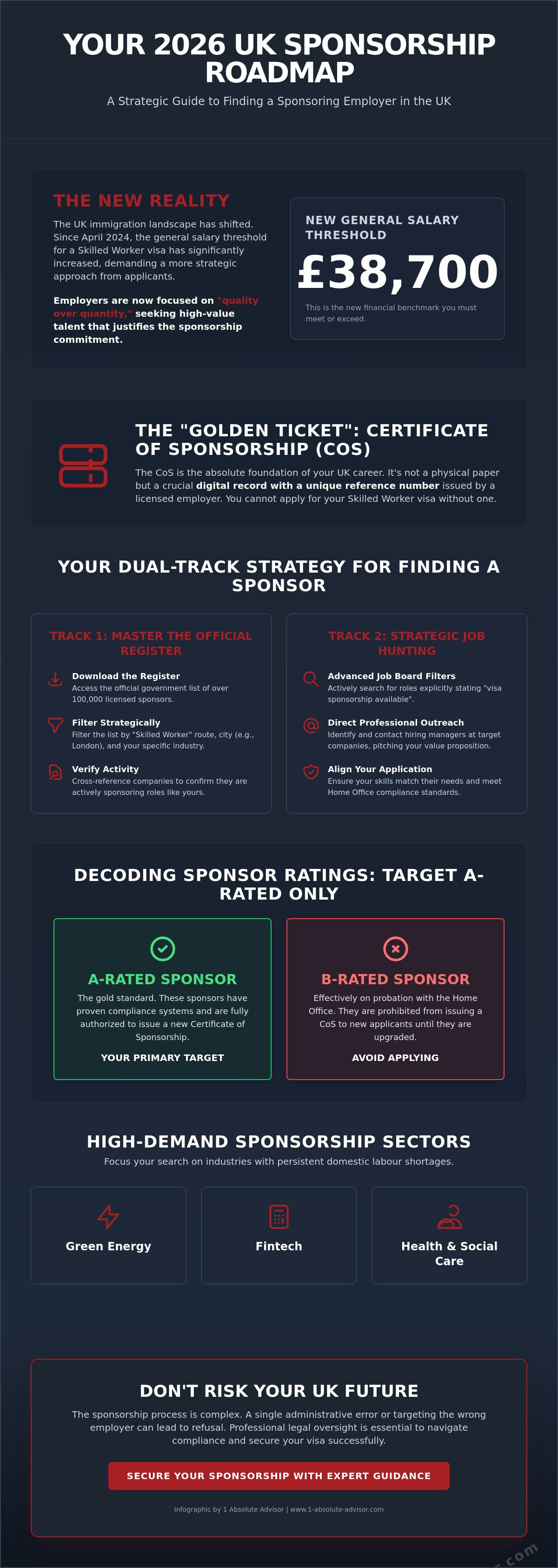
Finding a Sponsoring Employer in the UK: The 2026 Strategic Guide

Since the general salary threshold for Skilled Worker visas jumped to £38,700 in April 2024, the barrier to entry for international talent has reached an unprecedented peak. By 2026, relying on volume based applications while finding a sponsoring employer in the uk is a strategy destined for failure. You’ve likely experienced the exhaustion of passing multiple interview rounds only to have the offer rescinded because the company’s license doesn’t cover your specific occupation code or salary requirements.

It’s understandable to feel overwhelmed by the complexity of the latest immigration rules and the sheer size of the Home Office register. We’ll provide you with a precise roadmap to identify active sponsors and master the art of the sponsorship pitch. This guide breaks down the 2026 financial criteria and offers a proven framework for building a shortlist of employers who possess the legal capacity and the commercial appetite to invest in your career. You’ll gain a clear understanding of how to verify a company’s sponsorship history and align your application with the most current Home Office compliance standards.

Key Takeaways

  • Understand the critical role of the Certificate of Sponsorship (CoS) and why securing this “golden ticket” is the absolute foundation of your UK career strategy.
  • Learn how to navigate and filter the official Register of Licensed Sponsors to efficiently identify high-potential employers in specific UK cities and sectors.
  • Discover a proven dual-track strategy for finding a sponsoring employer in the uk by combining advanced job board filters with professional direct outreach.
  • Master the 2026 salary threshold requirements and learn how to verify the “Going Rate” for your specific SOC code to ensure your application meets the latest financial benchmarks.
  • Identify the common pitfalls in the sponsorship process and why professional legal oversight is essential to prevent administrative errors that could jeopardise your visa.

Understanding the UK Sponsorship Landscape in 2026

To succeed in finding a sponsoring employer in the uk by 2026, you must understand the regulatory architecture governing international recruitment. A licensed sponsor is a UK-based organization that the Home Office has vetted and authorized to hire non-settled workers. This authorization, known as a Sponsor Licence, isn’t a mere formality or a badge of honor. It’s a rigorous legal status that places significant compliance duties on the firm. When a company sponsors you, they’re effectively acting as a guarantor to the UK government, ensuring you meet the requirements of the UK’s points-based immigration system.

The central mechanism of this process is the Certificate of Sponsorship (CoS). It’s often called the “golden ticket” of UK immigration, but it’s actually a digital record, not a physical document. Each CoS has a unique reference number that you need for your visa application. By 2026, the appetite for sponsorship has shifted toward high-value roles. While the salary threshold increases introduced in April 2024 (raising the general minimum to £38,700 for many) created hurdles for entry-level positions, businesses in growth sectors continue to view sponsorship as a vital tool for securing global talent.

It’s crucial to recognize that sponsorship is a heavy legal commitment for the employer. They must track your attendance, report changes in your job description, and maintain detailed records for Home Office inspections. Because of these administrative and financial burdens, finding a sponsoring employer in the uk requires demonstrating that your skills offer a return on investment that justifies their compliance risk.

The Difference Between A-Rated and B-Rated Sponsors

The Home Office maintains a public register of licensed sponsors, assigning them ratings based on their ability to meet compliance duties. You should almost exclusively target A-rated sponsors. This rating indicates the company has proven systems for monitoring sponsored workers. If a company fails an audit, they’re downgraded to a B-rating. A B-rated sponsor is essentially on probation; they’re prohibited from issuing a CoS to new employees until they complete a government-mandated action plan. As a new applicant, a B-rated firm cannot help you.

To maintain these high standards of operational integrity, many organizations seek independent verification of their management systems. Partnering with a global certification and auditing body like International Associates Limited helps companies demonstrate their adherence to international benchmarks, providing further assurance of their commitment to regulatory compliance and quality.

The Role of the Skilled Worker Visa in 2026

The Skilled Worker route remains the primary pathway for sponsored employment. In 2026, the landscape is characterized by a “quality over quantity” approach from employers. Sectors such as Green Energy, Fintech, and Health and Social Care remain sponsorship-heavy due to persistent domestic labor shortages. For a comprehensive analysis of current salary benchmarks and specific occupation codes, refer to the Skilled Worker Visa UK 2026: The Definitive Guide. Understanding these technicalities ensures you don’t waste time targeting firms that cannot meet the updated financial requirements for your specific role.

How to Use the Official Register of Licensed Sponsors

The official Register of Licensed Sponsors is the most critical asset for anyone finding a sponsoring employer in the uk. As of early 2024, this database tracks over 100,000 organisations authorised to hire international talent. It’s a raw, high-volume dataset that requires a methodical approach to extract actionable leads. You won’t find job descriptions here; you’ll find the legal architecture that makes your employment possible.

To begin, download the “Worker and Temporary Worker” register in CSV format. This file often exceeds 11MB, so it’s best handled in Excel or Google Sheets rather than a standard text editor. Once opened, apply a filter to the header row. Your first move should be filtering the “Route” column for “Skilled Worker” or “Global Business Mobility,” depending on your specific visa path. Use the “Town/City” column to narrow your search to specific economic hubs like London, Manchester, or Birmingham if you have geographic constraints.

Distinguishing between active and legacy sponsors is vital for efficiency. A company might hold a license but hasn’t issued a Certificate of Sponsorship (CoS) in years. Check the “Rating” column; an “A (Premium)” or “A-rated” status is the standard. After identifying a potential lead, cross-reference the company name on LinkedIn. Search for the company name followed by “sponsorship” or “international recruitment” in the LinkedIn search bar. This reveals if they’re currently active in the talent market or merely maintaining a dormant license.

Filtering for Your Specific Industry

Precision is key when finding a sponsoring employer in the uk. Use Companies House to find the Standard Industrial Classification (SIC) codes for businesses in your field. By matching these codes to the names on the sponsor register, you can isolate firms that actually operate in your niche. While the “Big Four” professional services firms—Deloitte, PwC, EY, and KPMG—are perennial sponsors with thousands of licenses, don’t overlook boutique firms. In the last 12 months, hundreds of specialized tech and engineering startups have acquired licenses for the first time to fill specific skill gaps.

Tools to Simplify the Search

Several third-party platforms and browser extensions, such as UK Hired or Otta, attempt to scrape this data and overlay it onto job boards. These tools provide a smoother user experience and can save hours of manual cross-referencing. However, they occasionally suffer from sync delays. The Register of licensed sponsors: workers is the only 100% accurate source. Use third-party tools for discovery, but always verify the firm’s current status on the official GOV.UK list before applying. For professionals seeking a more tailored strategy for their UK transition, consulting an Absolute Advisor provides the regulatory clarity needed to move forward with absolute confidence.

Finding a Sponsoring Employer in the UK: The 2026 Strategic Guide

Strategic Job Hunting: Where to Find Sponsoring Employers

Finding a sponsoring employer in the uk requires a transition from passive searching to a data-driven recruitment strategy. While the Home Office register of licensed sponsors lists over 100,000 organizations, it functions as a directory rather than a live job board. You must cross-reference this list with active vacancies to identify viable targets. Successful candidates often bypass generic applications by contacting HR departments at companies already on the register. This direct outreach demonstrates initiative and ensures your CV reaches someone who understands the administrative framework of the Skilled Worker route.

When you encounter the “Do you have the right to work in the UK?” question on application forms, clarity is essential. If you don’t currently hold a long term visa, answer “No” but immediately clarify your status in any available text box. State that you’re seeking a Skilled Worker visa and emphasize that the company’s status as a licensed sponsor makes the process straightforward. If you’re working with recruitment agencies, prioritize those specializing in international placements or high-demand sectors like engineering, tech, and healthcare; for instance, hospitality professionals should check out Operational Chef Consultant for specialized staffing support. These specialists often have pre-negotiated agreements with employers who’ve already budgeted for sponsorship costs.

Top Job Boards for Sponsored Roles

LinkedIn has refined its “Visa Sponsorship” keyword filter for 2026, making it a primary tool for international talent. However, many employers forget to tick this box. You should manually search for terms like “Certificate of Sponsorship” or “Tier 2” within job descriptions. On Indeed and Reed, look for “hidden” sponsorship offers by filtering for roles with salary levels that meet the current salary thresholds and eligibility requirements. For health and care professionals, the NHS Jobs portal is the most reliable source, as the majority of Trusts are established sponsors with dedicated international recruitment teams.

The Power of the Graduate Route Transition

Starting your UK career on a Graduate Visa UK is a highly effective “try before you buy” strategy for both you and your employer. This route allows you to work for two years without the company needing to sponsor you immediately. Use this time to become an indispensable asset. By the 18 month mark, you should initiate the conversation about “switching” to a Skilled Worker visa.

Timing your request is critical. Don’t wait until your visa is weeks from expiring. Instead, bring up sponsorship during an internal promotion cycle or a positive performance review. Presenting a clear plan that highlights your value and the company’s existing license status reduces the perceived risk for management. Businesses are 70% more likely to sponsor an existing high-performing employee than a new external hire because the cultural fit and technical competence are already proven.

The 2026 financial landscape for international professionals is defined by the high salary floor established during the 2024 policy shifts. Most applicants now face a general threshold of £38,700. This figure represents a significant jump from previous years, making the process of finding a sponsoring employer in the UK a matter of financial alignment as much as professional merit. You must recognize that this £38,700 is merely a baseline; the Home Office requires you to be paid whichever is higher: the general threshold or the “going rate” for your specific Standard Occupational Classification (SOC) code.

Strategic flexibility exists for those classified as “New Entrants.” This group typically includes individuals under age 26, recent UK graduates, or those working toward professional qualifications. New entrants can often qualify with a salary of £30,960, provided the pay meets 70% of the job’s specific going rate. Additionally, tradeable points offer a mechanism to lower the threshold. A relevant PhD can reduce the salary requirement by 10%, while a PhD in a Science, Technology, Engineering, or Mathematics (STEM) subject can reduce it by 20%, provided the salary doesn’t drop below £30,960.

Standard vs. Lower Salary Rates

While the corporate world grapples with the £38,700 minimum, the Health and Care Visa route maintains a distinct structure. These roles generally follow national pay scales or a lower threshold of £29,000, ensuring the NHS remains accessible to international talent. In sectors like fintech or AI development, the “going rate” often sits well above £60,000, rendering the general threshold irrelevant. The “going rate” is specific to the job title, not just the visa category.

What if the Salary is Too Low?

If an offer falls short of the legal requirement, you must enter negotiations with precision. Focus on the gross basic salary; the Home Office does not count performance bonuses, regional allowances, or pension contributions toward the threshold. When finding a sponsoring employer in the UK, it’s vital to identify firms that understand these compliance nuances. If a potential sponsor cannot or will not meet the statutory minimum, you should walk away. Accepting a sub-threshold offer leads to an immediate visa refusal, which complicates all future immigration efforts.

Understanding these complex financial requirements is the first step toward a successful relocation. For a detailed assessment of your eligibility under current regulations, consult with our specialists at Absolute Advisor to secure your professional future.

Securing a formal job offer is a significant milestone, but it represents only 50% of the journey toward working in Britain. The transition from candidate to visa holder involves a complex legal framework where even minor administrative oversights lead to immediate rejections. While finding a sponsoring employer in the uk is the necessary first step, the technical execution of the visa application determines your success. The Home Office’s scrutiny has intensified following the April 2024 threshold changes, making professional oversight a necessity rather than an optional luxury.

An incorrectly issued Certificate of Sponsorship (CoS) is a primary cause of application failure. If the assigned SOC code doesn’t perfectly align with your actual day-to-day duties, or if the salary falls even £1 below the updated £38,700 general threshold (or the specific going rate for your role), the visa will be refused. These errors are costly. You risk losing thousands of pounds in non-refundable fees, including the Immigration Health Surcharge, which currently stands at £1,035 per year for most adults. Expert guidance ensures these technical details are verified before any documents are submitted.

Vetting Your Future Sponsor

Not every company with a sponsor licence is a safe bet for your career. 1 Absolute Advisor performs deep-dive compliance checks on potential employers to identify red flags before you sign a contract. We examine the firm’s history with the Home Office to ensure they haven’t faced recent suspensions or civil penalties. Our advisors pay specific attention to “Genuine Vacancy” requirements. If the Home Office suspects a role was created solely to facilitate a visa rather than to meet a real business need, they’ll issue a refusal. We help you and your employer document the necessity of the role to prevent this outcome.

We also support candidates who find the perfect role at a company that doesn’t yet hold a licence. We can manage the sponsor licence application for the employer, turning a “no” into a “yes” by removing the administrative burden from their HR department. This proactive approach expands your options when finding a sponsoring employer in the uk beyond the existing list of registered sponsors.

Our Skilled Worker Visa Application Service

Our comprehensive management service takes the pressure off both the candidate and the employer. We handle the process from the moment the CoS is drafted until the final visa approval is granted. This includes a meticulous review of your English language evidence, financial requirements, and TB test results where applicable. We don’t believe in hidden costs; our fixed-fee transparency ensures you know exactly what your legal investment is from day one. You’ll work with a dedicated mentor who understands the nuances of the 2026 immigration landscape.

Don’t leave your UK career to chance. Ensure your application is resilient, compliant, and professionally managed from start to finish.

Book a consultation with our OISC-registered advisors

Securing a role in the UK’s evolving job market requires more than a strong CV; it’s about a precise understanding of current Home Office regulations. By 2026, the baseline salary threshold for most Skilled Worker applicants remains a significant hurdle, often requiring a minimum of £38,700 unless specific tradeable points apply. Success depends on strategically identifying firms listed on the official Register of Licensed Sponsors and ensuring your role matches the specific SOC codes defined by the government. The process of finding a sponsoring employer in the uk is now a technical challenge where compliance is just as vital as your professional talent.

Absolute Advisor provides the stability and expertise needed to manage these complexities. As an OISC-registered immigration consultancy, we offer fixed-fee legal services that eliminate financial uncertainty. Our team specializes in the intricate 2026 salary threshold rules, ensuring your application meets every regulatory requirement from the start. Secure your UK future with expert Skilled Worker visa support. Your professional goals in the United Kingdom are within reach when backed by methodical planning and expert advocacy.

Frequently Asked Questions

How do I know if a UK company is licensed to sponsor?

You can verify a company’s status by checking the “Register of licensed sponsors: workers” published on the official UK government website. This public database is updated daily and lists every organization authorized to hire international talent. Finding a sponsoring employer in the uk starts with searching this list to ensure the firm holds a valid A-rated licence for the Skilled Worker route.

Can I apply for a job if the company is not on the sponsor list?

You’re free to apply, but the employer must obtain a sponsor licence before they can legally hire you. This application process typically takes 8 weeks, though companies can pay a £500 priority fee to receive a decision within 10 working days. Most successful candidates focus on firms already on the register to avoid the risk of a licence being denied.

What are the 2026 salary requirements for a Skilled Worker visa?

The general salary threshold for 2026 remains at £38,700 per year, or the specific “going rate” for your job code, whichever is higher. If you’re a “new entrant,” such as a graduate under age 26, you might qualify with a lower salary of £30,960. These figures are mandatory benchmarks that ensure your compensation aligns with current UK economic standards.

Do I need a job offer before I apply for a work visa?

You must have a formal job offer and a valid Certificate of Sponsorship (CoS) before you can submit a Skilled Worker visa application. The CoS isn’t a physical document but a unique digital reference number issued by your employer. It proves that a licensed organization has vetted your skills and committed to employing you under specific terms.

Can a small business sponsor my UK visa?

Small businesses can sponsor workers as long as they meet the Home Office’s eligibility criteria and pay the reduced fee of £536 for their licence. A company is classified as small if its annual turnover is £10.2 million or less and it has 50 or fewer employees. Many boutique firms in tech and creative industries use this route to secure specialized global expertise.

What happens if my sponsoring employer loses their licence?

If the Home Office revokes your employer’s licence, your visa will usually be shortened to 60 days. You’ll need to leave the UK or find a new position within this timeframe. Finding a sponsoring employer in the uk quickly during this period is vital to maintaining your residency and continuing your career path without interruption.

How much does it cost an employer to sponsor a worker in 2026?

Large organizations pay a £1,476 licence fee, while small sponsors pay £536. Beyond this, employers must pay the Immigration Skills Charge, which costs £1,000 per year of the visa for large firms and £364 for small ones. Every Certificate of Sponsorship issued also carries a flat fee of £239, making the total investment significant for any business.

Is it harder to find a sponsor after the 2024/2025 rule changes?

The 48% increase in the minimum salary threshold that took effect in April 2024 has made the market more competitive for entry-level roles. Employers are now more selective, focusing their sponsorship budgets on high-value positions that justify the higher salary requirements. While the total number of visas issued in the health sector fell by 81% in late 2024, engineering and IT sectors continue to show resilience.

UK Dependent Visa Guide 2026: Bringing Your Family to the United Kingdom

A single missing bank statement or a misinterpretation of the March 11, 2024, policy shifts can turn a £5,000 investment into a heartbreaking refusal letter. It’s a harsh reality in an era where the Home Office scrutinizes relationship evidence with clinical precision. You’re likely feeling the pressure of the UK’s increasingly rigid immigration environment, where the £1,035 annual Immigration Health Surcharge is just the starting point of your financial commitment. It’s natural to worry that “insufficient evidence” might derail your plans, especially with the 2024 restrictions for care workers now fully embedded in the system.

This guide gives you the technical precision required to secure a dependent visa uk in 2026, ensuring your application is legally sound and strategically prepared from the outset. We’ll detail the exact financial thresholds, relationship proofing strategies, and the step-by-step process to bring your family to the United Kingdom with absolute confidence. By the end of this article, you’ll have a clear, actionable roadmap to overcome administrative hurdles and ensure a successful relocation for your loved ones.

Key Takeaways

  • Identify which primary immigration routes, including Skilled Worker and Student visas, allow your family members to qualify as dependants under the latest 2026 regulations.
  • Gain clarity on the specific evidentiary standards required to satisfy the two-year cohabitation rule and prove a subsisting relationship for spouses and partners.
  • Prepare for the mandatory financial maintenance thresholds, ensuring you hold the required funds-such as £285 for a partner-for the full 28-day qualifying period.
  • Streamline your dependent visa uk application by understanding the nuances of biometric appointments and the strategic differences between applying from inside or outside the country.
  • Recognize the strategic advantage of OISC-registered professional advice in navigating complex family cases and ensuring absolute compliance with UK Home Office requirements.

Understanding the UK Dependent Visa: Who Can Join You?

The UK immigration system underwent significant structural changes in 2024. These changes directly impact how you bring your family to Britain. A dependant is someone who relies on your financial support and residency status to live in the UK. Most commonly, this applies to those on the Skilled Worker or Health and Care Worker routes. Understanding the dependent visa uk requirements is the first step toward a successful relocation. The broader UK immigration policy dictates that while the government aims to reduce net migration, they maintain pathways for essential workers to remain with their immediate families under specific conditions.

Defining Eligible Family Members

Your spouse or civil partner must be at least 18 years old at the time of application. You’ll need to provide a valid marriage or civil partnership certificate that’s recognized under UK law. For unmarried partners, the Home Office requires proof of a durable relationship. Since January 31, 2024, the strict two-year cohabitation rule has been slightly relaxed to include those who haven’t lived together due to work or cultural reasons. However, you still need to demonstrate a relationship similar to marriage for at least 24 months through joint bank statements, tenancy agreements, or utility bills. It’s about proving a shared life, not just a shared address.

Children must be under 18 when they first apply. They can’t be leading an independent life, which means they shouldn’t be married or in a civil partnership. If only one parent is moving to the UK, you must prove “sole responsibility” for the child’s upbringing. This is a high evidentiary bar. You’ll need court orders, school records, or medical documentation showing you’re the only person making significant decisions for the child. If the other parent is alive and involved, the Home Office will likely refuse the application unless there are “serious and compelling” circumstances.

Restrictions for Care Workers and Students

The landscape for care workers shifted on March 11, 2024. From this date, new care workers (SOC 6145) and senior care workers (SOC 6146) can’t bring dependants to the UK. However, a “Grandfather Rule” protects those already in the system. If you held a care worker visa before March 11, 2024, and you’re extending your stay or changing employers within the same sector, you retain the right to have your family join you. This remains true for applications made in 2026, provided you haven’t broken your continuous leave.

Student visa holders face similar hurdles. Only those enrolled in postgraduate research programs, such as a PhD or a research-based Master’s, can sponsor family members. If you’re on a standard taught Master’s course, your family won’t be eligible for a dependent visa uk unless they were already present in the UK before January 1, 2024. You must also show you have enough money to support them. The current maintenance requirements are £285 for a partner, £315 for the first child, and £200 for each additional child, held for 28 consecutive days.

Children born in the UK during your stay occupy a unique legal space. Even if you’re on a restricted visa route that prevents bringing in new dependants from abroad, a child born on British soil can apply for permission to stay. This ensures the child has legal status to access the NHS and travel. You’ll need to provide a full UK birth certificate showing both parents’ names. It’s a vital safety net for families who find their visa rules changed mid-stay.

Eligibility Criteria and Proving Your Relationship

Securing a dependent visa uk requires more than just a valid marriage certificate or birth record. The Home Office applies rigorous scrutiny to ensure that every relationship is genuine, subsisting, and meets specific legal thresholds. Since the rule changes on January 31, 2024, the definition of a “durable relationship” has expanded, but the evidentiary burden remains high. You must demonstrate that your family unit is a functional reality rather than a legal convenience. This involves a strategic approach to documentation that leaves no room for ambiguity or doubt from entry clearance officers.

For spouses who’ve been living apart due to work or international commitments, the challenge is proving the relationship is “subsisting.” This requires a chronological trail of contact. If you’ve lived in separate countries for 12 months, you’ll need to show consistent financial transfers, regular travel logs, and digital communication records. The goal is to prove that despite the physical distance, the emotional and financial partnership remains intact. If you require a detailed assessment of your specific documentation, our strategic visa planning services provide the clarity needed for a successful submission.

The Document Strategy for Partners

The Home Office prefers “hard evidence” over personal testimonials. You should provide at least six pieces of joint correspondence, such as bank statements, tenancy agreements, or utility bills, spread evenly over the last 24 months. Soft evidence, including dated photographs and WhatsApp logs, should only supplement these official records to fill gaps in your history. A durable relationship is defined under the 2024 Appendix Relationship rules as a couple who’ve lived together in a relationship akin to marriage for at least two years or can provide a significant explanation why they haven’t while maintaining a subsisting bond. For the most accurate requirements, consult the official UK family visa guidance to ensure your evidence list is compliant.

Proving Dependency for Children

When bringing children, the “Both Parents” rule is the default standard; typically, both parents must be present in the UK or applying at the same time. If you’re a single parent, you must meet the “Sole Responsibility” threshold. This isn’t satisfied by a simple custody order. You must prove you’ve made every major decision regarding the child’s education, health, and daily welfare, often requiring letters from schools or doctors confirming you’re the sole point of contact.

  • Family Linking Code: Ensure the 16-digit Global Web Form (GWF) or Unique Application Number (UAN) of the lead applicant is clearly cited to link the dependent visa uk applications.
  • Over 18s: You must prove the child isn’t leading an “independent life,” which means they shouldn’t be married, have their own children, or be working full-time.
  • Financial Support: Provide bank statements showing 100% of the child’s living costs are covered by the parent, especially if the child is in full-time university education.

The complexity of these applications often stems from the 2024 requirement to prove that a child over 18 still resides in the family home. If the child is at university, you’ll need a letter from the registrar confirming their term-time address and a statement from you confirming they return to the family home during every holiday period. Precision in these details prevents the common 15% rejection rate associated with insufficient proof of dependency.

Financial Requirements and Maintenance Funds in 2026

Securing a dependent visa uk requires more than just proof of a relationship; it demands a clear demonstration of financial stability. The Home Office enforces strict maintenance requirements to ensure that families arriving in the United Kingdom don’t rely on public funds. For 2026, the specific amounts remain tiered based on the number of family members joining the lead applicant. You’ll need to show £285 for your partner, £315 for the first child, and £200 for each additional child. These figures are cumulative. If a spouse and two children are applying, the total maintenance fund required is £800. This capital must be held in a regulated financial institution for a consecutive 28-day period. The closing balance of this 28-day window cannot fall below the required threshold even for a single day, or the application will face an immediate refusal.

Timing your evidence is the most common pitfall for applicants. The bank statement used as evidence must be dated within 31 days of the online application submission. If your statement is 32 days old when you hit “submit,” the Home Office will disregard it. You should check the UK government family visa information to confirm if your specific bank is on the approved list, as certain institutions in countries like India, Pakistan, or Ghana are occasionally restricted due to verification concerns. Precision here isn’t just a suggestion; it’s a mandatory requirement for a successful outcome.

How to Meet the Maintenance Requirement

You can satisfy these requirements through personal savings or employer certification. If you’re using savings, the funds can be in the lead applicant’s name or the dependant’s name; joint accounts are also perfectly acceptable. Most applicants find that an “A-rated” sponsor provides the most streamlined path. If the lead applicant’s employer is A-rated, they can certify maintenance on the Certificate of Sponsorship (CoS). This “tick box” exercise on the CoS waives the need for bank statements entirely, as the employer guarantees they’ll provide at least £1,600 in support if needed during the first month. We’ve seen this reduce document heavy-lifting by 40% for our corporate clients.

Budgeting for the Immigration Health Surcharge (IHS)

The Immigration Health Surcharge remains the most substantial upfront cost for a dependent visa uk. In 2026, the adult rate is £1,035 per year of the visa’s duration, while the rate for children under 18 is £776 per year. For a three-year visa, a partner will pay £3,105 in IHS fees alone, excluding the standard visa processing fee of approximately £827 for those applying from outside the UK. It’s a significant financial commitment that must be paid in full at the time of application. However, there’s a vital exemption for those on the Health and Care Worker visa. Dependants of these professionals are exempt from the IHS, which saves a family of four over £10,000 across a three-year term. This exemption is a critical strategic consideration when choosing which visa route the lead applicant should pursue.

The Application Process and Common Pitfalls

The transition from understanding eligibility to submitting a formal application requires absolute precision. Applicants usually face two distinct pathways based on their current location. Those already residing in the UK on a qualifying visa, such as a Skilled Worker or Graduate visa, can often switch to a dependent visa uk through an in-country application. It’s a strategic choice that avoids the logistical burden of returning home. However, individuals on visitor visas are strictly prohibited from switching while inside the UK; they must depart and apply from their country of residence.

Your biometric appointment is the cornerstone of the identity verification process. You’ll visit a center managed by VFS Global or TLScontact to provide fingerprints and a digital photograph. In 2026, the Home Office has maintained a tiered pricing structure for processing speeds. A standard out-of-country application typically takes 15 to 20 working days, costing the base fee of £1,846 for a partner. Priority service, which aims for a decision within 5 working days, adds £500 to your costs. For many of our corporate clients, this extra expense is a sound investment to avoid the financial fallout of delayed school starts or missed housing contracts. Super Priority service, offering a 24-hour turnaround, is now available in 85% of global application centers for an additional £1,000.

Step-by-Step Application Timeline

The process begins with the online application form where you must generate a Family Linking Code. This unique identifier ensures your file stays attached to the lead applicant’s record, preventing administrative separation. Once the fee is paid, you’ll gain access to the document upload portal. In 2026, we’ve seen a 12% increase in digital processing speeds, yet manual errors in the upload stage remain the primary cause of delays. Follow this sequence for absolute clarity:

  • Complete the digital form and pay the Immigration Health Surcharge, currently £1,035 per year.
  • Generate and record the Family Linking Code to synchronize your application with your sponsor.
  • Upload all supporting evidence to the VFS Global or TLScontact portal at least 48 hours before your appointment.
  • Attend the biometric appointment and await the electronic notification of your decision.

Avoiding the “Insufficient Evidence” Refusal

Generic evidence is a high-risk strategy that often leads to disappointment. The Home Office frequently rejects applications that rely on “template” cover letters or bank statements that fail to clearly highlight the required maintenance funds. Case workers expect to see a clear narrative of your relationship and financial stability. If your documents aren’t in English, they must include a certified translation that lists the translator’s credentials and the date of translation. Minor oversights, like a missing signature on a tenancy agreement or a bank statement that is 32 days old instead of the required 28, lead to immediate refusals.

A refusal doesn’t just delay your plans; it creates a permanent record that must be declared in all future global travel. To mitigate this risk, Our Document Checking Service can identify these technical errors before submission, providing the professional oversight required for a successful relocation. We treat every dependent visa uk application as a strategic project, ensuring that every piece of evidence serves to strengthen your case rather than merely filling a checklist requirement.

Professional Assistance for Your Family’s UK Immigration

Securing a dependent visa uk involves more than filling out forms; it requires a strategic approach to UK immigration law. The Office of the Immigration Services Commissioner (OISC) sets the benchmark for this sector. Choosing an OISC-registered advisor ensures your case follows strict ethical guidelines and legal standards. This regulation protects you from the risks associated with unregulated consultants who often cause application rejections through simple clerical errors or a lack of current policy knowledge.

This principle of seeking specialized legal counsel holds true for all international legal matters, not just UK immigration. For example, when dealing with complex business or investment law between different jurisdictions like the US and Israel, professionals will visit Israel Cross Border Law Firm to navigate those specific regulations.

A London-based advisor provides a distinct advantage for complex family structures. We deal with the Home Office’s evolving digital systems daily. Our proximity to the UK’s legal and financial heart allows us to interpret policy shifts faster than regional firms. We don’t just process paperwork; we build a comprehensive legal framework for your family’s residency. This is vital when dealing with intricate financial requirements or non-standard family units where the burden of proof is higher.

Cost transparency remains a cornerstone of our professional integrity. Many firms use hourly billing; this often leads to unexpected costs during the standard 8-week to 12-week processing window. We utilize a fixed-fee model. This approach eliminates financial ambiguity and allows you to budget accurately for your family’s relocation. You’ll know exactly what the professional fees are upfront, without fearing hidden disbursements or “admin” surcharges that can inflate a bill by 20% or more.

The 1 Absolute Advisor Advantage

Our team drafts personalized legal cover letters that act as a strategic roadmap for Home Office caseworkers. These documents highlight how you meet every statutory requirement under the current Immigration Rules. We perform exhaustive document audits to ensure your evidence is 100% compliant with Appendix Skilled Worker or Appendix FM. Whether you’re a Skilled Worker holder or a British citizen sponsoring a spouse, our holistic review process catches inconsistencies before they become grounds for refusal.

Secure Your Family’s Future in the UK

Booking your initial consultation is the first step toward certainty. During this session, we’ll map out your timeline and identify if you qualify for “fast-track” Priority or Super Priority services. These services can reduce wait times from months to just 24 hours for an additional Home Office fee of £1,000. Don’t leave your family’s stability to chance. Book a consultation with an OISC-registered advisor today to begin your journey toward a secure life in the United Kingdom.

Secure Your Family’s Future in the United Kingdom

Navigating the 2026 immigration landscape requires more than just filling out forms; it demands a strategic approach to meet the £29,000 minimum income threshold and provide irrefutable evidence of your subsisting relationship. Whether you’re navigating the complexities of “Sole Responsibility” for a child or proving a long-term commitment for an “Unmarried Partner” application, the dependent visa uk process leaves no room for administrative errors. Success hinges on precise documentation and a clear understanding of Home Office scrutiny. Mistakes can lead to costly delays or immediate refusals that disrupt your family’s plans.

You don’t have to manage these high-stakes legal requirements alone. Our OISC-registered immigration consultants provide the professional oversight needed to ensure your application is audit-ready from day one. We offer fixed-fee application management with no hidden costs, giving you complete financial predictability throughout the process. Our team specializes in resolving complex cases that often prove challenging for standard applications, ensuring your family stays together without unnecessary stress. Secure your family’s UK visa with expert guidance from 1 Absolute Advisor and take the first definitive step toward your new life together in Britain. We’re ready to help you build your future here.

Once your visas are secured, the logistical challenge of the physical move comes next. For professional assistance with the entire relocation process, from packing to transport, many families turn to specialists like VP Smart Removals to ensure a smooth transition to their new home in the UK.

For professional families, arranging reliable childcare is often the next critical step after the move. Securing qualified support helps ensure a smooth transition into work and school routines. Agencies like Superstar Nannies specialize in placing elite, vetted childcare professionals and can be a valuable resource for those relocating internationally.

As you begin your new life in the UK, making your house a home is a wonderful part of the journey. For professional framing to display family photos or new art, many people turn to specialists like the First4Frames Gallery to help preserve their most cherished memories.

For those starting or expanding their family, the journey of pregnancy is another significant part of settling in. To capture some of these early, precious moments, you can visit Scan Baby Ltd for a range of private ultrasound services.

Exploring the UK’s rich history and iconic landmarks is a rewarding part of settling in. For families looking to celebrate their arrival or introduce loved ones to their new home, Timescape Tours provides private, driver-guided day trips from London.

Making your new house feel like a home is a key part of settling in. For made-to-measure window dressings that provide both privacy and style, you can check out Universal Blinds UK.

Frequently Asked Questions

Can I bring my parents to the UK on a dependent visa?

Bringing parents to the UK on a dependent visa is only possible under the Adult Dependent Relative (ADR) route, which requires proving they need long-term personal care for daily tasks. This isn’t a standard addition to a work visa. You must demonstrate that the required level of care is unavailable or unaffordable in their home country, a threshold the Home Office maintains with high rejection rates for non-essential cases.

How much does a UK dependent visa cost in 2026?

A standard dependent visa uk application for a Skilled Worker’s family member costs £827 for stays up to 3 years or £1,636 for longer periods. These 2026 figures exclude the Immigration Health Surcharge, which currently stands at £1,035 per year for adults. Total costs for a three-year stay typically exceed £3,932 per person when including all mandatory Home Office levies and biometric enrollment fees.

Can my partner work in the UK on a dependent visa?

Your partner can work in almost any role in the UK once their visa’s granted, including self-employment or professional consultancy. They aren’t restricted to specific shortage occupations or salary thresholds like the main applicant. The only major prohibitions involve working as a professional sportsperson or a doctor in training, ensuring full economic integration for your household and strategic financial stability.

For those looking to enter a new trade, intensive courses can be a fast track to a skilled career; you can check out YTA Training for examples of accredited construction programs.

What happens to dependants if the main applicant’s visa is cancelled?

If the main applicant’s visa is cancelled, the Home Office will typically curtail the dependants’ leave to remain to 60 days. This period allows families to either apply for a different visa category or arrange their departure from the UK. Failure to secure a new legal status within this window results in overstaying, which carries severe implications for future immigration compliance and international travel.

Is there an English language requirement for dependent visas?

Most applicants for a dependent visa uk linked to a work route don’t need to meet an English language requirement for their initial entry. This differs from the Family Visa route, where a CEFR level A1 is mandatory. However, all dependants must pass a B1 level test eventually if they intend to apply for Indefinite Leave to Remain after completing their five-year residency period in the UK.

Can a child over 18 apply as a dependant if they are still at university?

A child over 18 can’t usually apply as a new dependant, even if they’re full-time university students. They must have been granted leave as a dependant before turning 18 to qualify for an extension from within the UK. If they’re applying for the first time at age 19 or 20, they’ll likely need to secure their own independent Student or Graduate visa to remain compliant with current regulations.

How long does it take to get a decision on a dependent visa?

Standard processing times for applications made outside the UK are three weeks, while applications submitted within the country usually take eight weeks. You can expedite this by paying £500 for the Priority Service to get a decision in five working days. The Super Priority Service offers a next-day decision for a £1,000 fee, providing absolute certainty for families managing urgent relocation timelines.

What is the “Family Linking Code” and how do I use it?

The Family Linking Code is a unique reference number generated when the main applicant submits their application, ensuring all family members’ files are processed together. You’ll enter this code in the “Relationship” section of the dependant’s form to maintain administrative consistency. This mechanism prevents the Home Office from treating applications as separate cases, which significantly reduces the risk of conflicting decision dates or processing errors.

Discuss Your Case For FREE