

A single administrative oversight in your SOC 2020 code selection can result in an immediate visa refusal, potentially wasting over £1,500 in non-refundable Home Office fees. This reality makes understanding the skilled worker visa uk requirements more critical than ever, especially as the April 2024 salary threshold increases have fundamentally changed the criteria for international professionals. You probably feel that the distinction between “going rates” and “general thresholds” is confusing, creating unnecessary anxiety during an already stressful transition. It’s a valid concern when a minor document error can derail your entire career trajectory and family plans.
This guide provides the strategic clarity you need to master these complexities with absolute confidence. We’ve analyzed the latest 2026 mandates to offer a definitive breakdown of salary rules, sponsorship compliance, and application tactics. You’ll gain a precise list of required evidence and a proven framework to ensure a successful relocation for both you and your family. By the end of this article, you’ll have the professional insight necessary to submit your application with total certainty and avoid the common pitfalls that lead to rejection.
Key Takeaways
- Understand how the significant regulatory shifts of 2024 and 2025 have redefined the 2026 landscape for non-UK nationals seeking employment under the current framework.
- Navigate the essential skilled worker visa uk requirements by ensuring your role meets the RQF Level 3 skill threshold and is backed by an A-rated licensed sponsor.
- Learn to distinguish between the general salary threshold and the specific ‘going rate’ for your occupation to ensure your application meets the 2026 financial criteria.
- Streamline your roadmap to approval by identifying the absolute evidence required, from English language proficiency to selecting the most efficient processing service.
- Discover how a comprehensive legal strategy and professional risk assessment can safeguard your application against common pitfalls and hidden sponsor compliance issues.
Understanding the Skilled Worker Visa Framework in 2026
The Skilled Worker visa serves as the primary gateway for non-UK nationals seeking to build a professional career within the United Kingdom. It functions as a sponsorship-led route, meaning every applicant must secure a valid job offer from an employer holding a Home Office-approved sponsor license. In 2026, the system operates under a refined version of the post-Brexit points-based framework, focusing heavily on high-skill retention and economic contribution.
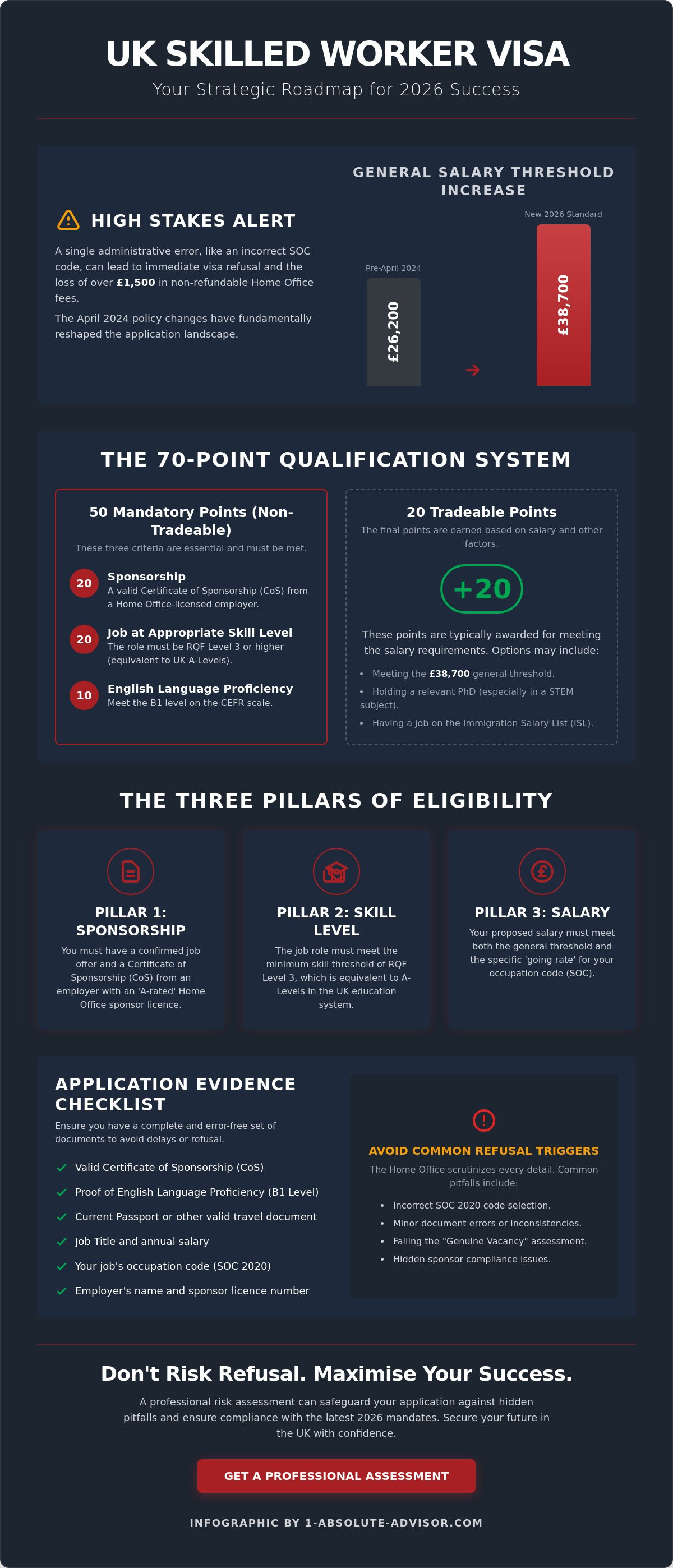
The current landscape is the result of significant policy shifts that occurred between 2024 and 2025. On 4 April 2024, the UK government implemented a substantial increase in salary thresholds, raising the general minimum from £26,200 to £38,700 for most new applicants. These updates were designed to prioritize high-value migration and ensure that the skilled worker visa uk requirements align with the country’s long-term economic objectives. Understanding the history of UK work permits reveals a clear trajectory from the rigid Tier 2 (General) system toward this more flexible, yet financially demanding, points-based model.
Success in 2026 depends on meeting a 70-point threshold. The Home Office maintains strict oversight of this process through “Genuine Vacancy” assessments. This means authorities don’t just check paperwork; they evaluate whether the role actually exists and if the sponsor has the financial capacity to sustain the employment. Compliance is not a one-time check but an ongoing obligation for the sponsoring business.
The Core Purpose of the Skilled Worker Route
This route exists to bridge the UK skills gap by allowing businesses to recruit globally when local talent is unavailable. It replaced the old Tier 2 system to provide a more streamlined application process while maintaining strict control over migration volumes. For the individual, the primary advantage is that this visa provides a direct five-year pathway to Indefinite Leave to Remain (ILR). This allows professionals to transition from temporary residents to permanent settlers, provided they meet the continuous residence and character requirements.
Mandatory vs. Tradeable Points
The 70 points required for the skilled worker visa uk requirements are divided into two categories. You must earn 50 “non-tradeable” points from the following mandatory criteria:
- Sponsorship (20 points): Having a valid Certificate of Sponsorship (CoS) from a licensed employer.
- Job at Appropriate Skill Level (20 points): The role must be at RQF Level 3 or above (equivalent to A-levels).
- English Language (10 points): Demonstrating proficiency at level B1 on the CEFR scale.
The remaining 20 points are “tradeable,” allowing for some flexibility based on salary, specific qualifications, or the nature of the role. Tradeable points are the mechanism for meeting salary thresholds through alternative qualifications. For example, an applicant earning less than the standard £38,700 threshold might still qualify if they hold a relevant PhD in a STEM subject or if the job is on the Immigration Salary List (ISL).
The Three Pillars of Eligibility: Sponsor, Skill, and Salary
The UK points-based immigration system relies on a structured framework designed to attract specific talent while maintaining economic stability. To qualify, you must satisfy three non-negotiable criteria. These pillars form the bedrock of the official Skilled Worker visa requirements, ensuring that both the employer and the employee meet the Home Office’s standards for compliance and professional integrity. Failure to align with even one of these pillars results in an automatic refusal.
- Pillar 1: Valid Sponsorship. You must hold a job offer from a business with a Home Office-approved ‘A-rated’ licence. This rating confirms the employer has the administrative systems to manage sponsored workers and meet their reporting duties.
- Pillar 2: Skill Level. The role must meet the Regulated Qualifications Framework (RQF) Level 3 or higher. This is equivalent to a UK A-Level. While you don’t necessarily need a degree, the job’s complexity must justify the sponsorship.
- Pillar 3: Financial Threshold. You must earn a salary that meets both the ‘General Threshold’ and the ‘Going Rate’ for your specific occupation. As of April 2024, the general threshold for most applicants is £38,700, though specific discounts apply for those on the Immigration Salary List or recent graduates.
The Certificate of Sponsorship (CoS) acts as the foundation of your entire application. It’s not a physical document but a digital record that links your identity to your employer’s licence. Our team at Absolute Advisor can review your job description to ensure it aligns with these complex regulatory standards.
Securing a Valid Certificate of Sponsorship (CoS)
You’ll encounter two types of certificates depending on your location. ‘Defined’ certificates are mandatory for those applying from outside the UK. ‘Undefined’ certificates apply to those switching visas or extending their stay from within the country. Your CoS must include your exact salary, start date, and the four-digit SOC 2020 occupation code. Accuracy is vital; a single discrepancy in the start date or a salary figure that falls £1 below the threshold leads to immediate rejection. The Home Office views these as “clerical errors,” yet they offer no leniency during the assessment phase.
Assessing Job Skill Levels (SOC Codes)
The Home Office uses the ONS Occupation Coding Tool to categorise roles. You must ensure your job title matches the duties described in the Standard Occupational Classification (SOC) system. “Misclassification” is a high-risk area for many businesses. If a role looks artificially inflated or ‘padded’ to meet the RQF Level 3 requirement, the Home Office will scrutinise the application for genuineness. To avoid this, use a checklist to match your actual daily duties to the SOC code description. Ensure the tasks you perform 80% of the time are reflected in the code’s primary duties. If the duties are too junior for the code, the caseworker will likely refuse the visa on the grounds that the role isn’t a “genuine vacancy.”
Navigating Salary Thresholds and the Immigration Salary List
The financial criteria for a sponsorship are the most frequent cause of application refusals. For 2026, the baseline general salary threshold for most applicants remains at £38,700. This figure represents a significant increase from previous years and serves as the primary benchmark to meet the skilled worker visa uk requirements. However, this is only the first step in the calculation. You must also satisfy the “going rate” for your specific occupation code, which is based on the 50th percentile of earnings for that role in the UK market.
Calculating Your Specific Salary Requirement
The Home Office applies a “higher of” rule to salary assessments. This means you’re required to earn whichever is greater: the general threshold of £38,700 or the specific going rate for your job code. For instance, if you’re hired as a Senior Software Developer and the going rate is £53,000, a salary of £40,000 won’t suffice, even though it exceeds the general threshold. Going Rates are updated annually and must be verified against the latest 2026 Immigration Rules to ensure compliance.
Calculations become more complex when adjusting for working hours. The standard going rates published by the government are typically based on a 37.5-hour work week. If your employment contract specifies 40 or 48 hours, the required salary must be pro-rated upward. A common trap for sponsors is offering a salary that meets the threshold for 37.5 hours but falls short when the actual, longer working week is factored in. We recommend a precise audit of the hourly rate to avoid these technical rejections.
Tradeable Points for Salary Reductions
The system allows for flexibility through “tradeable points,” where certain qualifications or circumstances permit lower salary requirements. This doesn’t lower the standard of the role, but recognizes the long-term value of the individual to the UK economy. These reductions are generally capped at a minimum floor, often £30,960, depending on the specific criteria met.
- The Immigration Salary List (ISL): Roles on this list, which replaced the old Shortage Occupation List, benefit from a 20% discount on the going rate, though the general threshold floor still applies.
- New Entrants: If you’re under 26, a recent UK graduate, or working toward professional qualifications, you may qualify for a 30% reduction on the going rate. It’s vital to remember this “New Entrant” status is temporary and limited to a maximum of 4 years, including any time spent on a Graduate visa.
- Educational Qualifications: Holding a PhD relevant to the job can reduce the salary requirement by 10%, while a STEM-specific PhD can lead to a 20% reduction.
- Health and Care Worker Visa: These roles operate under a separate salary scale entirely, often aligned with national pay scales (such as the Agenda for Change in the NHS), exempting them from the standard £38,700 threshold.
Strategic planning is essential here. Sponsors should not only look at the immediate salary but also the long-term progression, especially for new entrants who will face a “salary jump” once their four-year eligibility period expires. Ensuring your offer aligns with skilled worker visa uk requirements from the outset prevents costly administrative hurdles later.
The Application Roadmap: Documents and Common Pitfalls
Securing your visa requires a methodical approach to evidence. The process begins with gathering “absolute” proof of your eligibility. You must demonstrate your proficiency in English by passing a SELT at level B1 or higher, unless you hold a degree taught in English that Ecctis has verified. Applicants from majority English-speaking countries, such as Australia or New Zealand, are exempt. Additionally, if you’ve lived in a country on the Home Office’s restricted list for six months or more, you’ll need a valid TB certificate from an approved clinic.
The online portal is your next destination. Once you’ve received your Certificate of Sponsorship (CoS), you’ll navigate the choice between Standard and Priority services. Standard processing typically takes three weeks for those outside the UK. If your timeline is tighter, the Priority service offers a decision within five working days for an additional £500. Super Priority provides a next-day decision for £1,000. It’s a significant investment, but it provides the certainty many businesses require for talent onboarding.
Biometric data collection follows the submission. Most applicants now use the “UK Immigration: ID Check” smartphone app to verify their identity digitally. If the app can’t read your chip, you’ll attend a physical appointment at a UKVCAS center. Efficiency is key during the final decision phase. If the Home Office requests additional information, you typically have 10 working days to respond. Failure to meet this deadline often results in an automatic refusal, regardless of the merit of your case.
The Essential Document Checklist
- Proof of English Language: A valid test certificate from providers like IELTS SELT Consortium or Pearson is mandatory for most.
- Financial Maintenance: You must show at least £1,270 in personal savings held for 28 consecutive days. This isn’t required if your A-rated sponsor “certifies maintenance” on your CoS.
- Criminal Record Certificates: Required for roles in health, education, and social care. You’ll need a certificate from every country you’ve lived in for 12 months or more over the last 10 years.
Why Applications Fail: The ‘Genuine Vacancy’ Test
The Home Office scrutinizes whether the role is legitimate or created solely to facilitate entry. This “Genuine Vacancy” test is a major hurdle. If your CV doesn’t align perfectly with the skills listed for your specific SOC code, caseworkers may suspect the role is a sham. Discrepancies between your past experience and your new job description are common triggers for rejection. To avoid these skilled worker visa uk requirements pitfalls, ensure your Skilled Worker Visa UK 2026 application is audited for internal consistency before you hit submit. A single mismatch in dates or job titles can derail the entire process.
Securing Your Future: How Professional Representation Maximises Success
Successfully navigating the skilled worker visa uk requirements demands more than a basic understanding of the Home Office website. It requires a calculated legal strategy that anticipates caseworker scrutiny. The Absolute difference lies in moving beyond a simple checklist. We treat your application as a comprehensive case file where every piece of evidence supports a specific legal argument, ensuring your submission is robust enough to withstand rigorous examination.
OISC-registered advisors identify hidden risks that self-represented applicants often overlook. These risks might include subtle issues with a sponsor’s licence status or historical immigration nuances that could trigger a refusal under General Grounds. A professional cover letter serves as a vital tool in this process. It explains complex salary structures or specific skill-level nuances directly to the caseworker. This eliminates ambiguity and ensures that niche professional qualifications are correctly mapped against the UK’s Standard Occupational Classification (SOC) codes.
Strategic planning doesn’t end with a visa stamp. We focus on your long-term stability by mapping out your 5-year route to Indefinite Leave to Remain (ILR) from the very first consultation. This proactive approach ensures that your salary increments, job title changes, and absences from the UK are always managed within the strict limits required for permanent residency. We help you build a future, not just secure a temporary permit.
Our Fixed-Fee Application Management
Our team provides end-to-end support, managing the entire process from the initial eligibility assessment through to the final visa approval. If you’ve already prepared your own paperwork, our standalone document audit service provides a final safety net. This professional review catches the minor administrative errors that lead to a high percentage of avoidable delays. Professional management eliminates the anxiety families and businesses feel when dealing with complex Home Office regulations, allowing you to focus on your professional transition.
Next Steps for Your UK Career
Once you’ve met the skilled worker visa uk requirements and received your approval, you can begin your career in the UK with confidence. You’re permitted to take on supplementary employment for up to 20 hours per week, provided the work is in the same profession or a shortage occupation. You can also bring your partner and children, provided they meet the specific relationship and financial maintenance thresholds. Current regulations typically require showing at least £285 for a partner and £315 for a first child in held funds for a consecutive 28-day period.
Securing Your Professional Standing in the 2026 UK Market
Successfully navigating the 2026 immigration landscape requires more than just a basic understanding of the rules. The updated framework places significant weight on meeting precise salary thresholds and aligning with the current Immigration Salary List. You’ve seen how the three pillars of eligibility form the bedrock of a valid application, yet the Home Office’s margin for error remains slim. Meeting the skilled worker visa uk requirements demands a strategic approach to documentation and a clear understanding of your sponsor’s specific obligations.
At Absolute Advisor, we function as your strategic partner, ensuring your transition to the UK is handled with professional integrity. Our OISC-registered consultants specialize in managing complex 2026 salary threshold cases through a fixed-fee service that eliminates financial uncertainty. We don’t just process paperwork; we provide a holistic compliance framework to protect your career goals. Secure your UK future with our expert Skilled Worker Visa application service
Your professional journey in the UK is a significant investment. We’re here to ensure it’s built on a foundation of absolute certainty and long-term stability.
Frequently Asked Questions
What is the minimum salary for a Skilled Worker visa in 2026?
The general salary threshold for a Skilled Worker visa in 2026 is £38,700 per year, or the specific going rate for your occupation code, whichever is higher. These figures reflect the significant increases implemented by the Home Office in April 2024. Certain professionals, such as those in Health and Care roles or positions on national pay scales, qualify for a lower threshold of £29,000.
Can I switch to a Skilled Worker visa from a Student or Graduate visa?
You can switch to a Skilled Worker visa from a Student or Graduate route if you’ve secured a valid job offer from an approved Home Office sponsor. Students must have completed their degree or be within three months of their course end date to transition. This strategic move is beneficial because time spent on a Skilled Worker visa counts toward Indefinite Leave to Remain, whereas the Graduate visa doesn’t.
How long does it take to get a decision on a Skilled Worker visa?
A standard decision on a Skilled Worker visa application typically takes eight weeks if you’re applying from within the UK. For those submitting applications from overseas, the processing time is usually three weeks. You can expedite this by paying for priority services, which provide a result in five working days, or super priority for a decision by the end of the next working day.
Do I need a job offer before I can apply for the Skilled Worker visa?
You must have a confirmed job offer and a valid Certificate of Sponsorship from a licensed UK employer before you can begin your application. Meeting the skilled worker visa uk requirements is impossible without this document, as it contains your unique reference number and salary details. The employer acts as your sponsor and must prove the role meets the minimum skill level of RQF Level 3.
What happens if my employer loses their sponsor licence?
Your visa will be curtailed to 60 days if the Home Office revokes your employer’s sponsor licence. During this two-month window, you must find a new licensed sponsor to submit a fresh application or make arrangements to leave the UK. If your current visa has less than 60 days remaining, that original expiry date remains the final deadline for your stay in the country.
Can I bring my partner and children on a Skilled Worker visa?
You can bring your partner and children to the UK as dependants if they meet the specific relationship and financial requirements. Your partner must be your spouse, civil partner, or someone you’ve lived with for at least two years. Each family member requires a separate application and must pay the relevant visa fees and the Immigration Health Surcharge to access the National Health Service during their stay.
Is there an age limit for the UK Skilled Worker visa?
There’s no upper age limit for the UK Skilled Worker visa, though applicants must generally be at least 18 years old on the date of application. The Home Office focuses on your professional qualifications, the job offer, and meeting the financial thresholds rather than your age. Older professionals often find this route beneficial for long-term career moves and eventual permanent residency after five years of continuous residence.
How much does the Skilled Worker visa cost including the Health Surcharge?
A three-year Skilled Worker visa costs £827 for the application fee plus £3,105 for the Immigration Health Surcharge, totaling £3,932. If you apply for a visa longer than three years, the application fee rises to £1,636 and the IHS increases to £5,175 for a five-year stay. These figures are based on the standard rates updated in early 2024 and apply to most individual applicants seeking professional entry to the UK.