
Spouse Visa Extension UK: The Complete 2026 Guide to a Successful Renewal

A single missing utility bill from 2024 or an incorrectly formatted bank statement can be the difference between a secure future and a life-altering refusal letter. We recognise that the spouse visa extension uk process feels less like a formality and more like a high-stakes hurdle, especially as you navigate the updated 2026 financial thresholds and the daunting task of documenting 30 months of continuous cohabitation. You’ve worked incredibly hard to build a life in Britain; it’s natural to feel concerned that a minor administrative oversight could jeopardise your family’s stability.

You deserve a clear, absolute path to residency without the constant shadow of immigration uncertainty. This guide provides the strategic framework you need to master these complexities and secure your further 30-month grant, ensuring your 5-year route to Indefinite Leave to Remain remains uninterrupted. We’ll examine the precise evidentiary requirements for 2026, break down the mandatory income benchmarks, and provide a methodical checklist to guarantee your application meets every professional standard of compliance.

Key Takeaways

  • Understand the critical 30-month milestone and how the FLR(M) application secures your continuous path toward Indefinite Leave to Remain.
  • Navigate the updated 2026 financial thresholds and English language requirements to ensure your spouse visa extension uk meets the Home Office’s stringent criteria.
  • Master the cohabitation rule by gathering the specific two-year evidence of joint correspondence required to prove a subsisting relationship.
  • Learn how to apply the “28-day rule” correctly and budget for the 2026 Home Office fees and Immigration Health Surcharge (IHS) to avoid overstaying.
  • Discover the strategic importance of OISC-registered advice in protecting your status via Section 3C Leave and identifying hidden weaknesses in your evidence.

Understanding the Spouse Visa Extension and the 5-Year Route

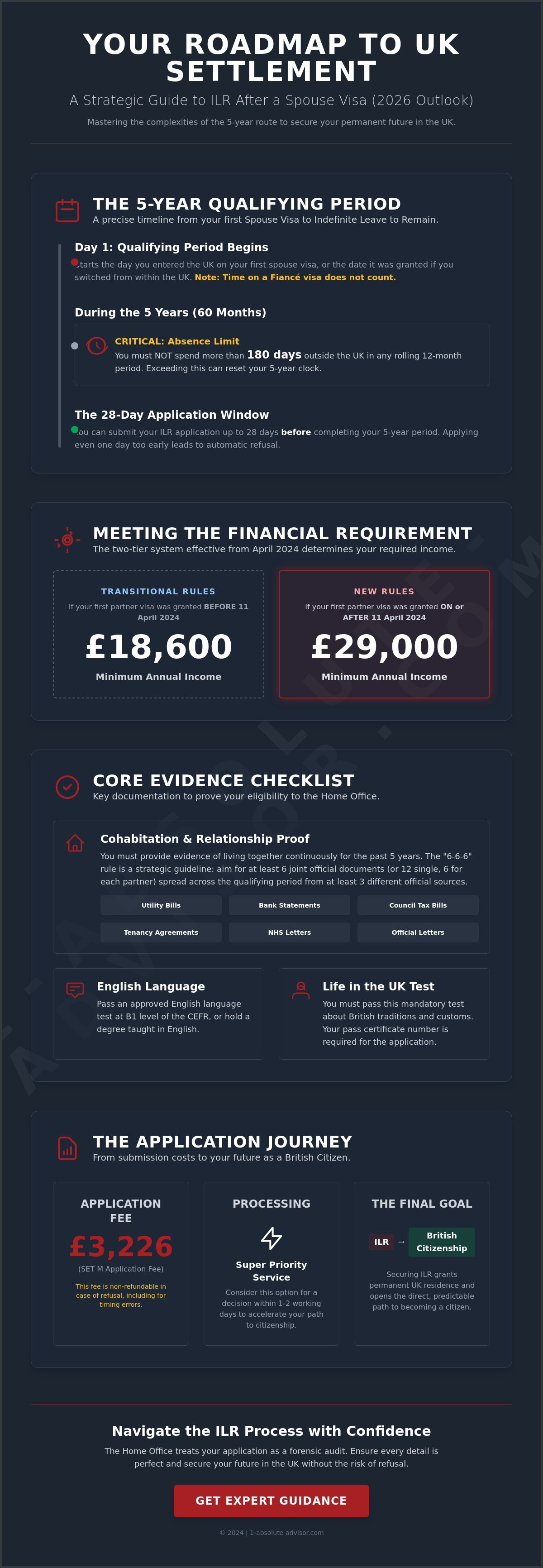
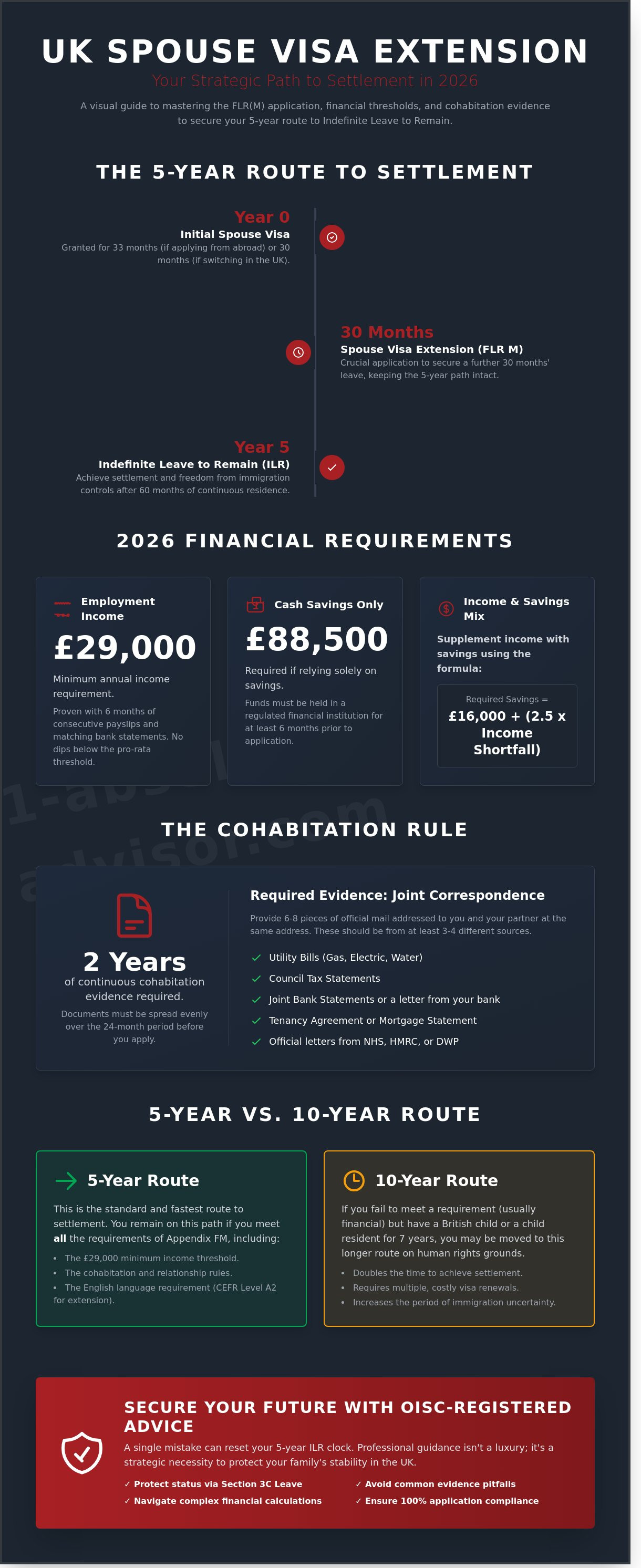
The spouse visa extension uk, formally categorised as Further Leave to Remain (M) or FLR(M), represents the vital second stage of the UK settlement process. This application is not a simple administrative update; it’s a comprehensive reassessment of your eligibility to remain in the country. For most applicants, this occurs at the 30-month milestone, marking the halfway point of the 5-year route toward Indefinite Leave to Remain (ILR). Successful completion of this stage grants an additional 30 months of leave, providing the stability required to complete the residency requirement.

The Home Office often applies a higher level of scrutiny to extension applications than to initial entry clearance. Caseworkers look for definitive proof that the relationship has remained subsisting and genuine throughout the preceding two and a half years. They expect a seamless paper trail of cohabitation and shared financial responsibility. Any gaps in evidence or inconsistencies in documentation can lead to delays or refusals. An unsuccessful extension application carries severe consequences. It can break your period of continuous residence, effectively resetting your 5-year ILR clock to zero and forcing you to start the multi-year process from the beginning. Maintaining the integrity of your residency timeline requires meticulous attention to the evolving standards of UK immigration law.

Eligibility Criteria for Your Further Leave to Remain

To secure a spouse visa extension uk, you must confirm your partner retains their status as a “settled person,” a British citizen, or someone with protected status. You must be physically present in the UK at the time of application. Suitability requirements are paramount; the Home Office will re-examine your character and criminal record. Any cautions or convictions acquired since your initial visa grant, even minor traffic offences, must be disclosed to avoid allegations of deception. We recommend a proactive audit of your personal history to ensure compliance with the suitability criteria defined in Appendix FM of the Immigration Rules.

The 5-Year vs. 10-Year Route to Settlement

The Home Office determines your route based on your ability to meet all standard requirements, particularly the financial threshold. Since the financial requirement changes in April 2024, many applicants find themselves under increased pressure to meet the new £29,000 minimum income floor. If you fail to meet this but have a child in the UK who is a British citizen or has lived here for seven years, you may be moved to the 10-year route on human rights grounds. While this prevents immediate deportation, it doubles the time required to achieve settlement. Strategic planning allows some applicants to switch back to the 5-year route during a subsequent renewal if they can demonstrate they once again meet the full financial and English language criteria.

Meeting the Financial and English Language Requirements in 2026

Securing a spouse visa extension uk in 2026 requires strict adherence to updated financial benchmarks and language proficiency standards. The Home Office maintains these requirements to ensure that non-EEA nationals can live in Britain without relying on public funds. Accuracy in your documentation is the only way to avoid a refusal, as the margin for error remains non-existent in the current immigration climate.

Updated Financial Thresholds for 2026

The minimum income requirement currently stands at £29,000 per annum. This threshold applies to most applicants, regardless of whether they have dependent children, following the policy simplification that removed the additional child-related income increments. You’ll need to prove this income through the “6-month rule,” which demands half a year of consecutive payslips and matching bank statements. Any dip below the monthly equivalent of the £29,000 annual salary during this period can lead to an immediate rejection.

You can meet this requirement through various channels. Salary from employment is the most common, but you’re also permitted to combine income from pensions, dividends from a limited company, or non-employment sources like property rentals. If your combined income doesn’t reach the £29,000 mark, you can supplement the shortfall with cash savings. To calculate the required savings, you must have £16,000 plus 2.5 times the amount of the income shortfall. For those relying entirely on savings with no employment income, the total required is £88,500, held in a regulated financial institution for at least six months.

Some applicants qualify for the “Adequate Maintenance” exception. This applies if the UK sponsor receives specific benefits, such as Personal Independence Payment (PIP), Attendance Allowance, or Carer’s Allowance. In these instances, you don’t need to meet the £29,000 threshold. Instead, you must demonstrate that your weekly income, after housing costs, is equal to or greater than the amount a British family would receive on Income Support. Determining your eligibility for this route requires a comprehensive financial assessment to ensure every penny is accounted for correctly.

The English Language Requirement: Level A2 and Beyond

The English language demand increases in difficulty when you move from your initial visa to the extension. While the entry clearance required a Level A1 certificate, the spouse visa extension uk necessitates Level A2 on the Common European Framework of Reference for Languages (CEFR). This ensures that your integration into British society is progressing as expected.

  • Approved Providers: You must take your test at a Secure English Language Test (SELT) centre approved by the Home Office, such as IELTS SELT Consortium or Pearson.
  • Validity: You can reuse a Level A1 certificate only if it was used in a previous successful application and you’re now moving to A2, or if you already passed at A2 or B1 level during your first application.
  • Exemptions: You’re exempt if you’re over 65, have a physical or mental condition that prevents you from taking the test, or hold a degree taught in English that’s recognised by Ecctis.

Detailed criteria for these exemptions and the list of approved test centres are available in the official UK government guidance. It’s vital to book your test at least two months before your current visa expires to account for any potential retakes or processing delays.

Spouse Visa Extension UK: The Complete 2026 Guide to a Successful Renewal

The Cohabitation Rule: Evidencing Your Relationship

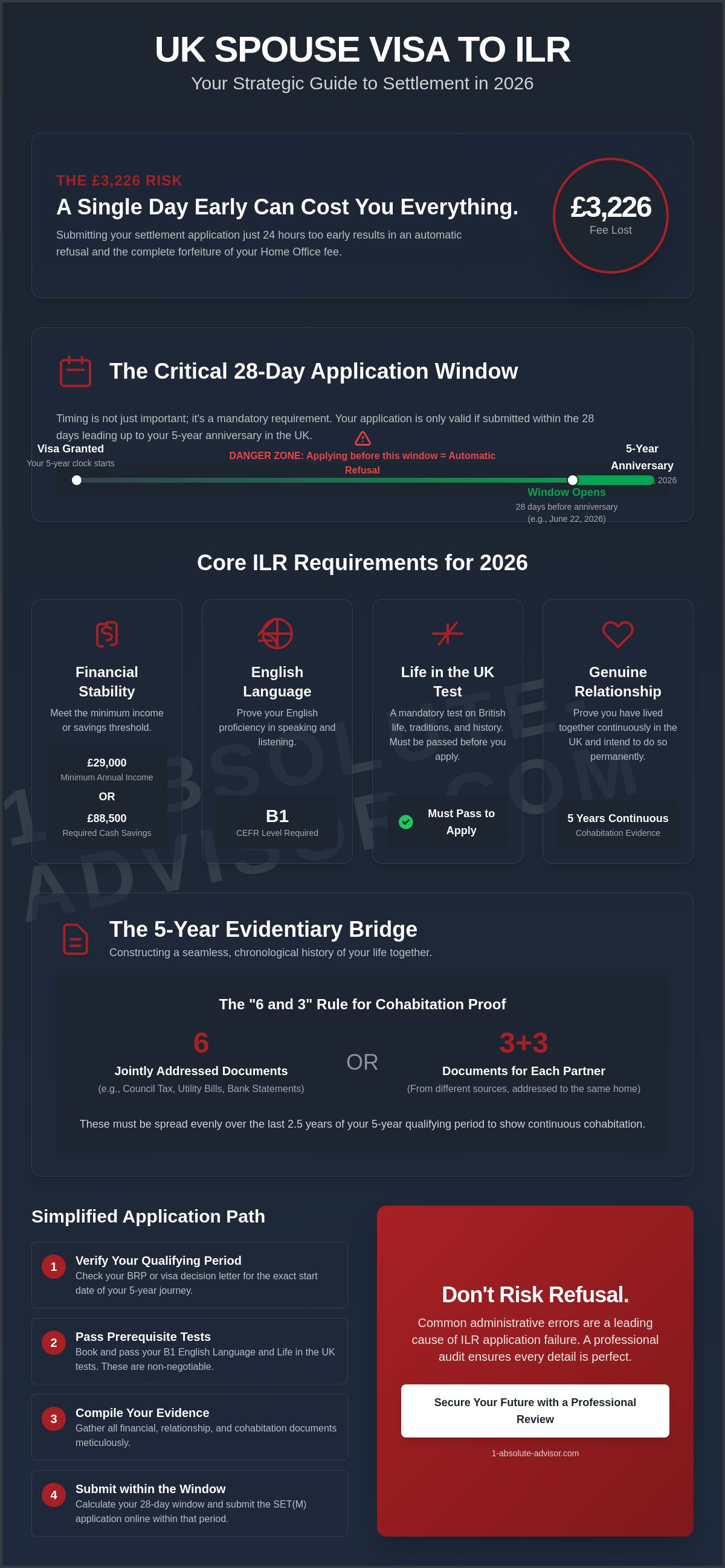
The Home Office requires definitive proof that your relationship remains subsisting and that you’ve lived together continuously since your initial leave to remain was granted. For a spouse visa extension uk, you must provide 6 items of correspondence addressed to you both jointly, or 12 items addressed to you individually at the same address. These documents must originate from at least 3 different official sources to demonstrate a shared life across multiple platforms of civil and financial responsibility. Caseworkers look for consistency; any period longer than 3 or 4 months without evidence can trigger a request for further information or a potential refusal.

Common mistakes often involve the quality of the evidence provided. Home Office guidance specifically prioritises “strong” evidence from government departments, such as HMRC or the DWP, and utility providers. Relying on “weak” evidence like mobile phone bills, gym memberships, or store cards is a frequent reason for delays. These items don’t verify residency with the same rigour as a water bill or a council tax statement. For those seeking clarity on the broader requirements, Citizens Advice guidance on partner visas provides a solid foundation for understanding how the Home Office assesses these living arrangements.

Organising Your Correspondence Portfolio

You must ensure your evidence covers the full 2.5-year period of your current visa. A strategic “spread” is essential; aim for one piece of joint evidence (or two individual pieces) for every 4-month interval. If you’ve lived apart temporarily for work or family reasons, such as a 3-month contract in a different city, you must provide a detailed explanation. Support this with evidence of your ongoing relationship, like travel tickets or logs of daily communication. Within your portfolio, council tax bills and formal tenancy agreements carry the most weight because they are legally binding records of residence.

Modern Evidence: Handling Digital Records

The shift towards paperless banking and billing has changed how applicants compile their spouse visa extension uk evidence. You can use PDF bank statements and electronic utility bills, but they must be high-quality digital originals rather than scanned photocopies. While the Home Office has become more flexible, it’s often safer to have digital documents authenticated by the issuing institution or accompanied by a formal letter. Proving joint financial responsibility in a paperless environment requires you to download statements that clearly show both names and the shared residential address, ensuring the metadata of the file remains intact for verification purposes.

Application Timeline, Fees, and the FLR(M) Process

The timing of your spouse visa extension uk application is a strategic decision rather than a mere administrative task. You must adhere to the “28-day rule,” which dictates that you shouldn’t submit your application more than 28 days before your current leave expires. This window is critical. It ensures you don’t inadvertently become an overstayer while protecting your long term path to permanent residency. Submitting the FLR(M) form within this period keeps your existing rights intact under Section 3C of the Immigration Act 1971, even if your current visa expires while you wait for a decision.

Financial planning is equally vital. In 2026, the Home Office application fee for a spouse visa renewal is £1,048. You must also factor in the Immigration Health Surcharge (IHS). This fee is currently £1,035 per year for adults. Since the extension is granted for a period of 30 months, you’ll be required to pay £2,587.50 upfront. These costs are non-negotiable and must be paid at the point of submission to validate your application.

Applicants often weigh the benefits of the Super Priority service. For an additional £1,000, you can receive a decision within 24 hours of your biometric appointment. While the standard 8-week processing time is often acceptable, the priority service is an “absolute” necessity for those with urgent travel requirements or complex financial arrangements that require immediate certainty. Once you’ve paid, you’ll attend a UKVCAS centre to provide your biometrics. Staff will scan your passport, take a digital photograph, and capture your fingerprints. It’s a methodical process that usually takes less than 45 minutes.

Step-by-Step Application Journey

The journey begins with the online FLR(M) form where precision is mandatory. You’ll need to provide exhaustive details about your subsistence, accommodation, and relationship history. Paying the IHS and application fee is what “locks in” your submission date. Following this, you’ll use the dedicated document upload portal. We recommend categorising your evidence into digital folders, such as “Financial Requirement” and “Relationship Evidence,” to ensure the Home Office caseworker can navigate your file without friction.

Calculating Your Settlement Date

Your extension timing directly influences your ILR UK eligibility. To qualify for settlement, you must complete a full 60 months on the 5-year route. Applying within 28 days of your current visa expiry is the safest way to ensure continuity of leave. If you apply too early, you risk falling short of the 60-month requirement by just a few days, which could force you into a third, expensive extension before you can apply for Indefinite Leave to Remain. Every day counts when calculating this five-year milestone.

Ensure your timeline is mathematically sound by choosing a partner who understands the nuances of Home Office logic. Consult with our specialist team to secure your future in the UK.

Why Professional OISC-Registered Advice is Essential

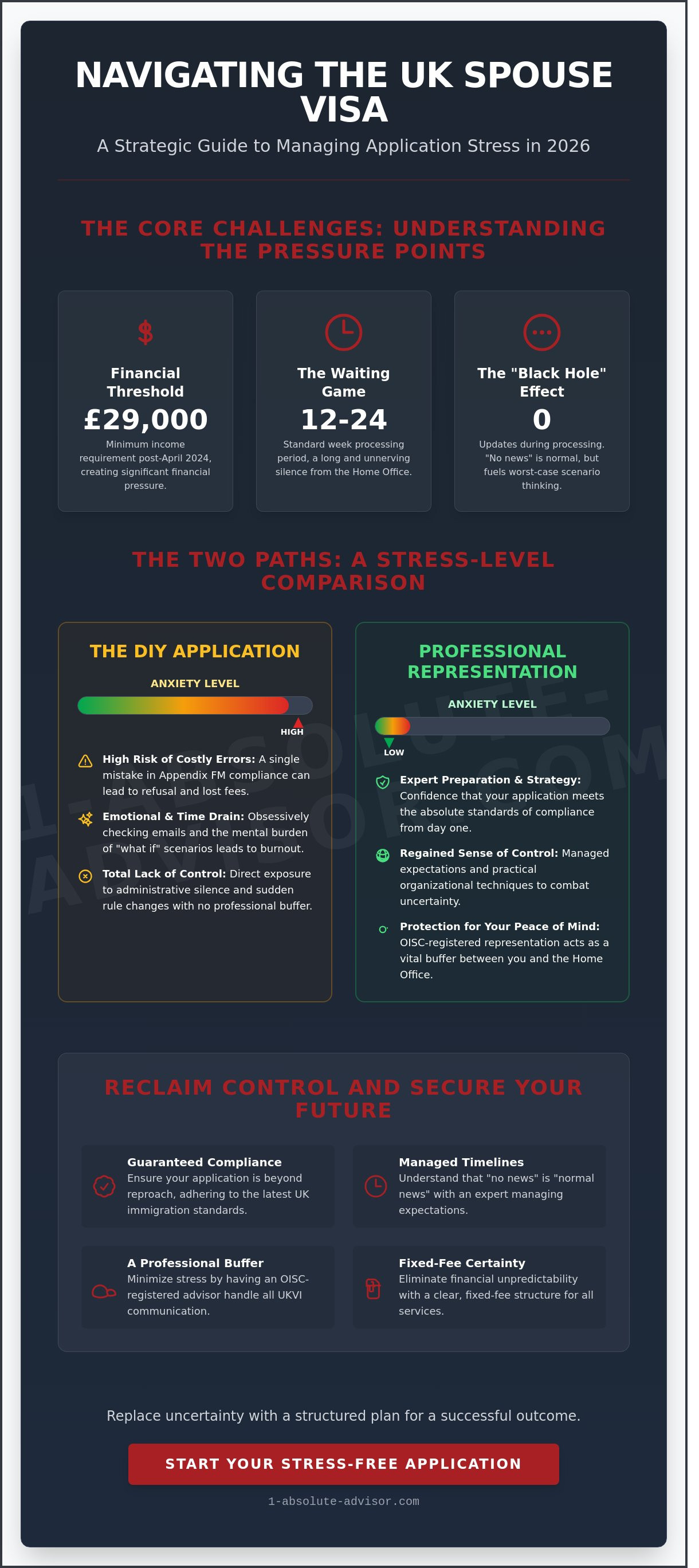
Securing a spouse visa extension uk involves more than just filling out forms; it requires a strategic approach to immigration law. The Home Office operates on a policy of strict compliance. Even a minor technical oversight can lead to an application being declared invalid. If this happens after your current visa expires, you risk losing the protection of Section 3C Leave. This specific legal provision allows you to remain in Britain under your existing conditions while a decision is pending. If your submission is rejected as invalid because of a procedural error, Section 3C protection evaporates instantly, potentially making your residence unlawful and jeopardising your 5-year route to settlement.

1 Absolute Advisor provides the professional oversight needed to mitigate these risks. Our consultants identify hidden weaknesses in financial evidence that often escape the untrained eye. For instance, we ensure that every payslip aligns perfectly with corresponding bank deposits and that no gaps exist in your employment history. A professional legal cover letter then acts as a roadmap for the Home Office caseworker. It doesn’t just list documents; it argues your case by directly referencing Appendix FM and Appendix FM-SE, ensuring the caseworker understands exactly how you meet every requirement.

Avoiding Common Refusal Pitfalls

Many applicants face automatic refusals due to the “28-day rule.” If your most recent bank statement is dated more than 28 days before the date of application, the Home Office will likely reject the evidence. We provide a comprehensive document checking service to prevent such avoidable failures. Our team is particularly adept at handling complex income scenarios. Whether you’re navigating the nuances of statutory maternity pay or managing fluctuating income from self-employment, we ensure your figures are presented in the specific format the Home Office demands.

  • Verification of bank statement dates to ensure total compliance with the 28-day rule.
  • Expert calculation of self-employed income to meet the specific £29,000 threshold requirements.
  • Strategic presentation of “adequate maintenance” for those exempt from the standard financial requirement.

The 1 Absolute Advisor Advantage

We believe in transparency and professional integrity. Our fixed-fee approach to spouse visa uk renewals means you’ll never face unexpected costs or hidden charges. You’ll have direct access to OISC-registered consultants who possess a deep understanding of current Home Office trends and policy shifts. We don’t just process paperwork; we act as your strategic partner throughout the renewal process. Your journey toward Indefinite Leave to Remain depends on the success of this extension. Contact us today to book your initial consultation and ensure your 5-year route remains secure and stress-free.

Securing Your Family’s Permanent Future in the United Kingdom

Successfully navigating a spouse visa extension uk requires a meticulous approach to the Home Office’s evolving 2026 criteria. Your success hinges on more than just meeting the current £29,000 minimum income threshold; it demands a comprehensive portfolio of evidence proving your relationship remains genuine and subsisting. From precise cohabitation records spanning the last two years to updated English language certifications, every detail in your FLR(M) application acts as a vital pillar for your family’s stability. While the administrative burden is significant, this stage is the final major hurdle on your five-year route toward Indefinite Leave to Remain.

Absolute Advisor provides the strategic oversight needed to eliminate the risk of a costly refusal. As OISC-registered immigration consultants, we’ve maintained a 99% success rate by treating every application with professional integrity and absolute precision. We provide fixed-fee application management, ensuring you have total financial predictability and a dedicated partner to handle the complexities of the legal framework. Secure your future in the UK with our expert Spouse Visa Extension service and take the next step toward your permanent home with confidence.

Frequently Asked Questions

Can I extend my spouse visa if my partner’s income has dropped below the threshold?

You can’t usually extend your visa if your household income falls below the £29,000 threshold, but certain exceptions apply. If your partner receives specific disability benefits like Personal Independence Payment, you only need to meet the “adequate maintenance” test. Alternatively, you can use cash savings over £16,000 to offset an income shortfall. Our advisors suggest a holistic review of your finances to ensure absolute compliance with these complex requirements.

How much does a spouse visa extension cost in 2026 including the IHS?

A spouse visa extension uk costs £1,048 for the application fee plus the Immigration Health Surcharge of £2,587.50 for a 30-month period. This brings the total mandatory government cost to £3,635.50 per applicant. You should also budget for biometric enrolment fees, which usually cost around £19.20. These figures reflect the most recent 2024 price adjustments and remain the benchmark for 2026 planning unless the Home Office announces further changes.

Do I need to take a new English language test for my spouse visa extension?

You’ll likely need to pass a higher level English test at level A2 for your extension if you previously used an A1 certificate for your initial entry. If you’ve already passed a B1 level test or hold a UK degree, you won’t need to sit another exam. It’s vital to ensure your test provider is on the Home Office’s approved SELT list. Using an expired or unapproved certificate will lead to an immediate refusal of your application.

What happens to my right to work while my extension application is pending?

Your right to work remains fully protected under Section 3C of the Immigration Act 1971 as long as your application is pending. This law ensures your current visa conditions stay active provided you applied before your previous leave expired. You can prove your status to employers using a share code from the Home Office online service. This continuity is essential for maintaining your career stability and financial security during the transition period.

How long does a spouse visa extension take to be processed by the Home Office?

The Home Office usually takes 8 weeks to process a standard spouse visa extension uk application after your biometric appointment. If you need a faster result, you can pay an extra £1,000 for the Super Priority service to get a decision within one working day. We recommend applying well in advance to avoid any stress related to processing queues, which can fluctuate based on seasonal demand and policy changes.

Can I include my children in my spouse visa extension application?

You’re able to include your children as dependants if they’re under 18 or were under 18 when they first joined the route. Each child requires their own application form and payment of the relevant visa fees and health surcharges. Under the current £29,000 financial requirement, there’s no longer an additional income threshold for children. This change simplifies the process for families looking to secure their long term future in the UK.

Is there a limit on how many times I can extend my spouse visa?

There’s no statutory limit on how many times you can extend your spouse visa if you continue to meet the eligibility criteria. Most people choose to apply for Indefinite Leave to Remain after five years to gain permanent security and stop paying visa fees. If you don’t meet the requirements for settlement, such as the Life in the UK test, you can simply keep extending in 30-month increments. It’s a flexible, albeit expensive, safety net.

What is the 28-day rule for spouse visa extensions?

The 28-day rule allows you to submit your renewal application up to 28 days before your current visa reaches its expiry date. Applying within this specific window ensures you don’t break your continuous residence for future settlement applications. If you apply too early, you might fall short of the five-year residency requirement later on. This timing is a strategic detail that prevents the need for a costly third extension before reaching permanent residency.

Managing Family Expectations During the UK Visa Process: A Practical Guide

Imagine it’s a Friday afternoon and you’re staring at an empty inbox while your partner asks for the fifth time if the Home Office has sent an update. This silent tension is often more taxing than the £1,846 application fee itself. Effectively managing family expectations during the uk visa process is just as critical as the legal paperwork, yet it’s the part most applicants overlook. You’re likely feeling the weight of their questions and the guilt of the mounting costs, but you don’t have to carry that burden alone.

We understand that waiting for a decision feels like your life is on hold, especially when children are asking for a firm move-in date you can’t provide. It’s completely normal to feel pressured by the lack of control over Home Office timelines. This guide will help you regain your household’s peace of mind by establishing a robust communication strategy and setting realistic expectations for 2026 processing times. We’ll outline how to translate complex immigration updates into a clear plan that keeps your loved ones informed and your stress levels manageable.

Key Takeaways

  • Understand the necessity of aligning family hopes with Home Office realities to mitigate household friction and maintain emotional stability throughout the application.
  • Distinguish between official service targets and actual processing outcomes for 2026 to establish a realistic timeline for both in-country and out-of-country routes.
  • Implement a structured communication framework for managing family expectations during uk visa process by designating a lead communicator and scheduling regular updates.
  • Learn how to tailor transparency levels for different family members, ensuring partners, children, and elderly parents receive information that is helpful rather than overwhelming.
  • Discover how professional OISC-registered guidance acts as a strategic buffer, providing the absolute peace of mind required for complex immigration transitions.

Why Managing Family Expectations is Crucial for UK Visa Success

Success in a legal context is often measured by a positive decision, yet for a family, success also includes emerging from the process with their relationships intact. Managing family expectations during uk visa process is the strategic alignment of a family’s personal hopes with the rigid, often slow-moving realities of the UK Visas and Immigration (UKVI) system. When expectations aren’t grounded in fact, misaligned timelines lead to significant household friction and unnecessary psychological stress. A family that anticipates a six-week turnaround but faces a five-month wait will struggle to maintain the composure needed for such a high-stakes endeavour.

A unified front is your most valuable asset. Complex legal applications require a high level of detail, and any internal discord can lead to errors in documentation or missed deadlines. Maintaining emotional stability isn’t a luxury; it’s a tactical necessity that allows for better decision-making during the entire UK immigration journey. By treating the application as a shared project rather than a source of blame, sponsors and applicants can navigate the bureaucracy with professional precision and clarity.

The Psychological Impact of Immigration Uncertainty

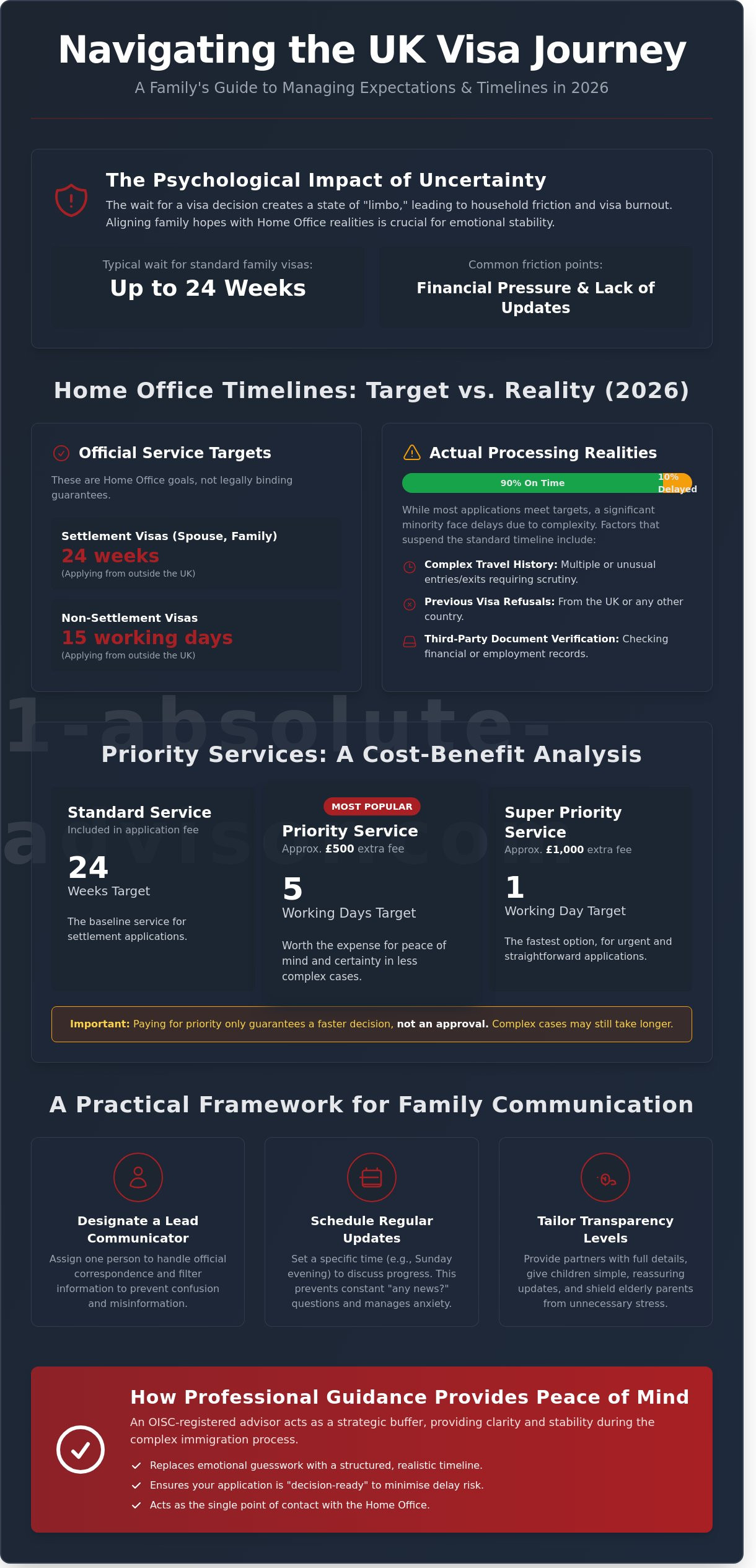
Families frequently enter a state of “limbo” while waiting for a decision. This period of waiting, which can span from 15 working days for priority services to 24 weeks for standard family routes, creates a vacuum of information. Visa burnout often manifests in partners as chronic anxiety, irritability, or a sense of helplessness. Professional oversight acts as a stabilising force, replacing emotional guesswork with a structured timeline. Having a clear roadmap provides a sense of control, which is essential for long-term resilience during the months of waiting.

Identifying Common Friction Points in Family Dynamics

Financial requirements are a frequent catalyst for domestic tension. Meeting the specific income thresholds for a spouse visa uk, which rose to £29,000 in April 2024, places immense pressure on the UK-based sponsor to provide perfect evidence of earnings. This pressure is compounded by the lack of transparency in Home Office status updates, which often remain stuck on “received” for months without progress. Sponsors must also manage external pressure from extended family members who may offer well-meaning but outdated advice, creating further confusion in an already complex regulatory environment.

Understanding Home Office Timelines and Processing Realities in 2026

The Home Office operates on service standards that function as targets rather than legal obligations. For those applying from outside the UK, the standard benchmark for non-settlement visas is 15 working days. Settlement applications, such as spouse or family visas, typically extend to 24 weeks. When you’re managing family expectations during uk visa process, you must distinguish between these targets and the actual delivery dates. Current official Home Office timelines indicate that while 90% of applications meet these windows, the remaining 10% often face significant hurdles.

Several factors trigger delays that are beyond your control. If an applicant has a complex travel history, previous visa refusals, or if the Home Office needs to verify documents with third parties, the standard timeline is suspended. No advisor can guarantee a specific decision date. Our role is to provide a specific standard of preparation that ensures your file is “decision-ready,” which reduces the risk of the caseworker setting it aside for further enquiries.

Standard vs. Priority Services: Making the Right Choice

In 2026, the Home Office continues to offer expedited processing for an additional cost. The Priority service usually costs around £500 and aims for a decision within five working days. The Super Priority service, costing approximately £1,000, targets a next-working-day result. These services are often worth the expense to provide family peace of mind and certainty. However, it’s vital to understand that paying for priority only guarantees a faster decision, not an approval. If your case is complex, the Home Office may still take longer than the advertised priority window, though they usually notify you if this happens.

Why “Estimated” Dates are Rarely Guaranteed

Processing speeds fluctuate based on global events and seasonal surges. Every year, the system faces immense pressure during the student visa peak in August and September. Additionally, shifts in skilled worker visa uk quotas or policy changes can create administrative bottlenecks that slow down all application types. These systemic shifts mean that an application submitted in May might be processed twice as fast as one submitted in August.

We advise all clients to build a minimum four-week buffer period into their travel and relocation plans. Don’t book non-refundable flights or resign from employment until the vignette is physically in your passport. If you need a professional review to ensure your timeline is realistic, our team offers strategic visa planning to help you navigate these uncertainties with confidence. This methodical approach ensures that your family remains informed and prepared for any eventuality.

Managing Family Expectations During the UK Visa Process: A Practical Guide

Tailoring Communication for Different Family Members

Effectively managing family expectations during uk visa process requires a nuanced strategy because a six-year-old child and a spouse interpret a “pending” status through entirely different lenses. Precision in communication prevents the spread of anxiety. You should provide enough detail to ensure clarity without overwhelming relatives with the technical minutiae of Appendix FM or complex maintenance requirements. Establishing a structured schedule for updates is essential for maintaining a sense of normalcy. Instead of discussing the application every evening, schedule a 20-minute weekly briefing. This keeps the move as a strategic goal rather than a source of daily friction.

Focusing on the “why” of the relocation is the most effective way to maintain long-term morale. Remind your family that the temporary administrative hurdles lead to specific benefits, such as access to the UK’s world-class education system or a 15% increase in household purchasing power. When uncertainty peaks, redirecting the conversation to these tangible outcomes helps ground the family in the purpose of the transition.

Discussing the Process with a Spouse or Partner

Financial transparency is vital, but it must be handled with care. The current minimum income requirement of £29,000, which rose from £18,600 on 11 April 2024, can feel like a heavy burden. Frame these financial thresholds as strategic benchmarks rather than personal pressures. It’s helpful to involve your partner in the evidence-gathering stage; asking them to organise their own bank statements or English language test results fosters a sense of agency. You should also co-author a “Plan B” together. If the Home Office exceeds the standard 12-week window, having a pre-agreed contingency for temporary housing or extended employment in your current location prevents a breakdown in trust.

Explaining the Move to Children Without Causing Anxiety

Children thrive on certainty, an element that the Home Office rarely provides. Consulting the official UK government visa processing times provides a baseline for your internal planning, but you shouldn’t share specific dates with your children. If you promise a flight in July and the visa arrives in August, it creates unnecessary distress and a loss of confidence. Use age-appropriate language to explain that the family is “waiting for an official invitation” to start their new adventure. Shift the focus to the positive aspects of their new environment, such as the local parks in your chosen UK borough or the specific extracurricular clubs at their future school. This replaces the anxiety of the unknown with the excitement of a new, well-planned reality.

A Practical Framework for Family Communication

Structure provides the stability that the Home Office’s processing timelines often lack. Without a clear system, the administrative burden of a visa application can erode family dynamics and create unnecessary friction. Successful relocation depends on managing family expectations during uk visa process by treating the application like a professional project rather than an emotional crisis.

Assigning a “Lead Communicator” is the first step toward internal stability. This person acts as the single point of contact for legal advisors or Home Office notifications, filtering technical jargon before presenting it to the rest of the family. It prevents the “too many cooks” scenario where different family members interpret status updates differently, leading to confusion. You should also maintain a shared digital folder. Storing scans of TB test results, English language certificates, and financial records in one accessible place ensures everyone feels informed without needing to ask for updates constantly.

  • Establish a fixed update schedule: Choose a specific time, such as Sunday evenings, to discuss progress. This stops the visa from becoming the sole topic of conversation at every meal.
  • Centralise documentation: Use a secure cloud drive for all application materials to maintain transparency.
  • Define roles: Ensure one person handles the logistics of the move while another manages the document gathering.

Setting “No-Visa-Talk” Zones to Preserve Mental Health

Constant discussion about Home Office delays can lead to burnout. Families must protect their mental space by designating “No-Visa-Talk” zones or times. This might mean banning the subject during dinner or after 8:00 PM. When well-meaning relatives ask, “Any news yet?”, have a scripted response ready. A simple “We’re following the standard 8 to 24-week processing window and will let you know when there’s a definitive update” keeps boundaries firm. Maintaining normal routines like Saturday morning sports or cinema trips is vital for children who may feel the underlying tension of the move.

Creating a Shared Contingency Plan

Hope is not a strategy. You need a concrete plan for when things don’t go according to the initial timeline. Managing family expectations during uk visa process requires discussing “Plan B” openly. If a visa is delayed by six weeks, how will that affect school start dates in September? If you’re looking toward the future and planning for ilr uk, you must understand that the journey is a marathon, not a sprint.

Financial planning is the bedrock of this contingency. Ensure you have an emergency fund in GBP to cover at least two months of unexpected accommodation if your house sale completes before the visa arrives. If a school place is missed, look into temporary tutoring or online British curriculum modules to keep children on track. Emotional support is equally important; acknowledge that the person most affected by the delay, often the spouse or older children, may need extra patience and perhaps professional relocation coaching.

For expert guidance on structuring your relocation strategy, contact Absolute Advisor today.

How Professional Guidance Minimises Family Stress

Engaging an OISC-registered advisor shifts the administrative burden from the household to a qualified professional. This advisor acts as a vital buffer between the family unit and the Home Office, interpreting technical requests and shielding relatives from the often-confrontational tone of official correspondence. By managing the primary communication channel, the advisor ensures that every interaction remains objective and precise, which removes the emotional volatility that typically disrupts domestic life during a high-stakes application.

The “peace of mind” provided by a professional document review cannot be overstated. A comprehensive audit of a 100-page evidence bundle identifies technical gaps that an untrained eye would likely miss. This level of scrutiny drastically reduces the risk of applications falling into the 15% to 25% of cases that face significant delays due to “evidential flexibility” requests or missing mandatory information. Viewing expert advice as an investment in family harmony, rather than just a legal cost, allows the sponsor to protect their relationships from the strain of a potential refusal.

The Value of Professional Oversight

A clear, upfront strategy eliminates the panic of searching for historical financial records or obscure housing documents at the eleventh hour. When a family follows a structured plan, the process becomes a series of manageable tasks rather than a looming crisis. A professionally drafted legal cover letter serves a dual purpose; it provides a narrative for the caseworker and pre-empts Home Office queries by explaining complex family dynamics or non-standard income sources before they become grounds for rejection. An OISC-registered advisor provides a structured, month-by-month roadmap for 2026 that transforms abstract visa requirements into a predictable, manageable timeline for the entire household.

Transitioning from Anxiety to Action

Professional support facilitates a psychological shift within the home. Instead of “waiting” in a state of perpetual anxiety, the family moves toward “preparing” for their future in the UK. This transition allows the sponsor to resume their role as a supportive partner or parent, leaving the technicalities of the Immigration Rules to their representative. This clarity is essential for managing family expectations during uk visa process, as it replaces guesswork with verified milestones.

For those at the beginning of their journey, whether applying for an initial family visa or seeking british citizenship, taking the first step with professional backing ensures the foundation of the application is sound. Proactive preparation remains the most effective tool for maintaining family stability throughout 2026 and beyond. By delegating the legal complexities, you ensure that your family’s focus remains where it belongs: on your shared future together in the United Kingdom.

Preparing for your new life also means looking after your personal well-being, which is often impacted by the stress of the immigration journey. Once settled, many find that investing in self-care is a vital step in feeling refreshed and confident. For those exploring rejuvenation treatments to counteract the effects of stress, you can learn more about Eternal Youth Clinic and its medically-led aesthetic services. Additionally, if the physical strain of relocation has impacted your joints, you may wish to explore Hyaluronic Acid (HA) Injections to restore your mobility and comfort.

Take Control of Your Family’s UK Immigration Journey

Navigating the Home Office’s shifting requirements requires more than just administrative accuracy; it demands a strategic approach to communication. Successfully managing family expectations during uk visa process hinges on transparency regarding the 2026 processing realities. Current Home Office service standards indicate that family visa applications from outside the UK typically take up to 24 weeks, while priority services aim for a decision within 30 working days. By establishing a clear framework and explaining these statutory timelines early, you’ll prevent the friction that often arises from uncertainty.

Our team at Absolute Advisor provides the stability your family needs during this transition. As OISC Level 1 Registered specialists, we bring expertise to complex family immigration cases, ensuring every detail aligns with current UKVI guidance. We manage the technical complexities through our fixed-fee application management, so you don’t have to worry about bureaucratic hurdles or unexpected costs. It’s about providing a professional roadmap that protects your family’s future through methodical, evidence-based planning.

Book a consultation with our OISC-registered advisors to secure your family’s future and replace anxiety with expert-led certainty. We’re here to ensure your move to the UK is handled with the absolute precision and care it deserves.

Frequently Asked Questions

How long is the current wait for a UK spouse visa in 2026?

Standard processing for a UK spouse visa from outside the UK currently averages 24 weeks; applications from within the country typically take 8 weeks. While Home Office targets aim for 100% of cases within these windows, 95% of family applications met these service standards in recent performance reports. You should prepare your family for a six-month window to ensure managing family expectations during uk visa process remains grounded in reality.

Can I speed up my family visa application after I have submitted it?

You cannot upgrade to a priority service once you’ve submitted your online application and paid the fee. The Home Office doesn’t permit retrospective changes to the processing level. If your circumstances become exceptionally urgent or compassionate, you might contact UK Visas and Immigration (UKVI) via their paid enquiry service, but this rarely changes the timeline. It’s vital to select the correct service speed at the initial payment stage.

What should I tell my children if our UK visa is delayed?

Explain the delay using simple, age-appropriate logic, focusing on the fact that the UK government is just checking the final details to make the move safe. Reassure them that a delay isn’t a refusal, but a longer wait. You might use a calendar to mark specific check-in dates every 7 days. This structure helps children visualise time and reduces the anxiety often associated with the uncertainty of managing family expectations during uk visa process.

How much does it cost to use a priority service for a UK family visa?

The priority service for family visa applications submitted outside the UK costs £500, which aims for a decision within 30 working days. If you’re applying from within the UK, the super priority service is £1,000 for a next-working-day decision. These fees are paid in addition to the standard application fee of £1,846 for overseas applicants. These costs are subject to annual Home Office reviews, typically occurring every April.

Does using an immigration advisor guarantee a faster decision?

Using an immigration advisor doesn’t guarantee a faster decision from the Home Office, as they don’t have back-door access to speed up government processing. However, OISC-regulated advisors reduce the risk of delays caused by incomplete documentation or errors. Since 15% of applications face delays due to missing evidence, professional oversight ensures your file is decision-ready. This precision prevents the clock from stopping while officials request additional information.

What happens to my family if my UK visa application is refused?

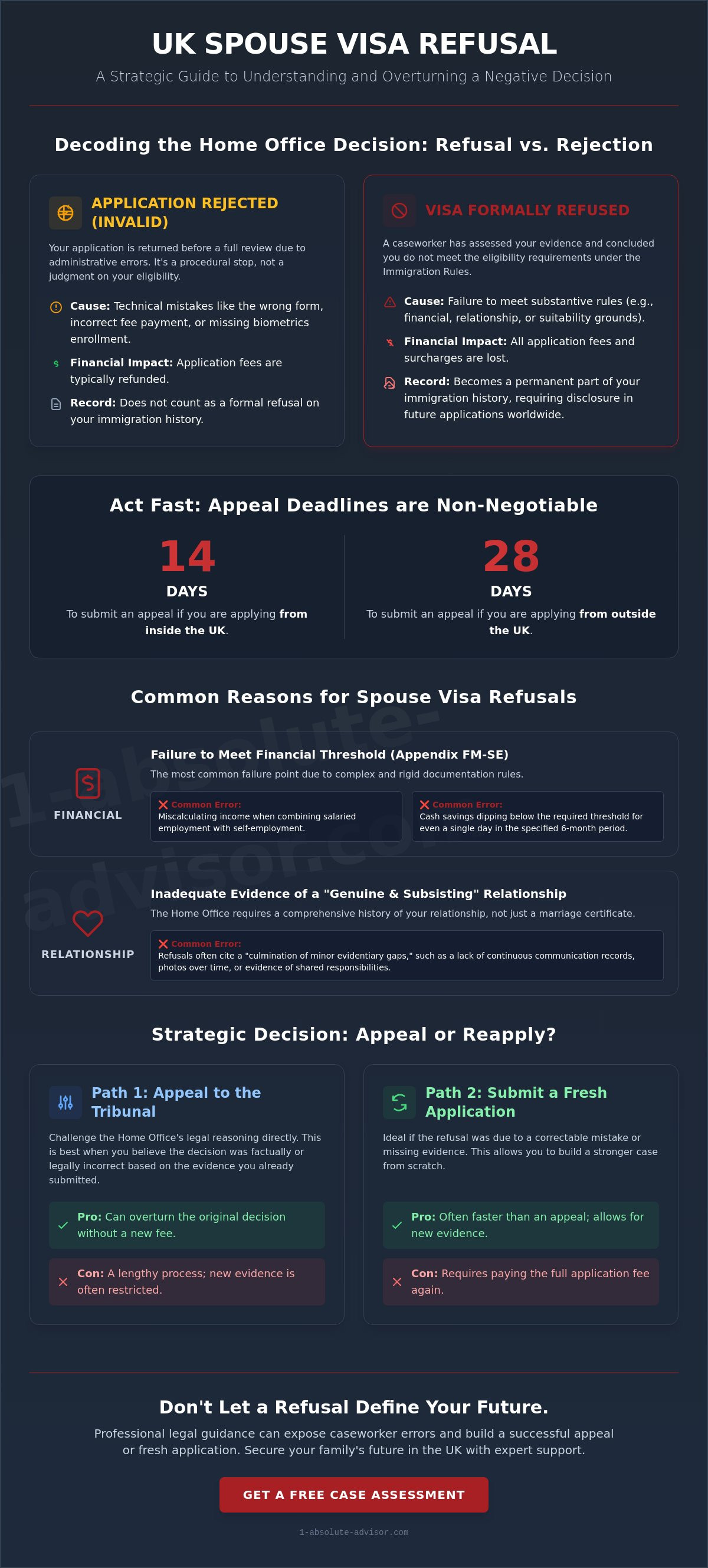
If the Home Office refuses your application, you’ll receive a decision letter outlining the specific grounds for the refusal and whether you have a right to appeal or administrative review. Your family’s status remains unchanged in their current location while you challenge the decision. Statistics show that roughly 50% of appeals are successful when they’re based on human rights or procedural errors. You’ll need to decide between a fresh application or a legal appeal within 28 days.

How can I track the status of my UK visa application online?

You can track your application status through the commercial partner’s website, such as VFS Global or TLScontact, using the reference number provided at your biometrics appointment. The Home Office doesn’t provide a real-time, step-by-step tracker for family visas. Instead, you’ll see status updates like “received by UKVI” or “dispatched.” For more detailed updates, you can use the UKVI paid email service, which costs £2.74 per enquiry.

How to Cope with Visa-Related Separation: A Comprehensive UK Guide for 2026

On January 15, 2026, a Family Visa holder discovered that the end of their three-year relationship had instantly triggered a mandatory reporting requirement to the Home Office. It’s a situation where personal grief meets cold, administrative reality, often leaving individuals feeling vulnerable to immediate deportation. Learning how to cope with visa-related separation requires balancing your emotional recovery with a rigorous adherence to UK immigration compliance. You aren’t alone in feeling that the legal system complicates an already painful life transition, but your residential security doesn’t have to be the casualty of a breakup.

This comprehensive guide provides the strategic clarity you need to protect your right to remain in the UK under the 2026 immigration rules. You’ll gain a precise understanding of your reporting duties and a clear roadmap for switching to alternative routes like the Skilled Worker or 10-year long residency streams. We’ll examine the specific procedural steps necessary to transform this period of legal uncertainty into a stable, independent future, ensuring you maintain absolute control over your status.

Key Takeaways

  • Understand your mandatory legal obligations to the Home Office and how the cessation of a ‘subsisting relationship’ fundamentally alters your right to remain.
  • Learn how to cope with visa-related separation by effectively utilizing the 60-day curtailment period as a strategic window to transition to an alternative visa route.
  • Identify independent pathways to residency, such as the Parent Route, to maintain your life and family ties in the UK without relying on a partner’s sponsorship.
  • Master the practical steps of a visa transition, including leave audits and the collection of critical evidence, to build a resilient and compliant application.
  • Discover why professional OISC-registered guidance is vital for navigating the complex legal and emotional landscape of a relationship breakdown while securing your future.

Immigration status under a Family Visa depends entirely on the existence of a “subsisting relationship.” This term is not merely a romantic sentiment; it is a strict legal requirement defined under Appendix Relationship with Partner of the UK Immigration Rules. A subsisting relationship requires that the couple is in a genuine partnership and intends to live together permanently in the UK. While a temporary “rough patch” or a brief period of marital friction does not legally terminate your status, a formal decision to separate permanently does. Understanding how to cope with visa-related separation requires a clear-headed approach to these legal definitions from the outset.

Transparency acts as your primary defense against future allegations of visa fraud. The Home Office views the failure to report a change in circumstances as a “material non-disclosure.” If you continue to live in the UK on a spouse or partner visa after the relationship has ended without informing the authorities, you risk a “bad character” finding. This designation can permanently jeopardize future applications for Indefinite Leave to Remain (ILR) or British Citizenship. Taking proactive steps ensures you remain compliant with the law even during personal turmoil.

How and When to Notify the Home Office

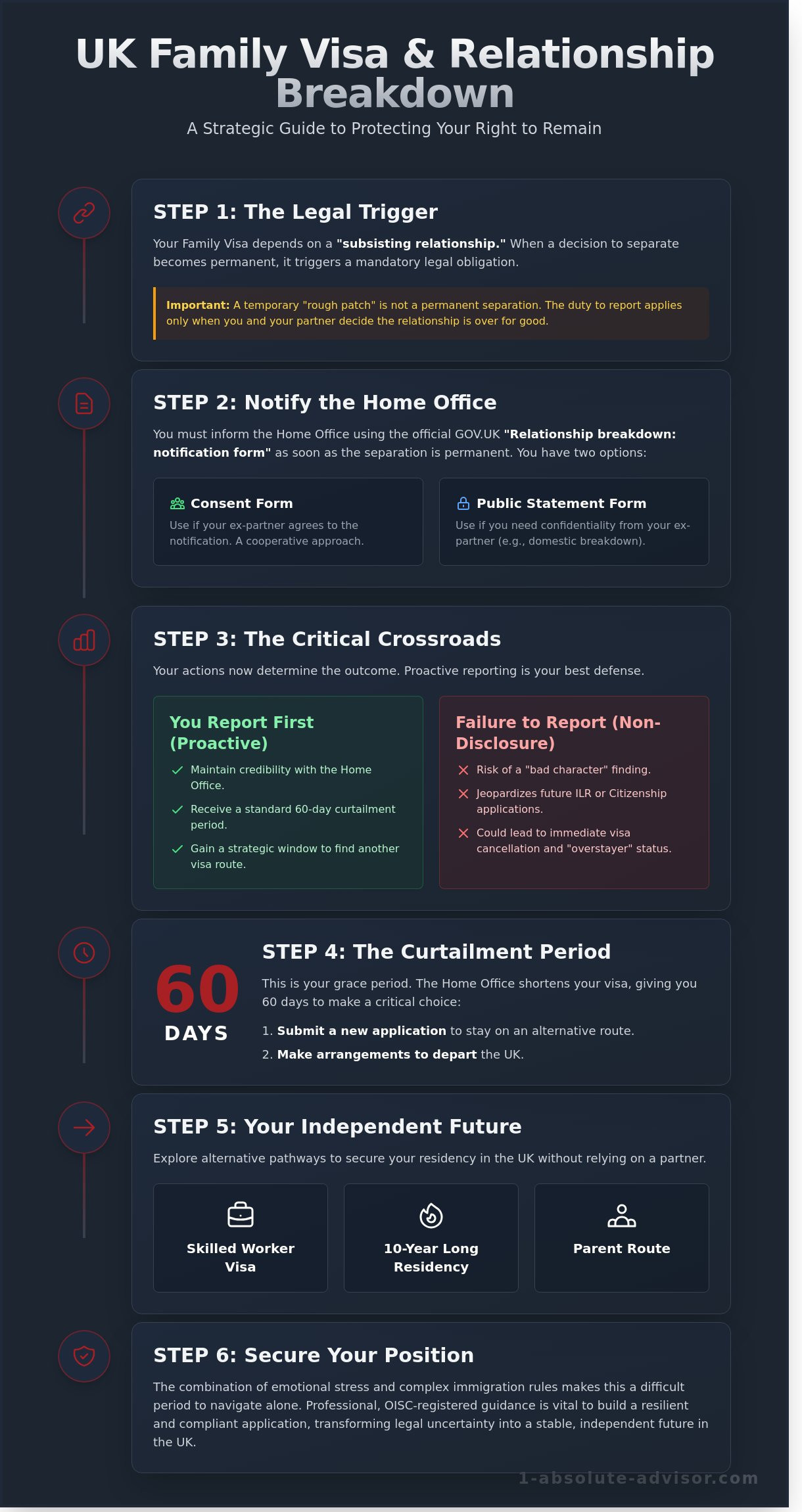
The duty to inform the Home Office is mandatory and should be completed as soon as the separation is considered permanent. You must use the official “Relationship breakdown: notification form” available on the GOV.UK website. The process requires specific data points, including your Home Office reference number, case ID, and your partner’s full details. If children are involved, you must provide their names and dates of birth to ensure their welfare is considered in any subsequent visa decisions.

Privacy is a significant concern during this process. The Home Office provides two distinct paths: the “Consent” form and the “Public Statement” form. If your ex-partner agrees to the notification, the Consent form is used. However, if you do not want your ex-partner to see the information you provide, or if the relationship ended due to domestic breakdown, the Public Statement form allows you to report the change while requesting that your new address and specific details remain confidential from your former partner.

The Consequences of Non-Disclosure

Failing to report a separation is a strategic error that often leads to the “curtailment” of your visa under less favorable terms. If your ex-partner reports the separation first, the Home Office may move to cancel your visa immediately. When you report the change yourself, you maintain a level of credibility that is essential for switching to a different visa category, such as a Work Visa or a Parent Visa. Usually, the Home Office will issue a letter giving you 60 days to either depart the UK or submit a new application to stay.

Ensuring your address is updated is a critical component of how to cope with visa-related separation effectively. All formal correspondence regarding your “curtailment” or “leave to remain” will be sent to the last address the Home Office has on file. If you have moved out and fail to update your details via the online “Update your UK Visas and Immigration account” service, you may miss the 60-day deadline to respond. Missing this window leads to an “overstayer” status, which carries severe legal penalties and complicates any future legal presence in the UK.

Curtailment is the formal process where the Home Office shortens your existing leave to remain. This usually occurs when the basis of your stay, such as a sponsorship or a marriage, ceases to exist. Under Immigration Rules Part 9, the Secretary of State has the power to reduce your remaining time to a standard 60-day window. Understanding this timeline is essential for anyone figuring out how to cope with visa-related separation, as it provides a finite period to assess future legal options before your status expires.

The 60-day rule acts as a transitional grace period. It’s a policy application designed to give individuals time to either depart the UK or find an alternative legal route. If your visa had more than 60 days left, it gets cut down; if it had less, the original expiry date usually stands. There are rare instances where the Home Office cancels permission with immediate effect, particularly in cases involving deception or serious criminal conduct. You must monitor your registered email and physical post daily. If a Notice of Curtailment is served to your last known address or “to file” because you’re unreachable, the 60-day countdown begins regardless of whether you’ve read the letter.

Your Rights and Restrictions During Curtailment

During these 60 days, your existing conditions generally remain in place. You can typically continue working or studying under the same terms as your original visa. Access to the NHS continues as you’ve already paid the Immigration Health Surcharge. However, you must not travel outside the Common Travel Area. Leaving the UK during a curtailment period effectively ends your leave immediately; you’ll likely be refused re-entry at the border because your permission to stay has been revoked.

Managing the Emotional and Practical Stress

The pressure of a ticking clock can be overwhelming. Use this time to organize your personal affairs, such as ending a tenancy or managing local assets, while you explore new pathways. Seeking assistance from migrant welfare organizations can provide emotional stability during this transition. Most importantly, securing a professional UK immigration assessment should be your priority. A strategic review of your situation helps identify if you qualify for a different visa category, such as a Skilled Worker or a private life route. Taking this step early transforms a crisis into a manageable transition. For those needing a clear roadmap, an Absolute Advisor consultation can provide the professional integrity required to navigate these complex legal waters and help you understand how to cope with visa-related separation through proactive planning.

How to Cope with Visa-Related Separation: A Comprehensive UK Guide for 2026

Evaluating Your Options to Stay in the UK Independently

Separation doesn’t always necessitate a departure from the UK. Understanding how to cope with visa-related separation involves a clinical assessment of your individual eligibility for non-partner routes. By April 2026, the Home Office has solidified several pathways that allow individuals to transition from a dependent status to an independent one. Analyzing the 10-year long residence rule is a logical first step. If you’ve lived in the UK legally for a continuous decade, you might qualify for Indefinite Leave to Remain (ILR) regardless of your relationship status. This path requires a clean criminal record and no absences exceeding 180 days in any 12-month period, providing a permanent solution for those who have built a life here over the last ten years.

Staying as a Parent: The Article 8 Route

Securing your status as a parent provides a vital safety net under Article 8 of the European Convention on Human Rights. This route is applicable if you have a British or settled child under 18 years of age. You’ll need to demonstrate an active role in the child’s upbringing through school reports, medical records, or financial support evidence. While the ‘sole responsibility’ test remains a high bar for single parents, shared parental access is often sufficient if you can prove the child’s best interests require your presence. Courts prioritize child welfare under Section 55 of the Borders, Citizenship and Immigration Act 2009, making this a robust option for those wondering how to cope with visa-related separation while maintaining essential family bonds.

Work and Study: Switching Categories

Switching into a skilled worker visa uk offers a path based on professional merit rather than domestic ties. As of early 2026, the general salary threshold remains at £38,700 for most applicants, though certain healthcare or education roles may qualify for lower requirements. If you’re a recent graduate from a UK institution, the Graduate visa serves as a 2-year bridge to gain work experience without the immediate need for an employer’s sponsorship. For entrepreneurs with scalable business ideas, the Innovator Founder route is a viable alternative, provided an endorsing body approves your plan. Reviewing a broader UK work visa strategy ensures your residency remains secure and entirely independent of your former partner’s sponsorship.

Practical Steps for a Successful Visa Transition

Understanding how to cope with visa-related separation requires a methodical approach to your immigration status. You must move from emotional reaction to strategic action. The UK immigration system operates on strict timelines; missing a single deadline can jeopardize your right to stay. Following a structured transition plan ensures you remain compliant while exploring new routes to residency.

Step 1: Audit your current leave. Check your eVisa or BRP to identify your exact expiry date. Since the UK transitioned to fully digital records in January 2025, you should verify your status through the official “view and prove” service to ensure no discrepancies exist in the Home Office database.

Step 2: Collect evidence of your life in the UK. Gather documents that prove your employment history, housing stability, and family ties. This data forms the foundational evidence for any subsequent application you might pursue.

Step 3: Formalise your separation with the Home Office. You’re legally required to notify them when a qualifying relationship ends. While this triggers the curtailment process, it stops the clock on your current status as a dependent and allows you to move toward an independent immigration category.

Step 4: Secure professional legal advice. A specialist can map out your new application, whether it’s a Skilled Worker visa, a family visa based on your children, or a human rights claim. Mapping these options early prevents rushed, high-stakes decisions.

Step 5: Submit your new application before the 60-day curtailment period ends. This 60-day window is non-negotiable. Submitting a valid application within this timeframe maintains your right to work and access services under Section 3C leave while the Home Office processes your request.

Evidence Gathering Checklist

A successful transition depends on the quality of your documentation. You’ll need to demonstrate your integration and self-sufficiency through a clear paper trail:

  • Proof of cohabitation: Bank statements, council tax bills, or utility invoices from the period your relationship was valid to prove the partnership was genuine.
  • Financial records: Six months of payslips or personal bank statements demonstrating you meet the financial requirements without relying on public funds.
  • Child-related documentation: Letters from schools, GPs, or social services if you have children in the UK, as their “best interests” are a primary consideration in many visa routes.

Applying for ILR Early

If your relationship ended because of domestic abuse, you don’t have to wait for the usual five-year period to settle. You can apply for ilr uk through the Domestic Violence Indefinite Leave to Remain (DV-ILR) route. This provision protects vulnerable individuals, allowing them to secure their status independently of their former partner. Securing your future involves learning how to cope with visa-related separation while simultaneously managing these complex legal requirements.

To succeed in a DV-ILR claim, you’ll need to provide evidence of the abuse, which can include police reports, medical records, or letters from support organisations. Even during this period of personal upheaval, you’ll still need to pass the Life in the UK test unless you’re exempt due to a specific physical or mental condition. Preparing for this test early can reduce overall stress during the final application stages.

For a detailed assessment of your eligibility and a strategic roadmap for your stay, consult with our expert advisors today.

How Professional Guidance Secures Your Future

Attempting a DIY visa application during a relationship breakdown often leads to critical errors. Emotional stress clouds judgment, causing applicants to miss deadlines or overlook mandatory evidence. In 2024, Home Office data indicated that a significant portion of family visa refusals stemmed from insufficient proof of relationship subsistence or financial requirements. When you are learning how to cope with visa-related separation, the technical burden of UK immigration law shouldn’t rest on your shoulders alone.

An OISC-registered advisor acts as your strategic partner. We don’t just fill out forms; we draft a comprehensive legal cover letter that contextualizes your situation for the caseworker. This document bridges the gap between raw evidence and the specific requirements of the Immigration Rules. Our team ensures that your current crisis doesn’t compromise your eligibility for british citizenship in the future. We meticulously review your history to satisfy “Good Character” requirements, which are essential for naturalisation in 2026. Managing these complexities through a fixed-fee service provides financial predictability when your personal life feels most unstable.

Avoiding Common Pitfalls

Ignoring a Home Office letter is a common mistake that leads to disastrous results. If you receive a notification regarding your leave to remain, you must act within the specified timeframe, usually 14 to 28 days. Failing to respond can lead to the curtailment of your visa. Overstaying even by a single day can trigger a re-entry ban and ruin your prospects for any future UK visa. Professional document checking identifies inconsistencies in bank statements or housing evidence before they reach the Home Office, significantly reducing the risk of a refusal based on technicalities.

Taking the Next Step

Every family situation is unique, and generic advice cannot replace a tailored strategy. Understanding how to cope with visa-related separation requires a clear roadmap for your legal status. Booking a consultation allows us to assess your specific circumstances, including any children involved or human rights claims. Before your first meeting, please gather your current passport, your BRP, any correspondence from the Home Office, and proof of your current living arrangements. Having these documents ready allows us to provide immediate, actionable advice during our initial session.

Don’t leave your residency status to chance during this difficult transition. Contact 1 Absolute Advisor for expert assistance with your visa transition and secure your long-term future in the UK with professional support.

Taking Control of Your UK Residency Path

Navigating a relationship breakdown while on a family visa requires a swift, strategic response to meet Home Office requirements. You must report changes to the authorities immediately to manage the 60-day curtailment period effectively. Understanding how to cope with visa-related separation involves evaluating your eligibility for independent routes, such as the Skilled Worker visa or the 10-year long residency path. These transitions are complex, but they provide a clear framework for remaining in the UK legally through 2026 and beyond. Our OISC-registered experts specialize in complex family visa transitions, ensuring every application aligns with current UKVI standards. We provide fixed-fee application management to remove financial uncertainty during this critical time. You don’t have to face the legal system alone when your future is at stake. By taking proactive steps today, you can transform a period of instability into a foundation for long-term security. Secure your future in the UK with a professional visa assessment and gain the clarity you need to move forward with confidence.

Frequently Asked Questions

Do I have to leave the UK immediately after my divorce is finalised?

You don’t have to leave the UK the moment your divorce is finalised. The Home Office typically issues a curtailment notice that grants you 60 days to either apply for a different visa or make arrangements to leave. This 60-day period begins from the date you receive the official letter, giving you a vital window to restructure your legal status.

Can I switch from a spouse visa to a work visa without leaving the country?

You can switch to a Skilled Worker visa from within the UK if you secure a job offer from a licensed sponsor. You’ll need to meet the specific salary and English language requirements defined in the 2024 Immigration Rules. This transition allows you to maintain continuous residency without the expense and disruption of returning to your home country for a new application.

What happens to my children’s visas if my partner and I separate?

Your children’s status usually depends on their length of residency and your new visa category. If a child has lived in the UK for 7 continuous years, they may qualify for leave to remain independently under private life rules. The Home Office must also consider the child’s best interests as mandated by Section 55 of the Borders, Citizenship and Immigration Act 2009.

Will the Home Office tell my ex-partner that I have applied for a new visa?

The Home Office won’t disclose your new application details or your current address to your ex-partner. Your privacy is strictly protected under the Data Protection Act 2018 and standard GDPR protocols. While the Home Office notifies the sponsor that the relationship has ended, they don’t share any information regarding your subsequent immigration steps or personal location.

How much does it cost to switch to a different visa category in 2026?

Switching to a Skilled Worker visa for up to 3 years costs £827 according to the fee structures established in 2024. You must also budget for the Immigration Health Surcharge, which currently stands at £1,035 per year of the visa’s duration. These figures represent the baseline government fees and don’t include potential costs for priority processing or professional legal representation.

What if I can’t find a job that meets the salary threshold for a work visa?

You might still qualify for a visa if your occupation is listed on the Immigration Salary List or if you’re under 26 years old. While the standard salary threshold rose to £38,700 in April 2024, “new entrants” and health sector workers often benefit from significantly lower requirements. Understanding how to cope with visa-related separation involves identifying these specific professional exemptions to secure your future.

Can I still apply for British Citizenship if my relationship ended before I got ILR?

You can’t apply for citizenship until you’ve held Indefinite Leave to Remain (ILR) for at least 12 months. If your relationship ends before you reach the ILR milestone, you must first switch to another visa, such as a work or ancestry visa, to complete the 5-year residency requirement. Learning how to cope with visa-related separation requires a strategic approach to bridge this gap in your settlement timeline.

What should I do if my ex-partner is threatening to ‘cancel’ my visa?

Your ex-partner doesn’t have the legal power to cancel your visa; only the Home Office holds that authority. If your partner uses your immigration status to threaten or control you, this is legally recognized as domestic abuse. You may be eligible for immediate settlement under the Appendix Victim of Domestic Abuse rules, which provide a path to permanent residency regardless of your partner’s wishes.

UK Visa Financial Requirements 2026: The Complete Expert Guide

On 11 April 2024, the Home Office implemented the most significant shift in family migration policy in a decade, raising the income threshold to £29,000. For many applicants, this change turned a straightforward process into a source of intense anxiety regarding the uk visa financial requirements 2025. You’re likely aware that even a minor technical error in your financial evidence can lead to a costly refusal. It’s frustrating to face these shifting goalposts, especially when the Immigration Health Surcharge has already climbed to £1,035 per year for most adult applicants.

We believe that your path to the UK should be defined by professional precision rather than luck. This expert guide helps you master the £29,000 minimum income requirement and shows you exactly how to evidence your finances to secure your UK visa with absolute confidence. We’ll provide a clear eligibility breakdown and a comprehensive list of documents that meet OISC standards to ensure your application is robust from the start. By the end of this article, you’ll have a definitive roadmap to navigate the current policy freezes and planned increases with total clarity.

Key Takeaways

  • Understand the strategic implications of the £29,000 minimum income requirement and how the 2025 policy freeze impacts your family’s immigration roadmap.
  • Learn how to navigate the complex uk visa financial requirements 2025 by correctly categorising your income sources and adhering to the mandatory six-month evidentiary rules.
  • Discover how to utilise the £88,500 cash savings threshold as a robust alternative to income, including the precise holding requirements and property sale exceptions.
  • Identify potential exemptions through the “Adequate Maintenance” test to determine if specific UK benefit receipts allow you to bypass the standard financial thresholds.
  • Minimise the risk of a technical refusal by mastering the “Specified Evidence” regulations and the critical 28-day rule for all submitted financial documentation.

Understanding the UK Visa Financial Landscape in 2025 and 2026

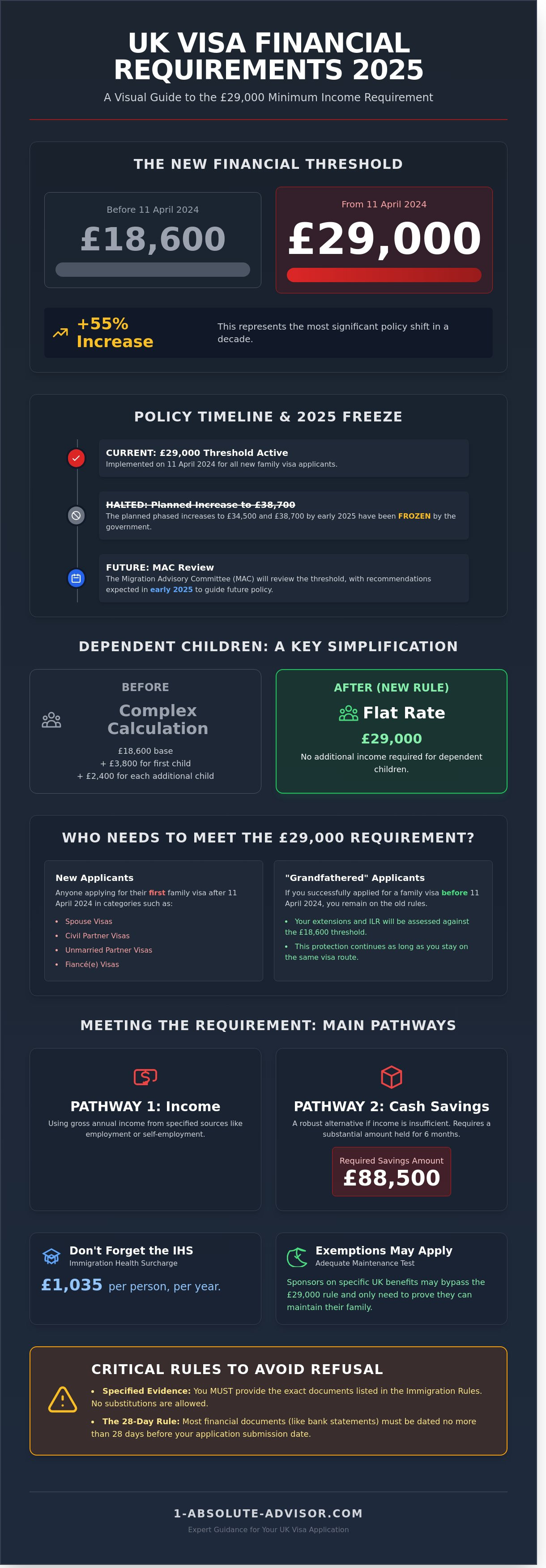
The UK’s immigration framework underwent a seismic shift on 11 April 2024. Before this date, the Minimum Income Requirement (MIR) for spouse and partner visas stood at a stable £18,600. Current regulations now demand a gross annual income of at least £29,000 for most applicants. This change represents the first stage of a multi-part adjustment designed to ensure that families are self-sufficient. For those planning their future, understanding the UK immigration policy overview is essential to see how these financial mandates align with broader border controls. These uk visa financial requirements 2025 reflect a move toward higher economic thresholds for residency.

Strategic planning is now more critical than ever. The Migration Advisory Committee (MAC) is currently conducting a full review of these thresholds, with recommendations expected in early 2025. This review will likely dictate whether the current stability remains or if further adjustments are necessary for 2026. Applicants must stay informed about these developments to avoid unexpected hurdles. One positive development involves dependent children. Previously, each child required an additional financial buffer of £3,800 for the first child and £2,400 for each subsequent child. Under the new £29,000 rule, this extra burden has been abolished. This simplification allows families to focus on meeting a single, flat threshold regardless of the number of children involved.

  • The current MIR is fixed at £29,000 per annum for new applicants.
  • The 2024 hike from £18,600 was a 55% increase in the baseline requirement.
  • Dependent child supplements no longer apply to the £29,000 threshold.
  • The MAC 2025 review will determine future policy shifts for the 2026 period.

The 2025 Policy Freeze: Why the £38,700 Threshold Was Halted

The previous government intended to raise the MIR to £34,500 and eventually £38,700 by early 2025. However, the Labour government announced a strategic freeze in July 2024. This decision keeps the threshold at £29,000 for the foreseeable future. It’s a vital window for applicants. It provides a level of predictability that was missing during the volatile policy shifts of early 2024. While the income requirement is frozen, applicants shouldn’t ignore other costs. The Immigration Health Surcharge (IHS) rose to £1,035 per year in February 2024 and remains at this elevated level. This stability in the income threshold allows for more precise long-term financial forecasting for families.

Who Does the £29,000 Requirement Apply To?

The £29,000 threshold applies to most family-based routes. This includes Spouse visas, Civil Partner visas, Unmarried Partner visas, and Fiance visas. The 11 April 2024 date is the critical divider. If you applied for your first visa in one of these categories before this date, you’re “grandfathered” under the old £18,600 rules. This protection extends to your extensions and permanent residency applications. New applicants entering the system for the first time after 11 April 2024 must meet the higher £29,000 standard. Meeting the uk visa financial requirements 2025 is mandatory for all new entries into the family migration system. The rules are strict. Even a small shortfall can lead to a refusal, making professional assessment of your income sources vital.

Calculating Your Income: The Five Primary Categories

The Home Office evaluates every application through a strict framework of seven categories, labelled A through G. Understanding which category fits your specific situation is the first step in meeting the uk visa financial requirements 2025. Mistakes here often lead to immediate refusals, as caseworkers follow the official Home Office financial requirement guidance with zero flexibility for missing evidence. You’re expected to provide a perfect paper trail that aligns exactly with one of these pre-defined routes.

One primary rule determines whose income you can actually use. If you’re applying from outside the UK, only the British sponsor’s income counts toward the threshold. The applicant’s overseas earnings are disregarded entirely. However, if the applicant is already in the UK with valid permission to work, you can combine both salaries to reach the target. This distinction catches many couples off guard during the initial planning phase, often requiring the sponsor to secure a higher-paying role before the process can begin.

Category A vs. Category B: Salaried Employment Explained

Category A is the most common route for those who’ve been with their current employer for at least six months. The Home Office calculates your annual income based on the lowest gross monthly salary received during that period. If you earn £3,500 one month but £3,100 the next due to unpaid leave, they’ll multiply the £3,100 by 12. Non-salaried income, such as hourly wages, is handled differently; caseworkers take the mean average of the last six months and annualise it to check if you meet the uk visa financial requirements 2025.

Category B serves those who’ve changed jobs recently or have fluctuating earnings that don’t meet the “lowest point” rule of Category A. Category B requires a two-part assessment where you must prove you’re currently earning the required threshold and have also earned that total amount in the 12 months prior to your application date. This route requires 12 months of payslips and bank statements rather than six, doubling the administrative burden on the applicant.

Self-Employment and Director Income (Category F and G)

Self-employed individuals and directors of specified limited companies face the highest level of scrutiny. Category F relies on the last full financial year, while Category G allows you to use an average of the last two financial years. This is often necessary if your business had a temporary dip in one year but performed strongly in the other. You’ll need to provide HMRC documents like the CT600 or SA302 to verify every pound claimed, alongside business bank statements that match the accounts exactly.

For many directors, the primary challenge isn’t just documenting income, but ensuring the business generates enough revenue to comfortably meet the threshold. If your B2B company needs to strengthen its sales pipeline to build a more robust financial profile for your application, you can check out Virtual Sales Limited for strategic guidance.

For company directors, managing the finances required for both visa applications and corporate tax liabilities (like the one documented in a CT600) can be complex. Specialist brokers such as V4B Business Finance can provide funding solutions to help businesses meet their tax obligations smoothly.

Timing is everything when it comes to business income. You must ensure your application is submitted within nine months of your company’s financial year-end to ensure the data is considered “current” by the Home Office. If your accounts are dated 31 March 2024, you must apply before 31 December 2024 to use those figures. If you’re unsure about your eligibility or the strength of your documentation, consulting a strategic advisor can prevent costly delays in your relocation plans. It’s better to delay an application by a month to gather better evidence than to risk a refusal on a technicality.

UK Visa Financial Requirements 2026: The Complete Expert Guide

Using Cash Savings to Meet the Financial Requirement

For many applicants, demonstrating a steady annual salary isn’t always feasible. The uk visa financial requirements 2025 allow for significant flexibility through the use of cash savings. If you choose to rely solely on savings to meet the threshold without any supplementary income, the required amount is currently £88,500. This figure stems from the updated minimum income requirement of £29,000 established in April 2024. Relying on savings provides a level of certainty for those who might not meet the strict employment criteria but possess substantial personal capital.

Home Office mandates state that these funds must have been under your control for at least six months prior to the application date. This 182-day rule ensures the money isn’t a temporary loan intended to artificially inflate your financial standing. There’s a vital exception for those who’ve liquidated assets; if you sell a property or receive an inheritance within that six-month window, you can use the cash immediately. You must provide a clear audit trail, such as land registry documents or a solicitor’s letter. Gifted money is also permitted, provided it’s a genuine gift with no obligation to repay. A signed declaration from the donor is essential to confirm the funds are yours to keep, preventing “recycled” funds from being used across multiple applications.

Using savings is particularly advantageous for self-employed individuals or those with seasonal contracts. It provides a stable buffer that compensates for months where earnings might dip below the pro-rata requirement. Detailed analysis from the House of Commons Library regarding the partner visa financial requirements highlights how these thresholds have evolved to ensure families can support themselves without relying on public funds. Understanding these nuances is vital for anyone navigating the uk visa financial requirements 2025 to ensure their application isn’t rejected on technical grounds.

The Formula for Combining Income and Savings

You can combine savings with employment income to bridge a shortfall. Current regulations ignore the first £16,000 of your savings because this is the threshold at which most means-tested benefits cease. The remaining balance is divided by 2.5, reflecting the 30-month duration of the initial visa. The exact calculation is: (Total Savings – £16,000) divided by 2.5 equals the income offset. A practical example of this is: if you earn £20,000, you need £38,500 in savings to bridge the £9,000 gap.

Permitted Sources of Cash Savings

Funds must be held in a regulated financial institution and be instantly accessible. Acceptable accounts include standard current accounts, savings accounts, and ISAs. You can’t use “locked” investments like certain pension schemes or stocks that haven’t been liquidated into cash. The money can be held in the name of the applicant, the sponsor, or both as a joint account. If the funds are in an overseas account, the bank must be on the Home Office’s list of approved institutions, and the balance will be converted to GBP using the OANDA exchange rate on the date of application.

Exemptions and the Adequate Maintenance Test

While the standard Minimum Income Requirement (MIR) serves as the primary benchmark for most applicants, the UK immigration system provides a specific safety net for sponsors who receive certain state benefits. This pathway bypasses the fixed £29,000 threshold, replacing it with the “Adequate Maintenance” test. It’s a recognition by the Home Office that individuals with disabilities or significant caring responsibilities may not have the same earning capacity as other sponsors, yet they still possess a right to family life.

This alternative route doesn’t mean the financial scrutiny is less intense. In fact, the evidentiary burden often increases because you must prove that the family can live above the poverty line without additional recourse to public funds. Meeting the uk visa financial requirements 2025 through this method requires a meticulous breakdown of weekly income against essential living costs. We often see applicants struggle not because they lack funds, but because they fail to document their “surplus” income with the precision required by entry clearance officers.

List of Qualifying Benefits for Exemption

To qualify for this exemption, the sponsor, not the applicant, must be in receipt of at least one specific benefit. The Home Office updated this list to reflect changes in the social security landscape, including the 2025 inclusion of modernised Scottish welfare payments. The qualifying benefits include:

  • Carer’s Allowance or Attendance Allowance.
  • Personal Independence Payment (PIP) and Disability Living Allowance (DLA).
  • Adult Disability Payment (ADP) or Child Disability Payment in Scotland.
  • Industrial Injury Disablement Benefit or Severe Disablement Allowance.
  • Armed Forces Independence Payment or Guaranteed Income Payment under the Armed Forces Compensation Scheme.

The sponsor’s status as a recipient must be current at the time of application. You’ll need the most recent DWP annual uprating letter or a confirmed statement of entitlement to validate this claim.

How to Calculate Adequate Maintenance

The Home Office uses a specific formula to determine if your finances are sufficient. It’s a three step process that leaves no room for estimation.

Step 1: Calculate your total net weekly income. This includes the sponsor’s benefits, any employment income from the sponsor or the applicant (if they’re already working legally in the UK), and any other permitted income sources.

Step 2: Deduct your weekly housing costs. This must include your full rent or mortgage payment plus your Council Tax. For example, if your monthly rent is £800 and Council Tax is £150, your weekly housing cost is roughly £219.23.

Step 3: Compare the remaining figure against the relevant DWP Income Support rate for a family of your size. For 2024/25, the rate for a couple is £142.25 per week. If your net income after housing costs is £142.26 or more, you technically meet the requirement.

To satisfy the Home Office guidance, the applicant must demonstrate that their weekly income, after deducting all housing costs, results in a surplus that is at least equivalent to the current DWP cash payment for a family of their specific size.

Accuracy is the foundation of a successful application under these rules. If you’re unsure how your specific benefit package fits into the uk visa financial requirements 2025, professional oversight is essential.

Contact our specialist advisors for a detailed financial assessment of your spouse visa eligibility.

Strategic Evidence Preparation: Avoiding Common Refusals

Caseworkers at the Home Office operate under the “Specified Evidence” rule defined in Appendix FM-SE. This isn’t a flexible guideline; it’s a rigid framework where the absence of a single monthly bank statement or a missing payslip results in an immediate refusal. Statistics from recent years indicate that approximately 15% of family visa refusals stem from technical document errors rather than a genuine lack of income. Precision is the only way to guarantee a successful outcome.

The “28-day rule” remains the most frequent point of failure for applicants. Every financial document, including the mandatory employer’s letter and the most recent bank statement, must be dated no earlier than 28 days before the online application submission date. If your final bank statement is dated 1st June but you don’t hit the “submit” button until 30th June, your evidence is technically expired. This single day of overlap often separates a successful uk visa financial requirements 2025 submission from a costly and stressful rejection.

As the Home Office transitions toward fully digital systems for 2026, the organisation of your evidence bundle is paramount. Applicants should scan and upload documents as clear, searchable PDFs. Using a logical naming convention, such as “01_Bank_Statement_Jan_2025.pdf”, assists the caseworker in navigating your file. A legal cover letter serves as the essential narrative for this bundle. It doesn’t just list documents; it explains them. If you’ve changed jobs or received a pay rise during the six-month period, the cover letter “narrates” these transitions to ensure the caseworker follows the logic of your financial eligibility without confusion.

The Document Checklist: Bank Statements and Payslips

Every payslip must align perfectly with a corresponding entry on your bank statement. If a payslip indicates a net pay of £2,450 but the bank deposit shows £2,400 due to a minor deduction, you must provide a written explanation. Internet bank statements are a common trap. The Home Office typically rejects simple PDF downloads unless every page is either stamped by the bank branch or accompanied by a formal letter on headed paper confirming the statements’ authenticity. Consistency across all dates and figures is the absolute standard required for approval.

Why Professional OISC-Registered Advice is Critical

Technical errors are the primary driver of visa delays and denials. A professional “Document Checking Service” provides a final safety net to identify gaps in your uk visa financial requirements 2025 evidence before you commit to the non-refundable application fees. Expert advisors at 1 Absolute Advisor identify complex “Category” overlaps, such as combining dividend income with salaried work, which require specific calculations that often elude DIY applicants. You can secure a professional eligibility assessment to verify that your documentation meets the current £29,000 threshold and adheres to the latest Home Office internal guidance.

Taking a proactive approach to evidence preparation isn’t just about gathering papers; it’s about building a bulletproof case. By adhering to the 28-day rule and ensuring every transaction is accounted for, you remove the element of caseworker discretion. This level of diligence ensures your family’s future in the UK is built on a foundation of absolute compliance and professional integrity.

Securing Your UK Residency Amidst Shifting Financial Standards

Navigating the uk visa financial requirements 2025 demands more than just a healthy bank balance; it requires a meticulous alignment of your financial history with strict Home Office categories. Whether you’re relying on the £29,000 minimum income threshold for family routes or calculating complex self-employment earnings under Category F, the margin for error is non-existent. Home Office statistics consistently highlight that evidentiary oversights remain a leading cause of avoidable refusals, making the strategic preparation of your 6-month or 12-month financial statements a critical priority for every applicant.

Our London-based team of OISC-registered immigration consultants brings a holistic, strategic perspective to your case. We’re specialists in complex Spouse and Skilled Worker visa applications, ensuring every document meets the exact technical standards required by the current rules. We don’t just process paperwork; we act as your strategic partners to mitigate risks before they surface. You’ll benefit from our national coverage and a commitment to professional integrity that places your future on certain ground.

Book a Fixed-Fee Visa Consultation with our London Experts to ensure your application is built on a foundation of absolute compliance. Your successful transition to life in the UK is within reach when you have the right professional expertise by your side.

Frequently Asked Questions

Can I combine my income from two different jobs to meet the £29,000 requirement?

You can combine income from multiple jobs held by the sponsor to reach the £29,000 threshold. If you’re already in the UK on a valid visa with work rights, you can also include your own earnings. It’s essential that both roles meet the specific evidentiary requirements, such as having 6 months of continuous payslips for each position under Category A.

What happens if my sponsor’s income drops below £29,000 after we apply?

The Home Office assesses your financial eligibility based on the evidence provided at the exact time of your application submission. If your documents prove you met the requirement when you paid the fee, a subsequent salary drop won’t typically lead to a refusal. We suggest maintaining your financial records carefully until a decision is reached to ensure total compliance with the rules.

Do I need to show extra income if I am bringing my children to the UK?

Under the rules effective from 11 April 2024, you don’t need to show additional income for dependent children. The financial requirement is now a flat £29,000 regardless of the number of children included in the application. This change simplified the previous system where the threshold increased by £3,800 for the first child and £2,400 for each subsequent child.

Can I use a gift from my parents as cash savings for the visa?

You can use gifted funds from parents, but the money must have been in your personal bank account for at least 6 months before applying. You’ll need a signed declaration from your parents confirming the money is a gift, not a loan, and that they’ve no legal claim to it. This ensures the Home Office views the funds as being under your absolute control.

How far back do my bank statements need to go for the financial requirement?

Your bank statements must cover at least 6 months if you’re using salaried income under Category A to meet the uk visa financial requirements 2025. If you’re relying on self-employment or Category B, you’ll need 12 months of records. Every statement must be original or certified by the bank; the Home Office won’t accept simple online screenshots or partial transaction histories.

Is the Immigration Health Surcharge (IHS) part of the financial requirement?

The IHS is a separate mandatory fee and isn’t included in the £29,000 income calculation. Since 6 February 2024, the surcharge is £1,035 per year for each adult applicant. For a standard 33-month spouse visa, you’ll need to pay £2,846.25 upfront. This payment is non-negotiable and provides you with access to the National Health Service during your stay.

Can I use rental income or dividends to meet the UK visa threshold?

Rental income and dividends are valid sources of non-employment income for the uk visa financial requirements 2025. To use these, you must provide 12 months of evidence, including tax returns and proof of property ownership or share certificates. Combining these with a salary is possible, but the documentation must be precise to show the income is stable and legally declared.

What is the “28-day rule” regarding visa financial evidence?

The 28-day rule dictates that your most recent financial document, like a payslip or bank statement, cannot be older than 28 days from your application date. If your evidence falls outside this window, the Home Office will likely reject the application for being outdated. It’s a strict deadline that requires careful strategic planning to ensure your submission is compliant and successful.

UK Spouse Visa Financial Requirement 2026: The Definitive Guide

For many families, the path to reunification in the United Kingdom is currently clouded by significant shifts in immigration policy. Navigating the spouse visa financial requirement uk has become increasingly complex following the 2024 and 2025 threshold adjustments, leaving many applicants concerned that a single oversight or a misunderstood calculation could lead to a costly rejection and months of unnecessary separation. At 1 Absolute Advisor, we recognize that meeting these stringent criteria is not merely a matter of gross income, but a challenge of precise documentation and strategic compliance.

This definitive guide for 2026 is designed to provide you with absolute clarity on the evolving landscape of Appendix FM. Whether you are navigating the nuances of self-employment, integrating overseas earnings, or calculating the necessary £29,000 threshold through complex cash savings, we offer a comprehensive roadmap to ensure your evidence meets the exacting Appendix FM-SE standards. By mastering these financial rules, you can approach your application with the confidence that your documentation is beyond reproach, securing a swift approval and a stable, legally sound future for your family in the UK.

Key Takeaways

  • Navigate the post-2025 Home Office landscape by understanding the updated 2026 Minimum Income Requirement and how it impacts your eligibility.
  • Identify the most advantageous income category for your specific situation to ensure your application aligns perfectly with the complex rules of Appendix FM.
  • Learn the precise mathematical formula for using cash savings over £16,000 to bridge any shortfalls in the spouse visa financial requirement uk.
  • Avoid the “Specified Evidence” trap by mastering the rigorous documentation standards required for bank statements and payslips under Appendix FM-SE.
  • Gain a strategic advantage by leveraging OISC-registered expertise to transform a high-risk application into a compliant, professional submission.

The UK Spouse Visa Financial Requirement in 2026: An Overview

The spouse visa financial requirement uk remains the most significant procedural hurdle for families seeking to build a life together in Britain. Formally established under Appendix FM of the UK immigration rules, the Minimum Income Requirement (MIR) is designed to ensure that non-EEA nationals are supported by their sponsors without relying on public funds. This mandate applies to sponsors who are British citizens, individuals with Indefinite Leave to Remain (ILR), or those with settled status under the EUSS.

Navigating this requirement requires a clear distinction between “gross annual income”-the total earnings before statutory deductions-and “available maintenance,” which focuses on the net resources available for daily living. In the eyes of the Home Office, the burden of proof lies entirely with the applicant. Achieving absolute compliance demands a strategic approach to financial documentation, as even minor discrepancies can lead to a refusal.

The 2026 Financial Landscape: Thresholds and Updates

As we move through 2026, the standard financial threshold for most new applicants remains £29,000 per annum. While previous policy trajectories suggested further escalations, the Home Office has maintained this level following post-2025 reviews to balance economic stability with family unity. It is critical to note that the Home Office exercises almost no flexibility regarding this figure; failing to meet the threshold by even a small margin typically results in an automatic rejection. For sponsors, this necessitates a rigorous audit of all qualifying income sources, including employment, self-employment, and non-employment income, to ensure they meet the benchmark with total precision.

Exemptions: When the Minimum Income Requirement Does Not Apply

In specific circumstances, the £29,000 MIR is replaced by the “Adequate Maintenance” test. This applies if the sponsor receives qualifying benefits, such as:

  • Personal Independence Payment (PIP)
  • Disability Living Allowance (DLA)
  • Attendance Allowance
  • Carer’s Allowance

Under this test, caseworkers use a specific formula: the family’s total weekly income, minus housing costs (rent/mortgage and council tax), must equal or exceed the amount a comparable British family would receive under standard Income Support rates. A common pitfall in these applications is the failure to provide a comprehensive breakdown of housing costs, which can lead the Home Office to conclude that the “adequate” threshold has not been met. Professional diligence in calculating these figures is essential to mitigate the risk of a high-stakes refusal.

Successfully meeting the spouse visa financial requirement uk is not merely about the total amount of money in your bank account; it is about demonstrating that income through the precise legal framework required by the Home Office. Categorizing your income is the most critical strategic step in the application process. A common pitfall for many applicants is selecting the incorrect category-even if the total income exceeds the threshold-which often results in an automatic refusal because the evidentiary requirements for each category are distinct and non-negotiable.

The “6-month rule” serves as a primary divider, but variable income history and the source of funds can shift an application into more complex territory. Furthermore, it is essential to note that if the applicant is applying from outside the UK, only the sponsor’s income can be utilized. However, if the applicant is already in the UK with a valid visa and permission to work, their income can be combined with the sponsor’s to meet the necessary threshold, as detailed in the official government guidance.

Employment Income: Categories A and B

These categories apply to those in salaried or non-salaried employment. The distinction rests on tenure and stability:

  • Category A: Applicable if the individual has been with the same employer for at least 6 months. The income is typically calculated based on the lowest monthly salary received during that period.
  • Category B: Used if the individual has been with their employer for less than 6 months or has a variable income. This requires a two-part test: proving the current income meets the threshold and demonstrating that the total earned over the last 12 months also meets the requirement.

Self-Employment and Directorships: Categories F and G

For business owners and Directors of specified limited companies in the UK, the Home Office requires a more longitudinal view of financial health:

  • Category F: Uses the income from the last full financial year to satisfy the requirement.
  • Category G: Allows for the averaging of the last two full financial years, which can be beneficial for those with fluctuating annual profits.

Presenting this kind of financial evidence requires meticulous corporate bookkeeping, a domain where senior consultants like Saverio Canepa often assist business leaders in structuring their corporate finances for clarity and stability.

Non-Employment Income and Pensions: Categories C and E

Passive income and retirement funds offer an alternative route to satisfy the spouse visa financial requirement uk. Category C covers rental income, dividends, and interest from investments, provided the assets have been owned for at least 12 months. Category E focuses on state, occupational, or private pensions, which are recognized as stable, recurring sources of maintenance. In all cases, the burden of proof lies in demonstrating clear, uninterrupted ownership of the underlying funds or assets.

Strategic Calculations: Combining Income and Cash Savings

When a sponsor’s salary falls short of the mandatory threshold, Category D (Cash Savings) often serves as the decisive factor in a successful application. Navigating the spouse visa financial requirement uk requires a methodical approach to how these assets are calculated and combined. At Absolute Advisor, we view cash savings not merely as a reserve, but as a strategic tool to bridge the gap between current earnings and Home Office mandates.

The Home Office applies a specific mathematical formula to determine how much “income equivalent” your savings provide. The calculation is as follows: (Total Cash Savings – £16,000) ÷ 2.5 = Annual Income Equivalent. The £16,000 figure is disregarded because it represents the level at which an individual generally ceases to be eligible for income-related benefits. The remaining balance is divided by 2.5 to reflect the 30-month duration of the initial visa grant.

Crucially, the “source of funds” must be beyond reproach. Funds must have been under the control of the applicant or sponsor for at least six months prior to the application. While gifts from third parties are permitted, they must be irrevocable and already sitting in the relevant account for the full six-month period; loans are strictly prohibited.

The Cash Savings Formula Explained

To utilize savings effectively, the funds must be held in a regulated financial institution and be “instant access.” This means the capital must be available for withdrawal at any time. As noted in a House of Commons Library research briefing, the complexity of these rules often necessitates careful timing. If you are relying on the liquidation of investments or the sale of a property, the six-month holding period can sometimes be waived, provided the asset was owned for the duration leading up to the sale and converted into cash before the application.

Permissible Combinations for 2026

Strategic planning is essential when blending different income streams to meet the spouse visa financial requirement uk. While you can combine salaried employment (Category A or B) with cash savings (Category D) and non-employment income (Category C), there are rigid prohibitions. Most notably, you cannot combine cash savings with self-employment income (Category F or G) to meet the threshold. For business owners and contractors, this necessitates a holistic review of their financial structure well in advance of the 2026 filing window to ensure compliance through a single, sufficient category.

The ‘Specified Evidence’ Trap: Why High Income Isn’t Enough

In our professional experience at Absolute Advisor, we frequently observe that the primary cause for application refusal is not a lack of wealth, but a failure to adhere to the rigid evidentiary standards dictated by Appendix FM-SE. Meeting the spouse visa financial requirement uk involves far more than simply surpassing a salary threshold; it requires a meticulous assembly of “specified evidence” that leaves no room for interpretation. The Home Office maintains a binary approach to compliance: if a single mandatory document is missing or formatted incorrectly, the application is likely to be rejected, regardless of the applicant’s actual financial stability.

Mandatory Document Standards

Precision is the cornerstone of a successful submission. To ensure your evidence satisfies the Home Office’s strict criteria, you must adhere to these non-negotiable standards:

  • Bank Statements: Every statement must be dated within 28 days of the online application date. For those using digital-only banking, downloaded PDF statements must be authenticated or accompanied by a formal letter from the bank to confirm their validity.
  • Payslips: Your payslips must match the net deposits shown on your bank statements to the exact penny. Any discrepancy, however minor, can lead to a refusal based on a lack of transparency.
  • Employer Letters: A compliant letter must cover six mandatory points: (1) current salary, (2) job title, (3) length of employment, (4) type of contract, (5) the period over which the stated salary has been earned, and (6) confirmation of the payslips’ authenticity.

Exceptional Circumstances and Human Rights

When an applicant is unable to meet the standard spouse visa financial requirement uk, they may attempt to rely on Paragraph EX.1 or human rights arguments regarding “unjustifiably harsh consequences.” However, the legal threshold for these claims is exceptionally high and the outcomes are notoriously unpredictable. Relying on exceptional circumstances is a high-risk strategy that lacks the strategic certainty of the standard routes. We consistently advise our clients to view these provisions as a final resort, rather than a primary planning tool.

Navigating these complexities requires a strategic partner who understands that the difference between success and failure often lies in the smallest procedural detail. For a comprehensive audit of your financial documentation and to ensure absolute compliance, visit 1-absolute-advisor.com.

Navigating the spouse visa financial requirement uk is a high-stakes endeavor where even a minor clerical error or a missing bank statement can lead to a costly and emotionally draining refusal. At 1 Absolute Advisor, we eliminate this uncertainty by providing a holistic, strategic approach to immigration law. Our role is not merely to process paperwork, but to act as your strategic partner, ensuring your financial evidence is presented with “Absolute” precision and compliance.

Our OISC-registered process is designed for maximum reliability, covering every stage of the application journey:

  • Initial Eligibility Assessment: A comprehensive review of your income sources, from PAYE to complex self-employment or dividend structures.
  • Exhaustive Document Audits: We catch errors in bank statements, employer letters, and P60s before the Home Office has the chance to see them.
  • Professional Legal Cover Letter: For complex cases involving combined income or significant savings, we draft a detailed legal representation letter. This document bridges the gap between your raw data and the legal requirements, guiding the caseworker through the evidence.
  • Fast-Track Options: For families facing urgent reunification needs, we offer expedited services to ensure your application is submitted without delay.

London-Based Expertise with National Reach

From our City Road office in the heart of London, we provide personalized consultations both in person and via secure video link for clients across the UK. Our commitment to “Absolute” transparency means you will receive a fixed-fee quote and a clear roadmap from the outset. We treat your family’s future with the professional integrity it deserves, ensuring every financial detail aligns with the latest 2026 Home Office regulations.

Next Steps for Your Spouse Visa

Securing your future in the UK should not be left to chance. By booking an eligibility assessment, you gain access to a mentor-like advisory service that prioritizes stability and predictability. We provide a “Peace of Mind” guarantee, rooted in our meticulous attention to detail and proactive risk management. Whether you are dealing with the standard £29,000 threshold or complex transitional arrangements, we ensure your case is robust and refusal-proof.

Take the first step toward certainty today:

Secure your UK Spouse Visa with 1 Absolute Advisor

Securing Your Future: Mastering the Spouse Visa Financial Requirement

Navigating the spouse visa financial requirement uk in 2026 demands more than just meeting a specific income threshold; it requires a meticulous approach to the Home Office’s strict “Specified Evidence” rules. Whether you are combining cash savings with employment income or navigating the complexities of Category F self-employment, the margin for error remains non-existent. Success hinges on a strategic synthesis of financial documentation and a holistic understanding of Appendix FM regulations to ensure your application stands up to the highest level of scrutiny.

At Absolute Advisor, our OISC-registered immigration consultants provide the professional certainty your application deserves. We specialize in complex Appendix FM cases, offering fixed-fee application management to ensure your submission is robust, compliant, and optimized for approval. Do not leave your family’s future to chance. Our proactive approach prepares you for every regulatory hurdle, providing the stability and predictability essential for a successful outcome.

Once that successful outcome is achieved and you begin building your life in the UK, practical considerations for stability, like vehicle security, will arise. As you plan ahead, you can discover Safe & Sound Mobile for nationwide solutions.

Book an Expert Spouse Visa Consultation today and take the first step toward a seamless transition to life in the UK. We are here to transform regulatory complexity into absolute confidence.

Frequently Asked Questions

What is the UK spouse visa financial requirement for 2026?

As of 2026, the standard spouse visa financial requirement uk is set at a gross annual income of £38,700. This threshold applies to most new applicants seeking to sponsor a partner for settlement. It is essential to ensure that your combined eligible income meets this specific figure to avoid a mandatory refusal. Strategic planning of your financial evidence is critical to demonstrating absolute compliance with these heightened Home Office standards.

Can I use my partner’s income to meet the UK spouse visa requirement?

If your partner, the applicant, is already in the United Kingdom with a valid visa that permits employment, their income can be combined with the sponsor’s to meet the threshold. However, if the applicant is applying from overseas, only the sponsor’s UK-based income can generally be considered. Understanding the jurisdictional nuances of income eligibility is a fundamental component of a successful, professional application process that ensures long-term stability.

How much cash savings do I need for a UK spouse visa if I have no income?

To meet the requirement solely through cash savings at the £38,700 threshold, you must hold a total of £112,750. This figure is calculated by multiplying the annual requirement by the 2.5-year visa duration and adding a £16,000 base buffer. These funds must have been under your control for at least six months and held in a regulated financial institution to satisfy the Home Office’s strict evidentiary and compliance criteria.

Can I combine my salary with my savings to meet the requirement?

Yes, the Home Office allows for a composite approach where salary is supplemented by cash savings, provided the savings exceed £16,000. For instance, if your salary is £30,000, the £8,700 shortfall is multiplied by 2.5 and added to the £16,000 base, requiring £37,750 in savings. This integrated financial strategy allows for greater flexibility in meeting the spouse visa financial requirement uk when a single income source is insufficient.

What happens if my sponsor is on disability benefits?

If the sponsor receives specific disability-related benefits, such as Personal Independence Payment (PIP), the fixed income threshold is replaced by the “adequate maintenance” requirement. This involves demonstrating that, after housing costs, the family has a weekly income at least equivalent to what a family would receive on Income Support. This alternative route requires a meticulous calculation of net income and essential outgoings to ensure alignment with Appendix FM regulations.

What are the most common reasons for spouse visa financial refusals?

Refusals often stem from technical non-compliance rather than a lack of total funds. Common issues include missing sequential payslips, bank statements that do not perfectly align with salary deposit dates, or failing to meet the specific “Category F” requirements for self-employed company directors. Precision in documentation is paramount; even a minor administrative oversight can lead to a refusal, necessitating a proactive and thorough review of all evidence.

Can I use income from a second job to meet the threshold?

Income from a second job is permissible, provided the sponsor has held the employment for at least six months under Category A. If the duration is shorter, the application may fall under Category B, which requires a more complex retrospective analysis of the previous 12 months’ total earnings. Every additional income stream must be supported by a full suite of employer letters, payslips, and corresponding personal bank statements to be considered valid.

Does the Home Office accept income from overseas employment?

Overseas income is generally only accepted if the British sponsor is returning to the UK and has a confirmed job offer starting within three months of their arrival. The sponsor must also demonstrate they earned the required threshold abroad during the preceding 12 months. This dual-requirement structure ensures that the household will be financially self-sufficient immediately upon relocation, maintaining the professional integrity of the United Kingdom’s immigration system.

UK Spouse Visa Guide 2026: Requirements, Costs, and Expert Application Strategy

Navigating the path to family reunification in the UK can feel like a labyrinth of complex rules and financial hurdles. The anxiety surrounding the evolving £29,000 income threshold, the meticulous documentation required, and the prospect of lengthy processing times can be overwhelming for any couple planning their future together. Securing a spouse visa uk is not merely a procedural step-it is the critical foundation for building your life in Britain.

This definitive 2026 guide is engineered to replace that uncertainty with absolute clarity. We will systematically deconstruct the financial requirements, provide a strategic checklist for your documentation, and illuminate the complete 5-year journey to Indefinite Leave to Remain (ILR). Our objective is to equip you with the expert knowledge and a clear application strategy, empowering you to achieve a successful visa grant on your first attempt and secure your family’s future with confidence and cost certainty.

Key Takeaways

  • Understand if your relationship (married, civil, or unmarried partner) meets the strict eligibility criteria under Appendix FM of the Immigration Rules.
  • Learn how to correctly calculate the financial requirement using various income sources or the specific cash savings formula to build a robust application.
  • Accurately budget for your spouse visa uk application by understanding the total costs, including the main Home Office fee and the substantial Immigration Health Surcharge (IHS).
  • Discover the most common reason for refusal and ensure your evidence, from financial documents to the correct English language test, is strategically prepared to avoid it.

Understanding the UK Spouse Visa in 2026: An Overview

The UK Spouse Visa, formally known as a Partner Visa under Appendix FM of the Immigration Rules, is the primary immigration route for a non-British national to join their partner in the United Kingdom. This category is designed for married partners, civil partners, and, crucially, unmarried partners who can provide substantial evidence of at least two years of cohabitation in a relationship akin to marriage. Understanding what is a spouse visa at its core is the first step towards a successful application.

Successfully obtaining this visa places you on the “5-Year Route” to settlement. This means that after two grants of limited leave to remain (each lasting 2.5 years), you become eligible to apply for Indefinite Leave to Remain (ILR), provided all requirements are continuously met. The landscape for a spouse visa uk application in 2026 is distinctly shaped by the phased financial threshold increases that began in 2024 and the Home Office’s continued push towards a fully digital, streamlined application process. Navigating this updated framework requires absolute precision.

Eligibility Criteria for Sponsors and Applicants

Meeting the foundational eligibility criteria is non-negotiable. The Home Office scrutinises both the applicant and the UK-based sponsor to ensure the relationship is genuine and the couple can be supported without recourse to public funds. Key requirements include:

The 2026 Financial Threshold: The £29,000 Reality

As of January 2026, the minimum income requirement for a UK Spouse Visa application is a gross annual income of £29,000, with no separate child element.

This figure represents the second stage of the government’s phased increase and is a critical benchmark for all new applicants. It is important to note, however, that certain exemptions apply. If the sponsoring partner receives specific benefits such as Personal Independence Payment (PIP) or Disability Living Allowance (DLA), they may be exempt from meeting the income threshold and can instead satisfy the requirement through ‘adequate maintenance’.

A successful spouse visa UK application rests on two fundamental pillars: demonstrating sufficient financial stability and proving your relationship is genuine and subsisting. The Home Office scrutinises both elements with equal rigour, requiring a comprehensive and meticulously prepared evidence portfolio. While the Official UK Spouse Visa Requirements provide a framework, navigating the nuances is critical. The financial threshold can be met through employment, self-employment, pensions, or property rental income. Alternatively, cash savings can be used, but the calculation is specific: any savings above £16,000 can be counted towards the requirement, following a precise formula.

Simultaneously, you must construct a compelling narrative of your relationship. The “genuine and subsisting” test requires more than a marriage certificate. For those living together, the “6 pieces of joint mail” rule is a common benchmark for proving cohabitation, sourcing documents like council tax bills, utility statements, and bank letters addressed to you both at the same address over the preceding two years.

Deep Dive: Combining Income Sources

Strategically combining income sources is permissible but demands absolute precision. For instance, Category A (salaried employment held for over 6 months) can be combined with Category C (non-employment income like property rental or dividends). However, the documentary evidence must be flawless. The pitfalls of using self-employment income (Category F/G) are significant, often requiring at least one full financial year of detailed accounts. For standard employment, providing at least the last 6 months of payslips and corresponding bank statements is the absolute minimum to establish the required income level.

Evidencing Your Relationship Narrative

Your evidence must paint a holistic picture of your life together. Go beyond the marriage certificate by compiling a timeline of your relationship supported by dated photos, travel itineraries, and logs of communication (such as WhatsApp or email excerpts). While supporting letters from family can add colour, they are considered secondary to objective evidence. For couples who have lived apart, proving “intervening devotion” is key. This involves demonstrating consistent communication, financial support, and visits, proving the relationship has been actively maintained despite the distance.

Application Logistics: Costs, Timelines, and London Biometrics

Navigating the administrative requirements of a spouse visa UK application demands a clear understanding of the associated costs, processing timelines, and procedural steps. The journey from submission to decision is governed by a structured framework set by the Home Office. Proper financial planning and a methodical approach to deadlines are not merely advisable; they are fundamental to a successful outcome. This section provides a strategic overview of these critical logistical components.

The Real Cost of a UK Spouse Visa

The headline application fee is only the starting point. Applicants must budget for several mandatory and potential supplementary costs. The most significant of these is the Immigration Health Surcharge (IHS), a mandatory upfront cost that grants access to the National Health Service (NHS) for the duration of the visa. For a comprehensive financial overview, it is helpful to consult external resources like the Citizens Advice guide to getting a partner visa, which complements official government information.

Below is an estimated cost breakdown for 2026, illustrating the total financial commitment. (Note: Fees are subject to change by the Home Office).

Cost Component Initial 2.5-Year Visa (from overseas) Total 5-Year Path to Settlement
Home Office Application Fee(s) ~£1,846 ~£2,894 (Initial + Extension)
Immigration Health Surcharge (IHS) ~£2,588 (2.5 years at £1,035/year) ~£5,175 (5 years at £1,035/year)
Estimated Total ~£4,434 ~£8,069

Additional costs to factor into your budget include:

Biometrics and Document Uploads in London

Once your online application is submitted, you must provide biometric information (fingerprints and a photograph). This is typically done at a UK Visa and Citizenship Application Services (UKVCAS) centre. In London, key hubs include facilities in Croydon, Mark Lane (City of London), and Victoria.

While many applicants must attend an in-person appointment, the Home Office is increasingly using the “UK Immigration: ID Check” app, allowing some to verify their identity digitally. If an appointment is required, you will use the UKVCAS portal to upload your supporting documents beforehand. The appointment itself is a straightforward process focused on facial scanning and fingerprint collection to confirm your identity and complete your spouse visa UK application.

Avoiding Refusals: Strategic Document Checklist and Common Pitfalls

A successful spouse visa uk application hinges on meticulous preparation. A single missing document or misunderstood requirement can lead to a costly and emotionally draining refusal. At 1 Absolute Advisor, we’ve identified the most frequent failure points and developed strategies to mitigate them, ensuring your application is robust and compliant from the outset.

The stress of this high-stakes process, particularly the fear of an emotionally draining refusal, can put immense pressure on partners. Managing this emotional well-being is just as important as gathering documents. For those seeking professional support to navigate these challenges, you can visit Jonathan Cullen Therapy for counselling and psychotherapy services.

The landscape of UK immigration is unforgiving of errors. The primary reason for refusal remains the failure to provide mandatory financial evidence in the prescribed format. Applicants must demonstrate they meet the Minimum Income Requirement (£29,000 as of early 2025, but always verify the current threshold) through specific, correctly dated documents like payslips and bank statements. Other common pitfalls include:

The 1 Absolute Advisor Strategy: Evidence Auditing

Our most requested standalone service is “Document Checking” for a simple reason: precision is non-negotiable. We conduct a forensic audit of your evidence portfolio, ensuring every document meets the Home Office’s stringent standards. This includes verifying that relationship evidence (photos, messages, travel documents) is presented in a clear, chronological order and that any non-English documents are accompanied by a fully certified translation, as per Appendix SN of the Immigration Rules.

What to Do if Your Visa is Refused

Receiving a refusal is not necessarily the end of the road. The appropriate response depends on the reasons cited. An Administrative Review challenges a caseworker’s error, whereas a full appeal is heard by an independent tribunal. In some cases, responding to a Section 120 notice to raise new matters, including human rights claims, may be the most strategic path. Understanding these options is key to a successful challenge. For expert guidance, consider our Administrative Review Service.

How 1 Absolute Advisor Secures Your Future in the UK

Navigating the complexities of UK immigration law requires more than just filling out forms; it demands strategic, regulated, and dedicated professional guidance. At 1 Absolute Advisor, we provide a comprehensive service designed to remove uncertainty and build a clear, successful path for you and your partner. Our approach is founded on three core principles: accredited expertise, transparent pricing, and a commitment to your long-term future in the UK.

As an OISC-registered firm, our advisors are held to the highest standards of professional conduct and knowledge, ensuring your application is managed with integrity and precision. While our team is based in the heart of London, we offer a national reach, providing the same dedicated service to clients across the UK and worldwide. We operate on a Fixed-Fee Guarantee, meaning the price we quote is the price you pay. There are no hidden charges or unexpected hourly bills-just absolute clarity from the start. We see your initial spouse visa uk application not as a single transaction, but as the first step in a long-term partnership, guiding you through visa extensions, Indefinite Leave to Remain, and ultimately, British Citizenship.

Our Application Management Process

Our methodical process is designed to maximise your chances of success by presenting a robust and irrefutable case to the Home Office.

Start Your UK Journey Today

Securing your future together begins with expert advice. Join the many families we have successfully reunited in 2026 by taking the first decisive step. We invite you to book a detailed consultation with one of our specialists, either in person at our City Road, London office or conveniently via Zoom.

Let us provide the clarity and strategy your application deserves. Book Your Spouse Visa Consultation and begin your journey with confidence.

Your Path to a Successful Spouse Visa Application

Successfully navigating the UK Spouse Visa application process in 2026 hinges on a meticulous understanding of its core pillars: the stringent financial requirements, the comprehensive evidence of a genuine relationship, and a strategically prepared documentary submission. As this guide has demonstrated, overlooking any single detail can lead to significant delays or a costly refusal, making professional guidance an invaluable asset.

The journey to securing your spouse visa uk is a significant undertaking, but it is one you do not have to navigate alone. At 1 Absolute Advisor, our London-based, OISC-registered immigration consultants provide end-to-end application management with a proven 99% success rate. We offer a transparent, fixed-fee service structure, ensuring absolute clarity and confidence from the outset. Secure your UK Spouse Visa with our OISC-registered experts and let our expertise transform this complex process into a clear path toward your future.

Your life together in the United Kingdom is an achievable goal, and with the right strategic partner, it is well within your reach.

Frequently Asked Questions: UK Spouse Visa

Can I apply for a UK Spouse Visa if I am currently in the UK on a Visitor Visa?

No, UK Immigration Rules strictly prohibit switching from a Visitor Visa to a partner route from within the UK. This action, known as ‘visa switching’, is not permitted for visitors. You are required to submit your Spouse Visa application from your country of nationality or a country where you hold legal long-term residence. Attempting to apply from within the UK on a visitor status will result in a mandatory refusal of your application.

How much money do I need in savings to meet the UK Spouse Visa financial requirement?

To meet the financial requirement solely through cash savings, you must demonstrate a minimum of £88,500. This amount must have been held in an account under your control, your partner’s control, or in joint names for at least six consecutive months prior to the date of application. The evidence required to prove the source and maintenance of these funds is highly specific, and any gaps in documentation can jeopardise the application’s success.

Does my partner’s income count toward the £29,000 threshold if they are outside the UK?

Generally, only the UK-based sponsor’s income is considered. However, if your partner is returning to the UK with you, their overseas income can be used to meet the requirement, provided they also have a confirmed job offer in the UK. This UK-based job must start within three months of their return and have a gross annual salary of at least £29,000. This is a complex evidential requirement demanding precise documentation of both past and future employment.

For professionals managing such a significant international relocation, ensuring the journey itself is seamless is often a key consideration. If you are exploring private and direct travel solutions for your move, you can check out FlyEliteJets.

How long does a UK Spouse Visa last before I need to extend it?

An initial Spouse Visa granted from outside the UK is typically valid for 33 months. If you apply to switch into this category from within the UK, the visa is granted for 30 months. Before this initial period expires, you must apply for an extension, known as Further Leave to Remain (FLR). This extension is necessary to complete the five-year (60-month) qualifying period required to become eligible for Indefinite Leave to Remain (ILR).

What is the English language requirement for a UK Spouse Visa in 2026?

For an initial spouse visa UK application, the applicant must prove their English language ability to at least level A1 on the Common European Framework of Reference for Languages (CEFR) scale. This is typically demonstrated by passing a Secure English Language Test (SELT) from an approved provider. For a visa extension, this requirement increases to level A2, and for the subsequent Indefinite Leave to Remain application, a B1 level of proficiency is mandatory.

Can I work in the UK while on a Spouse Visa?

Yes, the UK Spouse Visa grants you the full right to work in the UK without restriction. You can take up almost any form of employment, be self-employed, or engage in voluntary work. The primary restriction is that you are not permitted to work as a professional sportsperson or sports coach. This right to work is a significant benefit, allowing you to contribute to your household income and integrate into the UK economy and society.

What happens to my visa if my relationship ends?

If your relationship with your sponsoring partner permanently breaks down, you are legally obligated to inform the Home Office. As your visa is contingent upon this relationship, its basis ceases to exist. The Home Office will then take steps to curtail (shorten) your leave to remain, typically to 60 days. During this period, you must either leave the UK or submit a new application to remain under a different immigration category for which you qualify.

Is there a fast-track service for UK Spouse Visa applications?

Yes, for applications made from outside the UK, a ‘Priority Visa’ service is often available for an additional fee. This service aims to process the application and provide a decision within 30 working days. For extension applications made from within the UK, a ‘Super Priority Service’ may be offered, targeting a decision in just one to two working days. The availability of these services can vary by location and is subject to change by UK Visas and Immigration.

Proving a Genuine Relationship for UK Visas: The 2026 Evidence Guide

For many couples, the prospect of navigating the Home Office’s scrutiny feels less like a standard administrative process and more like an intrusive investigation into their private lives. As we move into 2026, the evidentiary standards for proving genuine relationship for uk visa applications have become increasingly nuanced, requiring a strategic balance between “hard” documentary proof and “soft” interpersonal evidence. Whether you are managing the complexities of a long-distance partnership or worrying that a lack of joint financial assets might jeopardize your future, understanding the underlying logic of the UK’s immigration framework is essential for a successful outcome.

In this comprehensive guide, we move beyond generic advice to provide an absolute roadmap for demonstrating that your relationship is both genuine and subsisting. You will gain a clear, actionable checklist of evidence designed to satisfy the most rigorous caseworker assessments, ensuring your application is never flagged as a sham. By adopting a holistic perspective on compliance and preparation, you can approach your submission with the professional confidence that your case is built on a foundation of integrity and strategic precision, securing your path to a life together in the United Kingdom.

Key Takeaways

  • Understand the rigorous “genuine and subsisting” legal standards under Appendix FM to effectively navigate the Home Office’s default skepticism toward relationship authenticity.
  • Master the hierarchy of evidence by prioritizing “Gold Standard” joint documents over secondary proofs to ensure your application meets the highest evidentiary thresholds.
  • Learn strategic approaches for proving genuine relationship for uk visa applications in complex scenarios, including long-distance arrangements and updated unmarried partner cohabitation rules.
  • Identify and proactively mitigate common “sham marriage” red flags, such as gaps in contact or short relationship durations, to prevent unnecessary Home Office investigations.
  • Discover how a professional document audit and strategic legal representation can unify your evidence and identify potential weaknesses before submission.

What Does “Genuine and Subsisting” Mean for a UK Visa?

In the rigorous landscape of UK immigration law, specifically under Appendix FM, a relationship must meet the dual standard of being “genuine and subsisting.” While these terms may appear subjective, they represent a precise legal threshold that goes far beyond the mere existence of a marriage certificate. For the Home Office, a genuine relationship is one entered into in good faith for the purpose of building a life together, while a “subsisting” relationship is one that is currently active, evidenced by ongoing contact and shared intentions.

The burden of proof lies entirely with the applicant and their sponsor. It is a common misconception that the Home Office must prove a relationship is fraudulent; in reality, the couple must proactively demonstrate its authenticity. The Home Office operates under a strict mandate to maintain the integrity of the borders, which involves a high level of scrutiny to prevent any sham marriage or civil partnership entered into solely for immigration advantage. Consequently, proving genuine relationship for uk visa approval requires a strategic and methodical approach to evidence gathering.

The Caseworker’s Mindset: What They Are Actually Looking For

Caseworkers are trained to look for “inconsistencies” rather than “perfection.” They evaluate whether there is a clear, shared intention to live together permanently in the UK. While the Home Office is theoretically required to consider cultural norms and traditions, the assessment remains inherently Western-centric. Applicants must ensure that their narrative is logically consistent and that any deviations from traditional relationship milestones are explained with professional clarity to avoid being flagged as a risk.

Common Myths About Relationship Proof

Understanding the difference between legal requirements and evidentiary weight is crucial for a successful application. Many applicants fail by relying on common misconceptions:

Ultimately, successfully proving genuine relationship for uk visa purposes is about providing a holistic view of your life together, ensuring that every piece of evidence serves to reinforce the stability and permanence of your bond.

The Hierarchy of Evidence: Categorizing Your Proof

When proving genuine relationship for uk visa applications, the Home Office does not weigh all documentation equally. A strategic approach involves categorizing your evidence into four distinct tiers, ensuring that “Gold Standard” documents form the foundation of your submission. This hierarchical structure allows caseworkers to verify your shared life through objective, third-party validated sources before moving to more subjective proofs.

Tier 1 & 2: Financial and Residential Interlocking

The most compelling evidence for any visa officer is financial and residential interlocking. Joint bank accounts are powerful because they demonstrate a high level of mutual trust and shared financial responsibility, although they are not strictly mandatory. To build a robust case, you should focus on providing a consistent trail of cohabitation through tenancy agreements, mortgage statements, and council tax bills.

According to the official government guidance, official correspondence is highly valued. This includes letters from government departments such as HMRC, the DWP, or the NHS. If joint documents are unavailable, providing several Tier 2 documents-individual letters addressed to each partner at the same property-is an acceptable and effective method of demonstrating a shared household.

Tier 3 & 4: Demonstrating Ongoing Contact and Social Recognition

While Tiers 1 and 2 prove the mechanics of a relationship, Tiers 3 and 4 prove its emotional and social reality. When proving genuine relationship for uk visa requirements, the “quality over quantity” rule is paramount for photographs and travel tickets. Rather than submitting hundreds of similar images, select 10-15 photos that show the progression of your relationship over time and in different social settings.

For chat logs (such as WhatsApp or Viber), avoid the common mistake of printing thousands of pages. A concise summary-perhaps 1-2 pages of screenshots per month showing dates and names-is sufficient to demonstrate consistent communication. Finally, letters of support from family and friends can add a layer of social recognition, but these should be used sparingly as supplementary evidence to reinforce the more authoritative financial and residential documents mentioned above.

Proving Relationships in Complex Scenarios: Long Distance and Unmarried Partners

The landscape for UK family immigration shifted significantly in early 2024, offering more flexibility for couples who do not fit the traditional “cohabiting” mould. The Home Office now acknowledges that a “durable relationship” does not strictly require two years of living together if there are valid reasons for the separation. This change is pivotal for couples navigating the complexities of proving genuine relationship for uk visa applications when professional, cultural, or legal barriers have kept them in separate households.

The Long-Distance Relationship Strategy

When physical cohabitation is not yet possible, the burden of proof shifts toward demonstrating a “commitment akin to marriage” through shared life goals and financial transparency. To build a compelling case, applicants should focus on:

Planning these crucial meetings is an opportunity to create the very memories and documentation—such as photos and itineraries—that strengthen your application. For inspiration on unique getaways, travel resources like tripaholics.co.uk can be particularly helpful.

Maintaining a detailed “Timeline of Key Events” is an essential strategic tool. It allows caseworkers to visualize the logical progression of your bond-from its digital origins to a committed, stable partnership.

Unmarried Partners: Navigating the 2-Year Rule

Historically, the two-year cohabitation rule was a rigid barrier. However, under the updated official Home Office guidance, applicants may now provide a “reasonable explanation” for not living together. Valid reasons often include work commitments in different jurisdictions, religious or cultural constraints, or specific visa restrictions that made shared residency legally impossible.

To bridge gaps in residential evidence, you must demonstrate that your relationship is “subsisting” through alternative means. This involves showing that despite living apart, you function as a single emotional and economic unit. For a comprehensive breakdown of the documentation required for this route, see our specialist guide on Unmarried Partner Visa UK: Proving Your Relationship.

By presenting a structured, evidence-heavy case, you ensure your strategy for proving genuine relationship for uk visa is robust enough to withstand the scrutiny of Home Office caseworkers, reflecting the professional integrity and stability required for a successful outcome.

Identifying and Pre-empting “Sham Marriage” Red Flags

The Home Office maintains a rigorous scrutiny process to identify non-genuine arrangements, often referred to as “sham marriages” or “marriages of convenience.” Successfully proving genuine relationship for uk visa applications requires a proactive approach to identifying and addressing potential “red flags” that might otherwise trigger a “Notice of Intent to Investigate.” Caseworkers are trained to look for anomalies; therefore, your submission must be strategically structured to provide clarity before doubts can arise.

Common Red Flags the Home Office Flags

While every relationship is unique, certain factors statistically increase the likelihood of additional scrutiny. It is essential to address these points directly rather than leaving them to the caseworker’s interpretation:

Anomalies such as significant age gaps or the lack of a shared primary language must also be handled with precision. These are not automatic grounds for refusal, but they do necessitate objective evidence of how the relationship functions. Similarly, “Gaps in Contact” or “Short Relationship Durations” should be justified by highlighting the intensity of the relationship and the frequency of digital communication or shared life milestones.

Drafting the Relationship Statement (Cover Letter)

The Relationship Statement serves as a chronological map that guides the caseworker through the evolution of your partnership, providing essential context to the raw evidence submitted.

This document is the primary vehicle for explaining why certain “standard” documents may be missing. For instance, if you reside in a jurisdiction where joint bank accounts are not culturally or legally common, you must explicitly state this to prevent an assumption of non-compliance. The statement must strike a precise balance: it should contain enough emotional narrative to prove a genuine bond, while remaining anchored in factual, verifiable evidence.

Strategic planning is the cornerstone of a successful application. For those requiring a holistic review of their documentation to ensure absolute compliance, professional consultation at 1-absolute-advisor.com can provide the necessary expertise to navigate these complexities with confidence.

How 1 Absolute Advisor Secures Your Spouse Visa Approval

Navigating the complexities of proving genuine relationship for uk visa applications requires more than just a collection of personal memories; it demands a methodical, evidence-based approach that aligns with strict Home Office caseworker guidance. At 1 Absolute Advisor, we provide the strategic oversight and professional integrity necessary to transform your personal history into a compliant, high-probability application.

Our comprehensive service is designed to mitigate risk through a series of rigorous checks and professional interventions:

Our Proven Methodology for Relationship Evidence

Many couples struggle with “chaotic” evidence-disorganized chat logs, scattered travel bookings, and ambiguous financial records. Our methodology involves organizing this data into a caseworker-friendly format that emphasizes chronological consistency. For those who have already prepared their files, our professional “Document Check” service provides a final layer of security, ensuring no critical detail is overlooked. Book a consultation with our London immigration experts to begin your assessment.

Why London Couples Trust 1 Absolute Advisor

We believe in absolute transparency and professional stability. Our fixed-fee structure ensures there are no hidden costs, providing predictability in what is often a stressful financial period. By choosing our firm, you gain direct access to experienced advisors in the heart of London who treat your application as a strategic partnership. For tailored support, visit our UK Spouse Visa Advisor London: Get Expert Help page to learn how we maintain our high success rates through meticulous preparation and absolute compliance.

Conclusion: Navigating the Path to a Successful UK Spouse Visa

Successfully proving genuine relationship for uk visa applications in 2026 requires more than just a collection of photographs; it demands a strategic and holistic approach to evidence. By understanding the hierarchy of proof-prioritising joint financial commitments over informal documentation-and proactively addressing potential “sham marriage” red flags, you can significantly mitigate the risk of a refusal. Whether you are navigating the complexities of a long-distance partnership or an unmarried relationship, meticulous preparation and strict adherence to Home Office compliance standards remain the cornerstones of a successful outcome.

At 1 Absolute Advisor, we act as your strategic partner, offering the professional integrity and expertise necessary to handle even the most intricate cases. Our OISC Level 1 Registered Advisors provide clear, fixed-fee pricing with no hidden costs, ensuring your application is managed with absolute precision and transparency. We invite you to Get Expert Help with Your Spouse Visa Application and secure your future in the United Kingdom with confidence. With the right professional guidance, your journey toward building a life together in the UK is within reach.

Frequently Asked Questions

How many photos do I need to provide for a UK spouse visa?

While there is no statutory limit, providing 10 to 15 high-quality photographs is generally considered optimal for a standard application. These images should document the progression of your relationship over time and include photos with family or friends to demonstrate social recognition. Focus on chronological diversity and quality rather than sheer volume, ensuring each image serves as clear, corroborative evidence of your shared history.

Is a joint bank account mandatory for a UK spouse visa in 2026?

No, a joint bank account is not a mandatory requirement for a UK spouse visa in 2026. While the Home Office views shared financial responsibilities as strong evidence of a subsisting relationship, you can demonstrate financial interdependence through other means. This includes joint tenancy agreements, shared utility bills, or proof of regular financial transfers between individual accounts to cover essential household expenses and UK living costs.

Can I prove my relationship if we have never lived together?

Yes, it is possible to apply if you have never lived together, particularly under the Fiancé or Proposed Civil Partner categories. However, you must provide robust evidence of your intent to cohabit permanently in the UK. In these instances, proving genuine relationship for uk visa applications relies heavily on demonstrating consistent communication, shared travel history, and concrete, documented plans for your future life and household together.

Do WhatsApp messages count as evidence for the Home Office?

WhatsApp messages are accepted as supporting evidence, though they are generally categorised as “weak” evidence on their own. Instead of submitting exhaustive chat logs, provide a concise selection of screenshots spanning the duration of your relationship. Focus on call logs and messages that discuss significant life events or future planning, as these provide the Home Office with a clear context of your ongoing commitment and emotional bond.

What happens if the Home Office thinks my marriage is a sham?

If the Home Office suspects a marriage of convenience or a “sham” arrangement, the visa application will be refused. Furthermore, such a finding often leads to a formal allegation of deception, which can result in a 10-year ban from entering the United Kingdom. This highlights the absolute necessity of ensuring all documentation is accurate, consistent, and professionally presented to mitigate any risk of misinterpretation during the assessment.

The principle of seeking specialized legal counsel for high-stakes situations is universal. Just as one would need an immigration expert for visa issues, someone facing the aftermath of an accident would seek a dedicated personal injury lawyer phoenix to ensure their rights are protected.

How far back should my relationship evidence go?

For unmarried partners, you must typically provide evidence of cohabitation and a committed relationship covering at least the last two years. For married couples, the evidence should ideally trace the relationship from its inception through to the present day. Providing a clear, chronological narrative supported by dated documents ensures the caseworker can easily verify the long-term stability and authenticity of your bond from the beginning.

Can family members write letters to prove our relationship is real?

Letters from family members and friends, often referred to as “Letters of Support,” can provide valuable social context to your application. While these are considered secondary evidence and cannot replace official documentation like tenancy agreements or marriage certificates, they assist in proving genuine relationship for uk visa by confirming that your partnership is recognised and supported by your wider social and familial circle in a professional manner.

What is the most common reason for a spouse visa refusal related to relationship proof?

The most common reason for refusal is a failure to demonstrate that the relationship is “subsisting” or ongoing. This frequently occurs when applicants provide historical evidence but neglect to include recent documentation from the months immediately preceding the application. Caseworkers require contemporary proof that the relationship remains active and that both parties maintain a genuine intention to live together permanently in the United Kingdom.

Expert UK Spouse Visa Application Help: The 2026 Strategic Guide

Navigating the evolving landscape of UK immigration requires more than just filling out forms; it demands a strategic approach to ensure your family’s future remains secure. With the financial threshold now exceeding £29,000 and the Home Office applying heightened scrutiny to the “genuine and subsisting” nature of relationships, the margin for error has effectively disappeared. Securing expert spouse visa application help is no longer a luxury but a fundamental necessity for those who refuse to leave their family’s unity to chance or administrative oversight.

At Absolute Advisor, we combine meticulous legal precision with a supportive, client-centered methodology to guide you through these institutional complexities. This 2026 strategic guide provides absolute clarity on the latest requirements, from navigating rigorous income benchmarks to compiling a compelling portfolio of relationship evidence. By following our OISC-registered guidance, you will move beyond the anxiety of potential refusal and toward a structured, stress-free path to a first-time approval. Discover how to manage your application with the professional integrity and legal certainty required to keep your family together in the United Kingdom with total confidence.

Key Takeaways

  • Understand the 2026 landscape where increased fees and heightened Home Office scrutiny make precision more critical than ever for maintaining family unity.
  • Master the three pillars of eligibility, including the £29,000 financial threshold and the nuanced requirements for proving a “genuine and subsisting” relationship.
  • Secure professional spouse visa application help to identify high-risk red flags, such as suitability grounds or document formatting errors, that frequently lead to DIY failures.
  • Follow a strategic two-phase roadmap that transitions from an absolute assessment of legal hurdles to the meticulous curation of a narrative-driven evidence portfolio.
  • Leverage the “Absolute Advisor Advantage” by utilizing OISC-registered expertise to ensure your submission meets every compliance standard with total legal certainty.

Understanding the UK Spouse Visa Landscape in 2026

Navigating the United Kingdom’s immigration system requires a strategic and methodical approach, particularly as we move through 2026. The UK Spouse Visa, a core component of the broader UK Family Visa category, remains the primary legal pathway for partners of British citizens or those with settled status to establish a permanent life together in the UK. However, the current landscape is defined by heightened complexity; applicants now face significantly increased application fees and a Home Office environment characterized by rigorous, uncompromising scrutiny.

In this climate, “absolute” precision is not merely an objective-it is a fundamental necessity. The Home Office increasingly relies on strict compliance; even a minor clerical error or a failure to provide the exact specified format of financial documentation can result in a summary refusal. Such outcomes lead to both significant financial loss and profound emotional distress. Engaging an OISC-registered advisor ensures that your submission adheres to the most recent shifting policies, providing the professional spouse visa application help required to mitigate risks and ensure your application is resilient against administrative challenge.

Who Qualifies as a Sponsor and Applicant?

To qualify for this route, the UK-based sponsor must hold British or Irish citizenship, Indefinite Leave to Remain (ILR), or settled status under the EU Settlement Scheme. Both the applicant and the sponsor must be at least 18 years of age and be able to prove a “genuine and subsisting” relationship. It is vital to select the correct sub-category based on your legal status:

The 2026 Timeline: What to Expect

Processing efficiency in 2026 is largely dictated by the service level chosen. Standard out-of-country applications typically receive a decision within 24 weeks. However, for those requiring a faster resolution, Priority services are available for an additional fee (often exceeding £500), typically reducing the wait time to 30 working days. The timeline involves several key milestones: the initial online submission, the biometric appointment at a visa application centre, and the final decision. Professional spouse visa application help is instrumental in this process, as it focuses on compiling “decision-ready” evidence that anticipates caseworker requirements, thereby preventing the delays associated with requests for further information.

To secure a successful outcome, an applicant must treat the process as a tripartite structure where every element is interdependent. The Home Office evaluates three core pillars: financial stability, relationship authenticity, and logistical compliance (accommodation and language). It is vital to understand that this is a binary assessment; a deficit in any single area results in an automatic refusal, regardless of how exemplary the other sections may be. Seeking professional spouse visa application help ensures that each pillar is reinforced with absolute precision and strategic foresight.

Mastering the Financial Requirement

The current financial threshold stands at £29,000, a figure that requires meticulous substantiation to meet the “adequacy” standard. While income can often be combined from salary, cash savings, and non-employment sources, the complexity increases significantly for those categorized under Category F or G (Self-employed or Directors of specified limited companies). In these instances, the Home Office mandates a strict adherence to specified evidence, typically requiring a 6-month or 12-month window of bank statements and payslips that must align perfectly with tax filings. Any minor discrepancy in these documents is frequently cited as a failure of compliance.

Proving Your Relationship is Genuine

Beyond the legal validity of a marriage certificate, applicants must satisfy the “genuine and subsisting” test. The Home Office requires a holistic body of evidence to prove a shared life and an intention to live together permanently in the UK. According to the official Spouse Visa Eligibility Requirements, this involves demonstrating financial interdependence and consistent contact. To mitigate the risk of a “Genuine Relationship Test” interview, we recommend a strategic compilation of:

Photographs and videos from your wedding day or key moments together are also vital. For instance, professional portfolios from services like One Vision Photography | South Wales Wedding Photographer can provide compelling visual evidence to support the “genuine and subsisting” nature of your relationship.

The Accommodation and English Language Pillars

The final pillar focuses on the applicant’s integration and living standards. You must provide evidence of a compliant living environment that meets UK housing standards without being “overcrowded.” Simultaneously, the applicant must satisfy the English language requirement (at least level A1 for initial entry) through a secure English language test (SELT) or a qualifying degree. While often viewed as administrative hurdles, these are absolute prerequisites. Integrating these requirements into a comprehensive spouse visa application help strategy is the only way to ensure the Home Office views the application as a low-risk, fully compliant submission.

Why DIY Applications Fail: Identifying High-Risk Red Flags

The UK Home Office maintains a rigorous standard for entry clearance, where even minor administrative oversights often result in summary refusals. Many applicants seeking spouse visa application help only do so after an initial DIY attempt fails, discovering too late that the process demands absolute precision rather than mere “good enough” intentions. A primary catalyst for failure is the submission of “generic” cover letters; these templates fail to address the unique complexities of a couple’s history, leaving Caseworkers with unanswered questions that lead to a lack of “genuine relationship” findings.

The absolute cost of a refusal is substantial, encompassing both financial loss and future immigration stigma. Beyond the non-refundable application fee (currently £1,846 for those applying from outside the UK) and the significant Immigration Health Surcharge (IHS), a refusal creates a permanent record. This “stigma of refusal” necessitates mandatory disclosure in all future global visa applications, increasing the scrutiny on every subsequent filing.

The Complexity of the Financial Rules

Technical non-compliance is the leading cause of rejection. When Navigating the Three Pillars of Spouse Visa Eligibility, applicants often struggle to reconcile their actual income with the strict evidentiary requirements of Appendix FM. Distinguishing between the 5-year route and the more restrictive 10-year route to settlement requires a strategic understanding of “insurmountable obstacles” and “exceptional circumstances.” Errors in calculating combined income or misinterpreting cash savings rules can lead to an immediate rejection, regardless of the couple’s actual financial stability.

Overlooked Suitability and General Grounds

The Home Office views “non-disclosure” as a form of deception. Whether it is a forgotten visa refusal from a different country or a historical overstay in the UK, failing to provide absolute transparency is a high-risk red flag. In complex cases involving past compliance issues, a standard application is rarely sufficient. Professional spouse visa application help becomes essential here to identify when a case requires a specialist “Human Rights” argument under Article 8 of the ECHR, ensuring that the right to family life is robustly defended through a lens of legal proportionality and strategic integrity.

The Strategic Roadmap to a Successful Submission

Securing a UK family visa requires more than just administrative accuracy; it demands a methodical, four-phase framework designed to eliminate ambiguity and demonstrate total compliance. At Absolute Advisor, we treat every application as a strategic project, moving through a disciplined timeline to ensure a positive outcome.

Drafting the Perfect Legal Representation Letter

Our legal representation letters are drafted with surgical precision, specifically referencing Appendix FM of the Immigration Rules to guide the Home Office caseworker through the file. By utilizing our “Absolute” approach, we tie every piece of evidence to a specific regulatory requirement. This is particularly vital when explaining non-standard evidence-such as self-employed income or complex cash savings portfolios-ensuring that potential questions are answered preemptively. This level of spouse visa application help transforms a collection of documents into a compelling legal argument.

Document Checking and Final Audit

In the high-stakes environment of UK immigration, a second pair of expert eyes is a critical safeguard. We offer two distinct pathways for our clients: a standalone Document Check for those who have prepared their own file but require a final professional audit, and Full Management for those seeking end-to-end strategic handling. We meticulously verify that all supporting evidence, including certified translations of foreign documents, meets the rigorous Home Office standards. Our goal is to ensure that no technicality or missing certification stands between your family and their future in the UK. For bespoke assistance, explore our services at 1-absolute-advisor.com.

Professional Spouse Visa Help: The 1 Absolute Advisor Advantage

Navigating the complexities of UK immigration law requires more than just administrative support; it demands professional integrity and a commitment to regulatory excellence. At 1 Absolute Advisor, our services are OISC-registered, ensuring that our advice meets the stringent standards set by the Office of the Immigration Services Commissioner. This regulation provides you with essential legal protection and the peace of mind that your future is being handled by qualified experts.

Based in the heart of London, we offer a local service with a national reach, combining deep-rooted knowledge of UK Home Office protocols with a sophisticated, holistic approach. We understand that financial predictability is vital for families; therefore, we operate on a fixed-fee basis. This transparency eliminates the risk of hidden costs, allowing you to manage your budget with absolute certainty while securing the highest tier of professional spouse visa application help.

Our commitment to your success extends beyond a single application. We view ourselves as your long-term strategic partner, guiding you through every milestone of the immigration journey-from the initial Spouse Visa and subsequent extensions to achieving Indefinite Leave to Remain (ILR) and, ultimately, British Citizenship.

Personalized Strategic Consultation

Every relationship is unique, and so is every application. Our strategic consultation process involves a meticulous analysis of your financial and personal circumstances. Whether you are meeting the £29,000 minimum income requirement through salaried employment, self-employment, or cash savings, we provide spouse visa application help that is tailored to your specific evidence profile.

Next Steps: Securing Your Future in the UK

Taking the first step toward your life together in the UK should be a calculated, informed decision. We invite you to book an initial strategic assessment with our London-based team to evaluate the merits of your case and establish a clear roadmap for success. To prepare for your consultation, please have your current passports, proof of your subsisting relationship, and your most recent financial statements (such as P60s or bank statements) ready for review.

Our methodology ensures that every application we submit is robust, compliant, and optimized for approval. Secure your UK Spouse Visa success-contact our London experts today to begin your journey with absolute confidence.

Securing Your Future: Strategic Precision in Your UK Spouse Visa Journey

In the evolving landscape of 2026, navigating the United Kingdom’s immigration requirements demands more than just administrative diligence; it requires a strategic, holistic approach to ensure total compliance with the Home Office’s stringent eligibility criteria. As we have explored, the risks of a DIY submission remain high, with many applications failing due to overlooked red flags or insufficient evidence regarding financial thresholds. Success is found in meticulous preparation and a deep understanding of the regulatory nuances that define a successful submission in a high-stakes environment.

At 1 Absolute Advisor, we provide the definitive spouse visa application help necessary to transform a complex legal process into a predictable path toward approval. As OISC-registered immigration consultants based in London, we provide a fixed-fee service with no hidden costs, ensuring your family’s future is handled with professional integrity and absolute transparency. By partnering with a strategic mentor, you mitigate risk and secure the stability your new life in Britain deserves.

Get Expert Spouse Visa Help from 1 Absolute Advisor today and take the first confident step toward your future together in the UK.

Frequently Asked Questions

What is the current financial requirement for a UK Spouse Visa in 2026?

As of 2026, the minimum gross annual income requirement for a UK Spouse Visa has been established at £38,700. This threshold is designed to ensure that sponsoring families are financially self-sufficient and can maintain a stable household without relying on public funds. Applicants must provide rigorous documentary evidence, such as six months of consecutive payslips and corresponding bank statements, to prove they meet this specific financial benchmark.

Can I use my savings instead of income to meet the Spouse Visa requirement?

Yes, cash savings can be utilized either to supplement a shortfall in earnings or to meet the requirement entirely. To satisfy the £38,700 threshold through savings alone, you must demonstrate a minimum balance of £112,750 held for at least six consecutive months. Given the complexity of these calculations, many couples seek professional spouse visa application help to ensure their financial portfolio is structured in full compliance with Home Office Appendix FM regulations.

How long does a UK Spouse Visa application take to be processed?

Standard processing times for applications submitted from outside the UK typically range between 12 and 24 weeks. For those applying from within the UK, a decision is generally reached within 8 weeks. However, the Home Office offers expedited “Priority” and “Super Priority” services for an additional fee, which can reduce the waiting period to as little as one to five working days, providing a predictable timeline for your relocation strategy.

What happens if my UK Spouse Visa application is refused?

In the event of a refusal, the Home Office will provide a decision letter detailing the specific legal grounds for the rejection. Most applicants are granted a right of appeal based on human rights grounds, which is heard by an independent tribunal. Alternatively, if the error was administrative or evidentiary, submitting a fresh application may be the most efficient route. A thorough professional audit of the refusal notice is essential to determine the most viable corrective action.

Do I need to be in the UK to apply for a Spouse Visa?

You are not required to be in the UK to initiate the process; many applicants apply for “Entry Clearance” from their country of residence. If you are already in the UK on a valid visa that permits switching-such as a Skilled Worker or Graduate visa-you may apply for leave to remain as a spouse domestically. It is important to note that individuals currently in the UK on a Visitor Visa are generally prohibited from switching to a Spouse Visa.

How much does it cost to get professional help with a Spouse Visa application?

Professional fees for comprehensive spouse visa application help typically range from £1,500 to £3,500, depending on the intricacies of your specific case and the level of representation required. While this is a separate cost from the mandatory Home Office filing fees and the Immigration Health Surcharge, the investment provides a strategic advantage by minimizing the risk of a costly refusal and ensuring that your documentation meets the highest standards of professional integrity.

What is the difference between a Fiancé Visa and a Spouse Visa?

A Fiancé Visa is a temporary, six-month permit granted to those intending to marry in the UK, but it does not allow the holder to work or access the NHS for free. Once the marriage has taken place, the holder must apply to switch to a Spouse Visa. In contrast, the Spouse Visa is granted for an initial period of 30 or 33 months, provides immediate “right to work” access, and counts directly toward the five-year path to Indefinite Leave to Remain.

Can I work in the UK while on a Spouse Visa?

Yes, one of the primary benefits of the UK Spouse Visa is that it provides the holder with an unrestricted right to work. You are permitted to engage in salaried employment across any sector or establish yourself as a self-employed business owner without requiring further sponsorship. This flexibility allows the migrant partner to contribute fully to the household’s financial growth and integrate seamlessly into the British professional landscape from the day they arrive.

How to Avoid Spouse Visa Refusal in 2026: Expert Legal Strategies

Navigating the complexities of the UK immigration system is a significant undertaking, where the emotional stakes of being separated from your partner are compounded by the substantial financial commitment of application fees, often reaching thousands of pounds. As we look toward 2026, the Home Office has implemented increasingly rigorous standards, making it essential to understand precisely how to avoid spouse visa refusal through meticulous preparation and strategic compliance. For many applicants, the confusion surrounding shifting financial thresholds and evidentiary mandates represents a significant barrier to the long-term stability they seek.

In this comprehensive guide, we move beyond basic documentation to provide a holistic framework for a “refusal-proof” application. You will gain absolute clarity on the 2026 financial requirements and the specific, high-level evidence necessary to satisfy Home Office caseworkers on your first attempt. Our objective is to replace the anxiety of the unknown with the peace of mind that stems from professional validation and strategic foresight. By adopting these expert legal strategies, you can ensure your path to a life together in the United Kingdom is built on a foundation of precision, predictability, and regulatory integrity.

Key Takeaways

  • Navigate the complex 2026 financial landscape by mastering the specific income thresholds and the £62,500+ cash savings alternative to ensure absolute compliance.
  • Understand why a marriage certificate is merely an “entry ticket” and how to document “Intervening Devotion” to satisfy the Home Office’s relationship standards.
  • Discover expert legal frameworks on how to avoid spouse visa refusal by proactively managing the burden of proof with a meticulously structured evidence portfolio.
  • Identify and bypass critical procedural traps, including strict “switching” prohibitions and the specific validity requirements for Approved English Language Tests (SELT).
  • Leverage the 1 Absolute Advisor strategy of OISC-registered evidence audits and professional Legal Cover Letters to frame your case for a successful first-time approval.

Table of Contents

Common Grounds for Spouse Visa Refusal in 2026

Navigating the UK immigration landscape requires more than just a valid marriage certificate; it demands a meticulous alignment with the Home Office’s evolving evidentiary standards. In 2026, the “burden of proof” remains entirely on the applicant. This means the Home Office is under no obligation to request missing information; instead, the onus is on you to present a comprehensive, “decision-ready” file. Understanding how to avoid spouse visa refusal begins with recognizing that caseworkers operate within a framework of strict compliance, where the absence of a single mandatory document can lead to an immediate rejection.

The introduction of AI-assisted document screening has further tightened the margin for error. These automated systems are programmed to cross-reference financial data and identify chronological gaps in cohabitation evidence with mathematical precision. This has created a significant “paperwork gap,” where genuine couples are refused not because their relationship is fraudulent, but because their documentary trail fails to meet the digital criteria. For those seeking a broader context on international standards, a family visa overview provides a useful baseline for how the UK’s stringent requirements compare to other jurisdictions.

The Three Pillars of Application Success

To ensure a holistic and secure application, candidates must address three core areas of compliance:

  • Eligibility: Demonstrating that both parties are over 18 and that the relationship is legally valid and “subsisting.”
  • Financial: Providing absolute proof of meeting the minimum income threshold (currently £29,000 for most new applicants) through specified evidence like P60s, payslips, and corresponding bank statements.
  • Procedural: Ensuring the correct forms are submitted from the appropriate legal jurisdiction, as applying from within the UK on a visitor visa, for instance, is a common ground for refusal.

Suitability and the “Good Character” Requirement

Suitability is often the “silent killer” of otherwise strong applications. The Home Office conducts rigorous background checks into an applicant’s history. Past immigration breaches, such as overstaying or working illegally, can trigger a mandatory refusal. Furthermore, undisclosed criminal convictions or outstanding debt to the NHS (typically exceeding £500) are viewed as “suitability” failures. In 2026, absolute transparency is the only viable strategy; any perceived attempt to deceive the Home Office will not only lead to a refusal but may result in a ten-year ban. Mastering how to avoid spouse visa refusal requires a proactive audit of your personal history to ensure every “Good Character” requirement is met with total integrity.

Mastering the 2026 Financial Requirements

The financial requirement remains the most common stumbling block for applicants. To understand how to avoid spouse visa refusal, one must first recognize that the Home Office has significantly increased the minimum income thresholds. As of 2026, the standard gross annual income requirement has risen to £38,700 (unless you are covered by transitional arrangements from a previous application). Precision is not merely encouraged; it is a mandatory prerequisite for success.

For those relying on “Cash Savings” to meet the requirement, the calculation is no longer the historical £62,500. Under the current formula-(Income Gap x 2.5) + £16,000-an applicant with zero eligible income would require £112,750 in accessible savings held for at least six months. According to the official UK spouse visa guidance, these funds must be held in a regulated financial institution and be immediately withdrawable.

  • The 6-Month Rule: Bank statements must show the required balance or income consistency for a full six-month period. A single day where the balance drops below the threshold, or a missing statement page, will result in an immediate rejection.
  • Combining Sources: While you can often combine salaried income with non-employment income (like rental dividends), you generally cannot combine self-employment income with cash savings to meet the threshold.

Proving Income: Employment vs. Self-Employment

For Category A employees (6+ months with the same employer), the Home Office demands a perfect correlation between documentation. Your payslips must match your bank statements to the exact penny. Any discrepancy, however minor, suggests financial inconsistency to a caseworker. For directors of limited companies or the self-employed, the evidentiary burden is higher, requiring CT600 forms, audited accounts, and proof of ongoing trade. This complexity is why meticulous strategic planning is essential to understand how to avoid spouse visa refusal due to technical accounting errors.

Common Financial Evidence Mistakes

Many applicants fail by submitting evidence from non-permitted sources. Funds held in cryptocurrency, certain illiquid ISAs, or stocks not liquidated prior to the application are frequently discounted. Furthermore, the “28-day rule” is absolute: your most recent financial document (bank statement or payslip) must be dated no earlier than 28 days before the date of your online application. Finally, ensure your employer’s letter is on official letterhead and explicitly confirms your salary, position, and contract type; a generic reference is rarely sufficient for compliance.

Proving a “Genuine and Subsisting” Relationship

In the eyes of the Home Office, a marriage certificate is merely an “entry ticket” to the application process; it is not definitive proof of a valid claim. To understand how to avoid spouse visa refusal, applicants must satisfy the “Intervening Devotion” standard. This requires demonstrating that the relationship is not only legally recognized but is active, emotional, and intended to be permanent. Caseworkers look for a consistent narrative of shared lives rather than a collection of isolated documents.

A strategic approach involves building a chronological evidence timeline. This narrative should span from the initial meeting through the development of the relationship to your current circumstances. If there are “weak ties”-for instance, if the applicant has never visited the UK or the sponsor has limited knowledge of the applicant’s home culture-it is vital to provide a holistic explanation of how the couple maintains their bond and plans their future together within the UK’s regulatory framework.

The Hierarchy of Relationship Evidence

The Home Office categorizes evidence based on its reliability. According to the Official UK Spouse Visa Requirements, objective financial and residential records carry the most weight. A well-structured application should prioritize the following:

  • Primary Evidence: Joint bank accounts, shared mortgages, tenancy agreements, or utility bills in both names.
  • Secondary Evidence: Travel logs, boarding passes from visits, and a curated selection of photos spanning the duration of the relationship.
  • Supporting Evidence: Brief witness statements from friends or family and logs of digital communication (e.g., WhatsApp or video call history).

Addressing Red Flags in Your Relationship History

Proactive transparency is the most effective way to mitigate potential concerns. If your relationship involves “red flags” such as a significant age gap or the lack of a shared primary language, you must provide a logical explanation. For example, if communication occurs via translation software, documenting this shows honesty and compliance.

For long-distance couples, documenting the frequency of physical reunions and consistent financial support is essential. Demonstrating a clear, shared plan for your life in the UK is a fundamental step in how to avoid spouse visa refusal, as it proves the “subsisting” nature of the union despite geographical challenges.

Procedural Traps: Location, English, and Health

Even when financial and relationship requirements are met, procedural oversights remain a leading cause of application failure. Understanding how to avoid spouse visa refusal requires absolute precision regarding where you apply from and the specific health and language benchmarks set by the Home Office. At Absolute Advisor, we view these procedural elements not as mere administrative hurdles, but as the foundational pillars of a successful strategic application.

One of the most frequent “traps” involves the prohibition on switching. You cannot apply for a Spouse Visa from within the UK if you are currently on a Marriage Visitor Visa or a standard Visitor Visa. Attempting to do so is a fundamental breach of eligibility that leads to an immediate refusal. Furthermore, the Immigration Health Surcharge (IHS)-currently £1,035 per year for most applicants-must be paid in full during the application process. A common error is failing to provide the correct IHS reference number or underpaying due to incorrect duration calculations, which can jeopardise the entire submission.

Finally, applicants from specific countries listed by the Home Office must provide a valid Tuberculosis (TB) test certificate. Crucially, this test must be conducted at a Home Office-approved clinic; results from non-approved medical centres will not be accepted, regardless of the clinician’s qualifications.

Applying from the Correct Jurisdiction

Determining your application “route” is a critical first step. You are generally only eligible for an “In-Country” switch if you currently hold a visa valid for more than six months (such as a Skilled Worker or Student visa). If applying from abroad, you must use the “Entry Clearance” portal. Once approved, you are typically granted a 90-day window to enter the UK. Managing this timeline is essential, as missing this window requires a costly vignette transfer application to regain entry rights.

English Language and Digital Compliance

Compliance also extends to your linguistic and digital evidence. By 2026, the UK’s transition to a fully digital immigration system (eVisas) will be complete, making the accuracy of your digital footprint more vital than ever. To meet the English language requirement, you must use a provider on the Secure English Language Test (SELT) approved list, such as IELTS SELT Consortium or Pearson PTE Academic UKVI.

  • Level: A minimum of A1 for the initial application (though B1 is recommended for future-proofing).
  • Digital Scans: Ensure all documents are uploaded in high resolution, staying within the 6MB file size limit to avoid legibility issues.

For a comprehensive review of your procedural readiness, visit 1-absolute-advisor.com to ensure your application meets the highest standards of professional scrutiny.

The 1 Absolute Advisor Strategy for Guaranteed Compliance

Navigating the complexities of UK immigration requires more than just a checklist; it demands a strategic alignment of your personal history with the Home Office’s stringent internal benchmarks. At Absolute Advisor, our OISC-registered experts perform a forensic audit of your evidence, cross-referencing every document against the latest Home Office caseworker manuals. This meticulous approach is the definitive method for how to avoid spouse visa refusal in an increasingly automated system.

Our strategy centers on three core pillars of professional representation:

  • The Legal Cover Letter: We don’t just submit documents; we frame your case. Our advisors draft a comprehensive legal submission that highlights how you meet every statutory requirement, effectively guiding the caseworker to a positive decision.
  • 2026 Digital Portal Management: With the full implementation of the 2026 digital-first immigration system, technical errors can lead to instant rejections. We provide fixed-fee management to handle the entire upload process, ensuring data consistency.
  • Document Check Service: For those who prefer a DIY approach, our “Final Review” serves as a critical safety net, identifying “hidden” grounds for refusal before you hit submit.

Why a London-Based Expert Makes the Difference

Operating from the heart of the UK’s legal hub, our advisors possess real-time insights into the policy shifts occurring in 2026. Whether you are dealing with complex financial structures-such as combined self-employment and dividend income-or a non-traditional relationship history, a London-based perspective ensures your application reflects current tribunal trends. We also specialize in fast-track assistance, prioritizing family reunification for those who cannot afford the standard 24-week waiting periods.

Take the Next Step Toward Your UK Future

Our professional audit provides the absolute peace of mind that your application is legally fortified against the scrutiny of Home Office caseworkers. When considering the path forward, evaluate the financial implications: a standard spouse visa application fee currently exceeds £1,800, and a refusal results in the total loss of this fee, alongside the potential costs of an expensive legal appeal. Investing in professional guidance is not merely a service; it is a safeguard for your family’s stability.

Don’t leave your future to chance. Book an Initial Consultation with a London Spouse Visa Expert today and ensure your journey to the UK is seamless and successful.

Conclusion: Strategic Precision for Your UK Spouse Visa Success

Navigating the complexities of UK immigration law in 2026 requires more than just completing forms; it demands a strategic, holistically planned approach. Understanding how to avoid spouse visa refusal hinges on two critical pillars: strictly adhering to the updated 2026 financial thresholds and providing undeniable, documented proof of a genuine and subsisting relationship. By proactively addressing potential procedural traps-from English language proficiency to specific health certifications-you move from uncertainty toward a predictable, successful outcome.

At Absolute Advisor, we act as your strategic partner, ensuring every aspect of your application meets the highest standards of compliance. As an OISC Level 1 Registered Firm, we are specialists in the complex 2026 financial requirements, offering fixed-fee pricing with no hidden costs to provide the stability and transparency your future deserves. Our methodical approach is designed to mitigate risks and protect your family’s long-term interests in the United Kingdom.

Take the first step toward a secure future with a team that prioritizes professional integrity and absolute quality. Secure your UK future with our expert Spouse Visa Application Service. With the right legal strategy and expert guidance, your path to a life together in the UK remains clear and achievable.

Frequently Asked Questions

What is the most common reason for a UK Spouse Visa refusal in 2026?

In 2026, the primary catalyst for refusal remains the failure to satisfy the updated financial requirement, which currently stands at £38,700 for most new applicants. Many couples fail to provide the specific, mandatory evidence required by Appendix FM, such as correctly formatted bank statements or specific employer letters. Understanding how to avoid spouse visa refusal starts with a meticulous audit of your financial documentation to ensure absolute compliance with the Home Office’s rigorous evidentiary standards.

Can I appeal a Spouse Visa refusal, or is it better to reapply?

The decision between appealing and reapplying depends on the specific grounds of the refusal. An appeal is generally appropriate if the Home Office made a legal error or overlooked submitted evidence, though the process is often protracted. Conversely, if the refusal was due to a simple administrative error or a missing document, reapplying is frequently the more efficient strategic path. A holistic assessment of your case is necessary to determine which route offers the highest probability of success.

How much cash savings do I need if my partner doesn’t meet the income threshold?

If your partner’s income does not meet the £38,700 threshold, you may utilize cash savings to bridge the deficit. To replace the income requirement entirely, an applicant generally needs £112,750 held in a regulated account for at least six months. This figure is derived by multiplying the threshold by 2.5 and adding the base amount of £16,000. Precise financial planning is essential, as the Home Office requires definitive proof regarding the source and accessibility of these funds.

Does the Home Office check my social media for relationship proof?

While the Home Office does not routinely monitor every applicant’s digital presence, they reserve the right to investigate public social media profiles if they suspect a relationship is not genuine or subsisting. Discrepancies between your application details and your public digital footprint can trigger further scrutiny and potential interviews. We advise ensuring that your public presence accurately reflects the reality of your relationship, providing an additional layer of consistency to your overall visa strategy.

What happens if I make a minor typo on my Spouse Visa application form?

A minor typographical error, such as a misspelled street name, rarely leads to an automatic refusal if the underlying intent is clear and the supporting evidence is accurate. However, errors in critical data-such as passport numbers or financial figures-can lead to a “minded to refuse” notification or an outright rejection based on false representations. Precision is the cornerstone of a successful application; every entry must be cross-referenced against primary documents to maintain absolute integrity.

How long does a Spouse Visa appeal take in 2026?

In 2026, a standard Spouse Visa appeal through the First-tier Tribunal typically spans between 6 to 12 months from lodgement to conclusion. This timeline accounts for the initial submission, the Home Office review period, and the eventual hearing date. Given this significant duration, it is often more strategically sound to submit a fresh, perfected application if the initial grounds for refusal can be easily rectified, thereby avoiding the lengthy uncertainty of the judicial system.

Can I stay in the UK while my Spouse Visa is being processed?

You may only remain in the UK during processing if you are applying for “leave to remain” as a switch from another valid visa category or an extension of an existing spouse visa. Under Section 3C of the Immigration Act 1971, your current leave and conditions are protected until a decision is reached. However, if you are applying for “entry clearance” from outside the UK, you must remain abroad until the visa is granted to ensure full legal compliance.

Is an OISC-registered advisor better than a standard solicitor for a spouse visa?

Both OISC-registered advisors and solicitors are legally qualified to assist, but their areas of expertise often differ. OISC advisors are specialist immigration practitioners whose entire professional focus is dedicated to Home Office regulations and tribunal procedures. Many applicants find that this specialized focus provides a more nuanced understanding of how to avoid spouse visa refusal compared to a general practice solicitor. Your choice should depend on the advisor’s specific track record in complex family migration cases.

Common Mistakes on Spouse Visa Applications 2026: The Expert Refusal Guide

Navigating the complexities of UK immigration in 2026 requires a level of precision that goes beyond simple form-filling. For many couples, the journey toward a life together is shadowed by the daunting prospect of a refusal, the high cost of non-refundable application fees-often exceeding £1,800-and the persistent anxiety of being separated by bureaucratic hurdles. In an environment where online forums offer a sea of conflicting and often outdated advice, it is easy to succumb to the common mistakes on spouse visa application processes that lead to avoidable Home Office rejections.

This guide provides a comprehensive breakdown of the 2026 regulatory landscape, offering the professional validation and strategic clarity necessary to navigate the updated financial thresholds and stringent relationship requirements. By adopting a holistic approach to your submission, we aim to replace uncertainty with a ‘refusal-proof’ application strategy. Our objective is to ensure your transition to life in the UK is defined by stability and compliance rather than the stress of technical pitfalls, providing you with the absolute peace of mind that your family’s future is built on a foundation of expert integrity and methodical preparation.

Key Takeaways

  • Navigate the updated 2026 Minimum Income Requirement (MIR) thresholds to ensure your financial evidence meets the Home Office’s stricter verification standards.
  • Identify the most common mistakes on spouse visa application forms, from ‘Specified Document’ rule breaches to English language qualification errors.
  • Master the ‘Genuine and Subsisting’ relationship test by focusing on strategic, high-impact evidence rather than overwhelming the caseworker with excessive chat logs.
  • Learn how to avoid the devastating financial loss and emotional toll of re-entry bans caused by technical pitfalls in the submission process.
  • Discover how a forensic audit by OISC-registered consultants can identify hidden refusal triggers before your application reaches the Home Office.

Understanding the High Stakes of UK Spouse Visa Refusals in 2026

Entering 2026, the UK immigration landscape has shifted toward an uncompromising, data-driven verification model. For couples seeking to build a life together in Britain, the margin for error has effectively vanished. The Home Office now employs sophisticated cross-referencing tools to validate financial records and employment history, making common mistakes on spouse visa application forms more visible-and more fatal-than ever before.

The cost of a refusal is not merely administrative; it is a significant financial and emotional blow. With application fees exceeding £1,800 and the Immigration Health Surcharge (IHS) adding thousands more to the total, a single mistake can result in the forfeiture of these funds. Beyond the capital loss, a refusal can trigger “re-entry” bans if the Home Office perceives any “material non-disclosure” as a deliberate attempt to deceive, potentially separating families for years.

It is critical to distinguish between a rejection and a refusal. A rejection typically occurs when an application is deemed “invalid” due to technicalities, such as incorrect fees. A refusal, however, is a formal finding that you have failed to meet the substantive requirements. In 2026, proving a “genuine and subsisting” relationship is no longer enough; technical compliance with every evidentiary sub-clause is the only path to approval.

The Reality of Home Office Decision Making

In the current climate, your case is handled by UK Visas and Immigration (UKVI), where Entry Clearance Officers (ECOs) review a digital dossier of your life. In 2026, automated systems pre-screen applications to flag inconsistencies in bank statements or tax filings against HMRC records. The burden of proof rests entirely on you; the ECO is not required to request missing information if your initial submission is incomplete or contradictory. Precision is the absolute prerequisite for success.

The Impact of a Refusal on Future UK Applications

A refusal is not a “clean slate” situation. It creates a permanent entry in your UK immigration history, acting as a red flag for every subsequent application, whether for a visitor visa or a future settlement attempt. Overturning a decision via Administrative Review has become increasingly difficult as the Home Office tightens its internal policy guidance. Appendix FM serves as the primary legal framework governing family-based immigration and spouse visa requirements in 2026. Avoiding common mistakes on spouse visa application submissions is therefore not just about the present, but about protecting your long-term right to remain in the United Kingdom.

The Financial Requirement: Why Most Applications Fail on Technicalities

The financial requirement is arguably the most rigid aspect of the UK immigration system. With the Minimum Income Requirement (MIR) set to reach £38,700 by 2026, applicants must demonstrate absolute precision in their financial disclosures. One of the most common mistakes on spouse visa application submissions is the assumption that simply meeting the income threshold is sufficient; in reality, the Home Office prioritizes the format and source of the evidence over the final figure.

To ensure compliance with Appendix FM-SE, you must observe the ‘6-Month Rule.’ This requires bank statements to be continuous, showing every transaction without gaps, and the final statement must be dated within 28 days of the online application. Even a 48-hour discrepancy in statement dates can lead to an immediate refusal. Furthermore, when combining income sources-such as mixing salaried employment with cash savings-the calculations become exponentially more complex, leaving no room for error.

Common Pitfalls in Salary and Employment Evidence

Discrepancies between employer letters and financial documents are a leading cause of failure. For a successful application, the gross salary stated in the employer letter must align perfectly with the payslips and the corresponding deposits shown in bank statements. We frequently observe refusals due to:

Self-Employed and Director Pitfalls

Applications under Category F (last full financial year) or Category G (average of the last two financial years) carry the highest refusal rates due to their evidentiary burden. Directors of specified limited companies must provide a CT600 (Company Tax Return), a Statement of Account, and evidence of dividend payments. Another of the common mistakes on spouse visa application forms for business owners is failing to prove the ‘full financial year’-the evidence must align with the relevant Company Tax Return period, not the calendar year or the personal tax year, unless they coincide.

Proving a Genuine Relationship: Beyond Wedding Photos and WhatsApp

The Home Office evaluates every application against the ‘Genuine and Subsisting’ test. This assessment determines whether a relationship is authentic, ongoing, and intended to continue in the UK. One of the most common mistakes on spouse visa application submissions is the assumption that a high volume of evidence equates to a successful outcome. Submitting 500 pages of WhatsApp logs or exhaustive call histories can be counterproductive; it often obscures the core narrative and suggests a lack of discernment in your presentation.

Instead, Caseworkers look for ‘Intervening Devotion’-clear, chronological evidence of how a couple maintains their bond during periods of separation. This includes travel bookings for visits, evidence of shared financial support, and a consistent pattern of communication. Furthermore, applicants must be mindful of cultural nuances. If your relationship follows specific traditional or religious customs that may not align with Western dating norms, it is vital to provide a clear, written explanation to ensure these are not misinterpreted by immigration officers as a lack of genuine intent.

The Hierarchy of Relationship Evidence

In the eyes of the Home Office, not all evidence is created equal. A strategic application prioritises primary evidence over social proofs. While meeting The Financial Requirement is a standalone necessity, demonstrating financial co-dependence-such as joint bank accounts, shared tenancies, or being named on each other’s insurance policies-acts as the strongest proof of a subsisting relationship.

Social Media and Digital Footprint Mistakes

Inconsistencies between your formal application and your digital footprint can lead to immediate suspicion. Immigration officers may review public social media profiles; if your relationship status or public posts contradict the timeline provided in your application, it creates a significant credibility gap. Another pitfall is the use of ‘staged’ evidence-overly curated or professional photo shoots that lack the organic feel of a long-term partnership. Ultimately, the quality of evidence always outweighs the quantity in relationship proofs. Focus on providing a concise, logical, and verifiable history of your life together to avoid the common mistakes on spouse visa application forms that lead to unnecessary refusals.

Procedural and Documentation Errors: The ‘Invisible’ Reasons for Refusal

While many applicants focus exclusively on proving the “genuine and subsisting” nature of their relationship, technical failures remain among the most common mistakes on spouse visa application submissions. These procedural errors often trigger automatic refusals because they violate the Home Office’s strict “Specified Document” rules, which leave little to no room for caseworker discretion.

Translation and Certification Standards

In 2026, the requirements for non-English documentation are more stringent than ever. Every document not issued in English or Welsh must be accompanied by a full translation that can be independently verified by the Home Office. An unofficial or “friend-assisted” translation is a guaranteed path to refusal. To meet the absolute standard of compliance, a certified translation must include:

Furthermore, when uploading to the Sopra Steria portal, digital documents must maintain original metadata integrity. Low-quality scans or photographs that obscure margins or security features are frequently rejected as “unreliable.”

The English Language Pitfall

Failure to meet the English language requirement is a frequent, yet avoidable, hurdle. Applicants must either hold a degree taught in English (verified by Ecctis) or pass a Secure English Language Test (SELT) from an approved provider. A common mistakes on spouse visa application is using a test provider that is not on the Home Office’s current approved list, or failing to meet the specific CEFR level: A1 for initial entry and A2 for the 30-month extension.

Strategic Note: Always verify the 2026 list of exempt countries, as the Home Office periodically updates which nationalities are deemed “majority English-speaking.”

Health Requirements and Surcharges

Beyond language and translations, two specific procedural areas often cause delays or denials:

At 1 Absolute Advisor, we believe that strategic preparation is the only way to mitigate these administrative risks. Ensuring every document meets the “Specified Document” rule is not just a formality; it is the foundation of a successful relocation strategy.

Securing Your Future: Why an Absolute Audit is Your Best Defense

The path to a successful UK visa is rarely paved with simple forms; it is built on a foundation of meticulous evidence. At Absolute Advisor, we employ a forensic “Absolute Audit” approach to every file. Rather than a cursory glance, our OISC-registered consultants perform a deep-dive analysis to identify “refusal triggers” before your application ever reaches a Home Office caseworker. By anticipating common mistakes on spouse visa application submissions-such as misaligned bank statement dates or insufficient proof of cohabitation-we transform a high-stakes gamble into a calculated success.

A critical component of our strategy is the professional Cover Letter. For applicants with complex financial histories, such as those relying on Category F self-employment income or intricate dividend structures, a standard checklist is insufficient. We narrate your financial history with precision, ensuring the caseworker understands exactly how you meet the £29,000 (or higher, depending on transitional arrangements) threshold. This transition from anxiety to certainty is underpinned by our fixed-fee model, providing you with absolute peace of mind without the fear of escalating legal costs.

The Document Checking Service vs. Full Management

Choosing the right level of support depends entirely on your case’s complexity. For those confident in their preparation but seeking a final “safety net,” Our Document Checking Service: Avoid Common Visa Errors provides a rigorous professional audit. This service often catches administrative oversights that even generalist solicitors might overlook. However, for cases involving previous refusals or non-standard income, our Full Management service offers a comprehensive strategic partnership from inception to approval.

Success as the Logical Conclusion of Preparation

Success in immigration is not a matter of luck; it is the logical result of exhaustive preparation. We recently assisted a couple who faced a refusal due to common mistakes on spouse visa application forms regarding the “adequate maintenance” requirement. By restructuring their evidence and providing a clear legal roadmap, we secured their approval through 2026.

A clean immigration record is an investment in your future, simplifying eventual applications for Indefinite Leave to Remain (ILR) and British Citizenship. Do not leave your family’s stability to chance. Book your Absolute Consultation today for a refusal-proof application and ensure your first application is your only application.

Securing Your Future: A Strategic Approach to UK Immigration

Navigating the complexities of the UK Home Office requirements in 2026 demands absolute precision and a proactive mindset. As we have explored, the most common mistakes on spouse visa application submissions often stem from technical oversights in financial documentation or a failure to present a holistic narrative of a genuine relationship. In a regulatory environment where the stakes involve your family’s unity, relying on guesswork is a risk few can afford. Success requires a commitment to compliance and a meticulous verification of every evidentiary detail before submission.

At Absolute Advisor, we act as your strategic partner, offering the stability and professional integrity necessary to navigate these high-stakes decisions. Our OISC Level 1 Registered Consultants provide a specialized focus on UK Immigration law, ensuring your application meets the most rigorous standards. With our fixed-fee pricing and no hidden costs, you gain the clarity and predictability essential for sound financial planning. Do not leave your future to chance; ensure your application is beyond reproach.

Secure your UK Spouse Visa with an Absolute Expert Audit and take the first definitive step toward your new life in the United Kingdom with confidence.

Frequently Asked Questions

Can I apply for a UK Spouse Visa if I don’t meet the financial requirement?

Generally, meeting the minimum income threshold of £29,000 is mandatory for a successful application. However, you may be exempt if your UK sponsor receives specific disability-related benefits, such as Personal Independence Payment (PIP) or Attendance Allowance, in which case you must satisfy the “adequate maintenance” test instead. Failing to correctly calculate these figures is one of the most common mistakes on spouse visa application, often requiring professional strategic planning to navigate.

How many photos do I need to provide for a Spouse Visa application in 2026?

There is no statutory number, but providing 10 to 15 high-quality photographs is considered the professional standard. These images should demonstrate the progression of your relationship over a significant period and across various settings. Focus on photos that include both partners alongside family and friends, as this provides evidence of social recognition. Quality and relevance are far more critical than volume; an excessive number of repetitive images can complicate the review process.

Will my Spouse Visa be refused if we had a small wedding?

The Home Office does not judge applications based on the size or cost of a wedding ceremony. Their primary concern is whether the marriage is legally recognized in the country where it took place and whether the relationship is genuine and subsisting. While a small ceremony is perfectly acceptable, you must ensure your supporting evidence-such as joint financial commitments and proof of cohabitation-is robust enough to demonstrate a legitimate and lasting union.

Can I use my partner’s income to meet the financial requirement?

This depends entirely on the applicant’s current location and legal status. If you are applying from outside the United Kingdom, only the UK-based sponsor’s income can be used to meet the £29,000 threshold. However, if the applicant is already in the UK on a valid visa that permits employment, such as a Graduate or Skilled Worker visa, their earnings can be combined with the sponsor’s income to satisfy the financial criteria.

What happens if my Spouse Visa is refused?

Upon refusal, you will receive a formal decision letter detailing the specific grounds for the rejection. You typically have the right to lodge an appeal with the First-tier Tribunal on human rights grounds or request an Administrative Review if an error was made by the caseworker. In cases where the refusal was due to a simple documentation error, it is often more efficient to submit a fresh application that addresses the previous deficiencies comprehensively.

Is a lawyer necessary for a UK Spouse Visa application?

While not legally mandatory, engaging a specialist advisor is a strategic step to mitigate risk. The complexity of UK immigration law and the strict evidential requirements make it easy to commit common mistakes on spouse visa application that lead to costly delays. Professional guidance ensures your submission is “absolute” in its accuracy, providing the stability and predictability needed when navigating life-changing legal processes.

How long must bank statements be valid for at the time of application?

Under the “28-day rule,” your most recent bank statement must be dated no more than 28 days before the date you submit your online application. This is a critical technical requirement that many applicants overlook. Furthermore, your bank statements must align perfectly with your payslips and employer’s letter. Any discrepancy in dates or amounts can lead to a refusal, as the Home Office requires precise financial transparency.

Does the Home Office check my social media during a Spouse Visa review?

While the Home Office does not routinely monitor every applicant’s social media, they reserve the right to investigate public profiles if they suspect a “marriage of convenience.” Discrepancies between your application details and your public digital presence can trigger additional scrutiny or an interview. It is prudent to ensure your public information is consistent with your application, although your primary focus should remain on providing high-quality documentary evidence.

Discuss Your Case For FREE