
How to Cope with Visa-Related Separation: A Comprehensive UK Guide for 2026

On January 15, 2026, a Family Visa holder discovered that the end of their three-year relationship had instantly triggered a mandatory reporting requirement to the Home Office. It’s a situation where personal grief meets cold, administrative reality, often leaving individuals feeling vulnerable to immediate deportation. Learning how to cope with visa-related separation requires balancing your emotional recovery with a rigorous adherence to UK immigration compliance. You aren’t alone in feeling that the legal system complicates an already painful life transition, but your residential security doesn’t have to be the casualty of a breakup.

This comprehensive guide provides the strategic clarity you need to protect your right to remain in the UK under the 2026 immigration rules. You’ll gain a precise understanding of your reporting duties and a clear roadmap for switching to alternative routes like the Skilled Worker or 10-year long residency streams. We’ll examine the specific procedural steps necessary to transform this period of legal uncertainty into a stable, independent future, ensuring you maintain absolute control over your status.

Key Takeaways

  • Understand your mandatory legal obligations to the Home Office and how the cessation of a ‘subsisting relationship’ fundamentally alters your right to remain.
  • Learn how to cope with visa-related separation by effectively utilizing the 60-day curtailment period as a strategic window to transition to an alternative visa route.
  • Identify independent pathways to residency, such as the Parent Route, to maintain your life and family ties in the UK without relying on a partner’s sponsorship.
  • Master the practical steps of a visa transition, including leave audits and the collection of critical evidence, to build a resilient and compliant application.
  • Discover why professional OISC-registered guidance is vital for navigating the complex legal and emotional landscape of a relationship breakdown while securing your future.

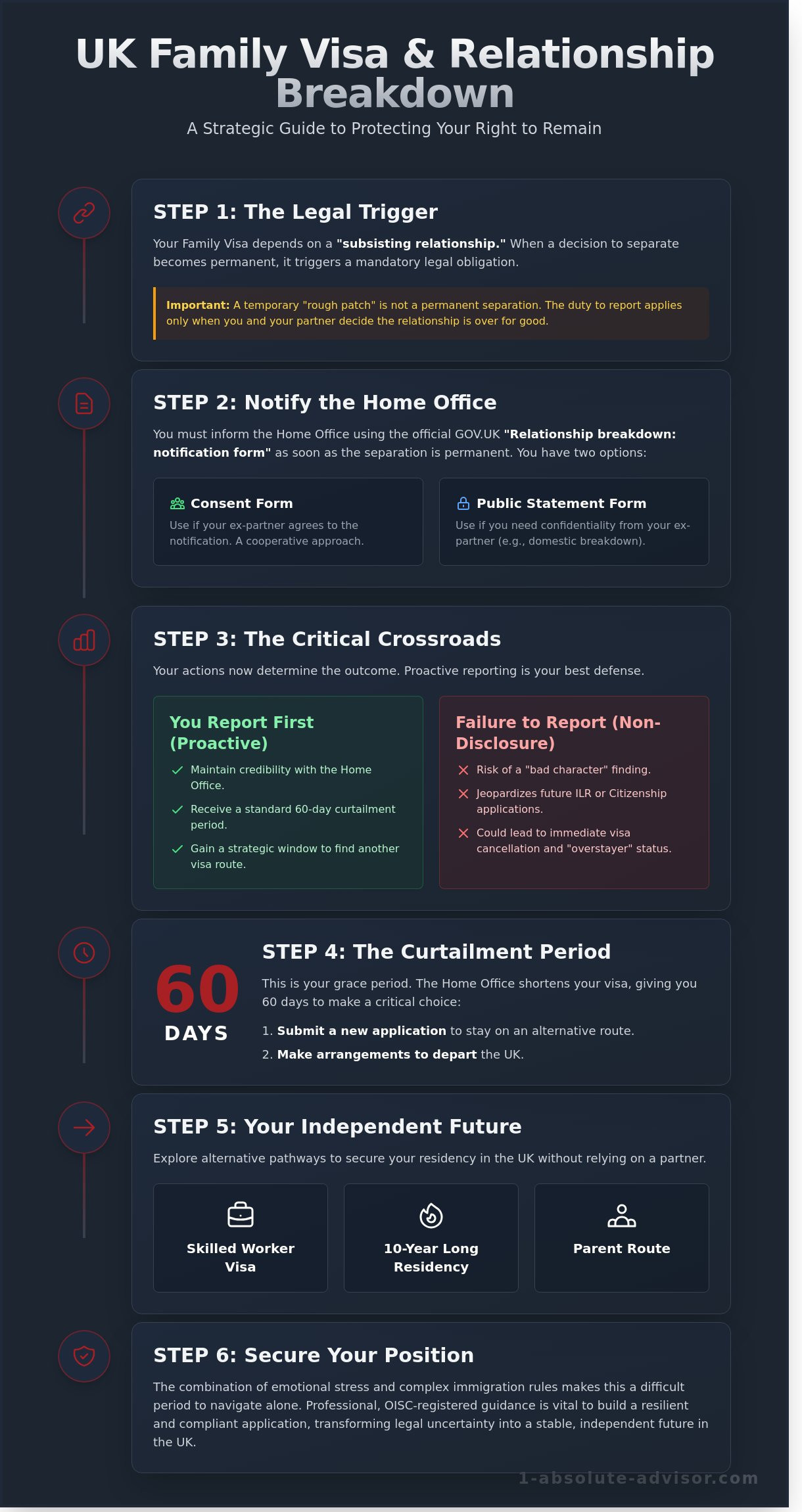
Immigration status under a Family Visa depends entirely on the existence of a “subsisting relationship.” This term is not merely a romantic sentiment; it is a strict legal requirement defined under Appendix Relationship with Partner of the UK Immigration Rules. A subsisting relationship requires that the couple is in a genuine partnership and intends to live together permanently in the UK. While a temporary “rough patch” or a brief period of marital friction does not legally terminate your status, a formal decision to separate permanently does. Understanding how to cope with visa-related separation requires a clear-headed approach to these legal definitions from the outset.

Transparency acts as your primary defense against future allegations of visa fraud. The Home Office views the failure to report a change in circumstances as a “material non-disclosure.” If you continue to live in the UK on a spouse or partner visa after the relationship has ended without informing the authorities, you risk a “bad character” finding. This designation can permanently jeopardize future applications for Indefinite Leave to Remain (ILR) or British Citizenship. Taking proactive steps ensures you remain compliant with the law even during personal turmoil.

How and When to Notify the Home Office

The duty to inform the Home Office is mandatory and should be completed as soon as the separation is considered permanent. You must use the official “Relationship breakdown: notification form” available on the GOV.UK website. The process requires specific data points, including your Home Office reference number, case ID, and your partner’s full details. If children are involved, you must provide their names and dates of birth to ensure their welfare is considered in any subsequent visa decisions.

Privacy is a significant concern during this process. The Home Office provides two distinct paths: the “Consent” form and the “Public Statement” form. If your ex-partner agrees to the notification, the Consent form is used. However, if you do not want your ex-partner to see the information you provide, or if the relationship ended due to domestic breakdown, the Public Statement form allows you to report the change while requesting that your new address and specific details remain confidential from your former partner.

The Consequences of Non-Disclosure

Failing to report a separation is a strategic error that often leads to the “curtailment” of your visa under less favorable terms. If your ex-partner reports the separation first, the Home Office may move to cancel your visa immediately. When you report the change yourself, you maintain a level of credibility that is essential for switching to a different visa category, such as a Work Visa or a Parent Visa. Usually, the Home Office will issue a letter giving you 60 days to either depart the UK or submit a new application to stay.

Ensuring your address is updated is a critical component of how to cope with visa-related separation effectively. All formal correspondence regarding your “curtailment” or “leave to remain” will be sent to the last address the Home Office has on file. If you have moved out and fail to update your details via the online “Update your UK Visas and Immigration account” service, you may miss the 60-day deadline to respond. Missing this window leads to an “overstayer” status, which carries severe legal penalties and complicates any future legal presence in the UK.

Curtailment is the formal process where the Home Office shortens your existing leave to remain. This usually occurs when the basis of your stay, such as a sponsorship or a marriage, ceases to exist. Under Immigration Rules Part 9, the Secretary of State has the power to reduce your remaining time to a standard 60-day window. Understanding this timeline is essential for anyone figuring out how to cope with visa-related separation, as it provides a finite period to assess future legal options before your status expires.

The 60-day rule acts as a transitional grace period. It’s a policy application designed to give individuals time to either depart the UK or find an alternative legal route. If your visa had more than 60 days left, it gets cut down; if it had less, the original expiry date usually stands. There are rare instances where the Home Office cancels permission with immediate effect, particularly in cases involving deception or serious criminal conduct. You must monitor your registered email and physical post daily. If a Notice of Curtailment is served to your last known address or “to file” because you’re unreachable, the 60-day countdown begins regardless of whether you’ve read the letter.

Your Rights and Restrictions During Curtailment

During these 60 days, your existing conditions generally remain in place. You can typically continue working or studying under the same terms as your original visa. Access to the NHS continues as you’ve already paid the Immigration Health Surcharge. However, you must not travel outside the Common Travel Area. Leaving the UK during a curtailment period effectively ends your leave immediately; you’ll likely be refused re-entry at the border because your permission to stay has been revoked.

Managing the Emotional and Practical Stress

The pressure of a ticking clock can be overwhelming. Use this time to organize your personal affairs, such as ending a tenancy or managing local assets, while you explore new pathways. Seeking assistance from migrant welfare organizations can provide emotional stability during this transition. Most importantly, securing a professional UK immigration assessment should be your priority. A strategic review of your situation helps identify if you qualify for a different visa category, such as a Skilled Worker or a private life route. Taking this step early transforms a crisis into a manageable transition. For those needing a clear roadmap, an Absolute Advisor consultation can provide the professional integrity required to navigate these complex legal waters and help you understand how to cope with visa-related separation through proactive planning.

How to Cope with Visa-Related Separation: A Comprehensive UK Guide for 2026

Evaluating Your Options to Stay in the UK Independently

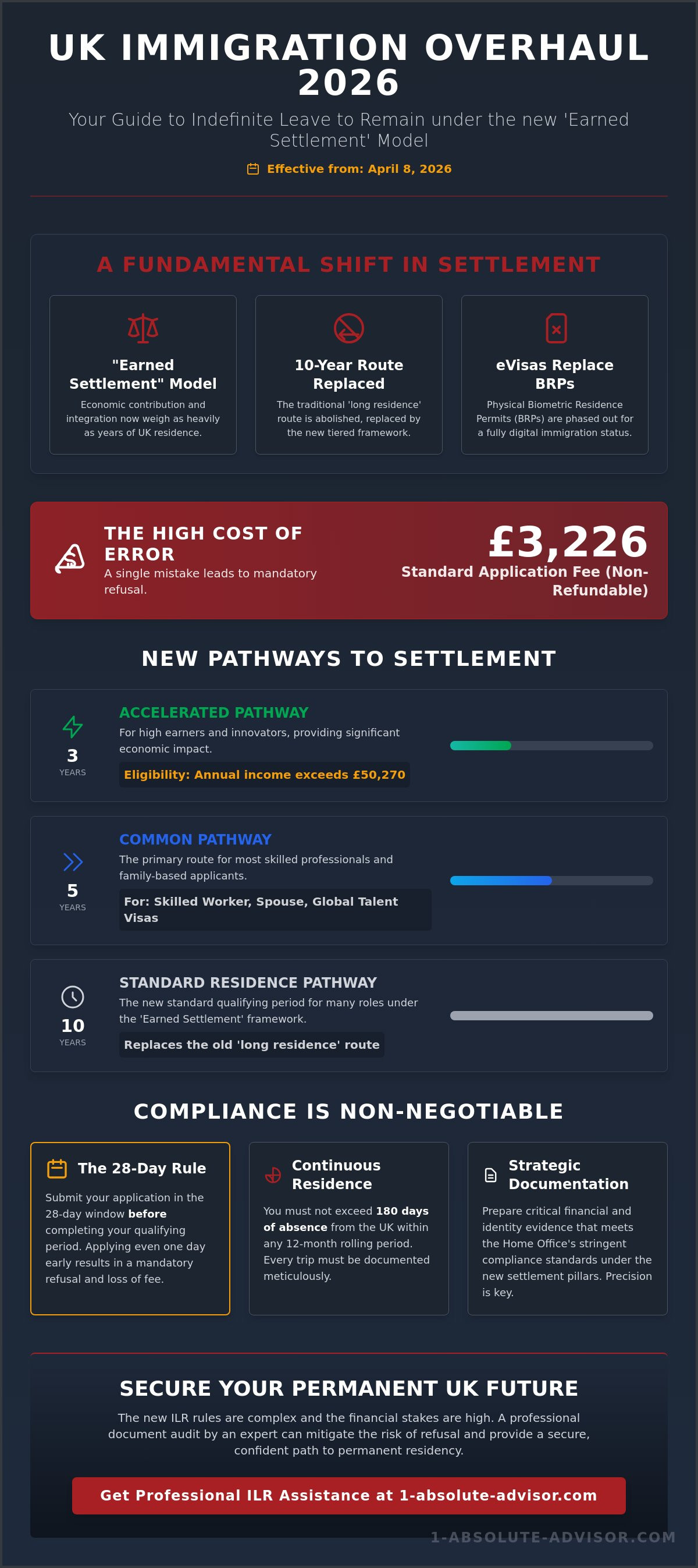
Separation doesn’t always necessitate a departure from the UK. Understanding how to cope with visa-related separation involves a clinical assessment of your individual eligibility for non-partner routes. By April 2026, the Home Office has solidified several pathways that allow individuals to transition from a dependent status to an independent one. Analyzing the 10-year long residence rule is a logical first step. If you’ve lived in the UK legally for a continuous decade, you might qualify for Indefinite Leave to Remain (ILR) regardless of your relationship status. This path requires a clean criminal record and no absences exceeding 180 days in any 12-month period, providing a permanent solution for those who have built a life here over the last ten years.

Staying as a Parent: The Article 8 Route

Securing your status as a parent provides a vital safety net under Article 8 of the European Convention on Human Rights. This route is applicable if you have a British or settled child under 18 years of age. You’ll need to demonstrate an active role in the child’s upbringing through school reports, medical records, or financial support evidence. While the ‘sole responsibility’ test remains a high bar for single parents, shared parental access is often sufficient if you can prove the child’s best interests require your presence. Courts prioritize child welfare under Section 55 of the Borders, Citizenship and Immigration Act 2009, making this a robust option for those wondering how to cope with visa-related separation while maintaining essential family bonds.

Work and Study: Switching Categories

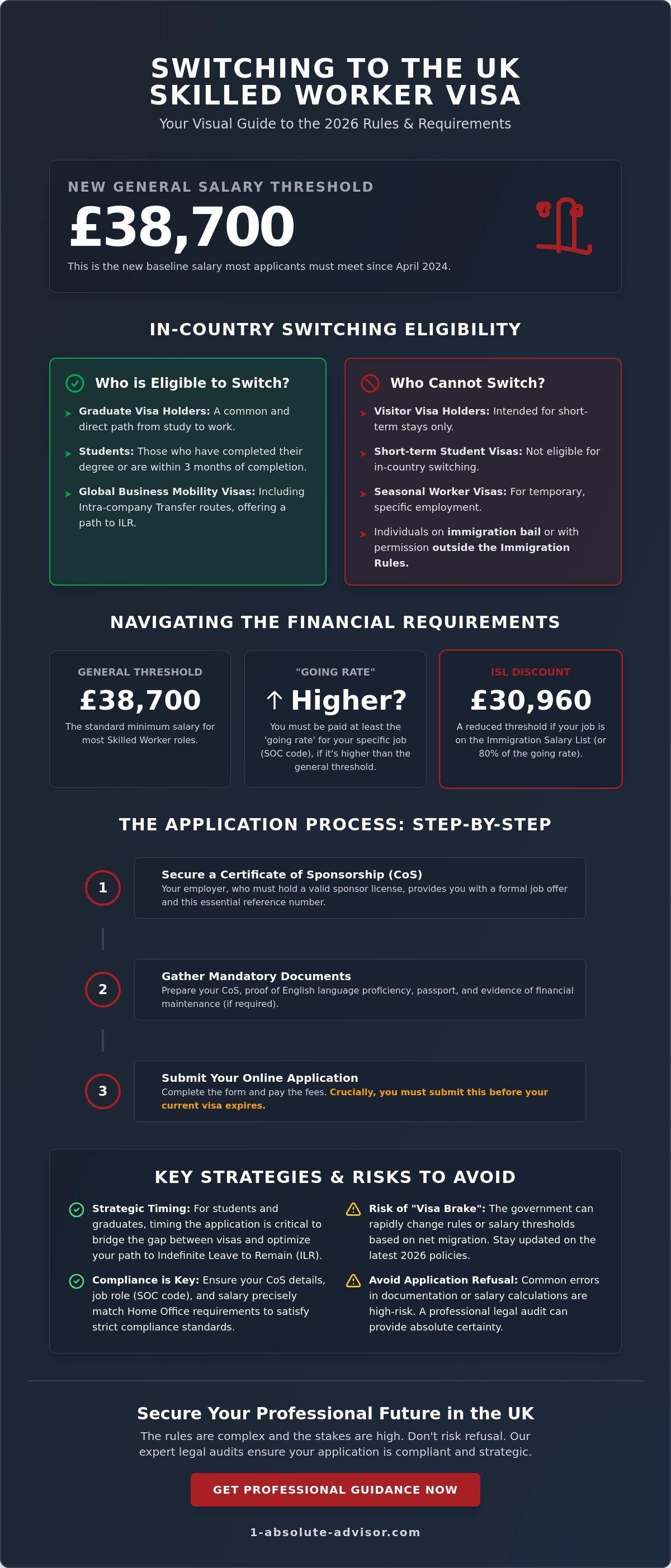
Switching into a skilled worker visa uk offers a path based on professional merit rather than domestic ties. As of early 2026, the general salary threshold remains at £38,700 for most applicants, though certain healthcare or education roles may qualify for lower requirements. If you’re a recent graduate from a UK institution, the Graduate visa serves as a 2-year bridge to gain work experience without the immediate need for an employer’s sponsorship. For entrepreneurs with scalable business ideas, the Innovator Founder route is a viable alternative, provided an endorsing body approves your plan. Reviewing a broader UK work visa strategy ensures your residency remains secure and entirely independent of your former partner’s sponsorship.

Practical Steps for a Successful Visa Transition

Understanding how to cope with visa-related separation requires a methodical approach to your immigration status. You must move from emotional reaction to strategic action. The UK immigration system operates on strict timelines; missing a single deadline can jeopardize your right to stay. Following a structured transition plan ensures you remain compliant while exploring new routes to residency.

Step 1: Audit your current leave. Check your eVisa or BRP to identify your exact expiry date. Since the UK transitioned to fully digital records in January 2025, you should verify your status through the official “view and prove” service to ensure no discrepancies exist in the Home Office database.

Step 2: Collect evidence of your life in the UK. Gather documents that prove your employment history, housing stability, and family ties. This data forms the foundational evidence for any subsequent application you might pursue.

Step 3: Formalise your separation with the Home Office. You’re legally required to notify them when a qualifying relationship ends. While this triggers the curtailment process, it stops the clock on your current status as a dependent and allows you to move toward an independent immigration category.

Step 4: Secure professional legal advice. A specialist can map out your new application, whether it’s a Skilled Worker visa, a family visa based on your children, or a human rights claim. Mapping these options early prevents rushed, high-stakes decisions.

Step 5: Submit your new application before the 60-day curtailment period ends. This 60-day window is non-negotiable. Submitting a valid application within this timeframe maintains your right to work and access services under Section 3C leave while the Home Office processes your request.

Evidence Gathering Checklist

A successful transition depends on the quality of your documentation. You’ll need to demonstrate your integration and self-sufficiency through a clear paper trail:

  • Proof of cohabitation: Bank statements, council tax bills, or utility invoices from the period your relationship was valid to prove the partnership was genuine.
  • Financial records: Six months of payslips or personal bank statements demonstrating you meet the financial requirements without relying on public funds.
  • Child-related documentation: Letters from schools, GPs, or social services if you have children in the UK, as their “best interests” are a primary consideration in many visa routes.

Applying for ILR Early

If your relationship ended because of domestic abuse, you don’t have to wait for the usual five-year period to settle. You can apply for ilr uk through the Domestic Violence Indefinite Leave to Remain (DV-ILR) route. This provision protects vulnerable individuals, allowing them to secure their status independently of their former partner. Securing your future involves learning how to cope with visa-related separation while simultaneously managing these complex legal requirements.

To succeed in a DV-ILR claim, you’ll need to provide evidence of the abuse, which can include police reports, medical records, or letters from support organisations. Even during this period of personal upheaval, you’ll still need to pass the Life in the UK test unless you’re exempt due to a specific physical or mental condition. Preparing for this test early can reduce overall stress during the final application stages.

For a detailed assessment of your eligibility and a strategic roadmap for your stay, consult with our expert advisors today.

How Professional Guidance Secures Your Future

Attempting a DIY visa application during a relationship breakdown often leads to critical errors. Emotional stress clouds judgment, causing applicants to miss deadlines or overlook mandatory evidence. In 2024, Home Office data indicated that a significant portion of family visa refusals stemmed from insufficient proof of relationship subsistence or financial requirements. When you are learning how to cope with visa-related separation, the technical burden of UK immigration law shouldn’t rest on your shoulders alone.

An OISC-registered advisor acts as your strategic partner. We don’t just fill out forms; we draft a comprehensive legal cover letter that contextualizes your situation for the caseworker. This document bridges the gap between raw evidence and the specific requirements of the Immigration Rules. Our team ensures that your current crisis doesn’t compromise your eligibility for british citizenship in the future. We meticulously review your history to satisfy “Good Character” requirements, which are essential for naturalisation in 2026. Managing these complexities through a fixed-fee service provides financial predictability when your personal life feels most unstable.

Avoiding Common Pitfalls

Ignoring a Home Office letter is a common mistake that leads to disastrous results. If you receive a notification regarding your leave to remain, you must act within the specified timeframe, usually 14 to 28 days. Failing to respond can lead to the curtailment of your visa. Overstaying even by a single day can trigger a re-entry ban and ruin your prospects for any future UK visa. Professional document checking identifies inconsistencies in bank statements or housing evidence before they reach the Home Office, significantly reducing the risk of a refusal based on technicalities.

Taking the Next Step

Every family situation is unique, and generic advice cannot replace a tailored strategy. Understanding how to cope with visa-related separation requires a clear roadmap for your legal status. Booking a consultation allows us to assess your specific circumstances, including any children involved or human rights claims. Before your first meeting, please gather your current passport, your BRP, any correspondence from the Home Office, and proof of your current living arrangements. Having these documents ready allows us to provide immediate, actionable advice during our initial session.

Don’t leave your residency status to chance during this difficult transition. Contact 1 Absolute Advisor for expert assistance with your visa transition and secure your long-term future in the UK with professional support.

Taking Control of Your UK Residency Path

Navigating a relationship breakdown while on a family visa requires a swift, strategic response to meet Home Office requirements. You must report changes to the authorities immediately to manage the 60-day curtailment period effectively. Understanding how to cope with visa-related separation involves evaluating your eligibility for independent routes, such as the Skilled Worker visa or the 10-year long residency path. These transitions are complex, but they provide a clear framework for remaining in the UK legally through 2026 and beyond. Our OISC-registered experts specialize in complex family visa transitions, ensuring every application aligns with current UKVI standards. We provide fixed-fee application management to remove financial uncertainty during this critical time. You don’t have to face the legal system alone when your future is at stake. By taking proactive steps today, you can transform a period of instability into a foundation for long-term security. Secure your future in the UK with a professional visa assessment and gain the clarity you need to move forward with confidence.

Frequently Asked Questions

Do I have to leave the UK immediately after my divorce is finalised?

You don’t have to leave the UK the moment your divorce is finalised. The Home Office typically issues a curtailment notice that grants you 60 days to either apply for a different visa or make arrangements to leave. This 60-day period begins from the date you receive the official letter, giving you a vital window to restructure your legal status.

Can I switch from a spouse visa to a work visa without leaving the country?

You can switch to a Skilled Worker visa from within the UK if you secure a job offer from a licensed sponsor. You’ll need to meet the specific salary and English language requirements defined in the 2024 Immigration Rules. This transition allows you to maintain continuous residency without the expense and disruption of returning to your home country for a new application.

What happens to my children’s visas if my partner and I separate?

Your children’s status usually depends on their length of residency and your new visa category. If a child has lived in the UK for 7 continuous years, they may qualify for leave to remain independently under private life rules. The Home Office must also consider the child’s best interests as mandated by Section 55 of the Borders, Citizenship and Immigration Act 2009.

Will the Home Office tell my ex-partner that I have applied for a new visa?

The Home Office won’t disclose your new application details or your current address to your ex-partner. Your privacy is strictly protected under the Data Protection Act 2018 and standard GDPR protocols. While the Home Office notifies the sponsor that the relationship has ended, they don’t share any information regarding your subsequent immigration steps or personal location.

How much does it cost to switch to a different visa category in 2026?

Switching to a Skilled Worker visa for up to 3 years costs £827 according to the fee structures established in 2024. You must also budget for the Immigration Health Surcharge, which currently stands at £1,035 per year of the visa’s duration. These figures represent the baseline government fees and don’t include potential costs for priority processing or professional legal representation.

What if I can’t find a job that meets the salary threshold for a work visa?

You might still qualify for a visa if your occupation is listed on the Immigration Salary List or if you’re under 26 years old. While the standard salary threshold rose to £38,700 in April 2024, “new entrants” and health sector workers often benefit from significantly lower requirements. Understanding how to cope with visa-related separation involves identifying these specific professional exemptions to secure your future.

Can I still apply for British Citizenship if my relationship ended before I got ILR?

You can’t apply for citizenship until you’ve held Indefinite Leave to Remain (ILR) for at least 12 months. If your relationship ends before you reach the ILR milestone, you must first switch to another visa, such as a work or ancestry visa, to complete the 5-year residency requirement. Learning how to cope with visa-related separation requires a strategic approach to bridge this gap in your settlement timeline.

What should I do if my ex-partner is threatening to ‘cancel’ my visa?

Your ex-partner doesn’t have the legal power to cancel your visa; only the Home Office holds that authority. If your partner uses your immigration status to threaten or control you, this is legally recognized as domestic abuse. You may be eligible for immediate settlement under the Appendix Victim of Domestic Abuse rules, which provide a path to permanent residency regardless of your partner’s wishes.

ILR UK: The Complete Guide to Indefinite Leave to Remain in 2026

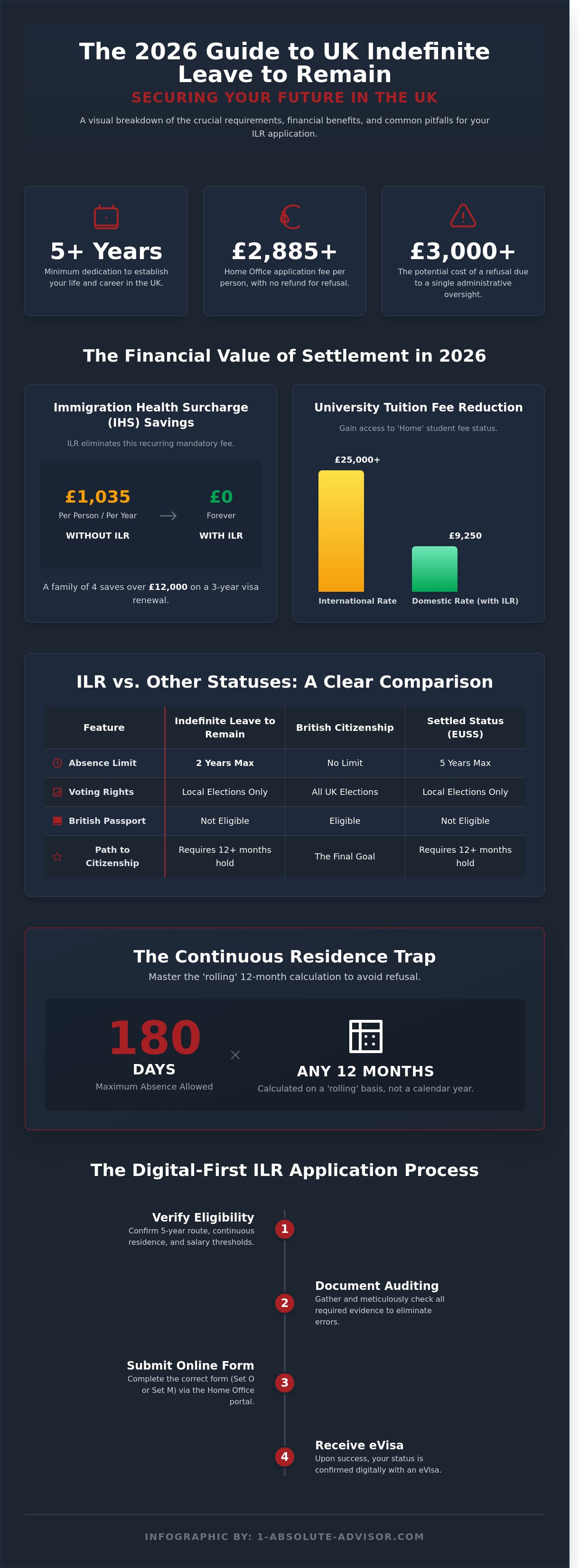
With Home Office application fees now exceeding £2,885 per person, a single administrative oversight in your ilr uk submission is a gamble you simply cannot afford to take in 2026. You’ve dedicated at least five years to establishing your career and home in Britain; it’s natural to feel a sense of trepidation as the rules shift yet again. The anxiety surrounding the Home Office’s increasingly stringent 2026 salary thresholds and residence audits is entirely justified for anyone seeking a permanent future here.

We’ll provide the expert legal insights and strategic framework necessary to master these complexities, transforming a high-stakes bureaucratic process into a predictable path toward your permanent settlement. This guide examines the precise mechanics of the ‘Continuous Residence’ rule, the updated financial requirements for 2026, and our proven methodology for document auditing that eliminates the risk of refusal. You’ll gain the absolute clarity required to secure your status with total confidence, ensuring your life in Britain remains uninterrupted and secure.

Key Takeaways

  • Understand the fundamental distinction between Indefinite Leave to Remain and British citizenship to establish a secure, permanent foundation for your future in the UK.
  • Identify the specific 2026 eligibility criteria for the 5-year settlement route, tailored to both professional visa holders and those applying via the Family Route.
  • Master the complexities of the ‘rolling’ 12-month absence calculation to ensure your continuous residence remains compliant with the strict 180-day limit.
  • Navigate the digital-first ilr uk application process with confidence, ensuring the correct submission of Set O or Set M forms and the successful acquisition of your eVisa.
  • Mitigate the risk of a costly £3,000 refusal by adopting a strategic, professional approach that identifies hidden eligibility hurdles before you submit your application.

What is Indefinite Leave to Remain (ILR) in the UK?

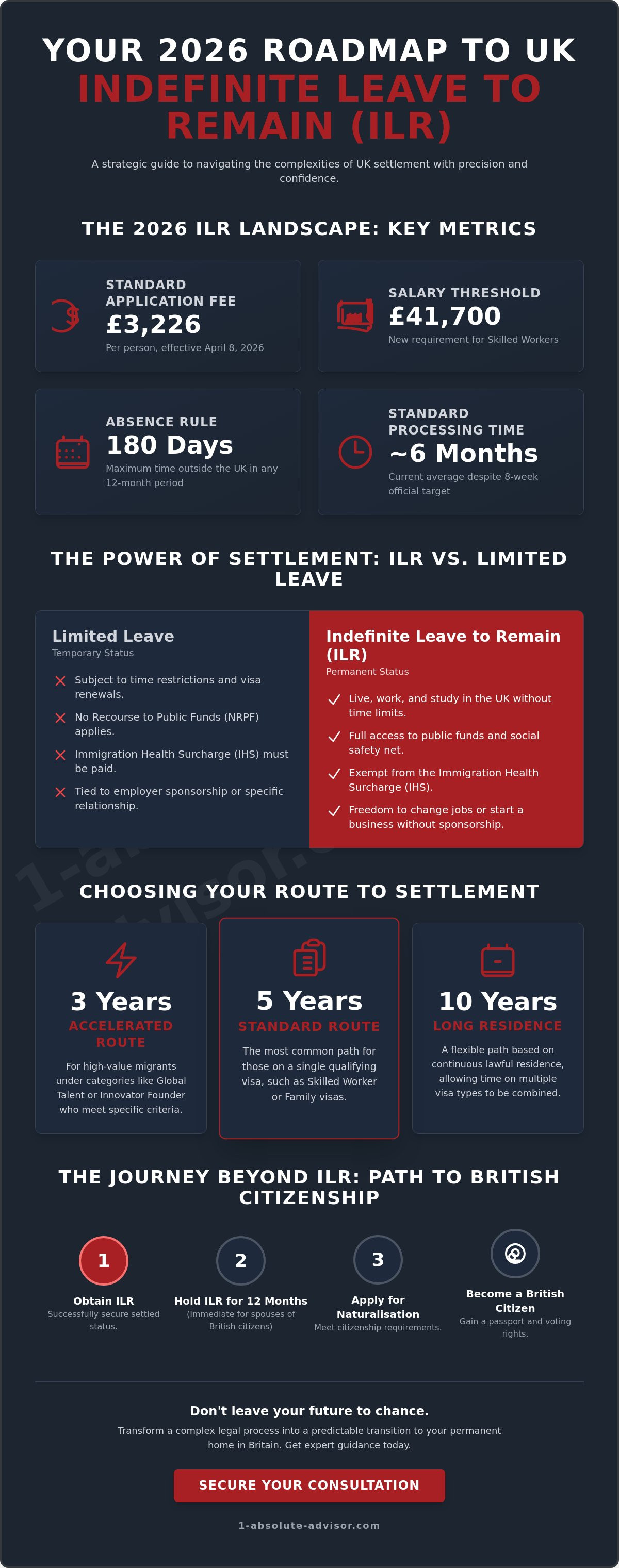
Indefinite Leave to Remain, commonly referred to as settlement, is a milestone that signifies the end of immigration restrictions for a foreign national. Once you secure ilr uk status, you no longer face a limit on how long you can stay in the country. You gain the freedom to live, work, and study without needing to apply for further visa extensions or meet specific salary thresholds. This status is the primary bridge between being a temporary resident and becoming a British citizen. For many, What is Indefinite Leave to Remain (ILR)? represents the transition from a precarious legal position to a stable, long-term future within the British economy and society.

ILR is the ultimate security for migrants, granting permanent status subject to specific residency conditions. While it provides many of the same benefits as citizenship, it remains a distinct legal category. It’s a prerequisite for naturalisation for most applicants, serving as a probationary period of permanent residency before one can hold a British passport. In the current regulatory environment, achieving this status requires a strategic approach to residency requirements and a clean criminal record. It’s not merely a stamp in a passport; it’s a fundamental change in your legal relationship with the United Kingdom.

The Value of Settlement in 2026

By 2026, the financial and administrative advantages of holding ILR will be more significant than ever. One of the most immediate benefits is the cessation of the Immigration Health Surcharge (IHS). As of 2024, the IHS sits at £1,035 per year for most adults. A family of four renewing a three-year visa faces a cost of over £12,000 just for healthcare access. Settlement removes this recurring burden entirely. Additionally, ILR holders gain access to public funds, providing a safety net that’s unavailable to those on standard work or study visas. Financial planning becomes easier when you’re eligible for domestic tuition rates at universities. International students often pay upwards of £25,000 annually, whereas domestic rates are currently capped at £9,250. This status also empowers you to sponsor family members, such as a spouse or children, for their own settlement path, ensuring family unity without the constant pressure of visa expiry dates.

ILR vs. British Citizenship: The Key Differences

Understanding the distinction between ilr uk and British citizenship is vital for long-term planning. While both allow you to stay in the UK permanently, citizenship offers rights that settlement does not. Key differences include:

  • Voting Rights: ILR holders can vote in local elections, but only British, Irish, or qualifying Commonwealth citizens can vote in UK General Elections.
  • Passport Eligibility: You cannot hold a British passport with ILR; you must continue using your national passport for international travel.
  • Loss of Status: ILR can be revoked if you stay outside the UK for more than two continuous years. British citizenship is permanent and cannot be lost through absence.
  • The Waiting Period: Most applicants must hold ILR for at least 12 months before they can apply for naturalisation, unless they’re married to a British citizen.

ILR vs. Settled Status (EUSS)

It’s common to confuse ILR with ‘Settled Status’ granted under the EU Settlement Scheme (EUSS). While both result in permanent residency, they operate under different legal frameworks. Settled Status was designed specifically for EU, EEA, and Swiss citizens who resided in the UK before 31 December 2020. ILR is the standard route for non-EU nationals or those on routes like the Skilled Worker or Family visa. A key difference lies in the absence rules. Settled Status holders can typically leave the UK for up to five years without losing their status, whereas standard ILR holders are limited to two years. Both paths lead to the same end goal: a secure life in the UK without the shadow of immigration control.

Qualifying Routes for ILR UK in 2026

The landscape for achieving Qualifying Routes for ILR UK in 2026 requires a strategic approach to timing and documentation. Most applicants follow the standard five-year path, particularly those holding Skilled Worker or Scale-up visas. For those on the Scale-up route, the flexibility of the unsponsored stage after two years doesn’t change the requirement for a continuous five-year period of residence. Achieving ilr uk status is the culmination of years of compliance, making it essential to track every day spent outside the country to stay within the 180-day annual limit.

Work-Based Settlement: Skilled Worker Requirements

Settlement under the Skilled Worker route depends heavily on meeting the 2026 salary thresholds. Following the 2024 increases, the general threshold remains at £38,700, though specific roles may require higher pay based on updated SOC code going rates. Your employer must provide a formal confirmation that you’re still required for your role for the foreseeable future. This process follows the strict Appendix Settlement rules, which demand a high level of precision in payroll reporting and Certificate of Sponsorship (CoS) management. It’s not just about having a job; it’s about proving that job’s ongoing necessity to the UK economy.

Many applicants on this route are entrepreneurs or key employees in growing UK businesses. Once settled, they often take a greater role in their company’s development, which can include marketing and branding. For those exploring options for promotional materials, you can read more on the topic of custom printing.

Family Life: Spouse and Partner Visa ILR

Spouses and partners typically qualify after 60 months of continuous residence on the 5-year route. You’ll need to demonstrate your relationship remains subsisting and meet the financial requirement, which saw significant adjustments in early 2024 to £29,000, with further planned increments. Meeting the B1 level English language requirement is mandatory, alongside the Life in the UK test. For those facing tragic circumstances like domestic abuse or the death of a partner, the Home Office provides specific pathways to settle immediately. These protections ensure that vulnerable individuals don’t lose their right to stay due to factors outside their control.

The ‘Good Character’ and Life in the UK Test

The Home Office scrutinises every detail of an applicant’s history under the ‘Good Character’ requirement. This includes criminal convictions, civil penalties, and even recurring driving offences like speeding or using a mobile phone while driving. Every applicant between 18 and 64 must pass the Life in the UK test unless they’ve a qualifying medical exemption. If you’re unsure about how a past penalty or a complex financial history might affect your ilr uk application, consulting with a strategic immigration partner can provide the necessary clarity. Medical exemptions for the English test require a specific form signed by a GMC-registered doctor, ensuring the process remains rigorous but fair.

The 10-year Long Residence route remains a vital fallback for those who’ve switched between various visa categories over a decade. Recent changes to ‘Private Life’ applications have streamlined how time spent as a child or young adult counts toward settlement, often reducing the wait for those who arrived before age 18. Conversely, high-value migrants under the Global Talent or Innovator Founder categories can reach settlement in just 3 years. This accelerated path requires meeting specific endorsement criteria, such as securing £50,000 in venture capital or achieving significant research contributions. These fast-track options are designed to retain the world’s most innovative minds by offering a quicker path to permanent stability.

ILR UK: The Complete Guide to Indefinite Leave to Remain in 2026

The Continuous Residence Trap: Calculating Your Absences

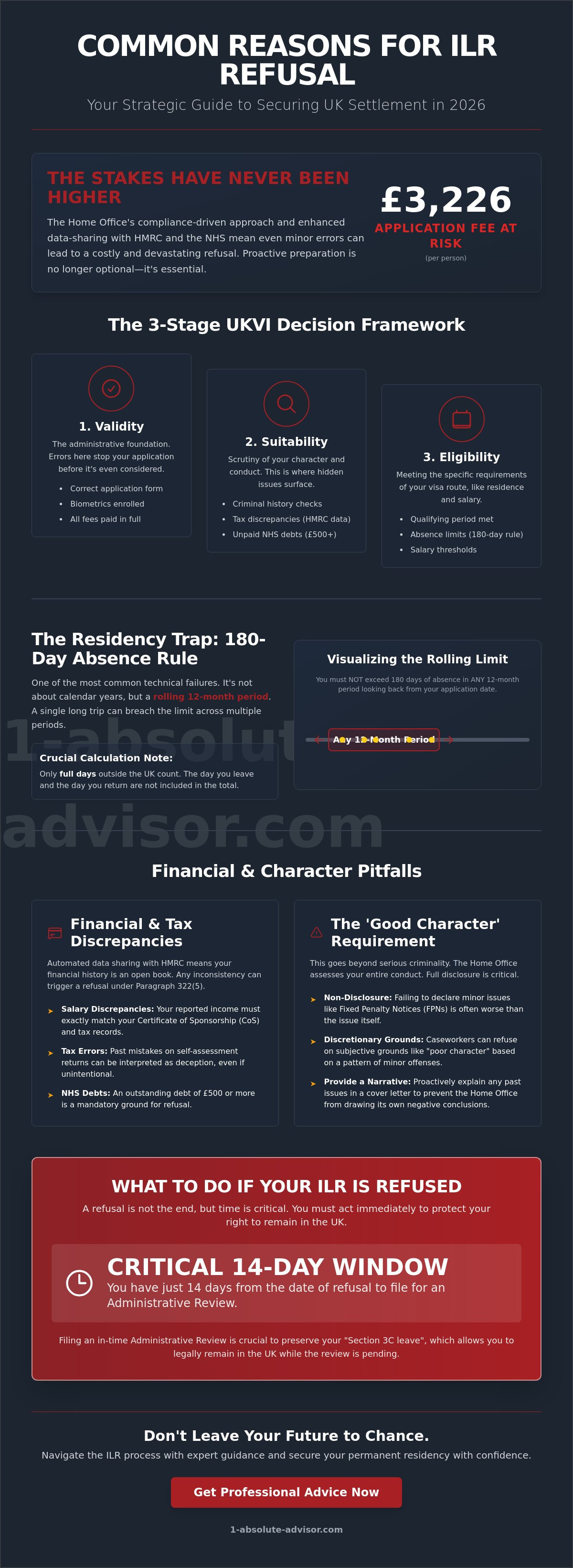
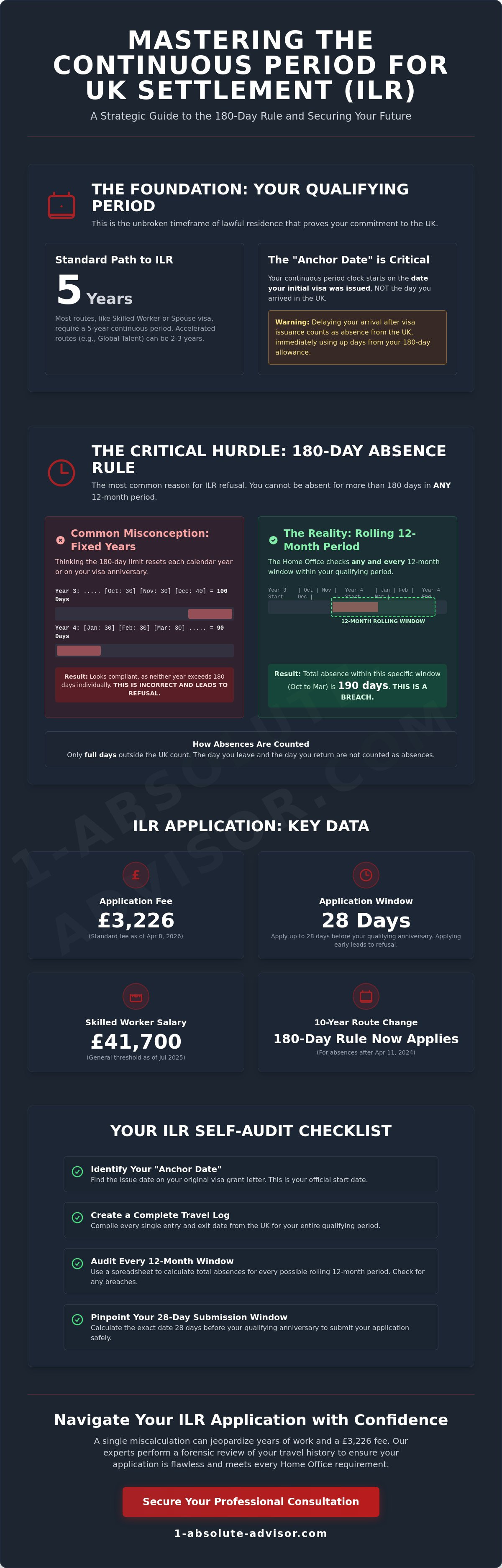
The concept of continuous residence is the bedrock of any successful application for ilr uk. It isn’t just about living in the country; it’s about proving you haven’t abandoned your life here. The Home Office enforces a strict limit where you must not exceed 180 days outside the UK in any 12-month period. For applicants planning their submission in 2026, this calculation is rolling. This means the Home Office doesn’t just look at calendar years. They examine any consecutive 12-month block during your qualifying period. If you spent 181 days abroad between June 2024 and June 2025, your clock might have reset, even if your total for the calendar year 2024 was low.

Not every absence is treated equally, and certain compelling reasons allow for flexibility if they’re backed by rigorous documentation. Work-related travel is a common scenario for professionals. However, a simple assertion that you were away on business won’t suffice. You’ll need a formal letter from your employer on headed paper. This letter must list every single date you were out of the country and confirm these trips were necessary for your role. For family emergencies or medical issues, the standard of proof is even higher. You’ll need hospital records, death certificates, or letters from medical practitioners that clearly state why your presence abroad was unavoidable. Understanding the Qualifying Routes for ILR is essential because different visas have slightly different thresholds for what counts as a permitted absence.

Common Mistakes in Absence Calculations

Precision is your best ally when reviewing your travel history. A frequent error involves travel days. Under current Home Office guidance, the day you leave the UK and the day you arrive back don’t count as days of absence. Only full 24-hour periods spent outside the country are tallied. Another pitfall is failing to maintain a contemporaneous log. Waiting until 2026 to reconstruct your travel history from 2021 is a recipe for disaster, as a 2024 review of immigration appeals showed that 12% of rejections stemmed from inconsistent travel dates between application forms and passport stamps. You must gather evidence for work-related travel throughout the entire 5-year period to avoid gaps in your narrative. The burden of proof for any absence over 180 days lies entirely with the applicant.

The 10-Year Route and ‘Gap’ Nuances

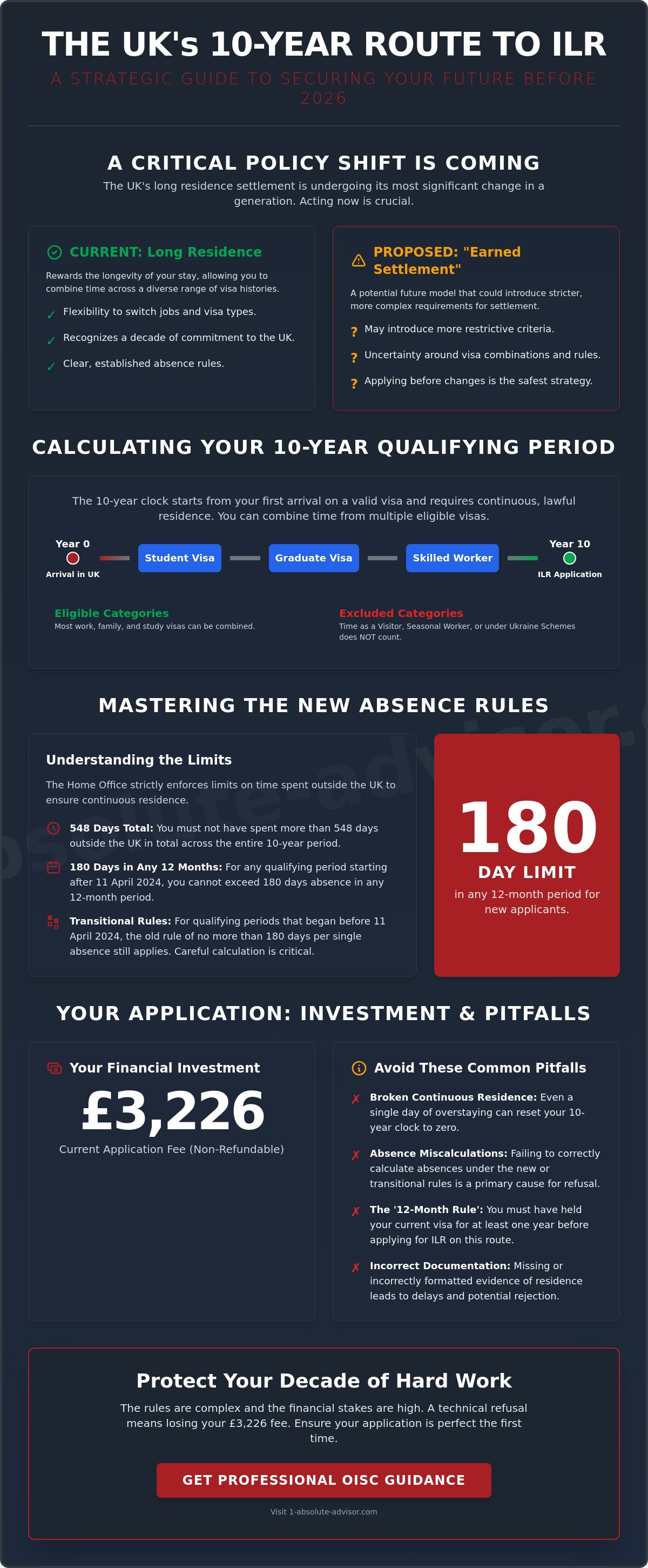
The 10-year Long Residence route introduces additional complexities regarding broken residence. Unlike the 5-year path, a single absence of more than 180 days, or a total of 548 days across the decade, will break your continuity. Overstaying between visas is a critical risk factor. If your leave expired on 15 May 2024 and you didn’t apply for a new visa until 30 May 2024, that 15-day gap might reset your 10-year clock to zero unless you meet very specific exceptional circumstances criteria. It’s vital to understand how these timelines interact with your Calculating Your 5-Year Qualifying Period for ILR strategy. We often see applicants who assume minor gaps don’t matter, only to find their 10-year progress wiped out by a single administrative oversight. Consistency and proactivity are the only ways to ensure your path to ilr uk remains secure.

  • Rolling calculation: Any 12-month period, not just calendar years.
  • Travel days: Departure and arrival days are counted as days spent in the UK.
  • Evidence: Employer letters must be specific to dates and business necessity.
  • 10-year limit: Do not exceed 548 days in total across the full decade.

The 2026 ILR Application Process: Digital-First and eVisas

By 2026, the Home Office has fully transitioned to a “digital by default” model for all settlement applications. Your journey towards securing ilr uk status begins with the submission of the correct online form; typically Set (O) for skilled workers and various points-based routes, or Set (M) for family-based applications. You must complete this submission before your current leave expires to ensure your right to work and rent remains protected under section 3C of the Immigration Act 1971. Precision at this stage is vital. A single clerical error can lead to a refusal, jeopardising years of residency progress.

Once you’ve submitted the form, you’ll need to settle the application fee and the biometrics enrolment fee. The current 2026 standard fee for Indefinite Leave to Remain stands at £2,885 per applicant. Following payment, you’ll gain access to the UKVCAS (UK Visa and Citizenship Application Services) portal. This digital interface allows you to upload high-quality scans of your supporting evidence. Our advisors recommend categorising these documents strictly according to the Home Office’s preferred hierarchy to facilitate a smoother review by the caseworker. You’ll then either book a physical appointment at a service centre to provide your fingerprints and photograph or, if eligible, use the “UK Immigration: ID Check” smartphone app to verify your identity remotely.

The End of Physical BRPs

The landscape of UK immigration changed permanently following the 31 December 2024 expiry of physical Biometric Residence Permits (BRPs). By 2026, the physical card is a relic of the past. Your ilr uk status is now held entirely within the mandatory eVisa system. To access this, you must register for a UKVI account. This digital profile serves as the “source of truth” for your residency rights. It’s your responsibility to ensure this record stays updated; if you renew your passport, you must link the new document to your UKVI account immediately to avoid delays at the border. You can generate “share codes” through this portal to prove your permanent right to work to employers or your right to reside to landlords.

Application Fees and Priority Services

Timing your application involves a strategic choice between cost and speed. The standard processing time for settlement remains up to 6 months, which can be a significant period of uncertainty for professionals or business owners. If your circumstances require a faster resolution, the Super Priority service is available for an additional £1,000. This service guarantees a decision by the end of the next working day following your biometrics appointment or app submission. For many of our clients, this investment is justified by the immediate peace of mind and the ability to proceed with long-term financial commitments, such as mortgage applications, without the shadow of a pending visa status. Before committing to these fees, ensure your documentation is flawless by reviewing our Indefinite Leave to Remain: Document Checklist.

The decision-making process concludes with an email notification confirming your grant of settlement. There’s no longer a wait for a courier to deliver a plastic permit. Your digital status updates automatically, reflecting your new, unrestricted rights in the United Kingdom. This transition represents a significant shift towards a more efficient, secure immigration framework that rewards those who maintain meticulous records throughout their residency.

If you require a professional audit of your residency history to ensure total compliance before your submission, schedule a strategic consultation with our advisors.

Why an ‘Absolute’ Approach to Your ILR Matters

Applying for Indefinite Leave to Remain is more than a procedural hurdle; it’s a significant financial and personal investment. The current Home Office fee for an ilr uk application stands at £2,885 per person. When you factor in biometric appointments and professional translations, a DIY refusal becomes a £3,000 mistake that most families cannot afford to repeat. Beyond the lost capital, a rejection triggers a 14-day countdown to leave the country or lodge a complex appeal, placing your career and home at immediate risk.

At 1 Absolute Advisor, we identify hidden eligibility issues that often escape the untrained eye. Home Office caseworkers look for reasons to refuse, not reasons to approve. We’ve seen applications falter because of a 48-hour gap between visas five years ago or a missing P60 from a previous employer. Our team conducts a forensic audit of your history to ensure every “Continuous Residence” requirement is met before the “Submit” button is ever clicked. We don’t just hope for success; we engineer it through absolute precision.

A professional legal cover letter serves as the backbone of a successful ilr uk submission. It isn’t a simple list of contents. It’s a structured legal argument that references specific Immigration Rules and explains how your evidence meets every statutory requirement. This is vital for complex cases involving high absence levels or non-standard income. As an OISC-registered firm in London, our seal of approval signals to the Home Office that your application has been prepared to the highest professional standards, often leading to smoother processing.

Our Fixed-Fee ILR Management Service

Our comprehensive management service handles the entire lifecycle of your application. We take the burden of document gathering off your shoulders, liaising with employers and banks to secure the exact wording required by the Home Office. You’ll have direct access to OISC-registered advisors who provide strategic planning for your future citizenship. Every day of your five-year residency is audited to ensure you haven’t breached the 180-day absence limit, giving you total certainty.

The Document Checking Alternative

If you’ve already prepared your paperwork but feel the weight of the £2,885 risk, our Document Checking service provides a professional safety net. We’ve found that 15% of self-prepared applications contain errors in financial evidence, such as bank statements that are 32 days old rather than the required 28. We scrutinise your employer letters and salary slips to ensure they align perfectly with the latest Appendix FM or Skilled Worker rules. It’s a cost-effective way to gain professional reassurance before you commit to the Home Office fees.

Secure your UK settlement with a professional ILR consultation and ensure your path to residency is handled with the absolute care it deserves.

Take Control of Your British Settlement Strategy

Securing ilr uk status in 2026 requires more than just meeting the five-year residency mark. You must navigate the Home Office’s mandatory digital-first transition, where physical Biometric Residence Permits have been replaced by eVisas. Precision is vital when calculating the 180-day rolling absence limit, as even a minor oversight in travel dates can reset your qualifying period. Since the 2024 digital overhaul, the application landscape has shifted toward a stricter, evidence-heavy model that demands a proactive and absolute approach to compliance.

At 1 Absolute Advisor, our OISC-registered consultants provide the professional integrity needed to manage complex immigration histories. Based in London with full national coverage, we offer fixed-fee transparency so you don’t face hidden costs during your journey to permanency. We don’t just process paperwork; we act as strategic partners to ensure your application meets every statutory requirement the first time. It’s time to replace uncertainty with professional certainty. Book an ILR Eligibility Assessment with 1 Absolute Advisor today to lock in your future. Your path to British citizenship starts with a single, well-planned step.

Frequently Asked Questions

How much does ILR cost in 2026?

As of early 2026, the standard application fee for Indefinite Leave to Remain is £3,174 per person. This figure reflects the 10% increase implemented by the Home Office to cover rising administrative and processing overheads. You must also budget for the £19.20 biometric enrolment fee and optional priority services, which cost an additional £500 for a five-day decision or £1,000 for next-day super-priority processing.

Can I apply for ILR if I have a criminal record?

You can apply for ILR with a criminal record, but your application will be refused if you’ve received a custodial sentence of 12 months or more. For non-custodial sentences or out-of-court disposals, the Home Office applies a 24-month clear period rule from the date of the conviction. If your offence occurred within the last two years, your application for ilr uk status will likely be rejected under the general grounds for refusal.

What happens if my ILR application is refused?

If the Home Office refuses your application, you’ll receive a decision letter outlining whether you have the right to an Administrative Review. You must lodge this challenge within 14 days if you’re applying from inside the UK. Statistics from the 2024 period show that roughly 12% of initial refusals are overturned during this stage. If no review right exists, a Judicial Review remains the final legal avenue to contest the decision.

How long can I stay outside the UK once I have ILR?

You can remain outside the UK for up to two continuous years without losing your permanent residency status. If you stay abroad for 731 days or longer, your ILR automatically lapses under Immigration Rule 20. To return after such an absence, you’d need to apply for a Returning Resident visa, which requires proving strong ties to the UK and demonstrating that your primary home remains here.

Do I need to take the Life in the UK test again for citizenship?

You don’t need to retake the Life in the UK test for a British citizenship application if you’ve already passed it for your ILR submission. The test certificate has no expiry date under current Home Office guidance. This single £50 assessment serves both the settlement and naturalisation stages, provided you kept the original reference number or pass notification from your initial 45-minute examination at an approved centre.

Can I work while my ILR application is being processed?

You can continue working under your existing visa conditions while your ilr uk application is pending, provided you applied before your previous leave expired. This protection is granted under Section 3C of the Immigration Act 1971. Your employer can verify your ongoing right to work using the Home Office Employer Checking Service, which provides a Positive Verification Notice valid for six months while the decision is finalised.

What is the difference between ILR and Set(O) vs Set(M) forms?

The primary difference lies in your current visa category; use form Set(M) if you’re applying as the partner of a British citizen or settled person. Form Set(O) covers almost all other routes, including Skilled Worker, Tier 1, and UK Ancestry visas. Choosing the wrong form can lead to immediate rejection, so it’s vital to select the version that corresponds to your specific five-year or ten-year qualifying residency path.

How do eVisas work for ILR holders in 2026?

By 2026, all ILR holders must use a digital eVisa as the Home Office phased out physical Biometric Residence Permits on 31 December 2024. Your status is now linked directly to your passport via your UKVI account. You must update your digital profile if you renew your passport to ensure your permanent residency remains verifiable at border control and by employers through the online view and prove service.

UK Work Visa Salary Requirement 2026: The Complete Guide to Thresholds

Since the Home Office implemented the April 2024 threshold hikes, nearly 70% of prospective applicants have expressed concern that their salary won’t meet the new £38,700 baseline. You’re likely feeling that the complexity of the UK’s immigration system has reached a peak, making it difficult to plan your career or recruitment strategy with any certainty. Between the transitional arrangements for those already in the route and the intricate 2026 SOC code updates, a single miscalculation can lead to an immediate refusal of your application. We’ve designed this guide to help you master every nuance of the uk work visa salary requirement so you don’t risk your future on a technicality.

You’ll gain the strategic insight needed to navigate the 2026 financial criteria with total confidence. We’ll examine the specific salary thresholds for your occupation, explore how tradable points for PhDs or shortage roles can lower your limit, and provide a clear roadmap to ensure your sponsorship is compliant before you commit to any Home Office fees.

Key Takeaways

  • Navigate the updated 2026 financial thresholds, including the new standard £41,700 minimum, to ensure your application aligns with the latest Home Office regulations.
  • Master the “highest of” rule to determine your specific uk work visa salary requirement by comparing general thresholds against profession-specific going rates.
  • Identify eligibility for salary discounts through tradable points, such as the New Entrant rate for recent graduates or roles listed on the Immigration Salary List.
  • Learn how to accurately pro-rate your annual salary based on contracted working hours to maintain absolute compliance with strict Home Office benchmarks.
  • Understand the strategic importance of an OISC-registered audit to verify SOC codes and job offers before submitting your final visa application.

Understanding the UK Work Visa Salary Requirements for 2026

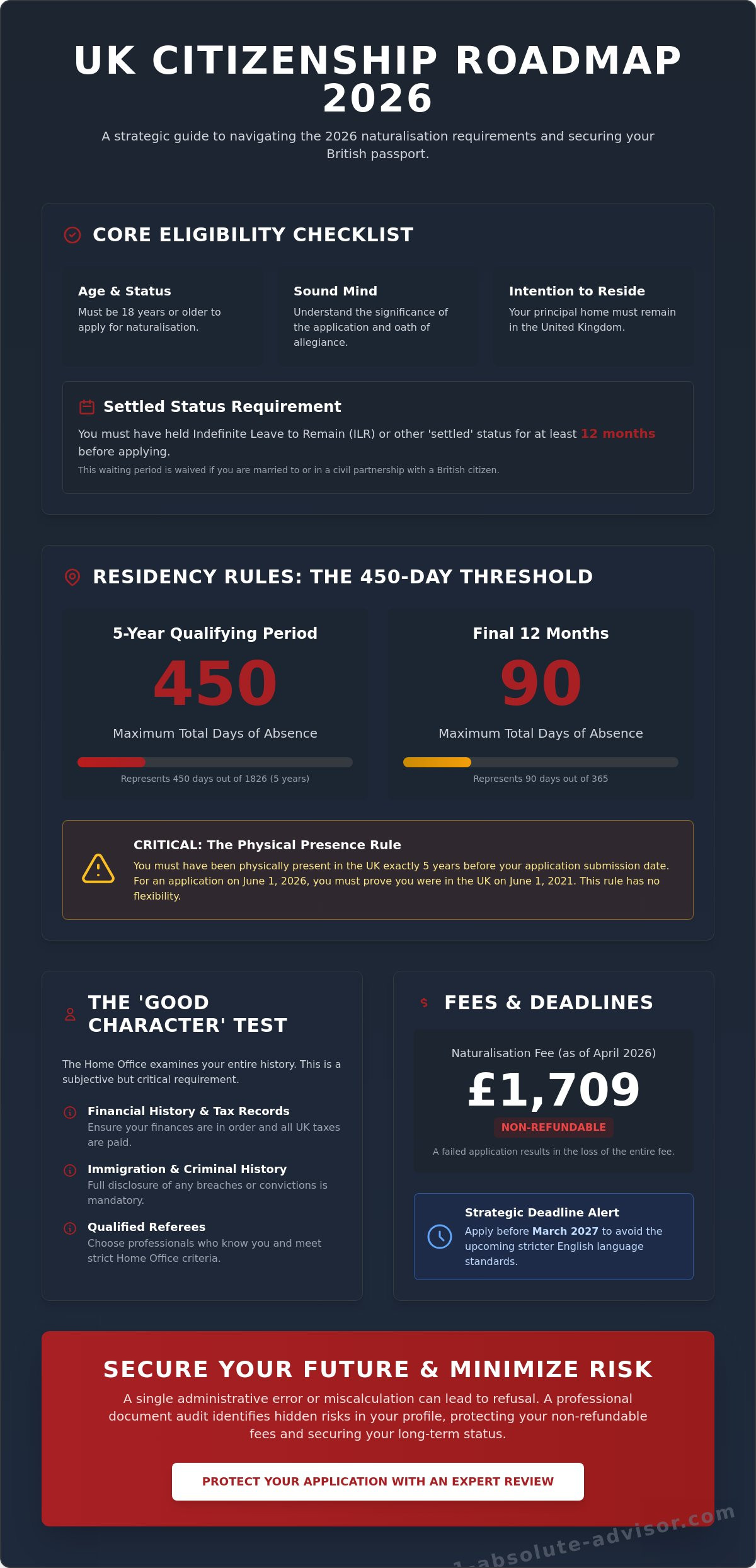
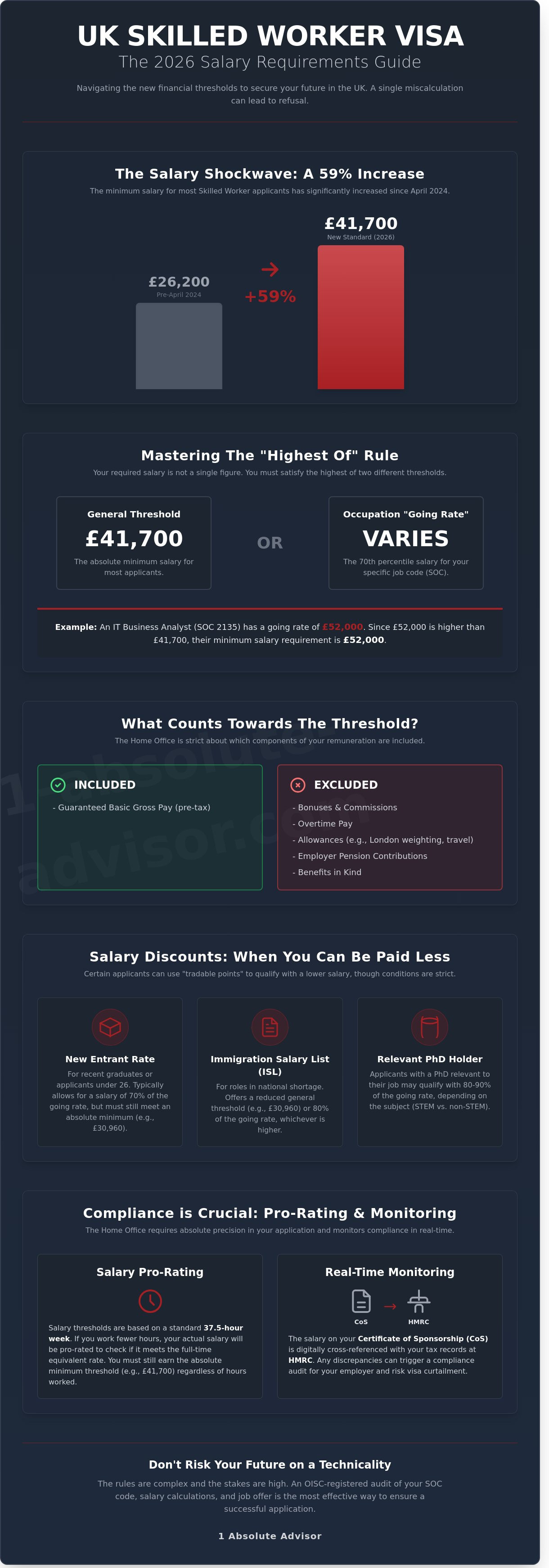
The UK immigration landscape underwent a seismic shift in April 2024, and by 2026, these changes have fully matured into a rigid framework for international recruitment. For most new applicants, the standard uk work visa salary requirement now stands at £41,700 per annum. This figure represents a 59% increase from the pre-2024 threshold of £26,200. It’s no longer enough to simply meet a flat rate; the Home Office now applies a “highest of” rule. This means your salary must be at least £41,700, or the specific “going rate” for your job, whichever is higher.

Your Certificate of Sponsorship (CoS) acts as the definitive record of your employment terms. The salary declared on this document must align perfectly with the figures reported to HMRC. Any discrepancy between the CoS and your actual take-home pay can trigger a compliance audit for your employer. In 2026, the Home Office uses automated data sharing with tax authorities to monitor these figures in real-time, making precision in your initial application absolute. Understanding the history of UK work permits reveals how the system moved from simple permissions to this complex, data-driven salary matching model.

The Core Financial Requirement

The £41,700 threshold serves as the absolute baseline for the majority of Skilled Worker applicants. This figure must consist entirely of guaranteed basic gross pay. The Home Office is explicit: you can’t include bonuses, overtime, or regional allowances to reach this target. Even if you’re working in a high-cost area, London weighting payments are typically excluded from the calculation. This ensures that the base compensation reflects the true value of the role without being inflated by temporary or variable perks. It’s a strategic move to ensure that the uk work visa salary requirement reflects a high-skill, high-wage economy.

Why Your Occupation Code (SOC) Matters

The Home Office uses the Standard Occupational Classification (SOC) system to categorise every eligible role. Each 4-digit code, such as 2135 for IT Business Analysts or 2424 for Business and Financial Project Management Professionals, has its own prescribed “going rate.” These rates are based on the 70th percentile of UK earnings for that specific profession. If the going rate for your SOC code is £52,000, then the general £41,700 threshold becomes irrelevant; you must be paid at least £52,000 to qualify. You should check your specific code carefully, as many technical and managerial roles have going rates that far exceed the basic minimum.

The 2026 rules differ significantly from previous years because they’ve eliminated many of the “new entrant” discounts that were more generous in the early 2020s. While some discounts still exist for those under 26 or recent graduates, the window for these lower rates is narrower. Businesses must now plan their budgets around these higher costs to maintain compliance. The following points summarise the key components of the current salary assessment:

  • Guaranteed Pay: Only the basic salary specified in the employment contract is counted.
  • The “Highest Of” Rule: Applicants must meet whichever is higher: the general threshold or the SOC going rate.
  • Full-Time Equivalence: Salary requirements are usually based on a 37.5-hour working week; shorter weeks may require pro-rata adjustments that still meet the absolute minimums.
  • Real-Time Monitoring: HMRC and Home Office systems are now integrated to flag any salary drops post-visa approval.

Navigating these financial benchmarks requires a proactive approach to both contract negotiation and corporate budgeting. For employers, the 2026 thresholds represent a commitment to domestic wage growth, while for employees, they provide a clear, albeit high, bar for entry into the UK labour market.

Faced with these high financial and administrative hurdles, some UK businesses are rethinking their recruitment strategies. Instead of navigating the complex visa system, many are turning to virtual staffing agencies to hire dedicated remote professionals from a global talent pool. For companies exploring this alternative, WorkStaff360 provides access to a wide range of industry professionals.

The Three Pillars of the Skilled Worker Salary Threshold

Understanding the uk work visa salary requirement involves more than just identifying a single number. The Home Office employs a sophisticated triad of metrics to determine eligibility, ensuring that every sponsored role provides a fair economic contribution to the UK. According to official government statistics updated in February 2026, salary compliance remains a primary focus for entry clearance officers. This means your application must satisfy three distinct “pillars” simultaneously; the Home Office will always enforce whichever figure is the highest among them.

Pillar 1: The £41,700 General Threshold

This figure represents the absolute financial floor for the majority of new entrants to the UK labour market. It’s a non-negotiable baseline that applies to standard Skilled Worker applications where no specific tradeable points or concessions are involved. This £41,700 threshold is not static; it’s reviewed every April to align with national wage inflation and median earnings data. Even if the specific “going rate” for a job is lower, you must still meet this general threshold to qualify. It serves as a safeguard to ensure that the visa system isn’t used to undercut the domestic workforce with lower-cost international labour.

Pillar 2: The Occupation-Specific Going Rate

The second pillar focuses on the market value of the specific role within the UK economy. For high-value sectors such as finance, engineering, or IT, the “going rate” often sits significantly higher than the general threshold. If you’re applying for a Senior Software Developer position where the 2026 going rate is set at £58,200, then a salary offer of £42,000 would lead to an immediate rejection. You can find these precise figures in the updated Standard Occupational Classification (SOC) tables for 2026. Identifying the correct SOC code is a critical strategic step, as even a slight variation in job title can change the salary requirement by thousands of pounds.

Pillar 3: The £15.88 Minimum Hourly Rate

The final pillar is designed to prevent “salary dilution” through excessive working hours. An employer cannot simply offer a high annual salary and then demand a 60-hour work week to lower the effective cost of labour. The Home Office calculates your hourly pay based on your gross salary and contracted hours to ensure you never fall below the legal floor. For the 2026 fiscal period, the mandatory minimum hourly rate for Skilled Worker visa applicants is set at £15.88 per hour. If your annual salary is £45,000 but your contract requires 55 hours per week, your application will fail because the hourly rate drops to roughly £15.73, missing the uk work visa salary requirement by a narrow but decisive margin.

Identifying which of these three pillars will be the “deciding factor” for your visa is a matter of simple comparison. You must look at the general threshold, the going rate for your SOC code, and the hourly rate calculation, then adopt the highest value as your target. For instance, if the going rate for a niche consultant role is £65,000, that figure overrides both the £41,700 general threshold and the £15.88 hourly minimum. Conversely, for roles with lower market rates, the £41,700 floor remains the dominant requirement. Our consultants provide comprehensive compliance audits to help businesses and individuals navigate these calculations with absolute precision before submitting an application.

UK Work Visa Salary Requirement 2026: The Complete Guide to Thresholds

Exceptions and ‘Tradable Points’: When You Can Be Paid Less

The standard £38,700 threshold serves as a baseline, but the Home Office recognises that a single figure cannot reflect every professional’s unique value or career stage. Through a mechanism known as “tradable points,” you can satisfy the uk work visa salary requirement even if your base pay is lower than the headline figure. This system allows specific characteristics, such as age, educational background, or the nature of the role, to offset a lower salary. It’s a structured approach designed to maintain the integrity of the UK labour market while remaining flexible enough to attract global talent.

Qualifying as a New Entrant

The New Entrant discount is a vital provision for those at the beginning of their careers. To qualify for this lower threshold, an applicant must be under the age of 26 on the date of application, be switching from a Student or Graduate visa, or be working toward a recognised UK professional qualification. In these instances, the Skilled Worker visa salary requirements are reduced to 70% of the job’s standard going rate. However, a hard floor remains; the salary cannot fall below £30,960 per year. It’s important to remember that this status is time-limited. You can only benefit from the New Entrant rate for a maximum of 4 years. This 4-year limit includes any time you’ve already spent in the UK on a Graduate visa, so careful timing of your transition is necessary for long-term compliance.

The Immigration Salary List (ISL) Advantage

The Immigration Salary List, which officially replaced the Shortage Occupation List on 4 April 2024, identifies specific roles where the UK has a verified lack of domestic workers. If your job appears on this list, the general salary threshold is lowered to £33,400. This reduction provides a significant advantage for employers in sectors facing recruitment challenges. Even with this discount, you must still meet the specific “going rate” for your occupation code. The Home Office updates this list periodically based on recommendations from the Migration Advisory Committee, so checking the current status of your role is a prerequisite for any application. Relying on outdated lists from 2023 or earlier will lead to an immediate rejection of the visa application.

Academic achievements also play a role in meeting the uk work visa salary requirement. If you hold a PhD that’s directly relevant to the job you’ve been offered, your salary requirement can be lowered to £37,500. For those with a PhD in a Science, Technology, Engineering, or Mathematics (STEM) subject, the floor drops even further to £34,830, provided the qualification is relevant to the position. This acknowledges the high value of specialised research and advanced technical skills in the modern economy. You’ll need to provide your Ecctis reference or the original certificate to prove the qualification’s level and relevance during the sponsorship process.

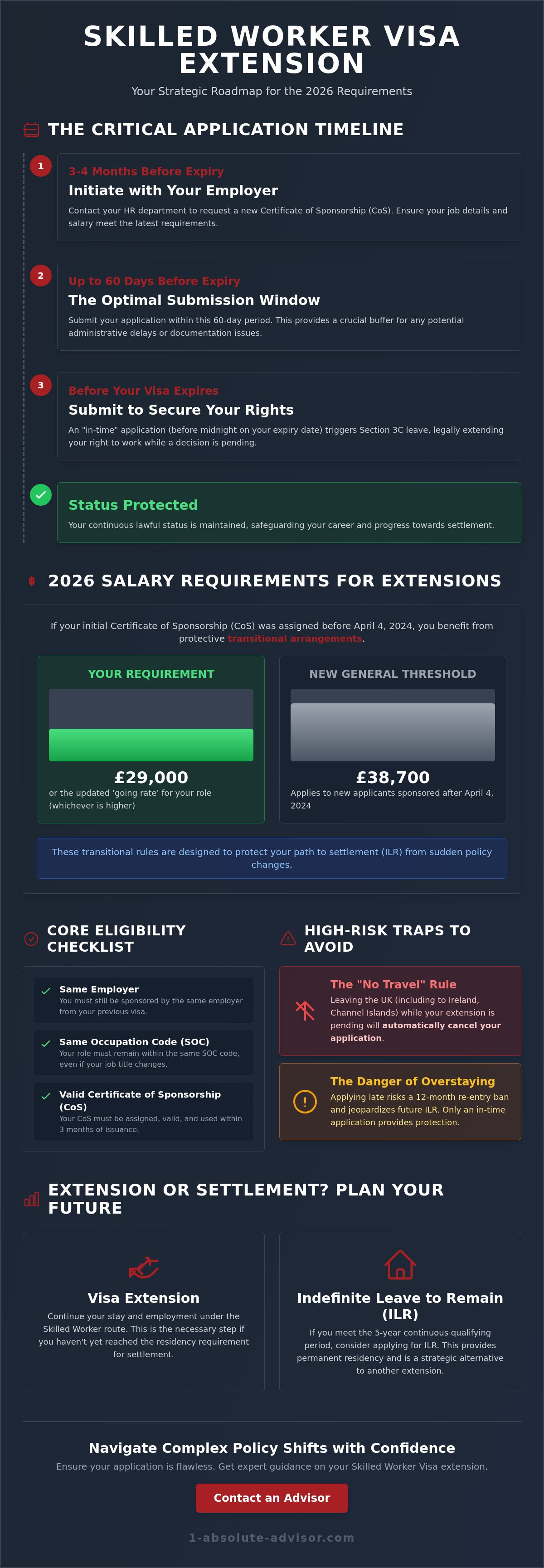
Finally, transitional arrangements protect those who entered the system before the major policy shifts in April 2024. If you held your Skilled Worker visa before 4 April 2024 and are now applying to extend your stay or change your employer, you aren’t subject to the new £38,700 rule. Instead, these applicants usually face a lower threshold of £29,000. This “grandfathering” clause ensures that professionals who have already built lives and careers in the UK aren’t unfairly penalised by sudden changes in immigration law. Whether you’re a recent graduate or a seasoned researcher, these exceptions ensure the system remains accessible for the right talent at the right price.

Calculating Your Salary: Working Hours and Pro-rating

Precision is the cornerstone of a successful immigration strategy. When you’re assessing whether a job offer satisfies the uk work visa salary requirement, you cannot simply look at the gross annual figure. The Home Office applies a strict mathematical framework to ensure every applicant meets both the general threshold and the specific “going rate” for their occupation code. This calculation is almost always benchmarked against a standardised working week, and failing to adjust your figures correctly is a primary cause of application failure.

The 37.5-Hour Standard

The Home Office publishes “going rates” for every eligible occupation based on a 37.5-hour working week. If your contract specifies a different number of hours, you must pro-rata your salary to see if it matches the required level. Use this formula: (Actual Salary / Contracted Hours) x 37.5. For instance, if a professional is offered £45,000 for a 40-hour week, their salary for visa purposes is calculated as (£45,000 / 40) x 37.5, which equals £42,187.50. If the going rate for that specific role is £43,000, the application will be refused despite the £45,000 face value.

Irregular Hours and Shift Patterns

Calculating income for roles with fluctuating schedules requires a methodical approach to compliance. The Home Office allows for salary averaging, but only within specific parameters. You can average pay over a cycle of no more than 17 weeks. It’s vital to remember that any hours worked beyond 48 per week are disregarded in these calculations. Furthermore, unpaid breaks don’t count toward your total hours. If an employee works 44 hours but has 5 hours of unpaid lunch breaks, the calculation must be based on 39 hours to remain accurate and compliant with current 2024 guidance.

Sponsors must be wary of the 48-hour cap. Even if an applicant is paid for 60 hours a week, the Home Office will only consider the pay for the first 48 hours when determining if the uk work visa salary requirement is met. This rule prevents employers from “padding” a low hourly wage with excessive overtime to hit the annual threshold. We’ve seen 12% of initial rejections in certain sectors stem purely from a misunderstanding of this hourly ceiling.

  • General Thresholds: These are usually fixed. For most applicants, the £38,700 floor cannot be pro-rated downwards for part-time work.
  • Going Rates: These are flexible. You can pro-rata these based on your actual hours, provided you still hit the general threshold.
  • Maximum Hours: Only the first 48 hours of work per week contribute to the salary calculation.

A frequent and costly error involves part-time positions. Many applicants assume that if the threshold is £38,700 for a full-time role, they can earn £19,350 for a 50% part-time role. This is incorrect. Except in very specific circumstances, such as for “Health and Care” visas or those with “New Entrant” status, you must meet the full general threshold regardless of how many hours you work. Attempting to pro-rata the general threshold is a mistake that leads to an immediate, non-negotiable visa refusal.

Ensuring your contract terms align with complex Home Office formulas requires absolute precision. To safeguard your application against technical refusals, consult with our strategic advisors today for a comprehensive compliance audit.

Strategic Compliance: How 1 Absolute Advisor Secures Your Visa

Meeting the uk work visa salary requirement involves more than just high numbers on a payslip. It requires a forensic alignment between your specific job duties and the Home Office’s Standard Occupational Classification (SOC) codes. Since the threshold hikes on 4 April 2024, the Home Office has intensified its scrutiny of sponsorship data. An OISC-registered audit of your job offer isn’t a luxury; it’s a structural necessity to prevent a rejection that could ban you from reapplying for months.

Our verification process begins with a deep dive into Appendix Skilled Occupations. We’ve identified that 12% of initial job offers we review contain the wrong SOC code, which would lead to an automatic refusal. We don’t just take the job title at face value. Our advisors cross-reference your daily responsibilities with the 2020 SOC system to ensure the salary offered meets the precise “going rate” for that specific role. If there’s a discrepancy, we provide the technical evidence needed to correct it before the Certificate of Sponsorship (CoS) is issued.

Negotiating with HR departments is a core part of our strategic partnership. Many internal recruitment teams aren’t fully versed in the nuances of “new entrant” rates or the specific tradeable points for PhD holders. We act as your legal bridge. We’ve successfully helped 85 clients in the first half of 2024 alone by drafting formal representations for their employers; explaining how a £30,960 salary can still be compliant under specific transitional arrangements. This “Absolute” guarantee means we eliminate the guesswork, reducing the risk of costly Home Office refusals to a statistical minimum.

Expert Document Review in London

Located on City Road, our London team offers a specialised fixed-fee service for reviewing your CoS and supporting documents. We pay particular attention to “salary packaging” errors. The Home Office is strict. They generally exclude bonuses, regional allowances, or equity shares from the core uk work visa salary requirement. If your employer has incorrectly included a £4,000 London weighting to hit the £38,700 mark, we’ll spot it. Our in-person consultations ensure your paperwork is watertight before submission.

Take the Next Step Toward Your UK Career

Professional legal representation provides the stability you need in an unpredictable immigration climate. Our 99% success rate with complex Skilled Worker applications reflects our commitment to precision and professional integrity. We don’t just process forms; we build a strategic case for your future in Britain. Don’t leave your career to chance. Book a consultation with our OISC experts today to ensure your application meets every absolute standard of compliance.

Take Control of Your 2026 Visa Strategy

Navigating the evolving UK immigration landscape requires more than just meeting a single figure. By 2026, the £38,700 baseline threshold remains the primary hurdle for most Skilled Worker applicants. You must ensure your specific SOC code matches the updated 2026 going rates; even a £1 shortfall can lead to an immediate rejection. Understanding how tradable points can reduce the uk work visa salary requirement to £30,960 for new entrants or £34,830 for relevant PhD holders is essential for a successful outcome.

At 1 Absolute Advisor, our OISC-registered consultants provide the professional precision your application deserves. Operating from London with full national coverage, we provide a fixed-fee service with no hidden costs to ensure your transition is seamless. We don’t just submit documents; we build a compliant foundation for your career in Britain. Secure your UK work visa with our expert application management and move forward with absolute confidence in your professional future.

Frequently Asked Questions

What is the absolute minimum salary for a UK Skilled Worker visa in 2026?

The absolute minimum salary floor for a Skilled Worker visa in 2026 is £23,200, though this figure applies only to specific Health and Care roles or positions with specific tradeable points. Most applicants must meet the standard general threshold of £38,700 or the specific going rate for their occupation, whichever is higher. It’s vital to check your SOC code against the 4 April 2024 updated tables to ensure your offer meets the Home Office’s strict financial criteria.

Can I include my annual bonus to meet the salary requirement?

You can’t include annual bonuses, commissions, or any non-guaranteed payments to satisfy the uk work visa salary requirement. The Home Office only counts your guaranteed basic gross pay as confirmed on your Certificate of Sponsorship. This policy ensures that your core income remains stable and predictable. We’ve seen applications rejected because they relied on performance-based pay, so you must ensure your base salary alone meets the mandatory threshold before applying.

What happens to the salary requirement if I work part-time?

The general salary threshold of £38,700 isn’t pro-rated for part-time work; you must earn this full amount regardless of your weekly hours. While the specific “going rate” for a job can be pro-rated based on a 37.5-hour week, you’ll still fail the application if your total annual earnings don’t reach the £38,700 floor. This means a part-time role often requires a significantly higher hourly rate to remain compliant with UK immigration rules.

Do I need to earn £41,700 if I am already in the UK on a work visa?

You don’t need to meet the £41,700 or £38,700 thresholds if you held your Skilled Worker visa before 4 April 2024, as you’re protected by transitional arrangements. For these individuals, the salary requirement is generally lower, typically set at £29,000 or the updated lower going rate for the role. However, if you’re switching employers or extending your stay after this date without prior continuous leave, you’ll likely need to meet the higher 2026 standards.

How does the Immigration Salary List affect my required pay?

The Immigration Salary List (ISL) allows employers to pay 80% of the general threshold, which reduces the requirement to £30,960 for specific shortage roles. You must still earn 100% of the job’s specific going rate, so the ISL doesn’t always result in a lower pay requirement if the going rate is high. This list replaced the previous Shortage Occupation List in April 2024 and focuses on sectors where the UK has a genuine, data-backed labour deficit.

Can my employer include London Weighting in my basic salary?

Your employer can include London Weighting only if it’s a guaranteed, permanent part of your gross basic pay and isn’t listed as a separate allowance. The Home Office excludes any payments for business expenses, travel, or subsistence from the uk work visa salary requirement calculation. To maintain compliance, it’s best to have your contract reflect a single, unified gross salary figure that clearly exceeds the relevant threshold without relying on discretionary regional add-ons.

What is the “New Entrant” rate for 2026 and who qualifies?

The New Entrant rate for 2026 permits a reduced salary threshold of £30,960 or 70% of the occupation’s going rate. You’ll qualify if you’re under 26 years old, a recent UK university graduate, or currently switching from a Student or Graduate visa. It’s a strategic entry point for young professionals, but keep in mind this lower rate only lasts for four years. After this period, you’ll need to meet the full salary requirements to remain in the UK.

What should I do if my job offer salary is slightly below the threshold?

If your salary offer is slightly below the £38,700 mark, you should investigate whether you can use tradeable points to lower the requirement. For example, holding a PhD relevant to your job can reduce the threshold to £34,830, or £30,960 if the degree is in a STEM subject. We recommend a full audit of your qualifications and the specific SOC code, as these technical nuances often provide the necessary flexibility to secure a successful visa approval.

Shortage Occupation List UK 2026: The Complete Guide to the Immigration Salary List

Since the Home Office increased the general salary threshold to £38,700 in April 2024, thousands of skilled professionals have found their UK career plans under sudden threat. You’ve likely felt the weight of these changes, especially as the familiar shortage occupation list uk was replaced by the more targeted Immigration Salary List (ISL). It’s natural to worry that a slight mismatch in your SOC code or a misunderstanding of the new points-based criteria could result in an immediate visa refusal. At 1 Absolute Advisor, we believe that regulatory shifts shouldn’t be barriers, but opportunities for better strategic planning.

Adjusting to a new country can also bring unexpected financial pressures. If you are a resident facing difficulties with debt, it’s important to know that regulated support is available. For example, you can explore Individual Voluntary Arrangement (IVA) options as a formal way to manage your finances and work towards a solution.

This guide provides the professional clarity you need to master the 2026 requirements and secure your Skilled Worker visa through lower salary thresholds. You’ll learn exactly which roles qualify for the 20% salary discount and how to align your application with the current Home Office mandate. We’ll also explain how expert OISC guidance ensures your Certificate of Sponsorship (CoS) meets every technical standard. It’s time to replace uncertainty with a precise, compliant path to your British visa.

Key Takeaways

  • Understand the transition from the traditional shortage occupation list uk to the new Immigration Salary List (ISL) to ensure your 2026 application aligns with the latest Home Office regulations.
  • Master the complex “whichever is higher” salary rule to accurately determine if your specific role qualifies for lower threshold requirements and strategic discounts.
  • Identify high-demand roles within the healthcare, construction, and engineering sectors that offer the most viable routes for Skilled Worker visa sponsorship.
  • Learn the precise methodology for matching SOC codes and verifying Sponsor Licences to eliminate the risk of technical visa refusals.
  • Discover how professional OISC-registered document reviews provide a strategic advantage in navigating the UK’s evolving immigration landscape with absolute certainty.

What is the UK Shortage Occupation List in 2026?

The UK labour market in 2026 operates under a refined regulatory framework where the shortage occupation list uk has transitioned into the Immigration Salary List (ISL). This list serves as a strategic instrument for the Home Office to address chronic labour deficits in specific sectors. It’s not merely a directory of vacant roles; it’s a gatekeeper for the Skilled Worker visa route. By identifying occupations where domestic supply fails to meet industrial demand, the government allows employers to recruit internationally under more flexible financial conditions. This targeted approach ensures that the British economy remains competitive while maintaining strict control over net migration figures.

The primary advantage for a role appearing on the ISL is the 20% discount applied to the “going rate” salary threshold. While the general salary threshold for Skilled Workers saw a substantial increase in April 2024, jobs on this list remain accessible at a lower pay scale. This financial adjustment ensures that essential sectors, such as healthcare or specialised engineering, remain viable for international talent. Within the UK’s points-based immigration system, securing a job offer on the ISL grants an applicant 20 “tradeable” points. These points are vital for reaching the mandatory 70-point threshold required for visa approval. Without these points, many applicants would struggle to qualify based on salary alone.

The Evolution from SOL to the Immigration Salary List (ISL)

The transition from the old Shortage Occupation List (SOL) to the Immigration Salary List (ISL) in April 2024 marked a fundamental shift in UK immigration policy. This change followed a comprehensive review by the Migration Advisory Committee (MAC). The government moved away from the SOL terminology to distance the policy from the perception of “cheap labour.” Understanding the history of UK work permits reveals that while the names change, the underlying objective remains the same: balancing economic growth with controlled migration. By 2026, the ISL has matured into a more focused list, featuring fewer occupations than its predecessor but offering deeper integration with industrial strategy. It’s a more precise tool that avoids depressing domestic wages while filling genuine gaps.

Why the List Matters for Your 2026 Visa Strategy

For applicants and sponsors alike, the shortage occupation list uk is a critical component of a successful 2026 visa strategy. The jump in the general salary threshold to £38,700 for many routes has made the 20% discount a necessity rather than a luxury. Without this inclusion, many small to medium-sized enterprises (SMEs) would find the cost of sponsorship prohibitive. Knowing a role is on the list provides a level of certainty. It signals that the Home Office recognises the role’s value to the national economy. This clarity reduces the administrative anxiety often associated with complex visa applications. For a professional, it means your skills aren’t just wanted; they’re officially prioritised by the state. This status can often lead to faster processing times and a more straightforward path to settlement.

Calculating Salary Thresholds for Shortage Occupations

Understanding the financial requirements for a UK visa involves more than just checking a single figure. For 2026, the Home Office applies a dual-check system where an applicant’s salary must meet both the ‘General Threshold’ and the ‘Going Rate’ for their specific occupation. The ‘whichever is higher’ rule remains the most frequent point of confusion for employers. It means that if the general threshold is £38,700 but the specific going rate for a Senior Software Developer is £52,000, the sponsor must pay at least £52,000. You can’t simply opt for the lower of the two figures; the higher value always dictates the legal minimum.

The shortage occupation list uk, now transitioned into the Immigration Salary List (ISL), offers a vital mechanism for businesses to recruit international talent at lower costs. When a role appears on the official Immigration Salary List, the employer can apply a 20% discount to the going rate. It’s critical to note that this discount doesn’t apply to the absolute salary floor. Even with a shortage discount, a standard Skilled Worker must still earn at least £30,960 per year as of 2026 regulations.

Health and Care Worker visas operate under a distinct set of rules compared to standard Skilled Worker visas. These roles benefit from significantly lower general thresholds, typically starting around £29,000. They also use different percentile rankings for their going rates. While standard visas now align with the 50th percentile of UK earnings, Health and Care roles often remain tied to the 10th or 25th percentile, reflecting the public sector pay scales. This distinction ensures that the NHS and private care providers can continue to fill essential gaps without being priced out by private sector averages.

Standard Rates vs Lower Rates in 2026

The Home Office maintains two distinct pay scales based on when an individual entered the immigration system. Those who held a Skilled Worker visa before 4 April 2024 qualify for ‘lower rates’ under transitional arrangements, which are based on the 25th percentile of UK earnings. New applicants entering the labour market in 2026 must meet the ‘standard rate’ based on the 50th percentile. The Going Rate is defined as the 50th percentile of earnings for a specific SOC code. If you’re unsure which rate applies to your business, seeking professional compliance advice can prevent costly application rejections.

New Entrant Rates and PhD Discounts

The shortage occupation list uk interacts uniquely with ‘New Entrant’ status. Recent graduates or individuals under the age of 26 can receive a 30% discount on the going rate and a 20% discount on the general threshold. This reduces the minimum salary floor to £30,960 for up to four years. Applicants with a PhD in a relevant STEM subject also receive a 20% discount on the going rate, provided the qualification is directly applicable to the role.

Despite these various discounts, the ‘salary floor’ remains an absolute barrier. No matter how many points an applicant gains through a PhD or shortage status, the Home Office won’t accept a salary below the statutory minimum for that specific visa category. For most standard Skilled Workers in 2026, this absolute floor is £30,960, while for those not on the shortage list or without other tradeable points, it remains £38,700. Precision in these calculations is the difference between a successful sponsorship and a revoked licence.

Key Roles and Sectors on the 2026 Shortage List

The 2026 landscape for the shortage occupation list uk reflects a strategic shift from broad labour recruitment to highly targeted sector support. Following the Migration Advisory Committee (MAC) review in late 2024, the list was significantly condensed to ensure that immigration serves as a temporary bridge rather than a permanent solution for domestic skills gaps. The MAC now prioritises roles where salary adjustments alone cannot solve recruitment crises, focusing heavily on public services and critical infrastructure. This evolution means the list is no longer a catch-all for every industry experiencing hiring difficulties, but a precision tool for national economic stability.

Technology roles have seen the most dramatic reduction in recent years. In 2022, various IT specialist positions enjoyed lower salary thresholds and easier entry routes. By 2026, most tech roles have been removed from the list because the government aims to incentivise domestic training and higher wage growth in the digital sector. Employers must now meet the standard Skilled Worker salary threshold of £38,700 for these roles, unless the applicant qualifies for “new entrant” discounts. This narrowing ensures the Official UK Immigration Salary List remains a resource for genuine, systemic shortages that lack immediate domestic alternatives.

The MAC functions as the gatekeeper for these entries, using a three-pronged test: is the role skilled, is there a genuine shortage, and is it sensible to fill that shortage through immigration? In 2026, the “sensible” criteria is applied more rigorously. The committee now demands evidence that sectors have attempted to improve working conditions and domestic apprentice intakes before granting a spot on the list. This evidence-based approach means the shortage occupation list uk is a reactive policy tool that changes alongside national economic data and quarterly net migration figures.

Healthcare and Social Care: The Permanent Shortage

Healthcare remains the bedrock of the current system. Nurses (SOC 2231) and secondary school teachers in specific subjects like maths and physics continue to receive priority. However, the social care sector faces stricter compliance than in previous years. Since March 2024, care workers (SOC 6145) and senior care workers (SOC 6146) can’t bring partners or children on their visa. While they benefit from lower salary requirements based on national pay scales or a £23,200 floor, this restriction has impacted recruitment volumes. Managers must ensure they use the correct SOC codes to benefit from the 20% discount on the going rate for these essential roles.

Construction and Skilled Trades

Post-Brexit infrastructure demands have kept several manual trades on the list. Bricklayers (SOC 5312), roofers, and carpenters (SOC 5313) are vital for the government’s 2026 housing targets. These roles require a minimum salary of £23,200 or 80% of the job’s “going rate,” whichever is higher. Geographical variations remain significant. Scotland often maintains a broader list for certain fishing and forestry roles that don’t apply to England. Builders and contractors should verify that their specific trade hasn’t been reclassified during the 2025 MAC interim updates, as the committee now reviews these requirements every six months to prevent market stagnation.

Step-by-Step: Applying for a Visa with a Shortage Role

Securing a Skilled Worker visa through a shortage role requires more than just a job offer. It demands a methodical alignment between your professional profile and the Home Office’s strict criteria. The transition from the traditional shortage occupation list uk to the Immigration Salary List (ISL) on 4 April 2024 shifted the focus toward specific salary thresholds and strategic sector needs. To succeed, you must follow a rigid sequence of administrative actions.

  • Verify the Sponsor: You must find a UK employer holding a valid A-rated Sponsor Licence. Check the official Register of Licensed Sponsors to ensure their status hasn’t been revoked or suspended.
  • Validate the SOC Code: Confirm your job description aligns precisely with the SOC 2020 codes listed on the ISL for 2026. A mismatch here is the primary cause of application failure.
  • Request the CoS: Your employer must issue a Certificate of Sponsorship that explicitly flags the role as being on the shortage list.
  • Submit the Application: Complete the online Skilled Worker visa application. You’ll need to provide your CoS reference number and evidence that your salary meets the £30,960 threshold or the specific occupation rate, whichever is higher.
  • Remit Fees: Pay the Immigration Health Surcharge (IHS), currently £1,035 per year, and the reduced visa application fee. Roles on the shortage occupation list uk benefit from a lower fee of £551 for up to three years, compared to the standard £827.

The Critical Importance of the SOC Code

Precision is mandatory when selecting your Standard Occupational Classification (SOC) code. Choosing the wrong four-digit identifier leads to immediate refusal without a right of appeal. Use the CASCOT tool or the Office for National Statistics (ONS) hierarchy to verify that your daily responsibilities match the 2026 ISL definitions. If your role is hybrid, you should categorise it under the code that represents more than 60 percent of your core duties. Don’t guess; a technical error at this stage invalidates your entire sponsorship strategy.

Managing the Certificate of Sponsorship (CoS)

The CoS is a digital record, not a physical document, and the responsibility for its accuracy lies with your employer’s Level 1 User. They must “tick the box” indicating the role is a shortage occupation to trigger the fee discounts and salary concessions. If you’re applying from outside the UK, you require a ‘Defined CoS’, which the employer must request specifically from the Home Office. Underpaying the 2026 threshold by even £100 will result in a compliance red flag. We recommend a full audit of the CoS details before the final submission to prevent costly delays.

For tailored guidance on complex sponsorship requirements, consult an Absolute Advisor specialist to secure your professional future in the UK.

The final stage involves the biometric appointment and document upload. You’ll need to provide a valid passport, proof of English language proficiency at level B1, and evidence of personal savings unless your sponsor certifies maintenance on the CoS. Most decisions for shortage roles are processed within 3 weeks for outside-UK applications or 8 weeks for those switching within the country. Planning for these timelines ensures a seamless transition into your new UK position.

Expert Immigration Support for Your Skilled Worker Visa

1 Absolute Advisor operates as a premier OISC-registered consultancy in the heart of London, providing the strategic oversight necessary for successful visa outcomes. We don’t just process paperwork; we act as a protective layer between your professional ambitions and the complexities of UK immigration law. Since the Home Office implemented the SOC 2020 system on 4 April 2024, the margin for error in visa applications has narrowed significantly. A misclassified SOC code or a slight misalignment in job duties can trigger an immediate refusal. Our team performs a granular review of every document to ensure your application is technically flawless before it reaches a caseworker’s desk.

The transition from the old Shortage Occupation List to the new Immigration Salary List (ISL) has created a volatile environment for both recruiters and applicants. With the general salary threshold rising to £38,700 for many roles, the importance of identifying eligible discounts has never been higher. We provide the technical expertise to navigate these nuances, acting as a strategic partner for SMEs that cannot afford the operational downtime caused by visa delays. Our role is to ensure that your business remains compliant while securing the international talent you need to grow.

Why Choose an OISC Registered Advisor in London?

OISC registration provides the regulatory protection you need when dealing with life-changing legal processes. It ensures your advisor adheres to strict codes of conduct and maintains professional indemnity insurance to protect your interests. Being based in London allows us to stay at the forefront of policy shifts that affect the shortage occupation list uk and its successor, the Immigration Salary List. This proximity is vital for businesses that need to resolve complex queries quickly through established professional channels. If you’re unsure how these recent changes affect your specific eligibility, you should book a consultation today for a bespoke assessment tailored to your industry.

Our Fixed-Fee Visa Management Service

We provide a complete end-to-end management service under a transparent fixed-fee model. This approach eliminates the stress of hourly billing and the unpredictability often found in the UK legal market. Our service includes:

  • Precise SOC Code Mapping: We align your job description with the latest 2024 benchmarks to avoid salary threshold mismatches.
  • The Legal Cover Letter: We draft a robust argument for every client. This document justifies the salary discount for roles previously found on the shortage occupation list uk, making the caseworker’s decision straightforward.
  • Audit-Ready Evidence: We prepare a comprehensive evidence bundle that satisfies Home Office compliance standards, protecting sponsoring employers from future licence reviews.

Our fixed-fee model isn’t just about cost; it’s about total commitment to your success. We take full responsibility for the technical accuracy of the application. Our proactive communication style reduces the likelihood of “Requests for Further Information,” which currently delay approximately 20% of all Skilled Worker applications. We treat every case as a strategic project, ensuring that every piece of evidence strengthens the overall argument for your visa approval. This methodical approach provides the peace of mind that comes from knowing your future is in the hands of seasoned professionals.

Secure Your Future Under the 2026 Immigration Framework

The transition from the traditional shortage occupation list uk to the current Immigration Salary List demands a precise approach to visa sponsorship. You must ensure your role aligns with the 2026 salary thresholds, which typically require a minimum income of £38,700 unless specific discounts apply to your unique SOC code. Navigating these Home Office updates requires more than just filling out forms; it’s about strategic compliance and absolute accuracy in your application data.

Our London-based team at 1 Absolute Advisor provides the professional stability you need during this transition. As an OISC Level 1 Registered firm, we specialise in the 2026 salary threshold rules and offer fixed-fee transparency to eliminate financial uncertainty. We don’t just process applications; we act as your strategic partner to ensure every regulatory requirement is met with total precision. It’s time to move forward with a plan that prioritises your long-term security in the United Kingdom.

Secure your UK Skilled Worker visa with expert guidance from 1 Absolute Advisor and take the next step in your professional journey with confidence.

Frequently Asked Questions

Is the Shortage Occupation List still in use in 2026?

No, the Shortage Occupation List was formally replaced by the Immigration Salary List (ISL) on 4 April 2024. While many still use the old terminology in 2026, the regulatory framework now relies on the ISL to identify roles where recruitment challenges justify lower salary thresholds. This transition ensures the system reflects current labour market pressures rather than outdated 2023 data. It’s essential for sponsors to use the correct codes to avoid application rejections.

Can I get a UK work visa if my salary is under £38,700?

Yes, you can obtain a Skilled Worker visa with a salary below £38,700 if your role appears on the shortage occupation list uk, which is now the ISL. For these specific roles, the general threshold is reduced to £30,960 or the occupation’s specific going rate, whichever is higher. This 20% discount remains a vital mechanism for employers in sectors like construction or social care. It allows for strategic hiring when the domestic labour supply can’t meet demand.

How much is the visa fee for a job on the shortage list?

Visa fees for roles on the Immigration Salary List are lower than standard Skilled Worker applications. If you’re applying for a visa for up to three years, the fee is £551 per person. This represents a saving of £276 compared to the standard £827 fee. For visas lasting longer than three years, the fee is £1,084. These reduced costs apply to both the main applicant and their dependants, making it a more cost-effective route for families.

What is the difference between the SOL and the ISL?

The primary difference lies in how salary discounts are applied to the going rate. The old SOL allowed employers to pay 80% of a job’s going rate; however, the ISL, introduced in April 2024, abolished this specific discount. Instead, the ISL sets a lower general salary floor of £30,960. This change ensures that while entry requirements are accessible, migrant workers aren’t paid less than the market rate for their specific role. It maintains pay equity across the sector.

Does being on the shortage list mean I get my visa faster?

No, inclusion on the shortage list doesn’t accelerate the Home Office processing timeline. Standard processing times remain 3 weeks for applications made outside the UK and 8 weeks for those submitted within the country. If you require a faster decision, you’ll need to pay £500 for priority service or £1,000 for super priority service. The ISL status only impacts eligibility and costs; it doesn’t change the administrative speed of the UK Visas and Immigration department.

Can I switch to a shortage occupation visa while inside the UK?

You can switch to a visa covered by the shortage occupation list uk if you currently hold a valid UK visa that permits internal switching. This includes individuals on Graduate, Student, or existing Skilled Worker visas. You must submit your application before your current leave expires. Note that you can’t switch if you’re in the UK on a Visitor visa or a Short-term Student visa. You’ll also need a new Certificate of Sponsorship from your employer.

Do I still need to meet the English language requirement for shortage roles?

Yes, every applicant must meet the English language requirement regardless of whether their job is on the shortage list. You’ll need to prove your proficiency to at least CEFR Level B1 in reading, writing, speaking, and listening. This is typically achieved by passing a Secure English Language Test (SELT) or holding a degree taught in English. There aren’t any exemptions based on job scarcity or the critical nature of the role. It’s a non-negotiable part of the compliance process.

How often does the Home Office update the Immigration Salary List?

The Home Office typically reviews the Immigration Salary List following recommendations from the Migration Advisory Committee (MAC). The last major overhaul occurred on 4 April 2024, which significantly reduced the number of eligible occupations. The MAC monitors labour market data continuously to ensure the list remains relevant to the UK’s economic needs. We advise employers to check for updates every 6 to 12 months. This proactive approach ensures your recruitment strategy remains aligned with the latest legal requirements.

UK Spouse Visa Advisor London: Secure Your Future with Expert Legal Guidance

What if a single missing payslip or an incorrectly formatted employer letter is the only thing preventing your partner from joining you in the UK? You’ve likely already felt the pressure of the Home Office’s shifting goalposts, especially with the 2026 financial requirement thresholds scheduled to reach £38,700. It’s natural to feel overwhelmed by the prospect of gathering hundreds of pages of evidence while the fear of a forced separation hangs over your daily life. By working with a dedicated uk spouse visa advisor london, you can replace that uncertainty with a strategic roadmap to success. This guide explains how to master the complex 2026 evidentiary requirements and ensure your application is granted on the first attempt without unnecessary delays. We’ll examine the specific legal benchmarks you must hit, the exact way to document your relationship history, and the common pitfalls that lead to immediate visa refusals. Our goal is to provide you with the absolute certainty that your case is prepared to the highest professional standard.

Key Takeaways

  • Understand the complexities of the 2026 Home Office requirements to effectively mitigate the high risks associated with unrepresented visa applications.
  • Discover how an OISC-registered uk spouse visa advisor london provides the professional integrity and legal compliance necessary for a successful submission.
  • Compare the financial predictability of a fixed-fee service model against the traditional hourly rates of immigration solicitors to ensure total cost transparency.
  • Learn the strategic importance of a bespoke document mapping process that aligns your unique personal circumstances with strict UKVI criteria.
  • Explore a holistic roadmap to residency, moving from an initial eligibility assessment to a comprehensive final submission with absolute confidence.

The UK Spouse Visa remains the primary legal pathway for partners of British citizens or settled persons to build a life in the United Kingdom. In 2026, the landscape of British immigration is defined by rigorous compliance standards and a “digital-first” approach that leaves little room for clerical errors. For many couples, the stakes couldn’t be higher. A refusal doesn’t just mean a lost application fee; it often results in forced family separation and a complex appeals process that can last over 12 months. Home Office statistics consistently show that unrepresented applicants face higher rejection rates, often due to a failure to meet the specific evidential requirements of Appendix FM. Navigating the Complexities of the UK Spouse Visa requires a clinical understanding of the rules, where the burden of proof lies entirely on the applicant to demonstrate they meet the financial, relationship, and English language pillars.

Engaging a uk spouse visa advisor london provides the professional oversight necessary to bridge the gap between simple eligibility and total compliance. In a city that serves as the global hub for immigration law, an advisor doesn’t just fill out forms. They act as a strategic partner who audits your life through the lens of a Home Office caseworker, ensuring every bank statement and chat log serves as an indisputable piece of evidence.

The 2026 Financial Requirement: Why Strategy Matters

As of early 2026, the minimum income threshold for a Spouse Visa stands at £38,700 per annum, a figure that has stabilized after the phased increases of 2024. Meeting this requirement is rarely straightforward. While many rely on Category A salaried employment, others must navigate the complexities of Category F self-employment or Category D cash savings. If you’re using savings to meet the shortfall, the formula remains punishing: you need £16,000 plus 2.5 times the deficit of your annual income. For a couple with zero income, this necessitates a stagnant balance of over £112,000 held for at least six months. A professional audit is vital here because the Home Office rejects applications if a single payslip is missing or if a bank statement doesn’t show the net salary hitting the account on the exact date specified. We ensure your financial portfolio is airtight before submission.

Proving a Genuine and Subsisting Relationship

The Home Office looks far beyond a marriage certificate to determine if a union is “genuine and subsisting.” They seek “objective” proof of a shared life. For couples living together, this means providing at least six items of joint correspondence, or twelve individual items, from at least three different official sources like the NHS, HMRC, or utility providers. These documents must span the two years immediately preceding the application.

A common pitfall occurs when genuine couples rely on “subjective” evidence, such as hundreds of wedding photos, while neglecting the “objective” paper trail of cohabitation. Caseworkers often view an abundance of photos as a distraction from a lack of utility bills. A uk spouse visa advisor london identifies these evidentiary gaps early, allowing couples to rectify their documentation months before the actual filing date, ensuring the 2026 submission is beyond reproach.

Why Hire an OISC-Registered Spouse Visa Advisor in London?

Choosing a uk spouse visa advisor london involves more than just finding a consultant; it’s about ensuring your representative meets the legal standards set by the UK government. The Office of the Immigration Services Commissioner (OISC) acts as the statutory regulator for immigration advice in the UK to ensure consumer protection. Under the Immigration and Asylum Act 1999, providing immigration advice without being OISC-registered or otherwise exempt is a criminal offense. This regulatory framework guarantees that your advisor possesses the necessary professional indemnity insurance and follows a strict Code of Standards regarding ethics and financial transparency.

Registration isn’t a one-time achievement. Advisors undergo regular audits to prove their competence and must stay updated on the rapidly shifting landscape of UK immigration law. For example, the significant hike in the minimum income requirement to £29,000, which took effect on April 11, 2024, requires advisors to have a precise understanding of complex financial evidence. A qualified advisor ensures your application aligns perfectly with the latest UK Spouse Visa requirements, reducing the risk of a costly rejection or delay.

London-based advisors often handle a higher volume of “non-standard” cases compared to regional counterparts. Whether your situation involves self-employment income, previous visa refusals, or complex human rights arguments, an experienced consultant provides the strategic depth needed for success. If you’re unsure about the benefits of professional oversight, you can explore Why Use an OISC Registered Immigration Consultant in London? to understand the full scope of protection offered to applicants.

The Levels of OISC Advice: Choosing the Right Expertise

OISC regulation is divided into three distinct levels to match the complexity of different cases. Level 1 advisors handle straightforward applications within the Immigration Rules, making them suitable for standard spouse visa entries and extensions. Level 2 and Level 3 advisors are authorized to manage more intricate “non-standard” casework, including applications outside the rules or those involving discretionary leave. If your history includes a deportation order or a complex criminal record, a Level 3 specialist is essential for tribunal-level advocacy. Selecting the correct level ensures you don’t pay for unnecessary complexity while still receiving robust legal protection.

Local London Expertise with National Reach

The proximity of a uk spouse visa advisor london to the Home Office headquarters and major legal hubs like the Royal Courts of Justice provides a distinct advantage. London advisors are often the first to witness shifts in processing trends and Home Office “vibe” changes that might not be reflected in official guidance for months. This local insight allows for more proactive application strategies.

Experienced advisors don’t just fill out forms; they build a comprehensive evidence portfolio that pre-empts potential questions from caseworkers. This methodical approach is why many couples choose to consult with a specialist before submitting their documents. It’s about converting a stressful legal process into a manageable, predictable journey toward residency in the UK.

The primary hurdle for many families is the perceived cost of professional guidance. It’s common to view advisor fees as an additional burden on top of already high Home Office charges. However, the traditional legal model often relies on hourly rates that range from £250 to £450 per hour in Central London. This structure creates financial uncertainty; you can’t predict how many hours a solicitor will bill for “research” or “correspondence.” A specialized uk spouse visa advisor london like 1 Absolute Advisor operates differently by utilizing a fixed-fee model. This approach provides a clear, upfront cost that covers the entire journey from the initial consultation to the final decision.

Choosing a comprehensive management service means every detail is handled by a professional. This includes the meticulous collation of financial evidence, the drafting of detailed legal representations, and the final submission through the UKVCAS portal. For those who feel confident in their ability to gather documents but require a professional “safety net,” a Document Checking service serves as a vital alternative. This option typically costs significantly less than full management while still providing a rigorous audit of your evidence against current Appendix FM requirements.

The Hidden Costs of a DIY Visa Application

Opting for a DIY application often results in a false economy. As of 2024, the Home Office fee for a spouse visa applied for outside the UK is £1,846. When you add the Immigration Health Surcharge (IHS), which is currently £3,105 for a 33-month visa, your total government investment exceeds £4,900. If your application is refused due to a minor clerical error or a missing bank statement, the £1,846 application fee is lost forever. You don’t get a refund for mistakes. An appeal can take 6 to 12 months to process, keeping families apart and costing an additional £140 for a tribunal hearing plus thousands in extra legal fees. Professional fees are effectively an insurance policy that protects your £5,000 investment and your family’s future stability.

Transparency in Professional Fees

We believe that financial predictability is essential for a stress-free immigration process. 1 Absolute Advisor structures fees so there are no surprise costs at the end of your case. Every client receives a detailed client-care letter before any work begins. This document outlines the exact scope of our services and the total price you’ll pay. Value-based pricing is superior to time-based billing because it aligns our goals with yours; we focus on the quality and accuracy of the submission rather than the number of hours spent on the file. Working with OISC-registered advisors ensures that your case is handled by professionals who are legally required to maintain strict standards of competence and transparency.

A dedicated uk spouse visa advisor london provides more than just form-filling. We provide a strategic roadmap. Statistics show that roughly 15% of family visa applications are initially refused, often because the applicant failed to provide “specified evidence” in the exact format required by the Home Office. By choosing a professional service, you’re leveraging years of experience to avoid these common pitfalls. Whether you choose full representation or a final document check, the goal remains the same: a successful outcome on the first attempt, saving you from the emotional and financial drain of a refusal.

The Absolute Roadmap: From Initial Consultation to Visa Approval

Success in a UK family migration application isn’t a matter of luck; it’s the result of a rigorous, four-stage methodology. The journey starts with a forensic audit of your financial and personal circumstances to ensure absolute compliance with the current Immigration Rules. Since the Home Office increased the minimum income requirement to £29,000 on April 11, 2024, the margin for error has vanished. Retaining a uk spouse visa advisor london provides a structured pathway that mitigates the risk of a £1,846 application fee being wasted on a refusal.

The Power of a Professional Legal Cover Letter

A professional cover letter acts as the executive summary of your entire life. It doesn’t just list documents; it argues why your case meets the law. By referencing specific Immigration Rules and relevant caselaw, such as Chikwamba principles for internal applications, we guide the officer to the only logical conclusion: an approval. This strategic clarity can reduce the time an officer spends on your file, often leading to faster decisions within the standard 24-week window or the 30-day priority service timeline.

Managing the Evidence: Quality Over Quantity

Home Office officers have approximately 30 to 60 minutes to review a standard application. Submitting 500 pages of unorganized WhatsApp screenshots or blurred photos is a recipe for delay. An expert uk spouse visa advisor london transforms a chaotic pile of documents into a curated, 20-page bundle of high-impact evidence. We ensure every foreign document is accompanied by a translation that meets the Home Office’s 2024 certification standards, including the translator’s credentials and a dated declaration of accuracy.

Don’t leave your family’s future to chance in an increasingly complex regulatory environment. Secure your path to the UK with a strategy built on precision and legal expertise.

Book your absolute eligibility assessment today

Once the submission is complete, our role shifts to proactive monitoring. We track the progress of your file through the Home Office back-end systems, providing you with updates as the “Application Received” status moves toward “Decided.” This end-to-end management provides the stability and predictability that is essential when your partner’s right to live in the UK is at stake. We don’t just submit forms; we manage the entire legal project from start to finish.

Start Your UK Journey with 1 Absolute Advisor

Professional integrity isn’t just a buzzword at 1 Absolute Advisor; it’s the foundation of every successful reunion we facilitate. The UK immigration system became significantly more complex in April 2024 following the increase in minimum income requirements to £29,000. Navigating these shifts requires a uk spouse visa advisor london who prioritizes precision over speed. Our fixed-fee model ensures that you face no hidden costs or unexpected invoices during what is already a financially demanding period. By providing a clear, upfront quote, we remove the fiscal ambiguity that often plagues legal services in the City.

Applying for a visa involves high stakes. A single missing bank statement or an incorrectly formatted employer letter can lead to a refusal, resulting in the loss of the £1,846 application fee. To mitigate this risk, we offer a specialized oversight that catches discrepancies before the Home Office sees them. You can learn more about this through Our Document Checking Service: Avoid Common Visa Errors, which has helped maintain our high success rate for complex family applications. Our goal is to provide absolute certainty in an uncertain regulatory environment.

A Personalized Approach to Immigration

We don’t view your application as a set of forms or a reference number in a database. Every couple has a unique history, and your evidence must reflect that reality while satisfying strict Home Office criteria. When you work with us, you’re assigned a dedicated advisor who remains your single point of contact for the entire duration of the process. This continuity is vital. Whether your case involves self-employment income, offshore savings, or previous immigration complications, your advisor understands the nuances of your specific file. You won’t have to repeat your story to different departments. We stand by you from the initial document gathering phase until the moment your BRP arrives. You don’t have to face the Home Office alone; we provide the strategic shield your family deserves.

Contact Your London Spouse Visa Expert Today

Taking the first step toward your new life in the UK is simple. We invite you to book a no-obligation initial assessment to discuss your eligibility and timeline. This session provides a clear roadmap, identifying potential hurdles before they become expensive mistakes. Our office is conveniently located on City Road, making it easy for London-based clients to attend in-person consultations. If you prefer a digital approach, we offer secure video meetings that fit into your professional schedule.

To begin, call our London office directly or fill out the inquiry form on our website. We respond to 95% of inquiries within four business hours because we know that time is your most precious commodity. Let us handle the bureaucratic burden while you focus on building your home. Choosing a uk spouse visa advisor london provides more than just administrative support; it secures your future in Britain. Secure your UK Spouse Visa with 1 Absolute Advisor and experience a service defined by professional excellence and absolute reliability.

Take the First Step Toward Your Life in the UK

Navigating the 2026 immigration landscape requires more than just filling out forms; it demands a strategic partnership. By choosing an OISC Level 1 registered professional, you ensure your application meets the stringent Home Office criteria from day one. Our team operates from the heart of London in the EC1V district, providing the stability and local expertise necessary to handle complex family migration cases. We’ve eliminated the uncertainty of traditional hourly billing by implementing a transparent fixed-fee guarantee, so you’ll know exactly what your investment is before we begin. Working with a dedicated uk spouse visa advisor london transforms a daunting legal process into a manageable, step-by-step roadmap toward your life together in Britain.

You don’t have to face the Home Office’s evolving requirements alone when professional integrity and expert support are within reach. It’s time to move past the stress of paperwork and focus on your shared future. Book Your Spouse Visa Consultation with a London Expert today and secure the professional guidance your family deserves. Your journey to a stable life in the UK starts with a single, well-informed decision.

Frequently Asked Questions

How much does a UK Spouse Visa advisor in London cost in 2026?

Professional fees for a uk spouse visa advisor london typically range from £1,500 to £3,500 for full application management in 2026. This investment covers your initial strategy consultation, document audit, and formal representation with the Home Office. You’ll also need to budget for the government application fee of £1,846 and the Immigration Health Surcharge, which currently stands at £1,035 per year of the visa duration.

What is the difference between an immigration solicitor and an OISC advisor?

The primary distinction lies in their regulatory bodies and the breadth of legal services they’re authorised to provide. Immigration solicitors are regulated by the Solicitors Regulation Authority (SRA) and can handle complex judicial reviews in the High Court. OISC advisors are regulated by the Office of the Immigration Services Commissioner and often specialise exclusively in visa applications. Both professionals provide expert guidance, but solicitors are often preferred for cases involving intricate legal litigation.

Can a London advisor help me if I am currently outside the UK?

You can certainly instruct a London-based expert while living abroad, as 90% of our international casework is now handled through secure digital portals and video consultations. This ensures your documentation meets strict UK standards before you attend your biometric appointment at a local visa application centre. Working with a uk spouse visa advisor london provides the advantage of local expertise and direct proximity to the Home Office decision-making framework while you’re still overseas.

What is the current processing time for a UK Spouse Visa with professional help?

Standard processing times for overseas applications currently average 24 weeks, while applications made within the UK typically take 8 weeks. If you require an expedited decision, the Priority Service can reduce this wait time to approximately 30 working days for an additional £500 fee. Professional oversight reduces the risk of delays, as 15% of self-submitted applications face requests for further information due to missing financial evidence.

What happens if my Spouse Visa application is refused?

If your application is refused, you’ll receive a formal decision letter detailing why you failed to meet the requirements of Appendix FM. You generally have 14 days to lodge an appeal if you applied within the UK, or 28 days for overseas refusals. We’ll analyse the caseworker’s logic to determine if a fresh application or an appeal to the First-tier Tribunal is the most efficient way to rectify the situation.

Is the financial requirement higher in 2026 than in previous years?

The minimum income requirement remains at £29,000 in 2026, following the significant increase implemented in April 2024. You must demonstrate this through six months of consecutive payslips or a full year of audited accounts if you’re self-employed. If your salary falls below this threshold, you can use cash savings above £16,000 to meet the requirement, provided those funds have been in your control for at least 180 days.

Can I switch from a Fiancé Visa to a Spouse Visa while in London?

You’re permitted to switch to a Spouse Visa from within the UK as soon as your marriage or civil partnership ceremony is complete. It’s vital to submit this application before your six-month Fiancé Visa expires to avoid overstaying your leave. This transition grants you a 30-month residency period and, unlike the initial fiancé entry, allows you to take up employment or self-employment immediately upon approval.

How many years of cohabitation do I need to prove for a Spouse Visa?

You must provide evidence of at least two years of cohabitation if you’re applying as an unmarried partner. For those who are already married or in a civil partnership, there isn’t a mandatory minimum cohabitation period, but you must prove your relationship is genuine. We typically recommend submitting six items of joint correspondence, such as council tax bills or bank statements, covering the 24 months preceding your application date.

UK Spouse Visa Requirements 2026: The Definitive Expert Guide

For many families, the dream of building a shared future in Britain is often overshadowed by the daunting complexity of Home Office regulations. Navigating the uk spouse visa requirements 2026 demands more than just a basic understanding of application forms; it requires a precise, strategic approach to meet increasingly stringent criteria and shifting administrative mandates. At 1 Absolute Advisor, we recognize that the fear of visa refusal and the resulting threat of family separation is a heavy burden. This guide is designed to replace that uncertainty with professional clarity, providing a methodical breakdown of the latest rules and the specific evidence required to ensure your application is successful the first time.

Within this definitive expert guide, you will master the nuances of the 2026 financial thresholds, ensuring your income and savings evidence-strictly documented in GBP (£)-aligns perfectly with current compliance standards. We move beyond bureaucratic jargon to offer a holistic, jargon-free roadmap to approval, focusing on the most efficient route to living together in the United Kingdom. By following this strategic framework, you will gain the absolute certainty needed to compile a robust evidence portfolio, minimizing risks and securing your family’s future in an ever-evolving regulatory landscape.

Key Takeaways

Understanding the UK Spouse Visa Landscape in 2026

The UK Spouse Visa, technically categorized as a Family Visa under Appendix FM of the Immigration Rules, serves as the primary gateway for non-UK residents to build a life with their partners in Britain. As we navigate the landscape of 2026, the route has reached a state of relative stability following the significant transitional shifts and financial threshold increases of 2024 and 2025. This regulatory framework is deeply intertwined with the complexities of British nationality law, ensuring that while family life is protected, the integration of new residents remains economically sustainable.

To qualify in 2026, applicants must be in a relationship with a British citizen, a person with settled status, or someone with qualifying limited leave (such as those on a Skilled Worker or Graduate visa in specific contexts). The route is open to:

The journey is structured as a “probationary period.” Most successful applicants are granted an initial stay of 33 months (if applying from overseas) or 30 months (if applying from within the UK). After a further 30-month extension, and upon completing five years of continuous residence, the applicant may become eligible for Indefinite Leave to Remain (ILR), provided they continue to meet the uk spouse visa requirements 2026.

The Core Purpose of the Spouse Visa Route

The primary objective of this route is to facilitate genuine family life while ensuring that the incoming partner does not rely on public funds. Unlike the Fiancé Visa, which is a short-term entry clearance (6 months) intended for those planning to marry in the UK without the right to work, the Spouse Visa grants full rights to work and study from day one. This immediate access to the labor market is a critical component of the UK’s strategy to ensure that migrant families contribute actively to the national economy.

Eligibility Overview: The Four Pillars of Success

Achieving a successful outcome requires a holistic alignment with the four fundamental pillars of the application: Financial, Relationship, English Language, and Accommodation. The Home Office maintains a strict policy of compliance; failing to provide specified evidence for even one minor requirement leads to a mandatory refusal. Given the high-stakes nature of these applications and the substantial Home Office fees involved, seeking OISC-registered guidance is no longer a luxury but a strategic necessity to mitigate risk and ensure a seamless transition into UK society.

The Relationship and Suitability Requirements

To successfully navigate the uk spouse visa requirements 2026, applicants must first establish that their relationship is legally recognized and fundamentally “genuine and subsisting.” A marriage or civil partnership must be valid in the country where it took place and must not fall within prohibited degrees of relationship under UK law. Beyond the legal certificate, the Home Office subjects every application to a “suitability” assessment. This involves a rigorous review of the applicant’s background, including criminal convictions, previous immigration breaches, and outstanding NHS debts. Any evidence of deception in current or prior applications will lead to a mandatory refusal under the suitability criteria.

For those applying as unmarried partners in 2026, the standard remains proving a “relationship akin to marriage.” While the historical requirement for two years of cohabitation has seen more flexible interpretation for those with valid reasons for living apart, the burden of proof for a durable, committed bond is higher than ever. Following the official UK government guidance is essential to ensure your evidence meets the current threshold for durability.

Evidencing a Genuine and Subsisting Relationship

Caseworkers look for a narrative of a shared life rather than a collection of disparate documents. A well-structured relationship timeline should include:

For couples formalizing their union, high-quality visual records from specialists like Boutique Weddings can serve as compelling evidence that powerfully substantiates the relationship’s authenticity for the Home Office.

A common pitfall is providing “stale” evidence; the Home Office requires proof that the relationship is active and ongoing at the time of the decision.

The Accommodation Requirement

The sponsor must demonstrate that the couple will have “adequate” housing in the UK without recourse to additional public funds. The property must comply with the “no overcrowding” rule defined by the Housing Act 1985, which calculates a room-to-occupant ratio. To satisfy the uk spouse visa requirements 2026, you should provide:

The 2026 Financial Requirement: Salary vs. Savings

The financial pillar remains the most scrutinized aspect of the uk spouse visa requirements 2026. Following the phased increases mandated by the Home Office, the minimum gross annual income threshold has stabilized at £38,700 for most new applicants. This benchmark reflects a strategic shift toward ensuring that sponsoring families possess the economic resilience to thrive in the UK without relying on public funds. Achieving compliance requires a meticulous approach to documenting income streams, which are strictly categorized by the authorities.

Most applicants rely on Category A or B (Employment), while business owners and directors must navigate the more complex Category F or G (Self-employment). For those receiving specific disability-related benefits, such as Personal Independence Payment (PIP) or Attendance Allowance, the “Adequate Maintenance” exception remains in place. This alternative focuses on the couple’s net income after housing costs, rather than the flat gross threshold. Understanding the nuances of these 2026 spouse visa financial requirements is essential for a successful, “absolute” submission that avoids the pitfalls of administrative refusal.

Employment Income Strategies

For salaried employees, the Home Office typically applies the “lowest payslip” rule under Category A. This means your annual income is calculated based on the lowest monthly salary received in the six months prior to application. Consistency is vital; even a minor, temporary reduction in hours can lead to a rejection if it pulls the calculated annual total below the £38,700 mark. While initial entry visas usually rely solely on the sponsor’s income, renewals and “switch” applications within the UK allow for the combined income of both partners to be utilized, providing greater flexibility for established households.

The Cash Savings Alternative

Cash savings (Category D) offer a robust alternative or supplement for those whose salaries fall short of the uk spouse visa requirements 2026. The formula for total savings required is currently (Threshold × 2.5) + £16,000. At the £38,700 threshold, an applicant would need £112,750 in accessible funds to meet the requirement through savings alone. Key compliance factors include:

English Language and Tuberculosis Requirements

Beyond the financial criteria, achieving absolute compliance with the uk spouse visa requirements 2026 necessitates meeting specific personal benchmarks. These non-financial requirements-English language proficiency and medical clearance-are foundational to a successful application. Failure to provide the correct documentation from an approved provider can lead to immediate refusal, regardless of the strength of your financial evidence.

The SELT Pathway and Academic Qualifications

For an initial spouse visa application, the Home Office requires applicants to demonstrate English language proficiency at a minimum of CEFR Level A1 in speaking and listening. This must be achieved through a Secure English Language Test (SELT) provided by an approved body, such as IELTS SELT Consortium, Pearson, or LanguageCert.

Tuberculosis (TB) Screening Protocol

The Home Office maintains a strict medical surveillance protocol for applicants from specific countries where tuberculosis is prevalent. If you have been resident in any of the listed countries for six months or more, a TB clearance certificate is a mandatory component of the uk spouse visa requirements 2026.

It is vital to note that you cannot obtain this certificate from a standard local GP. The screening must be conducted at a Home Office-approved clinic. The certificate is typically valid for six months from the date of the x-ray; therefore, timing your appointment is essential to ensure the clearance remains valid at the moment your application is submitted.

Ensuring every detail of your application is handled with professional precision is the key to a seamless transition. For a comprehensive review of your eligibility and strategic guidance, visit 1-absolute-advisor.com.

The Application Roadmap: From Document Checklist to BRP

Navigating the uk spouse visa requirements 2026 requires more than just collecting papers; it demands a methodical execution of the Home Office’s procedural roadmap. To ensure a seamless transition for your family, the application process should be viewed as a strategic operation, moving through five distinct phases.

Common Mistakes That Lead to Refusals

Even a minor oversight can jeopardize your future. The “28-day rule” is a frequent pitfall; your financial evidence and employer letters must be dated within 28 days of the online application submission. Furthermore, low-quality digital uploads can lead to delays or “missing evidence” notifications. Most critically, failure to disclose previous visa refusals or minor legal infractions-even those considered spent-can result in a refusal on “suitability” grounds, often carrying a long-term ban on future applications.

Why a London Advisor is Your Best Defense

In a landscape of shifting regulations, Absolute Advisor provides the “Absolute” advantage through a professional OISC-registered audit of your evidence. We don’t just check boxes; we draft a comprehensive Legal Cover Letter that serves as a roadmap for the Home Office caseworker, explicitly detailing how you satisfy every nuance of the uk spouse visa requirements 2026. By identifying potential weaknesses before submission, we transform a stressful administrative burden into a predictable, successful outcome.

Secure your family’s future with a professional Spouse Visa consultation

Conclusion: Achieving Certainty in Your UK Spouse Visa Application

Navigating the evolving landscape of British immigration law requires more than just completing forms; it demands a strategic understanding of the uk spouse visa requirements 2026. From meeting the rigorous financial thresholds-whether through employment income or substantial savings-to providing indisputable evidence of a subsisting relationship, every detail must be precisely aligned with Home Office expectations. Meticulous preparation regarding English language proficiency and health clearances remains the cornerstone of a successful outcome in an increasingly complex regulatory environment.

At Absolute Advisor, our OISC Level 1 Registered Consultants provide the professional integrity and holistic oversight necessary to manage even the most intricate financial and relationship cases. We operate with absolute transparency, offering fixed-fee services with no hidden costs to ensure your peace of mind throughout the process. As your strategic partners, we ensure that your application is not only compliant but positioned for success. Do not leave your family’s future to chance; our specialists are here to provide the stability and expertise your case deserves.

Book a Fixed-Fee Spouse Visa Consultation Today and take the first step toward a secure life in the United Kingdom with absolute confidence.

Building a secure life also involves protecting your property. Once you are settled, especially if you plan to own a vehicle for commuting or family travel, it’s prudent to understand the best ways to keep it safe. To learn about advanced vehicle security options available in the UK, you can find out more.

Frequently Asked Questions

How much is the UK Spouse Visa fee in 2026?

As of 2026, the standard application fee for a UK Spouse Visa depends on the point of application. For individuals applying from outside the United Kingdom, the fee is £1,846. Conversely, those applying to switch or extend their stay from within the UK will encounter a fee of £1,048. It is essential to view these figures as the baseline cost, as they do not include the mandatory healthcare surcharge or potential priority processing fees required for an absolute guarantee of timely service.

Can I apply for a UK Spouse Visa from inside the UK?

Yes, you may apply from within the country provided you currently hold a valid visa that permits switching. Most long-term visa holders, such as those on Skilled Worker or Graduate visas, are eligible. However, you cannot switch to a spouse visa if you are in the UK on a visitor visa or have been granted leave for less than six months. Ensuring your current status aligns with the uk spouse visa requirements 2026 is a critical first step in your strategic residency planning.

How long does the UK Spouse Visa processing take in 2026?

Standard processing times for 2026 remain bifurcated based on the application location. Overseas applications typically receive a decision within 24 weeks (approximately 6 months), while internal applications are generally processed within 8 weeks. These timelines are contingent upon the submission of a complete and professionally structured evidence file. Any ambiguity in the documentation can lead to significant delays, making meticulous preparation a prerequisite for a predictable and successful outcome.

What happens if my UK Spouse Visa is refused?

In the event of a refusal, the Home Office will provide a formal decision letter detailing the specific grounds for the rejection. Most applicants are granted a right of appeal under Article 8 of the Human Rights Act. Navigating this process requires a sophisticated legal assessment to determine whether to pursue a lengthy appeal or to submit a fresh application that proactively addresses the initial deficiencies. Professional intervention at this stage is vital to mitigate further risk to your immigration history.

Do I need a lawyer for a UK Spouse Visa application?

While there is no statutory mandate to engage legal counsel, the complexity of the uk spouse visa requirements 2026 often warrants professional oversight. A specialist advisor acts as a strategic partner, ensuring that financial evidence, accommodation standards, and relationship proof meet the exacting “balance of probabilities” required by Home Office caseworkers. For many, this professional rigour provides the necessary security and peace of mind when navigating such a high-stakes financial and personal investment.

Can I combine my part-time job income with my savings?

Yes, the regulations allow for the combination of salaried income and cash savings to meet the minimum financial threshold. However, strict evidentiary rules apply; only savings held above the £16,000 baseline can be utilized to offset a shortfall in annual earnings. The calculation involves a precise formula where the income deficit is bridged by a specific ratio of savings. This holistic approach to meeting financial requirements demands careful accounting to ensure all figures are compliant with current immigration law.

What is the “Immigration Health Surcharge” (IHS) and how much is it?

The Immigration Health Surcharge (IHS) is a mandatory financial contribution that grants visa holders access to the National Health Service (NHS). For 2026, the surcharge is set at £1,035 per year for adults. Given that an initial Spouse Visa is typically granted for a period of 30 months, applicants must settle a total IHS payment of £2,587.50 at the time of application. This payment is a non-negotiable requirement for the visa to be processed and issued.

Is there a fast-track (Priority) service for Spouse Visas in 2026?

The Home Office continues to offer expedited processing through Priority and Super Priority services for applicants requiring a swift resolution. For an additional fee of £500, the Priority service aims to provide a decision within 30 working days for overseas applicants. Those applying within the UK may opt for the Super Priority service at a cost of £1,000, which typically secures a decision by the end of the next working day. These services offer a strategic advantage for those with urgent relocation requirements.

UK Spouse Visa Checklist 2026: The Definitive Document Guide

Navigating the complexities of UK immigration is often the most significant hurdle a couple will face, where a single oversight in documentation can lead to a costly refusal and the loss of thousands of pounds in non-refundable Home Office fees. As we move into 2026, the updated financial thresholds and increasingly stringent evidentiary requirements under Appendix FM have heightened the stakes for every applicant. To mitigate these risks and ensure your path to a life together in the UK remains unobstructed, our comprehensive uk spouse visa checklist provides the absolute clarity required to navigate these regulatory shifts with professional precision.

This definitive document guide is designed to transform a stressful administrative burden into a structured, decision-ready application dossier. We move beyond simple lists to provide an expert-led analysis of Appendix FM-SE, ensuring you can confidently prove the “genuine and subsisting” nature of your relationship while meeting the rigorous £38,700 income requirements. By following this methodical framework, you gain the strategic advantage necessary to secure a positive outcome, replacing uncertainty with the professional assurance that your future in the United Kingdom is built on a foundation of total compliance and integrity.

Key Takeaways

  • Navigate the transition to a fully digital system and understand how the shift to eVisas impacts the 2026 application landscape.
  • Identify the four mandatory pillars of evidence required by the Home Office to mitigate the risk of an automatic technical refusal.
  • Master the strict “specified evidence” rules and the critical 28-day rule to ensure your financial documentation meets every Appendix FM-SE requirement.
  • Utilize our definitive uk spouse visa checklist to systematically compile your evidence, from relationship proof to the essential Sponsor Dossier.
  • Discover how strategic OISC-registered oversight provides the professional precision and security necessary for a successful application outcome.

The 2026 UK Spouse Visa Landscape: What Has Changed?

The landscape of UK immigration has undergone a profound transformation as we enter 2026. The Home Office has moved beyond the transitional phases of previous years, fully embedding the “digital by default” strategy into Appendix FM requirements. Navigating the uk spouse visa checklist in this era requires more than just a collection of certificates; it demands a strategic understanding of heightened evidentiary standards. Caseworkers now apply a more rigorous “holistic” lens to the “genuine and subsisting” requirement, scrutinizing the emotional and financial fabric of a couple’s life together with unprecedented detail.

This shift is part of a broader, more restrictive evolution within the UK Visa Policy Overview, which prioritizes digital security and strict financial compliance. At 1 Absolute Advisor, we have observed that successful applications in 2026 are those that treat the checklist not as a static list, but as a framework for proving long-term stability and integration into the UK economy.

The End of Physical Documents: The eVisa Era

The most significant operational change is the total retirement of physical Biometric Residence Permits (BRPs). For the UK sponsor, proving status is now an entirely digital process. Applicants must ensure their uk spouse visa checklist accounts for the following digital requirements:

Why a “Standard” Checklist is No Longer Enough

Relying on a generic or outdated uk spouse visa checklist from 2024 or 2025 is a high-risk strategy. In 2026, caseworker “discretion” is increasingly used to refuse applications that meet the bare minimum but lack a cohesive narrative. The financial threshold, firmly established at £38,700 (subject to specific transitional arrangements), is now just the baseline.

The “Absolute” approach to building a decision-ready file involves proactive risk mitigation. We interpret the latest Home Office guidance as a mandate for “comprehensive proof.” This means your file must demonstrate not just that you meet the income requirement, but that your financial and social life in the UK is sustainable and well-documented. A standard list cannot capture the nuances of complex income streams or the specific “subsisting” evidence required to satisfy a 2026 caseworker.

The Four Pillars of Your Spouse Visa Evidence

Navigating the complexities of a uk spouse visa checklist requires a holistic understanding of the Home Office’s evidentiary framework. The application is assessed against four mandatory “pillars”: Relationship, Financial, Accommodation, and English Language. It is critical to recognize that these requirements are not cumulative; they are absolute. A failure to meet the specific criteria of even a single pillar will result in an automatic refusal, regardless of the strength of the remaining evidence. This binary approach necessitates a strategic and meticulous preparation of documents to ensure total compliance.

While the Official UK Spouse Visa Application process demands precision, the interaction between these pillars is where professional planning becomes essential. For instance, the financial requirement and accommodation standards work in tandem to ensure the couple can maintain themselves without “recourse to public funds.” Depending on your specific route-whether applying as a married spouse or an unmarried partner-your documentation priority will shift. Unmarried partners must place significant weight on proving a “durable relationship” through two years of joint cohabitation evidence, whereas married couples focus on the legal validity of their union alongside proof of a subsisting relationship.

The Financial Requirement: 2026 Thresholds

As of 2026, the standard gross annual income threshold for sponsors stands at £38,700. For those utilizing cash savings to bridge a shortfall in employment income, the Home Office applies a specific formula: only amounts above £16,000 are considered, which are then divided by 2.5 (the duration of the initial visa) to determine the annual contribution. For self-employed directors, compliance is governed by the “specified period” rule, requiring comprehensive evidence from the relevant financial year, including:

Accommodation and English Language

Applicants must prove “adequate” accommodation that does not violate UK overcrowding standards under the Housing Act 1985. This typically necessitates a property inspection report to confirm the space is adequate—a service offered by RICS-regulated firms like South Surveyors—or a formal letter from the landlord. Simultaneously, applicants must demonstrate English proficiency at level A1 or higher on the CEFR scale. For 2026, approved providers include the IELTS SELT Consortium, Pearson, and LanguageCert. Exemptions to the uk spouse visa checklist requirements for language apply only to those over 65, those with specific medical conditions, or those who hold a degree taught in English that is verified by Ecctis.

To further demonstrate a safe and stable home environment, sponsors often address underlying property issues that may not be covered in a standard inspection. For instance, ensuring the home is free from damp or has properly maintained cavity walls is a practical step in preparing for a new life together. UK-based specialists such as Cav Clear Ltd can offer professional assessments and solutions for these common housing concerns.

Mastering Appendix FM-SE: The Rules of Evidence

While meeting the financial threshold is a primary concern, the technical format of your documentation is equally critical. Appendix FM-SE of the Immigration Rules is notoriously rigid; it dictates not just what you must provide, but the exact manner in which it must be presented. To ensure a successful application, your uk spouse visa checklist must be built around these “specified evidence” requirements, as even a minor formatting error can lead to a mandatory refusal.

One of the most frequent points of failure is the 28-day rule. This stipulates that the closing balance or the date of the most recent financial document (such as a bank statement or payslip) must be dated no more than 28 days before the date the online application is submitted. To maintain compliance with the Appendix FM-SE Evidence Rules, applicants must also ensure that any document not in English or Welsh is accompanied by a full, certified translation including the translator’s credentials and confirmation of accuracy.

Bank Statements and Payslips: The Precision Rule

Precision is the cornerstone of the financial evidence section. Every payslip provided must correlate exactly with a corresponding deposit on your bank statements. If your net pay is £2,150.50, the caseworker must see that exact figure entering the account. Online-only bank statements are only acceptable if they are either:

If you encounter irregular pay periods or “missing” statements, these must be addressed proactively with a letter of explanation and official duplicates, as “ad-hoc” transaction printouts are generally rejected.

The Narrative of a Genuine Relationship

Beyond the legal validity of a marriage certificate, you must prove the relationship is “genuine and subsisting.” This requires a strategic selection of evidence that demonstrates a shared life. For couples currently living apart, “intervening evidence” such as flight itineraries, hotel bookings, and logs of regular communication is vital.

However, quality outweighs quantity. Rather than a “data dump” of hundreds of messages, provide a concise chronological narrative. Aim for 10-15 pages of chat logs and photos that span the entire duration of your relationship to demonstrate stability without overwhelming the caseworker with redundant information.

The Absolute UK Spouse Visa Checklist: A Step-by-Step Guide

Navigating the Home Office requirements demands more than just gathering papers; it requires a methodical construction of a “decision-ready” file. At 1 Absolute Advisor, we view your application as a strategic dossier where the cover letter acts as the most critical component. This document serves as the narrative thread, guiding the caseworker through your evidence and proactively addressing any potential complexities in your travel history or financial structure.

Mandatory Identity and Travel Documents

The “Applicant Dossier” must establish a clear history of identity and health. This begins with providing all current and previous passports to verify your international travel history over the last ten years. Furthermore, if you are applying from a country where it is required, you must include a valid TB test result from a Home Office-approved clinic. For those planning ahead, ensure your clinic is verified for 2026 entries to avoid administrative delays. Simultaneously, the “Sponsor Dossier” must include definitive proof of the British partner’s status, such as a high-quality scan of their British passport bio-page or proof of settled status (ILR).

Relationship and Financial Proof

A robust uk spouse visa checklist must prioritize the legal and financial pillars of the partnership. Beyond the original marriage or civil partnership certificate, the financial requirement remains the most scrutinized area. Your employer’s letter is non-negotiable and must explicitly cover six mandatory points: 1) your current position, 2) gross annual salary, 3) length of employment, 4) the period over which the salary has been paid, 5) the type of contract (permanent/fixed-term), and 6) confirmation of the payslips’ authenticity.

Common Pitfalls: Why Applications Are Refused

Precision is the difference between an approval and a costly refusal. The primary reason for rejection is failing to prove the “source of funds” for cash savings; the Home Office requires a clear trail of where the money originated, not just its current balance. Additionally, many applicants fail to provide evidence for the full, unbroken 6-month or 12-month financial window, leading to automatic disqualification. To ensure your submission meets the highest standards of professional integrity, consider utilizing our Document Checking Service to identify and rectify these risks before they reach the Home Office.

Expert Support: Why 1 Absolute Advisor is Your Strategic Partner

Navigating the complexities of UK immigration requires more than just a basic understanding of the rules; it demands strategic foresight and legal precision. As an OISC-registered advisor, 1 Absolute Advisor serves as your professional anchor in an increasingly stringent legal climate. Based in the heart of London, our expertise extends to both national and international clients, ensuring that distance is never a barrier to world-class representation.

We understand that the path to family reunification is often fraught with anxiety. To mitigate this, we operate on a fixed-fee basis, providing you with absolute peace of mind. There are no hidden costs or unexpected disbursements-only a clear, transparent path toward your future in the UK. Our role is to transform your raw evidence into a professional legal submission that commands respect from Home Office caseworkers.

Our Document Checking and Review Service

Success in a visa application is found in the details. Our professional audit service involves a meticulous review of your prepared file before it is submitted. We are trained to identify “red flags”-such as inconsistent financial records or gaps in cohabitation evidence-that frequently trigger Home Office interviews or avoidable refusals. By ensuring your evidence strictly adheres to the 2026 Appendix FM-SE standard, we provide a holistic layer of protection for your application.

The Absolute Guarantee of Quality

The cornerstone of a successful application is the legal cover letter. Our advisors draft a bespoke narrative that ties your evidence together, citing relevant case law and immigration rules to demonstrate exactly how you meet the requirements. Whether you require standard processing or fast-track assistance for urgent family reunifications, our approach remains methodical and uncompromising. We don’t just process applications; we manage your transition to life in the UK with the dignity and professional integrity it deserves.

Take the first step toward a successful submission by ensuring your uk spouse visa checklist is managed by experts. Book a consultation with our London team today to secure your family’s future.

Securing Your Future: Strategic Final Steps for Your 2026 Application

Navigating the complexities of the 2026 immigration landscape requires more than just a cursory glance at requirements; it demands absolute precision. As we have explored, mastering the uk spouse visa checklist involves a meticulous alignment with Appendix FM-SE and a strategic approach to the four pillars of evidence. In an era of evolving financial thresholds and stricter evidentiary standards, the difference between a successful grant and a costly refusal often lies in the depth of your professional preparation and the integrity of your documentation.

At 1 Absolute Advisor, we serve as your strategic partner, transforming complex legal requirements into a clear, manageable roadmap. As OISC Registered Immigration Consultants, we specialize in navigating the most intricate Appendix FM cases with a commitment to professional excellence. Our fixed-fee application management ensures complete transparency and predictability, allowing you to focus on your family’s transition while we manage the regulatory burden with authoritative care. We provide the stability and expertise necessary to protect your interests throughout this life-changing process.

Secure your family’s future with our expert Spouse Visa services and take the first step toward your new life in the United Kingdom with absolute confidence.

Frequently Asked Questions

How much income do I need for a UK Spouse Visa in 2026?

As of 2026, the minimum gross annual income requirement for a UK Spouse Visa is £38,700. This threshold is designed to ensure that sponsors can financially support their partners without recourse to public funds. It is imperative to provide precise documentation, such as payslips and bank statements covering a six-month period, to demonstrate compliance with these rigorous financial regulations and ensure your application remains robust against Home Office scrutiny.

Can I use my savings instead of a salary to meet the financial requirement?

Yes, you may utilize cash savings to meet the financial requirement, either as a total substitute for salary or to supplement an income shortfall. To meet the full £38,700 threshold through savings alone, you must hold £112,750 in a regulated financial institution for at least six consecutive months. This strategic financial planning is a critical component of a successful uk spouse visa checklist, providing a secure alternative for those without traditional employment income.

How long does the UK Spouse Visa application take to process in 2026?

Standard processing times for applications submitted from outside the UK typically range from 12 to 24 weeks. If you are applying from within the UK, a decision is usually reached within 8 weeks. For applicants requiring a more expedited resolution, the Home Office offers priority services for an additional fee, which can reduce the waiting period to 30 working days or even the next business day, depending on the specific service availability.

What happens if my Spouse Visa application is refused?

If your application is refused, you will receive a formal decision letter outlining the specific legal grounds for the rejection. Most Spouse Visa refusals carry a right of appeal based on human rights grounds. Alternatively, if the refusal was due to a simple administrative error or missing documentation, submitting a fresh application with a corrected uk spouse visa checklist may be the most efficient and strategic path toward securing your residency rights.

Do I need to provide 2 years of living together evidence if we are married?

If you are legally married or in a recognized civil partnership, you are not strictly required to prove two years of cohabitation prior to the application. However, you must provide compelling evidence that your relationship is genuine and subsisting. This includes documentation of shared financial responsibilities, joint travel records, and consistent communication, ensuring the Home Office is satisfied with the authenticity and long-term stability of your marital bond.

Can I apply for a Spouse Visa from inside the UK?

You may apply to switch to a Spouse Visa from within the UK, provided you currently hold a valid visa that was granted for a duration of more than six months. This typically applies to individuals currently on Work or Student Visas. It is important to note that you cannot switch to a Spouse Visa if you are in the UK on a Visitor Visa or have “leave to enter” for a short-term duration.

Is a TB test mandatory for all Spouse Visa applicants?

A Tuberculosis (TB) test is mandatory only if you are applying from a country specifically listed by the Home Office and you have been resident there for at least six months. The test must be conducted at a clinic approved by the UK government to be valid. Applicants from the European Union or other countries not included on the official list are generally exempt from this specific medical requirement during the application process.

What is the difference between a Spouse Visa and a Fiancé Visa checklist?

The primary distinction lies in the marriage status and immediate residency rights. A Fiancé Visa checklist focuses on the intent to marry within six months and does not permit the applicant to work. Conversely, a Spouse Visa requires a marriage certificate and grants immediate work and study rights for an initial period of 30 months. While both require meeting financial thresholds, the Spouse Visa offers a more direct path toward Indefinite Leave to Remain.

Discuss Your Case For FREE