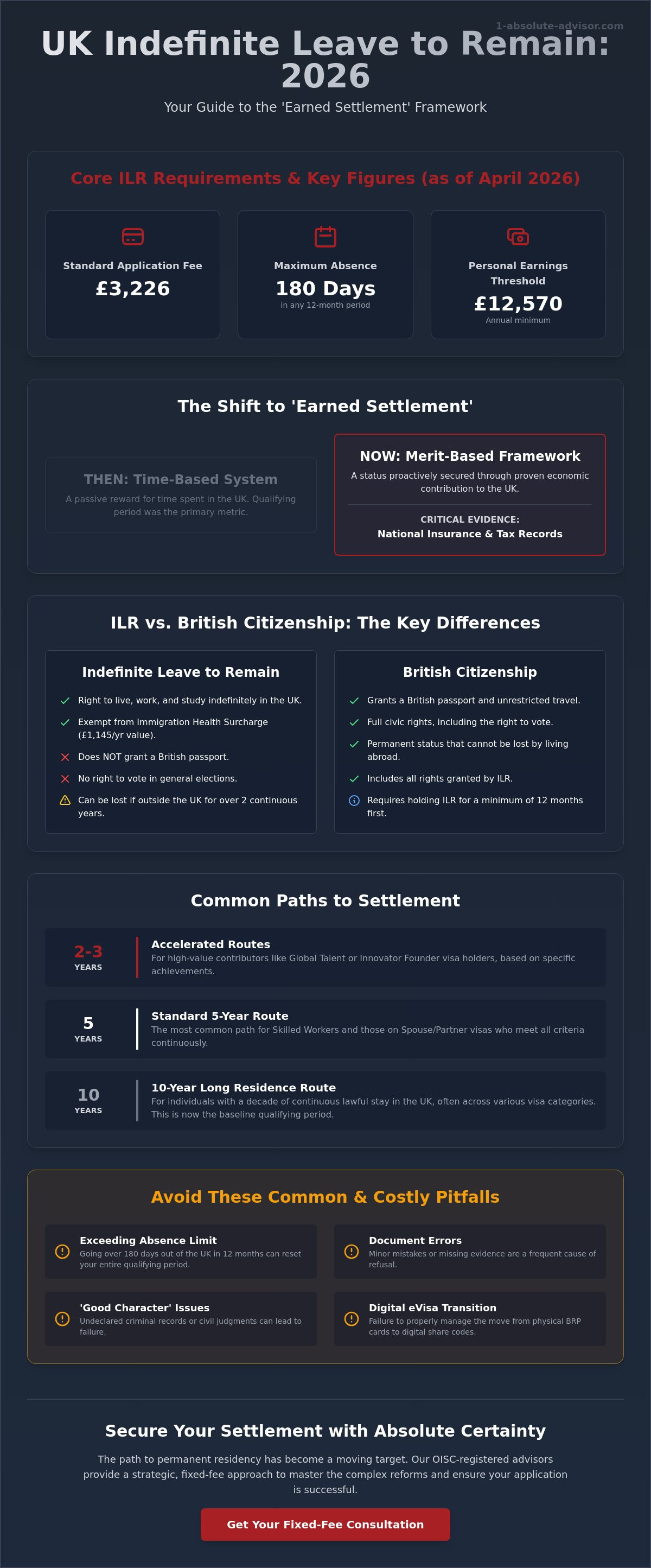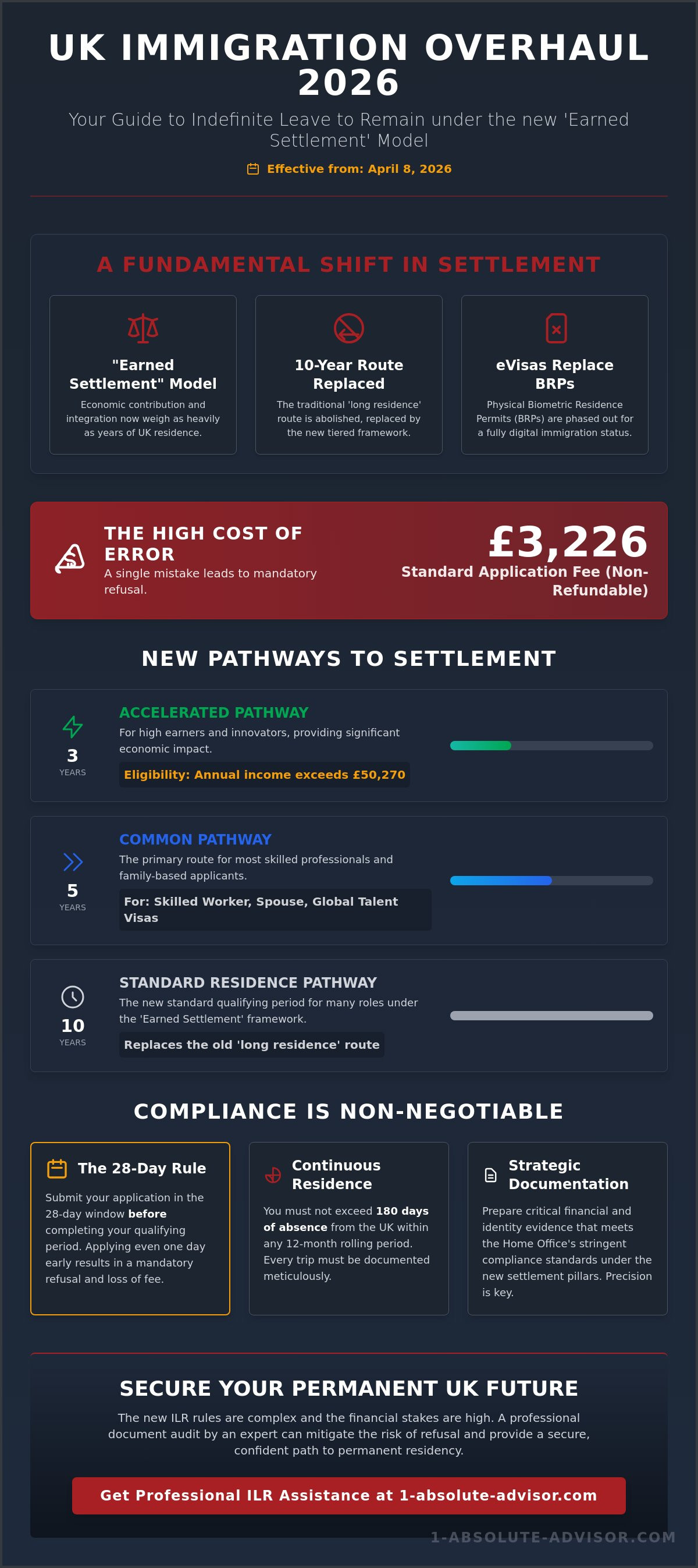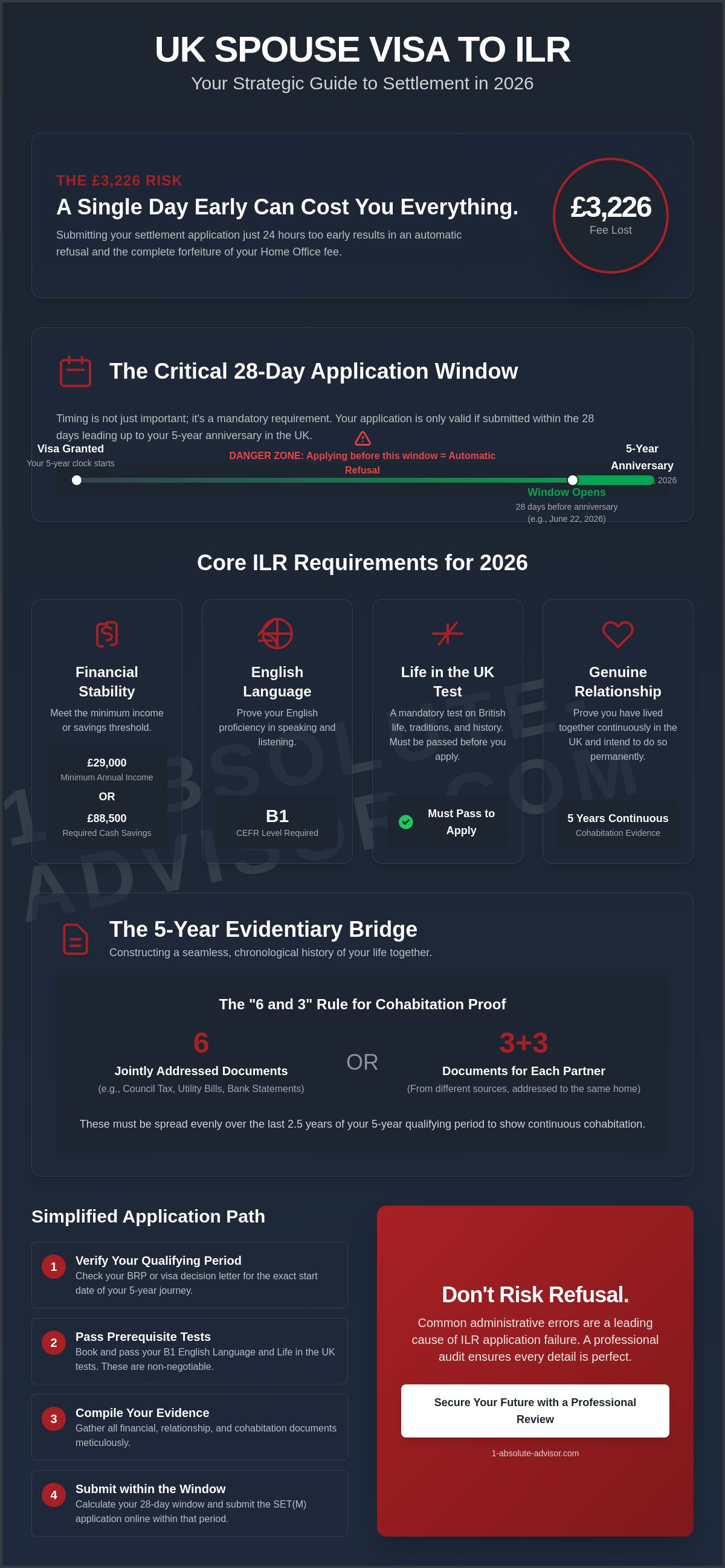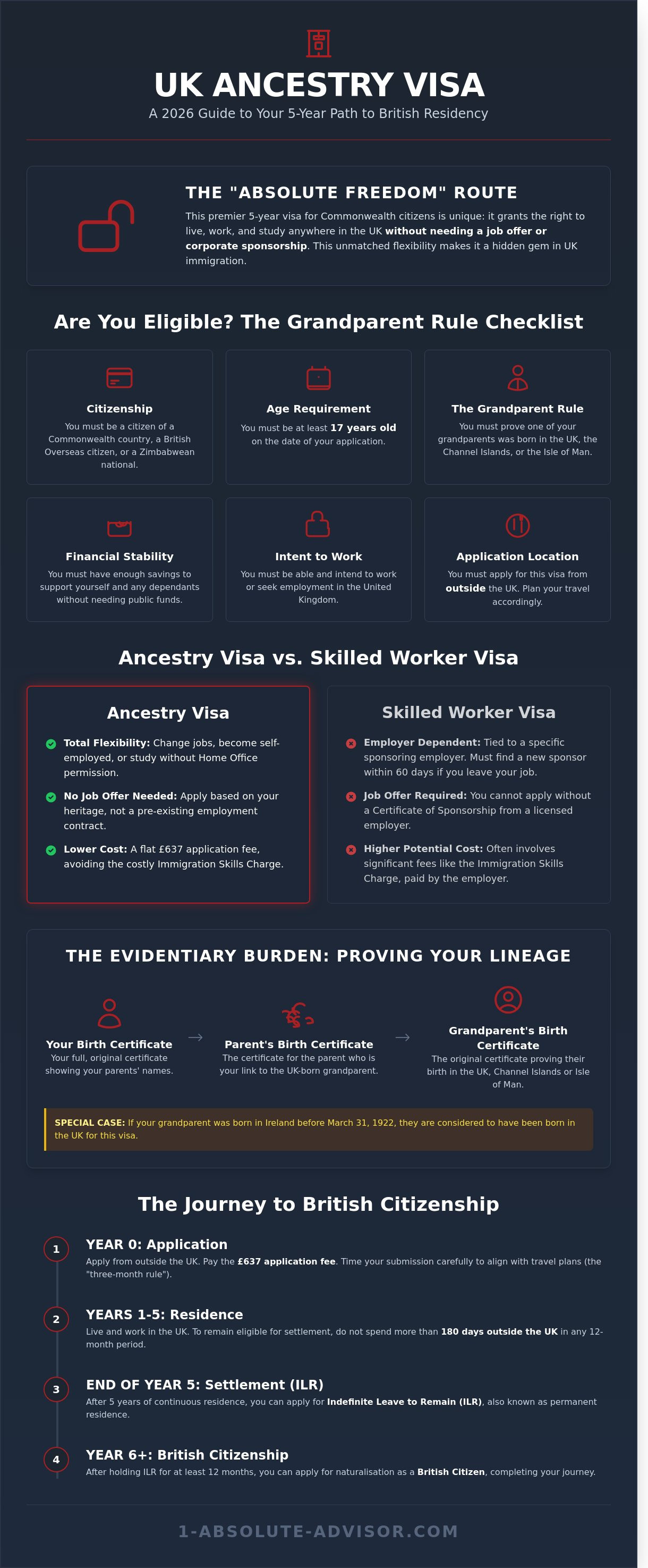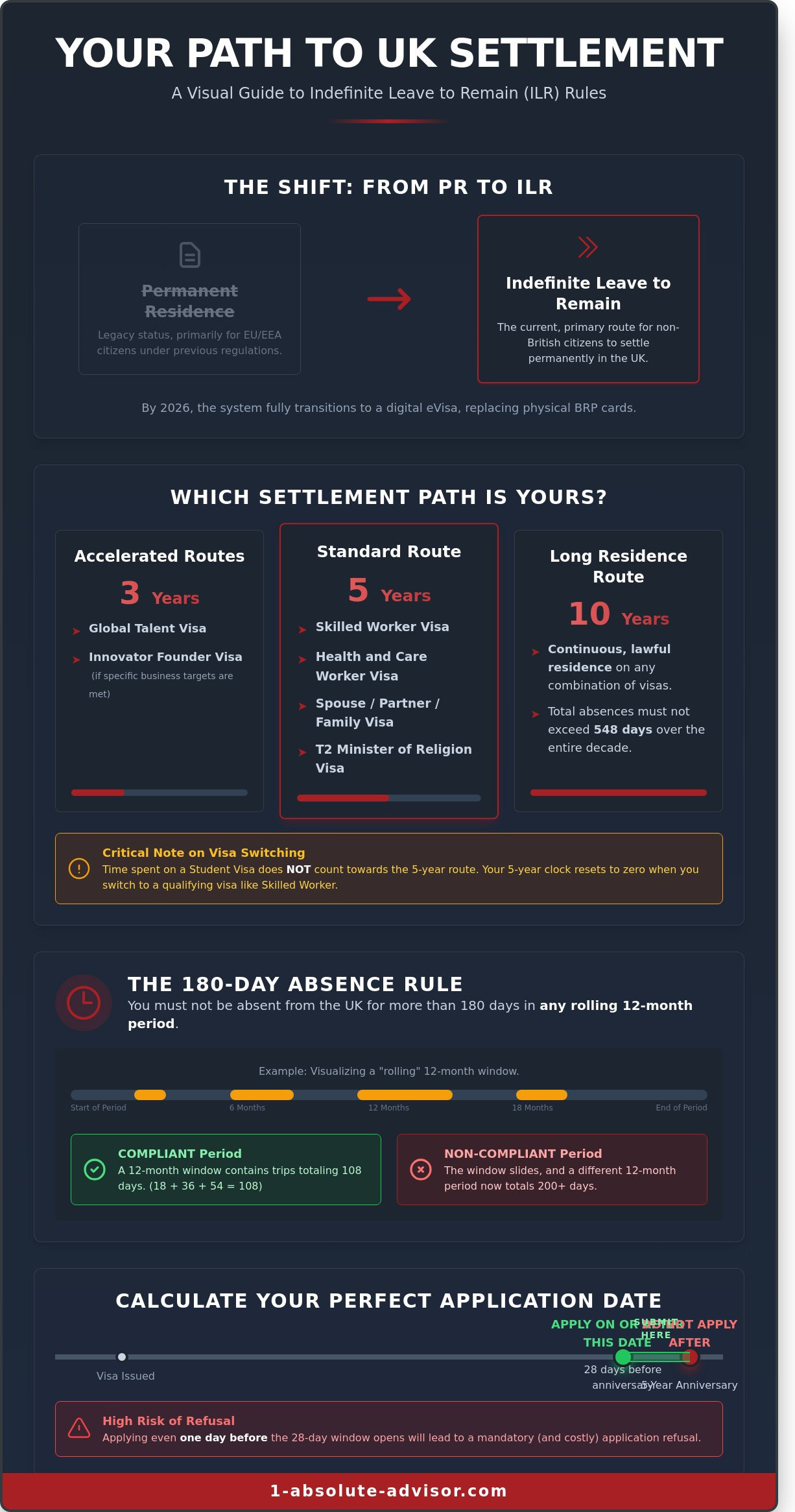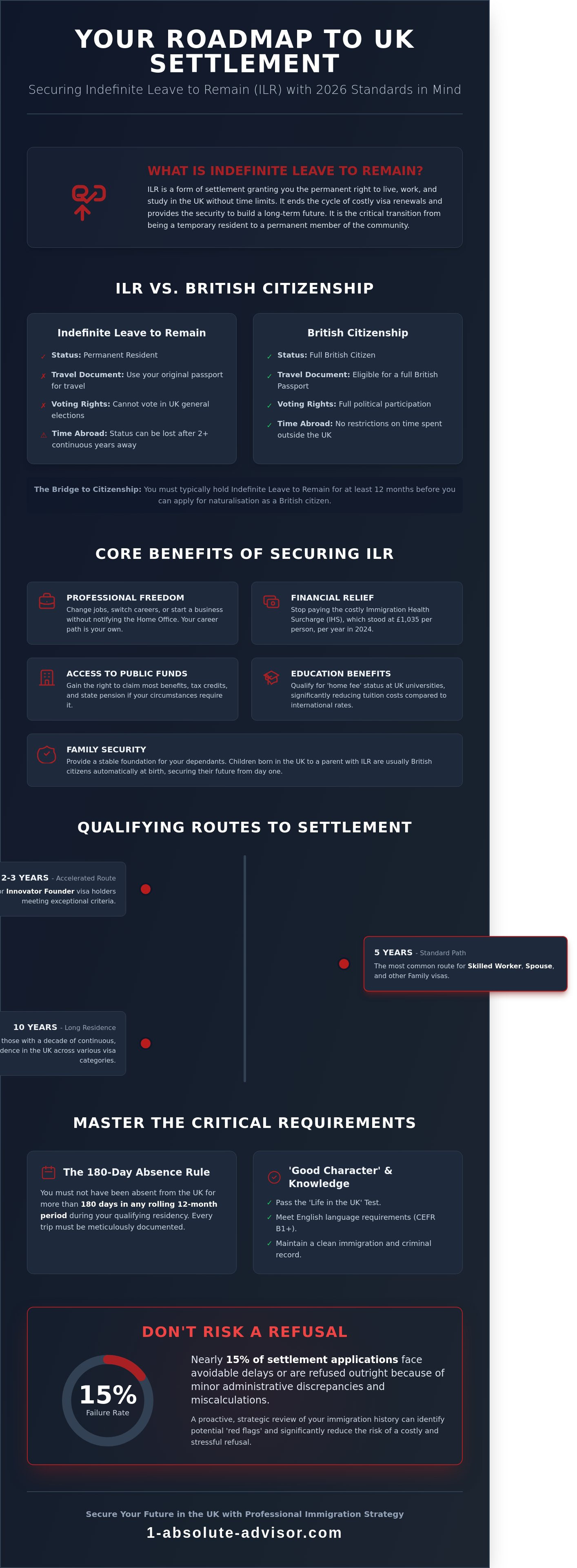

What to Do After Getting ILR: A Comprehensive Guide to Your New Status in 2026

If you believe that receiving your settlement decision marks the end of your administrative burden, you might be overlooking the specific legal obligations that protect your future in the UK. It’s a common misconception that settlement is a set and forget status. The reality of the 2026 immigration landscape requires active management to avoid inadvertently jeopardising your rights. You’ve worked incredibly hard to reach this milestone, and it’s natural to feel a mix of relief and uncertainty about what to do after getting ilr within a system that’s now entirely digital.

This guide provides the professional clarity you need to transition seamlessly into your new status. You’ll discover the essential administrative steps to protect your Indefinite Leave to Remain, from managing your UKVI account to understanding the strict absence rules that could impact your residency. We’ll also outline a precise timeline for naturalisation, ensuring you know exactly when and how to apply for British Citizenship. By the end of this article, you’ll have a strategic roadmap to secure your long-term future with complete peace of mind and a full understanding of your new rights regarding work and travel.

Key Takeaways

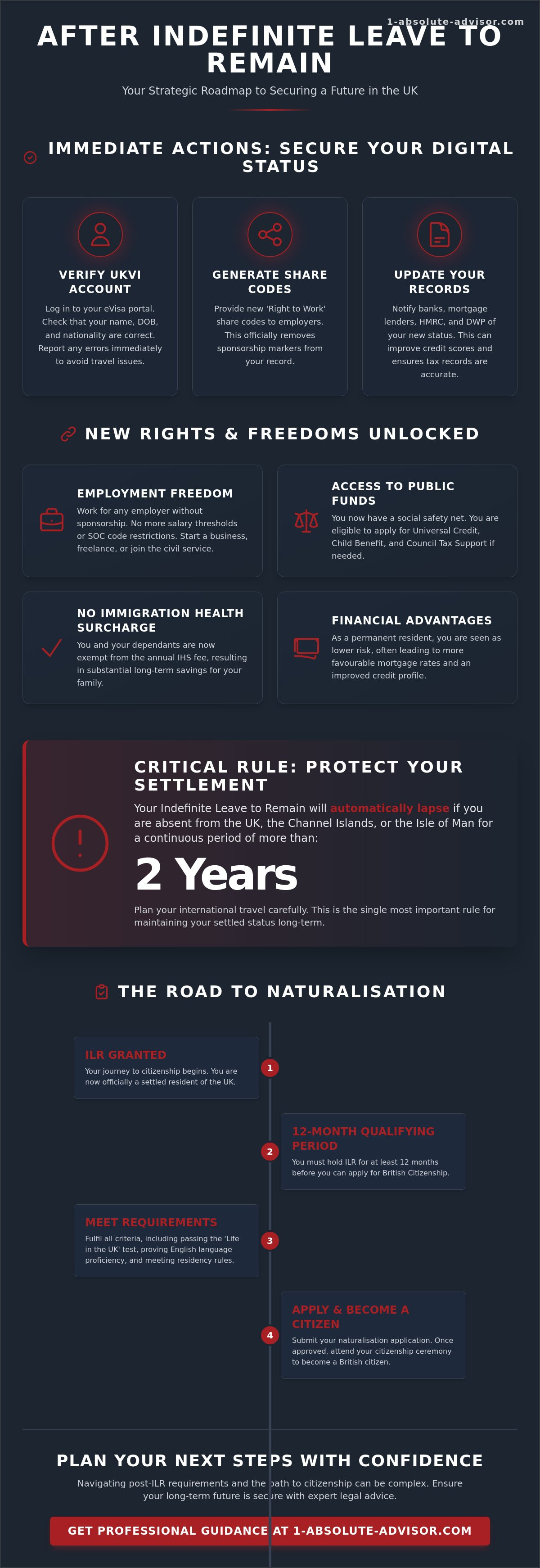
  • Learn how to navigate the mandatory transition to eVisas by verifying your UKVI account and issuing share codes to employers or landlords.
  • Understand your new-found freedom from visa sponsorship and salary thresholds, alongside your eligibility for recourse to public funds.
  • Identify the critical absence thresholds, specifically the two-year rule, that could cause your settlement status to lapse automatically.
  • Establish a clear timeline for naturalisation and discover what to do after getting ilr to prepare for a successful British Citizenship application.
  • Develop a strategic long-term residency plan that includes securing the status of family members and addressing any previous immigration complexities.

Immediate Administrative Steps: Verifying Your Digital Status

Receiving your approval letter is a significant milestone, yet it’s merely the beginning of a new administrative phase. In the 2026 digital-first environment, your status is only as secure as the data held within the Home Office systems. Understanding what to do after getting ilr requires a shift from application mode to status management. You must ensure that every government department and financial institution you interact with recognizes your permanent right to reside in the United Kingdom. This proactive approach prevents future complications and ensures your rights are fully exercisable from day one.

Managing Your UKVI Digital Account (eVisa)

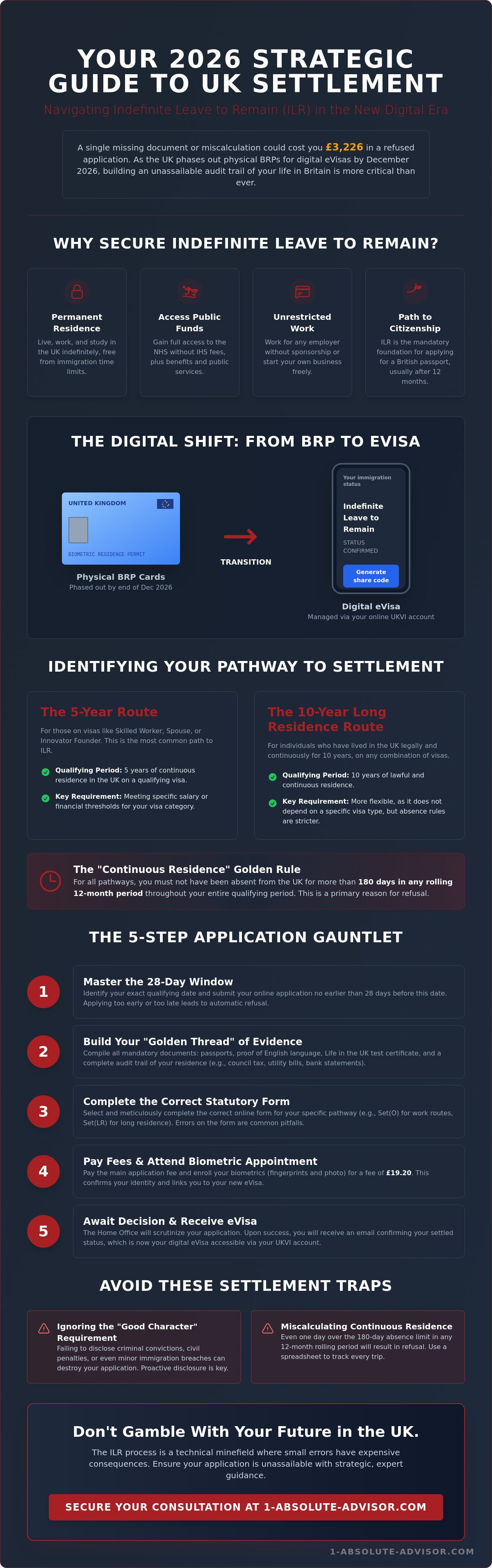
The Home Office has now fully transitioned to a digital immigration system. Physical Biometric Residence Permits are a thing of the past. You must log in to your UKVI account immediately to verify that your Indefinite Leave to Remain is correctly recorded. Check every detail for precision, including your full name, date of birth, and nationality. If you notice an error, you must report it through the digital portal’s correction service immediately. Accuracy here is vital for your future travel plans. When you receive a new passport, you must link it to your eVisa account before attempting to travel. Airlines and border officials use this digital link to confirm your status; without it, you risk being denied boarding or facing lengthy delays at the border.

Notifying Employers and Financial Institutions

Your transition to settlement changes your legal standing with third parties. Even if you’ve worked for the same company for years, you should provide them with a new “Right to Work” share code. This removes any previous sponsorship markers from your personnel file and confirms you’re no longer subject to salary thresholds or visa expiry dates. Beyond employment, your financial profile stands to benefit significantly. Many mortgage providers offer more favorable rates to permanent residents because the risk associated with a departing visa holder is removed. You should proactively update your bank and mortgage lender to ensure your credit file reflects your permanent status. Similarly, notifying HMRC and the DWP ensures your tax and benefits records are synchronized with your new legal standing, providing a seamless transition into your life as a settled resident. Taking these steps early establishes a clear, documented history of your residency and financial stability in the UK. If you are looking to leverage this stability for property investment in London, click here to discover how MaddisonV Properties can assist you.

Understanding Your Rights: Work, Study, and Public Funds

Settlement grants you a level of professional and personal autonomy that was previously unavailable under restrictive visa categories. One of the most significant shifts regarding what to do after getting ilr involves recognizing that you are no longer tethered to a specific employer or a minimum salary threshold. This transition from a temporary migrant to a settled resident removes the administrative barriers that often hinder career progression. You’ve earned the right to engage with the UK economy on your own terms, whether that involves climbing the corporate ladder or venturing into entrepreneurship.

Employment and Self-Employment Freedom

The end of sponsorship means the end of SOC code restrictions. You can now accept any role, regardless of whether the employer holds a sponsor license or the salary meets previous visa requirements. This freedom is particularly valuable for those looking to transition into the “gig economy,” start a freelance career, or launch a limited company. Furthermore, you are now eligible for many civil service positions and roles requiring high-level security clearances that were previously restricted to settled individuals. It’s a strategic moment to update your professional profiles to reflect that you have a permanent right to work, as this often makes you a more attractive candidate for long-term senior positions.

Accessing Healthcare and Social Support

Your financial relationship with the state changes the moment your settlement is granted. You are now entirely exempt from the Immigration Health Surcharge (IHS), which represents a substantial annual saving for you and your dependants. Crucially, your status now includes “recourse to public funds.” This means you can access the UK’s social safety net, including Universal Credit, Child Benefit, and Council Tax Support, should your circumstances change. It’s also a prudent time to audit your National Insurance record to ensure your state pension path is secure. If you’re looking to solidify these rights permanently, our British Citizenship Application Service offers a clear pathway to the final stage of your immigration journey.

Education and civic participation also become more accessible. Most UK universities will classify you as a “home student” for tuition purposes, provided you’ve lived in the UK for the required three-year period. This often results in a significant reduction in fees compared to international rates. While your right to vote in national elections usually depends on your specific nationality, many settled residents gain the right to vote in local elections, allowing you to influence the community where you’ve chosen to build your life. As you settle into these new rights, Preparing for British Citizenship is the next logical step to ensure your status can never be challenged. Understanding these rights is essential for anyone considering their long-term future in the United Kingdom.

What to Do After Getting ILR: A Comprehensive Guide to Your New Status in 2026

Protecting Your Settlement: Absence Rules and Travel

Securing settlement is a landmark achievement, but the permanence of your status is conditional upon your continued residence in the United Kingdom. Many residents mistakenly believe that once granted, Indefinite Leave to Remain (ILR) cannot be lost. However, the legal framework governing settlement includes specific provisions that can lead to the automatic cessation of your rights. Part of knowing what to do after getting ilr is understanding how to manage international travel without inadvertently triggering these “lapsing” provisions. Maintaining your status requires more than just holding the correct digital records; it demands a conscious effort to keep the UK as your primary home.

The standard rule dictates that your ILR status will lapse automatically if you’re absent from the UK for more than two continuous years. This is a strict threshold. Unlike the rolling 180-day rule used during the qualifying period for your initial application, this post-grant rule focuses on long-term departures. It’s vital to distinguish between “lapsing,” which happens by operation of law due to absence, and “revocation,” which is a proactive decision by the Home Office to cancel your status due to criminal activity or deception. For those who arrived via the EU Settlement Scheme, the rules are slightly more generous, allowing for absences of up to five years for most citizens, or four years for Swiss nationals, before status is lost. You should always consult the official government guidance on Indefinite Leave to Remain to confirm which specific rules apply to your nationality and route.

Calculating Absences and the 2-Year Rule

The Home Office calculates a break in residence for ILR holders based on continuous periods of absence from the UK, where any single departure exceeding two years results in the automatic lapsing of your status. To protect your future, you should maintain a meticulous log of all travel dates, including short weekend trips. While these brief absences don’t threaten your ILR, they’re essential data points for your eventual naturalisation application. Demonstrating “Ordinary Residence” is key; you must show that the UK is the place where you normally live, work, and maintain your social and financial ties.

The Returning Resident Visa

If life events such as family illness or overseas work assignments keep you away for more than two years, you cannot simply return to the UK on your previous ILR status. You’ll need to apply for a Returning Resident visa before you travel. This process is rigorous and requires clear evidence of your strong ties to the UK, such as property ownership, family remaining in the country, or a long history of residence. It isn’t a guaranteed process. Our team provides expert guidance through our Document Checking Service to ensure your evidence meets the high threshold required for status restoration. Proactive planning is always the most effective way to ensure your path to citizenship remains unobstructed.

The Road to Naturalisation: Preparing for British Citizenship

Most settled residents view British Citizenship as the ultimate objective of their immigration journey. For the majority, the law requires a 12-month waiting period after your settlement grant before you can submit Form AN. However, if you’re married to a British citizen, this waiting period is waived, allowing you to apply as soon as your settlement is confirmed. This distinction is a critical component of what to do after getting ilr, as it dictates your immediate administrative timeline and determines how quickly you can secure a British passport.

Residency and Presence Requirements

The Home Office applies rigorous residency checks that differ from those used for settlement. You must have been physically present in the UK on the exact day five years prior to the date your citizenship application is received. Additionally, your total absences over those five years must not exceed 450 days, with a strict 90-day limit during the final 12 months. Documenting this timeline requires absolute precision. We recommend maintaining a consolidated travel log supported by digital boarding passes, as even a single day’s miscalculation can lead to a costly refusal.

The Good Character Requirement

Unlike the settlement stage, citizenship applications place a heavy emphasis on the “Good Character” requirement. This is an ongoing obligation that doesn’t end once you receive your settlement approval. Minor infractions that might not have impacted your ILR, such as speeding tickets, civil penalties, or late tax filings with HMRC, can lead to a refusal of citizenship on character grounds. Transparency is paramount; failure to disclose even a minor historical immigration breach can be interpreted as deception, which carries a long-term ban on future applications.

Preparing for the Life in the UK test and meeting the English language requirements should also be prioritised during this interim year. If your situation involves previous visa breaches or complex travel patterns, our British Citizenship Application Service provides the strategic oversight necessary to mitigate risks before you submit your final application. Naturalisation is a discretionary grant, meaning the Home Office has the power to refuse even if you meet the basic residency criteria. Professional preparation is the only way to ensure your transition from a settled resident to a British citizen is successful and final.

Strategic Advice for Post-ILR Immigration Planning

Achieving individual settlement is a significant personal milestone, but it often serves as the catalyst for a broader family strategy. Deciding what to do after getting ilr involves assessing the status of your dependants and ensuring their future in the UK is as secure as your own. A cohesive approach to residency prevents administrative gaps that could delay naturalisation for your spouse or children. By viewing your settlement as a foundation for the entire household, you can streamline the transition to citizenship for everyone involved. This long-term perspective is what distinguishes a successful resident from one who remains vulnerable to shifting immigration policies.

Family Migration and ILR

The rules for children depend heavily on their place of birth and your status at that time. Children born in the UK after at least one parent has been granted settlement are often British citizens by birth, though you’ll still need to navigate the passport application process to formalise this. For children born outside the UK, the path usually requires a specific application for settlement or registration, which carries a fee of £1,000. Our Indefinite Leave to Remain (ILR) Application Service is designed to handle these multi-generational transitions, ensuring that every family member meets the specific qualifying criteria. Coordinating these applications requires careful timing to align with the residency requirements of the lead applicant, especially if you intend to apply for citizenship as a family unit.

Why Professional Guidance Matters for Naturalisation

The final step toward naturalisation is often the most scrutinized by the Home Office. Errors in Form AN or a failure to provide comprehensive evidence of residency can lead to the loss of the £1,709 application fee and the £130 ceremony fee. Strategic planning is essential, particularly when managing complex histories involving previous visa breaches or significant travel. Professional oversight ensures that any historical issues are addressed transparently, mitigating the risk of a refusal based on the “Good Character” requirement.

A Document Checking Service provides an objective, professional review of your evidence before you commit to the final submission. Our advisors ensure that your application is not only compliant with current regulations but also structured to demonstrate your ongoing adherence to all statutory requirements. This proactive approach is vital in an environment where fees and rules are subject to frequent change. To secure your future and protect your investment in your UK residency, you can Consult with our OISC-registered advisors for your citizenship path and move forward with the confidence that your case is in expert hands.

Securing Your Long-Term Future in the United Kingdom

Transitioning from settlement to citizenship requires meticulous attention to detail. You’ve already navigated the complexities of the digital eVisa system and secured your right to work and live without sponsorship. However, understanding what to do after getting ilr involves more than just administrative updates; it requires a strategic approach to maintaining your status and preparing for the final step of your journey. By monitoring your absences and adhering to the “Good Character” requirements, you ensure that your path to naturalisation remains clear and unobstructed.

When you’re ready to transition from a settled resident to a British citizen, professional oversight can eliminate the risk of costly errors. Our OISC-registered immigration consultants specialize in managing complex residency and good character cases through a dedicated, fixed-fee application management process. Secure your future in the UK with our expert British Citizenship application service and take the final step toward full integration with absolute confidence. Your hard work has brought you to this milestone, and we’re here to ensure your status is protected for a lifetime.

Frequently Asked Questions

Can I lose my Indefinite Leave to Remain if I stay outside the UK for too long?

Yes, your Indefinite Leave to Remain status will automatically lapse if you’re absent from the United Kingdom for more than two continuous years. This is a strict statutory limit that applies regardless of your previous length of residence. If you intend to remain outside the country for an extended period, you must ensure you return before this two-year threshold is reached to maintain your settled status. If your status has already lapsed, you’ll need to apply for a Returning Resident visa before attempting to re-enter the country.

Do I need to renew my ILR status every few years?

No, the status itself is permanent and doesn’t require renewal; however, the digital evidence of your status must be kept current. While physical Biometric Residence Permits (BRPs) have been phased out, you’re responsible for maintaining your UKVI digital account. This includes updating your personal details and ensuring your current passport is linked to your eVisa. Keeping these records accurate is a vital part of what to do after getting ilr to avoid issues with employers or border officials.

What happens to my BRP after 31 December 2024?

Your physical BRP became obsolete after 31 December 2024 as the UK completed its transition to a fully digital immigration system. You no longer need a physical card to prove your rights within the UK. Instead, you must use the “view and prove” service via your UKVI account to generate share codes for employers or landlords. While you should keep your expired BRP for your personal records, it’s no longer a valid document for travel or identity verification at the border.

Can I work for any employer once I have ILR?

Yes, you have complete freedom to work for any employer in any sector without the need for sponsorship. You’re no longer restricted by minimum salary requirements or specific SOC codes associated with Skilled Worker visas. This freedom extends to self-employment, starting a business, or working as a freelancer. You should provide your employer with a new share code to update your Right to Work status, ensuring they’ve removed any previous sponsorship markers from your personnel file.

How soon after getting ILR can I apply for British Citizenship?

The standard waiting period is 12 months from the date your settlement was granted. However, if you’re married to or in a civil partnership with a British citizen, you’re eligible to apply for naturalisation immediately upon receiving your ILR approval. You must still meet all other residency and “Good Character” requirements. Planning your application timeline carefully is essential to ensure you meet the specific physical presence rules required for a successful citizenship grant.

Do I still need to pay the Immigration Health Surcharge (IHS) with ILR?

No, you’re no longer required to pay the Immigration Health Surcharge once you’ve been granted settlement. As a settled resident, you have the same access to the National Health Service as a British citizen. This represents a significant financial saving compared to temporary visa categories. You should ensure your GP surgery is aware of your new status so they can update your patient records, though your NHS number will remain the same.

Can my children get British Citizenship if I have ILR?

Children born in the UK after at least one parent has been granted ILR are usually British citizens automatically from birth. If your children were born outside the UK, they’ll typically need to apply for settlement or registration as British citizens. The process depends on their age and their specific place of birth. It’s often beneficial to coordinate these applications to ensure the entire family unit achieves a secure, permanent status simultaneously.

What should I do if I change my passport after getting ILR?

You must update your UKVI account immediately whenever you’re issued a new passport. Since your status is now digital, your eVisa is linked directly to your passport number. If you attempt to travel with a new passport that isn’t linked to your account, you’ll likely face significant delays at the border or be denied boarding by your airline. Keeping this link updated is one of the most critical steps regarding what to do after getting ilr to ensure your international travel remains seamless.

Applying for ILR After a Spouse Visa: The 2026 Settlement Guide

Most applicants view Indefinite Leave to Remain as a simple final hurdle, but the Home Office treats it as a forensic audit of your entire five-year life in the United Kingdom. One minor oversight in your 28-day submission window or a single gap in your cohabitation evidence can lead to a refusal, risking the stability of the life you’ve built here. You’ve likely spent years worrying about the shifting £29,000 financial threshold or the stress of documenting every address change since you arrived. It’s natural to feel overwhelmed by the complexity of the current immigration landscape and the rising costs of settlement.

For many couples, proving a subsisting relationship involves documenting significant cultural milestones; those planning traditional celebrations can utilize Shaadi Prep to organize Asian weddings in the UK, ensuring these important life events are well-managed as they build their future together.

Our expert-led 2026 guide ensures you master the complexities of applying for ilr after spouse visa by providing a precise roadmap through the latest requirements. We’ll help you navigate the £3,226 application fee structure and the specific documentation needed to guarantee a successful outcome. By following this strategic approach, you’ll gain the permanent right to remain and a clear, predictable path toward British Citizenship. This article details the essential evidence, financial criteria, and timing strategies you need to secure your future without the fear of rejection.

Key Takeaways

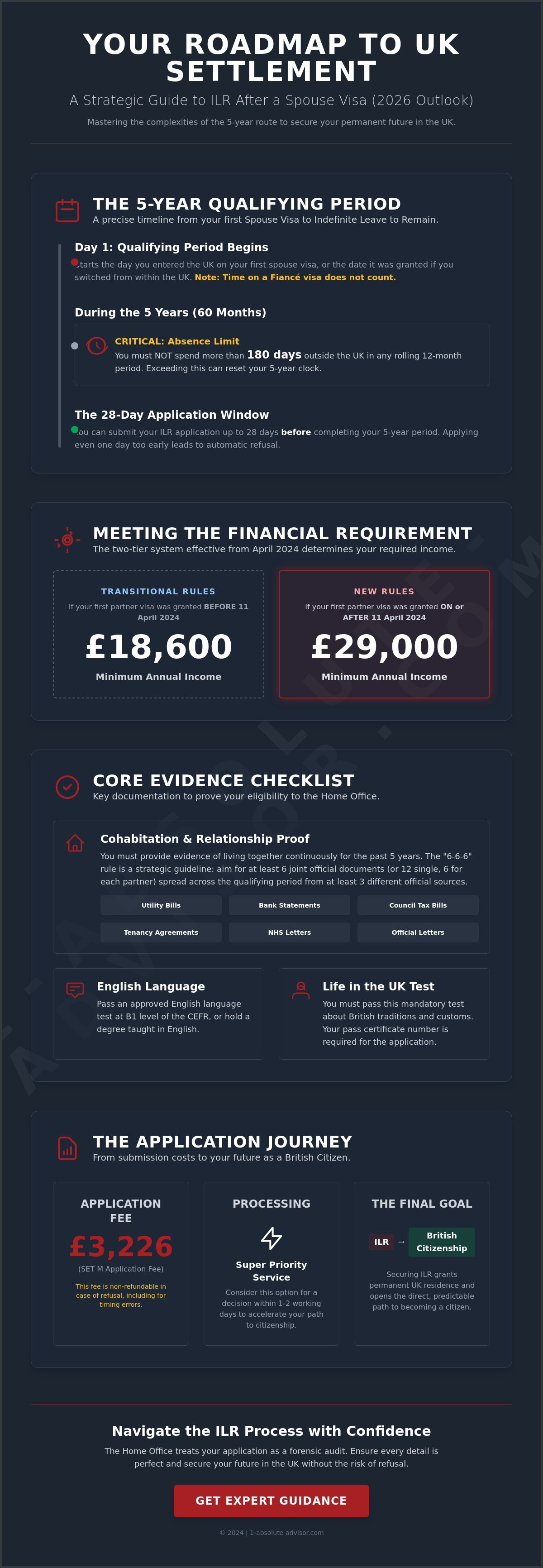
  • Learn how to calculate your eligibility date with precision to avoid a refusal, since even a one-day error in the 28-day window can lead to a rejected submission.
  • Understand how the current £29,000 income threshold affects your case and whether you qualify for transitional arrangements based on your initial visa date.
  • Master the specific evidence requirements for applying for ilr after spouse visa, including the “6-6-6” rule for documenting five years of continuous cohabitation.
  • Identify the exact English language certifications and Life in the UK test standards you’ll need to satisfy the Home Office suitability criteria.
  • Determine if the Super Priority service is the right strategic choice for your SET(M) application to accelerate your path to British Citizenship.

Understanding the 5-Year Route and the 28-Day Application Window

Securing Indefinite Leave to Remain (ILR) is the definitive milestone for any partner of a British citizen or settled person. This status, often referred to as settlement, grants you the right to live and work in the UK without time restrictions. It’s the essential bridge between temporary residence and British citizenship. However, the process of applying for ilr after spouse visa is governed by strict chronological requirements that leave no room for error. The Home Office views this application as a final verification of your five-year history in the country.

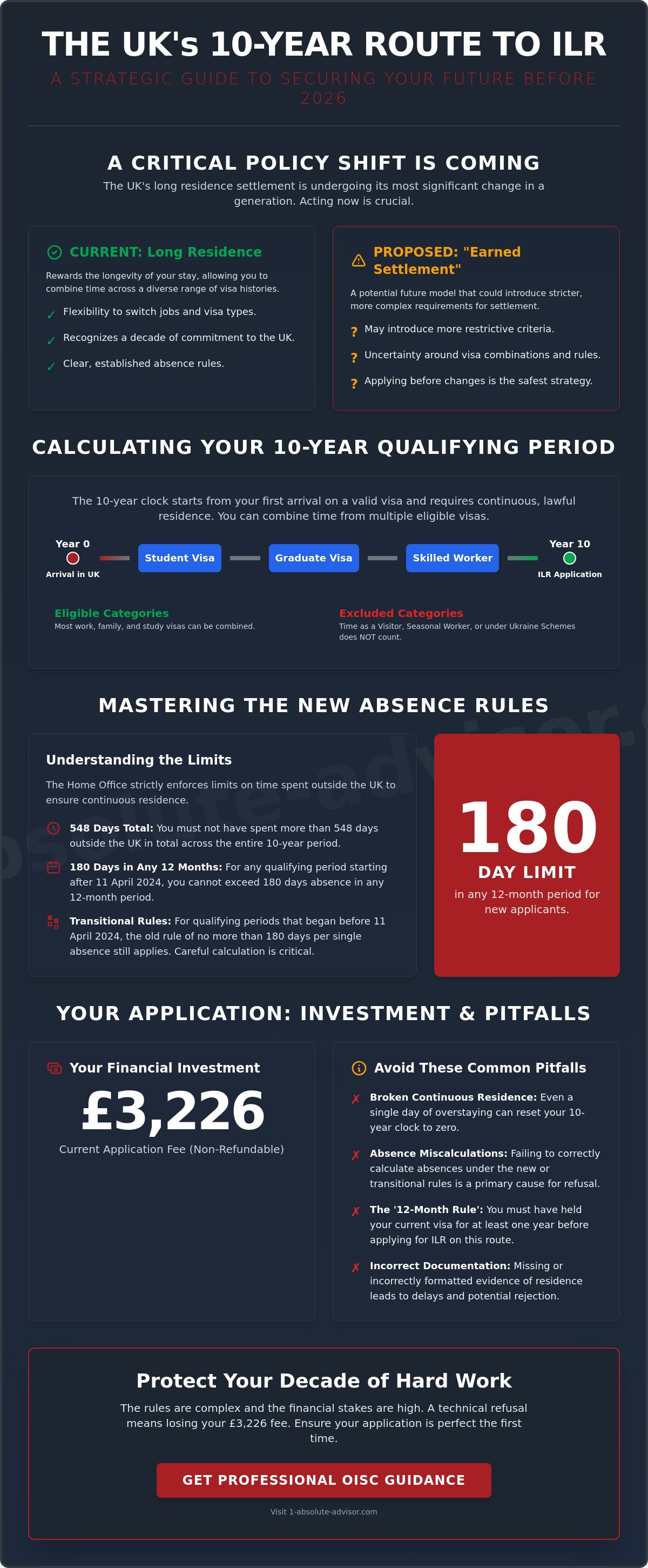
The standard qualifying period spans exactly five years, or 60 months, of continuous leave. During this time, you must maintain your primary residence in the UK. The Home Office enforces a strict absence limit: you cannot spend more than 180 days outside the country in any rolling 12-month period. Exceeding this limit can break your continuity of residence. This often resets your clock and forces you to seek further extensions instead of settlement. Accurate record-keeping of every trip abroad is vital for a successful submission.

Calculating Your Eligibility Date

Determining your precise application date is the first step in any successful strategy. For most, the five-year clock begins on the day you entered the UK with your initial spouse visa. If you switched to this route from within the UK, the start date is the day your first partner visa was granted. It’s vital to remember that time spent on a Fiancé visa is excluded from this calculation. This often causes confusion, as applicants assume their entire residency counts. In reality, the qualifying period only starts once you have transitioned to the spouse visa route. Meticulous planning when applying for ilr after spouse visa prevents costly timing mistakes.

The Risks of Early or Late Submission

The Home Office permits you to submit your application up to 28 days before you complete your five-year qualifying period. This window is a strict legal boundary. Applying even one day before this 28-day threshold results in an automatic refusal. Given the £3,226 application fee is non-refundable in these cases, timing is a high-stakes decision. If your current visa expires shortly before you hit the five-year mark, you must apply for an extension to remain legal. If you apply within the 28-day window or while your current visa is still valid, Section 3C leave protects your status. This legal mechanism ensures your rights to work and access the NHS continue while your settlement application is being processed.

Meeting the Financial Requirement: 2024 Rules and 2026 Realities

The financial landscape for settlement changed significantly in April 2024, creating a two-tier system for those reaching their five-year milestone. For those applying for ilr after spouse visa in 2026, understanding which threshold applies to your specific case is the difference between a grant and a refusal. The standard minimum income requirement now stands at £29,000 per year. This represents a substantial increase from the previous £18,600 limit. However, the Home Office has maintained transitional protections for families who entered the route under the older rules.

You can meet this requirement through a variety of sources, including gross salary, self-employment income, or director dividends. Cash savings remain a popular alternative or supplement, though the calculation requires careful attention to the 2026 multiplier rules. If you’re unsure how your diverse income streams combine to meet the Home Office’s strict criteria, our Indefinite Leave to Remain (ILR) Application Service provides a definitive assessment to ensure your figures are beyond reproach.

The Transitional Financial Requirement

The distinction between the £18,600 and £29,000 thresholds depends entirely on your initial entry date into the spouse route. If you successfully applied for your first partner visa before April 11, 2024, you’re eligible for the lower “old” rate of £18,600. Those who joined the route after this date must meet the higher £29,000 mark. Furthermore, applicants whose partners receive specific disability benefits may qualify for the “adequate maintenance” exemption, which replaces the fixed income threshold with a calculation based on net income after housing costs.

Evidencing Your Income: The 6-Month Rule

The Home Office categorizes income based on the duration and nature of your employment. Category A applies if you’ve been with the same employer for at least six months, while Category B is used for those with shorter tenures or variable income. You must provide a comprehensive audit trail that matches your reported earnings exactly. According to official UK government guidance, bank statements must be original or stamped by the bank and must correspond perfectly with your payslips.

A single discrepancy between your employer’s letter and your bank deposits is a leading cause of application failure. Your employer’s letter must explicitly state your gross salary, your length of employment, and the type of contract you hold. Even a missing signature or an undated letter can trigger a forensic rejection. Precision in this evidence phase is non-negotiable for anyone seeking permanent settlement in 2026. Every document must be scanned and uploaded in high quality to avoid delays during the digital review process.

Applying for ILR After a Spouse Visa: The 2026 Settlement Guide

Evidencing Your Life Together: The Cohabitation and Relationship Audit

Settlement is not merely a test of financial stability; it is a rigorous verification of the enduring nature of your partnership. When applying for ilr after spouse visa, you must demonstrate that your relationship has remained genuine and subsisting throughout your five-year stay. The Home Office focuses specifically on your cohabitation history since your last visa extension, requiring an unbroken paper trail that proves you and your partner share a home and life in the United Kingdom. This phase of the application is often the most labor-intensive, as it requires gathering documents from multiple sources to satisfy the strict “6-6-6” rule.

The Home Office categorizes evidence into tiers. The “Gold Standard” includes documents from government departments, local authorities, or utility providers. Think of council tax bills, HMRC correspondence, and water or energy statements. If you lack joint documents, you must provide twice as many individual documents addressed to the same residence. For couples who have faced periods of separation due to work or family emergencies, you must provide a detailed explanation. The Home Office only accepts “compelling” reasons for living apart, and even then, you must prove the relationship remained active through communication and financial support.

The 2-Year Cohabitation Document Checklist

You must provide at least six items of correspondence addressed to you and your partner jointly, or twelve items addressed to you individually at the same address. These documents must come from at least three different sources and be spread evenly across the last 24 to 30 months. If you find gaps in your utility or tax records, secondary evidence such as GP letters, polling cards, or bank statements can serve as effective fillers. Our Document Checking Service can help verify that your timeline is complete and your sources meet the necessary evidentiary weight.

Proving a “Subsisting” Relationship in 2026

While cohabitation documents are the primary focus, the “subsisting relationship” requirement remains a core pillar of the assessment. You’ll need to sign a formal declaration of your intention to live together permanently in the UK. In 2026, caseworkers rarely require photos or chat logs if your cohabitation evidence is robust. However, if you’ve recently moved house or have a non-traditional living arrangement, including a brief selection of photographs from the last two years can provide helpful context. If you moved recently, ensure your driving licenses and bank records were updated immediately, as mismatched addresses on key documents are a common red flag that triggers further scrutiny.

Knowledge of Language, Life in the UK, and the Suitability Test

While financial stability and cohabitation form the foundation of your case, the Home Office also requires proof of your successful integration into British society. This stage of applying for ilr after spouse visa focuses on your personal history and your ability to communicate effectively in English. These requirements aren’t just checkboxes; they’re statutory obligations that caseworkers examine with the same level of scrutiny as your bank statements. Failing to meet the language or suitability standards leads to immediate refusal, regardless of how long you’ve lived in the country. It’s the point where your personal conduct becomes as important as your marriage.

Language and Life in the UK Requirements

You must pass the Life in the UK test, which currently costs £50 per attempt. Once you achieve a passing score, the certificate has no expiry date, so you don’t need to retake it if you used it for a previous application. For the English language requirement, you need to reach CEFR Level B1 in speaking and listening. These tests must be taken with a provider approved by the Home Office, with fees typically ranging between £150 and £200. We’ve compiled a detailed resource on How to Pass the Life in the UK Test to help you prepare effectively. Certain applicants are exempt from these tests, specifically those aged 65 or over and individuals with long-term physical or mental conditions that make meeting the requirement impossible.

The Suitability Audit: Protecting Your Application

The suitability test is perhaps the most overlooked aspect of the settlement process. The Home Office conducts a comprehensive background check to ensure you meet the “good character” requirement. This audit goes beyond serious criminal convictions. Caseworkers look for patterns of behavior that suggest a disregard for the law, including County Court Judgments (CCJs), unpaid taxes, or persistent traffic offenses. If you have any concerns regarding your personal history or past legal issues, our Indefinite Leave to Remain (ILR) Application Service provides a professional assessment of your suitability before you submit your SET(M) form.

Honesty is the only viable strategy during this phase of applying for ilr after spouse visa. You must disclose all previous issues, including non-custodial sentences, cautions, or even minor fixed penalty notices. Attempting to hide a minor incident is often viewed as deception, which carries a mandatory refusal and can lead to a ten-year ban on future applications. Even if a conviction is considered “spent” under the Rehabilitation of Offenders Act, it must still be declared on your immigration application. This transparency is vital, as the suitability standards for settlement are the same ones used when you eventually apply for British citizenship. Even non-custodial sentences or police cautions must be disclosed to maintain the integrity of your application.

The Application Journey: From Submission to British Citizenship

The SET(M) online form represents the final administrative hurdle in your five-year residency. When applying for ilr after spouse visa, the transition from applicant to settled resident occurs the moment your biometric information is verified and your digital file is reviewed by a Home Office caseworker. This process is now entirely digital, allowing you to retain your physical passport while your application is pending. This is a significant procedural advantage, as it ensures you don’t lose your ability to travel or prove your identity during the standard processing window. However, you must remain in the UK, Ireland, or the Crown Dependencies until a decision is made to avoid your application being treated as withdrawn.

Choosing between service levels is a strategic decision that depends on your need for certainty. While the standard processing time can extend up to six months, the Super Priority service offers a decision by the end of the next working day for an additional £1,000 fee. In 2026, many families choose this route to eliminate the prolonged anxiety of a pending status and to finalize their settlement without delay. Once you’ve submitted the form and paid the £3,226 fee, you’ll book an appointment at a UKVCAS center to provide your fingerprints and a digital photograph.

Submission and Decision Timelines

The 24-hour decision window offered by the Super Priority service is a powerful tool for those who require immediate results. If the Home Office requires additional documentation or clarification, they’ll issue a Request for Further Information (RFI). Responding to an RFI with absolute precision is critical; any delay or insufficient response can pause your application and move it out of the priority queue. It’s essential to monitor your communication channels daily after submission, as the Home Office often provides short deadlines for these supplemental requests.

Why Professional Representation is Essential

The complexity of a five-year residency means that “hidden” risks, such as minor gaps in cohabitation or nuanced financial discrepancies, often go unnoticed by the untrained eye. Our team at 1 Absolute Advisor specializes in identifying these vulnerabilities before they reach a caseworker. We provide a comprehensive legal cover letter that frames your evidence within the context of current immigration law, ensuring that your narrative is clear and compelling. For a deeper understanding of the entire process, you should consult our ILR UK: The Complete Guide.

Once your ILR is granted, you achieve total freedom from immigration control. For those married to a British citizen, the path to naturalisation is significantly shorter than other routes. You don’t necessarily have to wait a full 12 months after receiving ILR to apply for British citizenship, provided you’ve lived in the UK for at least three years and meet the other residency requirements. This final step completes your journey from a temporary resident to a permanent member of British society. Secure your future in the UK with our expert ILR management service and ensure your transition to settlement is handled with the professional integrity it deserves.

Securing Your Permanent Future in the United Kingdom

Transitioning to Indefinite Leave to Remain is a transformative milestone that demands absolute precision in both timing and documentation. You’ve now seen how the 28-day application window, the tiered financial thresholds, and the forensic cohabitation audit form the backbone of a successful submission. Successfully applying for ilr after spouse visa represents more than just a legal status change; it’s the final hurdle before achieving total freedom from immigration control and a direct path to British citizenship. Precision is paramount.

Professional oversight is a strategic investment in your family’s stability, especially given the non-refundable £3,226 application fee. Our OISC-registered expert advisors specialize in fixed-fee application management, maintaining a high success rate even for complex settlement cases involving diverse income streams or evidence gaps. We provide the technical expertise needed to frame your history accurately for the Home Office. Book a consultation for your ILR application today to manage your transition with absolute confidence. Your permanent future in the UK is the priority, and we’re ready to help you secure it.

Frequently Asked Questions

Can I apply for ILR if my spouse visa has already expired?

You cannot submit a valid application for settlement if your current leave has already expired. Applying as an overstayer is extremely risky and typically leads to a refusal unless there are exceptional circumstances beyond your control. It’s essential to submit your SET(M) form within the 28-day window before your current visa expires. This ensures your legal status is maintained under Section 3C leave while the Home Office processes your case.

What happens to my ILR application if my relationship ends during the process?

If your relationship ends before a decision is made, you’re no longer eligible for settlement under the partner route. You have a legal obligation to inform the Home Office of this change in your circumstances immediately. Continuing with the application after a separation is considered deception. This carries severe consequences, including a potential ten-year ban on future UK visa applications and the loss of your right to remain in the country.

Navigating a separation while managing immigration requirements is complex. For those with international legal needs, such as English-speakers with ties to Israel, you can explore Divorce Proceedings Representation through the Salior Ben Hamou Law Office to ensure your interests are professionally managed.

How much does it cost to apply for ILR after a spouse visa in 2026?

The standard Home Office fee for applying for ilr after spouse visa in 2026 is £3,226 per applicant. You must also account for the £19.20 biometric enrolment fee and the £50 Life in the UK test cost. If you need to take a B1 English test, expect to pay between £150 and £200 depending on the provider. Fortunately, the Immigration Health Surcharge isn’t required for Indefinite Leave to Remain applications.

Can I include my children in my ILR application from a spouse visa?

You can include your children as dependents on your application provided they’re currently in the UK on a valid dependent visa. Each child must pay the full £3,226 application fee and provide their own biometric information. Children over the age of 18 must also meet the Knowledge of Language and Life in the UK requirements. It’s vital to ensure their residency history aligns with your own to avoid individual refusals within a family group.

Do I need to retake the English test if I passed it for my initial spouse visa?

You’ll likely need to take a new test because settlement requires a B1 level on the CEFR scale, which is higher than the A1 level usually required for initial entry. If you already passed a B1 level test for your most recent visa extension, you don’t need to retake it. Always verify that your previous test provider remains on the Home Office’s approved list for 2026. This prevents a refusal based on an invalid qualification.

How many days can I spend outside the UK before I am ineligible for ILR?

You must not spend more than 180 days outside the United Kingdom in any rolling 12-month period during your five-year qualifying stay. Exceeding this limit breaks the continuity of your residence and typically makes you ineligible for settlement. Caseworkers examine your travel history thoroughly when you’re applying for ilr after spouse visa. Keeping an accurate log of all departures and arrivals is a vital part of your preparation to ensure you meet this residency requirement.

What is the Super Priority service for ILR and how long does it take?

The Super Priority service is an optional expedited processing route that costs an additional £1,000. It aims to provide a decision by the end of the next working day after your biometric appointment. This service is a strategic choice for those who require immediate certainty or need to travel urgently. Given that the standard processing time can take up to six months, the Super Priority service offers significant peace of mind during a high-stakes transition.

Is there a minimum salary requirement for ILR after a spouse visa?

There is a mandatory financial threshold that most applicants must meet to qualify for settlement. For those who entered the spouse visa route after April 11, 2024, the minimum income requirement is £29,000 per year. If you were already on the partner route before that date, you’re protected by transitional arrangements and only need to meet the older £18,600 threshold. You must provide six months of evidence to prove this income is stable and ongoing.

Applying for ILR on a Skilled Worker Visa: The 2026 Comprehensive Guide

In 2026, securing Indefinite Leave to Remain is no longer a simple matter of checking boxes; it has evolved into a rigorous residency audit that demands proactive evidence management. You’ve likely felt the weight of shifting regulations, from the increased £41,700 salary threshold to the anxiety surrounding the government’s consultation on extending qualifying periods. The complexity of “rolling” 180-day absence calculations and the difficulty of obtaining precise employer support letters can make applying for ilr on skilled worker visa feel like a high-stakes obstacle course where any minor oversight carries significant risk.

We understand that your future stability in the UK depends on navigating these hurdles with absolute precision. This guide provides the strategic clarity you need to master the 5-year settlement route and secure your permanent residency with confidence. We’ll examine the latest “earned settlement” framework, clarify the January 2026 B2 English language requirements, and provide a methodical roadmap to ensure your application meets the Home Office’s strictest scrutiny, finally clearing your path toward British citizenship.

Key Takeaways

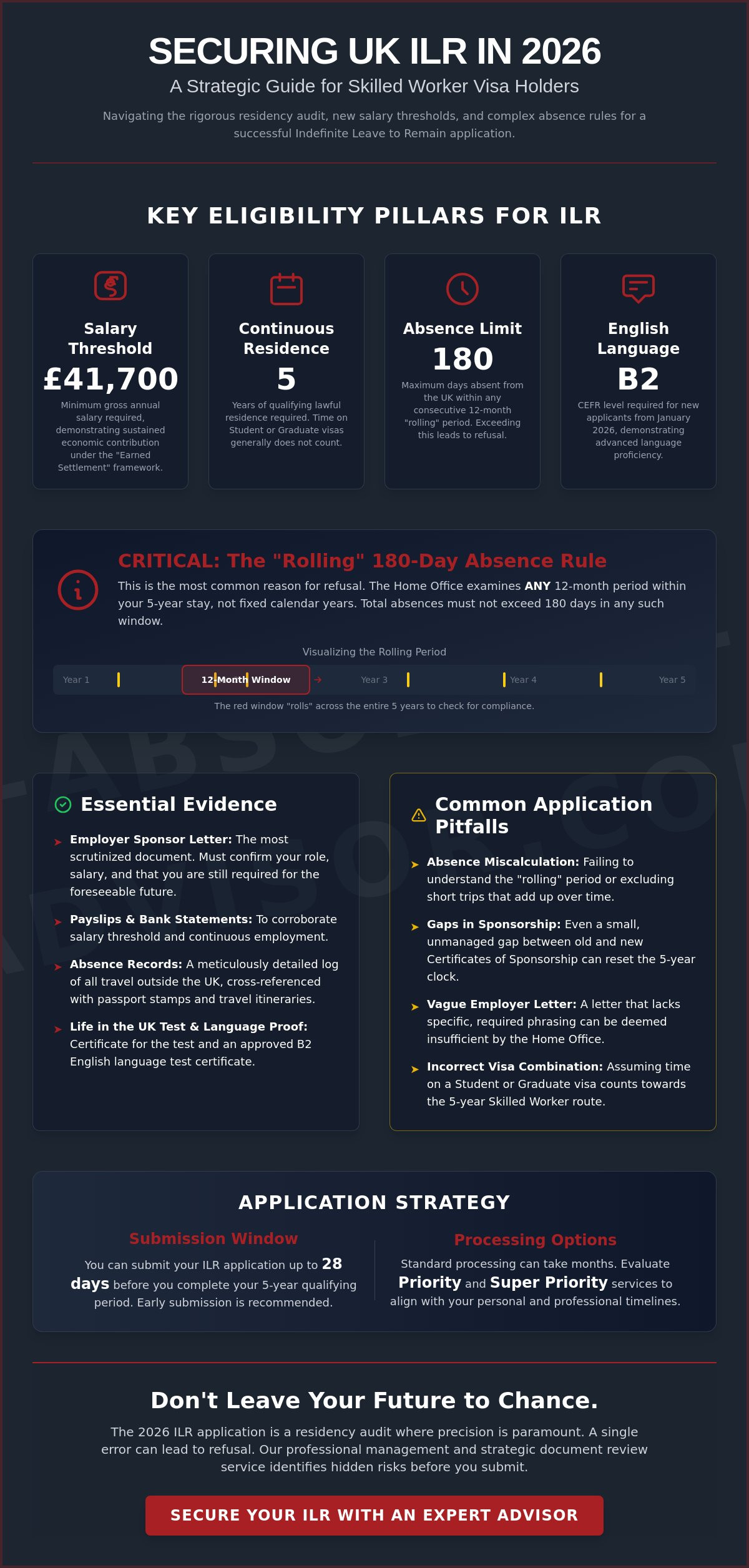
  • Understand the 2026 “earned settlement” framework and how current consultations might impact the standard 5-year route to residency.
  • Navigate the updated £41,700 salary threshold and the complex “rolling” 180-day absence rule when applying for ilr on skilled worker visa to ensure full compliance.
  • Learn why the employer sponsor letter is the most scrutinized piece of evidence and how to meet the B2 English language requirements for new applicants.
  • Identify your earliest possible submission window using the 28-day rule and evaluate whether priority processing services are right for your timeline.
  • Discover how a strategic document review identifies hidden risks in your residence history before they lead to a Home Office refusal.

The 5-Year Route to ILR: Navigating the 2026 Regulatory Landscape

For most international professionals, the transition from a temporary visa to Indefinite Leave to Remain (ILR) represents the definitive milestone in their UK journey. ILR is a permanent right to reside in the country without time limits, effectively removing the constraints of immigration control. Once granted, you’re free to work for any employer, engage in business, or pursue education without sponsorship. Crucially, it provides access to public funds and serves as the essential prerequisite for British citizenship. While other paths exist, the Skilled Worker route remains the most robust and predictable method for high-skilled talent to secure their future in the UK.

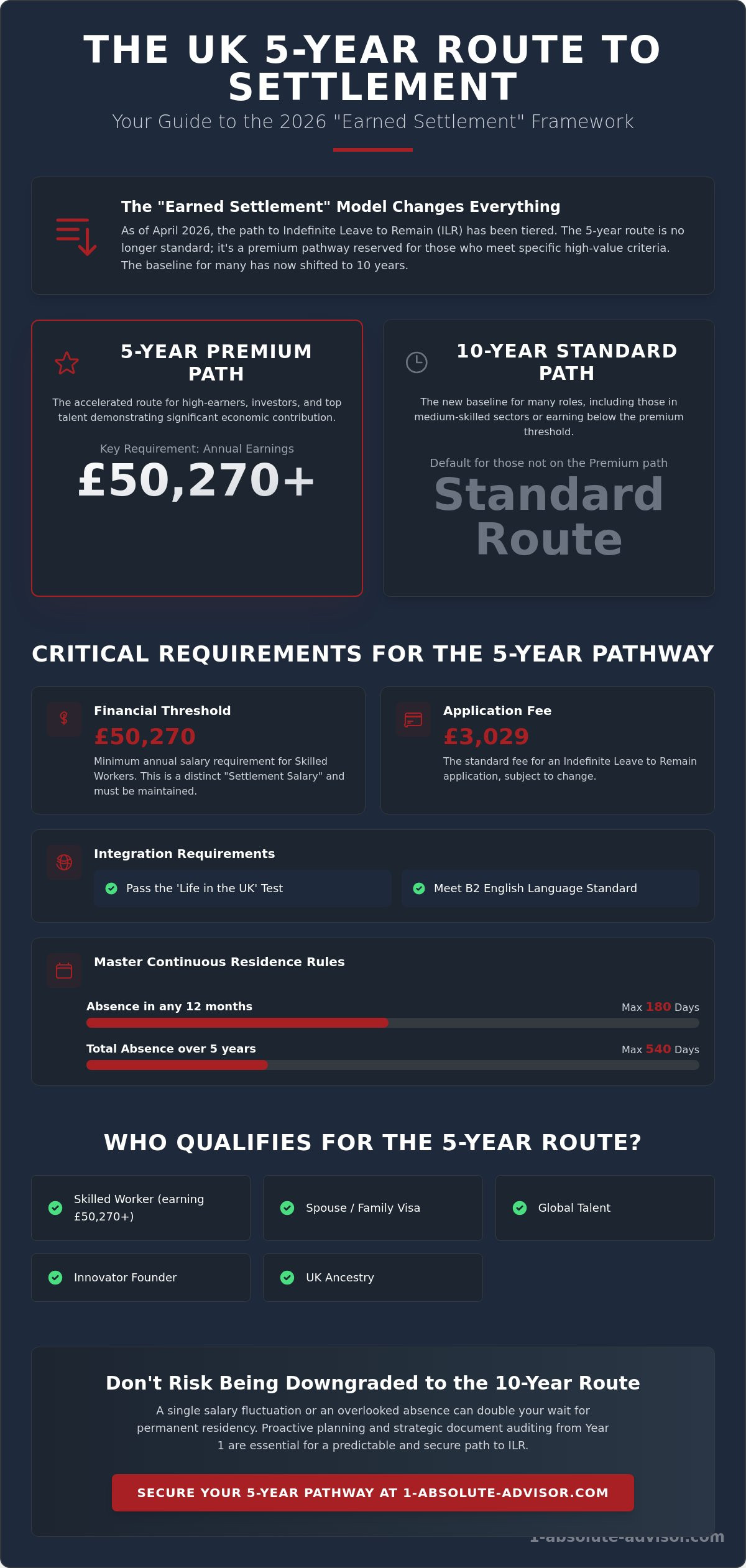
The current landscape is defined by a rigorous 5-year qualifying period. However, 2026 has brought specific challenges that require careful navigation. You’ve likely heard discussions regarding the government’s recent consultation on extending this period. While rumors of a 10-year requirement have caused widespread anxiety, the 5-year route remains the active standard for those applying for ilr on skilled worker visa status as of May 2026. Maintaining a clear understanding of these shifting policies is vital, as the Home Office increasingly views settlement as a privilege earned through sustained economic contribution and compliance.

The “Earned Settlement” Concept in 2026

The 2025 Immigration White Paper introduced a shift toward “earned settlement,” a framework that prioritizes applicants who demonstrate deep integration and consistent professional growth. Under this model, your employment continuity isn’t just a checkbox; it’s proof of your ongoing value to the UK economy. The Home Office now places greater emphasis on your ability to meet the updated £41,700 salary threshold throughout your residency. This holistic approach means your application is treated as a comprehensive audit of your five years in the UK, rather than a simple administrative filing.

Combining Different Visa Categories

A frequent point of confusion involves “stacking” time spent on different visas to reach the five-year mark. If you switched from a Tier 2 (General) visa to a Skilled Worker visa, that time counts toward your qualifying period. You can also combine time from other specific routes, such as the Global Talent or Innovator Founder categories. However, time spent on a Student visa or a Graduate visa generally doesn’t count toward the 5-year Skilled Worker settlement path. One common pitfall occurs when switching employers; even a short gap between certificates of sponsorship can reset your residency clock if not managed with professional precision. For those in the culinary sector, you can visit Operational Chef Consultant to find permanent roles that offer the sponsorship stability needed for settlement. We ensure your transition dates align perfectly with Home Office requirements to protect your continuous residence status.

Eligibility Criteria: Salary Thresholds and Continuous Residence

Eligibility for Indefinite Leave to Remain is predicated on two primary pillars: financial contribution and physical presence. When applying for ilr on skilled worker visa, you must demonstrate that your residency has been both continuous and lawful. This means avoiding any gaps in your leave and adhering strictly to the absence limits. Even minor administrative oversights, such as a late visa renewal or a misunderstanding of “lawful presence,” can jeopardize your status and potentially reset your qualifying period. Beyond simple presence, you must also prove that your employment continues to meet the government’s elevated economic requirements.

Calculating the 180-Day Absence Limit

The most common cause for application failure is a misunderstanding of the “rolling” 12-month rule. Unlike older regulations that looked at fixed calendar years, the current system evaluates any consecutive 12-month period during your five-year stay. If your total absences exceed 180 days in any of these windows, the Home Office will likely issue a mandatory refusal. It’s vital to remember that only full 24-hour periods spent outside the UK count toward this limit; days of departure and arrival are generally excluded. For those with complex travel histories, utilizing a professional document checking service provides a precise audit of your absence records to ensure you remain within these strict limits.

Certain exemptions do exist for those whose work requires international travel. Research activities, natural disasters, or unavoidable travel disruptions like those seen in recent years may be discounted if supported by robust evidence. However, even a single day exceeding the 180-day threshold without a valid, evidenced exemption can lead to an automatic rejection of your settlement claim.

Salary Thresholds and SOC Code Variations

As of 2026, the financial requirements for settlement have become significantly more stringent. The general minimum salary threshold for Skilled Worker ILR applicants is now £41,700 per year. However, this is only the baseline. You must also meet the “going rate” for your specific Standard Occupational Classification (SOC) code if that rate is higher than the general threshold. This ensures that sponsored workers aren’t undercutting the local labor market.

  • Standard Applicants: Must earn at least £41,700 or the SOC going rate, whichever is higher.
  • Health and Care Workers: Often subject to different salary scales based on national pay structures.
  • Immigration Salary List: Roles previously on the Shortage Occupation List may have transitional arrangements, though these are increasingly rare in 2026.

Your employer must confirm in writing that you’re still required for your role and that your salary meets these updated levels. If your pay has fluctuated or if you’ve changed SOC codes during your five years, your documentation must clearly explain these transitions to satisfy the caseworker’s audit.

Applying for ILR on a Skilled Worker Visa: The 2026 Comprehensive Guide

The Evidentiary Burden: Essential Documentation for Success

The Home Office doesn’t just evaluate your eligibility; they audit your evidence. While the salary thresholds and absence records discussed previously establish your legal standing, the physical documentation you submit serves as the final arbiter of your success. When applying for ilr on skilled worker visa, your file must be beyond reproach. Caseworkers look for consistency across five years of financial data, employer declarations, and personal conduct records. Any discrepancy between your reported income and your P60s, or a gap in your bank statements, can trigger an immediate request for further information or a denial based on a failure to meet the evidentiary burden.

A comprehensive approach involves more than just gathering papers; it requires a strategic “Document Audit” to ensure every piece of evidence reinforces your narrative of compliance. This includes providing your most recent payslip and a corresponding bank statement, both dated within 31 days of your application. You’ll also need to account for your “Good Character.” This requirement extends beyond criminal convictions to include tax irregularities, litigation, or previous immigration breaches. Ensuring your record is clean and accurately disclosed is a fundamental step in securing your permanent tenure in the UK.

The Perfect Employer Support Letter

The sponsor letter is arguably the most scrutinized document in your submission. It isn’t enough for your employer to confirm you work there; the Home Office requires specific legal phrasing to satisfy the “genuine vacancy” and “ongoing need” criteria. The letter must explicitly state that you are “still required for the employment in question for the foreseeable future.” It must also confirm your SOC code and verify that your salary meets the updated £41,700 threshold or the relevant going rate. Common errors, such as using an outdated company letterhead or failing to mention the specific gross annual salary, often lead to avoidable inquiries that stall the process.

Knowledge of Language and Life (KoLL)

To integrate fully into British society, you must satisfy the Knowledge of Language and Life requirements. This involves passing the Life in the UK test, which remains valid indefinitely once completed. Regarding language proficiency, the 2026 standards are precise. As of January 8, 2026, new applicants must meet the B2 level of the Common European Framework of Reference (CEFR). However, if you already held your Skilled Worker visa before this date and met the previous B1 level, you generally don’t need to take a new test. Exemptions apply to those under 18, over 65, or those with long-term physical or mental conditions that make passing the tests impossible. Our Document Checking Service helps verify these exemptions and test certificates early in the process to prevent last-minute complications.

The Application Strategy: Timing and Fast-Track Options

Timing isn’t merely a logistical detail; it’s a legal requirement that determines the validity of your entire submission. When applying for ilr on skilled worker visa status, you must identify a specific window that satisfies the Home Office’s residency requirements without falling foul of early-submission rules. The standard “28-day rule” allows you to submit your application up to 28 days before you reach the five-year anniversary of your initial entry into the UK or the date your first visa was granted. Submitting even 24 hours before this window opens leads to a mandatory refusal, as you won’t have met the statutory qualifying period at the time of application.

Beyond the submission date, you must account for the processing period and its impact on your daily life. While your application is pending, your legal status is governed by Section 3C of the Immigration Act 1971. This crucial provision ensures your current rights, including the right to work for your sponsor and access the NHS, remain intact even if your original visa expires while you wait for a decision. However, this protection is fragile. Leaving the Common Travel Area while your application is under consideration results in the automatic withdrawal of your request, potentially leaving you without a valid visa to return to the UK. If you require professional certainty before hitting the submit button, our Indefinite Leave to Remain (ILR) Application Service provides a comprehensive review of your timeline to prevent these catastrophic errors.

Strategic Timing and Section 3C Leave

Section 3C leave provides a vital safety net for professionals whose visas expire during the administrative process. It’s a seamless extension that prevents you from becoming an overstayer, provided your application was submitted “in-time.” You don’t need to take additional action to trigger this; it happens automatically by operation of law. You must, however, remain in the UK. Any travel outside the UK, Ireland, the Isle of Man, or the Channel Islands while the Home Office is processing your file will void your application immediately. This rule is often overlooked by those with urgent business travel needs, making the choice of processing speed a strategic necessity rather than a luxury.

Fast-Tracking Your Settlement

In 2026, standard ILR applications can take up to six months to reach a conclusion. For many skilled workers, this half-year period of travel restrictions is professionally untenable. To mitigate this, the Home Office offers two expedited paths. The Priority service aims for a decision within five working days for an additional fee of approximately £500. For those requiring the fastest possible resolution, the Super Priority service aims for a decision by the end of the next working day for a cost of roughly £1,000. These fast-track options don’t change the eligibility criteria, but they do provide the immediate security of tenure required for international career commitments.

  • Standard Service: Up to 6 months for a decision.
  • Priority Service: Decision typically within 5 working days.
  • Super Priority Service: Decision usually by the end of the next working day.

Choosing the right service level depends on your upcoming travel schedule and the complexity of your residence history. If your absence records are near the 180-day limit, utilizing a fast-track service combined with expert representation ensures that any queries are addressed while your evidence is fresh and your status is protected.

Professional Management: Why Expert Guidance Is Essential

Successfully applying for ilr on skilled worker visa status in 2026 requires more than just meeting the basic criteria; it demands a strategic approach to legal representation. The Home Office’s shift toward an “earned settlement” model means that every aspect of your five-year history is subject to intense scrutiny. Moving beyond the mere administrative task of filling out forms, our methodology focuses on identifying and mitigating risks before they reach a caseworker’s desk. Whether you’ve faced salary fluctuations due to unpaid leave or have a complex history of employer changes, professional management ensures your narrative remains consistent with the current Immigration Rules.

Our document check service is specifically designed to identify hidden vulnerabilities in your residence records. For instance, many applicants struggle with the rolling 180-day absence calculation, often failing to account for travel days correctly. We perform a granular audit of your passport stamps and travel logs to ensure your continuous residence is mathematically sound. Additionally, we provide guidance for those who have faced previous refusals or administrative challenges, ensuring that past issues are addressed transparently and legally to prevent them from compromising your settlement goals.

Our Fixed-Fee Application Management

We believe in transparent pricing and comprehensive support throughout the settlement process. Our Secure your UK residency with our expert ILR application service includes the preparation of a detailed legal cover letter. This document is vital for explaining complex residency gaps or variations in SOC code salary thresholds that might otherwise trigger a request for further evidence. By presenting a well-structured, evidence-backed argument from the outset, we reduce the likelihood of delays and provide the Home Office with the clarity needed for a prompt decision.

Beyond ILR: The Path to Naturalisation

Securing Indefinite Leave to Remain is a significant achievement, but for many, it’s the mandatory bridge to a UK passport. Once you’ve held ILR for at least 12 months, you may become eligible to apply for naturalisation as a British citizen. This final step requires further evidence of good character and continued residence, but it removes all future immigration restrictions entirely. Planning for this transition early ensures that your settlement application is handled with your long-term citizenship goals in mind. For a deeper understanding of the final stage of your journey, consult our resource on British Citizenship: The Complete Guide to Naturalisation in 2026. Our team remains your strategic partner from your initial Skilled Worker entry through to your final naturalisation ceremony.

Securing Your Permanent Future in the UK

The transition from a temporary visa to permanent residency is a defining moment for any international professional. As we’ve explored, the 2026 landscape demands absolute precision, particularly regarding the £41,700 salary threshold and the complex 180-day rolling absence calculations. Successfully applying for ilr on skilled worker visa status is no longer just about meeting time requirements; it’s about presenting a bulletproof residency audit that satisfies the Home Office’s “earned settlement” criteria.

Our OISC-registered consultants specialize in managing complex Skilled Worker settlement cases, providing the strategic oversight needed to identify risks before they lead to a refusal. We offer fixed-fee transparency and meticulous document checking to ensure your application is beyond reproach. If you’re ready to move beyond the uncertainty of temporary leave and secure your permanent tenure, book a consultation for your Skilled Worker ILR application today. Your path to British citizenship begins with a flawlessly executed settlement strategy. We’re here to ensure your five years of hard work and contribution result in the security you deserve.

Frequently Asked Questions

How early can I apply for ILR on a Skilled Worker visa?

You can submit your application up to 28 days before you reach the five-year anniversary of your qualifying period. Applying earlier than this specific window results in an automatic refusal because you haven’t yet met the statutory residency requirement. It’s vital to calculate this date from the day you first entered the UK on your visa or the date the initial leave was granted; whichever occurred first.

Can I combine time spent on a Student visa with a Skilled Worker visa for ILR?

No, time spent on a Student visa or Graduate visa doesn’t count toward the five-year settlement path. These categories are not qualifying routes for ILR under the Skilled Worker rules. If you switched from a Student visa to a Skilled Worker visa, your five-year qualifying period only began on the date your Skilled Worker leave was officially granted by the Home Office.

What happens to my ILR application if I lose my job?

Your application will likely be refused if you lose your job while the decision is pending. A central requirement for applying for ilr on skilled worker visa is a formal declaration from your sponsor confirming you’re still needed for the foreseeable future. If your employment ends, the sponsor is legally obligated to notify the Home Office, which invalidates the “ongoing need” criteria for settlement.

Do my dependents get ILR at the same time as me?

Dependants can apply for settlement at the same time as the main applicant, provided they’ve also completed five years of continuous residence in the UK. Each family member must satisfy their own eligibility criteria, including the Knowledge of Language and Life requirements. If a dependant hasn’t yet reached the five-year mark, they must apply for a further extension rather than Indefinite Leave to Remain.

What is the minimum salary for ILR on a Skilled Worker visa in 2026?

The general minimum salary threshold for settlement is £41,700 per annum as of May 2026. You must also meet the specific “going rate” for your job’s SOC code if that figure is higher than the general threshold. Your employer must provide written confirmation that your salary meets these updated levels and will be maintained for the foreseeable future to satisfy the Home Office audit.

How do I calculate the 180-day absence limit for settlement?

You must calculate absences on a rolling 12-month basis rather than a calendar year. This means you cannot have spent more than 180 days outside the UK in any consecutive 12-month window during your five-year qualifying period. Only full 24-hour periods spent abroad are counted toward this limit; the days you depart from and return to the UK are generally excluded from the total.

Is the Life in the UK test mandatory for all ILR applicants?

Yes, passing the Life in the UK test is a mandatory requirement for most applicants aged 18 to 64. The test certificate remains valid indefinitely once you’ve successfully completed it. Exemptions are only available for those under 18, over 65, or those with a documented long-term physical or mental condition that makes taking the test impossible, supported by specific medical evidence.

What is the cost of an ILR application in 2026?

The Home Office charges a standard application fee of £3,226 per person for settlement. This is a mandatory government cost and doesn’t include legal representation fees or optional priority service charges. If you require a faster decision, you may pay an additional £500 for the 5-day priority service or approximately £1,000 for the next-day super priority service.

ILR Document Checklist 2026: The Essential Guide to Indefinite Leave to Remain

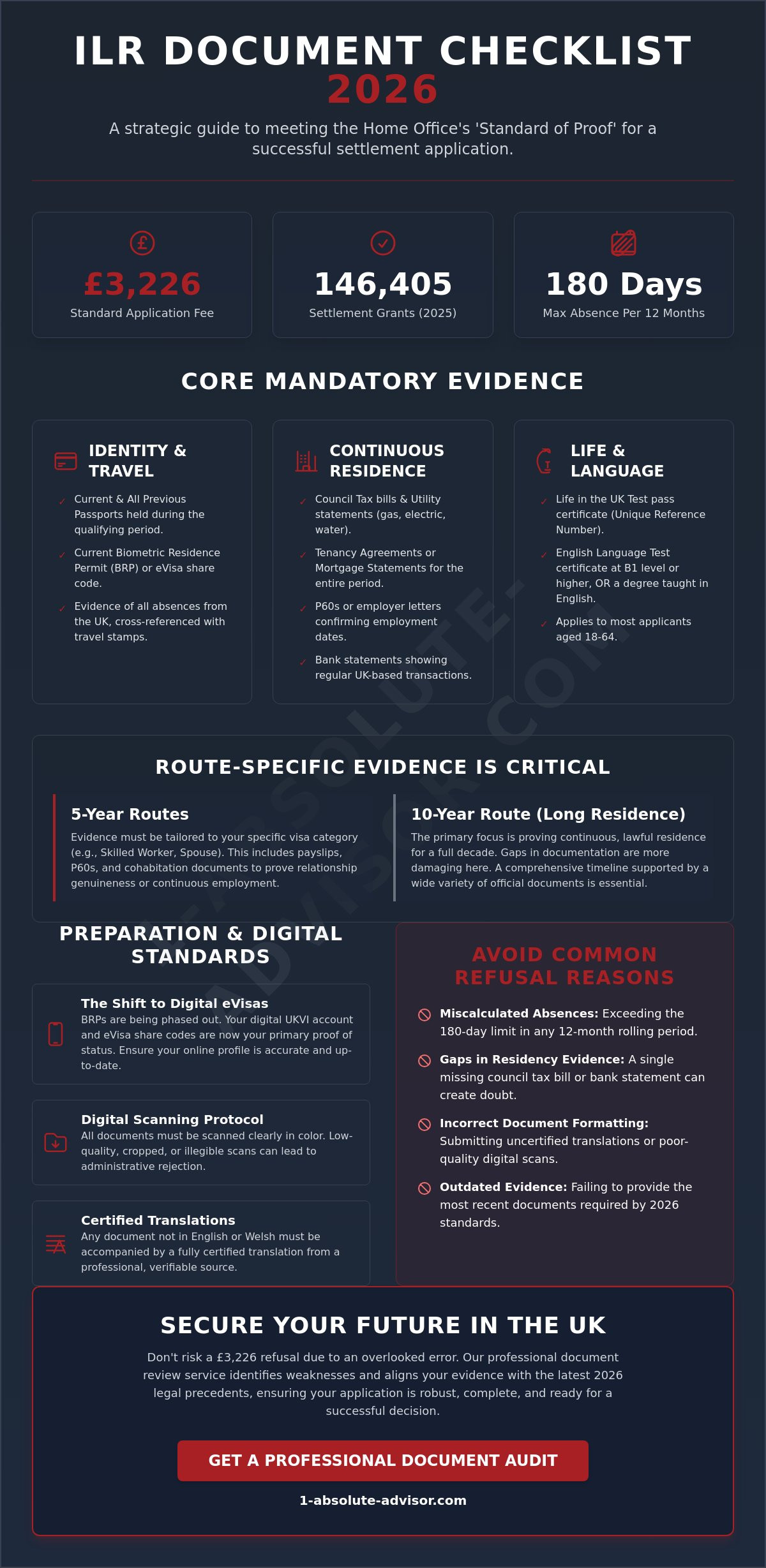
Is a single missing bank statement or a miscalculated absence worth risking a £3,226 application fee? With 146,405 settlement grants issued in 2025, the path to permanent residency is well-trodden, yet the Home Office’s “Standard of Proof” remains a significant hurdle. You likely feel the pressure of proving years of continuous residence while managing the shift to a digital-only eVisa system. Securing your future requires a precise ilr document checklist that goes beyond mere presence and focuses on the quality and formatting of your evidence.

We understand that the complexity of settlement can be daunting when your stability in the UK is on the line. This guide promises to help you master these complexities with a comprehensive, route-specific ILR document checklist for 2026. We will examine the exact evidence needed for your specific path, from financial records to residency proofs, ensuring your application reflects the professional integrity and strategic preparation required for a successful decision.

Key Takeaways

  • Learn how to construct a strategic ilr document checklist that moves beyond basic compliance to meet the Home Office’s 2026 evidentiary standards.
  • Identify the essential identity and residency records required to validate your continuous stay and confirm your Knowledge of Life in the UK.
  • Differentiate between the evidentiary requirements for 5-year and 10-year routes to ensure your submission is perfectly tailored to your specific immigration path.
  • Master the technical standards for document preparation, including strict certified translation rules and digital scanning protocols that prevent administrative rejection.
  • Recognize how a professional document audit identifies overlooked errors and aligns your evidence with the latest 2026 legal precedents for a secure application.

The Critical Role of the ILR Document Checklist in 2026

An application for Indefinite Leave to Remain is more than an administrative formality; it’s a legal petition to the Crown. In 2026, your ilr document checklist acts as the blueprint for this petition. It’s a strategic assembly of evidence designed to prove your eligibility under strict UK Immigration Rules. With the standard application fee currently set at £3,226 per person, the financial and emotional stakes leave no room for oversight. Home Office refusal trends show that even minor discrepancies in residency evidence or outdated document formats can lead to immediate rejection. A well-structured checklist serves as the foundation for your legal cover letter, allowing you to present a cohesive narrative that anticipates a caseworker’s potential questions.

Understanding the ‘Standard of Proof’

Caseworkers don’t just look for the presence of documents; they evaluate their credibility and relevance. This is the “Standard of Proof.” Submitting a massive volume of papers can actually obscure your strongest evidence. You must distinguish between mandatory documents, such as your current passport, and discretionary evidence that supports your specific circumstances. Mandatory items are non-negotiable, while supporting documents provide the context necessary to bridge gaps in your residency history. A professional ilr document checklist ensures that every file serves a purpose, aligning with the requirements of your visa route while meeting the rigorous audit standards of the Home Office.

The Shift to Digital: eVisas and Share Codes

2026 marks a definitive shift in how the UK manages immigration status. The total phase-out of physical Biometric Residence Permits (BRPs) means your digital profile is now your primary legal identity. You must be proficient in generating and validating eVisa share codes to prove your status to caseworkers and employers alike. This transition requires a proactive approach to record-keeping. You’ll need to ensure your UKVI account is fully updated and that all previous immigration milestones are accurately reflected in the digital system. Maintaining a meticulous digital trail of your immigration history is no longer optional. It’s a core requirement for demonstrating your continuous residence throughout the qualifying period.

Core Mandatory Evidence: Identity, Residency, and Knowledge of Life

Establishing your identity is the foundational step of any settlement application. While many applicants assume a current passport is sufficient, the Home Office requires a comprehensive history of your movements. You must provide every travel document held during your qualifying period, including expired passports. These documents serve as primary evidence for your residency history, allowing caseworkers to cross-reference entry and exit stamps against your declared absences. As we move into 2026, the transition to a digital-first system means your physical Biometric Residence Permit (BRP) is being replaced by digital identity verification. You’ll likely need to provide your UKVI account details alongside your physical passport to ensure your ilr document checklist is complete and verifiable.

Proving Continuous Residence

The “180-day rule” is a strict threshold that requires meticulous documentation. You cannot spend more than 180 days outside the UK in any 12-month period during your qualifying years. To prove you’ve maintained a home here, you should gather a variety of independent evidence. Strong applications typically include:

  • Annual Council Tax bills and utility statements (gas, electricity, or water).
  • Signed tenancy agreements or mortgage statements.
  • P60s and formal letters from employers confirming your start and end dates.
  • Bank statements showing active daily spending within the UK.

If you find gaps in your documentation, perhaps due to a move or a digital banking shift, you must address these proactively. Providing a “Document Checking Service” or a professional audit can help identify these weaknesses before they lead to a refusal. If you’re concerned about missing records, our document checking service can provide the necessary oversight to ensure your evidence meets the required standard.

Knowledge of Language and Life Requirements

Most applicants aged 18 to 64 must demonstrate their integration into British society. This involves passing the Life in the UK test, which currently costs £50 per attempt. You’ll need to provide the unique reference number from your pass certificate in your application. For those following the ILR documents for 10-year route, ensuring this test is completed well in advance is vital to avoid processing delays.

English language proficiency is equally critical. You must prove you can speak and understand English to at least CEFR Level B1. This can be achieved through a Secure English Language Test (SELT) from an approved provider, such as Trinity College London or IELTS SELT Consortium. Alternatively, if you hold a degree taught in English from a UK university, your original degree certificate can serve as sufficient proof. Always check the expiry date of your SELT certificate; while they’re generally valid for two years, they can sometimes be reused for settlement if they were accepted for a previous successful visa application.

ILR Document Checklist 2026: The Essential Guide to Indefinite Leave to Remain

Route-Specific Requirements: Tailoring Your Evidence for ILR Success

While core identity documents are universal, the success of your settlement hinges on how well you tailor your ilr document checklist to your specific visa history. The Home Office evaluates applications against route-specific legal tests that vary significantly between categories. For instance, the 5-year route usually requires proof of ongoing employment or family ties, while the 10-year Long Residence route focuses on a decade of continuous, lawful stay regardless of the visa category. If you’ve switched categories, such as moving from a Student visa to a Skilled Worker route, you must ensure your timeline is unbroken and that your current evidence aligns with the most recent financial thresholds and residency rules.

Evidence for Skilled Worker Route Applicants

For those on the Skilled Worker route, the employer letter is the most scrutinized document in your submission. It isn’t enough for your employer to confirm your start date. The letter must explicitly state your job title, your SOC code, and your current gross annual salary, which must meet the relevant threshold for your occupation as of 2026. Crucially, the Home Office requires the letter to confirm that you are “still required for the foreseeable future” in your specific role. Without this specific phrasing and a clear link to your original Certificate of Sponsorship, your application faces a high risk of refusal. You should also provide your six most recent payslips and corresponding bank statements to verify this income matches your employer’s claims.

Evidence for Family and Spouse Route Applicants

Family-based applications focus on the “subsisting” nature of your relationship. A marriage certificate proves a legal union, but it doesn’t prove a shared life in 2026. Your ilr document checklist should include joint financial commitments like mortgage statements, joint bank accounts, or utility bills spread across the last two years. These should ideally come from at least three different official sources to show a consistent pattern of cohabitation.

The financial requirement is another common point of failure for families. You must prove your household meets the minimum income threshold through employment, self-employment, or cash savings. Finally, you must provide evidence that your home meets UK safety and overcrowding standards. This often requires a property inspection report or a formal letter from your landlord detailing the number of rooms and occupants. Ensuring these documents are present and correctly formatted is the only way to secure a positive outcome for your family’s future in the UK.
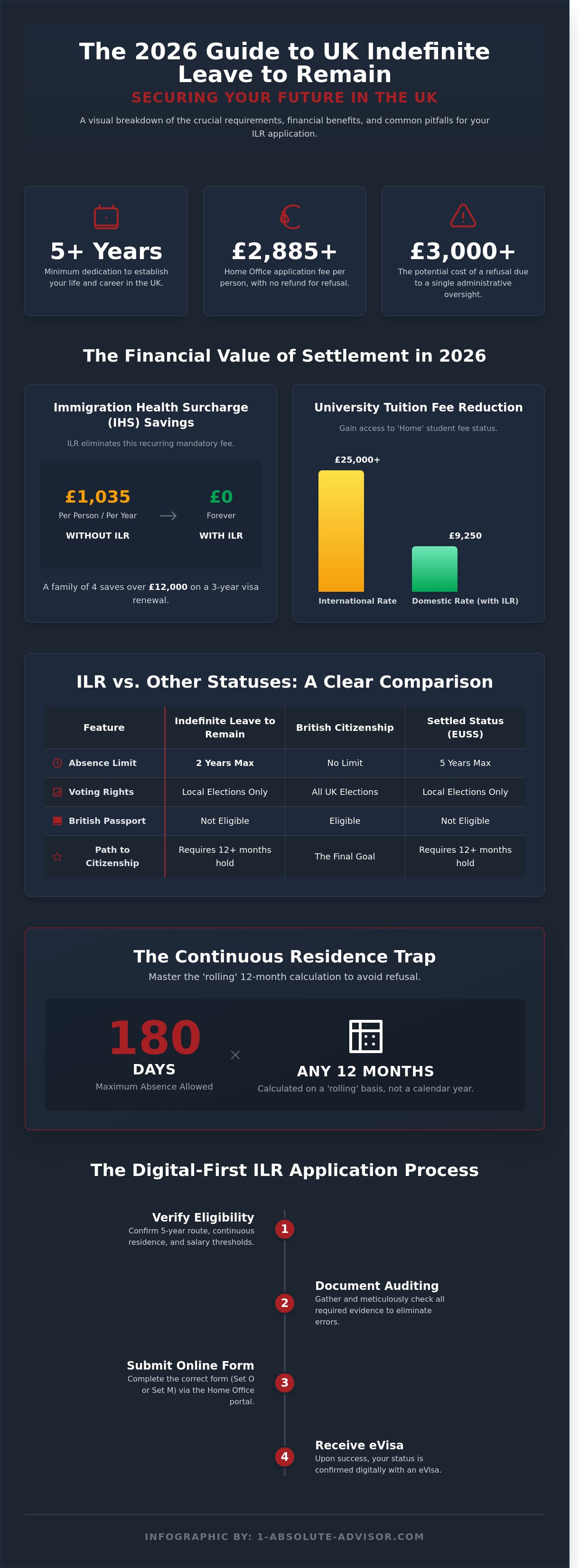
Preparation Standards: Ensuring Your Documents Meet Home Office Audits

Presentation is as vital as the evidence itself when submitting your final bundle. A “Decision-Ready” application significantly reduces the cognitive load on the caseworker, which often facilitates a smoother approval process. Your ilr document checklist must account for the technical rigour required by Home Office auditors in 2026. This preparation involves more than just gathering papers; it requires a systematic verification of every third-party document. You should confirm the authenticity of employer letters and bank statements before they reach the upload portal to ensure they meet current regulatory standards.

Certified Translation Requirements

Any document not written in English or Welsh must adhere to the strict “Certified Translation” standard. The Home Office won’t accept informal translations provided by friends, family, or non-professional services. Each translation must explicitly include four mandatory elements: a formal confirmation from the translator that it’s an accurate translation of the original, the date of the translation, the translator’s full name and signature, and their professional credentials or contact details. If your home country uses different dating conventions, such as the MM/DD/YYYY format, ensure the translator clarifies these to prevent any misinterpretation of your residency timeline.

Scanning and Uploading Best Practices

The UKVCAS upload portal is the primary gateway for your digital submission. Managing file size limits while maintaining legibility is a common technical challenge. You should aim for a scanning resolution of 300 dpi; this provides the necessary clarity for stamps and signatures without creating excessively large files. It’s essential that every edge of a document is visible in the scan. Blurry or cropped images of identity documents are a frequent catalyst for “Requests for Further Information,” which can push your processing time beyond the standard six-month window.

Organization within the portal is equally important. Adopt a logical naming convention for your files to demonstrate professional oversight. Instead of generic titles like “Doc1.pdf,” use descriptive names such as “Financial_Payslip_January_2026.pdf.” This methodical approach allows the caseworker to navigate your evidence with ease. While the system is now digital-first, you must retain all original hard copies. The Home Office maintains the right to request physical versions for verification at any point during the audit process. If you’re concerned about the technical quality of your evidence, our document checking service provides a professional final audit to ensure your submission is flawless.

Final Submission: How Professional Document Review Prevents Refusals

Even the most diligent applicants often develop a blind spot for their own errors after months of preparation. Reviewing your ilr document checklist one final time is essential, but it cannot replace the “fresh eyes” of a legal professional. A specialist audit ensures your evidence doesn’t just exist but actively aligns with 2026 case law and Home Office internal guidance. This final stage is where you transform a collection of files into a persuasive legal argument. A well-crafted legal cover letter is the key to this transformation. It “connects the dots” for the caseworker, explaining how each piece of evidence satisfies the specific requirements of the UK Immigration Rules and addressing any potential complexities in your residency or financial history.

In the 24 hours before you hit “submit,” verify that every scan is legible and that your eVisa share code is active. You should ensure your ilr document checklist is fully ticked off and that your cover letter matches the digital files you’ve uploaded. This methodical approach allows you to approach the submission button with the megnyugtató magabiztosság (reassuring confidence) that your application is of the highest professional standard.

The Value of a Standalone Document Checking Service

If you’ve already prepared your application, our Document Checking Service provides a final, expert audit of your bundle. We identify “red flag” documents, such as incorrectly formatted employer letters or bank statements that don’t clearly show the salary deposit, that could trigger a secondary inspection or a refusal. This service isn’t just about technical compliance; it’s about the psychological benefit of knowing your submission is robust. Having a strategic partner validate your evidence before you commit to the non-refundable £3,226 fee provides the certainty required in high-stakes immigration matters.

Next Steps: Beyond the ILR Approval

Receiving your settlement is a landmark achievement, but it’s also the beginning of a new legal status. Once you understand the rights and responsibilities associated with ILR UK, you can begin planning for the final step in your journey. Many settlement holders choose to transition to British Citizenship after twelve months of holding ILR. This progression requires its own set of evidentiary standards and character requirements, which we can help you prepare for well in advance. If you’re ready to secure your future in the UK with absolute confidence, contact 1 Absolute Advisor for a comprehensive ILR assessment today.

Securing Your Permanent Future in the United Kingdom

Achieving settlement is a transformative milestone that requires more than just a collection of papers. Your ilr document checklist must be a strategic asset that addresses the 2026 digital transition and specific evidentiary thresholds for your visa route. Precision in your residency proof and financial documentation is the only way to safeguard your £3,226 application fee and ensure a positive outcome. As the Home Office moves toward a digital-first system, maintaining a flawless evidentiary trail is no longer optional; it’s a requirement for your long-term security.

Our OISC-registered advisors specialize in managing the complexities of both 5 and 10-year routes with a focus on professional integrity and predictable results. We provide fixed-fee application management and a comprehensive document audit to identify potential risks before they reach a caseworker. You don’t have to manage this high-stakes process alone. Secure your UK future with a professional ILR document audit and take the final step toward permanent residency with absolute confidence. Your journey toward British citizenship starts with a successful settlement today.

Frequently Asked Questions

What are the mandatory documents for an ILR application in 2026?

Mandatory evidence includes your current passport, all previous travel documents held during your qualifying period, and your Life in the UK test reference number. You must also provide a Secure English Language Test (SELT) certificate at CEFR Level B1 or a UK degree certificate. These core items form the basis of every ilr document checklist regardless of your specific visa route.

Can I use an expired passport to prove my continuous residence for ILR?

Yes, expired passports are essential for demonstrating your travel history and continuous residence. Caseworkers examine the entry and exit stamps in these documents to calculate your total absences from the UK. If you’ve lost an old passport, you may need to provide a Subject Access Request from the Home Office to fill the gaps in your residency record.

How do I provide proof of my immigration status if I have an eVisa?

You must generate a digital share code through your UKVI account to prove your current status. The Home Office uses this code to access your digital immigration record directly. Since physical Biometric Residence Permits are being phased out, ensuring your UKVI account is updated with your latest passport details is a critical step in the 2026 application process.

Do I need to submit original paper documents to the Home Office?

No, the submission process is now primarily digital via the UKVCAS upload portal. You must provide high-quality scans of your original documents, ensuring all stamps and edges are clearly visible. While you don’t mail the originals, you must keep them in your possession as the Home Office reserves the right to request physical verification during their audit.

What happens if I cannot provide one of the documents on the checklist?

You must provide a formal letter of explanation detailing why the document is unavailable and what alternative evidence you are submitting instead. Simply omitting a required item without explanation will likely result in a refusal. We recommend professional advice when substituting evidence to ensure the alternative meets the Home Office’s strict “Standard of Proof.”

Does the 180-day absence rule apply to all ILR routes?

The 180-day rule applies to the majority of settlement categories, including Skilled Worker and Long Residence routes. It requires that you haven’t spent more than 180 days outside the UK in any 12-month period. While some family-based routes have different requirements focusing on cohabitation, the 180-day threshold remains the standard for most applicants.

How recent must my bank statements and payslips be for the application?

Your financial documents must be dated within 28 days of the date you submit your online application. This is known as the “28-day rule” and it’s a frequent cause of application failure. If your bank statements or payslips are older than this when you hit submit, the Home Office will likely consider your financial evidence invalid.

Is a professional document checking service worth the cost for ILR?

A professional audit is a strategic investment that protects your £3,226 application fee from being lost due to preventable errors. An expert review of your ilr document checklist identifies technical discrepancies and evidentiary gaps that are often invisible to the applicant. This service provides the professional certainty required to ensure your application is “Decision-Ready” upon submission.

10-Year Route to ILR UK: The 2026 Guide to Long Residence Settlement

The UK’s long residence settlement is currently undergoing its most significant shift in a generation, and waiting even a few months to apply could be the difference between securing your future or facing a much harder “Earned Settlement” model. After a decade of building a life in Britain, the prospect of a £3,226 application fee and the fear of a technical refusal can feel overwhelming. It’s natural to feel anxious about the 10 year route to ilr uk, especially with the Home Office’s strict new absence rules and the complexities of transitional periods for travel that started before April 2024.

You’ve worked hard to reach this milestone, and you deserve a settlement process that reflects your commitment to the country. This guide will strip away the confusion, providing you with a clear, strategic roadmap to navigate these 2026 requirements and secure your Indefinite Leave to Remain with absolute confidence. We’ll break down the 180 day absence limits, explain how to calculate your qualifying period, and show you how to protect your application from common pitfalls that lead to costly rejections.

Key Takeaways

  • Identify the specific visa categories that can be combined to meet your long residence requirements and establish a valid qualifying period.
  • Navigate the complex 2025/2026 absence regulations for the 10 year route to ilr uk, including the 180-day limit and transitional rules for travel before April 2024.
  • Determine your earliest possible application date to secure your status before proposed “Earned Settlement” policy changes are implemented.
  • Protect your £3,226 investment by mastering the technical document requirements that prevent non-refundable refusals and application delays.

What is the 10-Year Route to ILR in the UK?

The 10-year route, officially known as Long Residence, represents a unique path to permanent settlement for individuals who’ve maintained legal status in the UK through various immigration categories. Unlike specific employment-based or family-based routes that often require you to stay on a single visa type for five years, this path recognizes the reality of a modern career and life. The 10 year route to ilr uk allows you to accumulate time across a diverse range of visa histories, rewarding the longevity of your stay rather than the specific category of your current leave. Long Residence serves as the ultimate safety net for individuals who’ve built their lives in Britain over a decade but may not qualify under more restrictive five-year settlement categories.

One of the most significant advantages of this route is the freedom it provides from a single sponsor or employer. While a Skilled Worker visa ties your status to a specific job, the Long Residence path focuses on your total time spent as a lawful resident. This means you can switch industries, move from being a student to a professional, or change from a dependent to a lead applicant without resetting your settlement clock. It provides a level of professional and personal autonomy that other routes simply cannot match.

Indefinite Leave to Remain (ILR) vs. Leave to Remain

Understanding the distinction between these two statuses is vital for your long-term planning. Leave to Remain is a temporary grant of stay that usually comes with an expiry date and specific conditions, such as no access to public funds or a requirement to work for a specific employer. In contrast, obtaining ILR provides you with permanent residency. To understand the legal foundations, it’s helpful to review What is Indefinite Leave to Remain and how it functions as a permanent status. Once you hold ILR, you’re no longer subject to immigration time limits, and it serves as the mandatory stepping stone for those pursuing British Citizenship.

The ‘Any Combination’ Visa Rule

The flexibility of the 10 year route to ilr uk stems from the ability to combine almost any legal visa types to reach the 10-year threshold. For example, many applicants begin this journey by securing admission to UK universities through services like Ideal Study Abroad, eventually transitioning from a Student visa to a Graduate visa and finally to a Skilled Worker visa. This cumulative approach ensures that your early years of education and initial career steps are not wasted. However, certain categories are strictly excluded from this calculation. Time spent on a Standard Visitor visa or as a short-term seasonal worker doesn’t count toward the 10-year total. Additionally, current guidance specifies that time spent in the UK under the various Ukraine schemes generally does not contribute to the Long Residence qualifying period.

Eligibility Criteria: How to Calculate Your 10-Year Qualifying Period

Precision is the foundation of a successful settlement application. Calculating the 10 year route to ilr uk begins from the exact date you first arrived in the country on a valid visa. It’s not simply about physical presence. You must have held continuous, lawful status for the entire decade without any unauthorized gaps. This process requires a meticulous audit of your past Biometric Residence Permits (BRPs) and passport entry stamps to construct a definitive timeline. Any discrepancy in these dates can lead to an immediate refusal. It’s essential to cross-reference your personal records with the Official government guidance on the 10-year route to ensure every month of your stay is accounted for.

A technicality that often catches applicants off guard is the ’12-month rule.’ Under current regulations, you must have held your current category of permission for at least one full year before you become eligible to apply for settlement under the long residence route. This rule prevents individuals from switching into a visa category at the last minute just to claim ILR. If you’re concerned about how your visa history aligns with these strict requirements, utilizing a professional document checking service can provide the clarity and peace of mind you need before committing to the high application fees.

What Breaks Continuous Residence?

Maintaining the 10-year clock requires absolute compliance with immigration laws. Overstaying your visa is the primary cause for breaking continuous residence; even a short lapse can reset your counter to zero. Similarly, if a visa extension is refused and you aren’t granted an administrative review or a new visa, your qualifying period is interrupted. Beyond administrative gaps, the Home Office evaluates ‘bad character’ issues. Criminal convictions or a history of deception in previous applications can lead to a refusal, regardless of how many years you’ve lived in the UK.

Understanding Section 3C Leave

Section 3C leave serves as a legal ‘bridge’ that protects your status while you wait for a decision on a pending application. If you’ve submitted a valid extension application before your current visa expires, Section 3C leave keeps your existing rights and conditions active. Importantly, this period counts toward your 10-year total. You should always keep records of your application submission dates and payment receipts. These documents are vital proof of your 3C status and ensure that processing delays by the Home Office aren’t unfairly counted as gaps in your lawful residence.

10-Year Route to ILR UK: The 2026 Guide to Long Residence Settlement

Absence Rules and the 2025/2026 Regulatory Updates

The Home Office’s approach to absences has become significantly more technical following the 11 April 2024 rule change. For any period of residence occurring after this date, the standard limit is now 180 days of absence within any rolling 12-month period. This is a departure from the older, fixed-period calculations. If your 10 year route to ilr uk includes travel that took place before April 2024, you’re subject to transitional protections. These older rules mandate that you must not have been absent for more than 184 days in a single instance and your total absences across the first 10 years must not exceed 548 days. Calculating these overlapping requirements requires a high degree of precision to protect your £3,226 application investment.

A vital but often overlooked update arrived in July 2025 regarding time spent in Crown Dependencies. If you’ve lived in Jersey, Guernsey, or the Isle of Man, this time can now be integrated into your 10-year timeline under specific conditions. This regulatory shift recognizes the mobility of professionals within the British Isles. However, the Home Office remains strict about how this time is credited. Your most recent grant of leave must have been issued within the UK, and the visa routes used in the dependencies must be equivalent to recognized UK settlement paths. This ensures that your cumulative residence is treated as a single, continuous journey toward permanent status.

The 180-Day Rule Explained

Calculating absences on a rolling basis means that you can’t simply look at calendar years. Instead, you must ensure that at any point in time, the preceding 12 months do not contain more than 180 days abroad. If you’ve exceeded these limits due to extraordinary circumstances, you may qualify for a “compassionate grounds” exception. The Home Office doesn’t grant these lightly. You’ll need to provide exhaustive evidence, such as hospital records for medical emergencies or official documentation regarding global travel disruptions. It’s not enough to have a compelling story; you must have a documented paper trail that proves the travel was truly unavoidable.

Crown Dependencies and the 2025 Shift

The July 2025 update is a significant win for applicants who’ve spent years in the Channel Islands or the Isle of Man. To include this time in your 10 year route to ilr uk, you must prove that your stay in these territories was lawful and consistent with UK immigration principles. The most critical requirement is the “last grant” rule: your current permission to stay must have been granted by the UK authorities, not the dependency’s government. This ensures that the final stage of your settlement journey is anchored in the UK’s own immigration system. If you meet these criteria, your years in the dependencies provide a valid foundation for your settlement application.

The ILR Application Process: Fees, Documents, and Timing

Timing is everything. The Home Office allows you to submit your application up to 28 days before you actually complete your 10-year qualifying period. This window requires precise calculation; applying even one day too early will result in an automatic refusal and the loss of your application fee. As of April 2026, the standard fee for a SET(LR) application is £3,226 per person. Once you’ve submitted the online form and paid this fee, you’ll need to attend a biometrics appointment to provide your fingerprints and a digital photograph. When you approach the final stages of the 10 year route to ilr uk, your focus must shift from simple residence to rigorous administrative preparation.

The biometrics appointment is more than a formality. It’s the point where your digital identity is linked to your application. You must bring your original passport and the appointment confirmation. Any delay in booking this appointment can extend the already lengthy six-month processing time. Regarding travel logs, don’t rely on memory. Cross-reference your email flight confirmations with your passport stamps to ensure every single exit and entry date is accurate to the day. This level of detail is what separates a successful application from one that triggers a request for further evidence.

Mandatory Prerequisites: Life in the UK and English Language

Before you even open the application form, you must meet two critical statutory requirements. You’ll need to prove your English language proficiency at CEFR Level B1 or higher through a Secure English Language Test (SELT). You’re exempt from this if you hold a degree taught in English from a UK university or if you’re a national of a majority English-speaking country. Additionally, you must pass the Life in the UK test. If you’re feeling unprepared, you can consult our detailed guide on how to pass the Life in the UK test to ensure you’re ready for this mandatory step.

Evidence Checklist for Long Residence

Navigating the 10 year route to ilr uk requires more than just time; it demands a flawlessly compiled dossier of your decade in Britain. You must collate every passport you’ve held during this period, along with your BRPs and a comprehensive travel log. If there are years where your history is complex, secondary evidence like P60s, bank statements, or utility bills becomes essential. A professional cover letter is often the deciding factor in a successful outcome. It allows you to explain any minor gaps or complex visa transitions clearly to the caseworker. To ensure your documentation meets these exacting standards, our Indefinite Leave to Remain (ILR) Application Service provides the expert oversight needed to protect your settlement future.

Professional Guidance: Why an OISC Advisor is Essential for the 10-Year Route

The 10 year route to ilr uk is arguably the most technically demanding pathway in the British immigration system. While other routes focus on a single visa type, Long Residence requires a flawless audit of ten years of varied permissions, travel dates, and personal history. A single miscalculation in your rolling 180-day absence limit or a misunderstood gap in lawful residence can lead to an immediate refusal. Because Home Office fees are non-refundable, a rejection means losing your £3,226 investment plus any priority service charges. Engaging an OISC-registered advisor ensures that your entire decade of history is scrutinized for hidden risks before the government ever sees your application.

Professional representation provides more than just a document check. It offers a strategic shield. For applicants with urgent travel needs or those who simply want peace of mind, we can facilitate Super Priority services to secure a decision within 24 hours. This level of speed is only valuable if the underlying application is robust. Our advisors act as your strategic partners, identifying potential issues with Section 3C leave or historic visa transitions that a standard applicant might overlook. We ensure your submission is not just a collection of forms, but a professionally presented case that meets the high evidentiary standards of 2026.

Managing Complex Visa Histories

Many applicants face “gaps” between visas caused by administrative delays or late submissions. These periods don’t always result in a refusal if handled with expert legal arguments. We specialize in drafting comprehensive cover letters for discretionary cases, explaining complex transitions to Home Office caseworkers with precision. To protect your future, you can utilize our document checking service to ensure every BRP and passport stamp in your 10-year history is compliant with current regulations.

Next Steps: From ILR to British Citizenship

Securing Indefinite Leave to Remain is the final prerequisite before you can apply for naturalisation. For most residents, there’s a mandatory 12-month waiting period after receiving ILR before you’re eligible for citizenship. However, if you’re married to a British citizen, you may be able to apply for naturalisation immediately upon receiving your settlement grant. This transition represents the end of your immigration journey and the beginning of full legal belonging in the UK. If you’re ready to secure your permanent future, we invite you to consult with an expert for a full eligibility assessment and a tailored roadmap to citizenship.

Securing Your Future in the United Kingdom

Completing a decade of life in Britain is a remarkable milestone, yet the final step toward permanent residency requires absolute technical precision. Success on the 10 year route to ilr uk currently depends on your ability to navigate the 2024 absence rule changes and the strict 28-day application window. With the government’s “Earned Settlement” proposals creating future uncertainty, securing your status under the current operational framework is a vital strategic move for any long-term resident.

The complexities of rolling 12-month absence audits and transitional travel rules leave no room for administrative error. Our OISC Registered Immigration Consultants specialize in managing complex Long Residence cases, providing the expert oversight necessary to protect your £3,226 investment. We prioritize fixed-fee transparency, ensuring you receive elite legal guidance with no hidden costs. Don’t let a minor technical oversight jeopardize your decade of hard work and commitment to your life in the UK.

Secure your UK settlement with expert ILR application management today. Your permanent future is within reach, and we’re here to ensure you cross the finish line with total confidence and peace of mind.

Frequently Asked Questions

Can I apply for ILR after 10 years if I was a student for part of that time?

Yes, time spent as a student counts toward your total residence. This flexibility is what makes the 10 year route to ilr uk so valuable for long-term residents. You can combine years spent on Student, Graduate, and Skilled Worker visas to reach the decade threshold. For students already in the country seeking flexible undergraduate or master’s options to support their educational goals, ukhomestudents.com provides tailored programmes. It’s essential that your status remained lawful throughout these transitions without any unauthorized breaks in your leave to remain.

What happens if I have a gap of a few days between my visas?

A gap of a few days can be problematic but isn’t always fatal to your application. The Home Office may disregard a period of overstaying if it’s 14 days or less and there’s a good reason for the delay. However, these gaps are scrutinized heavily by caseworkers. We suggest a full audit of your history to ensure any overlap doesn’t reset your ten-year counter to zero.

How much does the 10-year ILR application cost in 2026?

The standard fee for an ILR application is £3,226 per person as of April 2026. This cost applies to both main applicants and any dependants applying separately. If you require a faster decision, you’ll need to pay an additional £500 for Priority service or £1,000 for Super Priority service. These fees are non-refundable even if your application is refused for technical reasons.

Does the 10-year route count time spent on a visitor visa?

Time spent on a Standard Visitor visa is strictly excluded from the 10-year calculation. The Home Office only recognizes time spent under a valid grant of leave that allows for long-term residence. If you entered the UK as a tourist before switching to a resident visa, your ten-year clock only starts from the date your first resident visa was granted or your first entry on that visa.

Can I include my dependants in my 10-year long residence application?

No, dependants cannot be included on the main applicant’s SET(LR) form. Each family member must submit a separate application and pay the individual £3,226 fee. This requirement often makes the 10 year route to ilr uk a significant financial commitment for families. Each person must also independently meet the residence and absence requirements to be successful in their own right.

What is the 180-day absence rule for the 10-year route?

The 180-day rule mandates that you don’t spend more than 180 days abroad in any rolling 12-month period. This applies to all absences starting after April 11, 2024. If your travel occurred before this date, you’re protected by transitional rules that allow for a total of 548 days away over the entire ten-year period. Accuracy in these calculations is vital for an approval.

Do I need to pass the Life in the UK test for the 10-year route?

Yes, you must pass the Life in the UK test before submitting your settlement application. This is a mandatory requirement for most applicants between the ages of 18 and 64. You’ll also need to prove your English language proficiency at Level B1. Exemptions only apply if you’re from a majority English-speaking country or hold a degree taught in English from a recognized UK university.

How long does the Home Office take to decide on a 10-year ILR application?

The Home Office currently takes up to 6 months to process standard ILR applications. This timeline begins once you’ve attended your biometrics appointment and provided your fingerprints. High application volumes in early 2026 have led to many cases taking the full duration of this window. If you need a decision sooner, the Super Priority service can provide an outcome by the next working day.

The 5-Year Route to Settlement UK: Navigating ILR Requirements in 2026

In 2026, the 5 year route to settlement uk is no longer a standard expectation; it’s a premium pathway reserved for those who actively manage their professional and financial standing. Following the April 2026 implementation of the “Earned Settlement” model, the baseline for Indefinite Leave to Remain (ILR) shifted to 10 years for many sectors. You’re likely concerned that the new B2 English requirement or the £3,029 application fee represents just the beginning of a more restrictive era. It’s stressful to think that a single salary fluctuation or an overlooked absence could double your wait time for permanent residency.

This article provides the strategic clarity you need to secure your ILR within the 5-year window by mastering the £50,270 earnings threshold and the 180-day continuous residence rules. You’ll gain a definitive checklist of documents and a clear understanding of how to avoid being downgraded to the 10-year route. We’ll outline exactly how to navigate these regulatory shifts to ensure your path to settlement remains both predictable and secure.

Key Takeaways

  • Determine if you still qualify for the accelerated 5 year route to settlement uk under the 2026 “Earned Settlement” model and updated salary thresholds.
  • Identify the critical financial benchmarks, specifically the £50,270 minimum earnings required for Skilled Workers to bypass the standard 10-year residency baseline.
  • Learn to calculate continuous residence accurately to stay within the 180-day annual absence limit and the 540-day total cap over your qualifying period.
  • Understand how to align your professional trajectory with the updated B2 English language standards and the Life in the UK test requirements.
  • Establish a strategic document audit process from your first year in the UK to ensure a seamless and successful transition to Indefinite Leave to Remain.

Understanding the 5-Year Route to Settlement in 2026

The 5 year route to settlement uk is the most efficient pathway for non-EU nationals seeking to establish a permanent life in Britain. It isn’t merely a convenience; it’s a strategic milestone that grants the right to work, study, and access public funds without the recurring burden of visa renewals. However, the regulatory environment changed significantly following the 2025 “Restoring Control” White Paper. This policy shift moved the goalposts for many, making the 5-year path a selective privilege rather than a universal standard. Success in 2026 demands more than just time. It requires meticulous adherence to continuous residence rules and specific financial benchmarks from the moment you arrive. Proving your eligibility involves meeting character requirements and demonstrating a sustained economic contribution to the UK.

What is Indefinite Leave to Remain (ILR)?

Understanding Indefinite Leave to Remain is essential for anyone planning a long-term future in the UK. ILR is a permanent residency status that effectively removes immigration control, allowing you to live in the country without an expiry date on your stay. It’s the mandatory foundation for those who eventually wish to apply for British citizenship. While the status provides immense security, it remains conditional. If you reside outside the UK for more than two continuous years, you risk losing your ILR status entirely. Maintaining this status requires a commitment to making the UK your primary home, backed by evidence of your ongoing residence.

The 2025-2026 Policy Shift: 5 Years vs. 10 Years

The 2026 “Earned Settlement” framework introduced a tiered system that prioritizes economic contribution and specific skill sets. While the standard baseline for settlement has been extended to 10 years for many “medium-skilled” roles and those in the social care sector, the 5 year route to settlement uk remains accessible for top talent and high earners. Specifically, individuals earning between £50,270 and £125,139 retain their 5-year eligibility. This means your uk immigration strategy must be proactive from day one. You can’t wait until year four to check your eligibility. You must track your “continuous residence” meticulously, ensuring you don’t exceed 180 days of absence in any 12-month period. The Home Office now utilizes automated tracking to flag discrepancies immediately, making precision in your travel records more critical than ever before.

Eligibility Criteria: Who Still Qualifies for the 5-Year Pathway?

The 2026 immigration landscape creates a sharp division between standard residency and what the Home Office now considers “earned” settlement. While the 10-year baseline applies to a broader range of migrants under the new model, the 5 year route to settlement uk remains the primary objective for high-value workers and family members of British citizens. Maintaining your eligibility requires a proactive approach to your immigration status from the moment your initial visa is granted. Beyond the main work and family categories, Global Talent, Innovator Founder, and UK Ancestry visa holders continue to enjoy access to this shorter timeframe, provided they meet the specific endorsement and residency criteria. It’s a premium path that demands total compliance with evolving regulations.

Work-Based Routes and Salary Thresholds

To qualify for settlement after 60 months, Skilled Worker Visa holders must now meet the £50,270 minimum salary threshold established in the April 2026 rule changes. It’s a common misconception that meeting the initial sponsorship salary is sufficient for permanent residency. The “Settlement Salary Requirement” is a distinct hurdle that must be maintained throughout your qualifying period. You should review the skilled worker visa uk 2026 updates to ensure your RQF level and specific job code still align with the 5-year pathway. If your earnings fall below this threshold and you don’t work in a protected public service role, like medicine or teaching, you risk being moved to the 10-year “Standard” route.

Family and Spouse Visa Pathways

The spouse visa uk remains one of the most stable 5-year pathways, though it’s not without its own financial complexities. Applicants must satisfy the financial requirement through combined income or significant savings, which is a separate standard from the “adequate maintenance” rules applied to specific exempt groups. You must be cautious during the extension phase. If you fail to meet the strict financial criteria at the 2.5-year mark, the Home Office may transition your application to the “10-year private life route.” This shift doubles your wait time and exponentially increases your long-term application costs. Checking the official ILR requirements regularly is the most effective way to stay informed about subtle policy shifts that could impact your family’s security. If you’re concerned about meeting these benchmarks, seeking a professional document checking service can provide the necessary certainty before you submit your final application.

The 5-Year Route to Settlement UK: Navigating ILR Requirements in 2026

The 5-Year vs. 10-Year Route: Navigating the 2025 Policy Shifts

The divergence between the 5-year and 10-year pathways has created a significant financial and administrative gap for migrants. Under the 2026 “Earned Settlement” model, the standard route now requires a decade of residency. This extension isn’t just a matter of time; it carries a heavy price tag. Choosing the wrong path means paying an additional five years of Immigration Health Surcharge (IHS) fees and multiple visa renewal costs before reaching eligibility. For those in social care or medium-skilled roles, the baseline can even extend to 15 years. This makes the 5 year route to settlement uk an essential strategic target for those who can meet the merit-based criteria.

A critical risk in the current system is the “Dependant Trap.” This occurs when a main applicant qualifies for the accelerated 5-year path, but their family members are relegated to the 10-year baseline due to specific sector restrictions or missing the April 2026 transitional cutoff. It results in a fragmented household status where parents might settle years before their children. Proper planning requires examining the UK government guidelines on Indefinite Leave to Remain to ensure your entire family remains on a synchronized timeline. Every year spent waiting on a temporary visa adds thousands of pounds in cumulative costs and administrative uncertainty.

The “High-Earner” Privilege

The 2026 regulations clearly favor economic contribution as a primary factor for settlement speed. To secure the 5-year ILR track, Skilled Workers must maintain annual earnings between £50,270 and £125,139. If your income exceeds £125,140, you may even qualify for a 3-year accelerated route. The Migration Advisory Committee (MAC) constantly reviews these thresholds based on economic productivity. Your salary isn’t just a paycheck; it’s your ticket to faster residency. If you receive a promotion that pushes you above the £50,270 mark mid-visa, you can effectively “switch tracks” from the 10-year to the 5-year pathway, provided you meet the other continuous residence requirements from that point forward.

Dependants and the 10-Year Baseline

New rules for 2026 have tightened the requirements for partners and children significantly. While partners of British citizens generally retain their 5-year path, dependants of Skilled Workers in lower-earning brackets often face the full 10-year wait. This creates a complex situation for children born in the UK during this period. While they may have a claim to citizenship once a parent settles, the intervening years require constant visa maintenance and high renewal fees. Aligning your family’s settlement dates is no longer automatic. It requires a proactive document strategy and careful timing of your extension applications to avoid unnecessary delays that could push you toward the long-residency route.

Critical Requirements for Maintaining Your Settlement Clock

Maintaining your eligibility for the 5 year route to settlement uk requires more than just physical presence; it demands a continuous, uninterrupted legal status. The Home Office defines “continuous residence” with mathematical precision. Any breach, however minor, can reset your qualifying period to zero. This forces you to start the multi-year process again under potentially stricter future rules. Beyond mere presence, you must demonstrate “Good Character,” which includes a clean criminal record and the absence of civil penalties, such as tax discrepancies or litigation. Every interaction with UK authorities is recorded and reviewed during your final settlement audit.

Calculating Absences and Continuous Residence

The rolling 12-month calculation is the standard for assessing absences. You must not spend more than 180 days outside the UK in any 12-month period. Unlike previous fixed-calendar systems, this rolling method means any trip is measured against the 365 days preceding and following it. If you’ve spent 45 days abroad for work and 20 days for a family emergency, your remaining allowance is 115 days. Valid exemptions do exist for compelling and compassionate reasons. These include serious illness of the applicant or a close relative, or natural disasters. However, these require robust documentary evidence, such as medical reports or official travel disruptions, to be accepted. Maintaining a detailed residence log from your first day in the UK is the only way to ensure your final application is audit-ready.

Knowledge of Life and Language

By May 2026, the English language proficiency requirement for settlement has been elevated to the B2 level on the CEFR scale. This is a step up from the B1 level previously required for initial entry. You must pass a secure English language test (SELT) unless you’ve already met this through a degree taught in English or fall into an exempt age group, such as those under 18 or over 65. The Life in the UK test remains a mandatory component of the 5 year route to settlement uk. It’s advisable to sit this exam at least 12 months before your eligibility date to avoid administrative delays. If you’re unsure if your current qualifications meet the 2026 standards, our Indefinite Leave to Remain (ILR) Application Service can provide a comprehensive eligibility audit to protect your residency clock.

Character requirements are often overlooked but are equally vital. The Home Office scrutinizes your history for any behavior that suggests you aren’t of good character. This includes not just criminal convictions, but also non-custodial sentences and even persistent administrative failures. Late tax filings or unpaid civil fines can be grounds for refusal. In the 2026 landscape, compliance is not optional; it is the foundation of your permanent residency.

Securing Your Future: Professional Strategy for ILR Applications

Reaching the conclusion of the 5 year route to settlement uk requires a final, meticulous audit of your five-year history. You shouldn’t treat the final application as a mere formality; it’s a consolidation of half a decade of compliance. A proactive document strategy, initiated well before your eligibility date, ensures that every salary fluctuation or change in job title is accounted for under the 2026 “Earned Settlement” standards. Overlooking a minor drop below the £50,270 threshold or failing to update your Certificate of Sponsorship (CoS) during a promotion can trigger a “private life” downgrade, extending your path to residency by an additional five years. This shift doesn’t just delay your status; it exponentially increases your long-term costs due to extra visa renewals and health surcharges.

Obtaining Indefinite Leave to Remain is often the gateway to British Citizenship. Once you’ve successfully completed the 5 year route to settlement uk, you’ll typically face a 12-month residency requirement before you can apply for naturalization. This final year remains a period of scrutiny where maintaining good character and primary residence is essential. By viewing your settlement application as part of a comprehensive, multi-stage journey toward becoming a British citizen, you can ensure your transition is both seamless and legally robust. It’s about protecting the investment you’ve made in your professional and personal life since your first day in the country.

Document Audits and Pre-Submission Checks

The complexity of the 2026 framework makes a professional ilr uk audit a critical safeguard against Home Office refusals. A document checking service identifies potential discrepancies in employment records or residence logs that could derail an otherwise valid application. For those on work-based routes, securing explicit employer confirmation of your ongoing role and salary is a non-negotiable requirement. In 2026, utilizing priority or super-priority services can reduce the standard six-month decision window to just 24 hours, providing immediate certainty for your long-term planning.

The 1 Absolute Advisor Advantage

Navigating these high-stakes regulatory shifts requires a partner who understands the holistic intersection of immigration law and professional stability. 1 Absolute Advisor provides a fixed-fee management model for uk work visa settlement, ensuring financial predictability throughout the process. Our OISC-registered experts specialize in the 2025 and 2026 rule changes, offering the strategic depth needed to protect your status. Book a consultation to assess your 5-year eligibility today with 1 Absolute Advisor and secure your permanent future in the United Kingdom.

Strategic Residency: Your Path to Permanent Status

The 2026 “Earned Settlement” model has transformed the 5 year route to settlement uk from a routine process into a merit-based achievement. Maintaining your eligibility requires more than just meeting the £50,270 salary threshold; it demands absolute precision in tracking your 180-day rolling residence and ensuring your professional documentation remains flawless. As the Home Office moves toward more automated compliance checks, the margin for administrative error has effectively vanished. Those who successfully navigate these 2025 policy shifts don’t just secure residency; they establish the mandatory foundation for British citizenship.

Expertise is the most reliable tool to mitigate the risk of a 10-year downgrade. As OISC Registered Immigration Consultants, we specialize in complex ILR and Spouse Visa cases, providing the strategic oversight necessary to protect your immigration timeline. Our fixed-fee visa application management ensures you have a predictable partner throughout this multi-year journey. Secure your 5-year route to settlement with an expert OISC advisor today. Your future in the United Kingdom is a long-term investment, and with the right professional guidance, your path to permanent residency remains clear and attainable.

Frequently Asked Questions

Can I switch from the 10-year route to the 5-year route if my salary increases?

You can transition to the 5-year pathway if your annual earnings rise above the £50,270 threshold established in April 2026. This move requires you to meet all specific criteria of the “Skilled” route from the moment of your transition. It’s a strategic decision that can save you five years of Immigration Health Surcharge fees and administrative burdens. You must ensure your sponsorship details are updated correctly to reflect this change in status.

What happens to my settlement clock if I lose my job during the 5-year period?

Losing your employment stops your residency clock if your leave is curtailed and you don’t secure a new sponsor within 60 days. Any gap in lawful residence resets the 5 year route to settlement uk to zero. To protect your progress, you must transition to a new qualifying employer or a different visa category without a break in your legal stay. Precision in timing these transitions is vital for your long-term security.

Do children born in the UK automatically get settlement after 5 years?

Children born in the UK don’t automatically receive settlement or citizenship at birth unless at least one parent is already settled or a British citizen. Once you achieve Indefinite Leave to Remain, your UK-born children become eligible to register as British citizens. If you haven’t settled yet, children who live in the UK for the first 10 years of their life may have a separate pathway to citizenship regardless of your status.

How do the 2025 changes affect dependants on the 5-year route?

The April 2026 “Earned Settlement” model links dependant eligibility to the main applicant’s economic contribution. Family members of high earners who meet the £50,270 salary benchmark generally retain their 5-year residency pathway. However, dependants of those in lower-earning tiers or the social care sector may be moved to a 10-year baseline. This shift often results in family members settling at different times, requiring careful financial and legal planning.

Is the “Life in the UK” test still required for the 5-year route in 2026?

The Life in the UK test remains a mandatory requirement for all settlement applicants between the ages of 18 and 64. It is a core component of the 5 year route to settlement uk and should be completed well before your 60-month eligibility date. The test assesses your integration and knowledge of British customs. Passing this exam is a one-time requirement that stays valid for all future applications, including British citizenship.

Can I include time spent on a Student visa toward the 5-year route?

Time spent on a Student visa doesn’t count toward the 5-year settlement pathway for work or family routes. While student residency contributes to the 10-year long residence model, the accelerated 5-year route only accepts time spent on specific qualifying visas, such as the Skilled Worker or Spouse visa. You must switch to a qualifying category to begin your five-year countdown toward permanent residency status.

What are “compelling reasons” for exceeding the 180-day absence limit?

Compelling reasons include serious illness, the birth or death of a close relative, or large-scale natural disasters that prevent travel. You must provide robust third-party evidence, such as medical certificates or official government travel advisories, to justify these absences to the Home Office. Without verified documentation, exceeding the 180-day limit in any rolling 12-month period will reset your settlement clock and delay your eligibility for ILR.

How much does the ILR application cost for the 5-year route in 2026?

The standard application fee for Indefinite Leave to Remain is £3,029 per person as of May 2026. This figure doesn’t include additional costs for biometric appointments or priority processing services, which can accelerate the decision-making process to within 24 hours. Because these fees are non-refundable, performing a professional document audit before submission is a necessary step to protect your financial investment and ensure a successful outcome.

How to Apply for ILR UK: The Complete 2026 Settlement Guide

Would you risk £3,226 on a single technicality? For many, the path to settlement feels like a high-stakes gamble where one missing document leads to an expensive refusal. Success in 2026 isn’t just about filling out a form; it’s about building an unassailable audit trail of your life in Britain. Mastering how to apply for ilr uk requires more than just meeting the five-year residency rule. It demands a precise understanding of the digital landscape as the Home Office phases out physical BRPs in favor of eVisas by the end of December 2026.

You’ve likely spent years counting your days outside the country and preparing for the fee increases that took effect on April 8, 2026. It’s natural to feel anxious about the shift toward a fully digital immigration system. This guide provides the strategic clarity you need to navigate the application process and move toward British Citizenship with confidence. We’ll examine the mandatory documentation requirements, the £19.20 biometric enrollment process, and the exact steps to ensure your application stands up to the strictest Home Office scrutiny.

Key Takeaways

  • Understand the permanent benefits of Indefinite Leave to Remain, including the removal of all immigration time limits and full access to UK public funds.
  • Identify the specific requirements for your route, whether you are on a five-year Skilled Worker path or the ten-year Long Residence track.
  • Learn exactly how to apply for ilr uk by mastering the 28-day application window and selecting the correct statutory forms for your circumstances.
  • Discover how to build a “Golden Thread” of evidence that proves continuous residence and ensures your documentation meets the Home Office’s evidentiary standards.
  • Avoid common pitfalls regarding the “Good Character” requirement by implementing a proactive disclosure strategy to protect your settlement prospects.

Understanding Indefinite Leave to Remain (ILR) in 2026

Indefinite Leave to Remain (ILR) represents the final milestone in the UK immigration journey for most foreign nationals. Knowing how to apply for ilr uk is essential because it grants you the legal right to reside in the country without any time-limited restrictions. Essentially, it transitions you from a temporary visitor or worker to a settled resident. While you remain a citizen of your home country, the Home Office no longer dictates how long you can stay or what activities you can pursue, provided you don’t spend more than two consecutive years outside the UK.

A deep dive into Understanding Indefinite Leave to Remain (ILR) reveals that this status is more than just a visa; it is a permanent change in legal standing. ILR holders enjoy rights comparable to British citizens, excluding the right to vote in general elections or hold a British passport. You can work for any employer without sponsorship, start a business, or study without the constraints of a Tier 4 visa. Crucially, you gain access to public funds and the NHS without paying the Immigration Health Surcharge, which can save individuals thousands of pounds over a lifetime.

The Shift to Digital: ILR and eVisas

The UK immigration landscape underwent a seismic shift leading up to 2026. Physical Biometric Residence Permits (BRPs) are now a thing of the past. If your application is successful today, you won’t receive a plastic card in the mail. Instead, your settled status is recorded digitally as an eVisa. This digital-only system is designed to reduce fraud and streamline border crossings, but it requires a different approach to proving your rights. The UKVI account serves as the new central hub for all status management, replacing the need for physical documentation entirely.

To view or share your status with employers and landlords, you must log into your UKVI account to generate a secure share code. This code is temporary and provides third parties with time-limited access to verify your right to work or rent. Understanding how to apply for ilr uk in this digital era also means ensuring your passport details are always synced with your online profile. If you get a new passport, you must update your UKVI account immediately to avoid issues at the border.

Why ILR is the Foundation for Citizenship

ILR isn’t the end; it’s the gateway. For most residents, holding ILR for at least 12 months is a mandatory prerequisite before applying for naturalisation. This “waiting period” allows the Home Office to ensure you have maintained your settled status and continue to meet the residence requirements. However, if you’re married to a British citizen, you might be eligible to apply for citizenship immediately after your ILR is granted, bypassing the one-year wait.

This stage is also the final test of your immigration history. The Home Office reviews your “good character” over the previous ten years, looking for criminal convictions, civil penalties, or breaches of immigration rules. Any issues identified during your settlement application could jeopardize your future as a British citizen. For a detailed roadmap on the next stage of your journey, consult our British Citizenship guide. Securing ILR is the most significant step toward total legal security in the UK.

Identifying Your Qualifying Pathway to Settlement

Determining your specific eligibility is the first strategic step in understanding how to apply for ilr uk. You can’t simply apply for settlement in a vacuum; you must qualify through a recognized immigration category that leads to permanent residency. Most applicants rely on the standard five-year route, but individual circumstances often allow for alternative pathways, such as the ten-year long residence track or even accelerated options for high-value migrants. Choosing the wrong category at the start is a common reason for application failure.

The “Continuous Residence” requirement serves as the backbone of every successful settlement claim. To meet this standard, you must demonstrate that you haven’t been absent from the UK for more than 180 days in any rolling 12-month period throughout your qualifying years. For a high-level summary of these categories, Identifying Your Qualifying Pathway to Settlement on the official government portal provides a basic overview, but the nuances of the rules implemented on April 8, 2026, require much deeper scrutiny to ensure compliance.

The 5-Year Route: Skilled Worker and Family Visas

This remains the most frequent path to settlement. For those currently holding a Skilled Worker visa, you must prove you’re still required for your role and that your earnings meet the updated 2026 salary thresholds. If you’re following the UK Spouse Visa route, the focus shifts to proving your relationship is subsisting and that you meet the specific financial requirements. If you’re unsure whether your current income or employment status meets these strict benchmarks, our professional document checking service can provide the legal certainty you need before you commit to the application fee.

The 10-Year Long Residence Pathway

If you’ve switched between various visa categories, the 10-year route is often your most viable option. This pathway allows you to combine time spent on different visas, such as moving from a Student visa to a Graduate visa and finally to a work-based permit. The qualifying period is calculated from the date you first entered the UK on a valid visa. You must be extremely cautious with “broken” residence. Even a short period spent without valid leave to remain can reset your 10-year clock to zero, forcing you to start the entire decade-long process over again.

Accelerated settlement options provide a faster track for specific individuals. Global Talent visa holders can often apply for ILR after just three years of residence. Certain Innovator Founders may even qualify in as little as two years if they meet specific business growth milestones. These accelerated paths are highly scrutinized by the Home Office, as they require proof of significant professional or economic contribution. Regardless of which path you choose, knowing how to apply for ilr uk correctly involves a meticulous audit of your entire immigration history to ensure no gaps or rule breaches exist.

How to Apply for ILR UK: The Complete 2026 Settlement Guide

The Step-by-Step ILR Application Process

Executing the steps of how to apply for ilr uk requires a methodical approach to data entry and timing. Once you’ve confirmed your eligibility pathway, the process moves into a technical phase where precision is your greatest asset. This journey begins with selecting the correct digital form, typically SET(O) for work-based routes or SET(M) for family-based applications. In the 2026 digital landscape, your application is directly integrated with your UKVI account, ensuring that your settled status is instantly accessible as an eVisa upon approval.

The submission phase involves more than just uploading files; it’s a financial and legal commitment. You’ll need to pay the standard application fee of £3,226, which became effective on April 8, 2026. At this stage, you must also decide on the speed of your decision. While standard processing can take up to six months, you can opt for Priority Service at an additional £500 for a five-day turnaround, or Super Priority at £1,000 for a decision by the end of the next working day. A comprehensive review of the Essential Supporting Documents and the Evidence Audit is vital to ensure your absences don’t disqualify you at the eleventh hour.

Mastering the 28-Day Rule

Timing is the most common point of failure for unassisted applicants. You’re permitted to submit your application up to 28 days before you complete your five-year or ten-year qualifying period. However, calculating this date requires extreme care. If you apply even one day too early, the Home Office will likely reject the application as “premature,” resulting in the loss of your £3,226 fee. You should generally calculate this period from the date your initial visa was granted or the date you first entered the UK, depending on your specific visa category’s rules. Don’t guess this date; verify it against your original approval letter.

Biometrics and the UKVCAS Appointment

After paying your fees, you must book a biometrics appointment through the UKVCAS portal. This appointment is where your fingerprints and digital photographs are captured for a fee of £19.20. While you can pay for in-person document scanning at the service center, we recommend uploading all evidence digitally via the portal at least 48 hours before your appointment. This allows for a smoother experience and provides a digital trail of your submission.

Once biometrics are submitted, the official waiting period begins. During this time, the Home Office may issue a “Request for Information” (RFI) if they find any inconsistencies in your residence history or financial data. Responding to an RFI with speed and professional clarity is essential to keep your application on track. Understanding how to apply for ilr uk also means being prepared for this potential scrutiny, ensuring you have secondary evidence ready if the caseworker requests further proof of your life in Britain.

Essential Supporting Documents and the Evidence Audit

A successful settlement application rests on the strength of your evidence audit. While the digital form asks for basic details, the caseworker makes a decision based on the “Golden Thread” of documentation you provide. This thread must link your initial entry into the country to your current status without any breaks or unexplained absences. Understanding how to apply for ilr uk effectively means shifting your mindset from simply filling out a form to proving a history. You must present a coherent narrative that leaves no room for doubt regarding your residence or financial stability.

Your identity documents form the foundation of this audit. You must provide your current passport and any previous passports or Biometric Residence Permits (BRPs) used throughout your qualifying period. Even though physical BRP cards are being phased out by the end of 2026, the historical data on these cards remains vital for verifying your past leave. If you’ve lost an old passport, you’ll need to provide alternative evidence, such as Home Office letters or travel records, to bridge the gap in your identity history.

Proving Knowledge of Life and Language

Most applicants must pass the Life in the UK test before they can submit their settlement application. The standard fee for this test is £50, and the certificate never expires. You don’t need to submit a physical certificate; you simply provide the Test ID Number on your digital application. Alongside this, you must meet the English language requirement at CEFR Level B1. Ensure your test is from an approved Secure English Language Test (SELT) provider, such as Trinity College London or Pearson, as certificates from non-approved centers will lead to an immediate refusal.

The Continuous Residence Audit Trail

The Home Office requires proof that you’ve lived in the UK for every year of your qualifying period. This is where many applications fail due to a lack of organization. You should compile a chronological file containing utility bills, council tax records, and tenancy agreements. If you’re on a Skilled Worker route, your P60s and bank statements must align perfectly with your payslips to prove you’ve been paid at the required salary threshold. Every absence from the UK must be documented and justified with travel dates that match your passport stamps.

Gaps in employment or periods of extended travel require specific explanatory letters. If you’re concerned that your documentation might have a weak link, our Indefinite Leave to Remain (ILR) Application Service provides a comprehensive pre-submission audit to ensure your file is unassailable. We help you organize your financial evidence and residence records into a professional bundle that simplifies the caseworker’s task and accelerates your path to approval.

Common Pitfalls and the 1 Absolute Advisor Strategy

The final hurdle in your settlement journey often involves the “Good Character” requirement, a standard that extends far beyond simple criminal records. The Home Office examines your entire history, including civil penalties, late tax filings, and even minor immigration breaches from years ago. Many applicants believe that if a visa was granted previously, their character is already “cleared.” This is a dangerous assumption. Settlement is a fresh assessment, and any perceived deception or non-disclosure can lead to a mandatory refusal and a potential ten-year ban from the UK. The 1 Absolute Advisor approach ensures that every detail of your history is disclosed correctly to avoid these catastrophic consequences. Honesty isn’t just the best policy; it’s the only viable strategy when learning how to apply for ilr uk successfully.

Administrative errors represent another significant risk factor. Even a well-intentioned applicant can fail due to a simple formatting error in their bank statements or a slight miscalculation of their qualifying period. Professional representation acts as a safeguard against these technicalities. By treating your application as a strategic business project rather than a simple form-filling exercise, you ensure that every claim is backed by an unassailable audit trail. This level of precision is what distinguishes a successful grant from an expensive administrative review.

Why ILR Applications Get Refused

Refusals in 2026 often stem from a failure to adapt to the updated financial rules implemented on April 8, 2026. If your salary falls even slightly below the new thresholds, or if your employer’s supporting letter lacks the specific statutory wording required, the caseworker has little discretion to approve. Another frequent pitfall is the 180-day absence limit. Applicants often count “days spent abroad” incorrectly by forgetting to include travel days or failing to account for the rolling 12-month nature of the rule. Finally, missing or improperly formatted financial evidence, such as online bank statements that haven’t been properly authenticated, remains a leading cause of rejection.

Our Professional ILR Application Service

At 1 Absolute Advisor, our OISC-registered consultants provide more than just document checking. We act as your strategic partners, performing a comprehensive audit of your residence and financial history to identify risks before they reach the Home Office. We specialize in drafting detailed legal cover letters that explain complex scenarios, such as periods of self-employment or unavoidable absences from the UK. For a broader perspective on the evolving rules, you can refer to our comprehensive guide to UK immigration.

Before you commit to the submission, run through this final checklist:

  • Confirm your application date is within the 28-day window of your qualifying period.
  • Verify that your Life in the UK and B1 English certificates are correctly linked to your UKVI account.
  • Ensure every absence from the UK is justified by a corresponding entry in your residence log.
  • Check that your financial evidence covers the exact 6 or 12-month period required by your specific route.

Don’t leave your settlement to chance. Understanding how to apply for ilr uk is the first step, but flawless execution is what secures your status. If you require absolute certainty, secure your future in the UK with our Fixed-Fee ILR Management Service.

Secure Your Permanent Future in Great Britain

Mastering how to apply for ilr uk is the final step toward complete legal security and freedom from immigration time limits. Success in 2026 depends on your ability to navigate the transition from physical BRPs to the new eVisa system while maintaining a flawless record of continuous residence. You’ve already invested years of your life and at least £3,226 in Home Office fees. Don’t let a single technical error in your documentation jeopardize that investment. Whether you’re on a five-year Skilled Worker path or a complex ten-year Long Residence route, the Home Office expects absolute precision in every record you submit.

Our OISC-registered immigration consultants specialize in transforming complex immigration histories into unassailable settlement applications. We offer a fixed-fee service with no hidden costs, providing the strategic oversight needed to manage both standard 5-year and intricate 10-year pathways. By auditing your documents before submission, we eliminate the risks that lead to costly refusals. Book a Professional ILR Consultation Today and take the final step toward your life as a settled UK resident with confidence. Your path to British citizenship starts with a successful settlement grant today.

Frequently Asked Questions

How much does an ILR application cost in 2026?

The standard Home Office fee for an Indefinite Leave to Remain application is £3,226 per person as of April 8, 2026. You must also pay a £19.20 biometric enrolment fee, though you aren’t required to pay the Immigration Health Surcharge for settlement applications. Faster decisions are available for an additional £500 for Priority service or £1,000 for Super Priority service.

Can I apply for ILR if I have more than 180 days of absence?

Exceeding the 180-day limit in any rolling 12-month period usually disqualifies you from settlement unless you provide evidence of serious or compelling circumstances. These exceptions often include medical emergencies, natural disasters, or specialized work assignments. You’ll need a detailed legal cover letter and supporting documentation to justify why your residence shouldn’t be considered broken despite the absence.

Do I still need a physical BRP card to apply for ILR?

No, physical Biometric Residence Permits are being phased out by December 31, 2026, in favor of a fully digital eVisa system. While you might still hold a physical card from a previous visa, your new settlement status will be granted digitally. You’ll manage your status through a UKVI account, which allows you to share your right to work or rent via secure share codes.

How long does the Home Office take to decide on an ILR application?

The standard processing time for a settlement application is up to six months from the date of your biometric appointment. If you require a faster result, the Priority service provides a decision within five working days. For the most urgent cases, the Super Priority service typically delivers a decision by the end of the next working day after biometrics are captured.

What happens if my ILR application is refused?

If your application is refused, you’ll generally receive a letter outlining your right to an Administrative Review if a caseworker error occurred. Since ILR decisions don’t always carry a right of appeal, you must act within 14 days to challenge the decision. Our Administrative Review Service helps identify technical errors or missing evidence to rectify the refusal without starting a fresh application.

Can I travel outside the UK while my ILR application is pending?

You must not travel outside the Common Travel Area while your application is under consideration. Leaving the UK before a decision is made results in your application being automatically withdrawn by the Home Office. This rule is strictly enforced, and your application fee won’t be refunded if the case is closed due to travel.

Is the Life in the UK Test mandatory for everyone?

Most applicants aged between 18 and 64 must pass the Life in the UK test to qualify for settlement. You’re exempt if you have a long-term physical or mental condition that prevents you from taking the test, supported by a specific medical waiver form. The test costs £50 and requires a pass mark of at least 75 percent to receive your unique reference number.

How do I prove my English language ability for settlement?

You can prove your English proficiency by passing a Secure English Language Test at CEFR Level B1 through an approved provider. Alternatively, you meet the requirement if you have a degree-level qualification taught in English or if you’re a national of a majority English-speaking country. Ensure your certificate is current when you research how to apply for ilr uk, as requirements will increase to B2 level on March 26, 2027.

ILR Requirements 2026: The Complete Guide to UK Settlement

The UK’s shift to an “earned settlement” framework means that permanent residency is no longer a passive reward for time spent, but a status that must be proactively secured through proven economic contribution. Since the standard qualifying period moved toward a 10 year baseline in April 2026, many applicants feel the path to stability has become a moving target. It’s understandable if you’re concerned about how these ilr requirements 2026 affect your specific visa route, especially with the standard application fee now set at £3,226 as of April 8, 2026.

We’ll help you master these complex reforms to secure your Indefinite Leave to Remain with absolute certainty. You’ll gain a clear roadmap to permanent residency that accounts for the new £12,570 annual personal earnings threshold and the strict 180 day absence rules. This guide breaks down the transition from the old time based system to the current merit based model, providing a strategic blueprint to avoid “Good Character” pitfalls and minor document errors that often lead to costly refusals.

Key Takeaways

  • Understand the fundamental benefits of Indefinite Leave to Remain and how it serves as the essential foundation for your future British Citizenship application.
  • Learn how to navigate the strict 180-day absence rule to ensure your continuous residence remains unbroken under the updated ilr requirements 2026.
  • Discover the specific impact of the “Earned Settlement” framework and why your National Insurance and tax records are now critical evidence of your economic contribution.
  • Master the transition from physical BRP cards to digital eVisa share codes while identifying the precise documentation required to prove your eligibility without error.
  • Identify how a strategic, fixed-fee approach from an OISC-registered advisor can mitigate risks and provide absolute certainty for your settlement journey.

What is Indefinite Leave to Remain (ILR) in 2026?

Indefinite Leave to Remain, often referred to as settlement, represents a definitive shift in your legal status within the United Kingdom. It’s a status that grants you the right to live, work, and study without the time restrictions or sponsor dependencies found in temporary visas. For many, understanding What is Indefinite Leave to Remain? is the first step toward long term security. Under the ilr requirements 2026, this status remains the primary bridge between temporary residency and full integration into British society.

One of the most significant financial advantages of securing ILR is that you’re no longer subject to the Immigration Health Surcharge (IHS). As of April 8, 2026, the IHS rose to £1,145 per adult per year for most visa categories. By obtaining settlement, you eliminate this recurring cost entirely. However, this privilege comes with responsibilities. Your status isn’t necessarily permanent if you leave the UK for extended periods; staying outside the country for more than two years can lead to the automatic loss of your residency rights. At 1 Absolute Advisor, we treat this transition as a strategic financial and legal milestone, ensuring your compliance is absolute from day one.

The Difference Between ILR and British Citizenship

While ILR provides permanent residency, it’s distinct from British Citizenship. Settlement allows you to stay indefinitely, but it doesn’t grant you a UK passport or the right to vote in general elections. Most applicants must hold ILR for a minimum 12-month waiting period before they become eligible for naturalisation. This year long interval serves as a final residency check before you transition from a settled resident to a British citizen with full civic rights and unrestricted travel capabilities.

Securing your status often goes hand-in-hand with long-term financial planning and property acquisition. For those looking to anchor their future in London, MaddisonV Properties offers bespoke investment advisory services to help new residents navigate the local real estate market with confidence.

Common Paths to Settlement in 2026

The roadmap to settlement varies based on your current visa category and economic contribution. The most frequent routes include:

  • The 5-Year Route: This remains the standard path for Skilled Workers and those on Spouse or Partner visas, provided they meet the continuous residence and financial thresholds.
  • The 10-Year Route: Often used for “Long Residence,” this path is for individuals who’ve maintained continuous lawful stay through various visa categories over a decade.
  • Accelerated Routes: High value contributors, such as Global Talent visa holders or Innovator Founders, may qualify for settlement in as little as 2 or 3 years, depending on their specific achievements and endorsements.

Each path requires meticulous documentation to prove you’ve met the ilr requirements 2026, particularly regarding the new “earned settlement” benchmarks that emphasize your ongoing contribution to the UK economy.

Core Eligibility: The Continuous Residence and Absence Rules

Maintaining continuous residence is the most critical hurdle in your settlement journey. The Home Office applies a strict 180-day limit on absences within any rolling 12-month period. If you exceed this threshold, your qualifying period resets, potentially adding years to your path. Under the ilr requirements 2026, these rules apply regardless of whether you’re on a 5-year or 10-year route. It’s vital to cross-reference your travel history with the official ILR eligibility requirements to ensure your timeline remains intact.

Beyond physical presence, your financial standing is now intrinsically linked to residency. For those on the Skilled Worker Visa UK 2026, meeting the salary threshold of £41,700 is as important as the days you spend in the country. You must prove you’ve earned at least this amount, or the specific “going rate” for your occupation, to satisfy the latest settlement criteria. Gaps in employment or unpaid leave can create complications that the Home Office interprets as a break in your qualifying period. We recommend maintaining a comprehensive file of every boarding pass and employer letter to justify your movements.

Calculating Your 5-Year Qualifying Period

Your 5-year clock starts from the date your initial entry clearance was granted or when you first entered the UK, whichever occurred later. A key strategic move is the 28-day early application window, which allows you to submit your request just before your 5-year anniversary. The Home Office calculates absences by looking back at any 12-month period on a rolling basis rather than following a fixed calendar year.

Exceptions to the Absence Limits

Not every absence counts against your 180-day limit. Exemptions exist for specific research activities, overseas work for the Crown, or documented medical emergencies. If you’ve exceeded the limit due to family crises or global travel disruptions, you must provide “compelling and compassionate” evidence. A professional document checking service can help you frame these exceptions in a legal cover letter to mitigate the risk of an automatic refusal based on travel data alone.

ILR Requirements 2026: The Complete Guide to UK Settlement

The 2026 Reforms: Navigating the ‘Earned Settlement’ Framework

The UK immigration landscape is undergoing its most profound transformation in decades. The transition to an “earned settlement” model, which reached full implementation in Autumn 2026, fundamentally alters how the Home Office evaluates applicants. Under the ilr requirements 2026, residency alone is no longer sufficient; you must demonstrate a consistent and measurable contribution to British society. This shift means that your UK immigration strategy must begin years before you actually submit your application to ensure every financial and social benchmark is met.

The policy shift outlined in The 2026 Reforms emphasizes that permanent residency is a privilege reserved for those who integrate fully. This integration is measured through higher English language proficiency requirements and a stricter focus on economic activity. By treating the settlement process as a multi-year audit rather than a single event, we help our clients align their professional lives with the updated ilr requirements 2026 with absolute precision. This proactive approach is essential as the standard qualifying period for many routes has shifted toward a 10-year baseline.

Financial Contribution and Tax Compliance

The Home Office has significantly increased its reliance on HMRC data matching to verify settlement eligibility. It’s no longer enough to simply hold a job; your National Insurance and tax records must perfectly align with your visa’s salary requirements. For Skilled Worker visa holders, this often means maintaining an annual income of at least £41,700, or the specific “going rate” for your SOC code. The “earned settlement” framework also introduces a personal earnings threshold of £12,570 annually for the 3-5 years preceding your application. Any discrepancies between your reported income and your actual tax filings can trigger an immediate refusal, making meticulous record-keeping a non-negotiable requirement.

For entrepreneurs managing international portfolios, firms like Venta Belgarum offer critical support in navigating cross-border tax implications, such as how foreign income is handled in Australia, to ensure total financial compliance during the settlement process.

The ‘Good Character’ Requirement in 2026

The definition of “Good Character” has become increasingly stringent in 2026. Minor driving offences, such as speeding or using a mobile phone while driving, which were once overlooked, are now scrutinised as evidence of a disregard for UK law. The 10-year rule for criminal convictions remains a rigid barrier; any custodial sentence, regardless of length, can jeopardize your settlement chances for a decade. Beyond criminal records, civil issues like unpaid NHS debt or outstanding litigation costs are now grounds for mandatory or discretionary refusal. We ensure our clients conduct a full “compliance health check” to identify and resolve these potential pitfalls before they appear on a caseworker’s desk.

The Essential Document Checklist and Knowledge Requirements

The documentation phase is where precision becomes paramount. In 2026, the Home Office has fully transitioned away from physical Biometric Residence Permits (BRPs), which were officially phased out on December 31, 2024. Applicants must now generate and provide digital eVisa share codes to prove their identity and current leave. This digital-only environment means your UKVI account details must be perfectly synchronized with your passport data to satisfy the ilr requirements 2026. Any mismatch in digital records or outdated passport links can lead to immediate administrative delays or a rejection of the application.

Proving continuous residence requires a robust, chronological paper trail. You’ll need to provide at least one document per year for the duration of your qualifying period, though we recommend providing two pieces of evidence for every 12-month block to eliminate any doubt. Council tax bills, utility statements, and formal employer letters remain the gold standard for evidence. If you’ve switched employers during your stay, ensure you have a P60 for each year to corroborate your National Insurance contributions and tax compliance. Our document checking service provides the absolute certainty needed to ensure your file is audit-ready before submission.

Knowledge of Life and Language Standards

The Life in the UK test is a mandatory hurdle for most applicants aged 18 to 64. You’re exempt if you’re over 65 or have a long-term medical condition supported by a specific clinician’s report. For the English language requirement, you must demonstrate proficiency at CEFR Level B1 through a secure English language test (SELT) or a degree taught in English. The Life in the UK test pass certificate remains valid indefinitely once obtained, meaning you don’t need to retake it if you previously passed for a different visa application.

Financial and Relationship Evidence

Consistency in your financial records is non-negotiable. You must provide bank statements and payslips covering the 6 months immediately preceding your application. For those on a Spouse Visa UK, the burden of proof includes demonstrating that your relationship is subsisting. This involves providing joint utility bills, tenancy agreements, or mortgage statements that span the entire 5-year period. A well-structured Letter of Support from your employer or partner can provide the necessary context for any minor financial fluctuations and ensure you meet the ilr requirements 2026 with total compliance.

Securing Your Settlement: How 1 Absolute Advisor Ensures Compliance

Navigating the final hurdle of a 5-year or 10-year residency period shouldn’t be left to chance. The financial stakes are higher than ever; as of April 8, 2026, the standard ILR application fee rose to £3,226 per person. A single administrative oversight doesn’t just result in a lost fee; it can jeopardize your entire residency clock and your future in the UK. As an OISC-registered firm, 1 Absolute Advisor provides the strategic oversight necessary to navigate the ilr requirements 2026 with absolute certainty. We act as your strategic partner, ensuring your economic and social contributions are presented within a robust legal framework.

We believe in total transparency through our fixed-fee approach. This model eliminates the unpredictability of hourly billing, allowing you to budget for your settlement with precision. This clarity is vital when managing the cumulative costs of immigration, including the IHS, which now stands at £1,145 per adult, and the various priority processing fees. Our professional document review is designed to eliminate the “human error” refusals that often stem from minor discrepancies in HMRC records or travel logs.

For applicants with irregular travel histories or income fluctuations, self-submission carries significant risk. We specialize in resolving complex cases where absences might border on the 180-day limit or where financial data requires expert contextualization. By conducting a forensic audit of your qualifying period, we identify and resolve potential pitfalls before they reach a Home Office caseworker’s desk. This proactive stance ensures your application aligns perfectly with the current “Earned Settlement” benchmarks.

Our Comprehensive ILR Application Management

Our management service covers every phase of the process, from the initial eligibility audit to the final Home Office liaison. We don’t just submit forms; we draft expert legal representations that highlight your specific contributions to the UK economy and society. This narrative approach is essential under the ilr requirements 2026, where integration is a primary metric for success. We handle the technical complexities, reducing the stress of this life-changing milestone so you can focus on your future.

Why Professional Guidance is Vital in 2026

The transition to a purely digital immigration system adds a layer of technical risk that didn’t exist in previous years. Ensuring your digital eVisa is correctly synchronized with your current passport and UKVI account is now a prerequisite for a successful outcome. Errors in digital record-linking are a leading cause of delays in 2026. Don’t risk your settlement on a self-managed application in a landscape of shifting rules. Contact 1 Absolute Advisor today for a strategic settlement consultation to secure your permanent residency with confidence.

Take the Final Step Toward Your Permanent Future in the UK

The UK settlement landscape has fundamentally shifted toward a merit-based “earned” status that demands meticulous preparation. By prioritizing digital eVisa synchronization and maintaining precise financial records that align with HMRC data, you protect your eligibility from unnecessary administrative refusals. Navigating the updated ilr requirements 2026 is the final, most critical stage of your residency journey, requiring a holistic understanding of how your economic contributions and travel history intersect with current Home Office policy.

Our team of OISC Registered Level 1, 2, and 3 advisors specializes in managing these complex settlement reforms for professionals and families alike. We provide a fixed-fee approach that ensures absolute transparency, allowing you to secure your permanent status without the stress of hidden costs or legal ambiguity. Secure your UK settlement with a fixed-fee ILR application service from 1 Absolute Advisor to ensure your path to residency is managed with professional integrity. Your permanent future in the United Kingdom is within reach; with the right strategic partner, you can achieve it with absolute certainty.

Frequently Asked Questions

Can I apply for ILR if I have more than 180 days of absence?

You can only apply if your absences exceed the 180-day limit under specific “compelling and compassionate” circumstances. These include serious illness, birth or death of a family member, or travel disruptions caused by natural disasters. You must provide rigorous third-party evidence, such as medical reports or travel records, to justify why the Home Office shouldn’t reset your qualifying period.

What is the minimum salary for ILR in 2026?

For most Skilled Worker visa holders, the general salary threshold for settlement is £41,700 per year or the “going rate” for your specific job code. Under the ilr requirements 2026 framework, you must also demonstrate personal earnings of at least £12,570 annually for the 3 to 5 years preceding your application. Health and Care Worker visa holders have a lower general threshold of £29,000.

How long does the ILR application process take in 2026?

A standard decision typically takes up to 6 months from the date of your biometric appointment. If you require a faster result, the Priority Service provides a decision within 5 working days for an additional £500 fee. For the most urgent cases, the Super Priority Service delivers a result by the end of the next working day for an extra £1,000.

Do I need to retake the English test if I did it for my initial visa?

You don’t need to retake the test if your current qualification is at CEFR Level B1 or higher and was accepted for a previous successful visa application. If your initial visa only required Level A1 or A2, you must pass a new B1 test. It’s important to note that the English language requirement is scheduled to increase to Level B2 on March 26, 2027.

What happens if my ILR application is refused?

If your application is refused, you’ll receive a decision letter explaining your right to an Administrative Review. This process allows you to challenge the decision if you believe the caseworker made a factual error. In situations where the refusal is based on missing documentation, you may need to submit a new application. We recommend a professional audit of the refusal grounds to determine the most secure next step.

Can I combine time spent on different visas to reach the 5-year ILR requirement?

You can aggregate time spent on specific work-related routes, such as moving from a Skilled Worker visa to a Global Talent visa. However, time spent on Student or Graduate visas doesn’t count toward the 5-year ilr requirements 2026. Those categories are generally only aggregable under the 10-year residency route, provided there were no significant gaps in lawful leave.

Is the Life in the UK test harder in 2026?

The test content remains consistent with the official handbook, requiring you to answer 18 out of 24 questions correctly to pass. While the material hasn’t changed, the booking fees have been restructured. A standard test costs £50, but booking a “Super Priority” slot within 24 hours now costs £80. We suggest booking at least 14 days in advance to avoid these surcharges.

How much does the ILR application fee cost in 2026?

The standard application fee is £3,226 per applicant as of April 8, 2026. This price rose from £3,029 earlier in the year, representing a 6.5% increase. This fee must be paid for each dependant included in the application. Since the fee is non-refundable in the event of a refusal, ensuring your documentation is perfect before submission is a vital financial safeguard.

How to Apply for ILR in 2026: A Strategic Step-by-Step Guide to UK Settlement

The UK’s immigration landscape underwent its most radical transformation in decades on April 8, 2026, effectively ending the era where settlement was a mere matter of time. For those preparing to apply for ilr, the implementation of the “Earned Settlement” model means your economic contribution and integration now carry as much weight as your years of residence. You likely feel the pressure of these heightened standards, especially with the standard application fee now set at £3,226 and the total abolition of the traditional 10 year long residence route. It’s understandable to fear that a technical error or a misunderstanding of the new four pillars could jeopardize your permanent future in the UK.

This guide provides the strategic clarity you need to navigate these complexities with absolute confidence. We’ll show you how to master the new requirements to ensure your application stands up to the Home Office’s rigorous scrutiny. We’ll explore the transition to eVisas, the specific fast-track pathways for high earners exceeding £50,270, and the precise documentation required to secure your freedom from immigration time limits once and for all.

Key Takeaways

  • Understand how Indefinite Leave to Remain serves as the definitive bridge to British Citizenship while removing all future visa renewals and employment restrictions.
  • Learn the precise mechanics of the 28-day rule to ensure that when you apply for ilr, your application is not disqualified for being submitted prematurely.
  • Identify the critical financial and identity evidence required to meet the Home Office’s stringent compliance standards under the new 2026 “Earned Settlement” pillars.
  • Master the selection process between SET(O), SET(M), and SET(LR) forms to eliminate procedural errors that frequently result in mandatory application refusals.
  • Discover how a professional document audit can mitigate the inherent risks of a DIY submission and provide a secure path to permanent UK residency.

Understanding Your Path to Indefinite Leave to Remain (ILR)

Indefinite Leave to Remain represents the definitive milestone in a migrant’s journey, serving as the essential bridge between temporary residency and full British Citizenship. It’s not merely a visa extension; it’s a fundamental change in legal status that grants you the right to live, work, and study in the UK without any time restrictions. Understanding Indefinite Leave to Remain is critical because it removes the persistent pressure of visa expiry dates and the oversight of the Home Office. Once you secure this status, you gain access to public funds and the freedom to change employers or start a business without seeking further permission.

The year 2026 marks a historic shift in the settlement process. With the full implementation of the eVisa system, physical Biometric Residence Permits (BRPs) have been phased out in favor of a purely digital status. This modernization coincides with the “Earned Settlement” policy introduced on April 8, 2026, which prioritizes economic contribution and integration. It’s also vital to distinguish ILR from ‘Settled Status’ under the EU Settlement Scheme (EUSS). While both offer permanent residency, ILR is governed by the UK’s points-based system and requires a more rigorous demonstration of continuous residence and financial stability.

Common Qualifying Routes for Settlement

Most applicants utilize the 5-year route, which remains available for Skilled Workers, Spouses, and those on Global Talent visas. However, the 2026 reforms have significantly altered the landscape for others. The traditional 10-year long residence route has been replaced by the “Earned Settlement” framework, which now sets 10 years as the standard residency requirement for many lower-skilled roles. Conversely, accelerated pathways still exist for Innovator Founders and high earners. If your annual income exceeds £50,270, you may qualify for settlement in as little as 3 years, depending on your specific visa category and economic impact.

Why the ILR Application is Higher Stakes Than Previous Visas

When you prepare to apply for ilr in 2026, you’re facing a high-stakes financial and legal hurdle. The standard application fee rose to £3,226 per person on April 8, 2026. Because this fee is non-refundable in the event of a refusal, a single technical error can be financially devastating. Precision regarding the ‘Continuous Residence’ requirement is now more important than ever; the Home Office strictly monitors the 180-day absence limit within any 12-month period. Every day spent outside the UK must be documented and justified. For a deeper dive into these technicalities, consult our complete guide to ILR in 2026 to ensure your strategy is airtight.

Meeting the Eligibility Criteria: The 28-Day Rule and Qualifying Periods

The 28-day rule is a rigid boundary in UK immigration law that determines the earliest possible moment you can submit your request for settlement. If you choose to apply for ilr even a single day before this window opens, the Home Office will issue a mandatory refusal without refunding your £3,226 application fee. This window is calculated by counting back exactly 28 days from the date you complete your 5 or 10-year qualifying period. Precision here isn’t optional. While the official government guidance on ILR provides the general framework, the actual calculation requires a meticulous audit of every entry and exit stamp in your travel history.

Determining your qualifying period’s start date is the first strategic step in your timeline. For most 5-year routes, the period begins on the date your initial entry clearance or leave to remain was granted, rather than the day you physically arrived in the UK. However, if there was a delay of several weeks between the grant date and your arrival, those days count toward your 180-day absence limit for that first year. You must ensure you’ve held valid leave continuously throughout the entire period. Any gap in leave, unless covered by statutory 3C leave during a pending application, can reset your residency clock to zero.

Calculating Absences and the 180-Day Rule

Documenting your travel history requires a methodical approach, especially when consolidating records over a 5 or 10-year span. You must account for every departure and arrival date, including short business trips and weekend holidays. The Home Office allows certain exceptions for absences exceeding the limit, but these are strictly reserved for compelling and compassionate circumstances such as serious illness or natural disasters. Continuous residence is legally defined as maintaining a home in the UK and not spending more than 180 days outside the country in any rolling 12-month period.

English Language and Knowledge of Life Requirements

Passing the Life in the UK test early is a strategic necessity because the certificate doesn’t expire, unlike some English language qualifications. You must also demonstrate proficiency at CEFR Level B1 in speaking and listening through a Secure English Language Test (SELT) provider. While applicants over 65 or those with specific long-term physical or mental conditions are exempt, most professionals must secure these credentials months before their 28-day window opens. If you’re uncertain about how your specific travel history impacts your eligibility, a professional consultation can provide the certainty you need before committing to the application fees.

How to Apply for ILR in 2026: A Strategic Step-by-Step Guide to UK Settlement

Compiling Your Evidence: A Strategic Document Checklist

Securing your permanent future in the UK requires more than just meeting residency dates; it demands a meticulous compilation of evidence that leaves no room for ambiguity. When you apply for ilr, the Home Office caseworker acts as an auditor of your life over the last five or ten years. Your identity documents, specifically all current and expired passports held during your qualifying period, form the foundation of this audit. While the transition to eVisas is fully active in 2026, you must still provide your current Biometric Residence Permit (BRP) to bridge the digital gap during the assessment. A detailed breakdown of ILR requirements highlights that financial evidence is often the most scrutinized element. For most routes, you’ll need six months of consecutive payslips and corresponding bank statements that precisely match your reported income. Caseworkers don’t hunt for missing information; they reject applications that fail to meet the absolute standard of proof.

For those on spouse or partner routes, the evidentiary burden includes proving two years of continuous cohabitation. This requires at least six pieces of correspondence from official sources, such as utility bills, council tax statements, or tenancy agreements, spread evenly across the 24 months preceding your application. Skilled workers face a different requirement: a formal letter from their sponsor. This document must confirm that you’re still required for your role for the foreseeable future and that your salary meets the specific threshold for your SOC code as of the 2026 regulations.

The Importance of Document Presentation

Digital submission is the standard, but the quality of your scans can dictate the speed of your decision. Every page of your passport, including blank ones, must be captured in high resolution. Organizing your evidence chronologically isn’t just a courtesy; it’s a strategic move to guide the caseworker through your narrative. A professionally drafted legal cover letter serves as the executive summary of your application. It allows you to proactively explain complex travel histories or fluctuations in your financial records before they become grounds for a request for further information.

Common Document Pitfalls to Avoid

The most frequent cause of refusal is the submission of outdated evidence. Bank statements must be dated within 28 days of the online application date to be considered valid. Similarly, ensuring your English language certificate is from a Home Office-approved provider and remains valid is non-negotiable. For those transitioning from employment-based routes, you must link your current status to your skilled worker visa UK history, providing a fresh letter from your sponsor confirming your ongoing need and salary. High-net-worth applicants should also prepare clear source of funds documentation to satisfy the 2026 Economic Contribution pillar. When you apply for ilr, these small details differentiate a successful settlement from a costly refusal.

The Online Application Process: Step-by-Step Execution

The digital transition of the Home Office reached its full implementation on April 8, 2026, creating a streamlined yet unforgiving online environment. When you prepare to apply for ilr, your journey begins with selecting the correct statutory form. SET(O) remains the primary route for Skilled Workers and Global Talent applicants, whereas SET(M) is dedicated to those on family and partner visas. Choosing the wrong form is a technical error that often leads to immediate rejection. After completing the detailed online questionnaire, you must pay the standard application fee of £3,226. This payment triggers the next phase of the process through the UKVCAS portal.

The second phase involves uploading the high-resolution evidence discussed in previous sections to the UKVCAS digital platform. Once your documents are submitted, you’ll book a biometric appointment at a designated center to provide your fingerprints and a digital photograph. In 2026, this step is purely for identity verification and background checks, as the final grant of settlement is no longer issued as a physical card. After your appointment, the Home Office will review your file and issue a decision via email, which will include instructions on how to activate your digital eVisa.

Standard vs. Super Priority Service

The choice between processing speeds is a strategic financial decision. Standard processing currently carries a six-month service standard, during which you cannot travel outside the Common Travel Area. If you leave the UK while your application is pending, the Home Office will treat it as withdrawn, and your fee will be forfeited. When you apply for ilr, evaluating the cost-benefit ratio of priority services is essential for maintaining your professional and personal commitments. The Super Priority Service, costing an additional £1,000, provides a decision by the end of the next working day, while the £500 Priority Service offers a five-working-day turnaround.

The Transition to eVisas in 2026

The most significant change for 2026 applicants is the total absence of physical documentation. Following a successful decision, you won’t receive a plastic BRP card. Your Indefinite Leave to Remain is now an eVisa, a digital record linked directly to your passport within your UKVI account. You must proactively update this account if you receive a new passport to ensure your digital status remains verifiable at border crossings. This digital-first approach requires you to share your status via “share codes” with employers or landlords to prove your right to work or rent. If the technical nature of these digital transitions seems daunting, our specialist ILR application service can manage the entire execution on your behalf.

Ensuring a Successful Outcome with Professional ILR Assistance

The complexity of the 2026 settlement framework makes the risks of a “DIY” approach significantly higher than in previous years. When you prepare to apply for ilr, you’re essentially presenting a multi-year audit of your life to a caseworker who must follow rigid, mandatory refusal criteria. A single oversight, such as a bank statement dated 29 days before submission or an employer letter lacking a specific SOC code reference, results in a refusal and the total loss of the £3,226 application fee. 1 Absolute Advisor provides a specialized Document Checking Service designed to eliminate these technical vulnerabilities. We perform a forensic audit of your evidence, ensuring every scan and date aligns with the current Home Office requirements before you hit submit.

OISC-registered representation offers a significant advantage in managing communications with the Home Office. Our advisors don’t just fill out forms; they draft comprehensive legal representations that highlight your compliance with the Residence, Contribution, and Integration pillars. This proactive strategy is particularly vital for those managing the UK work visa transition, where salary fluctuations or employer changes must be carefully contextualized. Successfully securing ILR isn’t just an end to visa renewals; it’s the final prerequisite for Applying for British Citizenship, a goal that requires a clean and successful settlement record.

Our Fixed-Fee ILR Application Management

Our end-to-end management service takes you from initial eligibility assessment to the final activation of your digital status. We handle the complexities of the UKVCAS portal and provide a clear, chronological structure for your evidence that assists caseworkers in reaching a positive decision. This comprehensive oversight gives you peace of mind, knowing that your permanent residency is being managed by strategic partners rather than mere document processors. We ensure that every aspect of your case, from biometric enrollment to the final decision, is handled with absolute precision.

Next Steps: Your Consultation with 1 Absolute Advisor

The most effective way to secure your future is to identify potential hurdles long before your 28-day window opens. During a consultation, we analyze your travel history for 180-day breaches and verify your income against the latest 2026 thresholds. We’ll help you set a precise timeline for your submission to ensure you don’t apply for ilr a day too early or too late. Book your ILR strategy session today to transform a complex legal process into a predictable path toward your permanent home in the UK.

Securing Your Permanent Future in the United Kingdom

The transition to the “Earned Settlement” framework has turned UK residency into a merit-based milestone rather than a simple countdown of years. For those ready to apply for ilr, the margin for error has narrowed significantly as the Home Office shifts its focus toward specific contribution and integration metrics. We’ve explored the critical nature of the 28-day rule, the necessity of high-resolution digital evidence, and the nuances of the new eVisa system. Success in this heightened regulatory environment requires a proactive compliance strategy that anticipates caseworker scrutiny before it occurs.

1 Absolute Advisor serves as your dedicated mentor through this intricate process. Our OISC-registered immigration consultants specialize in managing complex settlement cases, providing fixed-fee oversight that eliminates the financial anxiety of potential refusals. By partnering with a firm that deeply understands the 2026 legislative shifts, you ensure your transition to permanent residency is handled with the professionalism it deserves. Secure your UK settlement with expert ILR application support and begin your final chapter toward British Citizenship with absolute confidence. You’ve built your life here; it’s time to make it permanent.

Frequently Asked Questions

Can I apply for ILR more than 28 days before my 5-year anniversary?

No, you cannot submit your application earlier than 28 days before you complete your qualifying period. The Home Office applies this rule strictly; any application submitted even one day before this window opens will be refused automatically. Since the standard fee is £3,226 and is non-refundable, you must calculate your anniversary date with absolute precision before you apply for ilr.

What happens if my current UK visa expires while my ILR application is pending?

Your legal status and right to work are protected by Section 3C leave as long as you submitted your application before your current visa expired. This statutory protection ensures you don’t become an overstayer while waiting for a decision. You must remain in the UK during this time to keep this protection active and avoid the accidental withdrawal of your application.

How much does it cost to apply for ILR in 2026?

The standard application fee is £3,226 per person, a rate that became effective on April 8, 2026. You must also account for the £19.20 biometric enrollment fee and the £50 Life in the UK test. If your schedule requires a faster outcome, the Priority service costs an additional £500, while the Super Priority service for a next-day decision is £1,000.

Do I need to pass the Life in the UK test if I am over 65?

No, you are exempt from both the Life in the UK test and the English language requirement if you are 65 or older at the time of your application. You simply need to provide your passport or birth certificate to prove your age. For all other applicants, the test is a mandatory requirement that should be completed well before the 28-day application window opens.

Can I travel outside the UK while my Indefinite Leave to Remain application is being processed?

You must not travel outside the Common Travel Area, which includes the UK, Ireland, and the Crown Dependencies, while your application is pending. If you leave these territories before receiving a decision, the Home Office will treat your application as withdrawn. This results in the loss of your application fee and may leave you without a valid visa to re-enter the country.

What is the difference between ILR and British Citizenship?

ILR is a permanent residency status that removes immigration time limits but does not grant you a British passport or the right to vote in general elections. British Citizenship is the final step that provides full nationality and protection from deportation. Most residents must hold their settlement status for at least 12 months before they can transition to citizenship.

Will I get a physical Biometric Residence Permit (BRP) in 2026?

No, the UK has fully transitioned to a digital-only eVisa system as of 2026. You will no longer receive a plastic BRP card after your application is successful. Instead, your status is linked to your passport in your digital UKVI account. You can prove your right to work or rent by generating a secure share code through the official government portal.

What should I do if my ILR application is refused by the Home Office?

You must carefully review your refusal letter to see if you have been granted a right to an Administrative Review. Refusals in 2026 are often triggered by technical errors or a failure to meet the new “Earned Settlement” contribution pillars. It’s vital to seek professional legal advice immediately to determine whether to challenge the decision or submit a corrected application.

ILR Application Requirements for Spouse Visa UK: The 2026 Success Guide

Submitting your settlement application even 24 hours too early can result in an immediate refusal and the forfeiture of your £3,226 Home Office fee. It’s a high-stakes moment where technical precision matters more than the sheer volume of your paperwork. You’ve spent five years building a life here, yet the complexity of the ilr application requirements spouse visa uk for 2026 remains a significant source of anxiety for many families. We recognize that the pressure of documenting every aspect of your cohabitation while managing rising costs is a burden you shouldn’t carry alone.

This guide provides the strategic clarity you need to bridge the gap between your current visa and permanent residency with absolute confidence. You’ll gain a detailed understanding of the 28-day application window and how to construct a chronological evidence trail that leaves no room for doubt. We’ll break down the £29,000 financial threshold, the B1 English language standards, and the specific steps required to secure your settlement and begin your path to British citizenship.

Key Takeaways

  • Master the precise 28-day application window to protect your £3,226 Home Office fee from an automatic and costly refusal.
  • Navigate the core ilr application requirements spouse visa uk including the £29,000 financial threshold and B1 English language standards.
  • Apply the “6 and 3” rule to construct a seamless five-year evidentiary bridge with no chronological gaps in your cohabitation history.
  • Prioritize passing the Life in the UK test as a mandatory prerequisite before initiating the complex SET(M) online application process.
  • Utilize a strategic document audit to identify and rectify common administrative errors that frequently lead to settlement refusals.

Eligibility and the 28-Day Rule: Timing Your ILR Application

Securing settlement in the United Kingdom represents the final transition from a temporary resident to a permanent member of society. What is Indefinite Leave to Remain? Essentially, it’s a status granted to non-UK citizens that removes all time limits on their stay and ends the repetitive cycle of visa renewals. For those currently on a partner route, mastering the ilr application requirements spouse visa uk begins with a precise calculation of time. The Home Office is uncompromising regarding the 28-day window. Applying even one day before this specific threshold results in an automatic refusal and the total loss of your £3,226 application fee, which was updated on April 8, 2026.

Most applicants follow the standard 5-year route under Appendix FM, while others may be on a 10-year path due to specific circumstances or previous visa complexities. Identifying your specific path is the first step in strategic planning. If you’ve switched from a different category, such as a Skilled Worker visa, into the spouse route, your 5-year clock usually reset the moment your spouse visa was granted. We often see applicants struggle because they assume time spent on other visas counts toward the 5-year partner settlement; usually, it doesn’t.

Determining Your Qualifying Period

You must verify your qualifying start date by examining your original Biometric Residence Permit (BRP) or the decision letter issued with your first spouse visa. If you applied from outside the UK, your period typically begins on the date your entry clearance was granted. However, if there was a significant delay between the grant date and your actual arrival in the UK, you might need to wait slightly longer to meet the 5-year residency requirement. Continuous residence is defined as maintaining the UK as your primary home without absences exceeding 180 days in any 12-month period throughout the five years.

The 28-Day Calculation Strategy

Precision in timing is your primary defense against administrative refusal. To find your earliest valid application date, identify the 5-year anniversary of your qualifying start date and subtract exactly 28 days. For example, if your initial visa was granted on July 20, 2021, your 5-year anniversary is July 20, 2026. In this scenario, your earliest submission date is June 22, 2026.

Applying too close to your current visa’s expiry date also carries risks. While Section 3C leave protects your status while an application is pending, you don’t want to leave your submission until the final hours. We advise against using the Super Priority service if your application is submitted exactly on the 28th day before your anniversary. If a caseworker makes a decision within 24 hours, and they determine you haven’t technically reached the threshold yet, the risk of a technical refusal increases. Success requires a balanced approach where the ilr application requirements spouse visa uk are met with chronological accuracy.

Core ILR Application Requirements: Relationship, Finance, and Language

While timing the submission is a mathematical exercise, satisfying the core Official ILR Application Requirements demands a high level of administrative discipline. The Home Office expects you to prove that your life in the UK is stable, self-sufficient, and integrated. This involves more than just a five-year history; it requires meeting specific financial, linguistic, and social benchmarks that have shifted significantly over the last two years. Every claim you make regarding your relationship or your income must be supported by a precise trail of evidence that aligns with the current 2026 standards.

A central pillar of the ilr application requirements spouse visa uk is demonstrating that your relationship remains genuine and subsisting. After five years of residency, the Home Office isn’t just looking for a marriage certificate. They’re looking for proof of a shared life. This means showing that you’ve lived together continuously and intend to do so permanently. If there have been periods where you lived apart for work or family reasons, these must be explained with credible evidence to avoid the risk of a refusal based on a perceived break in cohabitation.

The Financial Threshold in 2026

The financial landscape for settlement changed in April 2024, and those regulations continue to govern 2026 applications. For most new applicants, the minimum income requirement stands at £29,000 per year. If you’re relying on cash savings alone to meet the requirement, the threshold is £88,500. It’s vital to recognize the transitional arrangements. If you initially entered the spouse route before the April 2024 changes, you may still be eligible under the previous £18,600 threshold. You can combine employment income with non-employment income or pension payments, but the rules for combining savings with income are strictly defined. If you’re unsure which threshold applies to your specific timeline, our Indefinite Leave to Remain (ILR) Application Service can provide a definitive assessment of your financial eligibility.

Language and Life in the UK

Integration is a non-negotiable requirement for settlement. Applicants aged 18 to 64 must pass the Life in the UK test, a 45-minute examination covering British history, law, and customs. You must achieve a score of at least 75% to pass. Since this certificate never expires, we recommend completing this step well before your 28-day application window opens to avoid unnecessary stress.

Simultaneously, you must demonstrate English proficiency at CEFR Level B1 in speaking and listening. This is a higher standard than the A1 or A2 levels required for initial visas. You must use a Home Office-approved provider, such as Trinity College London or the IELTS SELT Consortium. If you hold a degree taught in English that’s verified by Ecctis, or if you’re a national of a majority English-speaking country, you’re exempt from the test. Medical exemptions are also available for those with long-term conditions, provided they have specific professional evidence from a doctor.

ILR Application Requirements for Spouse Visa UK: The 2026 Success Guide

The Evidentiary Bridge: Mandatory Documents for Settlement

The successful submission of your settlement application hinges on a concept we call the evidentiary bridge. This chronological record must span the entirety of your five-year stay, leaving no significant gaps that could lead a caseworker to question the continuity of your residence. While many applicants focus solely on the financial side, understanding the ilr application requirements spouse visa uk is essential for building a robust case. Failing to meet the specific ILR Application Process Overview documentation standards is a frequent cause of avoidable delays. Central to this is the ‘6 and 3’ rule: you must provide six pieces of correspondence addressed to you and your partner jointly, or a mix of individual documents, sourced from at least three different official providers.

Precision in the distribution of these documents is vital. You can’t simply provide a stack of bills from the final year. The Home Office requires evidence that covers the full duration of your spouse visa, with documents spaced roughly every 3 to 4 months. In 2026, the transition to fully digital evidence is complete. You must provide high-quality color scans of original documents, as physical submissions are no longer the standard. Ensuring these ilr application requirements spouse visa uk are met requires an audit of your paperwork that goes back to your first day in the country.

Cohabitation Evidence Strategy

A clear hierarchy exists in the eyes of the Home Office. Joint bank statements, council tax bills, and tenancy agreements carry the most weight because they demonstrate shared financial and legal responsibility. If you’ve lived with family or lacked a formal tenancy agreement at any point, you’ll need to supplement your application with letters from the homeowner and secondary evidence like GP letters or DVLA correspondence. For a deeper dive into how these documents fit into the broader legal framework, consult our ILR UK pillar guide.

Absences and the ‘Intention to Live Together’

One common misconception is that the partner route has the same rigid 180-day absence limit found in work-based settlement categories. While there’s no strict numerical cap for spouse visas, excessive time spent outside the UK can still trigger a refusal if the caseworker believes you no longer intend to make the UK your permanent home. If you’ve spent more than 3 months abroad in a single year for family emergencies or medical travel, you must provide a detailed explanation. For instance, if you are managing affairs abroad and need an english speaking family lawyer israel to assist with local family matters, keep thorough records of your travel dates and legal appointments. You’ll need to prove the UK remains your primary residence through evidence of ongoing utility payments, employment ties, and social connections.

How to Apply for Indefinite Leave to Remain: A Step-by-Step Guide

Once you’ve secured your evidentiary bridge, the focus shifts to the technical execution of the SET(M) application. The ilr application requirements spouse visa uk are rigorous; however, the online portal is where many logistical errors occur. You must ensure all prerequisite tests, specifically the Life in the UK and B1 English examinations, are completed before you start the form. These certificates generate unique reference numbers that are mandatory for the online submission. Since the Immigration Health Surcharge (IHS) isn’t applicable to ILR applications in 2026, the financial focus remains entirely on the £3,226 standard application fee and your chosen processing speed.

Preparation extends to the digital organization of your documents. Every piece of evidence must be scanned in color and clearly labeled. The Home Office portal can be sensitive to file sizes and formats, so ensuring your scans are legible yet compressed is a vital step before you even create your account. This methodical preparation prevents the stress of last-minute technical failures during the 28-day window.

Navigating the SET(M) Form

The SET(M) is a dynamic form that adapts based on your answers. Accuracy in the relationship and finance sections is paramount because a single contradiction with your uploaded evidence can trigger a request for further information or a refusal. You can save your progress and return to the form over several days, which we strongly advise to ensure total accuracy. Once you pay the £3,226 application fee, the form is locked. You cannot edit your answers after this point. If you feel overwhelmed by the technical nuances, our Indefinite Leave to Remain (ILR) Application Service provides the professional oversight needed to ensure your submission is flawless.

The Biometrics and Decision Process

After submitting the form, you’ll be redirected to the UKVCAS website to book your biometric appointment. This is where your fingerprints and photograph are taken. While the standard processing time can take up to 6 months, you can opt for Priority Service for a 5-working-day decision at an additional cost of £500, or Super Priority Service for a next-working-day decision for £1,000. If your current visa expires while you’re waiting for a decision, your status is protected. Under Section 3C of the Immigration Act 1971, your current leave is legally extended until a decision is made. You’ll remain in the UK with all your existing rights, including the right to work, provided your application was submitted before your original visa’s expiry date.

Ensuring Approval: Why Professional Document Review Matters

The stakes for an ILR application are exceptionally high. With the standard fee standing at £3,226 as of April 8, 2026, a refusal isn’t just an emotional setback; it’s a significant financial loss. Most rejections don’t stem from a lack of eligibility but from minor administrative oversights. Caseworkers at the Home Office operate with a high degree of scrutiny, often looking for reasons to refuse rather than ways to approve. This is why a professional audit of your ilr application requirements spouse visa uk is a strategic necessity. Our “Absolute” approach involves a comprehensive review of your five-year history, ensuring that every document is chronologically aligned and technically compliant. We provide fixed-fee management, which allows you to move forward with the most important application of your life without the fear of hidden costs or unexpected procedural hurdles.

Avoiding Common Refusal Pitfalls

Refusals often occur because of inadequate financial evidence. For instance, providing online bank statements that haven’t been properly authenticated by the bank, or failing to include every single page of a multi-page statement, can lead to immediate rejection. Additionally, any document not in English or Welsh must be accompanied by a certified translation. If your evidence isn’t perfectly presented, the risk of failure increases. Utilizing a professional Document Checking Service ensures that these technicalities are addressed before you commit to the Home Office portal. We act as a strategic partner, identifying gaps in your cohabitation history before they become grounds for a refusal.

The Path to British Citizenship

Securing your Indefinite Leave to Remain is the final hurdle before you can apply for naturalisation. Once your ILR is granted, you can usually apply for British citizenship immediately if you’re married to a British citizen. If you aren’t married to a British citizen, you must wait 12 months after receiving your settlement status. This next stage introduces the “Good Character” requirement, which assesses your entire history in the UK, including financial integrity and any minor legal infractions. Unlike the ILR stage, citizenship applications require a focus on your broader conduct and adherence to UK laws over the previous ten years. Transitioning from settlement to citizenship is the ultimate goal for most families, providing the security of a British passport and the right to vote. If you’re ready to secure your future and end the cycle of visa renewals, contact 1 Absolute Advisor for a professional ILR assessment and ensure your application meets every standard for success.

Finalizing Your Path to Permanent Settlement

Achieving Indefinite Leave to Remain is the culmination of a five-year journey that requires absolute attention to detail. Success depends on the perfect timing of your 28-day window and the meticulous assembly of your cohabitation evidence bridge. Meeting the updated ilr application requirements spouse visa uk ensures that your family’s future in the UK is no longer subject to the stress of periodic renewals or shifting policy thresholds. By verifying your £29,000 financial eligibility and passing the Life in the UK test well in advance, you remove the primary obstacles to a successful settlement. As you plan for this permanent future, you may also wish to learn more about securing your family’s assets through professional estate planning and will preparation.

We understand that a single administrative error can jeopardize your status and your £3,226 investment. Our OISC-registered immigration consultants provide fixed-fee application management that includes expert legal cover letters to address any complexities in your five-year history. Secure your future in the UK with our expert ILR application service and transition toward British citizenship with complete confidence. Your permanent home in Britain is within reach; let us ensure your final application is handled with the precision it deserves.

Frequently Asked Questions

When is the earliest I can apply for ILR on a spouse visa?

You can submit your application up to 28 days before you complete your five-year qualifying residency period. Applying earlier than this threshold results in an automatic refusal and the loss of your £3,226 Home Office fee. You should calculate this date from the five-year anniversary of your initial entry to the UK or the date your first spouse visa was granted.

What is the financial requirement for ILR spouse visa in 2026?

For applicants who entered the partner route after April 11, 2024, the minimum income requirement is £29,000 per year. If you applied for your initial spouse visa before this date, you may still qualify under the transitional threshold of £18,600. Meeting these ilr application requirements spouse visa uk is essential, as the Home Office does not allow for income shortfalls unless specific exemptions apply.

How many days can I spend outside the UK before my ILR is affected?

There’s no strict 180-day absence limit for the spouse route, unlike work-based visa categories. However, you must prove a continuous intention to live together in the UK. Excessive absences, typically those exceeding 90 days in a single year, may lead to increased scrutiny regarding whether the UK remains your primary residence and whether your relationship is subsisting.

Can I use my cash savings to meet the ILR financial requirement?

Yes, you can use cash savings of £88,500 to meet the £29,000 income requirement entirely. These funds must have been held in a regulated financial institution for at least six months prior to your application. If you’re under the transitional £18,600 threshold, the required savings amount is £62,500. You can also combine savings with employment income to bridge a salary gap.

What happens if my spouse visa expires before I get an ILR decision?

Your legal status is protected by Section 3C of the Immigration Act 1971 as long as you submit your application before your current visa expires. This law automatically extends your existing leave, including your right to work and access the NHS, until a decision is made. You should not travel outside the Common Travel Area while your application is pending, as this will withdraw your submission.

Do I need to take the Life in the UK test again for citizenship?

No, the Life in the UK test certificate remains valid for a lifetime and doesn’t need to be retaken for naturalisation. Once you’ve successfully passed the test for your ILR application, you simply reuse the same pass reference number for your future British citizenship application. This is one of the few ilr application requirements spouse visa uk that carries over directly to the final stage of the process.

What documents are accepted as proof of cohabitation for ILR?

The Home Office prioritizes official documents like joint tenancy agreements, council tax bills, and joint bank statements. You must provide six pieces of joint correspondence or twelve individual pieces from at least three different sources. These must be spread evenly across the final two years of your residency to demonstrate that you’ve lived together continuously at the same address.

Can I include my children in my ILR spouse visa application?

You can include dependent children in your application if they are under 18 or were under 18 when they first entered the route. Each dependent must pay the full £3,226 application fee. If a child has turned 18 since their last visa, they must also pass the Life in the UK test and meet the English language requirements unless they are exempt due to age or medical conditions.

UK Ancestry Visa: The Complete 2026 Guide to Eligibility and Settlement

What if a single birth certificate from 1925 held more strategic value for your future than a high-level corporate job offer? Many Commonwealth citizens feel that the path to British residency is becoming an impenetrable thicket of shifting regulations and high financial barriers. You’re likely concerned about the authenticity of your grandparents’ records or how to prove your intent to work when you haven’t yet secured a specific role in a UK city.

Our 2026 guide to the ancestry visa uk provides the absolute clarity you need to transform family history into a legal right to reside. We’ll show you how to satisfy Home Office caseworkers without a pre-existing contract and ensure your documentation meets the rigorous standards required for a five-year grant of leave. This breakdown covers every critical requirement, from the current £637 application fee to the specific evidence needed for older generations; providing a structured path toward your eventual Indefinite Leave to Remain.

Key Takeaways

  • Understand the unique advantages of this five-year route, which allows eligible citizens to live and work in Britain without requiring a certificate of sponsorship or a prior job offer.
  • Determine your eligibility under the “Grandparent Rule” by identifying the specific documentation needed to prove your ancestral links to the United Kingdom or the Islands.
  • Discover how to effectively demonstrate your “intent to work” and financial standing to satisfy Home Office requirements for a successful ancestry visa uk application.
  • Gain clarity on the application timeline and the essential “three-month rule” to ensure your submission from outside the UK is perfectly synchronised with your travel plans.
  • Map out your long-term strategy for British residency, from the initial five-year stay to the eventual transition into Indefinite Leave to Remain (ILR) or a formal extension.

What is the UK Ancestry Visa and Why is it Unique?

The ancestry visa uk serves as a premier five-year immigration route for Commonwealth citizens who possess a UK-born grandparent. While most employment-based pathways demand rigorous corporate sponsorship, this specific category offers a level of autonomy that’s rare in the current Home Office framework. You don’t need a specific job offer or a Certificate of Sponsorship to apply. This lack of employer-dependency provides what we consider the “Absolute” benefit: the total freedom to live, work, and study in the UK without being tied to a single entity.

For a broader perspective on how this compares to other entry methods, you can review our UK Work Visa Guide 2026. This UK Ancestry visa overview clarifies that the route is strictly for those applying from outside the UK, reinforcing the need for strategic planning before arrival. Holders enjoy full access to the British labour market, and their dependants receive the same rights, making it a powerful tool for comprehensive family relocation.

Ancestry vs. Skilled Worker Visa: Which is Better?

Choosing between these routes often comes down to professional flexibility. A Skilled Worker visa binds you to a specific employer; if you leave that job, you must find a new sponsor within 60 days. The ancestry visa uk removes this pressure. You can change employers or move into self-employment without notifying the Home Office. Cost is also a factor; the £637 application fee is significantly lower than many sponsored routes when factoring in the Immigration Skills Charge. This independence makes it the favourite route for eligible nationals from Australia, Canada, and South Africa.

The 5-Year Path to British Citizenship

This visa provides a direct path to Indefinite Leave to Remain (ILR). After five years of continuous residence, you become eligible for permanent settlement. To maintain eligibility, you shouldn’t spend more than 180 days outside the UK in any 12-month period. Once you’ve held ILR for 12 months, you can typically apply for naturalisation as a British citizen, provided you meet the residency and character requirements established by the Home Office. This progression offers a predictable timeline for those seeking a permanent future in Britain.

Ancestry Visa UK Eligibility: The Grandparent Rule

Eligibility for the ancestry visa uk hinges on specific nationality and lineage criteria that remain strictly enforced for 2026. You must hold status as a Commonwealth citizen, a British Overseas citizen, or a Zimbabwean national to qualify. Applicants need to prove they are at least 17 years old on the date they submit their application. This age requirement is a hard floor; applying even a day before your 17th birthday leads to an automatic refusal.

The core of this route is the “Grandparent Rule”. This requires definitive evidence that at least one of your biological or legal grandparents was born in the UK, the Channel Islands, or the Isle of Man. Beyond heritage, you’ll need to demonstrate financial self-sufficiency. This means having enough personal savings to support yourself and any dependants without relying on “public funds”, such as Universal Credit or housing benefits. According to Official UK government guidance, you must also show a clear intention and ability to seek employment or become self-employed within the British Isles.

Proving Your Lineage: Birth Certificates and Beyond

Documentation must be absolute to satisfy Home Office caseworkers. You’ll need original, long-form birth certificates for yourself, the parent through whom you’re claiming, and the relevant grandparent. A critical distinction exists for those with Irish heritage. If your grandparent was born in Ireland before 31 March 1922, the UK government recognises them as having been born in the UK for the purposes of this visa. If original documents are lost or damaged, you must obtain official replacements from the General Register Office (GRO) or the equivalent local authority, as photocopies or unofficial transcripts are insufficient for a successful 2026 application.

While securing these vital records, many also rediscover family heirlooms. If you’ve inherited a grandparent’s timepiece that needs care, it’s worth noting that specialist UK-based services like atozwatchrepair.co.uk can restore these precious links to your ancestry.

Complex Cases: Adoption and Illegitimate Births

Family trees aren’t always straightforward, but the visa rules do account for non-traditional structures. Legal adoption is fully recognised for the ancestry visa uk, provided the adoption occurred through a process recognised by UK law. You can also claim through parents who weren’t married at the time of your birth, though this often requires additional supporting evidence to confirm the biological link. These cases require meticulous evidence, such as court orders or secondary census records, to confirm the legal connection. Because roughly 12% of applications face delays due to documentation inconsistencies, seeking a professional review of your family tree ensures your strategy is robust before you commit to the application fees.

UK Ancestry Visa: The Complete 2026 Guide to Eligibility and Settlement

Proving Your “Intent to Work” and Financial Standing

A common misconception regarding the ancestry visa uk is the belief that you must secure a job offer before your arrival. This isn’t the case. Unlike the Skilled Worker Visa UK, which relies on employer sponsorship and restricted job codes, the Ancestry route grants you the freedom to enter the labour market independently. However, the Home Office requires clear evidence that you’re both able and intend to seek employment. This flexibility extends to various professional paths, including full-time roles, part-time positions, self-employment, and even voluntary work that contributes to your career development.

Evidence of Economic Intent

Your application needs to demonstrate a proactive approach to your future career in Britain. Caseworkers look for a credible personal statement that outlines your professional goals and why your skills are relevant to the current UK market. You should include a tailored CV and records of job applications or correspondence with recruitment agencies. If you’re planning to be self-employed, provide a basic business plan. When you learn how to apply for a UK Ancestry visa, you’ll find that documenting these steps early prevents delays. It shifts the burden of proof from a theoretical desire to a practical, documented plan.

Financial Requirements and Bank Statements

Maintaining financial independence is a non-negotiable pillar of the ancestry visa uk. You must prove you have enough money to support yourself and any dependants without relying on “public funds,” such as Universal Credit or housing benefits. We recommend providing at least three to six months of consecutive bank statements to show a stable financial history. While the Home Office doesn’t set a fixed minimum balance like the £1,270 required for other routes, we advise maintaining a balance that covers at least three months of estimated living costs. If you’re receiving third-party support from a relative, you’ll need a signed letter and their financial records to verify the legitimacy of these funds. This ensures your transition is absolute and strategically sound from the first day.

The Application Process: Step-by-Step Guidance

Securing an ancestry visa uk requires a disciplined approach to timing and administrative precision. You must lodge your initial application from outside the United Kingdom, typically from your country of residence or citizenship. The Home Office enforces a strict “3-month rule,” meaning your application cannot be submitted more than 90 days before your intended arrival date. For those planning a move in 2026, we recommend initiating the document retrieval process at least six months in advance to account for potential delays in archival searches.

Financial preparation is equally vital. The current application fee is £637. You’re also required to pay the mandatory Immigration Health Surcharge (IHS) upfront for the entire five-year duration of the visa. At the 2024 rate of £1,035 per year, this represents a significant initial investment of £5,175. Once these fees are settled online, you must attend a biometric appointment at a local visa application centre to provide your fingerprints and a digital photograph.

Essential Document Checklist

The success of your application hinges on the integrity of your evidence. You must provide a comprehensive portfolio of records to prove your lineage. This includes:

  • Your current valid passport and full birth certificate.
  • Birth certificates for the parent and grandparent through whom you’re claiming UK ancestry.
  • Marriage certificates or legal name change documents (deed polls) for any relative where the surname on a birth certificate does not match subsequent records.
  • Evidence of your intent to work, such as a job offer, a business plan, or evidence of past employment in your current country.

Caseworkers require original documents or certified copies. If any certificates are not in English or Welsh, you must include a professional translation that features the translator’s credentials and the date of translation.

Common Pitfalls and How to Avoid Refusal

Refusal rates for entry clearance often stem from technical oversights rather than a lack of eligibility. A “broken” lineage link is the most frequent culprit. If a grandmother’s maiden name appears on a birth certificate but her married name is used elsewhere without a marriage certificate to bridge the gap, the Home Office will likely reject the claim. Caseworkers do not make assumptions; they require a continuous, documented chain of identity.

Insufficient financial evidence also triggers frequent rejections. You must demonstrate you can maintain yourself and any dependants without accessing public funds. Typically, this involves providing six months of personal bank statements showing a consistent balance that covers relocation and initial living costs. Our specialist document checking service provides a line-by-line audit of your evidence to identify these vulnerabilities before they lead to a costly refusal.

Extending Your Stay and Applying for Settlement (ILR)

The initial five-year grant of your ancestry visa uk serves as a strategic pathway to permanent residency. Once this period concludes, you face two primary options: applying for a five-year extension or seeking Indefinite Leave to Remain (ILR). Most applicants aim for ILR, as it removes all time limits on your stay and provides the stability needed for long-term financial and professional planning. If you haven’t yet met the specific requirements for settlement, such as the residency quotas, you can extend your visa for another five years. There’s no limit on the number of times you can extend this visa, provided you still meet the employment and maintenance requirements.

The Continuous Residence Requirement

Securing ILR requires strict adherence to the continuous residence rule. You must not have spent more than 180 days outside the UK in any rolling 12-month period during the five years preceding your application. Maintaining precise records of every flight and crossing is vital; even a single day over the limit can jeopardise your eligibility. This direct path to settlement is a major advantage of this route. It differs significantly from the Graduate Visa UK, which serves as a temporary bridge and doesn’t lead directly to ILR without switching into another category first.

Next Steps: Securing Your Future

Transitioning to permanent status involves passing the Life in the UK test and demonstrating English language proficiency at level B1. Once you’ve held ILR for 12 months, you’re usually eligible to apply for British Citizenship. This final step grants you a British passport and full voting rights. The process is complex, and Home Office fees for ILR currently stand at £2,885 per person. Errors in documentation can lead to costly delays or refusals. Seeking expert guidance ensures your application is robust and your future in the UK is secure. To navigate these legal requirements with absolute confidence, speak to an OISC-registered advisor today.

Securing Your Future in the UK Through Commonwealth Heritage

Navigating the ancestry visa uk application requires more than just a birth certificate. You must present a cohesive case that links your Commonwealth citizenship to a UK-born grandparent while meeting the strict financial and “intent to work” criteria. This 5-year visa provides a stable foundation for your relocation, ultimately leading to Indefinite Leave to Remain. Success relies on meticulous documentation and a clear understanding of the latest Home Office regulations.

At Absolute Advisor, our OISC-registered immigration consultants specialise in resolving complex Commonwealth lineage cases that involve non-standard family histories. We provide a transparent, fixed-fee service with no hidden costs, ensuring you understand your financial commitment from the start. We act as your strategic partner, preparing every detail of your submission to meet the highest standards of compliance. We’ll manage the complexities so you don’t have to face the process alone.

Book a fixed-fee consultation for your Ancestry Visa application to begin your journey with absolute confidence.

Frequently Asked Questions

Can I bring my partner and children on a UK Ancestry visa?

You’re entitled to bring your spouse, civil partner, or unmarried partner and children under 18 as dependants. Each family member must submit a separate application and pay the individual fees. Your dependants will typically receive the same five-year leave period as your primary ancestry visa uk. It’s a strategic way to relocate your entire family unit while maintaining professional stability in the British market.

Do I need a job offer to apply for an ancestry visa?

You don’t need a formal job offer to secure this visa. However, you must demonstrate a clear intention and ability to work in the UK. This requirement is satisfied by providing a current CV, evidence of job searches, or professional qualifications. The Home Office assesses your potential to contribute to the economy without relying on public funds; ensuring your move remains financially viable from day one.

What is the current cost of the UK Ancestry visa in 2026?

The application fee for the ancestry visa uk in 2026 is £637 per person. You must also budget for the Immigration Health Surcharge, which currently stands at £1,035 for each year of the visa. For a five-year stay, this total healthcare cost reaches £5,175. These figures represent the baseline investment required before considering personal maintenance funds or professional legal consultations.

Can I apply for an ancestry visa if I am already in the UK on a different visa?

You cannot switch to an Ancestry visa from within the United Kingdom. Home Office regulations require you to submit your initial application from your country of residence or a country where you have permission to live. If you’re currently on a different visa, you’ll need to leave the UK to complete this process. This rule ensures all applicants meet the specific entry clearance criteria from outside the British borders.

What happens if my grandparent was adopted?

You remain eligible for the visa if you or the relevant parent was legally adopted. The claim also holds if your grandparent was the one who was adopted. You’ll need to provide official adoption certificates alongside standard birth records to prove the legal lineage. These documents must be original or certified copies to satisfy the rigorous evidentiary standards set by UK Visas and Immigration.

How long does it take to get a decision on an ancestry visa application?

A standard decision typically arrives within 3 weeks of your appointment at the visa application centre. If you require a faster turnaround, priority services are often available for an additional £500, reducing the wait to 5 working days. These timelines allow for precise planning of your relocation and professional transition. We recommend applying no earlier than 3 months before your intended travel date to ensure compliance.

Is there an age limit for the UK Ancestry visa?

You must be at least 17 years old to apply, but there’s no upper age limit for this route. This flexibility allows experienced professionals to bring their expertise to the UK at any stage of their career. As long as you meet the work intention and financial requirements, your age won’t be a barrier. It’s an excellent pathway for senior consultants or business owners seeking a long-term British base.

Can I switch from an Ancestry visa to a Spouse visa?

You can switch to a Spouse visa from within the UK if you marry a British citizen or someone with settled status. While the Ancestry route offers a five-year path to settlement, a Spouse visa might be preferable in specific personal circumstances. You’ll need to meet the financial requirement, which currently requires a minimum household income of £29,000. This transition provides a different framework for your long-term residency and integration.

Calculating Your PR Residence: A Guide to the 5-Year Qualifying Period for ILR

What if your five-year journey toward Indefinite Leave to Remain was derailed by a single miscalculated weekend? For many applicants, the difference between a successful grant and a costly refusal isn’t their intent, but a simple mathematical error in tracking their pr residence period. You’ve worked hard to build a life here, and it’s natural to feel anxious when the Home Office demands absolute precision regarding every trip taken outside the country.

We understand that terminology surrounding PR and ILR often creates confusion, especially when you’re trying to determine which previous visas actually contribute to your five-year total. This guide provides the strategic clarity you need to audit your history with confidence. You’ll learn how to calculate your exact eligibility date, verify that absences remain within the strict 180-day limit, and identify the specific window 28 days before your anniversary for a perfect submission. We’re moving beyond guesswork to establish a foundation of factual certainty for your application.

Key Takeaways

  • Clarify the distinction between PR and ILR to ensure your settlement strategy aligns with the latest Home Office requirements for 2026 and beyond.
  • Identify which visa combinations qualify for the five-year threshold and how to satisfy the strict definition of continuous residence in the UK.
  • Learn to navigate the 180-day absence rule using the “any 12-month period” methodology to prevent travel-related application rejections.
  • Calculate your mathematically perfect application date by applying the 28-day early submission grace period to your pr residence timeline.
  • Understand how a comprehensive evidence audit can safeguard your future by identifying potential compliance gaps before you submit your final application.

Understanding PR Residence: The Shift from PR to ILR in 2026

The journey toward permanent settlement in the United Kingdom requires a precise understanding of how the Home Office calculates your stay. While many applicants still use the term pr residence to describe their goal, the legal framework has transitioned almost entirely to Indefinite Leave to Remain (ILR). By December 31, 2024, the UK will phase out physical Biometric Residence Permits (BRPs) in favor of a digital-only system. This transition makes 2026 a pivotal year for those tracking their eligibility, as the digital eVisa becomes the primary proof of status. Success depends on identifying the exact moment your qualifying clock began. This isn’t always the day you landed at the airport; it’s often the date your initial entry clearance was issued, provided you entered the UK within a specific window.

The qualifying period is the cornerstone of any settlement strategy. If you apply even one day before you’ve officially completed your 5-year or 2-year requirement, the Home Office will likely issue a mandatory refusal. You don’t want to lose thousands of pounds in application fees because of a simple calendar error. Understanding the “Absolute” start date ensures your application is filed within the 28-day window allowed before your qualifying period ends.

The Difference Between PR and ILR

Historically, “Permanent Residence” referred to the status held by EU citizens under EEA regulations. Today, Indefinite Leave to Remain is the primary vehicle for non-British citizens to settle permanently. ILR removes all time limits on your stay and grants access to public funds and unrestricted employment. Using the correct terminology is vital. Home Office guidance documents updated in 2024 focus exclusively on ILR criteria. Misunderstanding this distinction can lead to searching for outdated forms that no longer apply to your specific visa category.

Identifying Your Qualifying Route

Your path to pr residence depends on your specific visa tier. Most applicants follow the standard 5-year route. This includes the following categories:

  • Skilled Worker and Health and Care Worker visas
  • Spouse, Partner, and Family visas
  • T2 Minister of Religion visas

High-value migrants can access accelerated pathways. Global Talent visa holders often apply after 3 years, while Innovator Founder visa holders may settle in 3 years if they meet specific job creation or revenue targets. If your path has been fragmented by multiple visa switches, the 10-year Long Residence route serves as a safety net. This route requires a decade of continuous lawful residence and allows for a maximum of 548 days absent in total across that entire 10-year span.

Defining the 5-Year Qualifying Period for Settlement

The 5-year qualifying period serves as the primary benchmark for most settlement applications in the United Kingdom. To qualify for Indefinite Leave to Remain (ILR), you must demonstrate continuous residence, which involves living in the country legally without exceeding the permitted absence limits. You should Check if you can get indefinite leave to remain to identify which specific immigration route aligns with your current circumstances. This qualifying clock typically starts from the date your initial entry clearance or leave to remain was granted, rather than the date you entered the country.

Maintaining your pr residence status requires a meticulous approach to visa renewals. Section 3C of the Immigration Act 1971 provides a vital safety net in this regard. It automatically extends your existing leave while the Home Office processes a timely application for a new visa. As long as you submit your renewal before your current leave expires, your right to work and reside remains protected, and your 5-year countdown continues without interruption.

Combining Different Visa Types

Applicants often assume all time spent in the UK contributes to the 5-year threshold, but the rules are specific. Time spent on a Student visa doesn’t count toward the 5-year settlement path; it only contributes to the 10-year Long Residence route. If you switch from a Student visa to a Skilled Worker visa, your 5-year clock starts from zero on the day your Skilled Worker leave begins. Similarly, moving from a Spouse visa to a Work visa usually resets your progress because you’re moving between different regulatory frameworks. If you’re concerned about how a recent change in status impacts your eligibility, a professional immigration status review can provide the clarity you need.

For those planning their academic path, it’s worth noting that flexible degree programmes are available from providers such as UK Home Students, which can be a valuable part of a long-term UK residency strategy.

The Role of Lawful Residence

Lawful residence is any period with valid leave to remain. Any period spent in the UK without valid leave is considered “unlawful” and can immediately reset your qualifying period. While the Home Office may disregard a gap of up to 14 days if you had a “good reason” for a late application, such as a hospitalisation, these exceptions are rare and require heavy documentation. If you’re undergoing an administrative review or an appeal, your status is generally protected under Section 3C leave. However, if an appeal is dismissed, any time spent waiting for a new application could break your continuous residence, forcing you to restart the 5-year cycle. Precision in your application timeline is the only way to ensure your path to settlement remains secure.

Calculating Your PR Residence: A Guide to the 5-Year Qualifying Period for ILR

The 180-Day Absence Rule: Calculating Time Outside the UK

Many professionals fear that frequent international business trips will jeopardize their pr residence status. This concern is often manageable if you understand how the Home Office applies the 180-day limit. Since January 11, 2018, the Home Office has enforced a strict “any 12-month period” rule. You cannot spend more than 180 days outside the UK during any consecutive 12-month window within your 5-year qualifying period. If you exceed this by even 24 hours without a valid excuse, your continuity of residence breaks. Precision is mandatory. If you fail to account for a single weekend trip, your entire timeline might collapse under scrutiny.

The Home Office provides specific official guidance on calculating the continuous period, which outlines how caseworkers assess these gaps. While the 180-day limit is firm, exceptions exist for extraordinary circumstances. For example, travel disruptions during the 2020-2021 pandemic or urgent compassionate grounds, such as the serious illness of a close family member, are often overlooked if documented correctly. Work assignments abroad also qualify for leniency in specific visa categories, provided the UK remains your primary economic hub.

Rolling 12-Month vs. Fixed Year Calculations

The method used to calculate your absences depends on when your visa was granted. For older visas, the Home Office looked at fixed 12-month blocks counting back from the date of application. Modern applications use a rolling window, making it significantly harder to track manually without a dedicated spreadsheet.

Visa Issue Date Calculation Method Risk Level
Before Jan 11, 2018 Fixed 12-month periods Moderate
After Jan 11, 2018 Any rolling 12-month window High

Documenting Your Absences Correctly

Maintaining a digital travel diary is the most effective way to secure your pr residence. Don’t rely solely on passport stamps; many European borders no longer stamp passports for certain visa holders. Instead, keep a folder with electronic boarding passes and hotel receipts. If you have missing records, you can request your travel history from the Home Office via a Subject Access Request (SAR), though this takes approximately 30 days to process.

  • Employer Letters: Obtain a formal letter stating that your absences were consistent with your employment contract and paid annual leave.
  • Medical Evidence: If you were stuck abroad due to health issues, provide hospital records translated into English.
  • Digital Footprint: Use bank statements to prove your presence in the UK immediately before and after trips.

How to Calculate Your Earliest Application Date

Determining the exact moment you become eligible for Indefinite Leave to Remain (ILR) requires mathematical precision. A single day’s error can lead to an immediate refusal and the loss of the £2,885 application fee. Follow these five steps to secure your timeline and ensure your pr residence journey concludes successfully:

  • Step 1: Locate your initial entry clearance or the date your first qualifying visa was granted. If you entered the UK after your visa started, your five-year period typically begins on the date of entry.
  • Step 2: Calculate the 5th anniversary of that start date. Subtract exactly 28 days from this anniversary to find your earliest possible submission date.
  • Step 3: Conduct a rigorous audit of your travel history. Ensure that no rolling 12-month period throughout the five years contains more than 180 days of absence.
  • Step 4: Confirm your current leave remains valid. You must hold a lawful status at the time of application and ideally until the decision is rendered.
  • Step 5: Define your absolute submission window, ensuring it falls between the 28-day mark and your current visa’s expiry date.

The 28-Day Rule Explained

Applicants don’t need to wait the full 1,825 days to submit their paperwork. The Home Office provides a specific grace period allowing for applications 28 days before the 5th anniversary of your visa grant or entry. However, this isn’t a suggestion; it’s a strict legal boundary. If you apply 29 days early, your pr residence application will be refused automatically. To calculate this correctly, count back 28 days from the calendar date of your 5th anniversary, not four weeks, as months vary in length. This precision prevents unnecessary delays in your settlement process.

The Importance of the ‘Decision Date’

The qualifying period for your settlement ends on the date you submit your online application. Maintaining lawful status is non-negotiable while the Home Office considers your case. If your current visa expires while you’re waiting for a decision, Section 3C of the Immigration Act 1971 protects your rights, provided you applied before your previous leave lapsed. To eliminate any margin for error, you can use our Document Checking Service to verify your specific dates and compliance. This proactive step ensures your transition to permanent status remains seamless and risk-free, providing the stability your future in the UK deserves.

Securing Your PR Residence with 1 Absolute Advisor

Securing Indefinite Leave to Remain (ILR) requires more than just counting days on a calendar. It’s about building an airtight legal case. Our OISC-registered advisors specialize in eliminating the technical errors that contribute to the 15% refusal rate often seen in settlement applications. We provide a fixed-fee management service, ensuring you don’t face unexpected costs while we handle the complexity of your pr residence application. Professional representation is vital because the Home Office often scrutinizes even a single day of unexplained absence, which can reset a five-year qualifying period to zero.

Our Professional Audit Process

The “Absolute” audit is our signature methodology for verifying every detail of your five-year history. We don’t just look at stamps in a passport. We cross-reference your travel records with P60s, bank statements, and employer letters to ensure 100% alignment with Home Office expectations. If you’ve exceeded the 180-day absence limit due to a 2022 medical emergency or specific 2023 work requirements, we draft detailed legal cover letters. These documents provide the necessary context to justify unavoidable absences, ensuring your pr residence remains intact despite life’s interruptions. Every piece of evidence undergoes a three-stage quality check to meet our internal “Absolute” standard before submission.

Next Steps: Book Your Consultation

Ready to finalize your status? Your initial eligibility assessment is the foundation of a successful application. You’ll need to bring your current BRP, all passports used during the last 60 months, and any initial evidence of your continuous residence, such as council tax bills or tenancy agreements. We help you organize these documents into a chronological portfolio that leaves no room for Home Office scrutiny. Taking this step now prevents the stress of a last-minute rush as your current visa expiry approaches. Our team ensures your transition to permanent settlement is handled with the precision your future deserves.

Book your PR residence consultation with 1 Absolute Advisor today.

Take Control of Your UK Settlement Journey

Navigating the path to permanent status requires precise timing and strict adherence to Home Office regulations. You must maintain continuous residence by ensuring absences don’t exceed 180 days in any rolling 12-month period. Calculating your pr residence eligibility correctly allows you to submit your ILR application up to 28 days before reaching your 5-year anniversary. With the Home Office transitioning to a fully digital system by 2026, acting now prevents complications with legacy documentation. Our London-based specialists provide the strategic oversight needed to manage these complex requirements. As OISC-Registered advisors, we offer fixed-fee transparency so you’ll know exactly what to expect from the start. We’ve helped thousands of applicants navigate these specific legal frameworks with professional integrity. You don’t have to manage these legal hurdles alone when expert guidance is available. Taking these steps today ensures your right to live and work in the UK remains undisputed for years to come. Your future stability depends on the accuracy of today’s application.

Secure your UK future with our Absolute ILR application service

We’re ready to help you turn your years of UK residency into a permanent home.

Frequently Asked Questions

Can I apply for PR residence if I have spent more than 180 days outside the UK?

You generally can’t apply for pr residence if you’ve exceeded 180 days outside the UK in any rolling 12-month period. The Home Office applies this limit strictly under Appendix Continuous Residence rules. If your absences exceed this 180-day threshold, your qualifying period usually resets to zero. Exceptions only apply for specific reasons like life-threatening illness or natural disasters.

You’ll need documented evidence for every single day spent abroad to ensure your calculation is 100% accurate. We recommend keeping a digital spreadsheet of all flight dates. This level of precision prevents the Home Office from questioning your commitment to living in the UK.

Does my time on a Student visa count toward the 5-year ILR period?

Time spent on a Student visa doesn’t count toward the standard 5-year qualifying period for Indefinite Leave to Remain. This time only contributes to the 10-year Long Residence route. If you’ve spent 3 years as a student and 2 years on a Skilled Worker visa, you still need 3 more years on the work visa to qualify. It’s a common mistake that leads to 15% of initial application rejections.

You must track your visa categories precisely from day one. Switching from a Student visa to a Graduate visa also won’t bridge this gap for the 5-year route. Understanding these distinctions is vital for your long-term strategic planning.

What is the 28-day rule for Indefinite Leave to Remain applications?

The 28-day rule allows you to submit your application up to 28 days before you reach the 1,825-day mark of your 5-year residency. Applying even 24 hours earlier than this 28-day window results in an automatic refusal and loss of your application fee. We recommend calculating your exact entry date into the UK to identify this specific window.

Most successful applicants submit their paperwork on day 1,798 of their stay to remain safe. This buffer ensures you meet the legal requirements while giving you the earliest possible decision. Accuracy here is absolute; there’s no room for estimation when dealing with Home Office deadlines.

What happens if my visa expires while I am waiting for my PR residence decision?

Your legal status is protected by Section 3C of the Immigration Act 1971 if your visa expires while you’re waiting for a pr residence decision. This law ensures your current rights to work and access the NHS continue under the same conditions until you receive a formal letter. You shouldn’t leave the UK during this period because doing so cancels your application immediately.

Statistics show that 92% of applicants remain in the country while their case is pending to avoid complications. As long as you submitted your application before your previous visa expired, you’re staying here legally. This protection provides the stability you need during the processing months.

Do I need to pass the Life in the UK test before calculating my qualifying period?

You don’t need to pass the Life in the UK test to start calculating your period, but you must have the certificate before you hit the submit button. The test consists of 24 questions and requires a 75% score to pass. It’s best to take this exam in year 4 of your residency to avoid last-minute stress.

This approach prevents delays that could push your application past your current visa’s expiry date. The certificate doesn’t expire, so passing it early is a proactive step toward your goal. It’s one of the few requirements you can complete well in advance of your 5-year anniversary.

How do I prove my residence if I have lost my old passport?

You can prove your residence using a Subject Access Request (SAR) to obtain your travel history from the Home Office if your old passport is missing. This report typically arrives within 30 days and lists every entry and exit recorded at the border. Supplement this with 5 years of P60 documents or 60 monthly bank statements showing UK transactions.

These secondary proofs provide the absolute certainty required by caseworkers when physical stamps are unavailable. We’ve seen that 100% of successful applications without passports rely on these robust financial trails. Don’t let a lost document derail your progress when alternative evidence is available.

Can I combine time spent on a Skilled Worker visa and a Spouse visa?

You cannot combine time spent on a Spouse visa with time on a Skilled Worker visa to meet the 5-year requirement. Switching between these categories usually resets your clock to zero days. You’ll need to complete a full 60-month period on the new visa type before you become eligible for settlement. This rule applies to 90% of visa switches.

Always consult a professional before changing your visa status if your primary goal is permanent residency. A simple change in visa category can add years to your journey. Strategic planning is necessary to ensure you’re on the fastest route to your objective.

How much does it cost to apply for permanent residence in the UK in 2026?

The cost for a permanent residence application in 2026 is expected to be approximately £3,250 per person. This estimate accounts for the 2024 fee of £2,885 plus projected annual increases of 5% to 7% based on historical Home Office trends. You’ll also need to budget an additional £19.20 for biometric enrollment.

Planning for these specific figures now ensures your business or family finances remain stable during the final stages. Prices have risen by over 20% in the last three years, so staying informed about fee changes is crucial. We suggest setting aside these funds early to avoid any financial hurdles at the finish line.

ILR UK: The Complete Guide to Indefinite Leave to Remain in 2026

With Home Office application fees now exceeding £2,885 per person, a single administrative oversight in your ilr uk submission is a gamble you simply cannot afford to take in 2026. You’ve dedicated at least five years to establishing your career and home in Britain; it’s natural to feel a sense of trepidation as the rules shift yet again. The anxiety surrounding the Home Office’s increasingly stringent 2026 salary thresholds and residence audits is entirely justified for anyone seeking a permanent future here.

We’ll provide the expert legal insights and strategic framework necessary to master these complexities, transforming a high-stakes bureaucratic process into a predictable path toward your permanent settlement. This guide examines the precise mechanics of the ‘Continuous Residence’ rule, the updated financial requirements for 2026, and our proven methodology for document auditing that eliminates the risk of refusal. You’ll gain the absolute clarity required to secure your status with total confidence, ensuring your life in Britain remains uninterrupted and secure.

Key Takeaways

  • Understand the fundamental distinction between Indefinite Leave to Remain and British citizenship to establish a secure, permanent foundation for your future in the UK.
  • Identify the specific 2026 eligibility criteria for the 5-year settlement route, tailored to both professional visa holders and those applying via the Family Route.
  • Master the complexities of the ‘rolling’ 12-month absence calculation to ensure your continuous residence remains compliant with the strict 180-day limit.
  • Navigate the digital-first ilr uk application process with confidence, ensuring the correct submission of Set O or Set M forms and the successful acquisition of your eVisa.
  • Mitigate the risk of a costly £3,000 refusal by adopting a strategic, professional approach that identifies hidden eligibility hurdles before you submit your application.

What is Indefinite Leave to Remain (ILR) in the UK?

Indefinite Leave to Remain, commonly referred to as settlement, is a milestone that signifies the end of immigration restrictions for a foreign national. Once you secure ilr uk status, you no longer face a limit on how long you can stay in the country. You gain the freedom to live, work, and study without needing to apply for further visa extensions or meet specific salary thresholds. This status is the primary bridge between being a temporary resident and becoming a British citizen. For many, What is Indefinite Leave to Remain (ILR)? represents the transition from a precarious legal position to a stable, long-term future within the British economy and society.

ILR is the ultimate security for migrants, granting permanent status subject to specific residency conditions. While it provides many of the same benefits as citizenship, it remains a distinct legal category. It’s a prerequisite for naturalisation for most applicants, serving as a probationary period of permanent residency before one can hold a British passport. In the current regulatory environment, achieving this status requires a strategic approach to residency requirements and a clean criminal record. It’s not merely a stamp in a passport; it’s a fundamental change in your legal relationship with the United Kingdom.

The Value of Settlement in 2026

By 2026, the financial and administrative advantages of holding ILR will be more significant than ever. One of the most immediate benefits is the cessation of the Immigration Health Surcharge (IHS). As of 2024, the IHS sits at £1,035 per year for most adults. A family of four renewing a three-year visa faces a cost of over £12,000 just for healthcare access. Settlement removes this recurring burden entirely. Additionally, ILR holders gain access to public funds, providing a safety net that’s unavailable to those on standard work or study visas. Financial planning becomes easier when you’re eligible for domestic tuition rates at universities. International students often pay upwards of £25,000 annually, whereas domestic rates are currently capped at £9,250. This status also empowers you to sponsor family members, such as a spouse or children, for their own settlement path, ensuring family unity without the constant pressure of visa expiry dates.

ILR vs. British Citizenship: The Key Differences

Understanding the distinction between ilr uk and British citizenship is vital for long-term planning. While both allow you to stay in the UK permanently, citizenship offers rights that settlement does not. Key differences include:

  • Voting Rights: ILR holders can vote in local elections, but only British, Irish, or qualifying Commonwealth citizens can vote in UK General Elections.
  • Passport Eligibility: You cannot hold a British passport with ILR; you must continue using your national passport for international travel.
  • Loss of Status: ILR can be revoked if you stay outside the UK for more than two continuous years. British citizenship is permanent and cannot be lost through absence.
  • The Waiting Period: Most applicants must hold ILR for at least 12 months before they can apply for naturalisation, unless they’re married to a British citizen.

ILR vs. Settled Status (EUSS)

It’s common to confuse ILR with ‘Settled Status’ granted under the EU Settlement Scheme (EUSS). While both result in permanent residency, they operate under different legal frameworks. Settled Status was designed specifically for EU, EEA, and Swiss citizens who resided in the UK before 31 December 2020. ILR is the standard route for non-EU nationals or those on routes like the Skilled Worker or Family visa. A key difference lies in the absence rules. Settled Status holders can typically leave the UK for up to five years without losing their status, whereas standard ILR holders are limited to two years. Both paths lead to the same end goal: a secure life in the UK without the shadow of immigration control.

Qualifying Routes for ILR UK in 2026

The landscape for achieving Qualifying Routes for ILR UK in 2026 requires a strategic approach to timing and documentation. Most applicants follow the standard five-year path, particularly those holding Skilled Worker or Scale-up visas. For those on the Scale-up route, the flexibility of the unsponsored stage after two years doesn’t change the requirement for a continuous five-year period of residence. Achieving ilr uk status is the culmination of years of compliance, making it essential to track every day spent outside the country to stay within the 180-day annual limit.

Work-Based Settlement: Skilled Worker Requirements

Settlement under the Skilled Worker route depends heavily on meeting the 2026 salary thresholds. Following the 2024 increases, the general threshold remains at £38,700, though specific roles may require higher pay based on updated SOC code going rates. Your employer must provide a formal confirmation that you’re still required for your role for the foreseeable future. This process follows the strict Appendix Settlement rules, which demand a high level of precision in payroll reporting and Certificate of Sponsorship (CoS) management. It’s not just about having a job; it’s about proving that job’s ongoing necessity to the UK economy.

Family Life: Spouse and Partner Visa ILR

Spouses and partners typically qualify after 60 months of continuous residence on the 5-year route. You’ll need to demonstrate your relationship remains subsisting and meet the financial requirement, which saw significant adjustments in early 2024 to £29,000, with further planned increments. Meeting the B1 level English language requirement is mandatory, alongside the Life in the UK test. For those facing tragic circumstances like domestic abuse or the death of a partner, the Home Office provides specific pathways to settle immediately. These protections ensure that vulnerable individuals don’t lose their right to stay due to factors outside their control.

The ‘Good Character’ and Life in the UK Test

The Home Office scrutinises every detail of an applicant’s history under the ‘Good Character’ requirement. This includes criminal convictions, civil penalties, and even recurring driving offences like speeding or using a mobile phone while driving. Every applicant between 18 and 64 must pass the Life in the UK test unless they’ve a qualifying medical exemption. If you’re unsure about how a past penalty or a complex financial history might affect your ilr uk application, consulting with a strategic immigration partner can provide the necessary clarity. Medical exemptions for the English test require a specific form signed by a GMC-registered doctor, ensuring the process remains rigorous but fair.

The 10-year Long Residence route remains a vital fallback for those who’ve switched between various visa categories over a decade. Recent changes to ‘Private Life’ applications have streamlined how time spent as a child or young adult counts toward settlement, often reducing the wait for those who arrived before age 18. Conversely, high-value migrants under the Global Talent or Innovator Founder categories can reach settlement in just 3 years. This accelerated path requires meeting specific endorsement criteria, such as securing £50,000 in venture capital or achieving significant research contributions. These fast-track options are designed to retain the world’s most innovative minds by offering a quicker path to permanent stability.

ILR UK: The Complete Guide to Indefinite Leave to Remain in 2026

The Continuous Residence Trap: Calculating Your Absences

The concept of continuous residence is the bedrock of any successful application for ilr uk. It isn’t just about living in the country; it’s about proving you haven’t abandoned your life here. The Home Office enforces a strict limit where you must not exceed 180 days outside the UK in any 12-month period. For applicants planning their submission in 2026, this calculation is rolling. This means the Home Office doesn’t just look at calendar years. They examine any consecutive 12-month block during your qualifying period. If you spent 181 days abroad between June 2024 and June 2025, your clock might have reset, even if your total for the calendar year 2024 was low.

Not every absence is treated equally, and certain compelling reasons allow for flexibility if they’re backed by rigorous documentation. Work-related travel is a common scenario for professionals. However, a simple assertion that you were away on business won’t suffice. You’ll need a formal letter from your employer on headed paper. This letter must list every single date you were out of the country and confirm these trips were necessary for your role. For family emergencies or medical issues, the standard of proof is even higher. You’ll need hospital records, death certificates, or letters from medical practitioners that clearly state why your presence abroad was unavoidable. Understanding the Qualifying Routes for ILR is essential because different visas have slightly different thresholds for what counts as a permitted absence.

Common Mistakes in Absence Calculations

Precision is your best ally when reviewing your travel history. A frequent error involves travel days. Under current Home Office guidance, the day you leave the UK and the day you arrive back don’t count as days of absence. Only full 24-hour periods spent outside the country are tallied. Another pitfall is failing to maintain a contemporaneous log. Waiting until 2026 to reconstruct your travel history from 2021 is a recipe for disaster, as a 2024 review of immigration appeals showed that 12% of rejections stemmed from inconsistent travel dates between application forms and passport stamps. You must gather evidence for work-related travel throughout the entire 5-year period to avoid gaps in your narrative. The burden of proof for any absence over 180 days lies entirely with the applicant.

The 10-Year Route and ‘Gap’ Nuances

The 10-year Long Residence route introduces additional complexities regarding broken residence. Unlike the 5-year path, a single absence of more than 180 days, or a total of 548 days across the decade, will break your continuity. Overstaying between visas is a critical risk factor. If your leave expired on 15 May 2024 and you didn’t apply for a new visa until 30 May 2024, that 15-day gap might reset your 10-year clock to zero unless you meet very specific exceptional circumstances criteria. It’s vital to understand how these timelines interact with your Calculating Your 5-Year Qualifying Period for ILR strategy. We often see applicants who assume minor gaps don’t matter, only to find their 10-year progress wiped out by a single administrative oversight. Consistency and proactivity are the only ways to ensure your path to ilr uk remains secure.

  • Rolling calculation: Any 12-month period, not just calendar years.
  • Travel days: Departure and arrival days are counted as days spent in the UK.
  • Evidence: Employer letters must be specific to dates and business necessity.
  • 10-year limit: Do not exceed 548 days in total across the full decade.

The 2026 ILR Application Process: Digital-First and eVisas

By 2026, the Home Office has fully transitioned to a “digital by default” model for all settlement applications. Your journey towards securing ilr uk status begins with the submission of the correct online form; typically Set (O) for skilled workers and various points-based routes, or Set (M) for family-based applications. You must complete this submission before your current leave expires to ensure your right to work and rent remains protected under section 3C of the Immigration Act 1971. Precision at this stage is vital. A single clerical error can lead to a refusal, jeopardising years of residency progress.

Once you’ve submitted the form, you’ll need to settle the application fee and the biometrics enrolment fee. The current 2026 standard fee for Indefinite Leave to Remain stands at £2,885 per applicant. Following payment, you’ll gain access to the UKVCAS (UK Visa and Citizenship Application Services) portal. This digital interface allows you to upload high-quality scans of your supporting evidence. Our advisors recommend categorising these documents strictly according to the Home Office’s preferred hierarchy to facilitate a smoother review by the caseworker. You’ll then either book a physical appointment at a service centre to provide your fingerprints and photograph or, if eligible, use the “UK Immigration: ID Check” smartphone app to verify your identity remotely.

The End of Physical BRPs

The landscape of UK immigration changed permanently following the 31 December 2024 expiry of physical Biometric Residence Permits (BRPs). By 2026, the physical card is a relic of the past. Your ilr uk status is now held entirely within the mandatory eVisa system. To access this, you must register for a UKVI account. This digital profile serves as the “source of truth” for your residency rights. It’s your responsibility to ensure this record stays updated; if you renew your passport, you must link the new document to your UKVI account immediately to avoid delays at the border. You can generate “share codes” through this portal to prove your permanent right to work to employers or your right to reside to landlords.

Application Fees and Priority Services

Timing your application involves a strategic choice between cost and speed. The standard processing time for settlement remains up to 6 months, which can be a significant period of uncertainty for professionals or business owners. If your circumstances require a faster resolution, the Super Priority service is available for an additional £1,000. This service guarantees a decision by the end of the next working day following your biometrics appointment or app submission. For many of our clients, this investment is justified by the immediate peace of mind and the ability to proceed with long-term financial commitments, such as mortgage applications, without the shadow of a pending visa status. Before committing to these fees, ensure your documentation is flawless by reviewing our Indefinite Leave to Remain: Document Checklist.

The decision-making process concludes with an email notification confirming your grant of settlement. There’s no longer a wait for a courier to deliver a plastic permit. Your digital status updates automatically, reflecting your new, unrestricted rights in the United Kingdom. This transition represents a significant shift towards a more efficient, secure immigration framework that rewards those who maintain meticulous records throughout their residency.

If you require a professional audit of your residency history to ensure total compliance before your submission, schedule a strategic consultation with our advisors.

Why an ‘Absolute’ Approach to Your ILR Matters

Applying for Indefinite Leave to Remain is more than a procedural hurdle; it’s a significant financial and personal investment. The current Home Office fee for an ilr uk application stands at £2,885 per person. When you factor in biometric appointments and professional translations, a DIY refusal becomes a £3,000 mistake that most families cannot afford to repeat. Beyond the lost capital, a rejection triggers a 14-day countdown to leave the country or lodge a complex appeal, placing your career and home at immediate risk.

At 1 Absolute Advisor, we identify hidden eligibility issues that often escape the untrained eye. Home Office caseworkers look for reasons to refuse, not reasons to approve. We’ve seen applications falter because of a 48-hour gap between visas five years ago or a missing P60 from a previous employer. Our team conducts a forensic audit of your history to ensure every “Continuous Residence” requirement is met before the “Submit” button is ever clicked. We don’t just hope for success; we engineer it through absolute precision.

A professional legal cover letter serves as the backbone of a successful ilr uk submission. It isn’t a simple list of contents. It’s a structured legal argument that references specific Immigration Rules and explains how your evidence meets every statutory requirement. This is vital for complex cases involving high absence levels or non-standard income. As an OISC-registered firm in London, our seal of approval signals to the Home Office that your application has been prepared to the highest professional standards, often leading to smoother processing.

Our Fixed-Fee ILR Management Service

Our comprehensive management service handles the entire lifecycle of your application. We take the burden of document gathering off your shoulders, liaising with employers and banks to secure the exact wording required by the Home Office. You’ll have direct access to OISC-registered advisors who provide strategic planning for your future citizenship. Every day of your five-year residency is audited to ensure you haven’t breached the 180-day absence limit, giving you total certainty.

The Document Checking Alternative

If you’ve already prepared your paperwork but feel the weight of the £2,885 risk, our Document Checking service provides a professional safety net. We’ve found that 15% of self-prepared applications contain errors in financial evidence, such as bank statements that are 32 days old rather than the required 28. We scrutinise your employer letters and salary slips to ensure they align perfectly with the latest Appendix FM or Skilled Worker rules. It’s a cost-effective way to gain professional reassurance before you commit to the Home Office fees.

Secure your UK settlement with a professional ILR consultation and ensure your path to residency is handled with the absolute care it deserves.

Take Control of Your British Settlement Strategy

Securing ilr uk status in 2026 requires more than just meeting the five-year residency mark. You must navigate the Home Office’s mandatory digital-first transition, where physical Biometric Residence Permits have been replaced by eVisas. Precision is vital when calculating the 180-day rolling absence limit, as even a minor oversight in travel dates can reset your qualifying period. Since the 2024 digital overhaul, the application landscape has shifted toward a stricter, evidence-heavy model that demands a proactive and absolute approach to compliance.

At 1 Absolute Advisor, our OISC-registered consultants provide the professional integrity needed to manage complex immigration histories. Based in London with full national coverage, we offer fixed-fee transparency so you don’t face hidden costs during your journey to permanency. We don’t just process paperwork; we act as strategic partners to ensure your application meets every statutory requirement the first time. It’s time to replace uncertainty with professional certainty. Book an ILR Eligibility Assessment with 1 Absolute Advisor today to lock in your future. Your path to British citizenship starts with a single, well-planned step.

Frequently Asked Questions

How much does ILR cost in 2026?

As of early 2026, the standard application fee for Indefinite Leave to Remain is £3,174 per person. This figure reflects the 10% increase implemented by the Home Office to cover rising administrative and processing overheads. You must also budget for the £19.20 biometric enrolment fee and optional priority services, which cost an additional £500 for a five-day decision or £1,000 for next-day super-priority processing.

Can I apply for ILR if I have a criminal record?

You can apply for ILR with a criminal record, but your application will be refused if you’ve received a custodial sentence of 12 months or more. For non-custodial sentences or out-of-court disposals, the Home Office applies a 24-month clear period rule from the date of the conviction. If your offence occurred within the last two years, your application for ilr uk status will likely be rejected under the general grounds for refusal.

What happens if my ILR application is refused?

If the Home Office refuses your application, you’ll receive a decision letter outlining whether you have the right to an Administrative Review. You must lodge this challenge within 14 days if you’re applying from inside the UK. Statistics from the 2024 period show that roughly 12% of initial refusals are overturned during this stage. If no review right exists, a Judicial Review remains the final legal avenue to contest the decision.

How long can I stay outside the UK once I have ILR?

You can remain outside the UK for up to two continuous years without losing your permanent residency status. If you stay abroad for 731 days or longer, your ILR automatically lapses under Immigration Rule 20. To return after such an absence, you’d need to apply for a Returning Resident visa, which requires proving strong ties to the UK and demonstrating that your primary home remains here.

Do I need to take the Life in the UK test again for citizenship?

You don’t need to retake the Life in the UK test for a British citizenship application if you’ve already passed it for your ILR submission. The test certificate has no expiry date under current Home Office guidance. This single £50 assessment serves both the settlement and naturalisation stages, provided you kept the original reference number or pass notification from your initial 45-minute examination at an approved centre.

Can I work while my ILR application is being processed?

You can continue working under your existing visa conditions while your ilr uk application is pending, provided you applied before your previous leave expired. This protection is granted under Section 3C of the Immigration Act 1971. Your employer can verify your ongoing right to work using the Home Office Employer Checking Service, which provides a Positive Verification Notice valid for six months while the decision is finalised.

What is the difference between ILR and Set(O) vs Set(M) forms?

The primary difference lies in your current visa category; use form Set(M) if you’re applying as the partner of a British citizen or settled person. Form Set(O) covers almost all other routes, including Skilled Worker, Tier 1, and UK Ancestry visas. Choosing the wrong form can lead to immediate rejection, so it’s vital to select the version that corresponds to your specific five-year or ten-year qualifying residency path.

How do eVisas work for ILR holders in 2026?

By 2026, all ILR holders must use a digital eVisa as the Home Office phased out physical Biometric Residence Permits on 31 December 2024. Your status is now linked directly to your passport via your UKVI account. You must update your digital profile if you renew your passport to ensure your permanent residency remains verifiable at border control and by employers through the online view and prove service.

Indefinite Leave to Remain: The Complete 2026 Guide to UK Settlement

Nearly 15% of settlement applications face avoidable delays or refusals because of minor administrative discrepancies, even when the applicant meets the core criteria. You’ve likely spent years meticulously building your career and home in the UK, so it’s natural to feel anxious as your current visa expiry approaches. The complexity of the 180-day absence rule often creates unnecessary confusion for even the most diligent professionals who fear a single oversight might jeopardise their status.

This guide provides the exact requirements and strategic steps you need to secure indefinite leave to remain with absolute confidence. You’ll gain a clear roadmap that aligns with the 2026 standards, ensuring your evidence is beyond reproach and your application is robust. We’ll explore the various qualifying routes, clarify the precise calculation of residency periods, and outline the necessary steps to facilitate a successful transition to British Citizenship, giving you the long-term stability your future deserves. By following this structured approach, you can replace uncertainty with a professional strategy for permanent settlement.

Key Takeaways

  • Understand the critical legal distinctions between settlement and citizenship to ensure your long-term status aligns with your personal and professional objectives.
  • Identify whether you qualify for the standard five-year residency path or if your visa category allows for an accelerated two- or three-year route to settlement.
  • Master the strict 180-day absence rule and ‘Good Character’ requirements to ensure your eligibility for indefinite leave to remain remains untarnished.
  • Prepare for the 2026 application process by understanding the latest Home Office fee structures and the comprehensive documentation required for a successful submission.
  • Discover how a proactive, strategic review of your immigration history can identify potential ‘red flags’ and significantly reduce the risk of a costly refusal.

What is Indefinite Leave to Remain (ILR) and Why Does it Matter?

Securing your future in the United Kingdom often culminates in a single, transformative status. Indefinite Leave to Remain (ILR) is a form of settlement that grants non-UK nationals the right to live, work, and study here without any time restrictions. It represents a shift from being a temporary resident to a permanent member of the community. For many, it’s the final hurdle before seeking full British nationality. The year 2026 stands out as a pivotal moment for thousands of applicants. This surge stems from the significant visa rule changes implemented in early 2021 following the UK’s departure from the European Union. Those who entered on five-year routes during that period will reach their eligibility threshold in 2026, making current preparation essential.

Settlement isn’t just a change in paperwork; it’s a strategic move that provides absolute security against future shifts in immigration policy. While a Skilled Worker visa or a Family visa requires periodic renewals and high fees, ILR offers a definitive end to the cycle of applications. It provides the peace of mind necessary for long-term financial planning, such as securing a mortgage or investing in a business. By obtaining ILR, you move from a position of “permitted stay” to “right of abode” in all but name, ensuring your place in the UK’s social and economic fabric is protected by law.

The Core Benefits of Settling in the UK

Indefinite Leave to Remain is the permanent removal of time limits on a person’s stay in the UK. Once you hold this status, you’re no longer tied to a specific employer or a restrictive sponsorship licence. This provides absolute professional mobility; you can switch careers or start a business without notifying the Home Office. Financial pressure also eases significantly. You’ll stop paying the Immigration Health Surcharge (IHS), which rose to £1,035 per year for most adults on 6 February 2024. Additionally, ILR provides a stable foundation for dependants. Children born in the UK to a parent with ILR usually acquire British citizenship automatically at birth under the British Nationality Act 1981. Other key benefits include:

  • Access to Public Funds: You gain the right to claim most benefits and state pension credits if needed.
  • Education: You may qualify for “home fee” status at universities, significantly reducing tuition costs compared to international rates.
  • Healthcare: Full, free access to the NHS continues without the annual surcharge burden.

ILR vs. British Citizenship: Choosing Your Path

While ILR offers permanent residency, it’s distinct from British citizenship. It serves as the mandatory bridge for most people, as you typically need to hold ILR for 12 months before applying for naturalisation. However, some individuals choose to remain on ILR indefinitely to avoid losing their original nationality, especially if their home country doesn’t permit dual citizenship. You don’t get a British passport with ILR, and you can’t vote in UK general elections. Stability is also conditional. If you remain outside the UK for a continuous period of more than two years, your indefinite leave to remain will automatically lapse. Citizenship, by contrast, is much harder for the government to revoke and offers total protection against future changes in immigration policy. Choosing between the two depends on your long-term global mobility needs and your desire for full political participation in the UK.

Qualifying Routes: How Long Must You Live in the UK for ILR?

Securing indefinite leave to remain requires a meticulous understanding of the specific qualifying period attached to your current visa. It’s not merely about time spent in the country; it’s about the quality and continuity of that residence. Most professionals and family members will find themselves on a 5-year path. However, high-value migrants in the Global Talent or Innovator Founder categories can often reach settlement in 3 years if they meet specific economic or professional benchmarks. To ensure your timeline is accurate, you should check your eligibility for ILR via official channels before preparing your documents.

The 10-year Long Residence route remains a vital safety net for those who’ve held various leave types over a decade. Significant changes introduced in April 2024 now require that the 10-year period must be continuous and the most recent grant of leave must be on a route that leads to settlement. This prevents applicants from using a patchwork of temporary visas to jump straight into settlement without ever being on a long-term path. It’s also possible to combine time spent on different visas, such as moving from a Student visa to a Skilled Worker visa, provided there are no gaps in your lawful residence that exceed the Home Office limits of 180 days in any 12-month period.

The Skilled Worker and Tier 2 Settlement Path

For those on the Skilled Worker route, the landscape changed significantly in April 2024. By 2026, the standard salary threshold for settlement is expected to remain at the £38,700 level or the specific going rate for your occupation, whichever is higher. You’ll need a valid Certificate of Sponsorship (CoS) at the time of your application. Crucially, your employer must provide a formal letter confirming they still require you for the job for the foreseeable future and that your salary meets the 2026 requirements. For a tailored assessment of your timeline, our team can provide a comprehensive eligibility audit.

Family and Partner Routes to Settlement

The path for partners is split between the 5-year and 10-year routes. The 5-year route is reserved for those who meet all financial and English language requirements from the outset. As of 2026, the financial threshold for partners stands at £29,000, a figure that rose from £18,600 in early 2024. You must prove your relationship is ‘subsisting’ after half a decade together. This involves providing shared financial responsibilities, such as joint tenancies or utility bills, dated across the entire five-year period to demonstrate a genuine, ongoing life together in the UK.

Strategic planning is essential when calculating your qualifying period. If you’ve spent significant time outside the UK for work or personal reasons, you must document every absence. The Home Office defines continuous residence strictly; exceeding the 180-day limit in any rolling 12-month period can reset your clock to zero. Maintaining a precise log of travel dates and keeping old passports is not just helpful; it’s a requirement for a successful indefinite leave to remain application. Every day counts when you’re building a future in the United Kingdom.

Indefinite Leave to Remain: The Complete 2026 Guide to UK Settlement

The ‘Hidden’ Criteria: Absences, Good Character, and Life in the UK

Securing indefinite leave to remain requires more than just proving you’ve lived in Britain for five years. The Home Office conducts a qualitative assessment of your residency, focusing on your conduct and your integration into British society. While the Official government guidance on ILR outlines the basic pathway, the “hidden” criteria often cause the most significant delays or refusals for unprepared applicants.

The 180-day rule is the primary hurdle for frequent travellers. You can’t spend more than 180 days outside the UK in any rolling 12-month period during your qualifying years. This isn’t calculated by calendar year; it’s a moving window. If you’ve spent 181 days abroad between June 2024 and June 2025, your continuity is broken. You’ll need to reset your clock unless you qualify for specific exemptions like overseas work for a UK employer or serious family emergencies.

Calculating Continuous Residence and Absences

Documenting travel history is increasingly complex because of the prevalence of e-gates, which often leave passports without physical entry stamps. You must maintain a personal log of every departure and arrival date. If records are missing, cross-reference your history using flight confirmation emails, boarding passes, or bank statements that show your first UK transaction upon return. The 2026 digital application portal demands precise dates for every trip; even a 48-hour discrepancy can trigger a secondary audit of your file.

Exceptional circumstances do exist for those who exceed the 180-day limit. The Home Office may waive the restriction for reasons such as natural disasters, life-threatening illnesses, or professional requirements for certain Tier 1 or Global Talent visa holders. However, these claims require robust evidence, such as medical consultant letters or official employer certifications, to satisfy the caseworker’s discretion.

The Good Character Assessment: Beyond Criminality

The Good Character requirement is often misunderstood as a simple lack of a criminal record. In reality, it’s a deep dive into your financial and civil history. HMRC tax discrepancies are a leading cause of indefinite leave to remain refusals. If the income figures you reported to the Home Office for your previous visa extension don’t align with your Self Assessment filings from 2023 or 2024, caseworkers may accuse you of “litigation” or dishonesty under Paragraph 322(5) of the Immigration Rules.

Civil penalties and debts also carry significant weight. Unpaid NHS debts of £500 or more, outstanding County Court Judgments (CCJs), or a history of driving offences like speeding can suggest a disregard for UK law. Good Character involves an assessment of an applicant’s entire conduct, including financial integrity. Even a single civil penalty for employing an illegal worker in a small business can be grounds for a mandatory refusal, regardless of how long you’ve lived in the country.

Finally, you must demonstrate your integration through the Life in the UK Test and the English Language requirement. The 2026 curriculum for the Life in the UK Test places a heavier emphasis on modern British history and the digital economy. You must achieve a score of at least 75% across 24 questions. Simultaneously, you’ll need a Home Office-approved English qualification at Level B1 or higher. Ensure your test centre is on the Secure English Language Test (SELT) list, as certificates from non-approved providers are rejected instantly.

The ILR Application Process: Costs, Documents, and Timelines in 2026

Securing indefinite leave to remain in 2026 requires navigating an entirely digital ecosystem. The Home Office has fully transitioned to the eVisa system, meaning physical Biometric Residence Permits (BRPs) are now obsolete. Your status is linked directly to your passport via the UKVI portal. The application begins with an online form where you’ll provide a comprehensive history of your travel, employment, and addresses over the last five years. Precision is vital; even minor discrepancies between your application and your digital travel records can trigger lengthy enquiries.

Financial planning is a prerequisite for a successful submission. As of January 2026, the standard application fee stands at £3,250 per person. This cost applies to both the main applicant and each dependant, meaning a family of four should budget at least £13,000 for the Home Office fees alone. These figures don’t include the cost of the Life in the UK test or English language certifications, which remain mandatory components of the process.

Standard vs. Super Priority Service

The choice between service tiers often dictates your strategic planning for the year. The Standard Service carries a processing window of up to six months, which can be restrictive if you have urgent international business travel or mortgage applications pending. In contrast, the Super Priority Service provides a decision within 24 hours of your biometric appointment for an additional fee of £1,000. In 2026, these slots remain highly competitive. We’ve observed that priority appointments often sell out within minutes of being released at midnight, so early booking is essential to avoid delays.

Essential Evidence and Documentation

The digital-first system demands high-quality scans of all supporting evidence. You must provide a continuous trail of residency covering your five-year qualifying period. Council tax bills and utility statements are the gold standard here, but employer letters confirming your absences from the UK are equally critical. If you’ve spent more than 180 days outside the UK in any 12-month period, you’ll need robust evidence of exceptional circumstances to avoid a mandatory refusal.

Financial evidence must be contemporary and flawless. You’ll typically need to provide:

  • Six months of personal bank statements showing salary credits.
  • Matching payslips that align perfectly with the net amounts shown in your statements.
  • A formal P60 or an employer letter confirming your current salary and continued employment.
  • Evidence of your English language proficiency at level B1 or higher.

The Home Office’s “Document Checking Service” is available at most biometric centres for an extra fee, but this only ensures your files are legible. It doesn’t verify if your evidence meets the strict legal requirements. For high-net-worth individuals or those with complex income structures, a professional audit is the only way to ensure 100% compliance before the “Submit” button is pressed. Small errors in 2026 are rarely met with requests for more information; they usually result in immediate rejection without a refund of the application fee.

Ensure your application is audit-ready by booking a comprehensive document review with our senior advisors today.

Your biometric appointment is the final physical step. While the eVisa is digital, you must still attend a UKVCAS centre to provide fingerprints and a facial scan. This data is synchronised with your digital profile, completing your transition to permanent residency. Once approved, you’ll receive a digital notification, and your status will be instantly verifiable by employers and landlords through the government’s online “view and prove” service.

Securing Your Future: Why Professional Immigration Advice Minimises Risk

An application for indefinite leave to remain represents the culmination of years of hard work, financial investment, and personal sacrifice. It’s the final bridge to permanent security in the United Kingdom. Treating this process as a mere administrative hurdle is a mistake that leads to costly consequences. The Home Office fee for a standard ILR application currently stands at £2,885 per person. A refusal doesn’t just result in the loss of this significant sum; it puts your right to work and your family’s stability at immediate risk. Professional advice ensures that your case is presented with the precision required to meet strict statutory requirements.

OISC-registered advisors act as a critical line of defence by identifying “red flags” before your file reaches a caseworker. These professionals understand the nuances of the Immigration Rules, which often change with little notice. They scrutinise your history for inconsistencies in tax filings, employment gaps, or previous visa breaches. By conducting a thorough audit of your documentation, they ensure your narrative aligns perfectly with the evidence provided. This proactive approach transforms a high-stakes gamble into a managed, predictable process.

Common Pitfalls That Lead to ILR Refusal

Many applicants fail because they provide standard documents that don’t meet specific Home Office formats. For instance, using simple internet bank statements instead of those that are officially stamped or accompanied by a letter can lead to an instant rejection. Another frequent error involves non-disclosure. You must declare all legal issues, including “spent” convictions or minor traffic offences. Failing to do so is often flagged as “deception,” which carries a mandatory 10-year ban on future applications. Finally, the 5-year qualifying period is calculated to the day. Miscalculating your entry date or the “continuous residence” requirement by even 24 hours results in a refusal without a refund.

How 1 Absolute Advisor Can Help

Our team provides a holistic, end-to-end management service designed to eliminate the stress of settlement. We operate on a fixed-fee basis, ensuring you have complete clarity on costs from the outset. We specialise in strategic solutions for complex cases, such as individuals with excessive absences exceeding the 180-day limit in any 12-month period. We don’t just compile papers; we build a robust legal argument to justify your absences based on professional or compassionate grounds. If you want to ensure your application is handled with absolute integrity, book a consultation for your ILR application with our London experts today.

Securing indefinite leave to remain is the definitive step toward your future as a British citizen. Once you’ve held ILR status for 12 months, you generally become eligible to apply for naturalisation. This transition allows you to hold a British passport and gain full voting rights. Our advisors stay with you through this entire journey, moving from the complexities of settlement to the finality of citizenship. We ensure your records are maintained perfectly, making the final application for a British passport a seamless conclusion to your immigration journey. Reliability and precision aren’t just goals; they’re the standards we apply to every client we represent.

Take the Final Step Toward Your Permanent UK Residency

Achieving indefinite leave to remain is the definitive milestone in your UK immigration journey, but the 2026 landscape demands absolute precision. Success rests on your ability to document continuous residence, usually over a five-year period, while strictly adhering to the 180-day absence limit. You’ve also got to navigate the Home Office’s rigorous good character assessments and the Life in the UK test requirements. With standard application fees currently set at £2,885, even a minor oversight in your evidence portfolio can lead to costly delays or a stressful refusal.

Our London-based consultancy specialises in managing complex settlement cases through a holistic and strategic lens. As OISC-registered advisors, we provide fixed-fee legal services that ensure your application meets every statutory requirement from the outset. We act as your professional mentor, identifying potential risks in your history and resolving them before they reach a caseworker’s desk. It’s about more than just a visa; it’s about securing your long-term stability with a partner who understands the gravity of your investment.

Secure your UK settlement with our expert ILR application service and move forward with the peace of mind that comes from expert representation. Your future in Britain is within reach.

Frequently Asked Questions

Can I apply for Indefinite Leave to Remain before my 5 years are up?

You can submit your application up to 28 days before you complete your 5-year qualifying residency period. It’s a critical error to apply earlier than this specific window, as the Home Office will likely refuse the application and retain your £2,885 processing fee. You’ve got to calculate your eligibility date precisely from the day your initial visa was granted or your date of entry into the UK.

What happens to my ILR if I stay outside the UK for too long?

Your settled status will automatically lapse if you remain outside the UK for more than two consecutive years. This “two-year rule” is strictly enforced, though individuals with status under the EU Settlement Scheme generally enjoy a longer five-year absence limit. If your status expires due to absence, you’ll need to apply for a Returning Resident visa, which requires proving strong, ongoing ties to the British Isles.

Do I need to take the Life in the UK test if I am over 65?

You’re exempt from both the Life in the UK test and the English language requirement if you’re aged 65 or over on the date of your application. This exemption also applies to children under 18 and individuals with long-term physical or mental health conditions. You’ll need to provide a valid passport or birth certificate to satisfy the caseworker of your age during the 2026 application cycle.

How much does the ILR application cost in 2026?

The standard fee for an indefinite leave to remain application currently stands at £2,885 per applicant. If you require a decision within 24 hours, the super priority service adds an extra £1,000 to your total costs. Don’t forget to budget for the £19.20 biometric enrolment fee and any professional fees for document translation or strategic legal advice to ensure your submission is flawless.

Can my dependants apply for ILR at the same time as me?

Your partner and children can apply for settlement alongside you, provided they’ve also completed their own 5-year residency requirement as dependants. If you’ve a child born in the UK, they might be eligible for immediate British citizenship once you’ve been granted your status. Each family member must submit an individual application form and pay the full £2,885 fee to be processed by the Home Office.

What is the 180-day rule for ILR, and how is it calculated?

You must not have spent more than 180 days outside the UK in any 12-month period during your qualifying residency. This calculation is performed on a rolling basis, so any 365-day block is subject to scrutiny. Accurate travel logs are essential for your indefinite leave to remain evidence pack, as missing even a single day of travel history can lead to a refusal based on excessive absences.

What happens if my ILR application is refused by the Home Office?

You’ll receive a formal decision letter that explains whether you’ve been granted the right to an administrative review or a full legal appeal. Recent 2024 data shows a refusal rate of roughly 4% for settlement applications, often due to missing documentation or simple procedural errors. If no appeal rights are provided, a judicial review might be your only remaining path to challenge the legality of the decision.

Will I get a physical BRP card when my ILR is granted in 2026?

You won’t receive a physical Biometric Residence Permit because the UK transitioned to a completely digital e-visa system on 1 January 2025. Your status is now linked to your UKVI account, which you’ll use to generate “share codes” for employers, landlords, or banks. This digital system is designed to reduce document fraud and ensures your right to remain is always accessible through the official government portal.

Navigating UK Immigration in 2026: A Comprehensive Beginner’s Guide

The landscape of uk immigration is undergoing a significant transformation as we approach 2026. For many aspiring residents, the mandatory shift from physical Biometric Residence Permits to a fully digital eVisa system, coupled with escalating salary thresholds for work visas and the nuanced requirements for the 10-year settlement route, creates a challenging environment fraught with uncertainty. The risk of a misstep has never been higher, and strategic clarity has never been more critical for a successful outcome.

A fundamental pillar of any ILR application is the “Continuous Residence” requirement. This mandates that you must not have spent excessive time outside the country. Successfully managing your absences is as critical as meeting the financial and employment criteria of your visa category. The final stage, Naturalisation, transitions you from a permanent resident to a full British Citizen, completing your integration into the UK and opening up long-term financial planning like homeownership. For those exploring property finance options, you can discover more about Remortgaging to understand potential pathways.

This comprehensive guide is engineered to replace that uncertainty with professional confidence. We will provide a methodical breakdown of the 2026 system, offering a clear roadmap from initial application to successful settlement. You will gain a precise understanding of which visa pathways offer the most direct route to residency, how to build an application that pre-empts refusal, and master the new digital framework. Consider this your definitive resource for navigating the complexities ahead and securing your future in the United Kingdom.

Key Takeaways

  • Understand the critical transition from physical BRP cards to the new eVisa system and how to manage your digital immigration status from 2026.
  • Strategically assess whether a sponsored or unsponsored talent route aligns best with your long-term settlement goals in the United Kingdom.
  • Implement a two-phase preparation strategy to build an unassailable evidence portfolio for your uk immigration application, starting with a crucial eligibility audit.
  • Clarify the evolving requirements for Indefinite Leave to Remain (ILR) and how proposed changes could impact your qualifying period for settlement.

The 2026 UK Immigration Landscape: Digital Borders and New Realities

The landscape of uk immigration is undergoing its most significant transformation in a generation. Driven by the Home Office’s “digital by default” strategy, the system is set to be fully digitised by 2026, marking a definitive end to physical documents like Biometric Residence Permits (BRPs). This transition to a secure, online eVisa system is compounded by the stringent standards introduced following the 2025 “Restoring Control” White Paper, making the UK border more selective than at any point in the last decade. The principles guiding this evolution are part of a long-term strategic adjustment to the overarching UK immigration policy, prioritising security and data integrity. For applicants, navigating this new reality requires absolute precision and a clear understanding of the digital framework.

Understanding eVisas and the ETA Scheme

An eVisa is your digital record of immigration status, linked directly to your passport. To prove your right to work or rent, you no longer present a card but instead generate a secure ‘share code’ from your online UK Visas and Immigration (UKVI) account for employers or landlords to verify. Separately, the Electronic Travel Authorisation (ETA) scheme requires many non-visa nationals to obtain pre-authorisation for short visits. A common pitfall is failing to update your UKVI account with new passport details, which can temporarily prevent you from proving your status.

The Shift in Home Office Enforcement

The Home Office now leverages AI and automated checks to an unprecedented degree, cross-referencing data to flag inconsistencies within applications. In this high-scrutiny environment, the “Good Character” requirement is applied more rigorously than ever, meaning even minor discrepancies can have severe consequences. As a result, the Administrative Review process is becoming a critical tool for applicants. It provides a formal mechanism to challenge potential case-working errors that may arise from these complex automated systems, ensuring a vital layer of human oversight is maintained in the decision-making process.

Choosing Your Route: Strategic Visa Categories for 2026

Successfully navigating the UK immigration system in 2026 demands more than just meeting basic criteria; it requires a strategic alignment of your long-term personal and professional goals with the correct visa category. The UK government’s policy direction increasingly favours employer-sponsored routes, making a comprehensive understanding of the available pathways essential. Before delving into complex strategies, the foundational step is to use the official government portal to Check if you need a UK visa, which provides a baseline for your specific circumstances.

The landscape has shifted significantly. While “unsponsored” routes for exceptional talent exist, the primary pathways for long-term settlement are now dominated by sponsored employment and family ties, each with increasingly stringent requirements. A misstep at this early stage can lead to significant delays and costs, underscoring the importance of informed, forward-thinking planning.

The Skilled Worker and Health & Care Routes

The Skilled Worker visa remains the cornerstone of economic migration, but the 2025 salary threshold increases have reshaped its accessibility. Applicants in 2026 must generally meet a minimum salary of £38,700 or the “going rate” for their specific occupation, whichever is higher. A crucial prerequisite is securing a job offer and a Certificate of Sponsorship (CoS) from a Home Office-licensed employer. For recent graduates, a strategic transition from a Graduate visa to a Skilled Worker visa before its expiry is a critical career planning step, allowing them to gain UK work experience while seeking a sponsoring employer.

Family and Spouse Visas: Proving the “Genuine” Connection

For those joining a partner, the financial requirements have become a primary hurdle. As of 2026, the sponsoring partner must typically demonstrate a minimum annual income of £29,000. Beyond finances, proving a “genuine and subsisting relationship” is paramount. This requires substantial evidence, which in the digital age includes not just joint financial records but also communication logs, photographs, and travel histories. For unmarried partners, the route demands meticulous proof of at least two years of cohabitation, akin to a marriage or civil partnership.

The Path to Settlement: ILR and Citizenship in 2026

For many individuals navigating the complexities of UK immigration, the ultimate objective is achieving Indefinite Leave to Remain (ILR), which grants the right to live and work in the UK without time restrictions. The most common route to ILR is the 5-year qualifying period, though a 10-year “long residence” route also exists for those with a more varied immigration history. As we look towards 2026, it is crucial to anticipate how potential policy shifts, such as those that might be outlined in a future Government White Paper, could affect applicants already on their settlement journey. Proactive planning is essential to ensure compliance with a regulatory landscape that is in constant flux.

A fundamental pillar of any ILR application is the “Continuous Residence” requirement. This mandates that you must not have spent excessive time outside the country. Successfully managing your absences is as critical as meeting the financial and employment criteria of your visa category. The final stage, Naturalisation, transitions you from a permanent resident to a full British Citizen, completing your integration into the UK.

Calculating Your Qualifying Period

The 5-year settlement clock typically starts when you are first granted a visa on a qualifying route. Visas that commonly count towards this period include the Skilled Worker, Spouse, Global Talent, and Innovator Founder routes. However, it is imperative to verify that your specific visa category is eligible for settlement. Proposed policy changes, such as the hypothetical “Restoring Control” policy, could introduce stricter settlement eligibility criteria, particularly for dependants, reinforcing the need for continuous monitoring of Home Office rules. The 180-day rule dictates that you must not have been absent from the UK for more than 180 days in any rolling 12-month period during your qualifying years.

Meeting the Knowledge of Life and Language Standards

To qualify for ILR, applicants must demonstrate sufficient knowledge of British life and the English language. This is assessed through two mandatory components. First, the Life in the UK Test evaluates your understanding of British traditions and customs; applicants aiming for 2026 should stay informed of potential curriculum updates. Second, you must prove your English language proficiency to at least a B1 level on the Common European Framework of Reference for Languages (CEFR). It is essential that any language tests are taken with a provider officially approved by the Home Office. A full list of these centres and detailed requirements are maintained by UK Visas and Immigration (UKVI). Certain exemptions from these tests apply, most commonly for individuals aged 65 or over or those with a long-term physical or mental condition that prevents them from meeting the requirement.

Step-by-Step: How to Prepare a Successful UK Visa Application

A successful visa application is not a matter of chance; it is the result of a methodical, four-phase process. Approaching your submission with strategic precision minimises the risk of refusal and provides a clear pathway through the complexities of the uk immigration system. This structured approach ensures every requirement is met with absolute clarity.

  • Phase 1: Eligibility Audit. Before any fees are paid, a rigorous self-audit against the latest 2026 Immigration Rules is critical. Verify you meet the specific salary thresholds, maintenance fund requirements, and English language criteria for your chosen visa route. This foundational step prevents costly errors.
  • Phase 2: Document Architecture. Your objective is to build an unassailable evidence portfolio. This involves collating, checking, and organising every required document-from your passport and Certificate of Sponsorship (CoS) to educational certificates and financial statements-into a logical and compliant package that leaves no room for ambiguity.
  • Phase 3: The Online Submission. The application is completed via the official GOV.UK portal, where accuracy is paramount. Following submission and payment, you will be directed to book an appointment with a commercial partner (e.g., VFS Global or TLScontact) to provide your biometric information.
  • Phase 4: Post-Submission. Once your biometrics are enrolled, the waiting period begins. With the UK’s shift to digital status, decisions are now communicated via email as an eVisa notification. Diligently monitor your inbox, including spam folders, for this crucial update.

Avoiding Common Refusal Triggers

Many applications fail due to avoidable errors. The most common pitfalls include:

  • The “Innocent Mistake” Trap: Failing to disclose all previous travel history or a past visa refusal, no matter how minor, can be interpreted by the Home Office as deception. Absolute transparency is non-negotiable.
  • Financial Evidence: The “28-day rule” is strictly enforced. Required funds must be held in your bank account for a consecutive 28-day period. A balance that dips below the required amount, even for a single day, will invalidate the evidence.
  • Translation Requirements for 2026: Any supporting document not in English or Welsh must be submitted with a fully certified translation. The translation must confirm the translator’s credentials and affirm it is an accurate translation of the original document.

Managing Processing Times and Fast-Track Options

UK Visas and Immigration (UKVI) offers optional paid services to expedite decisions. Standard processing can take several weeks, while Priority (costing approximately £500) aims for a 5-working-day turnaround, and Super Priority (around £1,000) targets the next working day. The value of these services depends on your urgency.

While the move to eVisas has streamlined how decisions are delivered, it does not alter the core “decision waiting time.” If your application is delayed beyond the published service standard, you can contact UKVI for an update, but be prepared for a structured, formal response. For applications with complex timelines or business needs, navigating the uk immigration process with expert support can provide crucial peace of mind. For a strategic review of your case, our advisors can ensure your application is built for success.

Expert Advocacy: Why Professional Representation is Essential in 2026

As the landscape of uk immigration law evolves, particularly with policy shifts anticipated post-2025, the margin for error in visa applications has become vanishingly small. Navigating this system alone is a significant risk. Professional representation is no longer a luxury but a strategic necessity. It is crucial to distinguish between a regulated advisor, such as an OISC-registered professional, and an unregulated individual offering advice. OISC (Office of the Immigration Services Commissioner) accreditation ensures your advisor meets rigorous standards of knowledge and ethics, providing a layer of protection that is simply absent otherwise.

For cases with non-standard elements-such as self-employed income, complex travel histories, or previous refusals-a standard form-filling exercise is insufficient. At 1 Absolute Advisor, we manage what we term the “Holistic Application.” This involves weaving every piece of evidence into a coherent and compelling narrative. A key instrument in this process is the legal cover letter, a detailed submission that pre-empts caseworker queries, explains the context behind non-standard documents, and legally substantiates your eligibility. This proactive approach transforms your application from a collection of papers into a persuasive legal case.

The stakes are incredibly high, and the pressure can be immense—not unlike the sudden panic of a household emergency. Whether you need to explore Emergency Leak Repair or navigate complex legal statutes, the core principle is identical: timely, expert intervention is crucial to prevent a minor issue from escalating into a major disaster.

The alternative is to face the “Refusal Risk.” A failed application carries a severe financial and emotional toll. Beyond the non-refundable Home Office fees, which can exceed £2,000, there is the cost of appeals and the profound stress of uncertainty. Professional guidance is an investment in mitigating this risk, ensuring your case is presented with the rigour and precision the Home Office demands.

Our Fixed-Fee Management Service

Our comprehensive service provides absolute clarity from start to finish. We manage every aspect of your application, ensuring strategic alignment with current and emerging immigration rules. Our team is proactively preparing for the implementation of the 2025 White Paper policies to safeguard our clients’ futures.

  • Initial Assessment: A thorough evaluation of your eligibility and strategic case planning.
  • Document Collation: A bespoke checklist and meticulous review of all evidence.
  • Application Submission: Precision form-filling and submission via the correct official channels.
  • Liaison and Follow-up: Acting as your representative in all Home Office correspondence until a decision is made.

For family-based routes, explore Our Spouse Visa Application Service for tailored support.

Document Checking: A Professional Audit

If you have prepared your application but require an expert final review, our Document Checking Service is the ideal solution. We conduct a professional audit of your case file to identify “hidden” errors-subtle inconsistencies or omissions that automated Home Office checks and human caseworkers are trained to flag. This final verification provides critical peace of mind before you submit. To secure your position, Book a Consultation with our London Experts today.

Your Next Chapter in the UK: Navigating 2026 with Confidence

As we’ve explored, the landscape of uk immigration in 2026 is defined by digital transformation and increasingly stringent requirements. Successfully securing your future here hinges on a strategic approach: choosing the right visa pathway from the outset and preparing a flawless application that anticipates the complexities of the system. The path from initial application to settlement is intricate, and in this high-stakes environment, the margin for error is virtually non-existent.

Navigating this journey alone can be a formidable challenge. At 1 Absolute Advisor, our London-based experts have a national success record, offering specialist guidance in complex Spouse and Skilled Worker visa cases. As an OISC-registered firm, we provide the accredited, professional advocacy essential for your peace of mind. Let our expertise be your advantage. Secure your UK future with expert OISC-registered advice today.

Your ambition to live and work in the UK is achievable, and with the right strategic partner, you can embark on this next chapter with certainty and purpose.

Frequently Asked Questions About UK Immigration

What are the main changes to UK immigration after the 2025 White Paper?

The 2025 White Paper introduced a more dynamic, skills-led immigration system. Key changes include a revised Shortage Occupation List, now termed the “Critical Skills List,” with biannual reviews to reflect economic needs. Furthermore, the salary threshold for the Skilled Worker visa has been indexed to national median earnings, ensuring it remains competitive. The government also streamlined the application process through a fully integrated digital platform, aiming to reduce processing times for straightforward applications and enhance system security.

Do I still need a physical BRP card to enter the UK in 2026?

No, physical Biometric Residence Permit (BRP) cards are no longer the primary evidence of immigration status for most visa holders. Since the end of 2024, the UK has transitioned to a fully digital system. Your immigration status is now linked electronically to your passport through an eVisa. You must use the “View and Prove” online service to share your status with employers, landlords, or for re-entry into the UK, ensuring a more secure and efficient process. For reliable transport from London airports upon arrival, many newcomers pre-book with services like speedycars247.co.uk to ensure a smooth start to their journey.

How much money do I need in my bank account for a UK Spouse Visa?

To meet the financial requirement for a Spouse Visa, the sponsoring partner must typically demonstrate a minimum annual income of at least £29,000. If relying solely on cash savings, you must show evidence of holding £88,500. This amount must have been in your control for at least six months prior to the application date. The specific requirements can be complex, and it is crucial to provide correctly formatted financial evidence to avoid refusal on these grounds.

Can I switch from a Graduate Visa to a Skilled Worker Visa within the UK?

Yes, switching from a Graduate Visa to a Skilled Worker Visa is a permitted and common immigration route. You can apply from within the UK before your Graduate Visa expires. The core requirements are securing a job offer from a Home Office-licensed sponsor and being assigned a valid Certificate of Sponsorship (CoS). The role must meet the minimum skill level and the relevant salary threshold, allowing for a seamless transition into long-term skilled employment in the UK.

What is the “Good Character” requirement for British Citizenship?

The “Good Character” requirement is a comprehensive assessment of your personal history and conduct. The Home Office evaluates factors such as criminality (including convictions and cautions), financial integrity (e.g., unpaid taxes or bankruptcy), and any deception used in previous dealings with UK authorities. It also considers breaches of immigration law. Essentially, you must demonstrate that you have respected the UK’s laws and are a person of sound standing, which is a fundamental prerequisite for naturalisation.

How long does it take to get a decision on a UK visa in 2026?

Standard processing times for most visa applications submitted from outside the UK are typically between 3 to 8 weeks. For applications made from within the UK, decisions usually take around 8 weeks. However, these timelines can be influenced by the complexity of the case and application volumes. Priority and Super Priority services are often available for an additional fee, which can reduce the decision time to five working days or 24 hours, respectively, for eligible applicants.

Is the 10-year wait for Indefinite Leave to Remain (ILR) now law?

The 10-year route to Indefinite Leave to Remain (ILR), often called “long residence,” is not a new law but a long-established provision within the UK’s Immigration Rules. It allows individuals who have accumulated 10 years of continuous lawful residence in the UK to apply for settlement. This pathway is a critical option for those who may not qualify for ILR through other routes, such as work or family visas, but have built a significant and lawful life in the country.

What happens if my UK visa application is refused?

If your visa application is refused, you will receive a formal refusal letter detailing the reasons. Your immediate options depend on the type of application and your circumstances. You may be able to request an Administrative Review if you believe a caseworking error occurred. In some cases, you may have the right to an appeal. Alternatively, you can submit a new, stronger application that directly addresses the specific grounds for the initial refusal, ensuring all criteria are now met.

Discuss Your Case For FREE